Chapter 1: “Your Honor!”
“YOUR HONOR!”
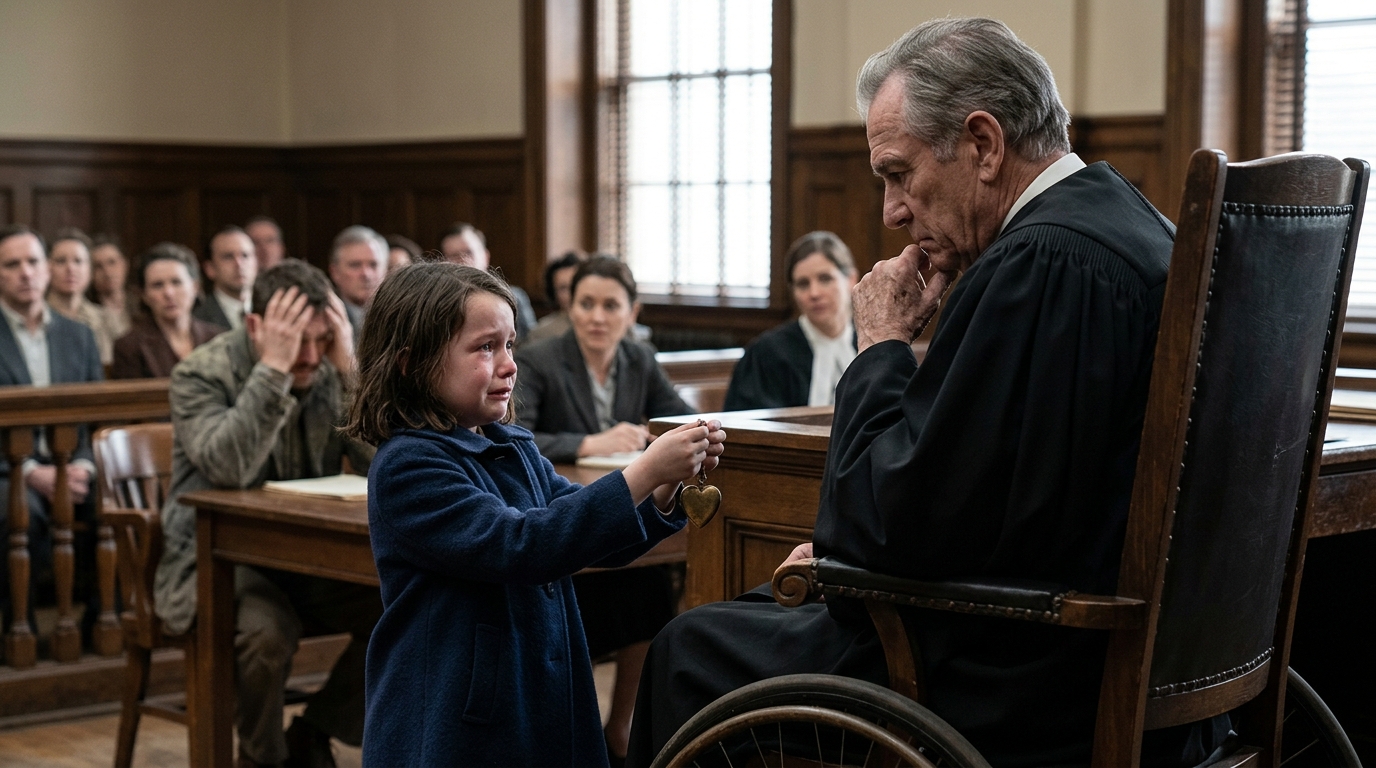
The small girl’s voice trembled through the quiet courtroom.
Every head turned.
She stood near the front row, barely tall enough to see over the polished wooden rail. Her hair was tied back with a crooked ribbon. Her dress was clean but old, the hem carefully mended in a color that didn’t quite match.
Tears streamed down her cheeks.
Her tiny shoulders shook as she tried to hold herself still.
At the defense table, her father lowered his head.
Nathan Reed looked like a man who had already lost before the sentence was spoken. His wrists were cuffed. His suit jacket was too large. His face was pale from exhaustion, shame, and fear.
Across the room, the prosecutor froze mid-sentence.
The bailiff stepped forward.
“Sit down, young lady.”
But the girl didn’t move.
Her eyes were locked on the judge.
Judge Elias Whitmore sat above them in his dark wheelchair, still as stone beneath the courtroom seal. He was seventy-one years old, sharp-eyed, feared, respected, and known for never letting emotion enter his rulings.
He had sentenced bankers, gang leaders, corrupt officials, desperate fathers, and dangerous men with the same controlled voice.
The law was the law.
That was what everyone said about him.
That was what he said about himself.
But now the entire courtroom watched as a crying child held out both hands toward him.
“If you let my dad come home,” she pleaded, her voice barely audible, “I can fix your legs.”
A collective gasp moved through the spectators.
The judge’s expression did not change.
But his fingers tightened around the armrest of his wheelchair.
Nathan Reed’s face crumpled.
“Emma,” he whispered. “No, sweetheart…”
But the girl did not stop.
“My brother needs him,” she cried. “Please. He didn’t steal because he’s bad. He stole because Lucas couldn’t breathe and nobody would help us.”
The prosecutor exhaled sharply.
Nathan closed his eyes.
Everyone knew the case.
A desperate man had broken into a medical storage unit and taken restricted medicine for his dying son. The child had a rare immune disorder. The treatment was expensive. Insurance had denied coverage. The hospital had delayed approval.
Nathan Reed had run out of time.
So he broke a lock.
Took the medication.
And saved his son’s life for one more week.
The law called it felony theft.
The courtroom called it tragic.
But tragedy did not erase charges.
Emma took one small step forward.
In her hands was a tarnished, heart-shaped locket.
“It’s true,” she whispered. “My dad can fix things. He fixes machines. He fixes hearts at the clinic. He said sometimes legs don’t forget. Sometimes they’re just sleeping.”
A few people shifted uncomfortably.
It sounded childish.
Impossible.
Painful.
But Judge Whitmore was no longer looking at her face.
His gaze had fallen to the locket.
Something in him changed.
Barely.
But enough.
His voice, when he spoke, was quieter than anyone expected.
“Bring that to me.”
The bailiff hesitated.
“Your Honor?”
“The locket.”
Emma looked frightened now, as if she had come too far and didn’t know whether courage could carry her back.
The bailiff took the locket gently from her hands and brought it to the bench.
Judge Whitmore reached out slowly.
His gnarled fingers closed around the antique piece with an unsettling reverence.
He knew that locket.
Not from the case file.
Not from evidence.
From a life he had buried so deeply that even memory had learned to walk around it.
With trembling hands, he opened it.
Inside was a faded sepia photograph.
A young girl’s face.
Soft eyes.
Dark curls.
A ribbon at her collar.
A smile he had not seen in fifty years.
The judge’s breath caught.
The courtroom saw it.
For the first time in decades, Judge Elias Whitmore looked afraid.
His jaw tightened.
His eyes widened in disbelief.
Then profound shock.
He looked down at Emma.
She wiped her cheeks with the back of her hand.
And whispered:
“Your son.”
Chapter 2: The Photograph from the Past
No one understood.
Not the prosecutor.
Not the jury clerk.
Not the spectators.
Not even Nathan Reed, who lifted his head slowly and stared at his daughter as if she had just opened a door he never knew existed.
Judge Whitmore looked at the photograph again.
The girl inside the locket was Clara Whitmore.
His wife.
His Clara.
But not the way most people had known her.
Not the elegant woman in charity photographs.
Not the poised young attorney who had married him before his career began.
This was Clara at sixteen.
The photograph had been taken before illness, before wealth, before grief.
Before their son disappeared.
Elias touched the edge of the picture with one shaking finger.
On the inside of the locket, half-hidden beneath the tarnish, was an engraving.
He had carved the words himself.
For Benjamin — so you always know your mother’s face.
The room blurred.
Benjamin.
His son.
His only child.
The child who had supposedly died forty years ago.
Elias closed the locket.
Opened it again.
As if the photograph might change.
As if old metal could not possibly carry a truth this large.
His voice came out hoarse.
“Where did you get this?”
Emma looked at her father.
Nathan’s face had gone white.
“I don’t know,” he said. “It was my mother’s.”
“Your mother’s name.”
Nathan swallowed.
“Rose Reed.”
The judge’s eyes narrowed.
“Was that her birth name?”
Nathan hesitated.
“I don’t know.”
A murmur spread through the courtroom.
The prosecutor stepped forward.
“Your Honor, with respect—”
Judge Whitmore lifted one hand.
The room fell silent.
He stared at Nathan Reed.
“How old are you?”
“Forty-one.”
The judge’s hand tightened around the locket.
Benjamin would have been forty-one.
The prosecutor’s face changed as she understood the same arithmetic.
Judge Whitmore looked at Emma.
“Who told you to bring this?”
“My grandma,” Emma whispered.
“Rose?”
Emma nodded.
“She said if Dad ever stood in front of the man in the black chair, I had to show him the heart. She said he would know.”
The judge shut his eyes.
For one moment, his face was not stern.
It was shattered.
Then he opened them and struck the gavel once.
“This court is in recess.”
The sound cracked through the room.
“All parties remain available. Counsel will meet in chambers. Now.”
Chapter 3: The Son Who Was Supposed to Be Dead
In chambers, Nathan sat without handcuffs for the first time all morning.
He rubbed his wrists absently, his eyes still fixed on the locket lying on the judge’s desk.
Emma sat beside him, clutching a paper cup of water with both hands.
Judge Whitmore remained behind his desk in the wheelchair, but something about him had changed. The authority was still there, but beneath it was something older and more wounded.
The prosecutor, defense attorney, court clerk, and bailiff stood in tense silence.
Judge Whitmore turned to Nathan.
“Tell me everything you know about your mother.”
Nathan looked overwhelmed.
“She raised me alone. She said my father died before I was born. She didn’t talk about her past much.”
“Did she ever mention the name Benjamin?”
Nathan shook his head.
“No.”
“Whitmore?”
“No.”
The judge closed his eyes briefly.
Nathan leaned forward.
“Your Honor… what is happening?”
The judge looked at him.
Forty-one years of grief stood between them.
“I had a son,” he said. “Benjamin. He disappeared when he was eighteen months old.”
Emma’s eyes widened.
Nathan went still.
The judge continued:
“My wife, Clara, was ill at the time. We were traveling between hospitals. There was an accident involving our car. I was injured. Clara died three days later.”
His fingers moved to the blanket over his legs.
“I was told Benjamin died in the crash.”
Nathan’s voice was barely a whisper.
“But there was no body?”
The judge looked at him sharply.
Nathan swallowed.
“I’m sorry. I just… if there had been a body, you wouldn’t be looking at me like that.”
The judge absorbed that.
Then nodded slowly.
“No. There was no body. They told me the river took him.”
Emma clutched her father’s sleeve.
Judge Whitmore picked up the locket again.
“I made this for him. Clara’s photograph was inside. It disappeared after the accident. I thought it was lost with him.”
The defense attorney spoke carefully.
“Judge, this creates a serious conflict.”
The judge’s face hardened.
“I am aware.”
The prosecutor added, quieter now:
“If there is even a possibility Mr. Reed is related to you…”
“I said I am aware.”
The room fell silent.
Judge Whitmore turned back to Nathan.
“Your mother. Rose. Is she alive?”
Nathan’s face fell.
“She died last year.”
The judge’s expression tightened.
Nathan reached into his jacket.
The bailiff moved.
The judge raised a hand.
Nathan slowly pulled out a folded piece of paper.
“My mother left this. I never understood it.”
He placed it on the desk.
The paper was old, softened by years of handling.
Judge Whitmore unfolded it.
The handwriting was shaky, but legible.
If Nathan ever needs the truth, find Elias Whitmore. Tell him Rose did not steal the child. She saved him.
The judge stopped breathing.
Nathan’s voice broke.
“She saved who?”
The judge looked at him.
Neither man spoke.
Emma understood before they did.
She looked from her father to the judge and whispered:
“Daddy… are we his family?”
Chapter 4: What Rose Saved Him From
The court did not resume that afternoon.
Judge Whitmore formally recused himself from Nathan’s case within the hour.
A substitute judge was called.
The prosecutor agreed to an emergency bond review.
Nathan was released pending further proceedings, with strict conditions, because even the state could see the ground beneath the case had shifted.
Not because he was innocent of taking the medicine.
He had done that.
But because the story around him had become larger than theft.
That evening, Judge Whitmore did something he had not done in years.
He left the courthouse before sunset.
His driver took him not to his townhouse, but to the county archive.
Then to a private investigator.
Then to the old hospital where Clara had died.
By midnight, the truth began crawling out of places it had been buried.
Rose Reed had once been Rose Calder, a night nurse at St. Mark’s Hospital.
Forty years earlier, she had worked in the emergency ward on the night of the Whitmore accident.
She resigned two days later.
She vanished from the city.
Six months after that, records showed she had adopted an infant under emergency guardianship through a rural parish office.
The child’s listed origin was unknown.
No father.
No mother.
No birth record attached.
His name became Nathan Reed.
Judge Whitmore read the file three times.
His hands shook so badly the investigator offered to stop.
He refused.
The next document was worse.
A sealed memorandum from the hospital’s former administrator, recovered from a private estate archive:
Infant Whitmore remains unaccounted for. Family counsel has advised no further inquiry due to inheritance instability. Mr. Whitmore is incapacitated and emotionally compromised.
Inheritance instability.
That was what they had called his son.
Not a missing child.
Not a living infant.
A financial inconvenience.
The investigator looked pale.
“Judge…”
Elias stared at the document.
“My father.”
“What?”
“My father controlled the family trust then. If Benjamin lived, Clara’s inheritance passed through him. If Benjamin died…”
“Then control remained with the Whitmore estate.”
Elias closed his eyes.
His own father had been dead for twenty-two years.
Too late to confront.
Too late to punish.
But not too late to expose.
Rose had not stolen Benjamin.
She had saved him from a family that found death more convenient than inheritance.
Chapter 5: Nathan’s Crime
The next morning, Nathan stood in his kitchen holding Lucas’s breathing mask while Emma watched the driveway.
She was waiting for the judge.
She called him “the man in the black chair” because she didn’t know what else to call him yet.
Grandfather was too large.
Judge was too cold.
Family was too new.
Lucas lay on the couch, small and pale, wrapped in blankets.
He was five.
His illness had made him look younger.
The medication Nathan stole had stabilized him, but only temporarily. They needed approval for continued treatment, and the hospital’s denial process had been brutal.
Nathan had spent months begging.
Calling.
Filling forms.
Waiting in hallways.
Watching his son gasp for air while people with clipboards said phrases like:
“Pending review.”
“Coverage exception.”
“Non-formulary restriction.”
Then Lucas turned blue at the lips one night.
And Nathan broke.
He did not break into the storage unit for money.
He did not sell the medication.
He did not run.
He took exactly what Lucas needed and left a note with his name.
My son will die tonight. I will answer for this tomorrow.
That note had destroyed the prosecutor’s claim that he intended profit.
But it had not erased the law.
When Judge Whitmore arrived, Nathan opened the door before he knocked.
The two men stared at each other.
Now that they were not in court, the resemblance was painful.
Same eyes.
Same line of the jaw.
Same way of holding grief too tightly.
Emma ran forward first.
She stopped just before the wheelchair.
“Are you mad?”
The judge looked at her.
“No.”
“At my dad?”
He looked up at Nathan.
“For taking medicine? I don’t know yet.”
Nathan lowered his eyes.
The judge continued:
“For being alive? No.”
Emma seemed to accept that.
She stepped aside.
Judge Whitmore entered the small house.
It was clean, poor, and full of repairs done by hand. A cracked cabinet carefully glued. A chair leg reinforced. A child’s toy car soldered back together.
Nathan fixed things.
Emma had not lied.
Judge Whitmore’s gaze moved to Lucas.
His expression softened.
“May I?”
Nathan nodded.
The judge wheeled closer.
Lucas opened his eyes weakly.
Emma whispered:
“This is the man from court.”
Lucas looked at the wheelchair.
“Can Emma fix your legs?”
Nathan closed his eyes in embarrassment.
But Judge Whitmore surprised them.
He smiled faintly.
“I’m beginning to think your sister fixes more than she understands.”
Chapter 6: The Legs She Promised to Fix
Emma’s promise had not come from nowhere.
Nathan worked as a biomedical equipment technician at a free clinic. He repaired infusion pumps, monitors, wheelchairs, nerve stimulators, and respiratory machines no one else wanted to maintain.
At night, after the children slept, he studied old medical journals and rebuilt discarded rehabilitation equipment.
Not because he believed in miracles.
Because poverty teaches people to become inventors.
One of his projects was a low-cost neuromuscular stimulation device for patients who had partial nerve response but no access to expensive therapy.
Emma had seen him test it on donated equipment.
She had heard him talk to Lucas.
“Sometimes the body remembers. Sometimes the pathway is still there, just quiet.”
So when she saw Judge Whitmore’s wheelchair in court, she believed what children believe:
If her father could fix broken machines…
if he could keep Lucas breathing…
if he could make dead-looking devices hum again…
maybe he could fix the judge too.
Nathan explained this with shame in his voice.
“I never told her I could make you walk.”
The judge looked at the workbench in the corner.
On it sat wires, circuit boards, labeled diagrams, and an old medical stimulator casing.
“No,” he said. “But you taught her not to see people as finished.”
Nathan looked up.
That sentence moved through the room quietly.
The judge rolled closer to the workbench.
“Did you build this?”
Nathan nodded.
“It’s crude.”
“It’s precise.”
“It’s incomplete.”
“So am I,” the judge said.
Nathan stared at him.
For the first time, something like a bridge formed between them.
Not father and son.
Not yet.
But two men who had lost too much and were afraid of hope.
Chapter 7: The Hearing That Changed Everything
Nathan still had to face the theft charge.
Judge Whitmore could not erase that.
He would not.
Instead, he did what the law allowed and what conscience demanded.
He recused himself fully.
He turned over the locket, the hospital records, Rose’s note, and the inheritance memorandum to investigators.
He arranged independent counsel for Nathan.
He contacted a patient advocacy group and a medical ethics board regarding Lucas’s denied treatment.
And he testified, not as a judge, but as a man whose family history had been manipulated by people who valued paperwork over life.
At Nathan’s next hearing, the courtroom was full again.
But the atmosphere had changed.
The prosecutor acknowledged mitigating circumstances.
The hospital’s medication denial process was under review.
The substitute judge ordered Nathan into a diversion program rather than prison, contingent on restitution, supervision, and community service through the clinic where he worked.
Nathan cried when he heard the ruling.
Not because he was free from consequence.
Because he could go home.
Emma ran into his arms before the bailiff could stop her.
This time, no one tried very hard.
Lucas’s treatment was approved three days later.
Not because the system suddenly became kind.
Because enough light had been forced onto it.
Sometimes justice is not mercy.
Sometimes it is pressure applied in the right place.
Chapter 8: Benjamin
The DNA test came back two weeks later.
Nathan Reed was Benjamin Whitmore.
No one celebrated immediately.
The truth was too big to greet with champagne.
Nathan sat at Judge Whitmore’s dining table, staring at the paper.
Emma leaned over his shoulder.
“What does it say?”
Nathan swallowed.
“It says he’s my father.”
She looked at the judge.
“So you’re Grandpa?”
The judge’s eyes filled.
Nathan looked pained.
“Emma…”
But the judge raised a hand.
“I would be honored if she called me that. When she wishes.”
Emma considered this carefully.
Then said:
“Can I call you Grandpa Judge?”
For the first time anyone could remember, Elias Whitmore laughed.
A real laugh.
Broken.
Rusty.
Alive.
“Yes,” he said. “That will do.”
Nathan did not laugh.
He was still staring at the DNA results.
“My whole life…”
The judge’s smile faded.
“I know.”
“No,” Nathan said, voice cracking. “You don’t. I had a mother who loved me. Rose loved me. But I spent my whole life thinking I came from nowhere.”
The judge lowered his eyes.
“And I spent mine thinking you were beneath the river.”
Nathan’s anger rose, then collapsed under the weight of that.
“What do we do now?”
The judge looked at him.
“I don’t know.”
It was the most honest answer he had given in years.
Nathan nodded slowly.
“Then we start there.”
Chapter 9: The First Movement
Months later, Nathan brought his stimulation device to the judge’s physical therapist.
Not secretly.
Not recklessly.
Properly supervised.
Medically reviewed.
Ethically approved.
The therapist was skeptical.
The neurologist was cautious.
Nathan was nervous.
Emma was certain.
Lucas sat beside her with a blanket and said:
“If it doesn’t work, Grandpa Judge can still come for soup.”
The judge smiled.
“That is reassuring.”
The first session was not dramatic.
No miracle.
No standing.
No courtroom gasp.
Just electrodes placed carefully.
Settings adjusted slowly.
A monitor tracking response.
Nathan watching the screen like a man afraid to breathe.
Then Judge Whitmore’s left foot twitched.
Tiny.
Almost nothing.
But visible.
Emma gasped.
“Dad!”
Nathan’s eyes filled.
The neurologist leaned forward.
“Again.”
They adjusted.
Waited.
A second twitch.
The judge looked down at his foot as if it belonged to someone else.
For years, his legs had been symbols of punishment, age, loss, and limitation.
Now one small movement changed nothing.
And everything.
Emma ran to him.
“I told you!”
The judge laughed through tears.
“Yes,” he whispered.
“You did.”
Nathan stood back, wiping his eyes.
The judge looked at him.
Not at the machine.
Not at the therapist.
At his son.
“You fixed more than my legs.”
Nathan shook his head.
“I didn’t fix anything yet.”
The judge smiled.
“You sound like a doctor.”
“I’m a repairman.”
“Good,” the judge said. “This family has needed one.”
Final Chapter: The Locket
Years later, people still spoke about the courtroom moment.
A child standing before a stern judge.
A desperate father facing prison.
A locket opening.
A photograph from the past.
Two words that changed everything.
Your son.
Some called it fate.
Some called it coincidence.
Emma called it Grandma Rose keeping her promise.
Nathan kept the locket in a glass case in the living room, not because it belonged to wealth, but because it belonged to survival.
Inside was Clara’s photograph.
On the back was Rose’s note.
Beside it was a small brass plate:
She saved him.
Not the judge.
Not the court.
Not the family name.
Rose.
The nurse who refused to let an infant disappear into a convenient death.
The woman who raised him.
The mother who told her granddaughter exactly what to do when the world became too heavy.
Judge Whitmore did not become a soft man overnight.
Men formed by grief rarely do.
But he changed.
He listened longer.
Ruled more carefully.
Asked different questions.
And sometimes, when Emma visited, she would sit beside his wheelchair and say:
“Try moving your foot.”
He would sigh dramatically.
“I am not a circus act.”
Then he would try.
Sometimes it moved.
Sometimes it didn’t.
Emma always clapped either way.
Lucas got stronger.
Nathan completed his diversion program, kept working at the clinic, and eventually helped develop affordable rehabilitation equipment for families who could not pay for miracles.
He never called Judge Whitmore “Dad” easily.
The word came slowly.
Awkwardly.
But one winter evening, while repairing a loose brake on the judge’s wheelchair, Nathan said:
“Hold still, Dad.”
Both men froze.
Emma looked up from her homework.
The judge looked away first.
But not before Nathan saw the tears.
That was how healing came.
Not all at once.
Not cleanly.
Not like a verdict.
It came in small motions.
A foot twitching.
A child laughing.
A sick boy breathing easier.
A man coming home instead of going to prison.
A father found too late, but not too late to love what remained.
And a tarnished heart-shaped locket, carried by a little girl brave enough to interrupt a courtroom and make a promise no adult was ready to believe.