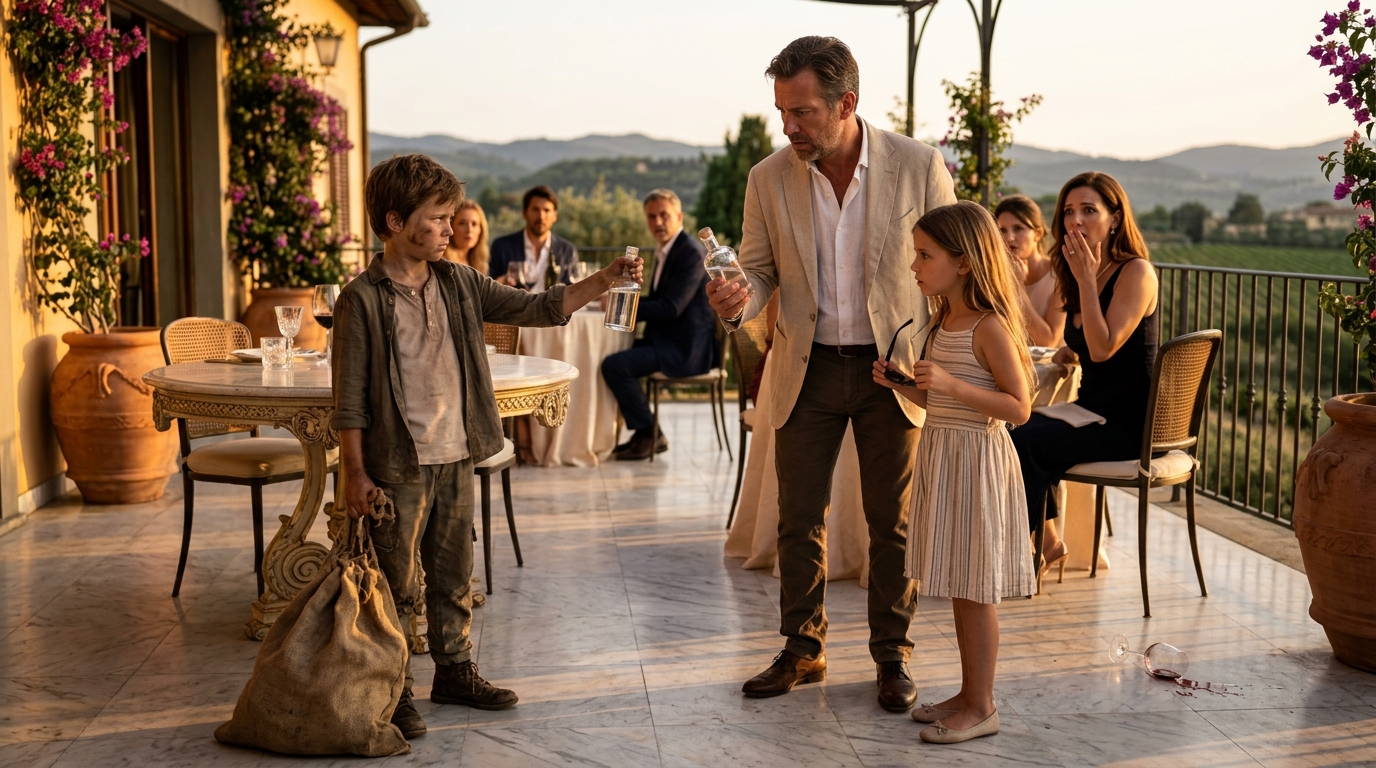
Chapter 1: The Cry That Stopped the Terrace
“YOUR DAUGHTER CAN SEE!”
The boy’s cry sliced through the golden glow of the sunset terrace.
For one impossible second, no one moved.
The sea beyond the balcony shimmered beneath the evening light. Crystal glasses sparkled on white-clothed tables. Waiters in black uniforms moved like shadows between wealthy guests. Soft violin music floated through the air, elegant and controlled.
Then came the sound.
CLANK.
A grimy sack hit the marble floor beside the long dining table.
The music stopped.
Conversations collapsed.
A woman’s hand froze halfway to her champagne glass.
At the head of the table, Lucas Harrington turned slowly.
He was a man used to control. A billionaire hotel developer. A father who had spent the last three years turning his grief into money, doctors, private nurses, and silent desperation.
Beside him sat his daughter, Sophie.
Eight years old.
Small. Pale. Beautiful.
Dark sunglasses covered her eyes. Her hands rested carefully in her lap. A soft pink ribbon tied her hair back. Everyone at the table had learned to speak around her gently, as though loud voices might hurt what the accident had already taken.
Three years ago, they said Sophie had lost her sight.
A rare neurological complication after a fall.
That was what the doctors said.
That was what her mother said.
That was what Lucas had believed.
Until now.
The boy who had shouted stood near the edge of the terrace, breathing hard.
He was thin, maybe twelve, with dirt on his face and a torn hoodie clinging to his shoulders. His shoes were soaked. His hands were scratched. His eyes burned with a fury too old for a child.
Security moved toward him.
The boy didn’t step back.
Instead, he pointed at Sophie.
“She can see.”
A ripple passed through the guests.
Someone whispered, “What?”
Someone else lifted a phone.
At the table, Sophie’s mother, Vivienne, went completely still.
She was elegant in a cream dress, diamonds at her throat, one hand curled around the stem of her glass. Her face was perfect. Too perfect. Like a mask painted moments before cracking.
Lucas stood.
His voice came out low.
Dangerously calm.
“What did you just say?”
The boy reached into the grimy sack and pulled out a small glass bottle.
No label.
Clear liquid inside.
His hand shook, but his voice didn’t.
“She poisoned her.”
The terrace inhaled.
Vivienne’s face drained of color.
“That is a disgusting lie.”
The boy stepped closer.
“She puts it in sweet juice.”
Lucas looked at the bottle.
Then at his wife.
Then at Sophie.
His daughter sat frozen.
Too frozen.
A blind child might turn toward sound.
But Sophie had turned toward the boy too quickly.
Too precisely.
Her covered eyes were hidden behind dark glass, but her face was aimed directly at him.
Lucas noticed.
For the first time, he noticed.
“Sophie,” he said softly.
Her lips trembled.
Vivienne leaned forward quickly.
“She’s frightened. Lucas, stop this.”
But then Sophie spoke.
A shaky whisper.
“Mommy gives it to me…”
A glass shattered somewhere behind them.
No one reacted.
Lucas moved like a man waking from a nightmare. He snatched the small bottle from the boy’s grasp and held it up to the fading light.
His fingers began to tremble.
“I know this…”
His voice cracked.
He had seen this liquid before.
Not here.
Not in this bottle.
But in a hospital room, months ago, when a private specialist had warned him about certain sedatives and neurological suppressants being dangerous in children.
Vivienne stood abruptly.
“That boy stole something from our house. Security!”
The boy did not blink.
“She hides it in juice.”
Lucas turned to Vivienne.
His gaze darkened.
“What did you do?”
Before Vivienne could answer, Sophie lifted both hands.
They shook violently.
Slowly, she reached for her sunglasses.
“Sophie, no,” Vivienne snapped.
That one word — no — was too sharp.
Too frightened.
Lucas heard it.
So did everyone else.
Sophie removed the sunglasses.
Her eyes, large and brown, blinked against the sunlight.
Her pupils adjusted perfectly.
Not cloudy.
Not unfocused.
Not blind.
She looked straight at her father.
Not near him.
At him.
And whispered, bewildered and heartbroken:
“Daddy… why did you let her do it?”
Lucas staggered back.
The whole terrace went silent.
Because in that instant, every beautiful thing around them — the chandeliers, the flowers, the crystal, the ocean view, the perfect family image — cracked open.
And the truth stepped out.
Chapter 2: The Daughter He Thought He Was Saving
For three years, Lucas had lived inside one sentence:
Your daughter may never see again.
It had been repeated by doctors, therapists, and specialists until it became the shape of his life.
Sophie had been five when it happened.
A fall from the staircase.
That was the official story.
Lucas had been away in London, closing a hotel acquisition. Vivienne called him in tears, saying Sophie had slipped in the hallway and hit her head.
By the time Lucas returned, Sophie was in a private hospital room with bandages around her head and dark glasses over her eyes.
Vivienne sat beside her, weeping beautifully.
“She can’t see,” she said.
Lucas remembered gripping the wall to keep from falling.
After that, everything changed.
He hired the best doctors.
The best nurses.
The best therapists.
He funded experimental programs.
He installed rails, sound systems, specialized learning tools, private tutors, tactile books, voice-guided devices.
He built a world around Sophie’s blindness.
But that world always had one gatekeeper.
Vivienne.
She controlled the appointments.
She chose the doctors.
She dismissed nurses who asked too many questions.
She insisted Sophie was too fragile for school, too overwhelmed for visitors, too emotionally unstable to spend time away from her mother.
Lucas believed her.
Not because he was stupid.
Because guilt makes intelligent people easy to guide.
He had not been there the night Sophie fell.
He had not been there when she woke crying.
He had not been there when his daughter’s world went dark.
So he let Vivienne lead.
And Vivienne used his guilt like a leash.
Every time Lucas questioned something, she cried.
Every time he suggested another specialist, she said he was torturing Sophie with false hope.
Every time Sophie seemed strangely aware of movement or light, Vivienne explained it away.
“She’s sensitive to sound.”
“She remembers the house layout.”
“Blind children adapt.”
“You should be proud of her.”
Lucas wanted to be proud.
So he stopped being suspicious.
That was what shame did.
It made him mistake silence for trust.
Chapter 3: The Boy With the Sack
The boy’s name was Evan Bell.
No one on the terrace knew him, but Sophie did.
She had met him two months earlier near the garden wall.
Not because she was allowed outside alone.
She wasn’t.
Not because Vivienne permitted strangers.
She never would.
Sophie met him because children trapped in beautiful cages learn the shape of every escape.
There was a small gap behind the rose hedge where the stone wall had cracked. Evan used to pass by the estate after collecting bottles from the beach road. Sometimes he sat near the wall to count coins.
One afternoon, Sophie heard him humming.
She whispered:
“Who’s there?”
Evan nearly ran.
Then he saw her.
A little girl in dark glasses sitting beneath the roses, hands folded tightly in her lap.
“You’re the blind girl,” he said.
Sophie flinched.
“I’m not supposed to talk to people.”
“Then why did you?”
She paused.
“Because you were humming the song from my old cartoon.”
That was the first crack.
Over the next few weeks, they spoke through the wall.
Evan told her about the beach, the market, the stray dog behind the fish shop, the old woman who gave him bread when she had extra.
Sophie told him about her room, her tutors, her mother’s rules, and the sweet juice she hated drinking every night.
“What sweet juice?” Evan asked once.
“The one that makes everything slow.”
That sentence bothered him.
Evan was poor, not foolish.
His mother had once worked as a pharmacy assistant before she became sick. He knew enough to understand that children should not be forced to drink something every night that made their thoughts foggy and their body heavy.
One day, Sophie whispered:
“I can see you.”
Evan went silent.
“What?”
“I’m not supposed to.”
“What do you mean?”
Her voice shook.
“Sometimes after I don’t drink it, the dark goes away.”
That was when Evan understood the shape of the secret.
He began watching.
Not Sophie.
Vivienne.
He saw the mother pour liquid from an unmarked bottle into a glass of juice near the terrace one evening.
He saw Sophie drink and become drowsy within minutes.
He saw a private nurse carry her inside.
Then, one morning, Evan found something in the trash near the side gate.
A small empty bottle.
No label.
Still smelling faintly sweet and chemical.
He took it.
He also took notes.
Dates.
Times.
What Sophie told him through the wall.
For a boy no one noticed, Evan became very good at seeing.
Then Sophie told him there would be a sunset dinner.
Important guests.
Her father would be there.
Her mother too.
“She said I have to wear the dark glasses the whole night,” Sophie whispered.
Evan asked:
“Will your dad be close?”
“Yes.”
“Then I’ll tell him.”
Sophie panicked.
“No. She’ll send you away.”
“Not if I’m loud enough.”
Chapter 4: The Terrible Question
On the terrace, Lucas stood frozen beneath the weight of his daughter’s question.
Daddy… why did you let her do it?
He wanted to say he didn’t know.
He wanted to say he had been lied to.
He wanted to say he would have stopped it if he had understood.
But the truth was more complicated.
He had seen things.
Small things.
Sophie reaching toward falling objects before hearing them hit.
Sophie tracking movement behind dark glasses.
Sophie flinching from sudden light.
Sophie becoming clearer, brighter, almost herself when Vivienne was away.
He had noticed.
Then looked away.
Because noticing meant admitting the woman he married might be harming their child.
And that was a thought too monstrous to hold.
So he had set it down.
Again and again.
Now his daughter was looking at him with eyes that worked.
Eyes he had mourned while they were still seeing.
Lucas turned to Vivienne.
“Answer me.”
Vivienne’s mouth opened.
Closed.
Opened again.
“This is hysteria,” she said. “She’s confused.”
Sophie whispered:
“No, I’m not.”
Vivienne snapped toward her.
“Sophie.”
The child shrank back.
Lucas saw it.
Not obedience.
Fear.
Real fear.
The kind that had lived in his house while he was signing contracts, hosting donors, and praising his wife’s strength.
The boy, Evan, lifted the sack again.
“I brought the other bottles.”
He dumped them onto the marble.
Three empty vials.
Two half-full.
A folded paper.
A torn pharmacy label.
Lucas knelt, picked up the paper, and read the first line.
His face changed.
“What is this?”
Evan answered:
“Your wife’s order sheet.”
Vivienne lunged forward.
“That is stolen!”
Lucas stood, paper in hand.
“From where?”
Vivienne froze.
The question trapped her.
Evan said:
“From the clinic trash. The name’s scratched off, but not all the way.”
Lucas looked closely.
There, beneath black marker, he saw the partial print:
V. Harrington
Vivienne Harrington.
His wife.
The terrace began to murmur.
Lucas turned to the security guard.
“Call Dr. Merrick. Now. And no one leaves.”
Vivienne’s eyes sharpened.
“You cannot imprison guests at a dinner party.”
Lucas looked at her.
“No. But I can stop my daughter from being taken back inside with you.”
Chapter 5: The Doctor Who Knew Too Much
Dr. Merrick arrived twenty minutes later.
He was the only doctor Lucas had ever chosen without Vivienne’s approval.
A neurologist from Boston who had reviewed Sophie’s file six months earlier and requested additional testing.
Two days later, Vivienne had dismissed him, saying he was “too aggressive” and “traumatizing Sophie.”
Lucas had allowed it.
Now Dr. Merrick stepped onto the terrace with a medical bag and a face full of restrained fury.
He examined Sophie privately in the glass sunroom while Lucas waited outside like a man awaiting sentencing.
Evan sat near the door, wrapped in a towel from the kitchen, eating bread so quickly one of the waiters brought him a full plate without being asked.
Vivienne stood under guard near the terrace railing, silent now.
No tears.
No performance.
Just calculation.
After ten minutes, Dr. Merrick came out.
Lucas stood.
“Well?”
The doctor looked at him.
“Your daughter is not blind.”
Lucas closed his eyes.
The words should have brought joy.
Instead, they struck like punishment.
Dr. Merrick continued:
“She appears to have been under the effect of a sedative or neurological suppressant for an extended period. We need blood tests immediately.”
Lucas’s voice broke.
“For how long?”
“I can’t say yet.”
Sophie’s small voice came from behind the door.
“Since Mommy said the dark made Daddy love me more.”
Every adult in earshot went still.
Lucas turned.
Sophie stood inside the doorway without sunglasses, holding the edge of the frame.
Her eyes were red from crying.
Vivienne shouted:
“That is not what I said!”
Sophie flinched.
Lucas moved instantly, placing himself between them.
It was the first time in years he had stood between his wife and daughter.
The tragedy was that Sophie looked surprised.
Chapter 6: The Reason
Vivienne did not confess easily.
People like her rarely do.
She denied.
Then softened.
Then cried.
Then blamed stress.
Then blamed Lucas.
“You were never home,” she said, tears streaming perfectly. “You don’t know what it was like after the accident. She needed me. You were gone.”
Lucas’s voice was flat.
“So you drugged her?”
“I helped her stay calm.”
“You told the world she was blind.”
“She was confused.”
“She can see.”
Vivienne’s eyes flashed.
“And what did she see, Lucas?”
The question struck the room strangely.
Vivienne stepped closer, voice trembling now with something more dangerous than fear.
“She saw the fall.”
Lucas froze.
Vivienne continued:
“She saw who was there. She saw what happened on the staircase.”
Sophie began to cry.
Lucas looked at his daughter.
“Sophie?”
The child covered her ears.
Vivienne smiled through tears.
“There it is. You wanted the truth? Ask her.”
Lucas turned back to his wife.
“What happened that night?”
Vivienne’s mask slipped.
Not completely.
But enough.
“She was supposed to be asleep.”
The sentence chilled everyone.
Lucas’s voice dropped.
“What did she see?”
Vivienne looked at him with bitterness.
“She saw me arguing with your mother.”
Lucas stopped breathing.
His mother, Eleanor Harrington, had died three weeks after Sophie’s accident.
A stroke, they said.
Grief, they said.
Age, they said.
Vivienne continued:
“Your mother wanted to change the trust. She said Sophie’s inheritance should be protected from me.”
Lucas took one step back.
“No.”
“She was going to ruin everything.”
“What did you do?”
Vivienne’s face twisted.
“I didn’t mean for Sophie to fall.”
The terrace went silent.
Sophie sobbed behind Dr. Merrick.
“She pushed Grandma,” the child whispered.
Lucas turned slowly.
Sophie’s voice shook.
“Grandma fell near the stairs. I screamed. Mommy grabbed me. I slipped.”
Vivienne shouted:
“She was hysterical! She doesn’t remember!”
But Sophie was looking at her father now.
“I remember.”
Lucas’s world collapsed in layers.
His daughter had not only been drugged to fake blindness.
She had been silenced because she witnessed a crime.
His wife had not protected their child.
She had imprisoned her.
Chapter 7: The Bottle Breaks
Vivienne tried to run.
It happened suddenly.
One moment she was crying.
The next, she grabbed a glass bottle from the table and smashed it against the marble edge.
Guests screamed.
Security moved.
Lucas pulled Sophie behind him.
Evan jumped up, still holding a piece of bread.
Vivienne pointed the broken glass toward the boy.
“You little rat.”
Evan went pale but did not move back.
“You were at the wall,” she hissed. “You ruined everything.”
Lucas stepped forward.
“Vivienne.”
She laughed.
A terrible sound.
“You think he saved her? He’s a street boy. Tomorrow everyone will say he lied for money.”
Evan’s jaw tightened.
“I don’t want your money.”
“No,” Vivienne spat. “You want to matter.”
That landed.
Evan flinched.
Sophie stepped around her father.
Small.
Shaking.
But standing.
“He matters to me.”
The room froze.
Evan looked at her.
Vivienne stared as if the child had struck her.
Security rushed in then.
The broken bottle fell.
Vivienne was restrained before she could reach anyone.
As they led her away, she screamed:
“You’ll come back to me, Sophie! You always do!”
Sophie did not answer.
She only reached for Lucas.
This time, when her father held her, she did not feel like a fragile child being protected from the world.
She felt like a prisoner who had finally found the door open.
Chapter 8: The Boy Nobody Invited
Police arrived.
Then paramedics.
Then investigators.
The terrace that had been arranged for wealthy guests became a crime scene under chandelier light.
Bottles were bagged.
Statements taken.
Phones surrendered.
Vivienne’s private nurse was questioned.
Dr. Merrick stayed with Sophie.
Lucas sat beside his daughter on the terrace steps, his jacket around her shoulders.
For a long time, he said nothing.
Then he looked at Evan.
The boy stood near the edge of the scene, holding his empty sack.
Ready to disappear.
Lucas called out:
“Evan.”
The boy stiffened.
“You can go if you want,” Lucas said. “But I would like you to stay.”
Evan looked suspicious.
“Why?”
Lucas’s voice broke.
“Because my daughter trusted you when she couldn’t trust me.”
That sentence hurt everyone who heard it.
Especially Lucas.
Evan looked at Sophie.
She nodded slightly.
So he stayed.
Not as a servant.
Not as a charity case.
As the first witness.
As the boy who listened through a cracked garden wall when no one inside the mansion heard a child begging silently to be saved.
Chapter 9: The Morning After
By morning, the story had reached every screen in the city.
The Harrington terrace scandal.
The “blind” heiress who could see.
The mother accused of drugging her daughter.
The boy from the street who exposed it.
Lucas hated the headlines.
Not because they embarrassed him.
Because none of them could capture the worst truth.
He had lived beside his daughter’s fear and mistaken it for illness.
At the hospital, Sophie underwent tests.
The effects of the drugging would take time to understand. Some symptoms would fade. Some trauma would not.
But she could see.
She could see sunlight through the blinds.
She could see the blue cup beside her bed.
She could see her father’s face when he cried.
She touched his cheek.
“You look older,” she said.
He laughed and sobbed at the same time.
“I feel older.”
“Are you mad at me?”
The question shattered him.
“No. Never.”
“I didn’t tell.”
“You were scared.”
“She said if I told, you’d stop loving me.”
Lucas closed his eyes.
“I am so sorry.”
Sophie looked toward the window.
“Evan believed me.”
“I know.”
“Can he come?”
“Yes.”
“Not as a thank-you thing.”
Lucas looked at her.
“What do you mean?”
“People give poor kids things to make themselves feel better.”
Lucas absorbed that.
His daughter had learned too much in silence.
He nodded.
“Then he can come as your friend.”
Sophie seemed to think about that.
“Good.”
Final Chapter: The Eyes That Opened
Months later, Sophie returned to the terrace.
Not for a dinner party.
Not for photographers.
Just for sunset.
Lucas sat beside her.
Evan sat on the steps, feeding crumbs to a small bird that had decided wealth made excellent flooring for snacks.
The terrace looked different now.
Less perfect.
More real.
Vivienne awaited trial.
The private nurse had confessed to administering “calming drops” under Vivienne’s direction.
Investigators reopened Eleanor Harrington’s death.
The trust was placed under independent protection.
The estate staff changed.
The garden wall was repaired — but Sophie insisted they leave the cracked section visible.
“That’s where I met Evan,” she said.
Lucas did not argue.
He argued less now.
Listened more.
Not perfectly.
But better.
Sophie no longer wore sunglasses unless she wanted to.
Sometimes bright light still hurt.
Sometimes memory did.
But she was learning the world again.
Colors.
Faces.
Motion.
Trust.
One evening, as the sun lowered over the water, Sophie turned to her father.
“Daddy?”
“Yes?”
“Why didn’t you see?”
Lucas looked at the horizon.
He could have defended himself.
Said he was lied to.
Said he trusted doctors.
Said grief made him blind too.
All of that was partly true.
None of it was enough.
So he answered simply.
“Because I was afraid of what seeing would cost.”
Sophie was quiet.
Then she said:
“It cost more not to.”
Lucas closed his eyes.
There are truths only children can say cleanly.
He nodded.
“Yes.”
Evan looked back at them.
“You two always talk like sad movies?”
Sophie laughed.
A real laugh.
Lucas smiled.
It was the first sound that made the terrace feel warm again.
Later, people would say Evan saved Sophie because he exposed the bottles.
That was only partly true.
He saved her because he believed what she whispered through a wall.
Dr. Merrick helped save her because he asked the questions others dismissed.
The police helped because they finally listened.
But Sophie saved herself too.
By taking off the sunglasses.
By looking directly at the father she still loved.
By asking the question that changed everything:
“Daddy… why did you let her do it?”
It was a terrible question.
A necessary one.
And from that day forward, Lucas never again confused not knowing with innocence.
Because sometimes blindness is not in the eyes.
Sometimes it lives in the choices adults make when the truth is too painful to face.
And sometimes it takes a child brave enough to see through darkness…
to make everyone else open their eyes.