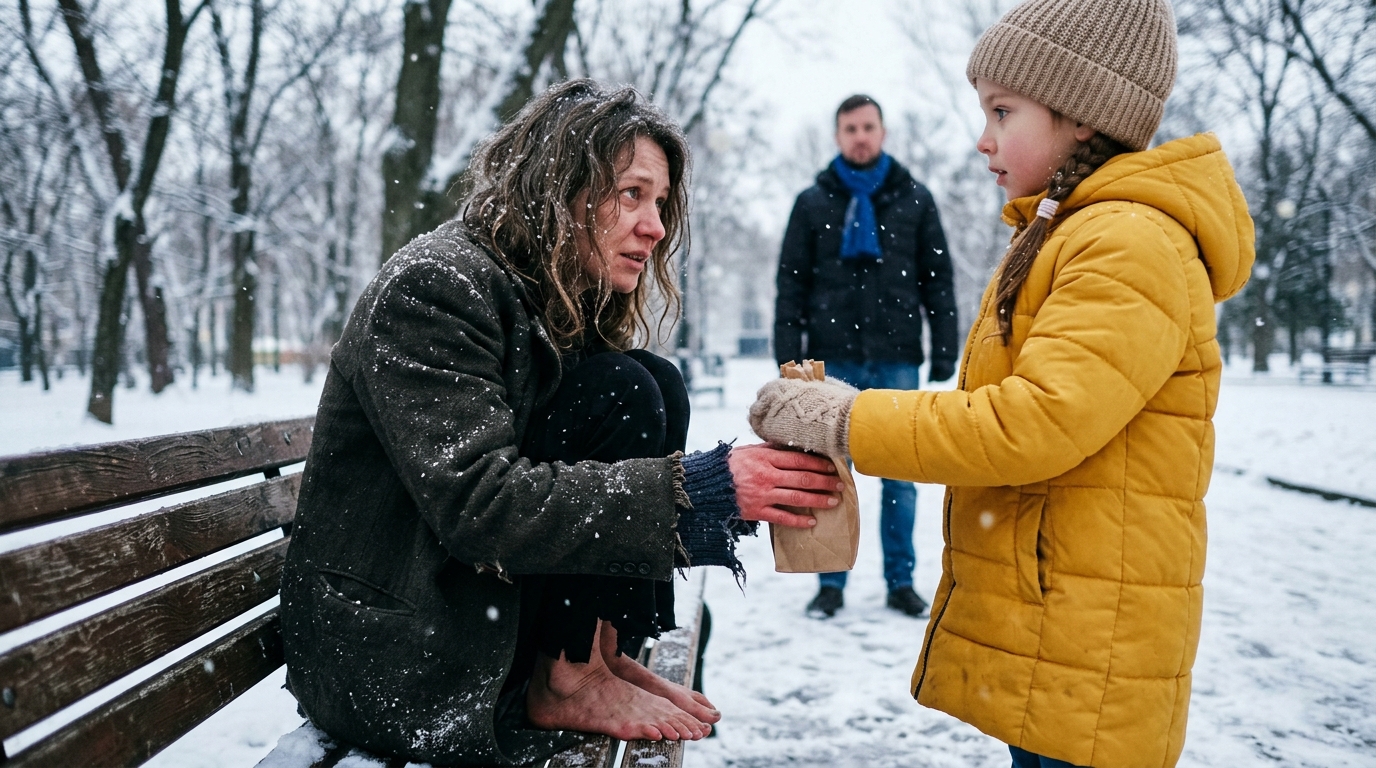
The Woman on the Bench
The snow had started before noon.
By three o’clock, the city looked softer than it really was.
White gathered along the edges of sidewalks, on the tops of parked cars, on the bronze shoulders of statues no one stopped to read anymore. The wind pushed loose flakes through the streets in small, restless spirals, carrying the smell of wet wool, exhaust, and roasted chestnuts from the vendor near the corner.
My daughter, Ellie, held my hand with both of hers.
She was six years old.
Small for her age.
Serious in the way children become when they have already learned that some questions make adults look away.
She wore a bright yellow coat that made her impossible to lose in the gray afternoon. Her pink gloves were too big. Her boots squeaked when she walked. In her other hand, she carried a brown paper bag from the bakery, warm with two cinnamon rolls I had bought because she had done well at her reading assessment.
She had earned them.
That was what I told her.
But Ellie had always been strange about gifts.
She could keep a ribbon from a birthday present for months, but give away the toy in the box the same afternoon. She once cried because I bought her a new stuffed rabbit and asked if the old one would feel replaced.
She noticed things.
Too much, sometimes.
That day, she noticed the woman before I did.
The woman sat on a bench outside St. Agnes Church, hunched beneath a bus shelter that did almost nothing against the snow. Her coat was thin, torn at the cuffs, and too large around her shoulders, as if it belonged to someone who had disappeared before she did.
Her hair hung in tangled brown strands around her face.
Her hands were tucked beneath her arms.
Her feet were bare.
Bare.
In the snow.
I stopped so suddenly that Ellie bumped into my leg.
“Daddy,” she whispered.
I looked down.
She wasn’t looking at me.
She was looking at the woman.
The woman seemed young, though hardship had made her age difficult to read. Maybe thirty. Maybe forty. Her cheeks were hollow. Her lips were faintly blue. Snow collected in her hair without her brushing it away.
People passed her.
Some glanced.
Most didn’t.
That is the talent cities teach you.
How to see suffering without slowing down.
Ellie pulled her hand from mine.
I felt it happen before I understood what she was doing.
“Ellie,” I said softly.
She took one step forward.
Then another.
The woman lifted her face only when Ellie was close enough for the yellow coat to brighten the edge of her vision.
For a moment, the woman looked afraid.
Not annoyed.
Not ashamed.
Afraid.
As if kindness had become something dangerous.
Ellie held out the paper bag.
The woman stared at it.
Then at my daughter.
“No, sweetheart,” she murmured, voice rough with cold. “You keep that.”
Ellie didn’t move.
“Are you feeling cold?”
The question was so simple it broke through something in the air.
The woman blinked.
A faint, painful smile touched her mouth.
“A little,” she said. “But I’m okay.”
Adults lie to children differently.
We soften the truth, trim its edges, wrap it in words that don’t bleed.
But Ellie had never trusted those kinds of answers.
She held the bag out again.
“This is for you,” she said. “Daddy got them for me. But you seem hungry.”
The woman’s hand rose slowly.
Reluctantly.
Their fingers touched.
Ellie’s gloves brushed against the woman’s skin, pale and stiff from cold.
The woman flinched at the warmth.
Not from pain.
From memory.
I saw it clearly.
Something opened in her face before she could hide it.
“Thank you,” she whispered.
I stood several feet away, silent, watching my daughter give away her treat to a stranger in the snow.
I should have stepped in.
I should have said something kind and practical.
Do you need help?
Can I call someone?
There’s a shelter nearby.
But my throat had closed.
Because there was something about that woman.
Something familiar in the tilt of her head.
Something in the way she held the bag on her lap like it was fragile.
Like it was more than food.
Ellie stared at her for a long moment.
Too long.
Then she said the words that turned the cold inside me into ice.
“You need a home,” my daughter whispered, “and I need a mom.”
The woman went completely still.
At first, she didn’t look confused.
She looked hurt.
As if a child had placed a hand directly on a bruise no one could see.
“What?” she breathed.
Ellie didn’t smile.
She didn’t laugh.
She just searched the woman’s face with that strange, frightening certainty she sometimes had.
Then she added softly—
“Because my daddy still keeps your blue scarf.”
The paper bag slipped from the woman’s lap.
And when she looked past Ellie toward me, the whole city seemed to disappear.
The Scarf I Never Threw Away
I had not heard anyone mention the blue scarf in five years.
Not out loud.
Not since the police gave up.
Not since my wife became a file number instead of a person.
Her name was Clara.
Clara Whitmore before she married me.
Clara Hayes after.
She had loved that scarf more than anything I ever bought her. It was deep blue, almost the color of winter dusk, soft cashmere with a tiny pulled thread near one edge from the day Ellie grabbed it as a baby and refused to let go.
Clara wore it the morning she vanished.
That was the detail that haunted me most.
Not because it mattered legally.
It didn’t.
The detectives said people disappear with coats, shoes, scarves, handbags. They said grief makes survivors attach meaning to objects. They said I needed to prepare myself for the possibility that Clara had left willingly.
Willingly.
That word nearly destroyed me.
Clara had struggled after Ellie was born. I knew that. There were sleepless nights, blank stares, long showers where she cried quietly and thought I couldn’t hear. But she loved our daughter. Loved her fiercely.
Then one freezing morning in February, she left our apartment to pick up medication from the pharmacy.
She never came back.
Her phone was found three blocks away in a storm drain.
Her purse was found a week later behind a bus depot.
Her scarf was never found.
That was why I kept its twin.
The blue scarf Ellie meant was not actually Clara’s missing scarf. It was the matching one Clara had bought me as a joke during our first Christmas together.
“Now we can be insufferable,” she had said, looping mine around my neck in front of a shop window.
After she disappeared, I kept it in the top drawer of my dresser.
Not because it helped.
Because throwing it away felt like killing the last version of myself who still believed she might walk through the door.
Ellie had found it once.
She was four.
She pulled it out, dragged it behind her like a blanket, and asked, “Was this Mommy’s?”
I told her the truth.
“Your mom had one just like it.”
Ellie pressed the scarf to her face.
“It smells sad,” she said.
I cried in the bathroom after that.
And now, two years later, my daughter had looked at a homeless woman on a bench and said—
Daddy still keeps your blue scarf.
The woman stood so suddenly she nearly fell.
I moved instinctively toward Ellie.
The woman stepped back.
“No,” she whispered. “No, no, no.”
Her eyes were locked on mine.
Brown eyes.
Clara’s eyes were green.
That should have ended it.
It should have made the moment ridiculous.
A coincidence.
A child’s imagination.
A grieving father’s weakness.
But her expression—
God.
Her expression knew me.
Not recognized me.
Knew me.
“Who are you?” I asked.
The woman shook her head.
Snow slid from her hair onto her shoulders.
“I’m sorry,” she said.
Then she turned and ran.
Barefoot.
Through the snow.
“Wait!” I shouted.
Ellie screamed after her.
“Mommy!”
The word struck harder than anything else could have.
People turned.
The woman stumbled at the curb, caught herself, and kept moving. She vanished between two parked delivery trucks near the alley beside the church.
I grabbed Ellie’s hand.
“Stay with me.”
“But Daddy—”
“Stay with me.”
We ran.
I shouldn’t have run with a child through snow-slick sidewalks.
I know that now.
But reason had already lost its place.
The alley was narrow, filled with trash bins, wet cardboard, and the metallic smell of old rain. A side door to the church basement stood half-open, swinging lightly in the wind.
I saw footprints in the snow.
Bare.
Small.
Bleeding.
My stomach turned.
Ellie saw them too.
Her hand tightened around mine.
“Daddy,” she whispered. “Her feet.”
We followed the prints to the basement door.
Inside, warm air drifted up the stairwell, carrying the smell of soup, damp coats, and disinfectant.
A shelter.
Of course.
The church basement had opened as a daytime warming center during the storm.
We stepped inside.
People sat at folding tables with paper cups of coffee. Volunteers moved between them. Someone coughed harshly near the back wall. A radio played Christmas music too softly to be cheerful.
I scanned the room.
Nothing.
Then Ellie pulled my coat.
“There.”
The woman stood near the rear exit, speaking quickly to an older nun in a gray cardigan.
The nun looked from her to us.
Then her face changed.
Not with confusion.
With fear.
The woman saw us and backed toward the exit.
“Please,” I called. “Just tell me your name.”
She froze.
For one second, I thought she would answer.
Instead, the nun stepped between us.
“Sir,” she said carefully, “I need you to leave.”
“My daughter thinks she knows this woman.”
The nun’s eyes flicked to Ellie.
Something unreadable passed through her face.
Then she lowered her voice.
“You should not have come here.”
Those words stopped me.
Not because they were harsh.
Because they were warned.
The woman pushed open the rear door.
Cold air burst in.
I moved forward.
The nun grabbed my sleeve with surprising strength.
“If you love your child,” she whispered, “do not follow her without knowing who took your wife.”
And just like that, the past I had buried opened under my feet.
The Woman Who Was Supposed to Be Dead
The police had never called Clara’s disappearance suspicious enough.
That phrase still made me sick.
Suspicious enough.
As if a woman needed to vanish in a certain shape before the world agreed something terrible had happened.
There was no ransom call.
No blood.
No witness reliable enough to matter.
A grainy camera caught a woman in a blue scarf near the pharmacy entrance at 9:14 a.m. Another camera showed someone who might have been Clara stepping into a black SUV twelve minutes later.
Might have been.
That was the language that ruined us.
Might.
Possibly.
Unclear.
Inconclusive.
After six months, the investigation slowed.
After a year, people began speaking of Clara in the past tense.
After two years, even her parents stopped asking for updates because hope had become too expensive.
But I never believed she left us.
Not fully.
Not cleanly.
I tried to.
There were nights I hated her for leaving.
Then hated myself for hating her.
Then sat outside Ellie’s bedroom door until dawn, listening to her breathe because she was the only proof I had that Clara had ever been real.
Now I stood in a church basement while a nun told me not to follow a barefoot woman unless I knew who took my wife.
My voice came out low.
“What did you just say?”
The nun closed her eyes briefly.
Like she regretted it already.
“Not here.”
The rear door had shut.
The woman was gone again.
I almost pushed past her.
But Ellie was beside me, and the nun’s warning had wrapped itself around my spine.
“If you know something,” I said, “you need to tell me.”
The nun looked at Ellie.
“What is your name, sweetheart?”
Ellie stayed close to my leg.
“Ellie.”
The nun’s mouth trembled.
Just once.
Then she looked away.
That was when I knew.
She knew Clara.
Not as a story.
Not as a missing person poster.
As a living person.
The nun led us into a small office off the basement hallway. It had one desk, two chairs, a space heater, and a corkboard filled with volunteer schedules. A crucifix hung above a filing cabinet.
She introduced herself as Sister Margaret.
Her hands shook when she closed the door.
“The woman you saw calls herself Anna,” she said.
“Calls herself?”
“That is not the name she gave us at first.”
“What name did she give you?”
Sister Margaret hesitated.
I stood up.
“What name?”
She reached into the filing cabinet and removed a folder. It was thin, worn at the corners, with a coffee stain across the tab.
She opened it but did not hand it to me.
“When she first came here, she was severely injured. Malnourished. Confused. She had no identification. She remembered very little.”
“When?”
“Almost five years ago.”
The room tilted.
Five years.
That was when Clara vanished.
My voice barely worked.
“What name?”
Sister Margaret turned the folder toward me.
On the intake form, written in shaky block letters, was one word.
Clara.
I sat down because standing was no longer possible.
Ellie tried to climb into my lap, but I couldn’t move.
Couldn’t breathe.
Couldn’t make sense of the letters on the page.
Clara.
Not proof.
Not yet.
But enough to destroy the walls I had built around myself.
“She didn’t know her last name,” Sister Margaret said gently. “She didn’t know where she lived. She was terrified of hospitals. Terrified of police.”
“Why didn’t you report it?”
“We tried.”
The answer came too quickly.
Too painfully.
“She ran every time anyone mentioned authorities. The first few months, she barely spoke. Later, she insisted no one could know she was here.”
“Why?”
Sister Margaret folded her hands.
“Because she believed someone would hurt her child.”
Ellie went still in my lap.
I looked down at her.
Her eyes were wide.
Listening.
Understanding too much.
“Who?” I asked.
Sister Margaret did not answer immediately.
Instead, she reached into the folder and pulled out a small plastic evidence bag.
Inside was a scrap of blue fabric.
Deep blue.
Cashmere.
With one tiny pulled thread near the edge.
The room vanished.
All sound disappeared except my own pulse.
I took the bag with both hands.
The scarf fragment was dirty, torn, and faded.
But I knew it.
I knew it the way you know the shape of someone’s hand in the dark.
“That’s hers,” I whispered.
Sister Margaret nodded.
“She had it tied around her wrist when she arrived.”
Ellie touched the plastic gently.
“Mommy?”
No one answered.
Because the answer was too large.
Too dangerous.
Sister Margaret opened another page in the folder.
“There is something else.”
I looked up.
Her face had gone pale.
“She drew the same picture over and over during her first year here.”
She handed me a stack of papers.
Crayon drawings.
Messy.
Frantic.
A black car.
A baby in a yellow blanket.
A woman in a blue scarf.
And beside them, always, a man with no face.
On the final page, written in jagged letters across the bottom, was a sentence.
He said if I went home, Ellie would disappear next.
The office seemed to collapse inward.
I stared at the words.
Ellie.
My daughter’s name.
I had never put her name on missing posters.
Never in news interviews.
Never online.
We had called her Eleanor publicly back then because Clara was private and careful about our child.
Only people close to us called her Ellie.
I looked at Sister Margaret.
“Who is he?”
Before she could answer, the office phone rang.
Once.
Twice.
Sister Margaret stared at it, frozen.
Then she whispered, “No one calls this line.”
I picked it up.
A man’s voice breathed into the receiver.
“Mr. Hayes,” he said softly, “take your daughter and walk away.”
My blood turned cold.
Then he added—
“Clara did.”
The Man Who Kept Her Lost
I do not remember hanging up the phone.
I remember the plastic receiver in my hand.
The sound of Ellie crying.
Sister Margaret locking the office door.
Then the distant slam of the shelter’s rear exit.
Someone had been listening.
Someone had known we were there.
For five years, I had imagined Clara’s disappearance as a wound from the past.
But it was not past.
It was active.
Breathing.
Watching.
Waiting close enough to call a church basement office minutes after I found the truth.
Sister Margaret whispered one name.
“Martin Vale.”
At first, I didn’t understand.
Then I did.
My father-in-law.
Clara’s stepfather.
A wealthy real estate developer with polished shoes, expensive grief, and a talent for standing beside missing-person posters while looking devastated for cameras.
Martin had paid for private investigators.
Martin had organized search parties.
Martin had sat in my living room after Clara vanished, one hand on my shoulder, telling me I needed to accept that some people broke under motherhood.
I had hated him for saying that.
Then I had hated myself for wondering if he was right.
“Why him?” I asked.
Sister Margaret looked at the drawings.
“Clara remembered pieces. Not all at once. A house near water. Men arguing. A document she refused to sign. A threat involving Ellie.”
“What document?”
Sister Margaret opened the folder again and removed a folded note.
It was not official.
Just one page.
Clara’s handwriting.
Broken in places.
Uneven.
But hers.
I don’t know how much I remember. I know Martin wanted the trust changed. I know he said Daniel would never agree. I know he said Ellie was leverage. I know I got into the car because he told me Ellie was sick. Then darkness. Then cold. Then nothing.
Daniel.
My name.
The paper shook in my hand.
I had forgotten how Clara wrote my name.
Not the shape of it.
The feeling of it.
“What trust?” I asked.
But I already knew.
Clara’s mother had died when Clara was twenty-two, leaving her a controlling interest in several family properties Martin had managed for years. When Clara married me, she quietly moved those assets into a protected trust for Ellie.
I never cared about the money.
Martin did.
He had smiled through the transfer.
He had toasted our future at dinner.
He had kissed Clara’s cheek and called Ellie his little legacy.
Legacy.
The word came back now like poison.
“He needed Clara dead?” I whispered.
Sister Margaret shook her head.
“No. He needed her legally absent.”
That was worse.
Cleaner.
If Clara died, investigations deepened. Assets froze. Questions multiplied.
But if Clara disappeared after a supposed breakdown?
If her husband eventually accepted abandonment?
If the world believed motherhood had broken her?
Then Martin could petition courts.
Delay transfers.
Challenge trustees.
Bleed the estate through legal management fees until nothing remained untouched.
He had not murdered my wife.
He had erased her.
Sister Margaret told me Clara had tried to leave the shelter twice.
Both times, men came looking the next day.
Not openly.
Not violently.
Just parked cars.
Questions.
Descriptions.
A donation envelope with no name.
After that, Clara stopped asking for help.
“She believed staying lost was the only way to keep Ellie safe,” Sister Margaret said.
I looked at my daughter.
Her yellow coat was dusted with melted snow. Her face was wet. She held the paper bag from the bench against her chest, though the cinnamon rolls were gone.
A child had found her mother because she chose to feed a hungry stranger.
Not the police.
Not money.
Not private investigators.
A child.
“We need to go to the police,” I said.
Sister Margaret’s face tightened.
“You don’t understand. Martin has police.”
“Then federal.”
“He has judges.”
“Then media.”
“He owns half the local stations.”
I stood.
“Then I’ll burn down the other half myself.”
Sister Margaret stared at me.
For the first time, she almost smiled.
“Clara said you were stubborn.”
The sentence hit me so unexpectedly that I almost laughed.
Almost.
Then a noise came from the hallway.
A chair scraping.
A muffled voice.
The office went silent.
Someone knocked.
Three times.
Slow.
Controlled.
Sister Margaret stepped back.
I moved Ellie behind me.
The knock came again.
Then Martin Vale’s voice drifted through the door.
“Daniel,” he called softly. “Let’s not frighten the child.”
Ellie clutched my coat.
My hand tightened around the scarf fragment.
Five years of grief sharpened into one clean edge.
The man who had sat beside me at memorial services was standing on the other side of the door.
And for the first time since Clara vanished, I knew exactly where to aim my rage.
The Home Waiting in the Snow
Martin did not force the door.
That was his style.
Men like him do not kick things open when they believe the world already belongs to them.
He waited in the hallway while Sister Margaret called 911 from her cell phone and I called the only person I still trusted from the original investigation.
Detective Laura Reeves.
Retired now.
Pushed out early, she once told me over coffee, because she “asked rude questions about generous men.”
She answered on the second ring.
I said only three words.
“I found Clara.”
Silence.
Then—
“Where are you?”
I told her.
Her voice changed.
“Do not leave with anyone. Do not hand your daughter to anyone. Do not let Martin talk you into a private conversation.”
Too late for that last part.
Martin was already speaking through the door.
“Daniel, you’re emotional. I understand. This is a lot to process.”
I said nothing.
He sighed.
That familiar disappointed sigh.
The one he used when waiters brought the wrong wine.
“If that woman has filled your head with stories, you need to consider her condition. Clara was unwell long before she disappeared.”
Ellie whispered, “He’s lying.”
Martin heard her.
The silence after that was small but telling.
Then his voice softened.
“Ellie, sweetheart. Grandpa is here to help.”
My daughter stepped behind me more fully.
“He’s not my grandpa,” she whispered.
I do not know if Martin heard that.
I hope he did.
Sirens came twelve minutes later.
Not local police.
Federal agents.
Detective Reeves had apparently spent her retirement preparing for a day no one else believed would come.
Martin’s voice stopped when heavy footsteps entered the basement.
Orders were given.
The hallway filled with movement.
Then silence.
When the door opened, Martin Vale stood between two agents in a charcoal overcoat, silver hair perfect, expression wounded.
Not afraid.
Offended.
As if arrest were a social inconvenience.
He looked at me.
Then at Ellie.
Finally, at the scarf fragment in my hand.
For the first time, his mask slipped.
Just slightly.
Enough.
“You always were sentimental,” he said.
I stepped toward him.
An agent held up a hand, stopping me.
Martin smiled again.
But it was too late.
I had seen the fear.
Not of prison.
Of Clara being found alive.
They took him upstairs.
The investigation that followed did not unfold cleanly. Real life rarely does.
There were sealed accounts.
Offshore transfers.
A judge under review.
A former police captain with unexplained deposits.
Medical records falsified to suggest Clara had a history of psychosis.
Security footage from the morning she disappeared, edited by a technician who later admitted Martin’s people paid him to remove three minutes from the tape.
Three minutes.
That was all it took to steal five years.
They found the black SUV in records from a shell company.
They found the driver in Arizona.
They found the safe house near the lake from Clara’s drawings.
They found blood in the basement.
Old.
Hers.
Not enough to kill.
Enough to break.
But before all of that, before the charges and hearings and headlines, before Martin Vale became a name people spat instead of praised—
We had to find Clara again.
She had run from the shelter through the rear exit when Martin arrived. Panic had taken over before reason could reach her.
For three hours, I searched the streets with federal agents, shelter volunteers, and a six-year-old child who refused to leave the car because, in her words, “Mommy might come back if she sees yellow.”
We found her near the river.
Under an overpass.
Curled behind a concrete pillar with the brown paper bag clutched against her chest.
The cinnamon rolls were gone.
The bag remained.
I approached slowly.
Snow fell between us.
She looked up, and in the dim light beneath the overpass, I saw her clearly for the first time.
Not the woman from our wedding photos.
Not the laughing girl in the blue scarf.
Not the mother holding a newborn Ellie against her chest.
But Clara.
Changed.
Starved.
Terrified.
Alive.
“Daniel,” she whispered.
My name sounded broken in her mouth.
I knelt in the snow.
“I’m here.”
She shook her head.
“No. If he sees—”
“He’s been arrested.”
She stared at me.
The words reached her slowly.
Like warmth returning to frozen hands.
“Ellie?”
“She’s safe.”
Her face crumpled.
Not beautifully.
Not softly.
Completely.
“I tried,” she sobbed. “I tried to come home.”
I moved closer.
“Clara.”
“I forgot things. Then I remembered. Then I thought if I came back, he’d take her. He said he’d make it look like you did it. He said no one would believe me.”
“I believe you.”
She covered her mouth.
“I don’t look like her mother anymore.”
The sentence broke me more than anything else.
Behind us, a car door opened.
I turned.
Ellie had climbed out before anyone could stop her.
Yellow coat.
Pink gloves.
Tears on her face.
She walked through the snow toward us, small boots sinking into the white.
Clara went still.
Every muscle in her body seemed to fight between reaching and running.
Ellie stopped a few feet away.
For once, my daughter did not rush.
She simply held out the other half of the cinnamon roll she had saved in her pocket, wrapped in a napkin.
“I kept some,” she said. “In case you were still hungry.”
Clara made a sound that was almost a cry and almost a laugh.
Then Ellie stepped forward.
“Are you my mom?”
Clara nodded, shaking.
“If you want me to be.”
Ellie frowned.
As if the answer made no sense.
“You already are.”
That was when Clara opened her arms.
And my daughter walked into them like she had been walking toward that moment her entire life.
Recovery was not a miracle.
I need to say that.
Miracles are too clean.
Clara did not come home and become whole overnight. She woke screaming. She hid food in drawers. She locked bathroom doors and forgot why. Some mornings she remembered everything. Some mornings she remembered almost nothing and cried because Ellie’s face looked both familiar and impossible.
But she stayed.
That was the miracle.
Not perfect healing.
Staying.
The blue scarf fragment was placed in a shadow box beside a photograph of the three of us taken six months after the day in the snow.
In the photo, Clara is thinner than she used to be.
Her smile is cautious.
Ellie is pressed against her side, wearing the yellow coat even though it was spring.
I stand behind them, one hand on Clara’s shoulder, still afraid that if I let go, the world might take her again.
It hasn’t.
Martin Vale was sentenced to thirty-two years for kidnapping, conspiracy, fraud, witness intimidation, and multiple financial crimes tied to Clara’s disappearance. Others fell with him. Not enough. Never enough. But enough to make the house feel safer when the locks clicked at night.
And the scarf?
I still keep mine.
Not in a drawer anymore.
Clara wears it sometimes on cold mornings when we walk Ellie to school.
The first time she wrapped it around her neck, she cried for ten minutes.
Then she laughed because Ellie said, “Mommy, now you smell sad and happy.”
Children understand more than we give them credit for.
That winter afternoon began with a paper bag.
A hungry woman.
A little girl in a yellow coat.
And one sentence no adult would have been brave enough to say.
You need a home, and I need a mom.
Ellie was right.
About all of it.
Because sometimes the person we think we lost is not gone.
Sometimes they are hidden.
Threatened.
Broken down until they believe love itself is dangerous.
And sometimes, it takes a child offering food in the snow to remind them that somewhere, somehow—
Home is still waiting.