Chapter 1: The Party That Wasn’t for Her
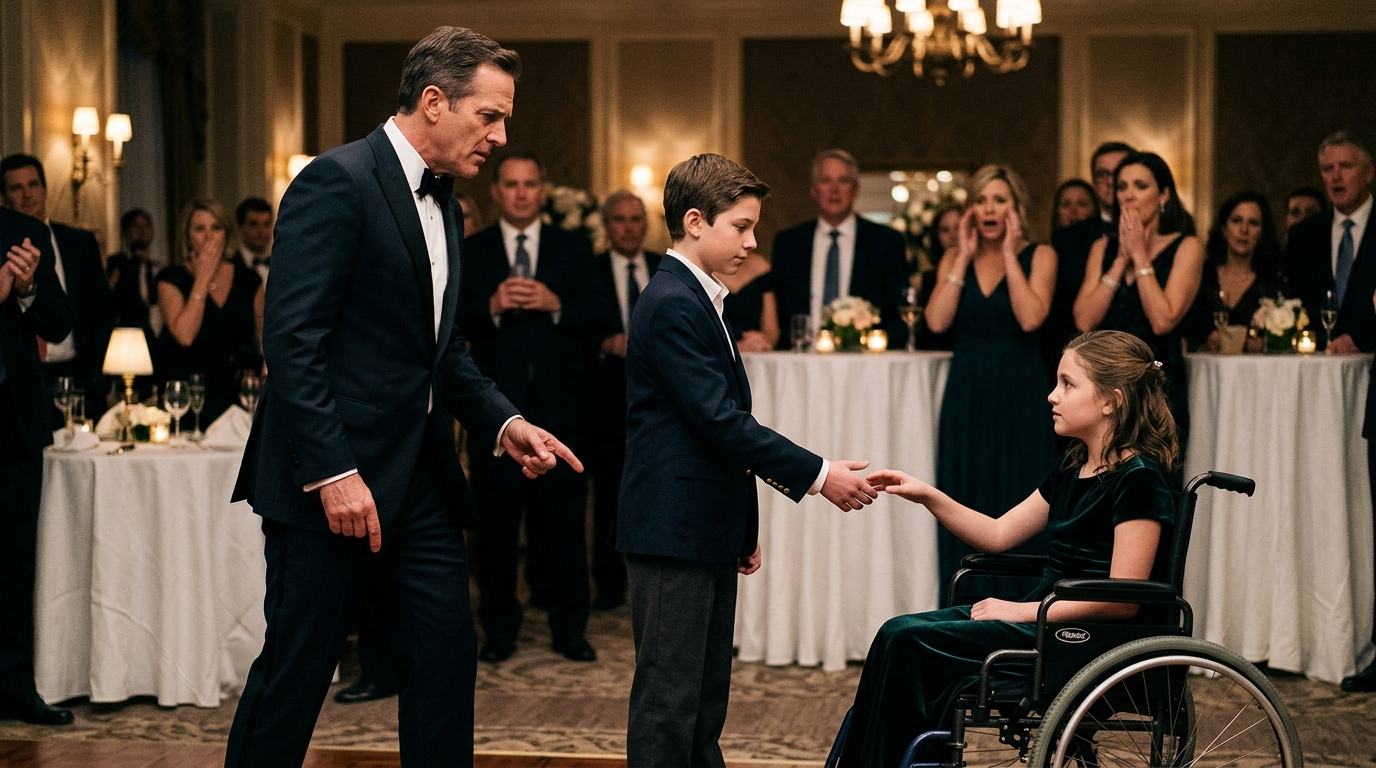
“STAY AWAY FROM MY DAUGHTER!”
The words cut through the sophisticated gathering like a glass dropped on marble.
Every head turned.
The string quartet faltered.
Champagne glasses paused midair.
Soft laughter died beneath the chandeliers.
At the center of the ballroom stood Edward Langley, dressed in a flawless black tuxedo, his face tightened with fury, one hand pointing directly at the boy standing in front of his daughter.
The boy looked painfully out of place.
His jacket was clean but old.
His shoes had been polished carefully, though the leather was cracked at the edges.
His tie was slightly crooked, as if he had tied it himself after watching a video too many times.
He couldn’t have been more than seventeen.
In front of him sat Edward’s daughter, Avery Langley.
Sixteen years old.
Beautiful in a pale lavender gown.
Silent in her wheelchair.
Her hands rested lightly on her lap, but her eyes were fixed on the boy with a kind of hope Edward had not seen in her face for years.
The party was supposed to be for Avery.
At least, that was what the invitations said.
Avery Langley’s Sweet Sixteen Gala
But everyone in that room knew it had become something else.
A charity spectacle.
A social event.
A polished reminder of Edward Langley’s wealth, influence, and devotion as a father.
The ballroom had been decorated with white roses and silver ribbons. A massive cake stood near the stage. A banner for the Langley Children’s Mobility Foundation hung behind the musicians.
Reporters had been invited.
Donors had been invited.
Doctors had been invited.
Politicians had been invited.
But the one person whose birthday they were celebrating had spent most of the evening quietly watching everyone else enjoy the night designed in her name.
Then the boy came.
He slipped in through the side entrance during the second song, rain still clinging to the shoulders of his jacket.
A few guests noticed him immediately.
Not because he was loud.
Because he was different.
The room was full of wealth that knew how to stand.
He stood like someone who had needed courage just to enter.
He walked straight toward Avery.
Not toward the cake.
Not toward the cameras.
Not toward the donors.
Toward her.
Edward saw him too late.
By the time he crossed the room, the boy had already stopped in front of Avery’s chair.
He bowed his head slightly.
Then, in a voice barely louder than the murmurs around them, he said:
“Just one dance.”
Avery’s lips parted.
Edward’s blood went cold.
He moved immediately.
“Stay away from my daughter!”
The boy did not step back.
The whole room drew in a breath.
Avery looked at her father.
“Dad…”
Edward didn’t hear the plea.
Or maybe he did and was too afraid of it.
He stepped between them.
“You think this is funny?” he snapped.
The boy shook his head.
“No, sir.”
“You walked into a private event uninvited and asked my daughter to dance?”
“Yes, sir.”
Edward’s anger sharpened.
“My daughter is not here for your amusement.”
The boy’s expression changed.
Only slightly.
A flash of hurt.
Then control.
“I know.”
“You know nothing about her.”
Avery’s fingers tightened on her dress.
The boy looked past Edward, not disrespectfully, but with quiet certainty.
“I know she loves music.”
Edward froze.
The boy continued:
“I know she hates when people talk to the chair before they talk to her.”
A ripple moved through the guests.
Avery’s eyes glistened.
“I know she counts the beats under her breath when she’s nervous,” the boy said softly. “And I know she has wanted one real dance since she was twelve.”
Edward’s fury faltered.
Not gone.
But shaken.
“How do you know that?”
The boy met his eyes.
“Because she told me.”
Chapter 2: The Daughter He Protected Too Well
Before the accident, Avery had danced everywhere.
In the kitchen while her mother cooked.
In the hallway before school.
Barefoot in the living room.
On rainy sidewalks when music played from passing cars.
Her mother, Juliet, used to laugh and say:
“That girl doesn’t walk through life. She hears it.”
Edward loved watching them dance together.
Juliet spinning Avery under one arm.
Avery laughing so hard she forgot the steps.
Music spilling through the house like sunlight.
Then came the accident.
A winter night.
A wet road.
A truck skidding through a red light.
Edward survived.
Avery survived.
Juliet did not.
Avery’s spinal injury left her unable to walk.
But Edward’s injury was different.
No surgeon could see it on a scan.
Fear settled into him like a second skeleton.
From that night on, he stopped being only a father.
He became a wall.
He controlled the house, the doctors, the schedule, the visitors, the treatments, the tutors, the friends, the outings, the music.
Especially the music.
At first, he told himself he was protecting Avery from pain.
Then from disappointment.
Then from pity.
Then from anything that might remind her of who she had been before the wheelchair.
But the more he protected her from grief, the more he protected her from joy too.
Avery became quieter.
Not bitter.
Not rebellious.
That would have been easier for Edward to understand.
She simply withdrew.
She answered politely.
She smiled when expected.
She thanked people for gifts she did not want.
And when music played, she looked away.
Edward thought it was because it hurt her.
He never asked whether it was because she missed it.
Chapter 3: The Boy From the Rehab Center
The boy’s name was Caleb Reyes.
Edward knew that now, though he had tried hard to forget him.
Three years earlier, Avery had spent months at a private rehabilitation center. Edward had chosen the place because it was the best money could buy — quiet, discreet, respected, expensive enough that most families couldn’t even walk through the front doors without feeling small.
Caleb was not a patient there.
His mother cleaned the therapy rooms in the evenings.
Caleb waited for her after school.
At first, he sat near the vending machines with textbooks open, doing homework beneath fluorescent lights.
Then he noticed Avery.
Noticed how she watched the therapy room after everyone left.
Noticed how her hands moved slightly whenever music played from the nurses’ station.
One evening, he found her alone near the piano in the recreation room.
She was staring at the keys.
He asked:
“Do you play?”
She said:
“No.”
He said:
“That sounded like a lie.”
She looked at him for the first time.
Most people saw the wheelchair before they saw Avery.
Caleb didn’t.
That was the first thing she liked about him.
The second was that he didn’t say sorry.
Over the next few weeks, they became friends quietly.
Caleb brought her sheet music from the public library.
Avery told him about her mother.
He told her his father had left when he was eight and that his mother worked too hard but pretended not to be tired.
They talked about music.
Then one day, Avery confessed:
“I miss dancing.”
Caleb didn’t say, “You still can,” in the bright, empty way adults did.
He asked:
“What kind?”
She blinked.
“What?”
“What kind of dancing do you miss?”
That question changed everything.
Because it did not treat dance like a metaphor.
It treated it like something real.
Something that could be adapted, learned, chosen.
Caleb began researching wheelchair ballroom dancing at the library.
He watched videos.
Practiced footwork alone.
Asked one of the older physical therapists questions until she finally realized what he was trying to do.
Avery started practicing after therapy.
Small movements at first.
Turns.
Timing.
Hand placement.
How to let the chair become part of the rhythm instead of something to hide.
For the first time after the accident, Avery laughed until she cried.
Then Edward found out.
He saw Caleb guiding Avery through a slow turn in the empty recreation room.
Saw her smiling.
Saw her face lit by something he had no control over.
And he panicked.
Not because Caleb was dangerous.
Because Avery looked alive without him.
That frightened Edward more than he wanted to admit.
The next day, Caleb and his mother were told not to return to that floor.
Avery was told Caleb had moved away.
Caleb was told Avery’s father wanted no further contact.
Neither believed the full story.
But both were children standing under the decisions of adults.
So the friendship ended.
Or so Edward thought.
Chapter 4: The Request
Now Caleb stood in the ballroom three years later, asking for one dance.
Avery stared at him as if he had stepped out of a memory she had carried too carefully to name.
Her voice trembled.
“You came.”
Caleb smiled softly.
“I said I would.”
Edward turned sharply toward her.
“You knew about this?”
Avery did not answer immediately.
For once, she did not shrink.
“Yes.”
The word was quiet.
But it landed harder than a shout.
Edward’s face changed.
“How?”
Caleb reached into his jacket and pulled out a folded envelope.
The paper was old, cream-colored, and sealed with a strip of clear tape to protect it from rain.
“I got a letter,” he said.
Edward stared.
“From whom?”
Caleb looked at Avery.
Then back at Edward.
“From Mrs. Langley.”
Edward’s body went rigid.
Juliet.
The room seemed to tilt beneath him.
“That’s not possible.”
Caleb held the envelope out.
“Your wife gave it to my mother before she died.”
Edward did not take it.
He couldn’t.
Avery’s eyes filled with tears.
“She wrote to me too, Dad.”
Edward turned to her.
“You knew?”
“I found out last month.”
“Why didn’t you tell me?”
Avery looked at him with a sadness far older than sixteen.
“Because every time I try to want something, you look like I’m about to break.”
Edward’s mouth opened.
No words came.
Caleb stepped forward slightly.
“I didn’t come to take anything from her.”
Edward’s eyes flashed.
“Then why are you here?”
Caleb looked at Avery.
“Because someone made her a promise before either of us knew how much it would matter.”
The room was silent.
Caleb’s hand extended slowly toward Avery again.
Gentle.
Steady.
Waiting.
Avery lifted her hand.
Edward almost stopped her.
His body wanted to.
His fear wanted to.
But then Avery looked up at him and whispered:
“Dad… please don’t take this too.”
Too.
That word struck him deeper than anything else.
Because it contained every other thing.
School.
Friends.
Music.
Independence.
The right to be disappointed.
The right to choose.
Edward lowered his hand.
Avery placed her fingers in Caleb’s.
The room held its breath.
Chapter 5: Juliet’s Letter
Before the music began, Caleb turned to Edward.
“She wanted you to read this first.”
Edward stared at the envelope like it might burn him.
Then he took it.
His name was written on the front in Juliet’s handwriting.
Not printed.
Not formal.
The quick, graceful script she used on grocery lists, birthday cards, and notes tucked into his coat pockets.
Edward — when Avery turns sixteen.
His hands began to shake.
He opened it.
The ballroom disappeared.
The chandeliers blurred.
Only Juliet’s words remained.
My love,
If this letter reaches you, then I am trusting someone else to do what I may not be there to do myself: remind you that our daughter is not made of glass.
Edward’s throat closed.
You will want to protect her from every sharp edge in the world. I know you. You will confuse control with care because fear will speak in my voice. Do not believe it.
He pressed one hand against the paper to steady it.
If Avery cannot walk, let her move. If she cannot dance the way we imagined, let her dance another way. If someone sees her as whole when you are still grieving what changed, do not punish them for seeing clearly.
Edward looked at Avery.
She was crying now.
So was he.
There is a boy at the rehabilitation center named Caleb. He made her laugh today. Not the careful laugh. The real one. I saw it. If life gives her a friend like that, don’t close the door.
Edward covered his mouth.
He remembered that day.
Juliet had still been alive then, lying in the hospital, weak but lucid for short stretches. She had asked about Avery constantly. He had told her Avery was “coping.”
He had never told her about Caleb.
She had known anyway.
That was Juliet.
She always knew where the light was.
Edward forced himself to read the last lines.
Promise me one thing. On her sixteenth birthday, if she wants to dance, let the music play.
Love her enough to step back.
— Juliet
Edward lowered the letter.
His chest hurt.
Not like grief.
Like recognition.
The worst kind of truth is the one spoken by someone who loved you enough to know exactly how you would fail.
Chapter 6: The Dance
Caleb looked toward the quartet.
“Can you play the waltz from the letter?”
The musicians exchanged uncertain glances.
Avery reached into the side pocket of her chair and pulled out a folded sheet of music.
“I brought it,” she whispered.
Edward stared at her.
“You planned this.”
She nodded.
“I hoped.”
That was worse.
Not planned.
Hoped.
The lead violinist took the sheet.
The pianist studied the notes.
Then, softly, the first melody rose.
Edward knew it immediately.
Juliet’s kitchen waltz.
The song she used to play on quiet Sunday mornings while Avery danced in socks across the tiles.
Avery closed her eyes.
Caleb stepped behind her chair.
He did not touch it right away.
“May I?”
Avery opened her eyes.
“Yes.”
He unlocked the brakes.
Then offered his hand again.
She took it.
The first turn was slow.
Careful.
The wheels moved over the marble with a soft whisper.
Caleb guided her not like someone pushing a wheelchair, but like a dance partner.
He stepped with the rhythm.
She turned with him.
Her lavender dress flowed around the chair like water.
The whole room watched.
At first, they watched with shock.
Then with tenderness.
Then with something close to awe.
Not because Avery looked fragile.
Because she didn’t.
For the first time that night, she was not the girl in the wheelchair at the charity gala.
She was a girl dancing at her own birthday.
Her smile appeared slowly.
Then fully.
Edward nearly broke at the sight of it.
He had spent years trying to protect that smile by controlling the world around it.
But it had returned only when he stopped standing in its way.
Caleb guided Avery into another turn.
Avery laughed.
Not politely.
Not for cameras.
A real laugh.
The sound cracked something open in Edward’s chest.
Several guests began crying.
The reporters lowered their phones.
Even Caroline Vale, the foundation’s largest donor and a woman famous for never showing emotion in public, wiped beneath one eye.
The dance lasted less than four minutes.
But to Edward, it felt like watching time return what grief had stolen.
When the final note faded, there was no applause at first.
Only silence.
Then Edward began clapping.
Slowly.
With shaking hands.
Avery looked at him.
The room followed.
Applause filled the ballroom.
But Avery wasn’t looking at the crowd.
She was looking at her father.
And for the first time in years, Edward did not see what she had lost.
He saw what was still there.
Chapter 7: The Apology in Front of Everyone
Edward walked toward them.
Caleb stepped back immediately, expecting another command.
Edward saw that.
And hated himself for being the reason.
He stopped in front of the boy.
For a long second, he could not speak.
Then he said:
“I owe you an apology.”
The room quieted again.
Caleb looked guarded.
“Yes, sir.”
The honesty in that answer nearly made Edward smile through the pain.
“I was wrong to push you away.”
Caleb said nothing.
“I was wrong to assume your presence in my daughter’s life was a threat.”
Still nothing.
Edward turned to Avery.
“And I was wrong to decide that loving you meant controlling every door you walked—or rolled—through.”
Avery’s eyes filled.
Edward knelt in front of her.
Not for drama.
Because he needed her to see his face clearly.
“I thought if I kept the world far enough away, it couldn’t hurt you.”
Her voice trembled.
“But it still did.”
He nodded.
“Yes.”
“You did too.”
The sentence was soft.
But it hit harder than anger.
Edward closed his eyes.
“I know.”
Avery reached out and touched his cheek.
“I don’t want you to stop protecting me,” she whispered. “I just want you to stop protecting me from living.”
Edward broke then.
Quietly.
Completely.
“I’ll try,” he said.
Avery gave him a sad little smile.
“You’ll mess up.”
He laughed through tears.
“Yes.”
“I’ll tell you when.”
“Please do.”
Then she looked toward Caleb.
“Can he stay?”
Edward looked at the boy.
The boy who had been thrown out of his daughter’s life because Edward feared what he could not control.
“Yes,” Edward said.
A pause.
“If he wants to.”
Caleb looked at Avery.
Then at Edward.
“I want to.”
Chapter 8: The Second Dance
The party changed after that.
Not instantly into perfection.
Real moments never do.
Some guests were uncomfortable because they had come expecting champagne and speeches, not a father being forced to confront his grief in public.
Some donors whispered.
Some reporters still wrote headlines.
But the atmosphere had shifted.
The night no longer belonged to Edward’s foundation.
It belonged to Avery.
The next song began.
A faster one.
Avery looked at Caleb.
“Think you remember the spin?”
Caleb smiled.
“Barely.”
“That means yes.”
He laughed.
They danced again.
This time, not alone.
A little cousin joined.
Then one of Avery’s friends.
Then two other teens.
Soon the ballroom floor filled with people moving awkwardly, joyfully, imperfectly around Avery’s chair.
No one treated the wheelchair like something to ignore.
No one treated it like the center of tragedy.
It was simply part of the dance.
Edward stood near the edge, Juliet’s letter still folded in his hand.
An elderly woman approached him.
Juliet’s mother.
She had not spoken much since the accident. Grief had made distance between them too.
She looked at Avery, then at Edward.
“Juliet would have liked him.”
Edward swallowed.
“I know.”
“She would have yelled at you first.”
He gave a broken laugh.
“I know that too.”
She touched his arm.
“Then she would have forgiven you if you did better.”
Edward looked at his daughter’s smile.
“I’m going to try.”
“That’s not enough forever,” she said.
“I know.”
“But it’s enough for tonight.”
Chapter 9: What Changed After
Edward did not become a different man overnight.
Fear does not leave just because one song plays.
He still worried too much.
He still asked too many questions.
He still sometimes looked at ramps, elevators, cars, restaurants, and strangers as if danger might be hiding inside them.
But now Avery had a voice in the conversation.
And Edward listened.
Not perfectly.
But more.
Caleb became part of her life again.
Slowly at first.
Then naturally.
He visited on weekends.
He brought music.
He argued with Avery over tempo.
He learned how to help without hovering.
He refused to treat her like she was breakable.
Edward noticed.
It irritated him at first.
Then humbled him.
Because Caleb understood something he had forgotten:
Avery did not need everyone to be careful with her feelings all the time.
Sometimes she needed honesty.
Sometimes humor.
Sometimes disagreement.
Sometimes someone who said, “That turn was terrible,” and made her laugh instead of cry.
A year later, Avery and Caleb helped start an adaptive dance program through the Langley Foundation.
This time, Edward did not put his own face on the brochure.
He did not stand in front of the cameras.
The program was named after Juliet.
The Juliet Langley Movement Project
Its motto came from her letter:
Let her move.
Avery chose it.
Edward approved it with tears in his eyes.
Final Chapter: Just One Dance
People remembered the gala for years.
They remembered the father’s shout.
The boy in the worn jacket.
The girl in the lavender dress.
The letter from a mother who had known love could become a cage if grief held the key.
But Avery remembered something smaller.
The moment Caleb’s hand extended.
Gentle.
Steady.
Waiting.
He did not demand.
He did not rescue.
He did not pretend the wheelchair was not there.
He simply offered a choice.
That was what made the moment powerful.
Not the dance itself.
The choice.
For years, people had made decisions around Avery.
For her.
About her.
Because of her.
That night, in front of everyone, she chose.
She chose the music.
She chose the boy.
She chose movement.
And eventually, her father chose to step back enough to let her life widen again.
Because love is not always the hand that blocks the world.
Sometimes love is the hand that releases the brake.
Sometimes love is admitting fear has been speaking too loudly.
And sometimes love is a boy standing in a room full of people richer and louder than him, asking for nothing grand.
No miracle.
No applause.
No permission to own the moment.
Just one dance.
And somehow, that was enough to change everything.