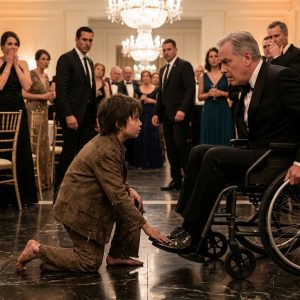
The Boy Who Ran Into Maggie’s Diner
“HELP ME—PLEASE—HE’S COMING!”
The door of Maggie’s Diner burst open so hard the neon sign in the window rattled against the glass.
Every fork stopped.
Every conversation died.
The old jukebox near the restroom kept playing for half a second too long, a soft country song drifting through a room that had suddenly forgotten how to breathe.
Then even that seemed to fade.
A boy stumbled inside.
He was small, maybe ten or eleven, soaked in rain, one shoe missing, his gray hoodie torn at the sleeve. His breath hitched like he had been running for miles. Tears streaked down his cheeks, cutting clean lines through dirt and sweat.
For one frozen moment, no one moved.
The waitress behind the counter stood with a coffee pot suspended in midair. A truck driver near the window slowly lowered his burger. Two college kids in the corner booth lifted their phones, then hesitated, unsure whether they were watching danger or becoming part of it.
The boy looked behind him.
Nothing was there.
But the way he looked made the doorway feel full of something unseen.
Something close.
Something coming.
He staggered forward and collided with the man seated at the center table.
Scar.
That was what everyone called him.
His real name was Caleb Maddox, but almost no one used it anymore. He was broad-shouldered, gray at the beard, and still in a way that made the room organize itself around him. A long pale scar ran from beneath his left eye to his jaw, not ugly exactly, but impossible to ignore.
He wore a black leather jacket with a worn patch across the back:
IRON OAKS.
Around him sat six other bikers, all older, all quiet now, all watching the boy with the kind of attention that made sudden movement seem unwise.
The boy grabbed Scar’s jacket with both hands.
Not asking.
Clinging.
Like that leather was the last solid thing in the world.
“Don’t let him take me,” he whispered.
Scar did not move at first.
He looked down at the child’s hands.
Then at his face.
Then toward the door.
His voice, when it came, was low.
“Who’s coming?”
The boy shook his head violently.
His mouth opened.
No words came.
Then the diner door creaked again.
This time, slowly.
Controlled.
Every head turned.
A man stepped inside.
Sharp suit.
Polished shoes.
Perfect posture.
He looked wrong in that diner, like someone from a courthouse had walked into a room full of grease, coffee, rainwater, and people who knew how to fix engines with their hands.
He scanned the room once.
Just once.
Then he smiled.
“There you are.”
The words were gentle.
But they landed like a weight.
The boy’s fingers tightened around Scar’s jacket.
“No,” he breathed.
The man took one step forward.
“My apologies,” he said to the room. “He has a tendency to run when he’s upset.”
Scar tilted his head slightly.
“You lost something?”
The man’s smile remained.
“My ward.”
The word made the boy flinch.
“That boy belongs with me.”
The diner went colder.
A chair creaked near the counter.
One of the bikers, a woman named Doc because she had spent twenty years as an emergency nurse, slowly set down her coffee.
Scar’s eyes stayed on the man.
“Funny,” he said. “He seems to disagree.”
The man’s expression did not change.
“Children often disagree with what is best for them.”
The boy’s voice cracked.
“He’s lying.”
The man sighed, patient now, as if performing for the room.
“This is a private family matter.”
Scar leaned back slightly.
“Then why’d he run into a public diner?”
The smile thinned.
The man reached slowly into his jacket.
Scar’s eyes sharpened.
“Stop.”
One word.
The man froze.
Not because he wanted to.
Because every biker at the table had shifted at once.
No one stood.
No one shouted.
But hands moved.
Shoulders squared.
Boots adjusted against the floor.
Outside, engines rumbled in the rain.
More bikes.
Closer.
The man looked around and gave a small, amused exhale.
“You really want to do this here?”
The boy leaned closer to Scar, struggling to breathe.
“He hurt them,” he whispered.
Scar’s expression changed.
Not much.
Just enough.
Something old and dark moved behind his eyes.
The man in the suit lowered his hand slowly.
“What did you say?” Scar asked the boy.
The child’s lips trembled.
“He hurt the others too.”
And with that, Maggie’s Diner stopped being a place where people came for coffee.
It became the first room where someone finally listened.
Video: A Terrified Boy Grabbed a Biker’s Jacket in a Diner—Then the Man in the Suit Walked In Claiming He Owned Him
The Man With the Papers
The man in the suit introduced himself as Graham Voss.
He said the name calmly, as if he expected it to solve the room.
Some names do that.
Names attached to money.
Courts.
Hospitals.
Boards.
Charities.
People in small towns often know the names of powerful men before they ever meet them, because those names appear on plaques and press releases long before their shadows reach the floor.
Graham Voss was one of those names.
He ran the Voss Children’s Initiative, a private placement organization that claimed to help “hard-to-place youth” find emergency housing, therapy, and long-term family support. His face had been in the county paper six months earlier, standing beside a senator at a ribbon-cutting ceremony, both of them smiling beneath a banner that read:
EVERY CHILD DESERVES SAFETY.
Now he stood in Maggie’s Diner while a barefoot boy shook against a biker’s jacket and begged not to go back to him.
Graham removed a folded document from his inside pocket.
Slowly.
Carefully.
Like a magician producing proof.
“I have legal guardianship authorization,” he said. “Temporary emergency custody.”
Scar did not take the paper.
Doc did.
She stood, walked over, and held out one hand.
Graham hesitated.
Only for a second.
Then he gave it to her.
Doc unfolded the page and read in silence.
Scar still had one hand resting lightly on the boy’s shoulder.
“What’s your name, kid?”
The boy swallowed.
“Eli.”
“Eli what?”
“Eli Turner.”
Graham’s jaw tightened.
The paper in Doc’s hands said the same thing.
Eli Turner.
Age eleven.
Runaway risk.
Behaviorally unstable.
Placed temporarily under the supervision of Voss Children’s Initiative pending review.
Doc’s eyes narrowed as she read further.
“This says he has no living relatives.”
Eli looked up instantly.
“I do.”
Graham smiled sadly.
“He believes that. Trauma can create attachments to people who are not safe.”
Eli shook his head hard.
“My aunt is real.”
Scar looked down.
“What’s her name?”
“Anna Turner. She came for me. He said she never showed up, but she did. I saw her car.”
Graham’s face remained composed.
“His aunt failed the background review.”
Eli cried harder.
“No. You told her I didn’t want to see her.”
Scar’s hand tightened slightly on the boy’s shoulder.
Graham turned his attention fully to Scar.
“Mr…”
“Maddox.”
“Mr. Maddox. I respect whatever protective instinct you believe you’re acting on, but this child is in state-recognized temporary care. Interfering with custody could become a serious legal matter.”
One of the bikers at the table gave a low chuckle.
It was not a friendly sound.
Scar did not smile.
“Funny thing about legal matters,” he said. “They tend to go better when the kid isn’t bleeding and missing a shoe.”
Graham looked at Eli’s feet.
For the first time, annoyance flickered across his face.
“He ran through a drainage lot. I’ve been trying to bring him back safely.”
Eli whispered, “No.”
Doc crouched in front of the boy.
“Eli, look at me.”
He did.
Her voice softened.
“Are you hurt?”
He nodded.
“Where?”
He looked toward Graham.
Fear closed his throat.
Doc noticed.
Scar noticed.
Everyone at the center table noticed.
Graham sighed.
“Children with oppositional behavior often—”
“Stop talking,” Scar said.
The room went silent.
Graham blinked.
Scar’s voice stayed low.
“Not another word over him.”
Graham’s smile vanished completely.
“That is not your decision.”
Scar leaned forward.
“It is while he’s holding my jacket.”
Outside, more engines rolled into the parking lot.
The windows trembled faintly.
Graham looked toward the glass.
For the first time, he seemed to understand that he had entered the wrong diner.
Scar Knew the Sound of a Child Lying From Fear
Scar had spent half his life learning the difference between a child lying for trouble and a child lying to survive.
The first kind looks around to see who believes them.
The second kind looks around to see who will punish them.
Eli was not performing.
He was calculating danger in every face.
That told Scar more than the papers did.
Twenty-two years earlier, Scar had been a Marine with a younger sister named Beth.
Beth was seventeen when she ran away from home with a man who said he could make her a model. By the time Scar found her, she was in a shelter two states away, pregnant, silent, and terrified of men in suits.
She died three years later from an overdose everyone called accidental because it was easier than naming the people who had used her.
Her daughter, Lacey, went into foster care.
Scar fought for custody and lost at first because he was deployed, unmarried, and looked exactly like the kind of man judges preferred not to trust with little girls.
He eventually brought Lacey home.
But he never forgot the months when paperwork stood between a child and the only person trying to save her.
That was why the Iron Oaks had changed over the years.
What began as a riding club became something else.
Court escorts.
Shelter protection.
Missing child searches.
Quiet pickups when terrified mothers needed to leave houses at 3:00 a.m.
They did not advertise.
They did not ask for praise.
They simply showed up when people who were supposed to protect the vulnerable needed someone larger standing behind them.
So when Eli clutched Scar’s jacket and whispered, “He hurt them,” Scar heard more than panic.
He heard a door opening.
And behind that door, maybe other children.
Doc handed the papers back to Graham but did not step away.
“These are copies.”
Graham’s eyes narrowed.
“Yes.”
“Where are the originals?”
“With the agency.”
“Which agency?”
“County placement services.”
“Name of caseworker?”
Graham paused.
“Mr. Maddox and his friends are not entitled to—”
Doc interrupted.
“Name.”
Graham’s jaw worked once.
“Karen Bell.”
Doc looked toward one of the bikers at the table.
“Bear.”
Bear was a huge man with a white beard and reading glasses hanging from his collar. He pulled out his phone.
“On it.”
Graham looked irritated now.
“You cannot verify confidential custody matters through a phone call.”
Bear glanced up.
“Watch me.”
Scar looked at Eli.
“How’d you get away?”
Eli wiped his nose with his sleeve.
“The van stopped near the alley. He was on the phone. The other kid told me to run.”
“What other kid?”
Eli’s face tightened.
“Tommy.”
Graham’s eyes moved.
Scar saw it.
Just a tiny shift.
But it was enough.
“Where’s Tommy?” Scar asked.
Eli looked at the floor.
“He didn’t run fast enough.”
The diner air turned heavy.
Doc stood slowly.
“What do you mean?”
Eli shook his head.
“He screamed. Then he stopped.”
Graham’s voice cut in.
“This is precisely why the child needs professional care. He invents stories under stress.”
Eli suddenly turned on him.
“Then where is Tommy?”
Graham’s face froze.
Eli stepped closer to Scar again.
“Where is he?”
The question hung in the diner.
Graham did not answer.
That was when the waitress, Maggie herself, reached below the counter and quietly locked the front door.
The Van Behind the Diner
Bear returned from his phone call with his expression changed.
“Karen Bell hasn’t worked county placement for eight months.”
Graham’s eyes sharpened.
“Your information is wrong.”
Bear turned the phone so everyone could hear the voice on speaker.
A woman spoke, tired and official.
“I don’t know who you’re talking to, but Karen Bell retired last winter. And Voss Children’s Initiative lost emergency placement privileges in this county pending review.”
The room went completely silent.
Graham moved toward the door.
Scar stood.
Not fast.
Not dramatically.
But enough that the entire diner seemed to lower its shoulders.
“You’re not going anywhere yet.”
Graham slipped his hand toward his jacket again.
This time, everyone moved.
Doc pulled Eli behind her.
Bear stepped into Graham’s path.
Another biker, Red, turned over a chair to block the aisle.
Scar’s voice was quiet.
“I told you once.”
Graham’s hand stopped.
Outside, headlights flashed through the rain.
A black van sat across the street near the alley.
Its engine was running.
Eli saw it and panicked.
“That’s it.”
Scar looked toward the window.
“The van?”
Eli nodded frantically.
“He has them in there.”
Graham said, “There is no one in that vehicle.”
Eli screamed, “You’re lying!”
Scar pointed to Red.
“Back door. Now.”
Red and two Iron Oaks moved instantly through the kitchen exit.
Graham lunged for the front door.
Bear caught him by the arm.
For the first time, Graham’s calm shattered.
“Get your hands off me!”
The suit tore slightly at the shoulder.
Maggie shouted, “Police are on the way!”
But Scar had learned long ago that sometimes the minutes before police arrive are the minutes that decide whether a child disappears.
He moved to the window.
Through the rain, he saw the van’s side door shift.
Just an inch.
Then close again.
Someone inside.
Small hand.
Small fingers.
Scar’s jaw tightened.
“Doc, keep Eli here.”
Eli grabbed his sleeve.
“No. Tommy.”
Scar looked down at him.
“I’m going to get him.”
Eli’s face twisted.
“Promise?”
Scar held his gaze.
“I don’t say that word unless I mean it.”
Then he and three bikers stepped into the rain.
The parking lot exploded with motion.
Motorcycle engines roared as Iron Oaks surrounded the black van from both ends. Red came from the alley side. Bear dragged Graham out of the diner entrance and pinned him against the wall while Maggie’s regulars watched from behind the glass.
“Open it!” Scar shouted.
No answer.
He tried the handle.
Locked.
A faint sound came from inside.
A child crying.
Scar’s face went cold.
“Break it.”
Red swung a tire iron into the side window.
Glass shattered.
The van alarm screamed.
Scar reached through, unlocked the door, and slid it open.
Inside were three children.
One girl no older than eight.
One boy curled on the floor with a bruised cheek.
And Tommy.
Small.
Curly-haired.
Barely conscious.
His wrists were zip-tied.
For a moment, even the Iron Oaks went still.
Then everything moved at once.
Doc ran from the diner with her trauma kit.
Eli tried to follow, but Maggie held him back.
Sirens rose in the distance.
Graham, pinned against the wall, stopped struggling.
Scar turned toward him.
The rain ran down his face, tracing the scar along his cheek.
“Still a family matter?”
Graham said nothing.
The House Called Bright Haven
The police arrived to find the black van surrounded by motorcycles, three children being treated under the diner awning, and Graham Voss sitting on the wet pavement with Bear standing over him like a courthouse statue.
At first, the responding officers looked overwhelmed.
Then one of them recognized Scar.
“Caleb.”
Scar nodded.
“Evening, Paul.”
Officer Paul Ramirez looked from the children to Graham.
“What the hell happened?”
Scar pointed toward the van.
“Start there.”
Paramedics arrived next.
Then detectives.
Then child protective services.
The diner became a command center by accident. Maggie served coffee no one drank. Customers gave statements. Phones were turned over. Graham’s documents were collected. Eli stayed wrapped in Scar’s jacket, refusing to let go even when Doc checked his ribs.
The girl from the van, whose name was Sophie, whispered that there were more children at the house.
“What house?” Detective Ramirez asked.
She looked at Eli.
Eli answered.
“Bright Haven.”
Everyone knew Bright Haven.
At least, they knew the name.
Bright Haven Youth Recovery Residence sat twenty miles outside town on a fenced property that used to be a horse farm. The website showed smiling children painting, reading, and planting gardens. Donors loved it. Politicians toured it. Graham Voss gave speeches about trauma-informed care and the importance of “difficult children being given structure.”
But no child in that van looked like they had been given care.
They looked like they had escaped a place designed to sound beautiful from far away.
Detective Ramirez looked at Graham.
“You want to explain?”
Graham’s attorney voice returned.
“I want counsel.”
Scar smiled without warmth.
“Smartest thing you said all night.”
Within an hour, a warrant was requested.
Within two, state police were involved.
By dawn, Bright Haven was raided.
What they found there made the town sick.
Children sleeping in locked rooms.
Medication logs with missing signatures.
Isolation rooms called “quiet spaces.”
Donated supplies never opened.
Records altered to show children had been placed with relatives when they had not.
Some children had been moved through the facility under false names. Some had living family members who had been told the children did not want contact. Some had relatives who had failed one background check but never been allowed to appeal because Voss’s agency buried paperwork.
Eli’s aunt, Anna Turner, had come for him three times.
Graham told her Eli was too traumatized to see her.
Then he told the county she had abandoned the petition.
Neither was true.
Tommy’s grandmother had been told he ran away.
He had not.
Sophie’s older brother had been told she was transferred to a therapeutic program in another state.
She was still in the room beside the laundry.
The story widened from one terrified boy to a machine of polished cruelty.
And Graham Voss, the man who walked into Maggie’s Diner smiling, had been standing at its center.
The Boy Who Chose the Scariest Table
People later asked Eli why he ran to Scar.
Why, in a diner full of people, he chose the biggest man in the room.
Eli’s answer was simple.
“He looked like he wouldn’t move if someone told him to.”
That answer made Scar quiet the first time he heard it.
Because Eli was right.
For most of his life, Scar had been judged by his face, his jacket, his size, his silence. People saw danger in him before they saw anything else.
That night, for the first time in a long while, a child saw safety in the same things adults feared.
Eli spent three days in the hospital.
Bruised ribs.
Dehydration.
A sprained wrist.
Nightmares so violent the nurses learned not to touch him awake.
Scar visited once.
Then again.
Then every day until Anna Turner arrived.
Anna came in an old blue sedan with one headlight dim and a folder full of ignored paperwork. She was thirty-two, exhausted, and shaking so hard when she saw Eli that she had to sit down before touching him.
Eli stood at the hospital room door.
For one terrible second, he did not move.
Then Anna whispered, “I came back every week.”
His face crumpled.
“I know.”
He ran into her arms.
Scar stepped out into the hall and gave them privacy.
Doc found him near the vending machines.
“You okay?”
He grunted.
That meant no.
She handed him a coffee.
“You did good.”
He looked toward Eli’s room.
“Kid did good. He ran.”
“Toward you.”
Scar said nothing.
Doc leaned against the wall beside him.
“Beth would’ve liked him.”
Scar closed his eyes.
That name still hurt.
“Yeah,” he said. “She would’ve fed him pie.”
Doc smiled faintly.
“Maggie already did.”
Graham Voss Finally Loses the Room
The trial came nine months later.
By then, the story had become national news.
Not because the media cared instantly.
They cared after the van.
After Bright Haven.
After the donation records.
After former staff came forward saying they had tried to report concerns but were dismissed.
After families held up photographs of children they had been told were unreachable.
Graham Voss entered court in the same kind of suit he had worn at the diner.
Perfect posture.
Controlled expression.
Polished enough to make strangers hesitate.
But he no longer owned the room.
Children testified behind screens.
Former employees testified under immunity.
Financial experts traced missing funds.
Caseworkers admitted files had been altered.
Anna Turner testified about being denied access to Eli.
Tommy’s grandmother testified while holding his school photo.
Sophie’s brother cried so hard on the stand the judge called a recess.
Then Eli testified.
He was small in the witness chair.
Too small.
But he sat upright.
The prosecutor asked him why he ran.
Eli looked toward Scar, who sat in the back row with the Iron Oaks.
Then he looked at Graham.
“Because Tommy told me to.”
“What did Tommy say?”
Eli swallowed.
“He said, ‘If one of us gets out, tell someone with a loud engine.’”
A ripple moved through the courtroom.
Scar lowered his head.
The prosecutor’s voice softened.
“And did you?”
Eli nodded.
“I told him.”
Graham’s attorney tried to suggest Eli was confused.
That trauma had affected his memory.
That he misunderstood discipline.
That the van was transporting children lawfully.
Eli listened.
Then said, “If it was lawful, why were Tommy’s hands tied?”
The courtroom went silent.
The attorney did not ask many more questions.
Graham was convicted on multiple charges, including kidnapping, fraud, unlawful restraint, child endangerment, and conspiracy tied to falsified placement records. Others followed: administrators, transport drivers, two county officials, and a doctor who had signed off on medication protocols without seeing the children.
Bright Haven closed permanently.
The property was later turned into something else.
Not a youth residence.
Not another institution with softer language.
A family reunification center named after the children who testified.
Eli refused to let his name be used.
He said names on buildings made him nervous.
Scar respected that.
The Diner After the Night Everything Changed
Maggie’s Diner replaced the shattered front window two weeks after the incident.
But Maggie kept one piece of broken glass.
She framed it beside the register with a small brass plate underneath:
The night someone ran in, and nobody let him run alone.
People came by just to see it.
Reporters wanted interviews.
Maggie mostly told them to order food or leave.
The Iron Oaks kept meeting there every Thursday.
Same center table.
Same coffee.
Same silence when the door opened too fast.
Eli came sometimes with Anna.
At first, he sat beside Scar and said almost nothing.
Then he began stealing fries from Bear’s plate.
Then he started asking questions about motorcycles.
Then, one afternoon, he asked Scar why everyone called him that.
Scar touched the pale line on his face.
“Because of this.”
Eli studied it.
“Does it hurt?”
“Not anymore.”
“Do people stare?”
“Sometimes.”
“What do you do?”
Scar thought about it.
“Let them.”
Eli nodded as if this were useful information.
Then he said, “I have scars too. Just not where people see.”
Scar looked at him.
The diner noise seemed to fade.
“Those hurt longer,” he said.
Eli nodded again.
“Yeah.”
Scar did not tell him it would all be fine.
He hated that lie.
Instead he said, “But they don’t get to own you.”
Eli looked at him for a long time.
Then stole another fry.
Years passed.
Eli grew.
Anna adopted him formally.
Tommy recovered, slowly, and became Eli’s closest friend. Sophie moved in with her brother. Other children found relatives, foster families, or advocates who stayed because the system had finally been forced to look.
Not all endings were perfect.
Some children had nowhere easy to return.
Some families were complicated.
Some damage did not vanish because the villain went to prison.
But more children were found.
More records were corrected.
More doors were opened.
And that mattered.
Scar kept riding.
The Iron Oaks expanded their volunteer work, partnering with legal advocates and child welfare reform groups. They still looked intimidating in parking lots. They still made officials nervous when they arrived at hearings in a line of leather jackets.
Scar considered that useful.
At the five-year anniversary of the night Eli ran into Maggie’s, the diner held a small gathering.
No speeches, Maggie insisted.
Then gave one anyway.
She stood behind the counter, wiping her hands on her apron.
“I don’t know much about courts or agencies,” she said. “But I know this. A child came through that door asking for help. The first thing he needed was not paperwork. It was someone who didn’t hand him back.”
Everyone went quiet.
Eli, now sixteen, stood near the jukebox.
Tall.
Still thin.
Still watchful sometimes.
But smiling more often.
Scar sat at the center table, older now, the scar on his face softened by time but not gone.
Eli walked over and placed something on the table.
A small patch.
Not an official Iron Oaks patch.
A handmade one.
Black cloth.
White letters.
LOUD ENGINE.
Scar picked it up.
His throat worked once.
“You make this?”
Eli shrugged.
“Tommy helped.”
Scar stared at the patch for a long moment.
Then he tucked it inside his jacket.
“Thank you.”
Eli looked embarrassed.
“You don’t have to get weird.”
Bear laughed so loudly half the diner turned.
Scar smiled.
Just a little.
Outside, rain began tapping against the new window.
The neon sign buzzed softly.
The door stayed closed.
But everyone in that diner remembered the night it had burst open.
The scream.
The boy.
The man in the suit.
The papers that lied.
The van in the rain.
The children inside.
And the moment one biker asked the simplest question no official document had bothered to ask:
Why is the child afraid?
That question changed everything.
Because Graham Voss had believed authority would win.
He believed polished shoes would beat bare feet.
He believed legal words would beat a child’s trembling voice.
He believed the world would see a man in a suit and a boy in a torn hoodie and choose the suit.
For a few minutes, maybe it almost did.
Then Eli chose the scariest table in the room.
And the scariest man in the room became the safest place he could find.