The Boy Outside the Jewelry Store
At first, everyone thought the boy had chosen the wrong woman.
That was the first mistake the crowd made.
The jewelry district was made for people who never looked down for long. Diamonds rotated slowly behind glass. Security guards stood beside velvet ropes. Women stepped from black cars with shopping bags on their arms and faces trained not to react to anything unpleasant.
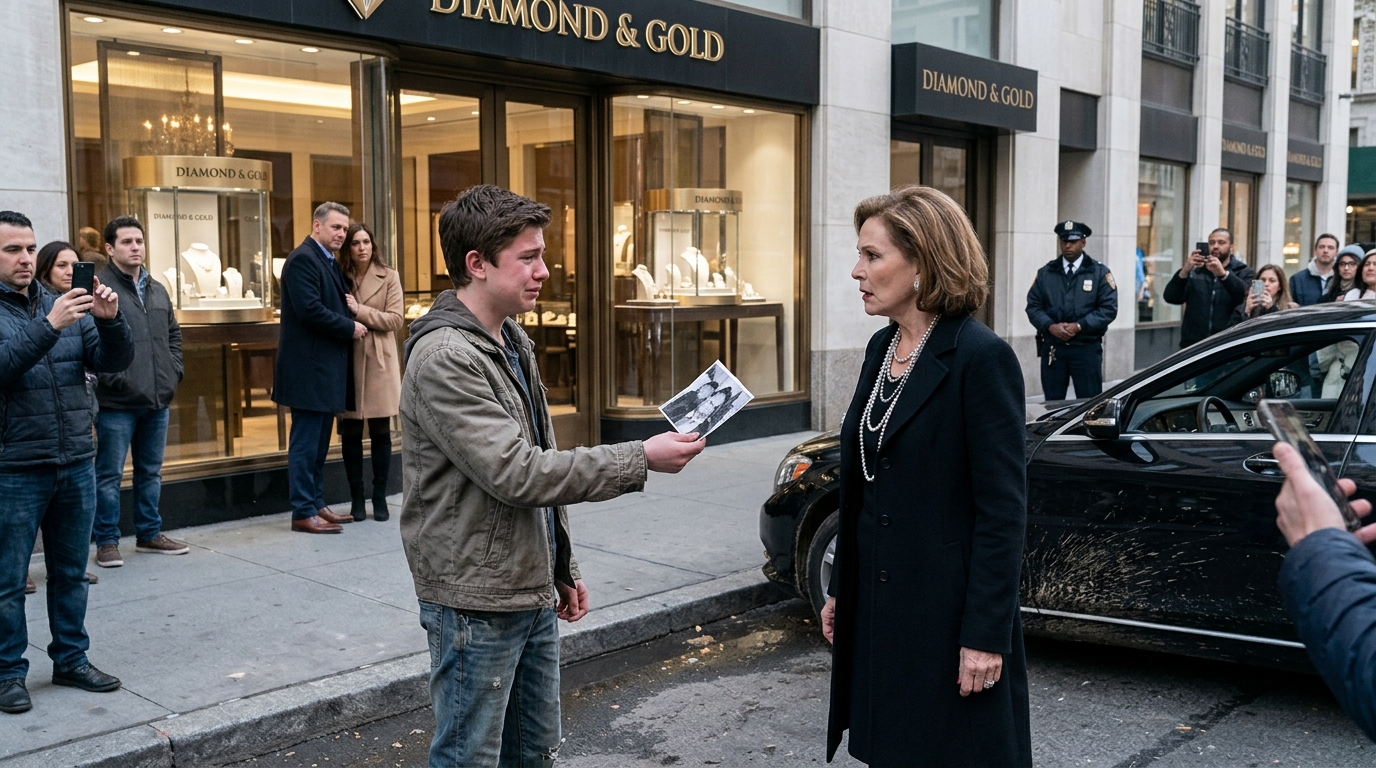
Then the dirty water hit my car.
It exploded against the passenger door in a brown, violent splash.
The sound cracked through the sidewalk.
People turned.
A few gasped.
Someone laughed once, then stopped.
I stepped out of the boutique with a diamond necklace still cold against my throat and saw him standing there.
A teenage boy.
Maybe fifteen.
Thin.
Soaked shoes.
Hands shaking.
His chest rose and fell as if he had run for miles just to reach that exact piece of sidewalk.
My driver opened the door before I could speak.
“Mrs. Vale, stay back.”
But I didn’t stay back.
I was too angry.
Too embarrassed.
Too used to the world moving out of my way.
“Are you out of your mind?” I snapped.
The boy flinched.
But he didn’t run.
That should have warned me.
Most children run when power turns its face toward them.
This one had already decided fear was cheaper than silence.
Phones rose around us.
A couple near the boutique entrance stepped backward. The guard beside the display window watched carefully, one hand near his radio, not yet brave enough to decide which side wealth wanted him on.
The boy took one step toward me.
“My mother waited for you,” he said.
His voice shook.
But it carried.
The crowd went quiet.
I stared at him.
At first, the words meant nothing. They struck the surface of my anger and slid off.
“What are you talking about?”
His lower lip trembled.
“But you never came back.”
That was when the air changed.
Not for the crowd.
For me.
Something inside my chest tightened with an old, familiar pressure.
A hospital hallway.
Rain on windows.
A woman crying.
A baby’s fist wrapped around my finger.
No.
Not here.
Not now.
The boy reached into his jacket pocket.
Slowly.
Carefully.
As if every movement had been rehearsed in a thousand sleepless nights.
He pulled out a photograph.
Old.
Bent at the corners.
Protected by nothing but desperation.
He held it up between us.
I looked.
And the city disappeared.
The photo showed me at twenty-six years old, standing outside a hospital room in a pale blue coat, my hair pinned back, my face younger and terrified.
In my arms was a baby.
A newborn.
Wrapped in a white blanket.
I knew that blanket.
I knew the room number behind me.
I knew the exact hour that photograph had been taken.
Because that was the night I was told the baby died.
The boy’s hand shook so badly the picture fluttered.
“She told me you left me behind.”
No one on the sidewalk moved.
Not the shoppers.
Not the guards.
Not my driver.
The boy looked at me like he had spent his whole life building hatred and had just discovered it might not hold.
My mouth opened.
No sound came.
Then I whispered the only truth I had.
“No.”
His face tightened.
“No?”
I shook my head.
Snow began to fall lightly over the glittering street.
“Not like that.”
His eyes narrowed.
“Then how?”
I looked at the photograph again.
At the baby.
At the hospital door.
At the young woman I used to be before grief, money, and silence taught me how to stand without shaking.
Then I saw something behind the boy.
Across the street, inside a parked silver car, a man lowered a newspaper just enough for me to see his eyes.
My husband’s eyes.
And suddenly I understood.
The boy had not found me by accident.
Someone had let him come.
Someone had watched him come.
And if the baby in that photograph was standing in front of me now—
Then someone had lied to both of us for fifteen years.
The Photograph That Shouldn’t Exist
“Where did you get that?” I asked.
The boy pulled the photograph closer to his chest.
“From my mother.”
“What is her name?”
He hesitated.
That hesitation told me everything.
A child who has lived with one version of the truth does not hesitate unless another version has already started to break through.
“Lena,” he said finally. “Lena Marsh.”
The name hit me so hard I almost reached for the car.
Lena.
I had not heard it spoken aloud in years.
Not since the hospital.
Not since the papers.
Not since my husband, Malcolm, told me saying her name was only keeping the wound open.
Lena Marsh had been my nurse.
No.
Not only my nurse.
She had been the only person in that hospital who treated me like a grieving mother instead of a wealthy inconvenience.
I had gone into labor too early.
Eight months pregnant.
Alone.
Malcolm was in London, or said he was. My father had died two weeks earlier, leaving me the majority stake in Vale Holdings and a marriage already buckling under money, inheritance, and quiet resentment.
The baby came during a storm.
A boy.
I held him for less than three minutes.
He was small, but alive.
I remembered his cry.
I remembered because for years people told me grief had invented it.
Then everything blurred.
A nurse adjusted the IV.
My body became heavy.
When I woke, Malcolm was beside my bed.
His hand held mine.
His face was arranged into sorrow.
“Our son didn’t make it,” he said.
No body.
No final goodbye.
No death certificate I was allowed to read without medication clouding the edges of the room.
Just a small white urn brought home two days later and placed in a locked cabinet because Malcolm said I was becoming unstable.
I believed him.
Not because the lie was good.
Because I was too broken to fight it.
Now a teenage boy stood on a jewelry district sidewalk holding a photograph of me with the baby I had buried without a body.
“What is your name?” I asked.
His chin lifted.
“Noah.”
Noah.
The name broke through me.
I had chosen that name.
Not Malcolm.
Me.
I chose it because my mother used to say every storm needed an ark.
Malcolm hated it.
Too biblical, he said.
Too soft.
I looked at the boy’s face again.
His eyes were mine.
The shape of his mouth was Malcolm’s.
And the anger—
The anger was all his own.
“Noah,” I whispered.
His expression twisted.
“Don’t say it like you know me.”
“I chose your name.”
He stepped back.
“No.”
“I did.”
“You’re lying.”
“I wish I were.”
My driver moved closer.
“Mrs. Vale, we need to leave.”
I turned on him.
“Not another step.”
The driver froze.
That was when I saw his earpiece.
My driver had never worn an earpiece.
Across the street, the silver car started its engine.
Malcolm.
Watching.
Leaving.
My hands went cold.
I looked back at Noah.
“Did Lena send you here?”
His face changed.
Fear.
Fresh.
Immediate.
“She’s sick.”
“What kind of sick?”
“She said if I found you, I should show you the picture. She said you’d know what they did.”
“What who did?”
He swallowed.
“The man with the black ring.”
My breath stopped.
Malcolm wore a black onyx ring on his right hand.
A family piece.
Heavy.
Distinctive.
Ugly.
Noah continued, voice cracking now.
“She said he paid her to keep quiet. Then he paid someone else to make sure she stayed quiet. But she kept me because she said nobody should be buried alive.”
The crowd was no longer entertained.
The phones were still up, but the energy had changed.
This was no longer rich-woman drama.
This was something darker.
Something people were beginning to understand they might later be asked about.
I reached for Noah’s arm.
He jerked away.
“Don’t touch me.”
“I’m not going to hurt you.”
“That’s what rich people say before someone disappears.”
I had no answer for that.
Because he was right.
In my world, people disappeared politely.
With severance.
With settlements.
With diagnoses.
With stories repeated often enough to become official.
I took off the diamond necklace still clasped around my throat and shoved it into my driver’s hand.
“Return this.”
He stared at me.
“Mrs. Vale—”
“Now.”
Then I looked at Noah.
“Take me to Lena.”
His eyes filled with panic.
“No. She said not to bring anyone unless—”
“Unless what?”
He looked past me.
Toward the silver car that had just pulled away from the curb.
“Unless he saw me first.”
A coldness spread through my body.
“What happens if he saw you first?”
Noah’s voice dropped to a whisper.
“She said that means we’re already too late.”
The Woman Who Raised My Son
Lena lived above a closed laundromat in the part of the city people like me donated to and avoided.
The stairs smelled of bleach, damp clothes, and old cigarettes. Noah climbed quickly, but every few steps he looked back to make sure I was still there.
I was.
For fifteen years, I had stood in ballrooms and boardrooms while people called me strong.
I had chaired foundations.
Signed checks.
Smiled beside my husband at hospital galas named in memory of a child who had never been allowed to die honestly.
But walking up those stairs, I felt weaker than I had in years.
Because at the top was either a lie too cruel to survive—
Or the truth.
Noah unlocked the door with a key tied to a red string around his neck.
“Mom?” he called.
The word struck me.
Mom.
It belonged to another woman now.
I deserved that.
Lena lay on a narrow bed near the window, propped up by pillows. Her hair was almost fully gray. Her skin looked thin and yellow under the lamp. A plastic pharmacy bag sat on the table beside her, unopened.
She turned her head when we entered.
Her eyes found Noah first.
Then me.
For one second, the years fell away.
She looked like the nurse from room 417.
The only person who cried when they took my baby away.
Then her face collapsed.
“Oh, God,” she whispered. “He found you.”
I stepped forward.
“Lena.”
She began to cry.
Not loudly.
Not dramatically.
Like someone whose guilt had outlived her strength.
“I wanted to tell you.”
My voice shook.
“Then why didn’t you?”
Noah stood between us, confused and rigid.
Lena reached for him.
He went to her automatically.
That small movement hurt more than I expected.
She had earned that trust.
I had not.
Lena took his hand.
“Because they told me you agreed.”
I stared at her.
“What?”
She closed her eyes.
“Your husband came to me after the delivery. He said the baby had complications. He said you were unstable. He said you didn’t want a sick child tied to the company scandal.”
“No.”
“I know that now.”
“No,” I said again, louder. “I held him. He cried.”
Lena sobbed once.
“Yes.”
Noah looked at me.
The anger in his face wavered.
Lena continued.
“They drugged you after. I saw them. I should have stopped it, but I was young and scared and your husband had the hospital administrator with him. They told me the baby would be transferred. Then Malcolm gave me papers.”
“What papers?”
“Private adoption paperwork. Sealed. Illegal. He said you signed them.”
“I didn’t.”
“I know.”
“How?”
Lena looked at Noah.
“Because the signature had your married name spelled wrong.”
The room went silent.
Of all the details that could have broken the lie, that one felt almost absurd.
“My name?”
“Vivienne,” Lena whispered. “Two n’s. He signed it with one.”
I almost laughed.
Instead, I nearly fell.
Malcolm had always said the second n was pretentious. A pointless flourish from my mother.
He had mocked it for years.
And that arrogance had saved the truth.
Lena squeezed Noah’s hand.
“I panicked. I took him. I told myself I’d keep him safe for one night, then go to the police. But by morning, my apartment had been searched. My sister was threatened. My nursing license was suspended. A man followed me for three days.”
“The man with the black ring?” Noah asked.
Lena nodded.
I felt sick.
Malcolm had not acted alone.
He had built a machinery of silence around a newborn.
“Why?” I whispered.
Lena looked at me with pity.
That was when I knew the answer was worse than fear.
“Your father’s will,” she said.
I stopped breathing.
“What about it?”
“You had inherited controlling shares. But if you had a living child, the shares transferred into a protected family trust. You could manage them, but Malcolm couldn’t touch them. Not even through marriage.”
I knew that.
My father had written the clause because he hated Malcolm.
I had thought it was paranoia.
It had been prophecy.
Lena swallowed.
“If the baby died, control stayed with you. And Malcolm could control you.”
The room tilted.
Fifteen years of my marriage rearranged themselves in one terrible line.
The medication after the birth.
The locked cabinet with the urn.
The doctors who called me fragile.
The lawyers Malcolm chose.
The way he slowly took over my calendar, my voting rights, my board meetings, my grief.
He had not killed my son.
That would have cost him the inheritance.
He had erased him.
Then buried me inside mourning.
Noah stepped back from the bed.
“So you kept me?”
Lena’s face broke.
“I loved you.”
“That’s not what I asked.”
“I kept you because I couldn’t give you to him.”
“But you didn’t give me to her either.”
Lena closed her eyes.
The sentence landed between the three of us.
No defense could soften it.
She had saved him.
She had stolen him too.
Then a phone began vibrating on the table.
Lena’s phone.
Unknown number.
Noah looked at it and went pale.
“He only calls when he knows where we are.”
I picked it up before either of them could stop me.
Malcolm’s voice came through calm and cold.
“Vivienne,” he said. “Step away from the boy.”
My hand tightened around the phone.
“You told me he died.”
“No,” Malcolm replied softly. “I told you what you needed to survive.”
“Where are you?”
A pause.
Then a quiet laugh.
“Close enough.”
The line went dead.
From the street below came the sound of tires stopping too sharply.
Noah ran to the window.
His face drained.
“Mom,” he whispered.
I looked down.
Two black cars had pulled up outside the laundromat.
And the men stepping out were not police.
The Ring That Bought the Hospital
There are moments when a person discovers what they are made of.
Not in speeches.
Not in grief.
In the few seconds between danger arriving and fear deciding what to do.
Lena tried to stand.
She couldn’t.
Noah grabbed a backpack from beside the bed.
I moved to the window and saw four men spreading across the sidewalk below. One stayed near the first car. One crossed toward the alley. Two entered the building.
Professional.
Quiet.
Not rushed.
Men paid to solve problems without leaving dramatic evidence.
My hand went to my purse.
No weapon.
Of course.
Women like me carried lipstick, credit cards, and keys to houses other people secured.
But I had something Malcolm had forgotten.
A second phone.
A private one.
My father had insisted I keep it years ago, back when he still tried to warn me that Malcolm wanted more than marriage.
“For the day your husband becomes exactly who I think he is,” he had said.
I had laughed then.
I wasn’t laughing now.
I dialed the only number saved in it.
Eleanor Price.
My father’s attorney.
She answered immediately.
“Vivienne?”
“Malcolm stole my child.”
A beat.
Then her voice turned to steel.
“Where are you?”
I gave her the address.
“Stay alive for ten minutes,” she said. “And do not trust local police.”
The call ended.
Ten minutes.
It sounded small unless men were already on the stairs.
Noah locked the door.
Then pushed a chair beneath the handle.
Lena was crying.
Not from fear for herself.
For him.
Always him.
“Noah,” she said. “The fire escape.”
He shook his head.
“I’m not leaving you.”
She grabbed his wrist.
“You listen to me for once.”
“No.”
I crossed to them.
Both looked at me.
For one impossible second, I saw what we were.
His two mothers.
One by blood.
One by choice.
Both too late in different ways.
“We all leave,” I said.
Noah stared at me.
“You can’t run in those shoes.”
I looked down at my heels.
Ridiculous.
Expensive.
Useless.
I kicked them off.
“Then I won’t.”
The first knock hit the door.
Not loud.
Controlled.
“Lena,” a man called. “Open up.”
Noah’s face twisted with recognition.
He knew that voice.
That made me want to kill someone.
Lena whispered, “Back window.”
We moved.
Noah opened the window to the fire escape while I helped Lena stand. Her body felt lighter than it should have, almost birdlike beneath my hands.
The chair at the door scraped as someone pushed from outside.
Noah climbed out first.
Then reached back for Lena.
I helped her through.
The door cracked.
One hinge bent.
I grabbed the old kettle from the stove and stood beside the window.
A ridiculous weapon.
Still a weapon.
The door burst open.
The first man entered fast.
He saw me.
Not Lena.
Not Noah.
Me.
That half second of surprise saved us.
I swung the kettle into his face.
He shouted, stumbled, and crashed into the table.
I climbed through the window as the second man lunged.
His hand caught my coat.
The fabric tore.
Noah grabbed my arm from outside.
“Come on!”
I fell onto the fire escape hard enough to knock the air from my lungs.
The metal stairs were slick with rain.
Lena was already struggling downward.
Noah held her with one arm and reached back for me with the other.
Below, the man from the alley looked up.
“Stop!”
We didn’t.
We climbed down two flights, then crossed onto the roof of the neighboring pawn shop. My feet burned against the cold metal. My stockings tore. The diamond bracelet on my wrist caught on the railing and snapped, scattering stones into the alley like meaningless ice.
I didn’t stop.
For the first time in years, wealth was falling off me and I felt lighter with every piece lost.
We reached the next building just as sirens sounded.
Not distant.
Close.
Black SUVs came around the corner.
Not Malcolm’s.
Federal plates.
Eleanor Price had not sent local police.
She had sent the truth with badges.
The men below scattered.
Two were caught before they reached their cars.
One pulled a gun.
An agent dropped him to the ground before he fired.
I held Noah and Lena behind a rooftop air unit, shaking so hard I could barely stay upright.
Then I saw Malcolm.
Across the street.
Standing beside the silver car.
Still calm.
Still immaculate.
Still wearing the black ring.
An agent approached him.
Malcolm smiled.
He actually smiled.
I knew that smile.
It had carried him through funerals, boardrooms, charity dinners, and my breakdowns.
It said nothing could touch him.
Then Eleanor Price stepped out of the lead SUV holding a folder thick enough to bury a dynasty.
Malcolm’s smile faltered.
That was the first time I saw him afraid.
Not when he saw me.
Not when he saw Noah.
When he saw paperwork.
The Son Who Was Never Buried
The case did not break open in one day.
Truth rarely has that mercy.
It opened in layers.
Hospital records first.
My consent forms had been forged.
The adoption papers were illegal.
The death record had no body attached to it, only a physician’s statement signed by a doctor who had received three million dollars through a Cayman shell account two weeks later.
The urn in my house did not contain my son’s ashes.
It contained fireplace soot and bone fragments from an animal lab.
I threw up when Eleanor told me.
Then I laughed.
A terrible, broken laugh.
Because for fifteen years, I had whispered goodnight to a locked cabinet full of ash Malcolm purchased like a prop.
They arrested him on financial fraud first.
Men like Malcolm are rarely taken down first for the thing that matters most.
They are taken down for accounts.
Transfers.
Signatures.
Tax filings.
Then came the kidnapping charges.
Conspiracy.
Medical fraud.
Witness intimidation.
Attempted abduction.
The hospital administrator took a plea.
So did the doctor.
So did one of the men who followed Lena for years.
Each testimony built the shape of the monster I had slept beside.
Malcolm had never wanted a child.
He wanted access.
When my father’s will made Noah a legal barrier, Malcolm made Noah disappear.
When grief made me manageable, he spent years tightening his control.
Board votes.
Trust documents.
Medical evaluations.
Private prescriptions.
Every time I had tried to return to work, he told me I was fragile.
Every time I asked to see the medical file, he said it would reopen the trauma.
Every time I mentioned the baby’s cry, he held my hand and said, “Memory is cruel, darling.”
No.
He was cruel.
Memory had been trying to save me.
Lena died seven weeks after the first hearing.
Cancer.
Untreated too long because hiding costs more than money.
Noah sat beside her hospital bed until the end.
So did I.
It was not simple between us.
It could never be simple.
She had raised my son with tenderness and lies. She had protected him from Malcolm and kept him from me. She had been victim, accomplice, mother, thief, savior.
Grief does not file people cleanly.
Before she died, she asked me to forgive her.
I told her the truth.
“I don’t know how yet.”
She nodded.
“That’s fair.”
Then she looked at Noah.
“He was loved,” she whispered. “Even when I was wrong, he was loved.”
Noah held her hand.
“I know.”
After she passed, he did not cry in the hospital room.
He cried in my car.
Not quietly.
Not beautifully.
He folded in half and made a sound no child should have to make.
I pulled over on the side of the road, and for a few minutes, I did not try to be his mother.
I just sat beside him while the world took one more person away.
Months later, Malcolm’s trial filled every screen in the country.
The billionaire who buried his living son.
That was what the headlines called him.
I hated them for making it sound clever.
Noah refused to testify at first.
“I don’t want people looking at me like I’m some miracle,” he said.
“You don’t have to.”
“Will it help put him away?”
“Yes.”
He stared out the window for a long time.
Then said, “Then I’ll do it.”
On the stand, he wore a navy suit Eleanor had tailored for him. He looked impossibly young under the courtroom lights.
The prosecutor asked why he had gone to the jewelry district that day.
Noah looked at Malcolm.
Then at me.
“My mom was dying,” he said. “She said I deserved to know whether I had been abandoned or stolen.”
The courtroom went silent.
“And what did you learn?” the prosecutor asked.
Noah’s voice shook.
But it did not break.
“That I was loved by two women. And stolen by one man.”
Malcolm stared straight ahead.
Not ashamed.
Not sorry.
Empty.
When the verdict came, he did not look at me.
Guilty.
Guilty.
Guilty.
Each word returned a piece of air to my lungs.
He was sentenced to life plus thirty years.
Not enough.
Nothing would have been enough.
But when they led him away, his black ring had already been removed and placed into evidence.
For some reason, that mattered to me.
The hand that signed away my son was finally bare.
A year after the jewelry district, Noah and I went back to the boutique.
Not inside.
Just the sidewalk.
The place where dirty water had splashed against my car and cracked open the grave I had been kneeling beside for fifteen years.
Noah stood with his hands in his jacket pockets.
He had grown taller.
Or maybe he simply stood differently now.
“You were awful that day,” he said.
I laughed softly.
“I was.”
“You looked like you wanted to have me arrested.”
“I almost did.”
He smiled.
Small.
Real.
Then he reached into his pocket and pulled out the old photograph.
The one of me holding him outside the hospital room.
The corners had been repaired.
The crease down the middle remained.
“I used to hate this picture,” he said.
“Why?”
“Because you looked happy.”
My throat tightened.
“I was.”
He nodded.
“I know that now.”
He handed it to me.
I shook my head.
“You should keep it.”
“I have copies.”
Copies.
Such a normal word.
Such an impossible gift.
I looked at the photograph again.
The young woman in the pale blue coat.
The baby in her arms.
The moment before the theft.
For years, I thought that was the last picture ever taken of my son.
Now it was the first.
Noah leaned his shoulder lightly against mine.
Not a hug.
Not yet.
Something better.
A beginning.
People passed around us, carrying shopping bags, wearing cautious smiles, never knowing that a boy once stood on that sidewalk shaking with rage and changed two lives with one weathered photograph.
He had thought I left him behind.
I had thought he was gone.
Both of us had been wrong.
And sometimes, when a lie has been powerful long enough, the truth does not arrive gently.
Sometimes it comes as dirty water against a rich woman’s car.
A trembling hand holding an old photo.
And a boy brave enough to ask why his mother never came back.