Wrong Turn on the Highway
Matthew Branson was not supposed to be in that diner.
Not on a Tuesday morning.
Not outside Yuma, Arizona.
Not sitting beneath a buzzing fluorescent light in a cracked vinyl booth with coffee so bitter it tasted like it had been brewed from burned pennies.
He was supposed to be in downtown Phoenix by ten.
A private meeting.
A clean conference room.
A polished table.
Projected numbers.
Investment reports.
People in pressed suits waiting for him to make a decision that could shift millions of dollars before lunch.
That was the life Matthew had built.
Controlled.
Scheduled.
Efficient.
No room for delays.
No room for surprises.
But life has a strange way of pulling a man off the road he thinks he owns.
A flat tire on the interstate changed everything.
His driver had called roadside assistance. The nearest service truck was at least an hour away. The desert sun was already rising hot over the highway, pressing light against the cracked pavement.
Matthew stepped out of the town car, adjusted his expensive jacket, and looked around.
There was nothing nearby except dust, scattered scrub brush, and a weathered roadside diner with a flickering red sign:
PATTY’S PLACE
He almost stayed in the car.
Almost made calls.
Almost kept himself sealed inside the world where assistants handled inconvenience and coffee came in porcelain cups.
Then he saw the diner door swing open.
A trucker stepped out holding a paper cup, laughing at something someone inside had said.
The smell of bacon drifted across the lot.
Matthew checked his watch.
He had time.
Not because he wanted to.
Because the road had taken his choices away.
So he crossed the gravel lot, pushed open the glass door, and stepped inside.
The bell above him gave a tired little chime.
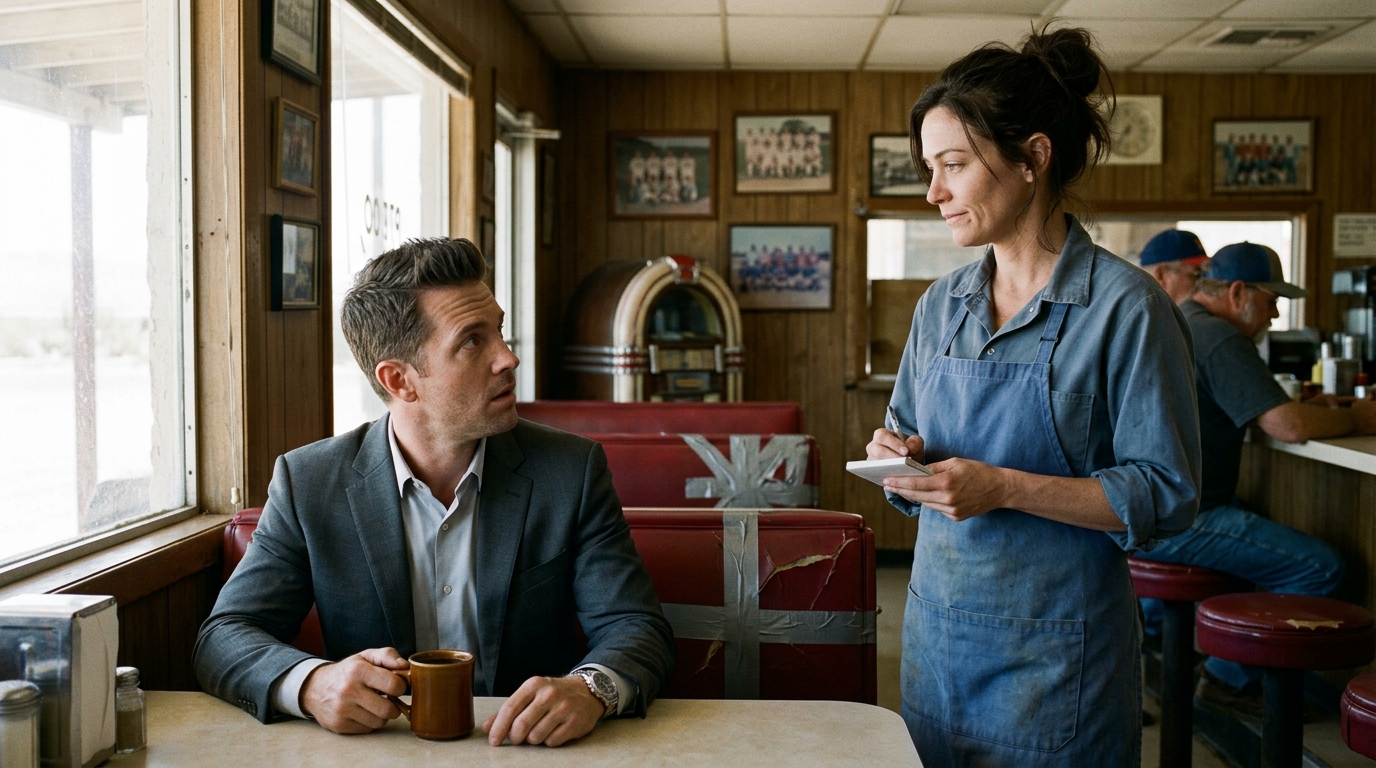
The diner looked like it had been waiting there since another decade and had no interest in catching up.
Vinyl booths patched with duct tape.
Faded photos of local softball teams on the walls.
A jukebox in the corner that looked as if it had not played music in years.
A long counter with silver stools.
A pie case with two sad slices of cherry pie under cloudy glass.
Matthew immediately felt out of place.
His tailored suit.
His polished shoes.
His watch.
Everything about him seemed too sharp for a room softened by grease, dust, and long shifts.
A few customers glanced over.
Truckers.
Farmers.
A tired mother with two children sharing pancakes.
An elderly man reading the same newspaper twice.
Matthew slid into a corner booth and pulled out his phone.
Before he could check his messages, a voice came from beside him.
“Morning. Can I get you started with some coffee?”
He looked up.
And the world stopped.
The waitress standing beside his table held a pen and order pad in one hand, a coffee pot in the other.
Faded apron.
Hair tied back in a loose bun.
Dark circles beneath her eyes.
A small scar across one knuckle.
She looked older, of course.
They both were.
But the eyes—
He knew those eyes.
He had last seen them more than twenty years ago on the stoop of an apartment building, back when both of them were poor kids making promises to the sky.
Matthew stared.
The waitress tilted her head.
“Sir?”
His throat tightened.
“Renee?”
The pen in her hand stilled.
For a second, she looked confused.
Then her eyes narrowed slightly, studying his face beneath the expensive haircut, the suit, the years.
Her lips parted.
“Matt?”
The name hit him harder than he expected.
Not Matthew.
Not Mr. Branson.
Matt.
The boy he used to be.
She whispered it again, almost laughing from disbelief.
“Matthew Branson?”
He stood halfway from the booth.
“Hey, Renee.”
The coffee pot trembled in her hand.
Then she smiled.
Not fully.
Not the bright, fearless smile he remembered.
But enough to make the past step into the room.
“Well,” she said softly, “look at you.”
The Girl Who Believed First
Matthew had not thought about Renee Parker in years.
That made him ashamed the moment he saw her.
Not because she had meant little.
Because she had meant too much.
There had been a time when Renee Parker was the one person who believed Matthew Branson could become more than his circumstances.
They grew up in the same struggling neighborhood outside Phoenix.
Apartment blocks with cracked stairs.
Laundry rooms that smelled like mildew.
Kids who learned too early which bills mattered most and which dreams had to wait.
Matthew’s mother worked nights at a packaging plant.
His father disappeared in pieces before disappearing completely.
Renee lived one building over with her mother and two younger brothers.
She was the kind of girl adults called “bright” and other kids called “bossy,” because she always had a plan.
At twelve, she already kept notebooks filled with ideas.
A bookstore.
A scholarship.
A future where rent was paid on time.
A life where nobody had to pretend cereal for dinner was fun.
Matthew had not been a bad student.
Just angry.
Tired.
Embarrassed.
He hated being the boy with thrift-store shoes. Hated opening his backpack and finding a shutoff notice his mother had forgotten to remove. Hated teachers who spoke to him as if poverty were a personality flaw.
Renee never let him sink into it.
When he failed math, she sat beside him on the apartment steps until he understood fractions.
When kids mocked his sneakers, she told him:
“Let them laugh at your shoes. You’re still going farther than they are.”
When he wanted to quit the debate club because he felt stupid standing beside kids whose parents owned houses, she shoved a stack of index cards into his hand and said:
“You don’t get to give up just because they had a head start.”
She was fourteen.
He was fifteen.
And somehow, she sounded like the only adult in his life.
They used to dream together.
Not romantic dreams.
Bigger ones.
Cleaner ones.
They would leave the neighborhood.
He would build things.
She would own a bookstore with beanbag chairs and free reading hours for kids whose parents worked late.
They promised each other they would escape.
Then life scattered them.
Matthew won a scholarship, then another.
Worked through college.
Found real estate almost by accident.
Bought his first run-down duplex at twenty-four.
His second at twenty-six.
By thirty-five, he owned apartment complexes across five states.
By forty, business magazines called him “self-made.”
Self-made.
He hated that phrase sometimes.
It erased too many people.
His mother.
His first teacher.
Renee.
Especially Renee.
And now she stood in front of him in a roadside diner, pouring coffee for strangers.
The Mask She Wore
Renee recovered first.
She always had.
“So,” she said, forcing brightness into her voice, “black coffee?”
Matthew nodded.
“Still remember?”
She gave a small shrug.
“You always drank it black because you said sugar was for people who trusted life.”
He laughed despite himself.
“I said that?”
“You were very dramatic at fifteen.”
She poured the coffee.
Her hand shook slightly.
He noticed.
She noticed him noticing and quickly set the pot down.
“What are you doing all the way out here?” she asked.
“Flat tire.”
“Ah.” She glanced toward the window. “The desert welcomes everyone eventually.”
He smiled.
But she was already looking over her shoulder toward the kitchen.
A bell dinged.
A cook shouted, “Renee! Order up!”
She grabbed the ticket from his table.
“You eating?”
“Whatever you recommend.”
“That’s dangerous.”
“I trust you.”
Something flickered across her face.
For one brief second, the old Renee appeared.
Then the waitress mask returned.
“Scrambled eggs, toast, bacon. Hard to ruin.”
She turned before he could say more.
Matthew watched her move through the diner.
She knew every table.
Every regular.
Every impatience before it was spoken.
She refilled coffee before cups were empty, dodged a child crawling under a booth, laughed at a trucker’s joke as if she had not heard it fifty times before.
But Matthew saw the fractures.
The way her smile vanished the moment she turned away.
The way she rubbed her wrist when she thought no one was watching.
The slight limp in her step.
The exhaustion beneath the efficiency.
She had become very good at surviving.
That realization hurt him more than he expected.
Renee returned with his plate ten minutes later.
“Here you go. Best eggs on the interstate.”
He looked down.
The eggs were slightly overcooked.
The toast was uneven.
The bacon smelled perfect.
“On the house,” she added.
“No.”
“Yes.”
“Renee—”
She leaned closer and lowered her voice.
“It’s not every day an old friend walks in wearing shoes worth more than Earl’s truck.”
He looked toward the kitchen.
“The cook?”
“Owner.”
“Ah.”
“He likes to think both.”
Matthew studied her face.
“How long have you been here?”
Her smile thinned.
“A while.”
“That’s not an answer.”
“It’s the answer I give people who are passing through.”
“I’m not people.”
She paused.
The words reached her.
Not completely.
But enough.
Before she could respond, a man at the counter lifted his mug.
“Renee! Coffee!”
She straightened.
“Duty calls.”
As she walked away, Matthew felt a familiar pressure in his chest.
The pressure he used to feel as a boy when he saw something unfair and had no power to change it.
The difference was, now he had power.
He just did not yet know what to do with it.
What Happened to Renee Parker
Matthew stayed longer than necessary.
Roadside assistance came and went.
His driver texted that the tire was fixed.
The Phoenix meeting was rescheduled.
Still, Matthew remained in the booth with coffee growing cold in front of him.
He watched the breakfast rush rise and fall.
By late morning, the diner thinned.
The mother with the children left.
The truckers paid.
The old man folded his newspaper and shuffled out.
Renee finally slid into the booth across from Matthew, no longer carrying the coffee pot.
“You’re still here,” she said.
“So are you.”
“That’s less mysterious. I work here.”
He leaned forward.
“Do you have a break?”
“Technically? Yes. Actually? Depends if Earl decides breathing counts as time theft.”
Matthew’s eyes darkened.
She waved it away.
“Joke.”
“Was it?”
She looked at him for a moment.
Then sighed.
“Not entirely.”
Silence settled between them.
Outside, desert wind pushed dust across the parking lot.
Inside, the kitchen clattered faintly.
Matthew said:
“You once told me I wasn’t allowed to quit just because other people had a head start.”
Renee looked down.
“That sounds like me.”
“It saved me more than once.”
She laughed softly, but her eyes shone.
“Matt…”
“I mean it.”
“I was a kid.”
“You were right.”
She looked away toward the window.
For a moment, he saw her fighting something.
Pride.
Embarrassment.
Memory.
Maybe all three.
Finally, she said:
“I did get out, you know.”
He waited.
“I got a scholarship to Arizona State. First in my family. I had a dorm, a meal plan, a stack of books I could barely afford and loved anyway.”
Her smile was faint.
Painful.
“I thought that was it. I thought once I got there, I’d become the person I always said I would be.”
“What happened?”
“My mom got sick.”
The words were simple.
Too simple for the weight inside them.
“Cancer. Stage three when they found it. My brothers were still in school. Bills started coming. I tried to stay enrolled and take care of her, but…”
She shrugged.
“You know how life is. It doesn’t ask if you’re ready before it takes the floor out.”
Matthew said nothing.
“She died the next year. By then, I was behind on tuition, behind on rent, behind on everything. I told myself I’d go back. Just one semester off. Then two.”
Her fingers traced a crack in the table.
“I married a man who seemed stable. He had a steady job, clean shirts, knew how to talk to people at church. I thought stable was the same as safe.”
Matthew’s jaw tightened.
“It wasn’t?”
She shook her head.
“No. He gambled. Lied. Took loans in my name. By the time he left, the only thing he didn’t take was my car, and that was probably because it barely runs.”
A small, humorless laugh escaped her.
“I came here because Earl said he’d pay cash while I got back on my feet. That was four years ago.”
“Four years?”
“Yeah.”
He looked around the diner.
“At this place?”
She smiled without humor.
“This place keeps the lights on. Barely. But barely is still on.”
Matthew felt something twist inside him.
“Why didn’t you call anyone?”
“Who?”
The question landed hard.
He had no answer.
Because the truth was, he had vanished into his own climb.
He had become successful.
Busy.
Important.
And somewhere along the way, people who once mattered became memories instead of responsibilities.
Renee softened when she saw his face.
“I’m not blaming you.”
“Maybe you should.”
“No.” She shook her head. “We were kids. We promised things kids promise because they don’t know how far life can throw people.”
He leaned back.
“I should have looked.”
“For me?”
“Yes.”
She laughed gently.
“That’s sweet. Also arrogant.”
He blinked.
“There she is.”
“The Renee who insults billionaires?”
He froze.
She raised an eyebrow.
“What? You thought I didn’t know?”
Matthew looked down at his coffee.
“I didn’t say billionaire.”
“You said real estate. You’re wearing a watch I saw in a magazine once at a dentist’s office. And Earl has been whispering from the kitchen for twenty minutes that some property guy named Branson is buying land around here.”
Matthew’s silence confirmed enough.
Renee’s expression shifted.
Not envy.
Not anger.
Something more complicated.
“So it is you.”
“Yes.”
She nodded slowly.
“Good for you.”
The words were sincere.
That made them hurt more.
Earl’s Interruption
Before Matthew could answer, the kitchen door swung open.
Earl stepped out.
He was broad, red-faced, with a stained apron stretched across his stomach and a look that suggested he had spent years mistaking volume for authority.
“Renee,” he barked, “you on break or vacation?”
She stiffened.
Matthew noticed immediately.
“I’ll be right there,” she said.
“You got tables.”
“There’s one customer.”
“He counts.”
Matthew turned slowly.
“I’m fine.”
Earl looked him over.
Recognition flickered.
Not personal.
Financial.
“You the guy with the town car?”
Matthew said nothing.
Earl wiped his hands on his apron.
“Renee talks too much when she should be working.”
Renee’s face flushed.
“Earl.”
He ignored her.
“Don’t let her sob story get you reaching for your wallet. She’s had plenty of chances. Some folks just like staying stuck.”
The diner went quiet.
A teenage busboy near the counter looked down.
Renee’s hands folded tightly in her lap.
Matthew felt a cold anger rise inside him.
Not loud.
Not impulsive.
The kind that came with clarity.
He stood.
Earl blinked, surprised by his height.
“What did you say?”
Earl forced a laugh.
“Just joking with her.”
“No, you weren’t.”
Renee whispered:
“Matt, don’t.”
But Matthew kept his eyes on Earl.
“How much does she make?”
Earl’s face hardened.
“That’s none of your business.”
“How many hours?”
“Excuse me?”
“Does she get overtime? Breaks? Proper tips?”
Renee stood quickly.
“Matthew.”
Earl’s cheeks reddened.
“She gets paid what the job’s worth.”
Matthew stepped closer.
“No. You pay people what you can get away with when they have nowhere else to go.”
The silence deepened.
Earl looked around, suddenly aware that every remaining person in the diner was listening.
Then he sneered.
“You buying breakfast or buying trouble?”
Matthew smiled faintly.
“That depends.”
“On what?”
“On whether you own this building.”
Earl’s expression shifted.
Just slightly.
Matthew saw it.
“Thought so.”
Earl’s voice lowered.
“You don’t know anything about my business.”
Matthew reached into his jacket and removed a business card.
He placed it on the table.
Earl looked down.
His face changed.
Matthew Branson
Branson Development Group
Earl swallowed.
Matthew said quietly:
“My company is reviewing several properties along this corridor. Including this parcel.”
Renee stared at him.
Earl’s confidence faltered.
“You can’t just come in here and—”
“I came in for coffee,” Matthew said. “You did the rest.”
An Offer That Wasn’t Charity
Renee followed Matthew outside after her shift ended.
The desert light had softened by then, spreading gold across the gravel lot. The diner sign buzzed above them, flickering weakly as trucks moved along the highway in the distance.
Her old sedan sat crooked near the side of the building, sun-faded and dented.
She tossed her apron into the back seat.
“You shouldn’t have done that,” she said.
Matthew looked at her.
“Which part?”
“The Earl part. The billionaire intimidation thing.”
“He was humiliating you.”
“He does that to everyone.”
“That doesn’t make it less wrong.”
She folded her arms.
Her expression hardened.
“I don’t need saving, Matt.”
“I know.”
“No, I mean it. I don’t need someone from my past showing up in a suit and deciding my life is tragic.”
“That’s not what I’m doing.”
“Then what are you doing?”
He took a breath.
The wrong answer would ruin this.
Money was easy.
Respect was harder.
“I’m remembering who you are,” he said.
Her face changed.
Just a little.
He continued:
“You were the first person who made me believe I wasn’t stuck. You didn’t give me charity. You gave me tools. Homework. Threats. Annoying speeches.”
A reluctant smile touched her mouth.
“They were excellent speeches.”
“They were.”
He stepped closer, keeping his voice gentle.
“I’m not offering you pity. I’m offering what you once gave me.”
“And what’s that?”
“A door.”
She looked away.
The word reached her.
He continued:
“I have a property office in Phoenix. We need an assistant manager. It’s not glamorous at first. Tenant calls. Vendor schedules. Rent ledgers. Maintenance requests. But it pays well. Benefits. Training. Real growth.”
She laughed once.
Nervous.
“Matthew, I wait tables in Yuma.”
“You also got into Arizona State.”
“That was another lifetime.”
“No. That was you before life buried the evidence.”
Her eyes filled, but she blinked it back.
“I don’t have a degree.”
“You have a brain. Work ethic. People skills. You know how to manage chaos without letting anyone see you sweat. Half the people in my office can’t do that with three monitors and a salary.”
She looked toward the highway.
“You make it sound simple.”
“It won’t be.”
That surprised her.
He added:
“You’ll be scared. You’ll feel out of place. You’ll think everyone knows more than you. Some days you’ll want to quit.”
“Great sales pitch.”
“But you won’t quit.”
Her eyes returned to him.
“Why?”
“Because the Renee Parker I knew never backed away from hard things. She just forgot she was allowed to choose a better one.”
For a long moment, neither spoke.
Then she asked the question beneath every other question.
“What happens if I fail?”
Matthew did not soften the truth.
“Then you fail in a place with health insurance, a paycheck, and people who won’t call you worthless for needing time to learn.”
She laughed through the emotion rising in her throat.
“That does sound like an upgrade.”
He smiled.
“Think about it. No pressure. No deadline today.”
She looked at him carefully.
“You mean that?”
“Yes.”
“Because men with money love saying ‘no pressure’ while holding the whole room hostage.”
He laughed.
“I deserved that.”
“Yes, you did.”
Her smile faded.
Then she said softly:
“I’m scared.”
“I know.”
“I’ve been here so long that leaving feels like jumping off something.”
Matthew nodded.
“Then don’t call it leaving. Call it walking through the door.”
The Call
The next morning, Matthew was in a motel outside Yuma, reviewing messages he had ignored all day, when his phone rang.
Unknown number.
He answered.
“Matthew Branson.”
A pause.
Then:
“It’s me.”
Renee.
He sat up.
“Hey.”
“I thought about it.”
His hand tightened around the phone.
“And?”
Another pause.
“I barely slept.”
“That sounds miserable.”
“It was.”
A small breath.
“I kept thinking about what you said. About the door.”
Matthew waited.
“I don’t know if I can do it,” she admitted. “I don’t know if I’m still that girl.”
“You don’t have to know yet.”
“I’m scared I’ll embarrass myself.”
“You might.”
She laughed.
“That’s not comforting.”
“It’s honest.”
Silence.
Then she said:
“If the offer is real… I want to try.”
Matthew closed his eyes.
A slow smile came before he could stop it.
“It’s real.”
“Don’t make me regret trusting you.”
“I won’t.”
“Don’t go easy on me either.”
“There she is.”
“I mean it. If I’m doing this, I want to earn it.”
“You will.”
Her voice softened.
“Matt?”
“Yeah?”
“Thank you for seeing me.”
He looked out the motel window at the desert morning.
The sun was rising over the highway, bright and unforgiving.
“You never became invisible, Renee,” he said. “Some rooms were just too small to notice you.”
The First Month
Phoenix overwhelmed her.
Matthew saw it the first day she walked into the office.
Renee wore a simple navy blouse, black pants, and shoes she admitted had taken half her savings before Matthew’s HR department reimbursed her relocation expenses.
She stood near the glass entrance with a folder clutched to her chest, staring at the polished floors, the reception desk, the rows of people moving quickly with tablets and headsets.
For a moment, she looked ready to run.
Matthew happened to be passing through the lobby.
He stopped.
“You okay?”
She looked at him.
“No.”
“Good. That means you’re awake.”
She glared.
“I forgot how annoying you are.”
“You’ll remember fully by lunch.”
The first weeks were hard.
Harder than Renee expected.
The software confused her.
The terminology frustrated her.
She hated asking for help.
She hated not knowing.
She hated being older than several coworkers who seemed to glide through tasks she struggled to understand.
Once, Matthew passed an empty conference room and found her sitting alone, eyes wet, spreadsheet open on the screen.
He knocked.
She quickly wiped her face.
“I’m fine.”
“No, you’re not.”
She looked angry then.
Embarrassed.
“I made a mistake in the vendor schedule. A dumb one. A twenty-three-year-old named Kyle had to explain it to me like I was his aunt learning email.”
Matthew sat across from her.
“Did the building collapse?”
“No.”
“Did anyone die?”
“No.”
“Then it’s a training issue.”
“I feel stupid.”
“You’re not stupid. You’re new.”
She looked down.
“I used to be quick.”
“You still are. You’re just learning a new language.”
Her voice broke.
“What if I’m too late?”
Matthew understood the question.
Too late for the life she wanted.
Too late to become who she might have been.
Too late to matter beyond survival.
He leaned forward.
“Renee, the world loves convincing people there’s an expiration date on becoming more. There isn’t.”
She looked at him.
“You sound like me.”
“I had a good teacher.”
The Woman Who Returned
Three months later, Matthew walked into the Phoenix office unexpectedly.
He found Renee at the front desk, headset on, typing quickly while speaking to a tenant with calm authority.
“No, Mrs. Alvarez, I understand the leak has been reported twice. I’m escalating it now, and I’m staying on the line until maintenance confirms the appointment.”
She clicked through the system.
Paused.
Listened.
Then smiled.
“No, ma’am. You’re not bothering me. That’s what we’re here for.”
Matthew stood near the entrance, watching.
This was not the exhausted waitress from Patty’s Place.
This was not the girl from the apartment steps either.
This was both of them.
The grit.
The warmth.
The intelligence.
The ability to hold someone else’s panic without becoming cruel.
She looked up and saw him.
Her smile widened.
“Boss man.”
He laughed.
“You’re busy.”
“I’m always busy. Some of us work for a living.”
“Good to know your attitude survived training.”
“It’s thriving.”
He walked closer.
“How are you?”
She considered that.
Then said:
“Tired. Overwhelmed. Learning. Paid on time. Insured. Not yelled at by Earl.”
“Solid list.”
“And…” She paused.
“And?”
Her smile softened.
“I signed up for two night classes.”
Matthew’s chest warmed.
“ASU?”
“Community college first. Don’t get dramatic.”
“Too late.”
She rolled her eyes.
“I’m taking business management and accounting.”
“You hate accounting.”
“I hate being afraid of things I don’t understand more.”
There she was.
The girl from the stoop.
The girl with notebooks.
The girl who refused to let numbers win.
Matthew looked around the office.
“You’re doing well here.”
“I know.”
The answer came without apology.
He smiled.
“Good.”
She leaned back.
“Don’t look so proud. It’s annoying.”
“I am proud.”
Her expression changed.
She looked down at the desk, blinking quickly.
Then she said:
“I forgot what that felt like.”
“What?”
“Having someone expect me to rise instead of just endure.”
Matthew did not answer immediately.
Some sentences deserve space.
Finally, he said:
“You did the same for me.”
She looked up.
“Then I guess we’re even.”
He shook his head.
“Not even close.”
Patty’s Place
Six months later, Patty’s Place closed.
Not because Matthew destroyed it.
Because Earl had been violating wage laws for years, and once Renee connected former employees with legal aid, the truth came out quickly.
Matthew’s development company did acquire the parcel, but not to turn it into a luxury stop with glass walls and coffee no trucker could afford.
That had been the original plan before the flat tire.
Before Renee.
Before the reminder that every building sits on someone’s story.
Instead, Matthew changed the project.
The old diner was restored.
The booths were repaired.
The sign was kept.
The kitchen was updated.
A small reading corner was added near the front window, with shelves of donated books and beanbag chairs in bright colors.
On the wall above it hung a sign:
Renee’s Corner
When Matthew showed her the plans, she stared at them for a long time.
“You remembered the bookstore.”
“Of course.”
She touched the rendering.
“You put it in a diner?”
“Kids traveling with tired parents need books too.”
She laughed, then cried, then threatened to ruin his suit if he hugged her before she had tissues.
He hugged her anyway.
Patty’s Place reopened as a roadside diner and community stop, managed by a local family, with fair wages, free coffee for stranded drivers, and a shelf where children could take a book and keep it.
Renee did not move back to Yuma.
That life was done.
But she visited opening weekend.
A little girl sat in the reading corner with a picture book in her lap.
Renee watched her for a long time.
Matthew stood beside her.
“You okay?”
She nodded.
“Yeah.”
Then she smiled.
“This is better than beanbags in my imaginary bookstore.”
“High praise.”
“Don’t get used to it.”
What One Stop Changed
Years later, Matthew still thought about that flat tire.
How angry he had been at the delay.
How annoyed by the inconvenience.
How close he had come to staying in the car, making calls, ignoring the diner completely.
If the tire had held, he would have gone to Phoenix.
He would have sat in the meeting.
He would have approved a development plan.
Patty’s Place would have been demolished.
Renee might have stayed behind the counter another year.
Maybe five.
Maybe until life convinced her that survival was the same as destiny.
Instead, a nail in the road changed both of them.
That was the part Matthew never forgot.
People love big turning points.
A check.
A job offer.
A grand gesture.
But most lives change because of smaller things.
A door opened.
A name remembered.
A conversation allowed to go deeper than politeness.
Someone saying:
“I see more in you than this room does.”
Renee did the hard part.
She made the call.
She packed her life.
She walked into the office scared.
She learned.
Failed.
Tried again.
Signed up for classes.
Built a new future one uncomfortable step at a time.
Matthew had not saved her.
He had only done what she once did for him.
Pointed toward a door and reminded her she could walk through it.
The Friend Who Believed First
On the anniversary of her first day at the Phoenix office, Renee left a small envelope on Matthew’s desk.
Inside was an old photograph.
Two kids sitting on apartment steps.
Matthew, skinny and serious, holding a math worksheet.
Renee beside him, pointing at the page with the expression of someone who would not tolerate excuses.
On the back, she had written:
You were not self-made. Neither was I.
Good.
Matthew sat with that photo for a long time.
Then he placed it on his office shelf.
Not beside awards.
Not beside magazine covers.
Beside a small wooden sign from Patty’s Place.
Coffee. Pie. Second Chances.
Whenever visitors asked about the picture, Matthew told them the truth.
“That’s my oldest investor.”
They would look confused.
He would smile.
“She invested belief before I had anything else.”
And that was the story he carried.
Not a story about a rich man helping a poor waitress.
That version was too small.
Too easy.
Too flattering to him.
The real story was about a boy who had once been lifted by a girl who believed in him, then grew into a man lucky enough to return the favor before it was too late.
Because sometimes the person who shaped your future does not need you to rescue them.
Sometimes they only need you to remember who they were before the world taught them to forget.