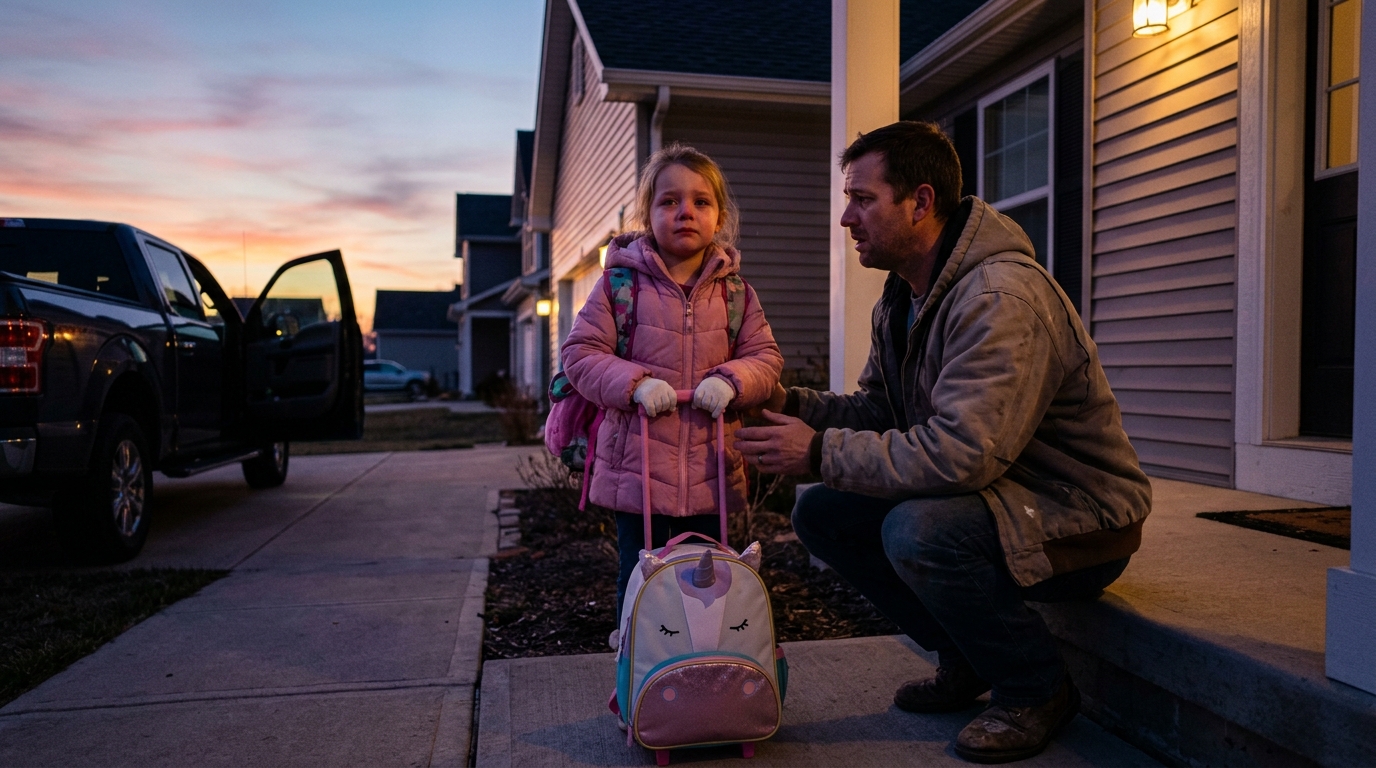
The sun had just vanished below the horizon, leaving long purple shadows across our quiet little driveway.
I remember the exact color of that evening.
Not black yet.
Not fully night.
That strange, bruised shade between day and darkness, when every house on the street looks peaceful from the outside, even if something inside is falling apart.
I was exhausted.
Ten hours at the plant had left my shoulders stiff, my shirt damp with sweat, and my patience worn thin. All I wanted was a cold beer, the sound of cartoons from the living room, and maybe five quiet minutes before dinner.
But when I pulled into the driveway, the house was too quiet.
No television.
No laughter.
No tiny feet running to the door.
Then I saw her.
My four-year-old daughter, Lily, was standing at the edge of the porch steps.
Alone.
In the dark.
She wore her favorite pink coat zipped all the way up to her chin, even though the evening was mild. Her kindergarten backpack was strapped to her small shoulders, so overstuffed it made her look like a little turtle.
Beside her was the unicorn rolling suitcase we only used for trips to my mother’s house.
Her hand gripped the handle with white-knuckled determination.
My stomach dropped.
I shut off the truck, but forgot to take the keys out.
The engine ticked as it cooled.
That was the only sound in the cul-de-sac.
“Lily?”
I got out fast, leaving the driver’s door open.
She didn’t run to me.
That was the first thing that scared me.
Usually, when I came home, she launched herself at my legs like a tiny pink missile. But that night, she stood still.
Her eyes were red.
Puffy.
She had been crying, but now she looked past crying.
Resolved.
Like a child who had made a decision no child should ever have to make.
I crouched in front of her.
“Sweetheart, what are you doing out here? Where’s Mommy?”
She didn’t look toward the door.
She looked only at me.
Then she took one shaky breath.
“Daddy,” she whispered. “I’m leaving.”
My hands hovered over her shoulders.
“What?”
“I’m leaving.”
The words came out firmer the second time.
I glanced at the suitcase.
Then at the closed front door.
“Baby, what do you mean you’re leaving? Where are you going?”
She clutched the suitcase handle tighter.
“I packed my bag. I have Teddy. I have my pajamas. I have to go.”
Cold panic moved through my chest.
“Lily, you’re scaring me.”
Her lower lip trembled.
“I can’t do it anymore.”
“Can’t do what?”
She finally glanced at the front door.
Not like a child afraid of being caught sneaking cookies.
Like someone afraid the house might hear her.
Then she leaned closer and whispered:
“I can’t live in that house anymore.”
My spine went cold.
That was not tantrum language.
That was not a four-year-old being dramatic because she didn’t get dessert.
It was the voice of a child who had been holding something too big for too long.
I gently took her hand.
“Why, baby? Tell Daddy. Did something happen?”
She leaned even closer.
Her breath shook.
“I can’t live with your wife anymore.”
I froze.
Your wife.
Not Mommy.
Not Mom.
Your wife.
Something about those two words struck me harder than if she had screamed.
“You mean… Mommy?” I asked carefully.
Lily’s eyes filled again.
“She’s not Mommy right now.”
The sentence made no sense.
And yet, somewhere deep inside me, something shifted.
Sarah was my wife.
Lily’s mother.
The woman I had married six years ago.
The woman who sang badly while making pancakes, cried during dog commercials, and tucked handwritten notes into Lily’s lunchbox even though Lily couldn’t read them yet.
Sarah was gentle.
Patient.
Soft-spoken.
At least, that was what I believed.
“What did she do?” I asked.
Lily let go of the suitcase handle. It clattered onto the concrete.
“She’s a monster,” she cried. “A real monster, Daddy.”
I stood immediately, pulling her behind me.
The porch light flickered once.
The front door sat closed.
Still.
Silent.
Menacing in a way I had never noticed before.
“Did she hurt you?”
Lily sobbed.
“She hurt my heart.”
My throat tightened.
“Did she touch you? Did she hit you?”
She shook her head hard.
“No. But she won’t let me live.”
Those words nearly stopped my heart.
I turned, scanning the windows.
No movement inside.
“Lily,” I said, trying to keep my voice calm, “where were you going to go?”
“Far away.”
“Where is far away?”
She looked down at her shoes.
“Grandma’s.”
My mother lived forty minutes away.
On the other side of town.
Across two main roads.
She would never have made it.
I looked at that tiny suitcase and imagined her pulling it down the sidewalk in the dark.
Alone.
My knees nearly gave out.
“Get in the truck,” I said.
Her eyes widened.
“Really?”
“Yes. Get in the truck. We’re going to sit where it’s safe, and you’re going to tell me everything.”
I opened the back door and helped her climb into her car seat. Her little hands were shaking so badly she couldn’t buckle herself.
I did it for her.
Then I put her suitcase on the floorboard and climbed into the driver’s seat.
The front door of the house remained closed.
No one came out.
That scared me more than anything.
I turned around to face Lily.
“Okay,” I said gently. “Tell me exactly what happened.”
She hugged her stuffed bear to her chest.
Then she said the words that made my blood run cold.
“Mommy talks to someone in the mirror.”
The Mirror
I stared at her.
“What?”
Lily’s face crumpled as if she knew I wouldn’t understand.
“In the bathroom,” she whispered. “She talks to someone in the mirror.”
I exhaled slowly.
Children say strange things.
They dream.
They misunderstand.
They turn shadows into monsters and ordinary arguments into fairy-tale curses.
But Lily’s fear was too real.
“What does she say?”
Lily looked toward the house again.
“She says, ‘She doesn’t know yet.’”
My chest tightened.
“Who doesn’t know?”
“Me.”
I felt my mouth go dry.
“What else?”
“She says, ‘He still thinks I’m her.’”
The truck seemed to shrink around me.
I turned slowly toward the house.
The upstairs bathroom window was dark.
I looked back at Lily.
“Sweetheart, was Mommy on the phone?”
Lily shook her head.
“No phone.”
“Maybe she was talking to herself?”
“No.” Her voice sharpened with that strange certainty children have when adults are trying to explain away what they know. “She was talking to the other Mommy.”
I closed my eyes for one second.
The other Mommy.
“Lily,” I said carefully, “why did you call her my wife?”
She looked down at Teddy.
“Because Mommy told me to.”
“Sarah told you to call her that?”
“No.”
She looked up.
Her eyes were huge.
“My real Mommy.”
The air left my lungs.
My real Mommy.
I had no idea what to say.
“Lily…”
She interrupted me, voice rising.
“I know I’m not supposed to say it. She told me to wait until you saw it too. But I can’t wait anymore.”
“Saw what?”
She pressed one hand into the pocket of her pink coat and pulled out a folded piece of paper.
It was crumpled.
Hidden.
Covered in little creases like she had opened it and closed it many times.
She handed it to me.
My fingers felt numb as I unfolded it.
At first, all I saw were scribbles.
A child’s drawing.
Our house.
Me.
Lily.
And two women.
One was smiling.
One was standing behind the other with black scribbles around her head.
Above the smiling woman, Lily had drawn a shaky label:
MOMMY
Above the other:
YOUR WIFE
My hands went cold.
On the back, in Sarah’s handwriting, were four words:
If she notices, run.
For several seconds, I couldn’t move.
I knew my wife’s handwriting.
I had seen it on grocery lists, birthday cards, notes stuck to the fridge.
That was Sarah’s handwriting.
Not Lily’s.
Not a copy.
Sarah’s.
I looked up slowly.
“Where did you get this?”
Lily whispered:
“From the blue box.”
My heart stopped.
The blue box.
Sarah kept an old blue tin under our bed. She said it held letters from her mother, old photos, things from before we married.
I had never opened it.
Marriage requires trust.
That was what I used to believe.
“What else was in the box?” I asked.
Lily’s lip trembled.
“Pictures.”
“What pictures?”
“Of Mommy sleeping.”
My fingers tightened on the paper.
“What do you mean sleeping?”
Lily looked toward the house again.
“She was in the hospital bed. With tubes.”
I felt the world tilt.
Sarah had never been in a hospital bed with tubes.
Not that I knew of.
Not recently.
Not ever, except when Lily was born.
“Lily,” I said, trying not to scare her with my voice, “did Mommy show you those pictures?”
She shook her head.
“I found them.”
“When?”
“Today. When your wife was cutting Mommy’s dresses.”
I stopped breathing.
“What?”
She began to cry again.
“She put them in a trash bag. The blue dress. The flower dress. The one Mommy wore when we made pancakes. She cut them with big scissors.”
The image hit me with such force that I gripped the steering wheel.
Sarah’s dresses.
Her favorite blue dress.
Her yellow floral sundress.
The one she wore in half the photos on my phone.
“Why didn’t you tell me sooner?” I whispered.
Lily’s face folded with guilt.
“Because she said if I told, you’d go away too.”
“Who said that?”
She didn’t answer.
But she looked at the house.
I unbuckled my seatbelt.
“Stay here.”
Lily grabbed my sleeve.
“No!”
Her terror was immediate.
Violent.
“Daddy, don’t go inside.”
“I have to.”
“She’ll know.”
“Lily—”
“She always knows.”
The way she said that made something primal wake up in me.
I reached into the glove compartment and pulled out the small flashlight I kept there.
Then I locked the truck doors from the inside.
“Listen to me,” I said. “You stay buckled. Do not open this door for anyone except me. If anyone else comes out, you scream and press the horn. Understand?”
She nodded, crying silently.
I stepped out of the truck.
The night air felt colder now.
The house stood in front of me.
My home.
My safe place.
The place where my daughter had just packed a suitcase to escape.
I walked toward the porch.
And for the first time since buying that house, I was afraid of what might be waiting inside.
The Quiet House
The front door was unlocked.
That was normal.
Sarah hated locked doors when I was on my way home.
She said it made the house feel unwelcoming.
I pushed it open slowly.
The smell hit me first.
Bleach.
Heavy.
Sharp.
Too much of it.
The living room was spotless.
Too spotless.
No toys on the rug.
No crayons on the coffee table.
No half-built block tower near the couch.
No cartoon noise.
No evidence that a four-year-old lived there at all.
“Sarah?” I called.
No answer.
My voice sounded wrong in the house.
I stepped farther inside.
The hallway light was off.
The kitchen light glowed.
I moved toward it slowly.
The kitchen counters were clean.
A pot sat on the stove.
Untouched.
No plates set out.
No dinner.
On the table was a trash bag.
Black.
Full.
Something pale blue hung from the torn edge.
I walked toward it.
Pulled it free.
Sarah’s blue dress.
Cut straight through the middle.
I couldn’t breathe.
I reached into the bag again.
The yellow floral dress.
Cut.
A cardigan.
Cut.
A scarf.
Cut.
Photographs.
Torn in half.
Our wedding picture ripped down the center.
One half showed me.
The other half, Sarah’s face.
Only her face had been scratched with something sharp.
My hands began to shake.
Behind me, a floorboard creaked.
I turned.
Sarah stood in the kitchen doorway.
At least, she looked like Sarah.
Same dark hair.
Same soft green sweater.
Same face I kissed every morning before work.
But her expression was not right.
It was empty.
Calm.
Too calm.
“You’re home early,” she said.
My mouth went dry.
“No. I’m home at the same time.”
She tilted her head slightly.
“Where’s Lily?”
“In the truck.”
Something flickered across her face.
Annoyance.
Not concern.
Not fear.
Annoyance.
“She shouldn’t be outside.”
“No,” I said. “She shouldn’t.”
Sarah stepped into the kitchen.
Her eyes moved to the trash bag.
Then to the torn dress in my hand.
“I was cleaning.”
“Cleaning?”
“She doesn’t need to cling to old things.”
“She is four.”
Sarah smiled faintly.
“Exactly. Young enough to forget.”
A chill moved over my skin.
I set the dress on the table.
“What is happening?”
She sighed, as if I were being difficult.
“She’s been dramatic all day.”
“She packed a suitcase.”
“She throws tantrums.”
“She said she can’t live with you.”
Sarah’s expression hardened.
“With me?”
The words came out sharp.
Too sharp.
Then she softened again.
“Poor thing. She’s confused.”
I took the folded drawing from my pocket.
Her eyes went to it.
For the first time, the calm broke.
Only slightly.
But enough.
“Where did you get that?”
“Lily gave it to me.”
Her mouth tightened.
“She went into my things.”
“Why does it say, ‘If she notices, run’?”
Sarah stared at me.
Then she smiled.
A small smile.
The kind that didn’t reach her eyes.
“Because your daughter is clever.”
My stomach twisted.
“What does that mean?”
“It means she pays attention.”
“Sarah.”
She turned away from me and walked toward the sink.
“You look tired. We can talk after you calm down.”
I grabbed her wrist.
Not hard.
Just enough to stop her.
She looked at my hand, then at me.
Something cold entered her face.
“Let go.”
“Tell me what’s going on.”
She leaned closer.
For one moment, her voice changed.
Lower.
Sharper.
Not Sarah’s softness.
Not Sarah’s rhythm.
“You should have let her leave.”
My grip loosened.
“What?”
The sound came before she could answer.
A horn.
Long.
Blasting from the driveway.
Lily.
The Woman at the Truck
I ran.
I left Sarah in the kitchen and sprinted through the hall, out the front door, down the porch steps.
The truck horn was still blaring.
Lily was inside, both little hands pressed against the center of the steering wheel, sobbing.
Beside the truck stood a woman.
For one impossible second, my mind refused to understand what I was seeing.
She wore a gray hoodie.
Her hair was shorter.
Her face was thinner.
Paler.
But it was Sarah.
My wife.
My real wife.
Standing outside my truck.
Barefoot.
Shaking.
Alive.
I stopped so hard I nearly fell.
The woman by the truck turned toward me.
Her eyes filled with tears.
“Michael.”
My name.
One word.
In my wife’s voice.
Not the woman in the kitchen.
Not the cold imitation.
My wife.
The front door opened behind me.
The other Sarah stepped onto the porch.
The two women looked at each other.
The world went silent.
Lily screamed from inside the truck:
“Daddy! That’s Mommy!”
The woman by the truck reached toward me.
“Michael, listen to me—”
The woman on the porch shouted:
“Get away from my family!”
Same face.
Same voice.
But now that they were both there, the differences became horrifying.
The woman near the truck had a scar near her hairline.
A tiny one.
From the time Sarah slipped on ice two winters ago.
The woman on the porch did not.
The woman by the truck had a birthmark near her left wrist.
The woman on the porch’s sleeve covered her wrist completely.
The woman near the truck wore the silver bracelet I gave Sarah the night Lily was born.
The woman on the porch had stopped wearing it three weeks ago, claiming it broke.
My brain fought the truth.
Failed.
I backed toward the truck.
“What is this?”
The real Sarah took one step forward.
“She’s my sister.”
The woman on the porch went still.
My mouth opened.
No sound came.
Sister.
Sarah had told me she was an only child.
For six years, she had told me that.
The woman on the porch smiled slowly.
Not kindly.
“Hello, Michael.”
The real Sarah whispered:
“Her name is Claire.”
Claire
Sarah had a twin sister.
An identical twin sister.
Her name was Claire.
And according to Sarah, she had spent most of her adult life drifting in and out of treatment facilities, family disputes, and trouble.
Their parents had hidden Claire from everyone after several incidents in their teenage years.
Obsession.
Jealousy.
Violent outbursts.
Then, at nineteen, Claire vanished after stealing Sarah’s identity for the first time.
Sarah never told me because she was ashamed.
Because she thought Claire was gone.
Because she wanted a life that didn’t begin with a warning label.
“I was going to tell you,” Sarah sobbed by the truck. “I swear I was. Then she came back.”
“When?” I asked.
My voice sounded like it belonged to someone else.
“Three weeks ago.”
Three weeks.
Three weeks of wrong smiles.
Wrong rhythms.
Wrong touches.
Three weeks of Lily pulling away from “Mommy.”
Three weeks of me being too tired to notice.
Sarah continued quickly, words spilling.
“She came to the house while you were at work. Said she needed help. I let her in. Lily was napping. I thought… I thought I could talk to her.”
“What happened?”
Sarah touched the scar at her hairline.
“She drugged my tea.”
My legs nearly gave.
“She kept me in the basement storage room.”
I looked toward the house.
The basement.
The door I rarely opened because it led to old boxes, tools, Christmas decorations.
“She told Lily I was sick,” Sarah said. “Then she started pretending to be me. I heard everything through the vents. I tried to get out, but she locked the door from the outside.”
“Why?” I whispered.
Claire answered from the porch.
“Because you chose the wrong one.”
Her voice was calm again.
Horribly calm.
Sarah stepped closer to the truck, keeping her body between Claire and Lily.
“She always believed my life should have been hers.”
Claire laughed softly.
“You were always handed everything.”
Sarah turned toward her.
“I was handed nothing. I built this.”
“You built it with my face.”
The sentence made my skin crawl.
Claire descended one porch step.
I moved instinctively between her and the truck.
“Don’t come closer.”
Her eyes shifted to me.
“You don’t even know which one of us you love.”
“I do.”
Her mouth twitched.
“No. You love whoever stands in the kitchen and remembers how you take your coffee.”
The worst part was that she had remembered.
She had fooled me in a hundred small ways.
But Lily—
Lily had known.
Not with logic.
With instinct.
Claire’s gaze moved to the truck window.
Lily recoiled.
Claire’s face hardened.
“The child ruined everything.”
Sarah’s voice sharpened.
“Do not look at her.”
Claire smiled.
“She noticed too fast.”
My stomach turned.
“What did you do to her?”
“Nothing.”
Lily screamed from inside the truck:
“She locked Mommy in the dark!”
Claire’s expression flattened.
Sarah closed her eyes.
“She heard me,” she whispered. “Through the vent.”
Lily had not imagined monsters.
She had heard her real mother trapped under the house.
The Basement Door
I called 911 with shaking hands.
Claire did not run.
That scared me.
She simply stood on the porch, watching us as if the police were a minor inconvenience.
The dispatcher told us to stay outside.
I intended to.
Then I heard it.
A faint pounding from inside the house.
Not from the basement.
From somewhere near the kitchen.
Sarah grabbed my arm.
“My phone,” she whispered. “She took it. The evidence is in the blue box.”
Claire’s eyes narrowed from the porch.
“You shouldn’t have said that.”
She turned and disappeared inside the house.
I ran after her.
Sarah shouted my name, but I was already through the door.
Claire moved fast.
Too fast.
She was in the kitchen, reaching for the blue tin on the counter.
I grabbed it first.
She lunged.
The tin fell.
Photographs spilled across the floor.
Hospital records.
Old letters.
A driver’s license with Sarah’s name but Claire’s face.
A restraining order Sarah had filed years before we met.
A newspaper clipping about Claire’s identity theft arrest.
And one photograph that stopped me cold.
Sarah at eighteen.
Claire beside her.
Same face.
Different eyes.
On the back, in Sarah’s handwriting:
If she comes back, don’t believe her alone.
Claire slapped me across the face with enough force to make me stumble.
Then she grabbed a kitchen knife from the counter.
I froze.
She held it low.
Not like someone panicking.
Like someone who had imagined this moment.
“Claire,” I said carefully.
“Don’t call me that.”
Her eyes were wet now.
Not with guilt.
With fury.
“I was Sarah before she was.”
Sirens wailed in the distance.
Claire heard them.
Her expression twisted.
Then she turned the knife toward herself.
“If I can’t have her life—”
I moved before she finished.
I grabbed her wrist.
We crashed into the table.
The knife skidded across the floor.
She screamed.
Not in pain.
In rage.
The front door burst open seconds later.
Police flooded the house.
Claire fought like someone possessed by years of resentment.
It took three officers to restrain her.
As they pulled her up, she looked at me and smiled through disheveled hair.
“You still kissed me goodnight.”
That sentence nearly destroyed me.
Sarah appeared in the doorway behind the officers, holding Lily in her arms.
Our daughter’s face was buried in her real mother’s neck.
Sarah heard the sentence.
So did I.
I looked at Claire.
Then at my wife.
At the scar.
The bracelet.
The trembling hands holding our child like she would never let go again.
“I kissed a lie,” I said.
Claire’s smile vanished.
“Not my wife.”
After
The police found the basement storage room exactly as Sarah described.
A mattress.
Water bottles.
A bucket.
A broken piece of wood she had used to tap messages into the wall.
Lily’s bedroom was directly above the vent.
That was how she heard Sarah whispering.
At first, Sarah told Lily to get help.
But Claire heard Lily asking questions and punished her emotionally, twisting her fear.
Telling her Daddy would leave.
Telling her Mommy was “the sick one.”
Telling her that if she spoke about the voice under the house, everyone would think she was lying.
So Lily did what only a brave four-year-old could think to do.
She packed.
She waited outside.
She used the only words that made sense.
“I can’t live with your wife anymore.”
Not because she was confused.
Because she was right.
The woman inside was not her mother.
She was my wife’s face with a stranger behind it.
Sarah spent three days in the hospital for dehydration, bruising, and the lingering effects of the drugs Claire had used.
Lily refused to leave her side.
I did not ask her to.
The first night, I sat in the hospital chair beside them and watched my daughter sleep curled against Sarah’s arm.
I thought about all the small signs I had missed.
The way Sarah had stopped singing.
The way she suddenly hated coffee even though she had lived on it for years.
The way she pulled away from old jokes.
The way Lily stopped running to the door.
The way our house had become too clean.
Too quiet.
Too controlled.
I had blamed exhaustion.
Routine.
Stress.
I had seen the surface of my life and called it normal because I was too tired to look underneath.
Sarah woke around 3 a.m.
Her voice was dry.
“Michael?”
I leaned forward.
“I’m here.”
She looked at Lily.
Then at me.
Her eyes filled.
“I tried to get back to her.”
“I know.”
“I heard her crying.”
“I know.”
“She packed a suitcase?”
My throat closed.
“Yes.”
Sarah began to cry.
“She’s four.”
“I know.”
“She shouldn’t have had to save us.”
I covered my face.
That was the truth that would haunt both of us.
Lily had done what I failed to do.
She had noticed.
She had listened.
She had believed the impossible because the truth was whispering through the vents.
The Trial
Claire’s trial lasted nine months.
Identity theft.
Kidnapping.
False imprisonment.
Child endangerment.
Assault.
Fraud.
The prosecutors found more.
Emails she had sent to herself from Sarah’s accounts.
Attempts to transfer money.
Searches for school withdrawal forms.
Fake passport inquiries.
She had not only wanted Sarah’s life.
She planned to take Lily and disappear before anyone could untangle the truth.
That was why Lily’s suitcase terrified me most in hindsight.
Claire had been packing too.
Only bigger.
More carefully.
Passports.
Cash.
Clothes from Sarah’s closet.
Documents from our filing cabinet.
If Lily had waited one more day, we might all have vanished into a lie.
During the trial, Claire’s attorney tried to argue mental instability.
Maybe that was true.
But instability did not erase planning.
It did not erase the locked basement.
It did not erase my daughter standing outside in the dark with a suitcase because the woman wearing her mother’s face had become a monster.
Sarah testified.
So did I.
Lily did not.
We refused.
Her therapist wrote a statement instead.
At sentencing, the judge looked at Claire for a long time before speaking.
“You did not simply steal a woman’s identity,” she said. “You attempted to steal a child’s sense of safety, a husband’s trust, and a family’s reality.”
Claire looked unmoved.
Then the judge said:
“The law can punish what you did. It cannot restore the nights this child spent afraid in her own home.”
That was the sentence that finally made Sarah cry.
Home Again
We did not move back into the house immediately.
For a while, we stayed with my mother.
Lily slept between us for weeks.
Sometimes she woke screaming:
“She’s in the kitchen.”
Sarah would hold her and whisper:
“No, baby. Mommy’s here.”
At first, Lily checked Sarah’s wrist every morning for the birthmark.
Then the scar near her hairline.
Then the bracelet.
Sarah let her.
Every time.
No matter how much it hurt.
Sometimes Lily would ask:
“Are you my real Mommy today?”
Sarah always answered:
“Yes. And I’m so glad you asked.”
We changed the locks.
Installed cameras.
Got therapy.
Lots of it.
We painted the basement door bright yellow because Lily said dark doors were bad.
Eventually, we turned the storage room into a playroom.
People thought that was strange.
But Sarah said we would not let Claire own any room in our house forever.
The first time Lily played down there, I sat on the stairs and cried quietly.
Sarah sat beside me.
Neither of us spoke.
Some healing does not need words.
It needs witness.
The Suitcase
We kept the unicorn suitcase.
For a long time, I couldn’t look at it.
Then one day, Lily dragged it into the living room and filled it with dolls.
I froze.
Sarah noticed.
Lily looked up.
“It’s not for leaving,” she said.
My chest tightened.
“What is it for?”
She smiled.
“Vacation.”
Sarah started crying instantly.
Lily sighed with the patience of a child surrounded by emotional adults.
“Happy crying?”
Sarah nodded.
“Very happy crying.”
We took that suitcase on a real trip two months later.
A cabin by a lake.
Nothing fancy.
Just us.
Lily packed Teddy, pajamas, three rocks, two crayons, and one sock she insisted was lucky.
On the first night, she stood by the cabin door, looked out at the dark trees, and said:
“This dark is okay.”
I swallowed hard.
“What makes it okay?”
She took my hand.
“You’re here. Mommy’s here. And nobody’s pretending.”
That became our family rule.
Nobody’s pretending.
Not that everything was fine.
Not that fear vanished.
Not that I didn’t still wake up some nights and check Sarah’s face in the dark.
Not that Sarah didn’t sometimes flinch at her own reflection.
Not that Lily didn’t still ask questions no child should know how to ask.
But we told the truth.
Even when it was hard.
Especially then.
What She Revealed
People later asked me how I didn’t know.
They didn’t always say it cruelly.
But the question was there.
How does a man fail to recognize his own wife?
I asked myself that more times than anyone else ever could.
The answer is not simple.
Claire had Sarah’s face.
Her voice.
Her gestures, copied from years of obsession.
She knew details stolen from old letters, social media, family notes, and those three weeks of studying our home while Sarah was trapped below it.
But the deeper answer is harder to admit.
I saw what I expected to see.
A wife.
A mother.
A normal house.
A tired child.
A few strange moments explained away by stress.
Lily saw what was there.
Children notice when love feels different.
They notice when hugs don’t warm.
When smiles don’t reach.
When a mother’s voice says the right words but not with the right heart.
That night, when I pulled into the driveway and saw my four-year-old daughter with her suitcase, I thought I was looking at a child running away.
I was wrong.
She was standing guard.
She was waiting for the one adult she still believed might listen.
And when she said, “I can’t live with your wife anymore,” she wasn’t being dramatic.
She was giving me the first true sentence anyone in that house had spoken in weeks.
The truth was impossible.
Unthinkable.
Terrifying.
But it was the truth.
My daughter packed her suitcase because she had heard her real mother whispering through the walls.
She stood outside alone because she knew the woman inside was not safe.
She saved Sarah.
She saved me.
She saved herself.
And every night now, before I lock the doors, I look at that little unicorn suitcase in the hallway closet and remember:
Sometimes the smallest person in the house is the only one brave enough to tell the truth.