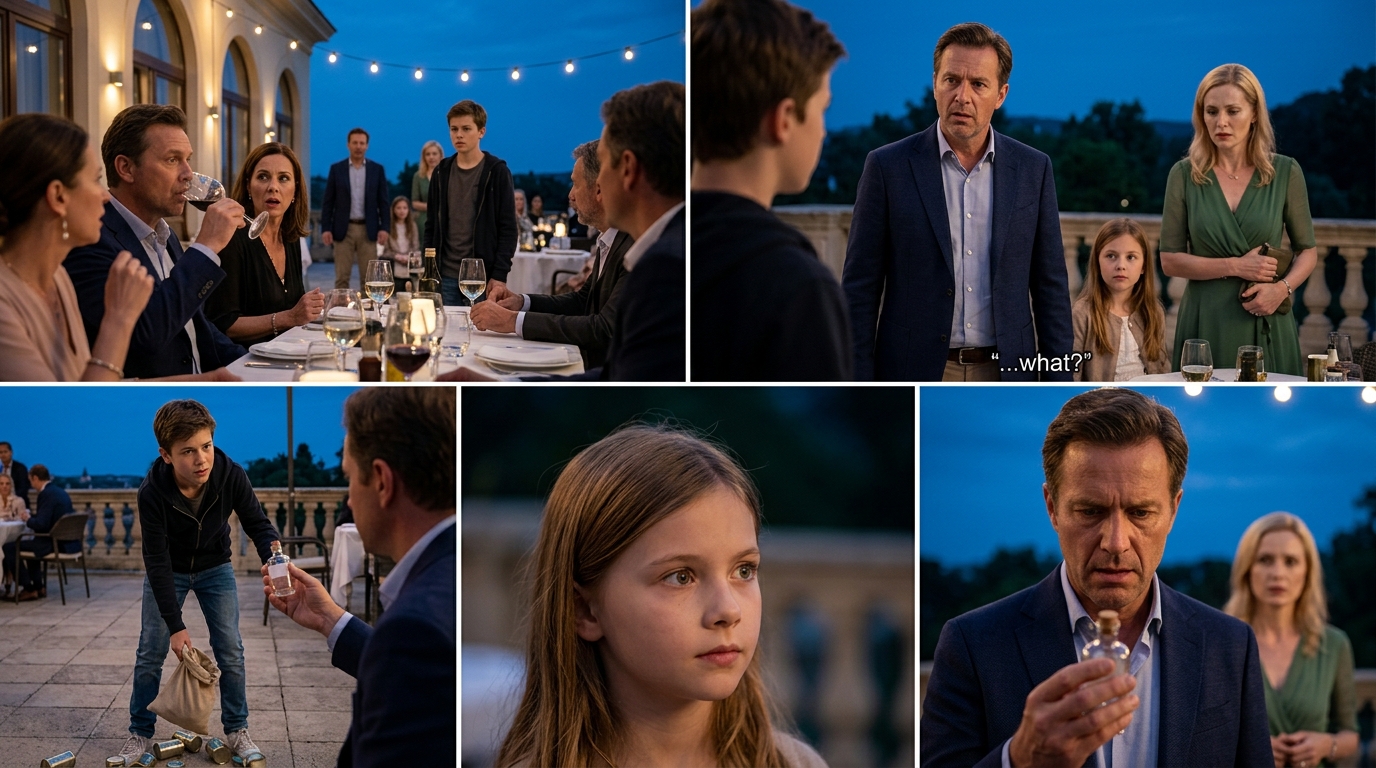
The Scream on the Terrace
The moment shattered without warning.
“SHE CAN SEE!”
The scream sliced through the terrace, sharp enough to hush the entire evening.
Glasses stopped mid-air.
Conversations halted instantly.
Even the soft music seemed to fade into silence.
Lucas Hartwell froze with one hand resting on the back of his daughter’s wheelchair.
“…what?”
The word barely escaped his lips.
Across the terrace, a boy stood near the garden steps, thin, breathless, and soaked in sweat from running.
He could not have been older than eleven.
His clothes were dusty.
His sneakers were split at the sides.
A burlap sack hung over one shoulder, filled with metal cans he had collected from the streets around the mansion.
Every guest turned toward him with shock, irritation, and curiosity.
This was not the kind of child who walked into a Hartwell charity reception.
Not through the front gate.
Not past the security line.
Not onto the terrace where donors drank champagne under strings of warm golden lights.
But the boy did not look at them.
He looked only at the little girl in the wheelchair.
Lucas’s daughter.
Dina.
Eight years old.
White dress.
Pink ribbon.
Dark glasses covering her eyes.
Hands folded quietly in her lap.
The boy stepped forward, his breath shaky but his eyes steady.
“Your daughter isn’t blind.”
Gasps rippled across the terrace.
Chairs shifted.
Phones lifted.
The world seemed to tilt.
Lucas turned slowly toward Dina.
For nearly a year, his daughter had lived in darkness.
That was what every doctor had told him.
That was what his wife, Celeste, had repeated until it became the center of their lives.
A mysterious neurological blindness after a severe fever.
No clear cause.
No predictable recovery.
No guarantee she would ever see again.
Lucas had built an entire foundation around helping children with vision loss after Dina’s diagnosis. He had hired specialists, private tutors, mobility trainers, and therapists. He had removed sharp furniture from the house. He had rearranged every room so Dina could move safely.
He had learned to guide her by touch.
To announce himself before entering.
To describe sunsets she could not see.
And now a boy in torn sneakers was standing on his terrace, telling him the impossible.
Dina moved.
Not aimlessly.
Not confused.
She turned her head directly toward the boy.
Perfectly.
Deliberately.
The silence that followed felt heavier than any sound.
Lucas’s hand tightened on the wheelchair.
His expression changed.
Something inside him shifted all at once.
He turned to his wife.
Slow.
Controlled.
Dangerously calm.
“…what is he talking about?”
Celeste Hartwell took one step back.
Just one.
But it said enough.
“This is insane,” she said.
Her voice tried to remain steady.
It failed.
The boy dropped the sack from his shoulder.
Metal cans clattered loudly across the terrace floor.
The sound echoed.
No one moved.
He reached inside the sack and pulled out a small bottle.
Unlabeled.
Cold.
Half-filled with pale liquid.
“She gives this to her,” the boy said.
Lucas snatched it from his hand immediately.
His hands were no longer steady.
There was no label.
Nothing written.
No pharmacy sticker.
No instructions.
No name.
But Lucas recognized the smell when the cap loosened.
Sweet.
Artificial.
Chemical under fruit.
A memory struck him.
Dina’s morning juice.
Celeste always insisted on preparing it herself.
Lucas stared at the bottle.
“…no.”
The word broke inside him.
Behind him came a soft voice.
Fragile.
Innocent.
“Mommy gives it to me.”
A glass shattered somewhere nearby.
No one reacted.
No one could.
Lucas turned back slowly toward his wife.
Her face had gone pale.
Empty.
Fearful.
The boy stepped closer.
Final.
Certain.
“She hides it in sweet juice.”
The truth fell all at once.
Heavy.
Irreversible.
Lucas’s breath hitched as his world shifted violently between denial and reality.
And before anyone could speak, Dina reached for her sunglasses.
Her small fingers trembled.
Then she removed them.
For the first time in nearly a year, Lucas saw his daughter’s eyes uncovered in front of strangers.
Clear.
Focused.
Terrified.
And looking directly at him.
The Girl Who Lived in Darkness
Dina had not been born fragile.
That was what Lucas remembered most painfully.
Before the diagnosis, she ran everywhere.
Barefoot through the halls.
Across the garden.
Into rooms she had been told not to enter.
She loved colors with a seriousness that amused everyone.
Yellow was “morning.”
Blue was “thinking.”
Red was “too loud.”
Green was “soft.”
When she was six, she once refused to eat a bowl of soup because she said it looked “lonely.”
Lucas’s first wife, Elena, had died when Dina was three.
A sudden illness.
Too fast for goodbyes.
For two years after that, Lucas raised Dina alone with the help of nannies and household staff, grieving quietly while trying to give his daughter enough joy to cover the missing shape of her mother.
Then Celeste entered their lives.
Graceful.
Patient.
Elegant.
She volunteered at children’s hospitals, chaired charity luncheons, and spoke with the kind of softness that made people confess pain to her before they realized they were doing it.
Dina liked her at first.
That was what made Lucas trust her.
Celeste brought books.
Braided Dina’s hair.
Remembered that she hated carrots.
Let her call her “Mommy” only after Dina asked, months into the relationship.
Lucas thought it was healing.
He thought his daughter was finding comfort in a world that had taken too much.
When Celeste married him, everyone said Lucas was lucky.
His daughter had a mother again.
His house had warmth again.
His charity work expanded.
His loneliness seemed less visible.
Then Dina got sick.
A fever came first.
Then dizziness.
Then headaches.
Then light sensitivity.
Celeste handled everything.
Doctors.
Appointments.
Medication schedules.
Private consultations.
Lucas was there, but always one step behind Celeste’s perfect organization.
“She needs quiet,” Celeste said.
“She trusts me with the medicine.”
“She panics when too many people ask questions.”
Then came the morning Dina said the room was dark.
At first, Lucas thought she meant the curtains.
But the curtains were open.
Sunlight covered the floor.
Dina reached toward his voice and missed his hand.
The first specialist said stress-related vision loss was possible.
The second said neurological complications could not be ruled out.
The third recommended observation.
Celeste cried in the hallway, gripping Lucas’s arm.
“We’ll adapt,” she whispered. “We’ll give her everything.”
And Lucas did.
He built Dina a life around darkness.
What he did not know was that the darkness had been built for him.
The Boy at the Garden Wall
The boy’s name was Eli Carter.
He lived three streets behind the Hartwell estate in a row of cramped apartments above a shuttered laundromat.
Every morning before school, he collected bottles and cans from the streets near the wealthy neighborhood.
The mansion parties were useful.
Rich people threw away better things than poor people could afford to buy.
Half-full water bottles.
Imported soda cans.
Decorative tins.
Sometimes unopened food.
Eli knew which gates had careless guards, which alleys led to service entrances, and which houses had staff who would pretend not to see him if he stayed quiet.
He first saw Dina two months before the terrace reception.
She was sitting near the garden fountain in her wheelchair, dark glasses covering her eyes, a white cane resting across her lap.
Celeste sat nearby reading from a tablet.
A nurse stood under the awning.
Eli was crouched behind the hedge, collecting cans from a trash bin near the service path, when a bright red ball rolled across the grass.
It stopped near Dina’s foot.
A younger child from the staff quarters shouted:
“Don’t touch it! She can’t see!”
But Dina turned.
Not toward the voice.
Toward the ball.
Her head moved with precision.
Then, before anyone noticed, her foot shifted slightly and nudged the ball back.
Eli froze.
Maybe it was luck.
He told himself it was.
Then he saw it again.
A week later, he was near the side wall when a butterfly landed on Dina’s sleeve.
She turned her head and smiled at it.
Not at the feeling.
At the flutter.
Her eyes followed it behind the dark glasses.
Then Celeste approached with a glass of orange juice.
Dina’s smile vanished.
Her shoulders tightened.
The moment she drank, her body changed.
Not immediately.
But slowly.
Her head drooped.
Her hand missed the armrest.
Her voice became small.
“I can’t see good,” she whispered.
Celeste knelt and brushed her hair back.
“I know, darling.”
But Eli heard something in her tone.
Not comfort.
Satisfaction.
From then on, he watched.
He saw Celeste prepare the juice herself, always from a small silver bottle she kept in her purse.
He saw Dina’s eyes brighten before the drink and dull after it.
He saw the child flinch when Celeste said, “Remember, sweet girl, darkness is safer.”
Eli did not know what to do with what he saw.
Who would believe him?
He was a poor boy collecting cans near a mansion wall.
Celeste was the wife of Lucas Hartwell.
A woman in pearls.
A woman with newspaper photos.
A woman who smiled beside hospital beds and donated money to clinics.
So Eli did the only thing he could think of.
He took proof.
One morning, after Celeste left her purse briefly on a garden chair, Eli slipped through the hedge, grabbed the small bottle, and ran.
He expected shouting.
Dogs.
Security.
Nothing came.
Because Celeste had not noticed yet.
That afternoon, Eli took the bottle to the only adult he trusted — his aunt Mara, who cleaned offices at night and had once worked as a medical aide before losing her license over paperwork she could not afford to fight.
Mara smelled the bottle and frowned.
“Where did you get this?”
Eli told her.
Her face changed.
“Do not go back there.”
“But the girl—”
“Eli.”
“She can see.”
Mara gripped his shoulders.
“People like them can make people like us disappear from a story.”
Eli looked down.
“She looked scared.”
Mara closed her eyes.
That was the sentence that changed her mind.
She helped him hide the bottle.
She told him to wait.
To watch.
To gather more.
But when the Hartwell reception was announced in the local paper — a benefit for children with blindness — Eli knew waiting had become another kind of silence.
So he climbed the back wall that evening with the bottle in his sack.
And when he saw Celeste lift a glass of sweet juice toward Dina under the lights, he screamed.
“SHE CAN SEE!”
The Wife Who Needed Darkness
Celeste did not run.
That surprised Lucas later.
Maybe because running would have made her look guilty.
Maybe because some people spend so many years controlling rooms that they cannot imagine one turning against them.
She stood on the terrace in her pale gold dress, one hand near her throat, while every guest stared.
Lucas held the bottle.
Dina sat rigid in the wheelchair, sunglasses in her lap now, eyes uncovered and full of terror.
The boy, Eli, stood beside the fallen cans, breathing hard.
“Security,” Celeste said finally.
Her voice had regained some strength.
Two guards moved instinctively.
Lucas turned.
“Stop.”
They froze.
Celeste looked at him.
“Lucas, this is dangerous. That boy is trespassing. We have no idea what he brought here.”
Lucas lifted the bottle.
“I know what he brought.”
“You don’t.”
“Then explain it.”
Her face tightened.
“It’s a calming supplement. Dina gets anxious around crowds. Her doctors approved—”
“Which doctor?”
Celeste paused.
Just long enough.
Lucas felt the pause like a knife.
“Dr. Voss,” she said.
Lucas stared.
The private neurologist Celeste had insisted on.
The one who spoke mostly to her.
The one whose reports were always carefully worded and impossible to challenge without sounding desperate.
Dina’s small voice came again.
“Mommy said if I see too much, the pain comes back.”
Lucas turned toward her.
“What pain?”
Dina’s lip trembled.
“The bright pain.”
Celeste stepped forward.
“Dina, darling, don’t confuse yourself.”
The girl flinched.
Lucas saw it.
Really saw it.
Not as grief.
Not as sensitivity.
Fear.
His daughter was afraid of his wife.
The realization hollowed him out.
“Dina,” he said softly, crouching in front of her. “Look at me.”
She hesitated.
Then her eyes moved to his face.
Perfectly.
Focused.
Seeing him.
Lucas’s breath broke.
“You can see me?”
Tears spilled down her cheeks.
“Sometimes.”
The word destroyed him.
Sometimes.
For nearly a year, he had mourned a world his daughter still partially possessed.
He looked back at Celeste.
“What did you do?”
Celeste’s mouth hardened.
“Everything I did, I did to protect this family.”
The old answer of guilty people.
Protect.
Family.
Necessary.
Lucas stood.
“Protect us from what?”
From the far edge of the terrace, an elderly woman’s voice answered.
“From Elena’s trust.”
Everyone turned.
Mrs. Rose, Dina’s former nanny, stood near the service entrance.
She had been dismissed six months earlier after Celeste accused her of “confusing Dina’s recovery.”
Lucas had never questioned it enough.
Now the old woman’s face was pale, but her voice was firm.
“Your first wife left controlling shares of the Hartwell Children’s Fund to Dina,” Mrs. Rose said. “But only if Dina was medically competent by age nine.”
Celeste’s face went white.
Lucas stared at her.
Mrs. Rose continued:
“If Dina was declared permanently disabled and dependent, trusteeship could pass to the surviving guardian.”
Lucas turned slowly toward Celeste.
“You.”
Celeste’s eyes flashed.
“That fund was being wasted.”
“It was Elena’s.”
“It was going to a child who can’t even understand what she controls.”
Dina began to cry.
Lucas’s voice went cold.
“She is sitting right here.”
Celeste looked at the crowd, then back at him.
“You think that foundation runs on sentiment? Elena left behind a mess of restrictions and emotional nonsense. I made it useful.”
“No,” Lucas said. “You made my daughter useful.”
The Sweet Juice
The guests had stopped pretending not to record.
Phones were raised openly now.
Some looked horrified.
Some ashamed.
Some hungry for scandal.
Lucas did not care.
He turned to Eli.
“How did you know?”
The boy swallowed.
“I saw her.”
“When?”
“Many times. Before the juice.”
Celeste snapped, “He was spying on our home.”
Eli flinched but kept going.
“I collect cans near the back wall. I saw her follow birds. I saw her look at a red ball. I saw her point at flowers when nobody was close.”
Dina whispered:
“The yellow ones.”
Lucas looked at her.
She was still crying.
“I liked the yellow ones,” she said.
His heart twisted.
Celeste had described flowers to her on walks.
All those soft, theatrical explanations.
All while Dina could see them sometimes.
Eli continued:
“Every time she drank the sweet juice, she got different.”
Lucas looked down at the bottle.
“What is it?”
No one answered.
Mrs. Rose stepped forward.
“I kept a sample once.”
Celeste turned on her.
“You old fool.”
Mrs. Rose did not back down.
“I gave it to a pharmacist I know. He said it contained strong sedatives and something that could blur vision. I tried to warn you, Mr. Hartwell.”
Lucas’s face tightened.
“You never told me.”
“I wrote letters. I called your office. Then I was told if I came near Dina again, I’d be arrested for harassment.”
Lucas looked at his assistant near the terrace doors.
The young man’s face had gone gray.
“Who told you to block her?”
The assistant looked at Celeste.
That was enough.
Lucas closed his eyes briefly.
Every wall had been built with his own trust.
Celeste had not only lied.
She had used his grief, his staff, his money, and his love for Dina as tools.
Eli spoke again.
“She hides it in sweet juice.”
Dina nodded.
“Because it tastes bad by itself.”
Lucas crouched in front of his daughter again.
“Did you know it made you not see?”
Dina looked ashamed.
“I thought… I thought I was bad when I could see.”
His voice broke.
“What?”
“Mommy said I was making it up because I missed my real mommy.”
The terrace went silent.
“She said if I told you, you’d think I was lying to get attention.”
Lucas covered his mouth.
Dina sobbed.
“I didn’t want you to be mad.”
He pulled her into his arms.
Not carefully.
Not with the distant tenderness of a father trained to guide a blind child.
He held her like he had almost lost her inside his own house.
“I am not mad at you,” he whispered. “Never at you.”
Celeste took another step back.
Then another.
This time, security moved without waiting for Lucas.
The Doctor’s Report
Dr. Adrian Voss was arrested two days later.
Celeste followed within the hour.
The bottle from the terrace was tested.
Mrs. Rose’s old sample matched.
The medication was not prescribed to Dina.
Not legally.
Records had been fabricated.
Reports had been altered.
The blindness diagnosis, it turned out, was built on a controlled pattern:
Dina was examined after Celeste administered the juice.
Always after.
Never before.
Lucas learned this from a medical investigator in a white-walled conference room where every sentence felt like another failure.
“Your daughter may have had an initial neurological reaction after her fever,” the investigator explained. “Some temporary visual impairment, possibly light sensitivity. But the ongoing blindness appears to have been chemically induced or exaggerated through sedation and visual disruption.”
Lucas stared at the table.
“How long?”
The investigator hesitated.
“We believe most of the last nine months.”
Lucas closed his eyes.
Nine months.
Nine months of darkness.
Nine months of describing sunsets.
Nine months of Dina apologizing for bumping into furniture.
Nine months of Celeste holding the glass.
The Hartwell Children’s Fund records revealed the motive.
Celeste had already begun moving money into “support programs” controlled by companies tied to her relatives.
Dr. Voss had received consulting fees.
Lucas’s assistant had been paid to filter communications.
Two trustees had been promised future board positions after Dina’s dependency status was finalized.
The plan had been elegant.
Cruel.
Almost complete.
At Dina’s ninth birthday, Celeste would petition for permanent guardian control over her trust interests, citing blindness, emotional instability, and ongoing cognitive stress.
Dina would become the face of the foundation.
Celeste would become the hand controlling it.
And Lucas, grieving and grateful, would sign whatever paperwork promised his daughter comfort.
That realization nearly broke him.
Not because he had been fooled.
Because Dina had paid for it.
Dina Sees Yellow
Recovery did not happen like a miracle.
Lucas learned to hate that word.
Miracle.
People used it because it made suffering sound neat.
Dina’s body needed time.
Her eyes needed time.
Her mind needed more.
Some days she could see clearly.
Some days light overwhelmed her.
Some days she panicked when offered juice.
Any juice.
Even water in a glass made her hesitate at first.
Lucas removed every covered bottle from the house.
He fired staff who had obeyed Celeste without question.
He apologized to Mrs. Rose.
The apology was too small, but she accepted it for Dina’s sake and returned to the house.
Eli and his aunt Mara were brought in as protected witnesses.
Lucas offered money.
Mara refused the first time.
Then accepted after Lucas stopped calling it reward money and called it what it was:
A debt.
Eli became Dina’s first real friend after the truth.
At first, she was embarrassed around him.
“You saw me before,” she said.
He shrugged.
“I saw birds too.”
That made her smile.
He visited on Saturdays with his aunt, usually carrying something unnecessary but thoughtful: a yellow flower, a bottle cap shaped like a star, a smooth stone, a comic book with bright colors.
One afternoon, Dina sat in the garden without sunglasses for the first time.
Lucas sat beside her.
Eli stood near the flowerbed.
“What color are those?” he asked.
Dina looked at the flowers.
Her eyes narrowed.
Then widened.
“Yellow.”
Lucas lowered his head.
The word was ordinary.
It was everything.
Dina looked at him quickly.
“Daddy?”
He wiped his face.
“I’m okay.”
“No, you’re crying.”
“I know.”
“Because yellow?”
He laughed through tears.
“Yes. Because yellow.”
She reached for his hand.
“I can still see it.”
He squeezed her fingers.
“Yes,” he whispered. “You can.”
The Terrace Again
Months later, Lucas reopened the terrace.
Not for donors.
Not for cameras.
For a small gathering.
Mrs. Rose.
Eli and Mara.
The honest doctors.
A few staff who had protected Dina when they could.
The terrace looked different without champagne towers and speeches.
Simpler.
Kinder.
Dina stood near the edge of the garden in a pale blue dress, no dark glasses, one hand resting lightly in Lucas’s.
She still used tinted lenses sometimes when light hurt.
But tonight, she wanted the evening as it was.
Soft gold.
Green leaves.
Yellow lanterns.
Lucas knelt beside her.
“Too bright?”
She shook her head.
“Just right.”
Eli walked up holding a small sack.
Lucas raised an eyebrow.
“More cans?”
Eli grinned.
“No. Presents.”
He opened it and pulled out a collection of painted bottle caps strung into a little wind chime.
“I made it,” he said.
Dina took it carefully.
The caps were yellow, blue, red, green, and silver.
She smiled.
“It’s loud colors.”
Eli nodded seriously.
“That’s the point.”
Lucas watched them hang it from the terrace railing.
When the wind moved, the bottle caps clicked softly together.
Not elegant.
Not expensive.
Perfect.
Mrs. Rose came beside Lucas.
“She looks lighter.”
Lucas nodded.
“She is.”
The old woman looked at him.
“And you?”
He watched Dina laugh as Eli tried to explain why silver was not technically a color but should count anyway.
“I’m learning,” he said.
Mrs. Rose nodded.
“That is harder than being fooled.”
He looked at her.
She smiled sadly.
“Being fooled happens to people. Learning means you stop hiding behind it.”
Lucas accepted the sentence.
He deserved it.
What the Boy Proved
People later told the story as if Eli had restored Dina’s sight.
He hated that version.
So did Dina.
“He didn’t fix my eyes,” she would say. “He believed them.”
That was the truth.
Eli did not bring a miracle to the terrace.
He brought evidence.
A bottle.
A memory.
The courage to shout what adults had missed.
He was a poor boy with a sack of cans, standing in front of people who had everything except the truth.
And because he shouted, the entire machine stopped.
Lucas never forgot the moment Dina turned her head toward Eli.
That perfect, deliberate movement.
The one that shattered the lie before the bottle was even shown.
The one that proved his daughter had been trapped not in darkness alone, but in fear.
He also never forgot Celeste’s face.
The single step back.
The instant calculation.
The collapse of her performance.
For months afterward, he asked himself how he had missed it.
The flinch.
The juice.
The blocked letters.
The way Dina’s blindness changed depending on who was in the room.
He could have drowned in that guilt.
Some nights, he nearly did.
But Dina needed more than a guilty father.
She needed a present one.
So Lucas learned to ask.
To listen.
To enter rooms without assuming silence meant peace.
To let Dina explain her own body.
To let yellow be yellow.
And when the Hartwell Children’s Fund was restructured, he gave Dina’s trust protections to an independent board until she came of age. He removed every person Celeste had placed. He opened an access program for children harmed by medical manipulation and family coercion.
At the entrance to the new foundation office, Dina chose the plaque herself:
Believe children before their silence becomes evidence.
Lucas cried when he saw it.
Dina pretended not to notice.
The Bottle in the Case
The unlabeled bottle was eventually sealed in evidence.
After the trial, Lucas requested its return.
The attorney warned him against it.
Dina asked why he wanted it.
He did not answer right away.
Then he said:
“Because I don’t want to forget what almost looked normal.”
Dina thought about that.
Then nodded.
They placed the bottle in a locked glass case inside Lucas’s private study.
Not as a shrine.
As a warning.
Beside it, Dina placed something else.
A yellow bottle cap from Eli’s wind chime.
Lucas smiled when he saw it.
“What does that mean?”
Dina looked at the dark little bottle.
Then at the bright cap.
“This was the lie,” she said.
She touched the yellow cap.
“This was who saw me.”
Lucas had no words.
So he hugged her.
And for once, that was enough.
The Moment Before Darkness
At the terrace reception, just before everything erupted, Lucas had felt the world go dark.
Not Dina.
Him.
The darkness of realizing the person beside him had been poisoning his child’s life one glass at a time.
The darkness of remembering every time he had thanked Celeste.
Every time he had trusted her.
Every time he had turned away because grief was easier to obey than doubt.
But darkness did not last.
Not that night.
Not forever.
A boy shouted.
A child turned her head.
A bottle changed hands.
A father finally looked.
And the truth, once spoken, became impossible to put back into silence.
Years later, Dina would remember the terrace differently than everyone else.
Others remembered the scream.
The bottle.
The scandal.
The arrest.
Dina remembered Eli’s face.
How scared he was.
How he shouted anyway.
She remembered her father kneeling in front of her and asking if she could see him.
She remembered being terrified to answer.
Then answering.
Sometimes.
That word had carried everything.
Her fear.
Her shame.
Her hope.
Lucas remembered it too.
Sometimes was not blindness.
Sometimes was not certainty.
Sometimes was a door.
And when Dina finally said it, the door opened.
Not easily.
Not without pain.
But open.
That was how the truth returned to the Hartwell house.
Not through experts.
Not through wealth.
Not through the people who claimed to protect her.
Through a poor boy with a sack full of cans, an unlabeled bottle, and the courage to scream what everyone else had failed to see.