The Challenge Beside the Piano
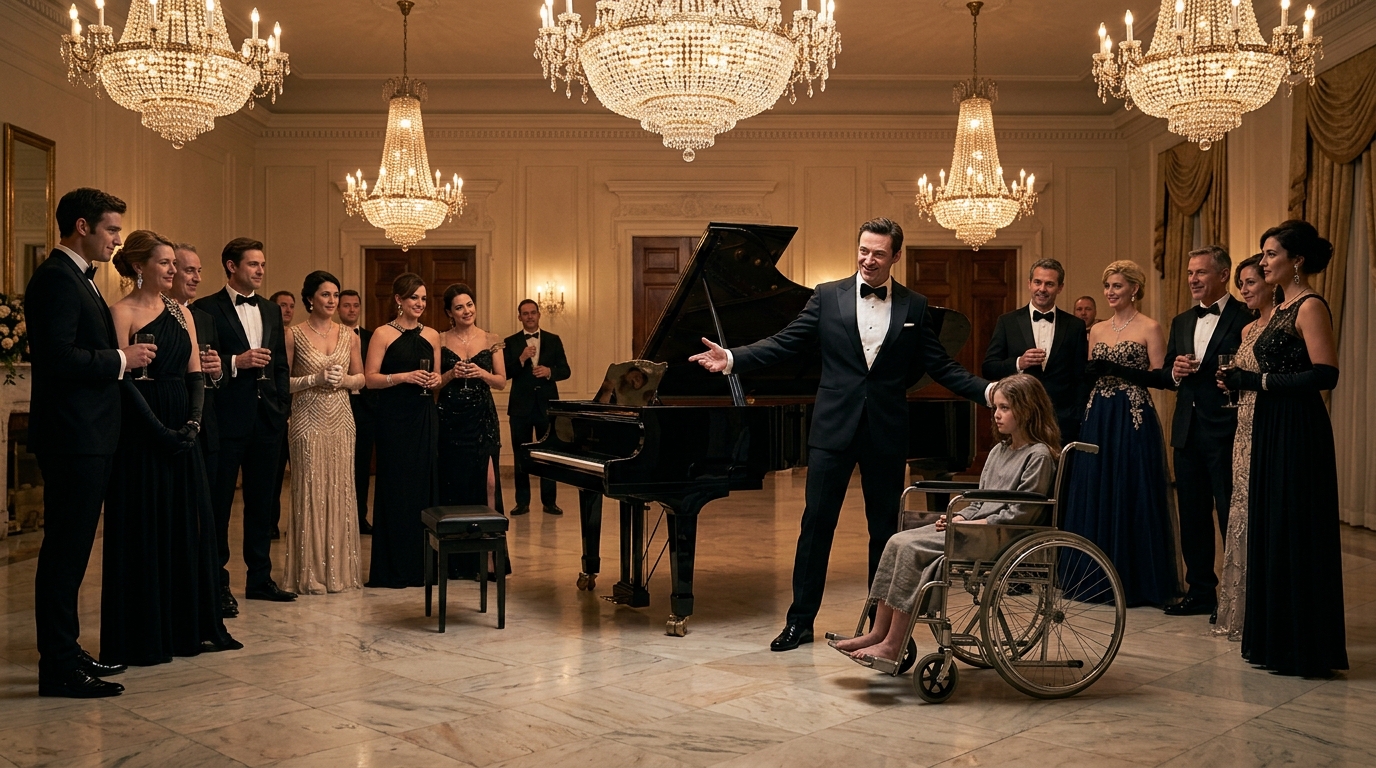
The grand hall shimmered with a light that seemed reserved for people who had never waited outside a clinic, counted coins for dinner, or learned how cold a night could become when no one was coming to help.
Crystal chandeliers glittered overhead.
Gold shimmered across the polished floors.
Guests in black tuxedos and elegant evening gowns gathered in soft clusters, their laughter floating above the music like something expensive and weightless.
At the heart of the room stood a glossy black grand piano.
Beside it stood Julian Ashford.
He wore a tuxedo so perfectly tailored it almost looked like part of him. His silver cufflinks caught the chandelier light each time he lifted his glass. His smile had the easy cruelty of a man who had spent too many years discovering that people laughed when he expected them to.
Before him, in a wheelchair, sat a young girl.
She looked no older than ten.
Her dress was clean, but worn thin at the sleeves. The hem had been repaired by hand. Her hair was neatly brushed, though the ribbon tied at the back had faded from blue to gray. She held herself very still, as though she had learned that drawing attention in rich rooms usually ended badly.
She did not belong there.
At least, that was what most people in the hall seemed to think.
A charity director had brought several children from the St. Agnes Home to the Ashford Foundation gala. The event was supposed to raise money for medical care, school supplies, and foster placement programs. There were banners near the entrance printed with phrases like Every Child Deserves a Future and Hope Begins With Us.
But the guests had mostly treated the children like decorations.
A few gentle smiles.
A few staged photographs.
A few remarks about courage.
Then they returned to champagne, auction bids, and conversations about yachts, board seats, and winter homes.
The girl in the wheelchair had sat quietly near the piano for almost an hour.
Her name was Clara.
No one had asked.
Julian Ashford had noticed her only when one of the donors mentioned that she loved music.
That was when his smile sharpened.
“Music?” Julian said, turning toward her. “Is that true?”
The girl looked up.
Her eyes were dark and calm, but not empty.
“Yes, sir.”
A few guests nearby turned, sensing entertainment.
Julian placed his glass on the piano and smacked the glossy surface lightly with one palm.
“Well then,” he said, raising his voice enough for the room to hear, “let’s make tonight interesting.”
The conversations faded.
The charity director’s face tightened.
“Mr. Ashford—”
Julian ignored her.
He pointed at the girl in front of everyone.
“If you can play,” he said, “I’ll adopt you.”
The words landed softly at first.
Then the cruelty inside them opened.
A few guests smirked.
Someone near the back stifled a laugh.
Another woman whispered, “Oh, Julian.”
Not in horror.
In amused disapproval.
The kind rich people use when cruelty is dressed as wit.
The girl did not move.
The director stepped forward. “That’s not appropriate.”
Julian smiled wider.
“Why not? It’s generous.”
The girl’s hands tightened around the wheels of her chair.
A man in a navy tuxedo chuckled. “Come on, little one. Show us what you’ve got.”
The room leaned toward her.
Waiting.
Not for music.
For failure.
The girl lowered her eyes.
Then she began to move.
Slowly.
Her small hands pushed the wheels forward.
One turn.
Then another.
The sound of rubber over polished marble seemed impossibly loud.
Julian stepped aside with a theatrical grin, already enjoying the embarrassment he expected to unfold.
The girl reached the piano.
For a moment, she sat facing it in silence.
The bench had been moved aside earlier for a performance, so she remained in her wheelchair, close enough to reach the keys.
Her right hand lifted.
It trembled slightly in the air.
Then her fingers touched the piano.
One note.
Clear.
Soft.
Pure.
Then another.
Then a third.
The hall changed.
Not gradually.
All at once.
The whispers died.
The smirks vanished.
Even the waiters along the wall stopped moving.
Because the melody was not random.
Not childish.
Not an uncertain attempt from a girl being mocked in front of strangers.
It was gentle.
Precise.
Heartbreakingly beautiful.
The notes carried something older than the room, older than the chandelier light, older than the wealth gathered around her. They moved like a lullaby remembered through tears.
Julian’s grin faded.
His glassy amusement cracked first.
Then his color changed.
He took one step closer to the piano.
Then another.
The girl kept playing.
Her face remained still, but her eyes had lowered to the keys with the focus of someone touching a memory, not an instrument.
A woman in the audience gasped and pressed a hand over her mouth.
Julian leaned down, his voice suddenly hollow.
“Who taught you that?”
The girl did not stop.
“My mother.”
Julian froze.
For one excruciating second, he no longer looked like the host of the gala.
He looked like a man hearing the dead reach out through a child.
The girl finally glanced up at him as her fingers pressed the next note.
“She said you would know me when you heard it.”
The audience gasped in unison.
Julian grabbed the edge of the piano.
And just before the final phrase began, his gaze dropped to the hem of her worn dress.
There, stitched in tiny silver thread, were two initials.
E.A.
The same initials he had sewn himself into a baby blanket years ago.
The Song No One Was Supposed to Know
Julian Ashford had not heard that melody in eleven years.
He had buried it under business deals, charity speeches, new houses, younger women, expensive distractions, and the kind of public generosity that made private guilt look less suspicious.
But the melody had survived.
It came back now through the hands of a child in a wheelchair.
And it did not ask permission.
Julian stared at her fingers.
The tune had no title.
At least, not one the world knew.
He had written it when he was twenty-eight, not for an audience, not for investors, not for any foundation gala. He had written it for Evelyn.
Evelyn Archer.
The only woman who had ever made him feel ashamed of being selfish.
She had been a violinist then, young and brilliant, with hair the color of chestnuts and a laugh that made Julian forget his own name. She came from nothing, at least according to his mother, who said it like a diagnosis.
Julian came from Ashford money.
Old hotels.
Private banks.
Land.
Trusts.
The kind of money that did not merely buy comfort, but rearranged other people’s lives quietly.
Evelyn did not care.
That was what first offended him.
Then fascinated him.
Then destroyed him.
She loved music with the seriousness Julian’s family reserved for inheritance. She could take a room full of bored donors and make them cry with four notes. She played for hospitals, schools, churches, subway stations, anywhere someone asked.
Julian once teased her for giving beauty away too easily.
She answered, “Beauty rots when it’s hoarded.”
He remembered laughing then.
He did not understand until much later.
They married against his family’s wishes.
His mother, Helena Ashford, called it impulsive.
His father called it temporary.
Julian called it love.
For a while, it was.
The melody the little girl played began as a tune Julian wrote one rainy night while Evelyn sat beside him, resting one hand over her stomach.
Their baby had not been born yet.
Evelyn said the child kicked whenever he played piano.
Julian said the baby clearly had taste.
Evelyn laughed and told him to play softer.
So he did.
He wrote the lullaby slowly, one phrase at a time, while she hummed along.
It belonged only to them.
Not recorded.
Not published.
Not performed.
A private song for an unborn child.
Then the pregnancy became dangerous.
Doctors used careful words.
Complications.
Restricted movement.
Monitoring.
Risk.
Evelyn grew weaker, but she refused to let fear become the only sound in the house. She asked Julian to play the lullaby every night.
“Even if she never remembers us,” Evelyn whispered once, “let her remember this.”
“She?” Julian asked.
Evelyn smiled.
“I know.”
They named the baby Clara.
Clara Evelyn Ashford.
The initials on the blanket: C.E.A.
But Julian had sewn only two into the corner at first — E.A. for Evelyn Archer, because Evelyn insisted the baby should carry her mother’s name somewhere, and Julian promised he would finish the rest later.
He never did.
The night Clara was born, everything collapsed.
Evelyn bled.
The baby did not cry at first.
Julian remembered shouting.
Doctors running.
His mother standing beside him with a face carved from stone.
Then someone said Evelyn was gone.
Someone else said the baby was too weak.
Julian never saw the child clearly.
That was the story he had lived with.
His mother told him both had died within hours.
A funeral was arranged quickly.
A tiny white coffin.
A larger one beside it.
Julian did not remember most of the service.
He remembered one thing.
The baby blanket folded on top of the small coffin.
The corner embroidered with E.A.
He had reached for it, but his mother stopped him.
“Don’t,” she said. “Let grief have dignity.”
Julian was too broken to argue.
Now, eleven years later, a girl in a worn dress sat at his piano playing the lullaby no one outside that room should have known.
And E.A. was stitched into her hem.
The Girl Named Clara
The final note lingered in the hall.
It seemed to hover above the guests, fragile and accusing.
The girl’s hands remained on the keys.
No one clapped.
No one dared.
Julian stared at her as if the room had vanished around them.
“What is your name?” he asked.
The charity director stepped in quickly. “Mr. Ashford, perhaps we should—”
Julian lifted one hand.
The woman stopped.
The girl looked at him.
“Clara.”
Julian’s knees nearly gave way.
A murmur spread through the hall.
His voice became barely audible.
“Clara what?”
The girl hesitated.
For the first time, fear crossed her face.
Not fear of the crowd.
Fear of the answer.
“I don’t know,” she said. “At the home, they call me Clara Vale.”
Julian closed his eyes.
Vale.
Not Ashford.
Not Archer.
A borrowed name.
A name given to a child who arrived without records, without family, without proof.
He opened his eyes.
“Who was your mother?”
The girl’s chin trembled.
“Her name was Evelyn.”
Someone in the audience gasped.
Julian turned sharply.
A woman near the front row had gone pale.
She was older, dressed in dark green silk, with one hand pressed against her throat.
Julian recognized her instantly.
Margaret Lane.
She had been Evelyn’s closest friend.
A violinist from the same conservatory.
After Evelyn died, Margaret had tried to speak to him twice.
His mother refused to receive her.
Julian had been told Margaret was unstable, dramatic, looking for money.
He believed it because grief made believing easier than questioning.
Now Margaret stood as though she had seen a ghost.
“Julian,” she whispered.
He stared at her.
“What do you know?”
Margaret’s eyes filled.
“I tried to tell you.”
The words hit him like cold water.
The room seemed to tilt.
The girl in the wheelchair gripped the edge of the piano.
“I’m sorry,” she said suddenly, as if she had done something wrong.
Julian turned back to her.
His face changed.
The cruelty, the arrogance, the performance — all gone.
For the first time that night, he looked at her not as entertainment, not as charity, not as a symbol at a gala.
As a child.
A child who had just played his dead wife’s lullaby.
A child wearing his unfinished stitches.
A child named Clara.
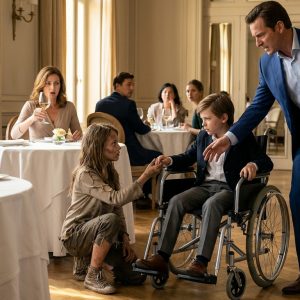
He crouched slowly beside the wheelchair, careful not to startle her.
“Who told you to come here?”
“My mother.”
His throat tightened.
“You said your mother taught you the song.”
Clara nodded.
“But she died when I was little.”
“How little?”
“I don’t remember her face clearly.” Clara looked down at her lap. “Only her hands. And the song.”
Julian’s chest hurt.
“Then how did she tell you to come here?”
Clara reached into the pocket of her dress.
The guests leaned forward as she pulled out a folded piece of fabric.
Old.
Cream-colored.
Soft with age.
She unfolded it.
A corner of a baby blanket.
Stitched in silver thread:
E.A.
Beside the letters, in faded ink, someone had written:
If the man at the piano hears the song, he will know.
Julian stopped breathing.
His hands shook as he reached toward the fabric, but he did not touch it without permission.
Clara saw and held it out.
He took it.
The moment his fingers touched the blanket, his face crumpled.
“This was buried,” he whispered.
Margaret stepped closer.
“No,” she said. “It was hidden.”
The Friend Who Was Silenced
Margaret Lane had spent eleven years carrying a story no one wanted to hear.
She had been at the hospital the night Evelyn gave birth.
Not in the delivery room, but close enough.
Evelyn had asked for her.
Helena Ashford refused at first, saying family only. Evelyn insisted. Julian was in and out of the room, frantic, arguing with doctors, making calls, losing control of a world that had always obeyed him.
Margaret remembered the baby’s first cry.
Weak.
But real.
She remembered Evelyn asking, “Is she alive?”
The nurse said yes.
Evelyn smiled.
Then everything became chaos.
Evelyn’s condition worsened. Doctors rushed her away. Julian was pulled into another room. Helena arrived with her private physician, Dr. Roland Voss, a man Margaret had never trusted.
Later, Margaret saw a nurse carrying the baby down a side corridor.
Not to the neonatal unit.
Away from it.
Margaret followed.
Helena stopped her.
“What are you doing?”
“I want to see the baby.”
Helena’s face was ice.
“There is no baby.”
Margaret stared at her.
“I heard her cry.”
“You heard grief.”
Margaret tried to push past.
Two security guards appeared.
The next morning, Julian was told Evelyn and the baby had died.
Margaret went to the funeral.
She saw the tiny coffin.
But it was too light.
That was what haunted her.
She did not tell anyone at first because she had no proof, only a sound, a corridor, a cold woman’s lie, and a coffin that seemed to hold air.
Then, three weeks later, she received a package.
No return address.
Inside was a torn piece of the baby blanket and a note written in Evelyn’s hand.
If my daughter lives, she must know the song. If Julian has been lied to, the song will bring her back to him.
Margaret believed Evelyn must have written it before delivery, perhaps fearing Helena would interfere. But the blanket piece meant someone had helped the baby leave the Ashford house.
Margaret tried to reach Julian.
Helena blocked every attempt.
Letters returned unopened.
Calls unanswered.
A lawyer warned Margaret that spreading delusions about a dead infant could lead to legal action.
Then Margaret’s conservatory funding vanished.
Her performances were canceled.
Her apartment lease was challenged.
She understood.
The Ashfords could not erase her easily, but they could starve her into silence.
So she did one thing.
She searched quietly.
For years.
Hospitals.
Church homes.
Private adoption lists.
Orphanages.
Records sealed or missing.
Finally, a year earlier, she found a child at St. Agnes Home who hummed Evelyn’s lullaby while staring at a piano she could not reach.
A girl named Clara.
A girl in a wheelchair.
A girl with no birth record before the age of three.
Margaret began visiting as a volunteer music teacher. She did not tell Clara everything at once. How could she? The child had been abandoned, moved through medical placements, then left at the home after a foster family claimed her disability was “too much.”
So Margaret taught her.
The melody.
The notes.
The story of a mother who loved music.
The idea that somewhere, perhaps, a man at a piano might recognize her.
Tonight, at the gala, Margaret had helped arrange for Clara to attend.
She had not expected Julian to mock her.
She had not expected the moment to unfold so cruelly.
But the cruelty had done one useful thing.
It made everyone watch.
And now everyone had heard the song.
Helena Ashford
Julian’s mother was not in the hall when the music began.
Helena Ashford rarely attended the early portions of charity events. She preferred to enter once the crowd was properly warmed and photographers were ready.
She arrived just as Margaret finished speaking.
The double doors opened.
A hush moved through the room for a different reason.
Helena entered in a silver gown, white hair swept elegantly back, diamond collar at her throat.
She paused when she saw the crowd gathered near the piano.
Then she saw Julian holding the blanket piece.
Then Clara.
For one tiny moment, her expression changed.
Not shock.
Recognition.
Julian saw it.
His voice cut through the hall.
“Mother.”
Helena looked at him calmly.
“What is happening?”
He lifted the blanket.
“Did my daughter die?”
The room went completely still.
Helena’s eyes moved toward the guests.
“Julian, this is neither the time nor the place.”
“That was not my question.”
She glanced at Clara.
The girl shrank slightly under her gaze.
Julian noticed.
His anger sharpened.
“Look at me,” he said.
Helena’s eyes returned to him.
“Did my daughter die?”
Helena exhaled slowly.
“Grief has made you vulnerable tonight.”
Margaret stepped forward.
“No. Your lies did.”
Helena turned her cold gaze on Margaret.
“I wondered when you would crawl back into this family’s pain.”
Julian stared.
The old Julian might have obeyed that tone.
The son trained to preserve appearances.
The man who let his mother arrange funerals, statements, silence.
But the girl beside the piano had played a song from the grave.
Something in him was awake now.
He looked at the charity director.
“Call my attorney.”
Helena’s eyes narrowed.
“Julian.”
“And call Dr. Voss.”
For the first time, Helena’s composure cracked.
Only slightly.
“Roland is retired.”
“Then wake him.”
“He is unwell.”
“So was my wife.”
The words struck the room.
Helena’s mouth tightened.
Clara whispered, “Mr. Ashford?”
Julian turned immediately.
Her voice had become small again.
“Am I in trouble?”
The question broke something in him.
All his adult life, he had been trained to respond to crisis by controlling the room.
This child did not need control.
She needed safety.
He lowered himself beside her again.
“No,” he said. “You are not in trouble.”
She looked unconvinced.
He softened his voice further.
“I am.”
The room heard him.
So did Helena.
Julian looked up at his mother.
“And I intend to find out why.”
The Night Reopens
The gala ended without ceremony.
Not officially, but no one cared about the auction anymore.
Guests remained in clusters, whispering, recording, calling, pretending to be concerned while making sure they had every detail. The charity director took Clara to a quiet side room, but Clara refused to leave without Margaret.
Julian followed them.
For the first time in years, he did not ask his mother’s permission for anything.
His attorney, David Orman, arrived within thirty minutes.
Dr. Roland Voss could not be reached at first.
Then he was.
Or rather, his daughter answered and said her father had suffered a stroke two years earlier, spoke little, and lived under private care.
Julian sent David anyway.
“Tonight,” he said.
David hesitated.
“Julian, this may require—”
“Tonight.”
There was enough evidence to begin.
Not proof.
But evidence.
The blanket.
The initials.
Margaret’s testimony.
Clara’s unknown records.
The song.
The missing hospital file.
The retired doctor.
The mother who had recognized too much too quickly.
Clara sat in the side room near a small lamp, holding a cup of tea she did not drink.
Julian sat across from her.
He did not know how to speak to her.
That seemed absurd.
He had delivered speeches to thousands. Negotiated with ministers. Faced hostile boards. Comforted donors with perfect phrases.
But now, before a thin child in a wheelchair who might be his daughter, words felt dangerous.
“Do you like piano?” he asked finally.
Clara glanced at him.
“Yes.”
“Do you play often?”
“No.”
“Why not?”
“There isn’t one at St. Agnes. Margaret brings a small keyboard sometimes.”
Julian looked at her hands.
“You play beautifully.”
Her eyes lowered.
“My legs don’t work right,” she said, as if offering a correction.
He frowned.
“What does that have to do with your music?”
She seemed startled by the question.
Then, after a moment, she shrugged.
“People usually mention it.”
Julian felt ashamed.
Not only of the challenge.
Of the world that had taught her to expect every compliment to pass through her wheelchair first.
“Then people are fools,” he said.
She looked up.
For the first time, a tiny smile touched her mouth.
Just for a second.
Then it vanished.
“My mother said the man at the piano would know me,” she said. “Did you?”
Julian could not lie.
“No.”
Her face fell.
He leaned forward.
“But the song knew me.”
She looked at him carefully.
He placed the blanket piece between them.
“And this knew me. And your name knew me.”
“My name?”
“My daughter’s name was Clara.”
She became very still.
“Was?”
He closed his eyes briefly.
“That is what I was told.”
“By her?”
Julian opened his eyes.
He did not need to ask who she meant.
Helena.
“Yes.”
Clara looked toward the closed door.
“She scares me.”
The words were soft.
But they landed like thunder.
Julian’s voice changed.
“Has she met you before?”
Clara nodded.
Margaret, standing near the window, turned sharply.
“What?”
Clara’s hands twisted in her lap.
“At St. Agnes. A lady came last winter. She asked if I knew the song. I said yes. She told the director I should not attend public events because excitement was bad for me.”
Julian stood.
The chair scraped back.
Margaret whispered, “That was Helena.”
Clara nodded.
“She told me nobody wanted children who came with stories.”
Julian’s face went white with fury.
For the first time in his life, he understood that his mother had not merely hidden the past.
She had kept guarding the door.
The Doctor’s Confession
Dr. Roland Voss did not confess easily.
He could barely speak.
But guilt had survived his stroke.
David Orman returned near dawn with a recording made with the permission of Voss’s daughter, who had spent years suspecting her father had done terrible things under the protection of rich families.
The old doctor’s words were broken.
Slow.
Difficult.
But clear enough.
The baby lived.
Weak, but alive.
Helena Ashford ordered her removed.
Not killed.
Helena was too careful for that.
The baby was transferred through a private network to a rural medical home under a false name. Dr. Voss signed the documents. A nurse objected. She was dismissed. Records were altered. The death certificate was filed under pressure.
Evelyn never knew.
She died believing her daughter had survived the first breath.
That detail ruined Julian.
He had spent eleven years thinking Evelyn died after losing their child.
Now he knew she died after bringing their daughter into the world, while others stole the child from her.
The doctor also confirmed the blanket.
Julian had sewn the initials E.A. into the corner before the birth. Helena ordered the blanket placed on the coffin for symbolism, but a nurse tore off a corner first, believing someone might one day need proof.
That nurse was never found.
Perhaps she sent the piece to Margaret.
Perhaps someone else did.
The truth had moved through frightened hands for eleven years, from nurse to friend, friend to child, child to piano.
When Julian finished listening to the recording, he did not speak for a long time.
Margaret sat beside Clara, one arm around the girl’s shoulders.
David waited near the door.
Finally, Julian asked, “Can we test it?”
David nodded.
“DNA, yes.”
Clara’s face tightened.
“Will it hurt?”
Julian turned to her immediately.
“No. Just a swab.”
She looked suspicious.
“I’ve had lots of tests.”
Julian’s anger softened into pain.
“I’m sorry.”
“People say that before tests too.”
He did not know what to say.
Margaret squeezed her hand.
“This one is only to tell the truth.”
Clara looked at Julian.
“And if I’m not her?”
The question hollowed him.
He had been so consumed by the possibility that he had not considered the terror from her side.
What if this became another room where she was almost wanted?
Julian sat in front of her again.
“Then I will still make sure you are safe,” he said.
Her eyes searched his face.
“You promise?”
The word almost destroyed him.
Promise.
The smallest word.
The hardest one.
“I promise.”
The Days of Waiting
DNA results took six days.
Those six days stretched longer than eleven years.
Julian did not return to the mansion.
He checked into a hotel near St. Agnes Home, against his mother’s furious calls and his board’s frantic advice. Helena’s legal team issued statements about grief, exploitation, and malicious attempts to damage a family legacy.
The public began to notice.
Someone had recorded Clara’s performance.
Of course they had.
The video spread overnight.
At first, people shared it for the shock of the moment: the rich man mocking a girl in a wheelchair, the girl playing beautifully, the host going pale.
Then the story changed.
The secret song.
The initials.
The missing baby.
The dead wife.
The mother’s arrival.
The world loves scandal, especially when it wears diamonds.
Julian hated that Clara’s face was everywhere.
He ordered attorneys to protect her privacy, but the video had already escaped. Margaret stayed with her at St. Agnes, guarding her from reporters, strangers, and staff who suddenly treated her like she was made of glass.
Julian visited every day.
At first, Clara said little.
She showed him the music room, which was not really a music room, only a storage space with a donated keyboard and two broken chairs.
She showed him the ramp that stuck in rain.
The window where cold air came through.
The garden patch where she grew one stubborn basil plant.
He listened.
Not as a donor.
As a man learning the geography of the life stolen from his child.
On the third day, she asked him to play the lullaby.
His hands trembled when he sat at the old keyboard.
The keys were cheap.
Some notes buzzed.
But when he played the opening phrase, Clara’s eyes filled.
“That’s how she hummed it,” she whispered.
“Evelyn?”
Clara nodded.
“She used to tap here.” Clara touched the arm of her wheelchair. “Like this.”
A simple rhythm.
Julian remembered Evelyn tapping that same rhythm against her belly.
He had to stop playing.
Clara watched him carefully.
“You cry quietly,” she said.
He gave a broken laugh.
“I wasn’t aware there were categories.”
“There are.”
“What kind do you do?”
She looked down.
“The kind where people tell me to stop.”
Julian’s hand curled into a fist.
Not in front of her.
Never in front of her.
But inside himself, something burned.
“No one should tell a child not to cry.”
She shrugged.
That shrug said more than any testimony.
On the fifth day, Clara asked, “If I’m yours, do I have to live in your big house?”
Julian blinked.
“No.”
She looked relieved.
“Good.”
He almost smiled.
“You don’t like big houses?”
“I don’t like places where people whisper.”
Julian thought of Ashford House.
His mother’s voice.
The closed nursery.
The silent halls.
“Neither do I anymore,” he said.
The Result
The call came on the sixth morning.
Julian was at St. Agnes, sitting across from Clara at a small table while she practiced scales on the keyboard Margaret had brought.
His phone rang.
David’s name appeared.
Julian stood too quickly.
Clara stopped playing.
Margaret entered from the doorway.
He answered.
David did not waste time.
“She’s your daughter.”
The room blurred.
Julian gripped the back of the chair.
“Say that again.”
“She is your biological child. The probability is conclusive.”
Julian closed his eyes.
For eleven years, he had mourned an empty coffin.
For six days, he had feared hope like a blade.
Now truth arrived in one sentence, and it did not feel simple.
It felt like joy colliding with grief at full speed.
Clara watched him.
Her face had gone pale.
“What did he say?”
Julian lowered the phone.
His voice broke.
“You’re my daughter.”
The keyboard fell silent.
Margaret covered her mouth.
Clara stared at him.
No tears at first.
No smile.
Just stillness.
Then her face crumpled.
Not like a child receiving good news.
Like a child realizing how much had been taken before the good news could arrive.
Julian crossed the room but stopped before touching her.
He remembered.
Permission.
Safety.
Choice.
“May I hug you?” he asked.
Clara looked at him through tears.
Then nodded.
He knelt and wrapped his arms around her carefully.
For a moment, she remained stiff.
Then she collapsed against him.
Small.
Shaking.
His daughter.
Julian pressed his face against her hair and wept in the way Clara had called quiet at first, then not quiet at all.
“I’m sorry,” he whispered. “I’m so sorry. I didn’t know.”
Clara cried harder.
“I waited,” she said into his coat.
The words cut through him.
“For what?”
“I don’t know.” Her voice broke. “Just someone.”
Julian held her tighter.
“I’m here now.”
He knew it was not enough.
Not yet.
Maybe never fully.
But it was true.
And truth was where they would have to begin.
Helena’s Last Performance
Helena Ashford did not surrender.
People like Helena rarely do.
She held a press conference from the steps of Ashford House, looking elegant and wounded.
She said Julian was being manipulated.
She said Margaret Lane had always been unstable.
She said the child was unfortunate but not family.
She called the DNA test “procedurally questionable.”
Then Julian released Dr. Voss’s confession.
David released hospital transfer records.
Margaret released copies of the blanket note.
A former nurse came forward after seeing the video. She was old now, living three states away, but she remembered the baby. She remembered Helena. She remembered tearing the blanket corner before the child was taken because Evelyn had begged someone to protect her daughter if she survived.
The nurse had sent the fabric to Margaret.
“I was a coward after that,” she told reporters. “But not in that one moment.”
The public turned.
The board turned.
Charity partners turned fastest of all, terrified of being associated with stolen infants and false death certificates.
Helena retreated into legal silence.
Julian went to see her once.
Not for reconciliation.
For answers.
She sat in the formal drawing room of Ashford House, back straight, pearls at her throat, as if posture could defeat evidence.
“You destroyed my family,” Julian said.
She looked at him coldly.
“I preserved it.”
“You stole my daughter.”
“I removed an impossible burden from your life.”
He stared at her.
“Clara was a baby.”
“She was sick. Disabled. Evelyn was gone. You were unstable with grief. The foundation, the company, the family name — everything was at risk.”
Julian felt sick.
“So you put her in an institution.”
“I arranged care.”
“You erased her.”
Helena’s voice sharpened.
“I saved you.”
“No,” he said. “You saved your idea of me.”
For the first time, she looked wounded.
That almost made him angrier.
He stepped closer.
“Evelyn died asking for her daughter, didn’t she?”
Helena looked away.
That was the answer.
Julian’s voice dropped.
“Did you tell her Clara died?”
Silence.
“Did you?”
Helena’s jaw tightened.
“She needed peace.”
Julian closed his eyes.
There are some cruelties too large for shouting.
When he opened his eyes, his mother seemed smaller.
Not weaker.
Just less mythical.
A frightened woman who had mistaken control for love and lineage for life.
“You will never see Clara unless she asks,” he said.
Helena laughed once.
“She is a child. She doesn’t know what she needs.”
Julian looked at her.
“That sentence is exactly why.”
Then he walked out of Ashford House and did not return for a long time.
A New Home With No Whispering
Clara did not move into the mansion.
Julian rented a smaller house near the park, with wide doors, ramps that did not stick, sunlight in the kitchen, and a music room on the first floor.
The first night, Clara asked if she could close her bedroom door.
Julian said yes.
Then she asked if she could lock it.
His heart broke quietly.
“Yes,” he said.
She studied him.
“You won’t be mad?”
“No.”
“At St. Agnes, they didn’t like locked doors.”
“This is your room.”
She nodded.
Then closed the door.
The click of the lock nearly brought him to his knees.
Not because she shut him out.
Because she finally had a door that belonged to her.
The adjustment was not easy.
People imagined reunion as a straight line toward happiness.
It was not.
Clara had nightmares.
She hid food in drawers.
She apologized whenever she needed help transferring from her chair.
She called him “Mr. Ashford” for three weeks, then “Julian” for two months.
The first time she called him “Dad,” it was by accident.
She had been frustrated with a difficult piano passage and said, “Dad, listen.”
Then froze.
Julian froze too.
Clara’s face went red.
“I didn’t mean—”
He kept his voice calm, though his hands were shaking.
“It’s all right.”
She stared at the keys.
“I can take it back.”
He sat beside her.
“You don’t have to.”
She did not say it again for eleven days.
Then, one morning over pancakes, she asked, “Dad, is there syrup?”
Julian turned toward the cabinet so she would not see him cry.
She saw anyway.
“You’re doing the quiet crying again,” she said.
He laughed through it.
“I’m working on that.”
The Song for Evelyn
Months later, Julian held a concert.
Not a gala.
Clara insisted.
“No chandeliers,” she said.
“There will be some lights.”
“No people in tuxedos laughing.”
“No laughing.”
“No adoption jokes.”
Julian flinched.
Clara noticed.
She had a way of noticing pain without softening the truth.
“You said it,” she reminded him.
“I know.”
“It hurt.”
“I know.”
“I still think about it.”
He nodded.
“You should tell me when you do.”
“I just did.”
He swallowed.
“Thank you.”
That was how they learned each other.
Not by pretending love erased harm.
By telling the truth before silence could grow around it.
The concert was held in a small theater Evelyn had loved. The proceeds went not to the Ashford Foundation, which Julian dissolved and rebuilt under independent oversight, but to disability access programs, child advocacy legal services, and medical record transparency initiatives.
Margaret performed violin.
Clara played piano.
Julian accompanied her for the lullaby.
Before they began, Clara rolled herself to the microphone.
She looked nervous, but not afraid.
“My mother taught me this song before I knew words,” she said. “Margaret helped me remember it. My father recognized it late, but he recognized it.”
A soft ripple of emotion moved through the audience.
Clara continued.
“This song is for Evelyn. And for children who are told their stories are too inconvenient to be true.”
Julian bowed his head.
Then they played.
This time, the room was not waiting for her to fail.
This time, no one smirked.
This time, the silence was reverent.
The lullaby filled the theater, carried by piano and violin, by father and daughter, by the friend who had refused to forget, by the mother who was gone but not erased.
At the final phrase, Julian felt Clara’s timing shift slightly.
A tiny hesitation.
The same hesitation Evelyn used to hum.
He almost lost the keys.
But Clara kept going.
Strong.
Precise.
Beautiful.
When the last note faded, the audience stood.
Clara looked startled.
Then overwhelmed.
Julian leaned close and whispered, “They’re clapping for the music.”
She looked at him.
“Not the chair?”
“Not the chair.”
Her eyes filled.
Then she smiled.
The Initials
The worn dress was eventually placed in a glass frame.
Clara wanted to throw it away at first.
“I hate that dress,” she said.
Julian understood.
It belonged to the night she was mocked.
The night she was watched.
The night she had to prove herself to people who should have protected her without proof.
But Margaret suggested keeping only the hem.
“The initials matter,” she said.
Clara thought about it for a long time.
Finally, she agreed.
The small piece of fabric with E.A. stitched in silver thread was framed beside the torn blanket corner.
Below it, Clara wrote the label herself:
My mother’s initials.
My father’s unfinished promise.
The thread that found me.
Julian could not read it without stopping.
The initials had haunted him once.
Then exposed him.
Then returned his daughter.
He had sewn them clumsily as a young husband, laughing while Evelyn corrected his stitches.
He had seen them on a coffin and believed a lie.
He had seen them on Clara’s dress and felt the dead rise through music.
Now they hung in a room full of light.
No longer a symbol of loss.
A map.
What the Hall Remembered
Years later, people still spoke about the gala.
They remembered the rich man’s cruel challenge.
The girl in the wheelchair.
The piano.
The melody.
The host’s face going pale.
Some versions made Julian sound better than he was.
Clara hated those versions.
“He didn’t save me at the piano,” she once said during an interview at seventeen. “He recognized me there. Those are different things.”
The interviewer asked, “Do you forgive him for what he said?”
Clara looked toward Julian, who sat off-camera.
He did not look away.
“Yes,” she said. “But forgiveness didn’t make the sentence disappear. He had to become someone who would never say it again to any child.”
Julian later told her that answer hurt.
She replied, “Good.”
He laughed.
Then cried.
Not quietly.
She approved.
The grand hall itself changed too.
Julian removed the piano from the center of the gala room and placed it in the Evelyn Archer Music School, a program for children in foster care and medical homes.
He kept the scratch his hand had left on the piano’s edge the night he grabbed it in shock.
The restoration team offered to polish it out.
Clara said no.
“Let it remember.”
So it did.
Children played that piano for years.
Some beautifully.
Some terribly.
No one was ever mocked beside it again.
The Child at the Center
The world wanted the story to be about Julian.
Powerful man discovers stolen daughter.
Billionaire confronts wicked mother.
Lost heiress returns.
But Julian knew better.
The story belonged to Clara.
Clara, who survived institutions, pity, medical neglect, and rooms where adults spoke over her head.
Clara, who learned a forbidden lullaby on a cheap keyboard.
Clara, who moved her wheelchair across a marble floor while strangers waited for her embarrassment.
Clara, who played anyway.
Not to impress them.
Not even to win the cruel promise of adoption.
She played because her mother told her the song would find the man who needed to hear it.
And it did.
Sometimes truth does not arrive like evidence first.
Sometimes it arrives as a melody.
A stitch.
A memory in the hands.
A child’s small steady voice saying:
“She said you would know me when you heard it.”
Julian spent the rest of his life trying to deserve the second chance he did not earn.
Clara spent hers making sure children like her did not need songs, public humiliation, or viral videos to be believed.
Margaret lived long enough to watch Clara perform on stages around the world, though Clara always returned to the small theater once a year to play Evelyn’s lullaby.
Helena died alone in Ashford House five years later, surrounded by portraits and silence. Clara did not attend the funeral. Julian did. He stood in the back, listened to the priest speak of legacy, and thought of a baby carried down a side corridor while her grandmother called it preservation.
Then he went home.
Clara was at the piano.
The house was warm.
The doorways wide.
No whispering.
No locked-away stories.
She looked up when he entered.
“Are you okay?”
He considered lying.
Then remembered what truth had cost them.
“No,” he said.
She nodded.
“Come sit.”
He did.
She began to play.
Not the lullaby this time.
Something new.
Something she had written herself.
It started with the same three notes Evelyn once hummed, then moved somewhere brighter, less haunted, more alive.
Julian listened.
His daughter’s hands moved across the keys, strong and certain.
And for the first time, the music did not feel like the dead reaching out.
It felt like the living answering.