The Word That Stopped Him
“MOM!”
The sharp cry shattered the morning stillness.
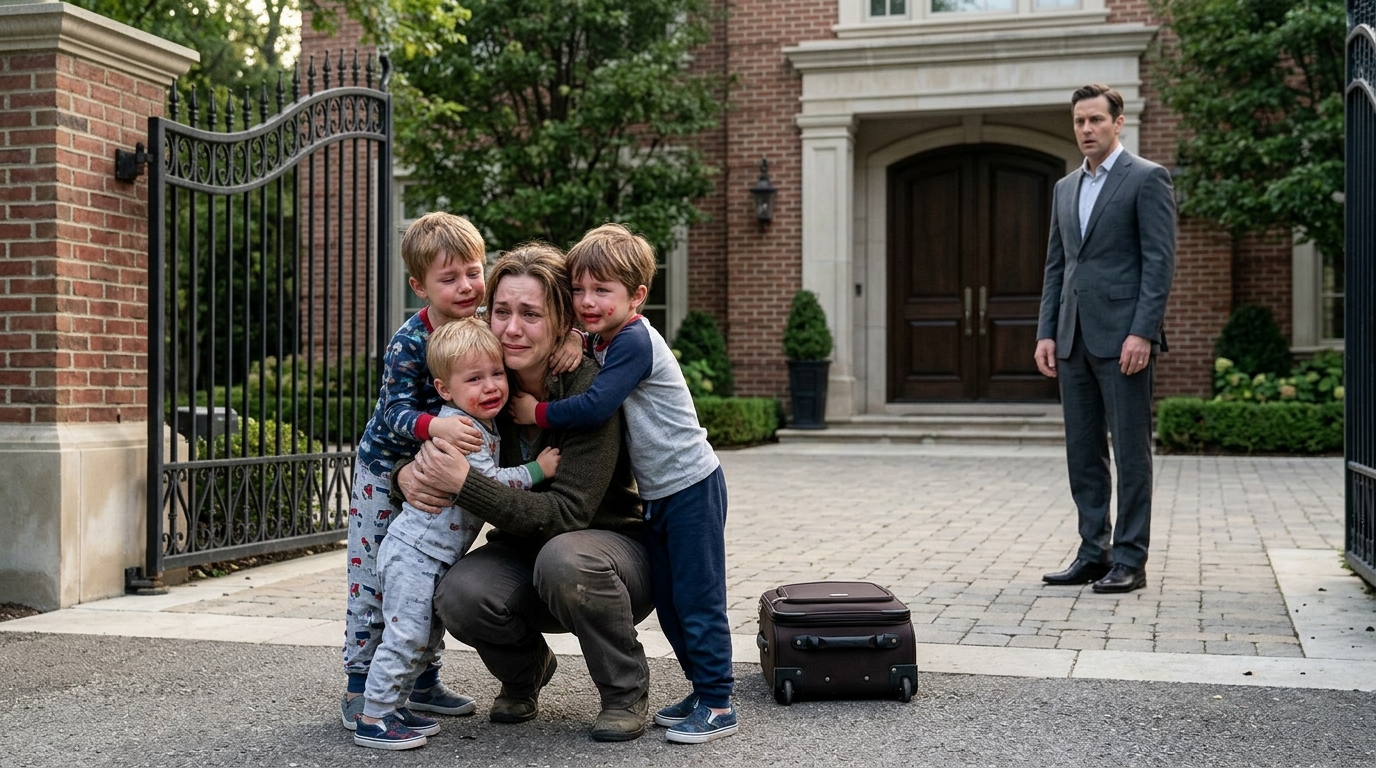
Julian Ashford stood at the entrance of his mansion with one hand still resting on the iron gate, his expression cold, his suit immaculate, his decision already made.
In front of him stood the woman he had just fired.
Mara Hale.
The nanny.
That was what he called her.
That was what everyone called her.
The woman who cooked breakfast, tied shoelaces, wiped tears, packed school lunches, remembered medicine schedules, found missing toy cars beneath beds, sat through fevers, stayed beside nightmares, and somehow made three motherless boys feel less alone in a house too large for childhood.
But to Julian, she had always been staff.
Important staff, perhaps.
Trusted staff once.
But staff.
And staff could be dismissed.
Mara stood on the pavement just outside the gate, one hand gripping the handle of a worn brown suitcase. Her navy cardigan was buttoned wrong, as if she had dressed too quickly after being summoned downstairs. Her eyes were tired, red at the edges, but she did not beg.
That bothered Julian more than he wanted to admit.
He had expected tears.
An apology.
A desperate explanation.
Instead, she stood quietly with her suitcase beside her, her face pale but steady.
Behind Julian, the mansion rose in perfect silence.
White stone.
Tall windows.
Trimmed hedges.
A fountain glistening in the pale morning light.
The kind of house that made people assume everything inside it was orderly, dignified, and safe.
Julian looked at Mara one final time.
“Don’t look back,” he said.
His voice was colder than he intended.
Or maybe exactly as cold as he had allowed it to become.
Mara’s fingers tightened around the suitcase handle.
She gave the smallest nod.
Then she turned.
The wheels of her suitcase clattered against the wet pavement.
A harsh, lonely sound.
A sound that should have ended everything.
Then—
“MOM!”
Three small figures burst through the front doors and down the path toward the gate.
Julian spun around.
His sons.
Oliver, eight.
Bennett, six.
Theo, four.
All three were crying.
Oliver’s face was streaked with tears, his shirt half-buttoned, his hair still messy from sleep. Bennett had a smear of red frosting across his cheek. Little Theo had the same bright red smudge around his mouth, as if he had tried to eat something too quickly before running outside.
They came barefoot across the cold stone path, hands reaching forward.
Not toward Julian.
Toward Mara.
“Mama, don’t go!” Theo sobbed.
The word hit Julian harder than any accusation could have.
Mama.
Mara dropped the suitcase.
The sound echoed.
For one unbearable second, she stood frozen as the boys collided with her.
Then she fell to her knees and wrapped all three of them in her arms.
Oliver clung to her shoulder.
Bennett buried his face against her cardigan.
Theo wrapped both arms around her neck and cried so hard his little body shook.
Mara closed her eyes.
Her face broke.
Tears fell freely now, but still she tried to comfort them.
“I’m here,” she whispered, voice trembling. “I’m here, sweetheart. I’m right here.”
Julian stood inside the gate, motionless.
The world seemed to go silent around him.
The fountain.
The wind.
The birds in the hedges.
Everything faded behind one impossible truth.
He had called her a nanny.
His sons called her Mom.
The Woman He Thought Was Replaceable
Julian Ashford had not always been a cold man.
There were photographs proving that.
Old ones.
Hidden in drawers.
Framed in rooms he rarely entered.
Julian laughing beside his late wife, Isabelle, on a beach in Maine. Julian holding newborn Oliver with terror and wonder all over his face. Julian kneeling beside Bennett’s crib, tie loosened, one finger caught in the baby’s fist. Julian asleep on a nursery chair with Theo curled against his chest.
Once, he had been the kind of father who came home early just to hear a baby laugh.
Then Isabelle died.
A sudden illness.
Three weeks from diagnosis to funeral.
No time to prepare.
No time to understand.
No time to learn how to be both parents in a house that still smelled like her perfume.
After the funeral, Julian broke in a way wealthy men are rarely allowed to break publicly. He did not collapse in front of business partners. He did not scream in hallways. He did not drink himself into scandal.
He disappeared into work.
Which was more respectable.
And far more damaging.
Meetings grew longer.
Trips became more frequent.
The children’s schedules became something his assistant forwarded to him instead of something he lived inside.
That was when Mara Hale entered the house.
She had been recommended by Isabelle’s older sister, Grace.
“She isn’t polished,” Grace had warned him. “But she loves children properly.”
Julian had barely listened.
He needed someone competent.
Someone calm.
Someone who could handle three grieving boys while he handled the empire Isabelle’s death had made feel meaningless.
Mara arrived with one suitcase, two references, and a soft voice that somehow reached children without frightening them.
At first, Julian noticed only the practical things.
The boys ate better.
They slept more.
They stopped crying whenever he left the room.
The nursery was organized.
School forms were signed.
Doctors’ appointments happened.
Birthday presents appeared wrapped and labeled.
The house began functioning again.
He mistook that for recovery.
It was not recovery.
It was Mara.
She learned Oliver liked his toast cut into triangles because Isabelle had done it that way.
She learned Bennett could not sleep unless someone checked the closet twice.
She learned Theo remembered his mother as a voice more than a face and cried whenever he smelled lavender soap.
She learned all of it because Julian was not there to learn it himself.
When Oliver had nightmares, Mara sat beside his bed.
When Bennett refused to speak for two weeks after Isabelle’s funeral, Mara communicated with him through drawings.
When Theo called every woman with dark hair “Mama” and then cried when they turned around, Mara held him until he slept.
And slowly, without anyone formally naming it, the boys began attaching themselves to her.
Not because she replaced Isabelle.
No one could.
But because grief leaves children reaching.
And Mara did not pull away.
Julian did.
That was the part he did not let himself see.
The Woman in the Silver Dress
Two years after Isabelle’s death, Julian met Celeste Morgan.
She was elegant.
Measured.
Perfect in public.
A woman who understood gala seating charts, investor dinners, and how to enter a room beside a powerful man without seeming impressed by him.
Julian admired that.
At first.
Celeste did not try to mother the boys immediately. She was too clever for that. She brought them expensive gifts, remembered their birthdays, and praised Mara’s “efficiency” with a smile that never reached her eyes.
Privately, she began planting small sentences.
“You rely on her too much.”
“She has made herself indispensable.”
“The boys are confused, Julian.”
“They should know the difference between family and staff.”
That last word stayed with him.
Staff.
It sounded reasonable.
Orderly.
Necessary.
Julian began noticing things through Celeste’s eyes.
Theo running to Mara before him.
Bennett asking if Mara could come to parent day.
Oliver drawing family portraits with Mara standing beside him.
Each time, Julian felt a discomfort he did not name.
Guilt, perhaps.
Jealousy, perhaps.
Failure, certainly.
Celeste named it for him.
“She is crossing boundaries.”
Mara never defended herself because no one formally accused her at first.
The house simply grew colder around her.
Celeste changed schedules.
Reassigned rooms.
Told the boys to call Mara “Miss Hale” instead of “Mara.”
Theo refused.
Bennett stopped talking at meals.
Oliver became watchful.
Julian saw the symptoms but accepted Celeste’s diagnosis.
“They’re adjusting,” she said.
Then came the accusation.
A necklace from Isabelle’s jewelry box was missing.
Not an expensive piece compared to the others, but sentimental.
A small gold locket with a faded photograph of Isabelle and the boys inside.
Celeste found the empty velvet slot two days before the engagement announcement dinner.
“How awful,” she said, holding the drawer open.
Mara was called into the study.
She looked confused.
Then hurt.
Then frightened when Julian asked whether she had entered Isabelle’s room.
“I dusted it,” she said. “Mrs. Morgan asked me to prepare the room for guests.”
Celeste lowered her eyes.
“I didn’t ask her to open drawers.”
Julian’s face hardened.
“Mara.”
“I didn’t take anything.”
Her voice was quiet.
Too quiet, Celeste later said.
Like someone hiding guilt.
The locket was found that night in Mara’s dresser.
Wrapped in a handkerchief beneath her folded clothes.
Julian did not ask enough questions.
He did not ask why someone who had stolen jewelry would hide it in the most obvious place.
He did not ask how Celeste knew exactly where to look.
He did not ask why Oliver was standing in the hallway crying silently while the adults searched Mara’s room.
He did not ask because asking might have forced him to see what his house had become.
Instead, he fired Mara the next morning.
At the gate.
In front of the staff.
Where it would be clear.
Final.
Controlled.
And then his sons ran out calling her Mom.
The Red Frosting
The red smear on Bennett’s cheek came from cake.
Julian learned that later.
At first, when he saw the color on his son’s face, his mind went somewhere darker.
“Bennett,” he said sharply. “What happened?”
Bennett turned toward him with such anger that Julian stepped back.
“You happened!”
The words were too adult for a six-year-old.
Too raw.
Oliver stood between his brothers and Julian, chest heaving.
“You can’t make her leave.”
Julian tried to recover authority.
“Oliver, go inside.”
“No.”
Julian stared.
His oldest son had never spoken to him that way.
Oliver’s face was wet with tears, but his voice held.
“No. You don’t get to send her away.”
Mara shook her head quickly.
“Oliver, sweetheart—”
“No!” he cried, turning back to her. “He needs to know!”
Julian looked at Mara.
“What is going on?”
Mara wiped Theo’s face with her sleeve.
“Please,” she said quietly. “Let me calm them first.”
Celeste appeared at the top of the steps behind Julian, wrapped in a pale silk robe despite the cold morning.
Her expression was composed, but her eyes were sharp.
“What is this scene?”
Oliver turned toward her.
“You lied.”
Celeste’s face stilled.
Julian frowned.
“Oliver.”
“She lied!” Oliver shouted. “Mara didn’t take Mom’s locket. We did!”
The world stopped.
Julian stared at his son.
“What?”
Oliver’s lower lip trembled.
“We took it because we wanted it for the cake.”
Bennett nodded furiously, still crying.
“We were making a surprise!”
Theo clutched Mara’s neck.
“For Mama Mara,” he whispered.
Celeste descended one step.
“That’s absurd.”
Oliver pointed at her.
“You said if we told Dad, Mara would go to jail.”
Julian felt the words enter him slowly.
One by one.
Like stones dropped into deep water.
He turned toward Celeste.
“What did he say?”
Celeste gave a short, brittle laugh.
“He is a child. He’s upset. Children say things when they’re emotional.”
Oliver ran back toward the house before anyone could stop him.
“Oliver!” Julian called.
But his son disappeared through the front doors.
A minute later, he returned carrying a small cake box, both hands shaking.
The cake inside was crooked, messy, and half-collapsed.
Red frosting was smeared along one side.
Uneven letters stretched across the top:
DON’T LEAVE, MOM.
A gold locket lay beside the cake, carefully cleaned, its chain tangled in a ribbon.
Julian could not breathe.
Bennett wiped his cheek, spreading frosting farther.
“We borrowed it,” he sobbed. “Because it has Mom’s picture. We wanted both moms on the cake.”
Both moms.
Julian looked at Mara.
She was crying silently now.
Not for herself.
For the boys.
Always for the boys.
Celeste stepped forward quickly.
“This is manipulation. She taught them this.”
Mara’s eyes snapped up.
For the first time since Julian had known her, something fierce moved across her face.
“No.”
The word was quiet.
But it cut cleanly through the air.
Celeste blinked.
Mara slowly stood, keeping Theo against her hip.
“No,” she repeated. “Do not put this on them.”
Julian looked at Celeste.
Her face was still arranged beautifully.
But something beneath it had begun to crack.
The First Time He Listened
Julian picked up the cake box with one hand.
The locket with the other.
His fingers trembled around the gold chain.
Inside the locket was Isabelle’s photograph.
And on the other side, tucked behind the tiny frame, was a folded paper.
He had never known it was there.
He opened it carefully.
Isabelle’s handwriting stared back at him.
If I am gone before the boys are grown, please make sure they are held more than managed.
Julian’s knees nearly weakened.
It was not a letter.
Only one line.
Maybe written years earlier.
Maybe tucked there by Isabelle herself.
Maybe found by Oliver while making the cake.
But it felt like she had reached through death and placed a hand on his shoulder.
Held more than managed.
He looked at his sons.
When had he last held them without checking the time?
When had he last stayed through a nightmare instead of sending Mara?
When had he last known what they feared, what they loved, what they needed before staff told him?
Celeste’s voice broke into his thoughts.
“Julian, you cannot let this sentimental performance confuse you.”
He turned toward her slowly.
“Where did you find the locket?”
Her eyes narrowed.
“What?”
“You said it was in Mara’s dresser.”
“It was.”
“How did you know where to look?”
“I didn’t. I checked obvious places.”
“You personally searched staff rooms?”
“She was stealing from you.”
“No,” Oliver said. “She wasn’t.”
Celeste’s lips tightened.
Julian looked at his son.
“Tell me everything.”
Oliver glanced at Mara.
She nodded, though fear shadowed her face.
He took a breath.
“We took the locket from the drawer because Theo was crying and said he wanted Mommy at breakfast for Mara’s goodbye party. We didn’t know it was wrong. We were going to put it on the cake, then put it back. But Miss Celeste came in and saw it.”
Celeste said sharply, “That is not true.”
Oliver flinched, but continued.
“She said if Dad found out, he’d send Mara away because she let us steal. Then she took it.”
Julian looked at Celeste.
The morning air felt cold enough to cut.
“And it appeared in Mara’s dresser.”
Celeste’s expression hardened.
“You are choosing a nanny’s story over mine.”
“No,” Julian said.
His voice was very quiet now.
“I am choosing my sons’ truth over your convenience.”
Celeste’s face changed.
For the first time, real anger surfaced.
“These boys are confused because of her. They call hired help Mom. Do you understand how humiliating that is?”
Julian stared at her.
There it was.
Not concern.
Not family order.
Humiliation.
That was what mattered to Celeste.
Not three grieving children.
Not a woman falsely accused.
Not a dead wife’s memory.
Only how it looked.
Theo lifted his head from Mara’s shoulder.
“She is Mom,” he said.
Small.
Certain.
Devastating.
Julian felt something inside himself split open.
What Mara Had Never Said
Mara tried to leave anyway.
That was what Julian would remember later.
Even after the boys exposed the lie.
Even after Celeste’s face gave away more than her words.
Even after Julian stood frozen with Isabelle’s locket in his hand.
Mara still reached for her suitcase.
“I should go,” she said.
The boys cried harder.
Julian stepped forward.
“Mara, wait.”
She stopped, but did not turn fully.
“I don’t want them hurt more than they already are,” she said.
Her voice was exhausted.
“By staying or by leaving?”
She looked at him then.
The question had struck something raw.
“I don’t know anymore,” she whispered.
Julian had no answer.
Because he had not asked himself that question when he fired her.
He had thought only of order.
Of appearances.
Of boundaries.
Of Celeste’s voice telling him that Mara had taken too much space.
Now he saw the truth.
Mara had not taken space.
She had filled the space he abandoned.
He looked at his sons.
Oliver still stood in front of Bennett like a shield.
Bennett held the cake box with both hands now, red frosting on his cheek, eyes swollen from crying.
Theo clung to Mara as if gravity itself depended on her.
Julian turned to Celeste.
“Go inside.”
Her eyes widened.
“Excuse me?”
“Go inside.”
“You are dismissing me?”
“Yes.”
Her mouth opened.
“Julian—”
He looked toward the house staff gathered discreetly near the entry.
“Marisol, please call Mr. Reed. Tell him I need him here immediately.”
Celeste stiffened.
His attorney’s name changed everything.
“Julian,” she said, softer now. “Let’s not turn a family misunderstanding into a legal matter.”
“This stopped being a misunderstanding when you planted my wife’s locket in Mara’s room.”
Her face went pale.
“I did no such thing.”
“We’ll review the cameras.”
Celeste’s lips parted.
Then closed.
Julian saw it.
The tiny calculation.
Which cameras?
Which hallways?
Which angles?
Which lies still survived?
His stomach turned.
Mara saw it too.
She closed her eyes as if the confirmation hurt more than suspicion.
Julian looked at her.
“How long has she been doing this?”
Mara shook her head.
“Mr. Ashford—”
“How long?”
The boys went quiet.
That silence told him the answer before she did.
Mara looked down.
“She has been trying to separate them from me since the engagement.”
Julian’s jaw tightened.
“And before that?”
“She would make comments.”
“What kind?”
Mara hesitated.
Celeste snapped, “Do not answer that.”
Julian turned toward her.
“You do not speak to her.”
The cold authority in his voice silenced everyone.
Mara swallowed.
“She said I was making myself their mother. That I should remember my place. That if I cared about the boys, I would make them stop depending on me.”
Julian looked at his sons.
Oliver whispered, “She told us real families don’t pay their moms.”
Celeste looked away.
There it was.
The wound.
Julian turned back to Mara.
“And why didn’t you tell me?”
Her expression changed.
Pain.
Then something like resignation.
“I tried.”
The words were soft.
Julian remembered.
A dozen moments.
Mara waiting outside his study.
Mara saying, “May I speak with you about the boys?”
Mara going quiet when Celeste entered.
Mara sending emails he skimmed and forwarded to his assistant.
Mara asking whether they could keep the boys’ routines stable.
His responses came back to him with brutal clarity.
Not now.
Celeste has it handled.
We’ll discuss later.
You’re too attached.
His shame was immediate.
And useless unless it changed something.
The Attorney at the Gate
Samuel Reed arrived thirty minutes later.
By then, Julian had moved everyone into the front sitting room except Celeste, who refused to sit and paced near the fireplace like a cornered animal.
The boys sat on the sofa pressed against Mara.
Julian sat across from them, not at the head of the room.
He did not deserve the head of anything yet.
The cake box rested on the coffee table.
The locket beside it.
The suitcase near the door.
Samuel entered with his leather folder and stopped when he saw the scene.
He was an old family attorney, the kind who had known Isabelle before the children were born. His expression softened when he saw the locket.
“Isabelle’s,” he said quietly.
Julian nodded.
Samuel looked at Mara.
Then at the boys.
Then at Celeste.
His face cooled.
“I assume this is not about wedding contracts.”
Celeste gave a tight laugh.
“It is about a household employee manipulating grieving children.”
Oliver shot to his feet.
“She didn’t!”
Mara pulled him gently back.
Samuel looked at Julian.
“Start from the beginning.”
For the first time in years, Julian did not rush.
He explained.
The accusation.
The locket.
The dismissal.
The boys running out.
The cake.
The note inside the locket.
Oliver’s account.
Celeste interrupted repeatedly until Samuel finally raised one hand.
“Ms. Morgan, if you interrupt again, I will recommend Mr. Ashford conduct this conversation in the presence of police.”
Celeste went silent.
Samuel asked the boys gentle questions.
Not leading.
Not frightening.
Oliver answered most.
Bennett added details in a small voice.
Theo fell asleep against Mara’s shoulder with one sticky hand still clutching her cardigan.
Then Samuel turned to Mara.
“Miss Hale, did Mrs. Ashford leave any instructions regarding the children?”
Julian frowned.
“What?”
Mara looked startled.
Samuel’s face shifted.
“You don’t know.”
Julian leaned forward.
“Know what?”
Samuel opened his folder slowly.
“Isabelle amended her personal letter of wishes shortly before her final hospitalization. It was not a will change, but it was attached to guardianship preferences and household continuity planning.”
Julian’s throat tightened.
“What did it say?”
Samuel looked at Mara.
Mara’s eyes filled.
She knew.
She had known all along.
Samuel read:
“If Julian is emotionally unable to care for the boys after my death, I ask that Mara Hale remain in their lives as a stabilizing caregiver for as long as she is willing. She has the gentleness I trust and the patience I fear grief may steal from us. Do not treat her as replaceable. The boys will need love that shows up every morning.”
Julian covered his mouth.
The room blurred.
Isabelle had known.
Not everything.
Not the details.
But enough.
She had known grief might take him away.
She had trusted Mara before he ever understood why.
Celeste’s voice was thin.
“That is sentimental nonsense. It has no legal force.”
Samuel looked at her.
“Perhaps not. But this does.”
He removed another document.
“Mrs. Ashford also established a childcare trust with discretionary authority for continuity of emotional care. Miss Hale was named as a preferred caregiver. Any attempt by a future spouse, partner, or household administrator to sever that relationship without documented cause would trigger review.”
Celeste went white.
Julian stared at Samuel.
“Why didn’t I know this?”
Samuel’s expression hardened.
“You signed the estate summary after Isabelle died. I advised a full reading. You declined and asked me to handle anything not urgent.”
Julian closed his eyes.
Of course he had.
He had been drowning.
But drowning did not undo consequences.
Samuel continued.
“Miss Hale has had grounds to request review several times. She never did.”
Julian looked at Mara.
“Why?”
She stroked Theo’s hair gently.
“Because I didn’t want to fight you through paperwork while the boys were already losing one parent.”
The answer destroyed him.
Celeste’s Last Mask
Celeste did not collapse.
People like her rarely collapse until every exit is gone.
Instead, she became cold.
“This is ridiculous,” she said. “You are all letting grief rewrite reality. Julian, I am your fiancée. We are building a future. Are you really going to let a nanny and three children dictate your life?”
Julian looked at his sons.
Three children.
Not his sons, to her.
Three children.
That was the last mask.
And it fell too late.
He stood.
“The engagement is over.”
The words were simple.
No shouting.
No performance.
Celeste stared.
“You don’t mean that.”
“I do.”
“Our wedding—”
“Canceled.”
“The guests—”
“Will be informed.”
“The press—”
“Can print whatever they want.”
Her face flushed.
“You will regret humiliating me.”
Julian looked at Mara’s suitcase by the door.
“No,” he said. “I regret humiliating her.”
Celeste stepped closer, voice low.
“You think she loves them? She loves this house. This life. The salary. The status of playing mother to rich boys.”
Mara flinched.
Julian did not.
“Then why was she leaving with one suitcase?”
Celeste had no answer.
Samuel spoke.
“Ms. Morgan, I recommend you leave before this becomes more damaging.”
She turned on him.
“You work for Julian.”
“I worked for Isabelle first,” Samuel said.
The room went silent.
Celeste’s mouth tightened.
Then she turned toward the door.
At the threshold, she looked back at Julian.
“You will come to your senses.”
Julian’s eyes moved to the cake.
DON’T LEAVE, MOM.
“No,” he said. “I think I just did.”
Celeste left.
The house did not instantly feel warm.
Nothing healed that fast.
But the air changed.
As if a door had finally opened in a room where everyone had been slowly suffocating.
The Apology That Could Not Fix It
After Celeste left, the boys refused to let Mara out of sight.
Julian did not force them.
Mara stayed that night in the nursery sitting room because Theo cried whenever she moved more than a few feet away. Bennett slept on the rug beside her chair. Oliver pretended he was not afraid but brought three blankets and stayed too.
Julian stood in the doorway long after midnight, watching the four of them sleep.
Mara was in the armchair, Theo curled against her chest.
Oliver’s hand rested on the edge of her cardigan.
Bennett’s cake-stained cheek pressed against a pillow.
Julian felt the full weight of what he had nearly done.
He had almost sent away the one person his sons trusted most.
Not because she failed them.
Because she succeeded where he had not.
The next morning, he found Mara in the kitchen making oatmeal.
The boys were still asleep.
For the first time in years, the house was quiet without feeling staged.
“Mara,” he said.
She turned.
Her face changed with automatic caution.
That hurt.
Good.
It should hurt.
“I owe you an apology.”
She looked down at the pot.
“Yes,” she said.
The honesty startled him.
Then humbled him.
He nodded.
“Yes.”
She stirred the oatmeal once, then set the spoon down.
“I don’t know if I can accept it yet.”
“I understand.”
“I don’t know if I can stay.”
The words hit him, though he knew he had no right to react.
He gripped the back of a chair.
“Will you tell me what you need?”
Mara looked at him for a long moment.
“I need the boys safe.”
“They are.”
“No,” she said gently. “They are loved. But safe means more than loved. Safe means adults don’t use them to win arguments. Safe means no one gets to decide their attachment is embarrassing. Safe means you don’t disappear into work and return only to enforce decisions other people made.”
Julian closed his eyes.
Every word found its mark.
“You’re right.”
“I need authority if I stay. Real authority. Not as their mother,” she added quickly, pain crossing her face. “I would never take Isabelle’s place.”
Julian opened his eyes.
“No one who heard them yesterday thinks you took anything. You gave them something.”
Her lips trembled.
“I gave them breakfast and bedtime stories.”
“You gave them a person who came back every morning.”
That silenced her.
Julian continued.
“I want you to stay. But not as someone trapped by their need for you. If you choose to leave, I will help make that transition safely. If you choose to stay, we formalize your role. Salary, protections, decision-making authority, time off, support staff, and respect.”
Mara looked away.
“And you?”
He swallowed.
“I become their father again.”
Her eyes returned to his.
“Not again,” she said softly. “For real this time.”
The words hurt more than accusation.
Because they were fair.
He nodded.
“For real.”
Learning the Word Mom
The boys did not stop calling Mara Mom.
Julian did not ask them to.
That was one of the first decisions he made correctly.
Instead, he began speaking of Isabelle more.
Not as a ghost.
Not as a shrine.
As their mother.
Their first mother.
The woman who loved them, held them, sang badly, burned pancakes, and once cried because Oliver smiled in his sleep.
At first, Theo was confused.
“Can I have two moms?” he asked one night.
Julian looked at Mara, who had gone very still.
Then he answered carefully.
“You have Mommy Isabelle, who loved you first. And you have Mara, who loves you every day.”
Theo thought about that.
“Mom Mara.”
Mara covered her mouth.
Julian’s eyes burned.
“Yes,” he said. “Mom Mara, if she is comfortable with that.”
Theo looked at her.
“Are you comfortable?”
Mara laughed through tears.
“I think so.”
Oliver, older and sharper, watched Julian closely.
“Are you mad when we say it?”
Julian sat beside him.
“I was.”
Oliver’s face closed.
Julian continued quickly.
“Not because it was wrong. Because it reminded me I had not been here enough.”
Oliver looked down.
“You were gone a lot.”
“Yes.”
“We stopped asking when you’d come home.”
“I know.”
“You don’t know everything.”
“No,” Julian said. “But I want to.”
Oliver studied him.
Then said, “Theo hates carrots unless Mara sings the rabbit song.”
Julian nodded solemnly.
“Important.”
“Bennett hides socks in the piano bench.”
“I suspected.”
“No, you didn’t.”
“No, I didn’t.”
Oliver almost smiled.
That was the beginning.
Not forgiveness.
Information.
A bridge built from small truths.
The House After Celeste
Celeste’s departure revealed more than one planted locket.
Emails showed she had arranged for Mara’s responsibilities to be gradually reduced after the wedding.
Boarding school brochures had been requested.
A child behavior consultant had been contacted to “address inappropriate attachment to domestic staff.”
A decorator had been hired to convert the nursery sitting room into a private dressing suite for Celeste.
Mara had not known that last part.
When she found out, she sat down hard.
“That’s where Theo learned to sleep again,” she whispered.
Julian felt sick.
“I’m sorry.”
Mara nodded, but her face had gone distant.
He realized then that apologies would come for months.
Maybe years.
Not because Mara demanded them.
Because he would keep discovering new ways he had failed to look.
The wedding was canceled publicly.
Celeste tried to spin the story, but the truth traveled faster.
Not all of it.
Julian protected the boys from becoming headlines.
But enough surfaced.
A false theft accusation.
A dismissed caregiver.
A broken engagement.
Celeste left the city for a while.
Julian did not care where she went.
He cared about breakfast.
School drop-off.
Therapy appointments.
Bedtime.
The rabbit song, which he learned badly and performed worse.
The boys loved that.
“Dad sings like a broken door,” Bennett announced one morning.
Mara laughed so hard she had to sit down.
Julian considered it a triumph.
The Cake Remade
One month after the gate, Mara found the boys in the kitchen with Julian.
Flour covered the counter.
Red frosting stained Bennett’s sleeve again.
Theo was eating sprinkles from a measuring cup.
Oliver stood on a stool, directing operations with the seriousness of a military commander.
Mara stopped in the doorway.
“What is happening?”
Julian looked up, frosting on his cuff.
“We are correcting history.”
“That sounds dangerous.”
“It is.”
Oliver held up a spoon.
“We’re remaking the cake.”
Mara’s face softened.
The first cake, the one that said DON’T LEAVE, MOM, had been wrapped and frozen at Oliver’s insistence, then eventually placed in a memory box with Isabelle’s locket note.
This new cake was larger.
Messier.
Somehow worse structurally.
But the words on top were carefully written in blue frosting.
PLEASE STAY, MOM MARA.
Mara’s hands flew to her mouth.
Julian stepped aside.
“This part is from them,” he said. “Not me.”
Mara looked at him.
“And your part?”
He reached for a smaller plate.
On it was a single slice of cake with uneven red letters.
THANK YOU FOR STAYING WHEN I DIDN’T.
Mara closed her eyes.
For a moment, she looked as if the sentence hurt too much.
Then she opened them.
“I stayed because they needed me.”
“I know.”
“And because I loved them.”
“I know.”
She looked at the boys.
Then back at Julian.
“I am staying.”
Theo cheered.
Bennett started crying.
Oliver pretended not to.
Julian turned away to hide his own face.
Mara saw anyway.
This time, no one pretended not to.
Years Later
Years later, people still whispered about the nanny the Ashford boys called Mom.
Some made it sound scandalous.
Others sweet.
Most did not understand.
They imagined Mara had replaced Isabelle.
She had not.
Love is not a chair with only one seat.
Children know this better than adults.
The boys grew up with two kinds of mother-love in their lives.
Isabelle in photographs, stories, recipes, songs, and the locket that stayed in the family room where everyone could see it.
Mara in packed lunches, school plays, teenage arguments, college applications, and the quiet everyday devotion that builds a life one morning at a time.
Julian became a different father.
Not perfect.
Never perfect.
But present.
He stepped down from two boards.
Stopped scheduling travel on birthdays.
Learned teachers’ names.
Sat through soccer games in rain.
Answered midnight calls.
Apologized when he failed.
And when the boys were older, he told them the truth about the gate.
Not the polished version.
The real one.
“I almost let shame make another terrible decision,” he said.
Oliver, then eighteen, looked at him.
“Whose shame?”
Julian answered honestly.
“Mine.”
Bennett said, “Because we loved her?”
“Because you loved her and I had not earned the same trust.”
Theo, now fourteen and far too tall for the child who once clung to Mara’s neck, leaned back in his chair.
“That was dumb.”
Julian smiled.
“Yes.”
“Mara would say emotionally avoidant.”
“She has.”
Oliver laughed.
The sound filled the dining room.
Mara entered then with a stack of plates and immediately narrowed her eyes.
“Why do you all look guilty?”
Theo said, “Dad’s admitting he was dumb again.”
Mara set down the plates.
“Good. Growth.”
Julian laughed.
She smiled at him.
Their relationship had become something difficult to define.
Not romance.
Not employment alone.
Not family by blood.
Family by choosing.
By showing up.
By staying.
What He Finally Understood
The morning at the gate became the moment Julian measured his life against.
Before it, he had believed providing meant protecting.
The mansion.
The schools.
The money.
The staff.
The trust funds.
The doctors.
The schedules.
All of it mattered.
None of it was enough.
Children do not feel loved by systems.
They feel loved by presence.
By the person who notices the cough before it becomes fever.
By the hand that reaches for them in the dark.
By the voice that says, “I’m here,” and then is still there the next morning.
Mara had been that voice.
Julian had nearly dismissed her because her love revealed his absence.
That was the truth he carried.
Not as punishment.
As warning.
When wealthy friends complained years later about children becoming “too attached” to caregivers, Julian would say, “Perhaps ask why the caregiver became the safest person in the house.”
That usually ended the conversation.
Good.
Some conversations deserved ending.
At Oliver’s college graduation, both Mara and Julian attended.
Oliver walked across the stage, tall and composed, then hugged Julian first.
Julian held him tightly.
Then Oliver turned to Mara.
“Mom,” he said.
She cried before he reached her.
Julian watched them embrace and felt no jealousy.
Only gratitude.
The old wound was still there, but it had changed shape.
It no longer asked, Why did they call her that?
It answered, Thank God they had someone to call.
The Suitcase by the Door
Mara kept the old brown suitcase.
Not because she liked remembering that morning.
Because she never wanted the house to forget how close it came to losing its heart.
For years, it sat in the attic.
Then, when the boys were grown, Theo found it and asked why she kept something so ugly.
Mara smiled.
“That suitcase once held everything I thought I had left.”
“What was inside?”
“Two dresses. A book. Your old drawing of a dinosaur. And enough heartbreak to make it heavy.”
Theo looked stricken.
“I don’t remember drawing you a dinosaur.”
“It was terrible.”
“Rude.”
“It had six legs.”
“Creative.”
She laughed.
He sat beside her on the attic floor.
“I’m glad you didn’t leave.”
Mara touched the suitcase handle.
“I did leave.”
“No. You were stopped.”
She looked at him.
Theo smiled.
“We were very dramatic children.”
“You were grieving children.”
“Same thing sometimes.”
Mara shook her head, smiling through tears.
Downstairs, Julian called for them, asking if anyone had seen the graduation photo album.
Theo stood and offered Mara his hand.
She took it.
The suitcase remained where it was.
Empty now.
Light.
A reminder that love can be nearly driven out by pride, suspicion, and fear — but sometimes three barefoot boys with frosting on their faces can run fast enough to stop it at the gate.
The Word That Saved Them
People thought the word Mom changed Mara’s life.
It did.
But it changed Julian’s more.
Because when his sons cried that word, they were not rejecting him.
They were telling the truth he had refused to learn.
Mother was not only biology.
Not only marriage.
Not only a portrait in a silver frame.
Mother was the person who stayed when the fever broke at 3 a.m.
The person who knew which child lied about being fine.
The person who could tell the difference between a tantrum and grief.
The person who became home in a house too large to feel safe.
Mara had been hired as a nanny.
She became the daily proof that love is not defined by contract.
Julian had been born their father.
He had to become worthy of the name after forgetting what it required.
That morning, at the mansion gate, with the suitcase wheels still echoing and Celeste’s lies unraveling behind him, Julian thought he was watching his authority collapse.
He was wrong.
He was watching his family tell him where the foundation really was.
Not in the mansion.
Not in the name.
Not in the money.
In the woman kneeling on the pavement, holding three crying boys as if no dismissal, no accusation, no humiliation could make her stop loving them.
Years later, when Julian looked back on that morning, he no longer remembered first the shame of being exposed.
He remembered Theo’s voice.
Small.
Desperate.
Certain.
“Mom!”
A single word.
Sharp enough to stop a suitcase.
Strong enough to end an engagement.
True enough to save a family.