The Folder on the Glass Counter
The bank’s VIP lounge was quiet.
Too quiet for a place built around money.
There were no shouting customers, no crowded lines, no children tugging at sleeves, no anxious people clutching bills they could barely pay. Only soft leather chairs, glass counters, polished marble, and the low murmur of wealthy clients speaking as if volume itself belonged to poorer people.
A crystal bowl of wrapped mints sat near the reception desk.
A silver coffee machine hummed in the corner.
Behind the counter, bank employees moved with careful smiles.
Everything was controlled.
Expensive.
Serene.
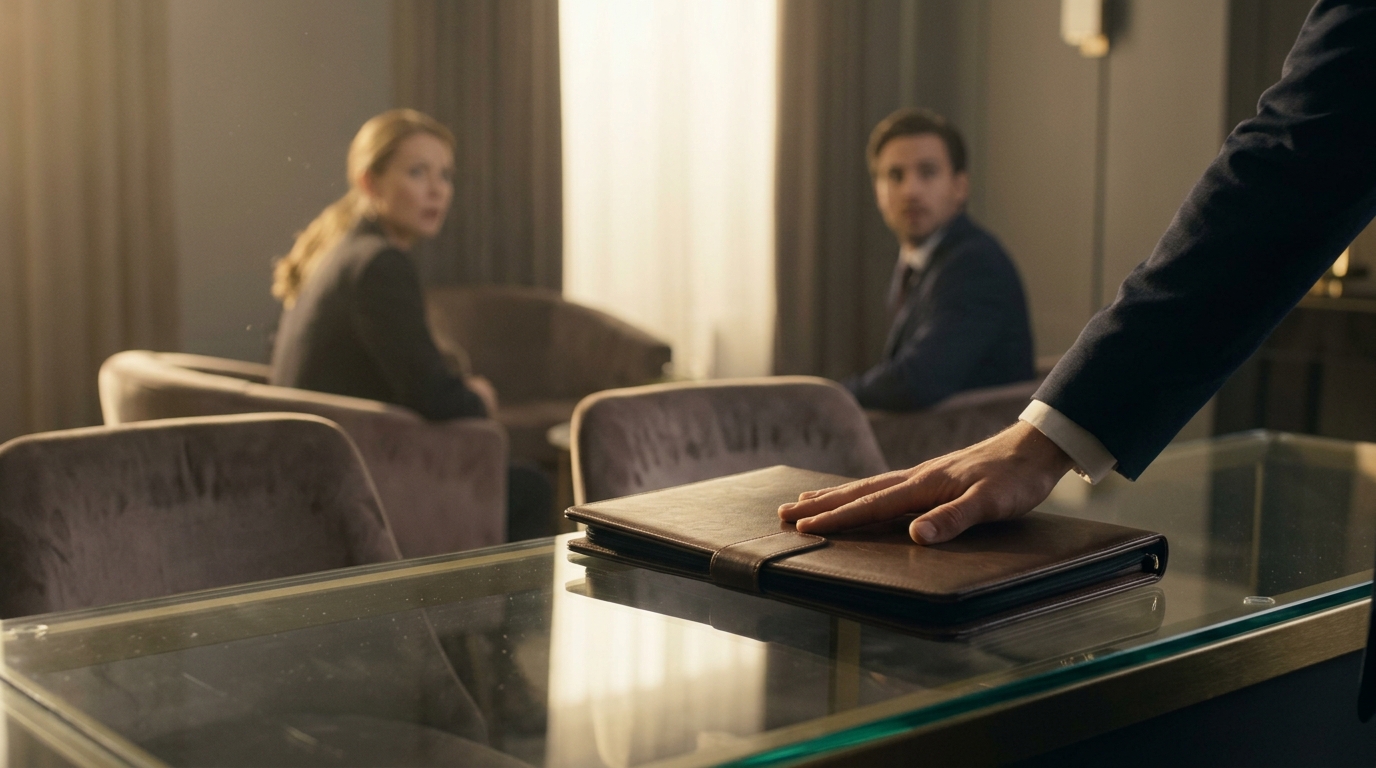
Until the folder hit the glass.
SLAM.
Heads turned.
A boy stood at the counter.
He looked twelve, maybe thirteen. His hair was neatly combed but damp from the rain outside. His navy school jacket was too thin for the cold. His shoes were polished, but old, the leather cracked near the toes. He carried no parent, no driver, no assistant, no sign that he belonged in a room where people discussed private portfolios and inheritance accounts over espresso.
Only a brown folder.
Pressed flat beneath one small hand.
The manager looked up from his tablet.
His name was Victor Hale.
He was a tall man with silver-rimmed glasses, a tailored suit, and the practiced expression of someone who had spent years deciding who mattered before they opened their mouth.
The boy spoke first.
“I just want to check my balance.”
For one second, no one reacted.
Then laughter broke from the far side of the lounge.
A woman in pearls lifted one hand to her lips, amused. A man in a charcoal suit smirked into his coffee. Two young bankers near the back exchanged glances. Someone muttered, “Is this a prank?”
Victor Hale’s smile was cold.
“You’re in the wrong place, kid.”
The boy did not move.
“My grandfather opened this account.”
The laughter softened.
Not because they respected him.
Because death entered the room.
The boy looked directly at the manager.
“He died last week.”
A few faces shifted.
One woman lowered her cup.
The security guard near the lounge entrance stepped closer, not aggressively yet, but with the confidence of a man used to removing people who made rich customers uncomfortable.
Victor Hale leaned one elbow on the counter.
“I’m sorry for your loss,” he said.
He did not sound sorry.
“But this lounge is reserved for important customers.”
The boy’s hand tightened slightly on the folder.
“My grandfather said this was where I should come.”
Victor’s smile thinned.
“And what was your grandfather’s name?”
“Arthur Bennett.”
The manager blinked.
Only once.
Then his face settled back into condescension.
“Do you have an appointment?”
“No.”
“Identification?”
The boy opened the folder and pulled out a small stack of papers.
“My birth certificate. My school ID. His death certificate. And this.”
He placed an old bank card on the glass.
It was black.
Not modern black metal like luxury clients loved to flash.
This one was old.
Worn at the edges.
With a faded gold emblem in the corner.
Victor stared at it.
His fingers did not touch it.
For the first time, something uncertain passed through his eyes.
Then he glanced around the lounge and remembered he had an audience.
He laughed softly.
“Where did you get this?”
“My grandfather gave it to me.”
“Before he died?”
The boy nodded.
“Convenient.”
The security guard moved closer.
The boy stayed composed.
“Please,” he said. “Just check.”
The word was polite.
But not weak.
Victor sighed loudly, as if humoring a child had become a burden placed on him by fate itself.
“Fine.”
He picked up the card with two fingers, like it might leave dirt behind.
He turned to his screen.
Typed slowly.
The lounge watched.
At first, Victor’s expression held its usual lazy arrogance.
Then his eyes narrowed.
He typed again.
Faster.
The screen refreshed.
His fingers paused.
He leaned closer.
The color drained from his face.
The woman in pearls stopped smiling.
The man in the charcoal suit sat upright.
Victor typed again, this time with both hands.
Then he stopped completely.
His mouth opened slightly.
“…it’s not possible,” he whispered.
The boy did not react.
Victor looked at the card.
Then at the boy.
Then back at the screen.
His hand began to tremble.
“Who…” His voice cracked. He swallowed and tried again. “Who are you?”
The boy locked eyes with him.
Calm.
Unfazed.
“My name is Noah Bennett.”
Victor’s face went white.
The security guard froze.
And somewhere behind the manager’s screen, a hidden account that had slept for twenty-two years had just awakened.
Video: Boy Humiliated in VIP Bank Lounge—Then the Manager Saw His Grandfather’s Account
Arthur Bennett’s Last Instruction
Noah Bennett had never been inside a VIP lounge before.
He had barely been inside banks at all.
His world was smaller than that.
A second-floor apartment above a closed bakery.
A school two bus rides away.
A narrow kitchen where his grandfather made oatmeal every morning and called it “fuel for kings.”
A cracked wooden table where they sorted bills every Friday night.
Arthur Bennett had raised Noah since he was five.
Noah’s parents were gone in the vague, painful way adults described things when they believed children could not survive details. His mother died first, from a sudden illness. His father disappeared a year later after promising to come back with work and never returning.
Arthur never lied about grief.
He only made it livable.
“Some people leave because they choose to,” he once told Noah. “Some because life drags them away. But you and I are here. So we build from here.”
And they did.
Arthur worked as a night watchman in an old warehouse district long after his knees began failing. He repaired neighbors’ radios for cash. He collected coins in glass jars labeled with careful handwriting.
Rent. Food. School. Emergency. Noah’s Future.
The last jar was always the emptiest.
Noah noticed.
Arthur pretended he didn’t.
To Noah, his grandfather was poor.
Proud, but poor.
The kind of poor that still pressed trousers under a mattress because an iron used too much electricity. The kind of poor that reused envelopes, saved rubber bands, and cut mold off bread instead of throwing the whole loaf away.
So when Arthur, lying in a hospital bed with oxygen beneath his nose, told Noah there was an account waiting for him at Dominion Trust Bank, Noah thought the fever had reached his mind.
“Grandpa,” he whispered, “you don’t have money at Dominion.”
Arthur smiled faintly.
“Not money.”
“What then?”
“A promise.”
Noah didn’t understand.
Arthur’s hand shook as he reached beneath his pillow and pulled out a black card wrapped in cloth.
“This card opens something I should have opened years ago.”
Noah took it carefully.
“Whose is it?”
“Mine.”
“But—”
Arthur closed his eyes for a moment, gathering strength.
“When I’m gone, you go to the main branch. Not the teller line. Not customer service. The VIP lounge.”
Noah almost laughed.
Arthur squeezed his hand.
“Listen to me. They will try to turn you away.”
“Why?”
“Because that is what people do when they think a child has no witness.”
Noah’s throat tightened.
“I don’t want money.”
“I know.”
“I want you.”
Arthur’s face softened with a pain too deep for comfort.
“I know, boy.”
He breathed slowly.
Then said, “In the folder, there is a sealed letter. Don’t open it until they check the account.”
“Why?”
“Because if you open it first, you may be too afraid to go.”
That was the last long conversation they had.
Arthur died two days later, just before dawn.
Noah sat beside him, holding the black card in both hands.
And one week later, with rain soaking through his school jacket, he walked into Dominion Trust Bank and entered a room designed to make people like him feel invisible.
The Account That Should Have Been Closed
Victor Hale stared at the computer screen.
His mind raced faster than his fingers could move.
The card should not have worked.
That was the first problem.
Old founder-tier access cards had been deactivated years ago, at least officially. They belonged to legacy accounts created before the bank merged, before digital systems, before modern compliance, before Victor Hale became regional manager and learned which records were safe to ignore.
The second problem was the name.
Arthur Bennett.
Victor knew that name.
Not because Arthur was a wealthy client.
Because Arthur Bennett was a ghost buried inside a file Victor had been told never to open.
Arthur Bennett had once been a founding security officer for the original Bennett & Vale Trust, the small private bank that later became Dominion Trust. He was not an owner, not officially. But he had been close to the founder, Henry Vale, and closer still to Henry’s daughter, Margaret.
There had been a scandal.
A fire.
A missing heir.
A sealed trust.
Victor had heard pieces over the years.
Never enough to care.
Until now.
The boy’s account did not display a normal balance.
It displayed a restricted trust marker.
BENNETT-VALE LEGACY HOLDING — BENEFICIARY ACTIVATION PENDING
Victor refreshed again.
The same line appeared.
Below it was a balance.
Not checking.
Not savings.
Not even a normal investment portfolio.
A consolidated trust value.
Victor stared at the number.
His throat went dry.
$418,672,904.17
The room seemed to tilt.
Noah watched him silently.
Victor lowered his voice.
“Where did you get this card?”
“I told you.”
“This account is restricted.”
“My grandfather said it would be.”
“You don’t understand.”
“No,” Noah said. “I don’t. That’s why I asked you to check.”
The answer irritated Victor because it was reasonable.
He hated reasonable answers from people he wanted to dismiss.
Victor glanced toward the glass wall of the VIP lounge. Several clients were openly watching now. Maria Chen, one of the senior wealth advisors, had risen from her desk. Her eyes were fixed on the screen Victor had foolishly angled too far.
She had seen enough.
“Victor,” she said slowly, “do you need assistance?”
“No,” he snapped.
Too fast.
Noah noticed that too.
Maria’s expression sharpened.
The security guard shifted uneasily.
Victor turned back to the boy.
“I need to verify these documents privately.”
Noah did not move.
“My grandfather said not to let the card leave my sight.”
Victor’s smile returned in a thinner, uglier shape.
“Your grandfather is dead.”
The room heard it.
The words landed hard.
Noah’s face changed for the first time.
Not fear.
Pain.
Maria stepped forward.
“Victor.”
He ignored her.
“Listen carefully, Noah. This may be a clerical error. If you found this card among your grandfather’s things, that does not make you entitled to anything.”
Noah opened the folder.
His hands were steady, though his face had gone pale.
“My grandfather also gave me this.”
He removed a sealed envelope.
Cream paper.
Red wax seal.
Stamped with an emblem matching the faded gold mark on the black card.
Victor’s body went cold.
Maria inhaled sharply.
She recognized it.
Any senior advisor would.
That was not a customer envelope.
That was a founder’s private trust seal.
Noah held it out.
“My grandfather said once the account woke up, I should give this to the person in charge.”
Victor reached for it.
Maria moved faster.
“No,” she said.
Victor turned on her.
“Excuse me?”
Maria’s voice was calm.
“This needs to be opened under dual custody with legal present.”
Victor’s eyes flashed.
“This is my branch.”
“And that is a founder-sealed trust document,” Maria said. “If you open it improperly, you’ll expose the bank.”
The word expose changed Victor’s expression.
Noah looked from one adult to the other.
For the first time, he understood his grandfather had not sent him to check a balance.
He had sent him to open a door.
And some people in the room were terrified of what stood behind it.
The Letter in the Seal
The bank’s legal counsel was called.
So was the regional compliance director.
So was the head of private trust operations.
The VIP lounge emptied slowly, though several clients lingered near the hall pretending to take calls. The man in the charcoal suit had stopped smiling entirely. The woman in pearls had quietly apologized to Noah before leaving, though she did it so awkwardly that Noah only nodded.
Victor tried three times to move the matter to his office.
Maria refused.
Noah refused because Maria did.
So they went to a glass conference room with cameras in the ceiling and recording systems activated.
Noah sat at one side of the long table, the brown folder in front of him.
He looked smaller there.
But not less steady.
Victor sat across from him, jaw tight.
Maria sat beside Noah, not too close, but clearly on his side of the table.
At 3:17 p.m., legal counsel arrived.
Her name was Helena Park.
She was a woman in her fifties with sharp eyes, a gray suit, and the exhausted look of someone who had spent her career cleaning up the arrogance of men in better offices.
She examined the card first.
Then the account marker.
Then the sealed envelope.
Her expression changed only once.
But Noah saw it.
So did Maria.
Helena looked at Victor.
“Why was this child nearly removed by security?”
Victor stiffened.
“There was confusion.”
Maria said, “He asked to check his balance. Victor refused until the old card was presented.”
Helena’s eyes remained on Victor.
“Did the customer provide identification?”
“He is a minor.”
“That is not what I asked.”
Victor said nothing.
Helena turned to Noah.
“Mr. Bennett, did your grandfather give you permission to present this envelope?”
Noah nodded.
“He said to give it after the account woke up.”
Helena’s face softened slightly.
“May I open it in front of you?”
Noah looked at Maria.
Maria nodded.
“Yes,” Noah said.
Helena broke the wax seal carefully.
Inside were three documents.
A letter.
A trust activation certificate.
And a photograph.
The photograph showed a younger Arthur Bennett standing beside an elderly man in a dark suit and a little girl with curly hair holding a stuffed rabbit.
On the back was written:
Henry Vale, Arthur Bennett, and Eleanor Vale — summer 1989.
Helena read the letter first.
The room grew colder with every line.
Finally, she looked up.
“Noah,” she said quietly, “I need to read part of this aloud.”
Victor shifted.
“Is that necessary?”
Helena did not look at him.
“Yes.”
She began.
To the officer of Dominion Trust who receives this letter:
If Arthur Bennett’s descendant presents the legacy card, it means Arthur is dead, and the final witness to the Vale succession fraud is gone. The child before you is to be treated as a protected beneficiary of the Bennett-Vale Legacy Holding. No branch employee, manager, trustee, or officer may deny access, conceal records, or redirect inquiry.
Victor’s face turned gray.
Noah sat very still.
Helena continued.
Arthur Bennett was not merely my employee. He was the guardian of my daughter’s child. If this letter is opened, the child presenting the card may be the living heir of Eleanor Vale, presumed dead under false circumstances.
Maria covered her mouth.
Noah whispered, “What?”
Helena’s voice softened.
The trust exists because I failed my daughter once. It shall not fail her child.
Noah stared at the photograph.
The little girl with the stuffed rabbit.
Eleanor Vale.
His grandfather had never mentioned her.
But something in her face looked familiar.
The eyes.
The shape of the mouth.
Noah looked like her.
Victor stood abruptly.
“This is outrageous.”
Helena turned to him.
“Sit down.”
“I will not be spoken to like—”
“Sit down, Mr. Hale, or I will have security remove you from the room while compliance freezes your credentials.”
Victor sat.
Slowly.
For the first time since Noah entered the bank, the manager looked like a man who understood that the floor beneath him was not as solid as he thought.
The Grandfather Who Kept a Secret
Noah did not cry in the conference room.
He wanted to.
But there were too many adults.
Too many glass walls.
Too much happening too quickly.
He focused on the photograph.
Arthur Bennett looked younger in it.
Stronger.
Standing beside Henry Vale, founder of the old bank, with one hand resting protectively near the little girl’s shoulder.
Eleanor Vale was maybe sixteen in the photo.
Smiling.
Alive.
Presumed dead under false circumstances.
The words kept circling in Noah’s mind.
Helena explained carefully.
Decades earlier, Henry Vale had one daughter: Eleanor. She was supposed to inherit controlling rights tied to the original bank and several family holdings. But Eleanor disappeared at seventeen after a family dispute. Official records said she drowned during a summer retreat.
Her body was never recovered.
Henry Vale never fully believed she was dead.
Before his own death, he created the Bennett-Vale Legacy Holding, a protected trust that would activate only if evidence emerged of Eleanor’s surviving child or lineal descendant.
Arthur Bennett was named as witness and temporary guardian of certain materials.
Noah listened without breathing properly.
“My grandfather was poor,” he said finally.
Helena looked at him.
“Sometimes people entrusted with secrets are kept poor by the people afraid of those secrets.”
Maria’s eyes moved toward Victor.
Victor looked away.
Noah opened his folder again and pulled out a second envelope.
“My grandfather said this one was for me after the first letter.”
His fingers shook now.
Maria said gently, “You don’t have to open it here.”
Noah looked around the conference room.
Victor.
Helena.
Maria.
The cameras.
The old card.
The account.
The photograph of a girl who looked like him.
“No,” he said. “I think he wanted witnesses.”
He opened it.
Arthur’s handwriting filled two pages.
Noah,
If you are reading this, then I am gone, and I am sorry.
I wanted to tell you everything while I was alive. I tried so many times. But truth without protection is just another danger, and I had to wait until the trust could protect you better than I could.
Your grandmother was Eleanor Vale.
Noah stopped reading.
The room blurred.
He blinked hard and forced himself to continue.
She was not drowned. She ran because her own family tried to force her into a marriage that would keep control of the bank in the hands of men who had already begun stealing from it.
I loved her.
I was only a security officer then. Not important. Not rich. Not someone her family would ever accept.
When she became pregnant, we planned to leave the city. Someone betrayed us. Eleanor vanished before we could run. I was told she died. Later, I learned she had given birth in secret.
That child was your mother.
Noah’s chest tightened.
My daughter?
His mother had not simply been Arthur’s daughter.
She had been Eleanor Vale’s child.
Arthur’s letter continued.
Your mother spent her life hidden because I was afraid. That is my shame. I told myself I was protecting her. Maybe I was. Maybe I also let cowards keep what should have been hers.
When your mother died, I promised I would not let the truth die with her. But you were little. Too little. So I waited.
I worked. I watched. I collected names.
Some of the men who buried Eleanor’s story are dead. Some are not. Some of their sons now sit in offices and call boys like you unimportant.
That line made Maria look at Victor again.
Noah kept reading.
The account is not a gift. It is a key.
Do not let them make you feel greedy for opening a door that was built for you before you were born.
You are not asking for charity.
You are claiming a name they stole.
I love you, boy.
I am sorry I left you with thunder.
Grandpa.
Noah folded the letter carefully.
His hands were shaking.
For a long moment, no one spoke.
Then Victor said the worst possible thing.
“This still proves nothing.”
Noah looked up.
And something in him changed.
The Boy Stops Asking
Until that moment, Noah had been polite.
Please check.
My grandfather said.
I just want to know.
He had walked into the bank as a boy asking adults to confirm something he did not understand.
But Victor’s words did what cruelty often does when it pushes one inch too far.
They burned away the last bit of fear.
Noah placed Arthur’s letter flat on the table.
Then the photograph.
Then the old card.
Then he looked at Helena Park.
“What happens now?”
Victor opened his mouth.
Noah did not look at him.
“What happens now?” he repeated.
Helena sat straighter.
“Now we secure the account. We verify your identity through legal channels. We notify the trust board. We freeze any suspicious activity tied to the legacy holding. And we appoint independent counsel for you, because the bank has a conflict.”
“What conflict?”
Helena glanced at Victor.
“The bank may have participated in keeping this dormant improperly.”
Victor snapped, “That is a dangerous accusation.”
Helena looked at him.
“It was meant to be.”
Maria leaned forward.
“Noah, do you have somewhere safe to stay tonight?”
The question hit him differently from all the others.
Safe.
His apartment above the bakery was empty now.
His grandfather’s chair still sat near the heater. His oatmeal pot was still on the stove. His school uniform hung behind the door.
He had neighbors.
A teacher who worried.
But no one waiting at home.
“My grandfather died,” he said.
Maria’s face softened.
“I know.”
“No,” Noah said quietly. “I mean… there’s no one else.”
The room changed.
Even Helena’s expression shifted.
Victor looked uncomfortable for the first time in a human way, though not enough to redeem him.
Helena made a note.
“Then temporary guardianship protection will be addressed today.”
Noah frowned.
“I don’t want to go with strangers.”
“You won’t be forced without explanation,” Maria said. “But if this trust is real, and if people have hidden it for years, then some people may not want you found.”
Noah understood that.
Arthur had understood it too.
That was why he waited until death to send Noah into the bank.
Because the old man had known the moment the account woke up, danger would wake with it.
The conference room door opened.
A man in an expensive suit stepped in without knocking.
He was older than Victor, with white hair, a red tie, and the entitlement of someone used to entering rooms already obeying him.
“Helena,” he said sharply. “What is going on?”
Victor stood quickly.
“Mr. Caldwell.”
Maria went rigid.
Helena’s face became unreadable.
Noah looked from one adult to another.
The man’s eyes landed on the old black card.
Then the photograph.
Then Noah.
For one second, his expression split open.
Shock.
Recognition.
Fear.
Then he smiled.
“Ah,” he said softly. “Arthur’s boy.”
Noah’s blood went cold.
He had never seen this man before.
But the man knew him.
And that was when Noah realized his grandfather had not sent him into a bank.
He had sent him into a battlefield.
Caldwell Knows the Name
The man was Richard Caldwell, chairman of Dominion Trust’s private holdings board.
He was also the son of William Caldwell, the man Arthur Bennett had named in a hidden note tucked behind the old photograph.
William Caldwell had been Henry Vale’s right hand.
The man who handled contracts.
Marriages.
Inheritance structures.
Disappearances softened into paperwork.
Richard Caldwell looked at Noah the way someone looks at a locked drawer that has unexpectedly opened.
“Everyone out,” Caldwell said.
Helena did not move.
“No.”
His eyes flicked to her.
“I beg your pardon?”
“This meeting is recorded, legally triggered, and involves a protected minor beneficiary. No one leaves except by documented agreement.”
Caldwell smiled.
“Helena, don’t be dramatic.”
Maria said quietly, “The account activated.”
Caldwell’s smile faded.
Fully this time.
He looked at the screen.
Then at Victor.
“You let it activate?”
Victor flushed.
“I didn’t know—”
“Clearly.”
Noah watched them.
The manager who had humiliated him was now being humiliated by someone richer.
Power had layers.
And people like Victor were brave only downward.
Caldwell turned to Noah.
His voice softened artificially.
“You’ve had a difficult day. I knew Arthur. He was a troubled man near the end.”
Noah said nothing.
“He filled your head with old stories, I imagine.”
Still, Noah said nothing.
Caldwell stepped closer.
“Whatever you think this is, it can be handled privately. Quietly. You’re young. You don’t want lawyers turning your grief into spectacle.”
Noah looked at Helena.
“Is he trying to scare me?”
Helena’s mouth twitched slightly.
“Yes.”
Caldwell’s face hardened.
“No, I am trying to protect him.”
Noah looked back at him.
“Like my grandfather protected my mother?”
The sentence landed.
Caldwell stared.
Then said softly, “Be careful, boy.”
Maria stood.
“That’s enough.”
Caldwell’s eyes moved to her.
“You should remember who signs executive recommendations here.”
Maria’s face paled, but she did not sit.
“I do.”
Helena closed the folder.
“Mr. Caldwell, compliance will now open a formal review of all Bennett-Vale Legacy Holding activity, including board-level access.”
Caldwell laughed once.
“You are making a career-ending mistake.”
Helena looked at Noah.
“No. I believe Mr. Hale began this meeting by deciding a child in old shoes wasn’t important enough to respect.”
Her eyes returned to Caldwell.
“I’m correcting the mistake before it becomes mine.”
For the first time that day, Noah felt something like protection.
Not certainty.
Not safety.
But the beginning of adults choosing the right side while it still cost something.
The Vault Recordings
The next forty-eight hours moved like a storm.
Noah was placed under temporary protective supervision through a court order arranged by Helena and an independent attorney named Samuel Ortiz. Maria Chen stayed involved as a witness, though Dominion suspended her “pending review” within a day.
That backfired.
Spectacularly.
Because Maria had copied her notes through proper compliance channels before they cut her access.
Victor Hale was put on leave.
Richard Caldwell issued a public statement about “legacy account irregularities.”
Noah hated every word.
Irregularities made it sound like a misplaced file.
Not a stolen life.
Then Samuel Ortiz found the vault recordings.
Arthur Bennett had left more than a card.
For years, he had rented a safe deposit box under a maintenance account tied to the original bank. Inside were cassette tapes, photographs, birth records, old letters, and a handwritten timeline.
Arthur had recorded everything he knew.
Eleanor Vale had not drowned.
She had been taken to a private clinic after giving birth to Noah’s mother. Her family declared her dead to prevent scandal and protect financial restructuring. Arthur was threatened with prosecution for “kidnapping” if he tried to find the child.
But he did find her.
Years later.
Noah’s mother, Clara.
Raised under another name.
Arthur did not tell her the full truth until she was older. By then, she wanted only peace. She had no interest in wealth, inheritance, or revenge.
Then Clara died young.
Arthur took Noah in.
And grief turned his regret into action.
The vault contained one recording that changed everything.
On it, William Caldwell’s voice could be heard speaking to Arthur in 1998.
“You will keep quiet, Bennett. The girl is gone. The child is contained. The money is protected. You want to raise your daughter? Then raise her poor and grateful.”
Noah listened once.
Only once.
Then he walked out of the room and vomited in the courthouse bathroom.
When he returned, Samuel Ortiz asked if he wanted to stop.
Noah wiped his mouth.
“No.”
The account was no longer just a balance.
It was evidence.
Back to the Bank
Three months after the folder slammed onto the glass counter, Noah returned to Dominion Trust.
This time, he did not enter through the rain.
He did not wear the thin navy school jacket.
He wore a dark suit chosen by Maria, who had been reinstated after public pressure and later promoted into an independent client protection role.
Samuel Ortiz walked beside him.
Helena Park waited at the entrance.
Reporters stood across the street, but Noah ignored them.
Inside, the VIP lounge was quiet again.
But not serene.
The staff knew who he was now.
Everyone did.
Noah Bennett.
Descendant of Eleanor Vale.
Protected beneficiary of the Bennett-Vale Legacy Holding.
The boy with the $418 million trust.
The child a bank manager laughed at.
Victor Hale was gone.
Richard Caldwell was under investigation.
Several board members had resigned.
Dominion Trust was facing regulatory review, lawsuits, and a scandal that reached back decades.
Noah walked to the same glass counter.
For a moment, he saw himself there again.
Small.
Wet from rain.
Trying to stay calm while people laughed.
Maria stood beside him.
“You okay?”
Noah looked at the counter.
Then nodded.
“Yeah.”
Helena handed him a document.
“This authorizes the first transfer.”
Noah read it carefully, just as Arthur had taught him.
The transfer was not for a mansion.
Not a car.
Not luxury.
It created the Arthur Bennett Witness Fund.
A legal aid and guardianship protection fund for children, elderly caregivers, and low-income heirs facing financial concealment, inheritance theft, or institutional intimidation.
Samuel had suggested a smaller name.
Noah refused.
“My grandfather stayed poor because rich men were afraid of the truth,” he said. “Use his name.”
So they did.
The first grant paid for Maria’s legal costs.
The second reopened a case involving an elderly woman pressured out of her family farm.
The third funded advocates for minors entering trust disputes.
When Noah signed the document, his hand shook.
Not from fear.
From weight.
Maria smiled faintly.
“Arthur would be proud.”
Noah looked at the old black card, now sealed in a protective case.
“I think he’d say I signed too slowly.”
Maria laughed.
“He probably would.”
Noah smiled.
Small.
Real.
The Balance That Mattered
People later told the story as if the most important moment was the number on the screen.
$418 million.
That was the part headlines loved.
Boy checks balance, discovers fortune.
Manager humiliates secret heir.
VIP lounge shocked by massive trust.
But Noah knew the balance was never the point.
The money had slept for years while his grandfather worked night shifts.
The money had grown while his mother died without knowing what could have helped her.
The money had sat protected inside systems built by men who used paperwork like walls.
The balance mattered because it proved theft.
But it did not heal it.
No amount could return Arthur’s years.
Or Clara’s health.
Or Eleanor’s life.
Or Noah’s childhood with a grandfather who counted coins while a fortune waited under a stolen name.
Still, money could become useful if it stopped being worshiped.
Arthur had said the account was not a gift.
It was a key.
Noah used it that way.
He stayed in school.
He kept the apartment above the bakery for one year, then turned the building into housing for students leaving foster care and grandparents raising grandchildren.
He bought Arthur’s warehouse and restored one room exactly as it had been, with the old desk, the metal lunchbox, and the radio Arthur used to repair.
On the wall, Noah hung a framed copy of the sentence from Arthur’s letter:
Do not let them make you feel greedy for opening a door that was built for you before you were born.
Years later, when Noah was old enough to sit on the trust board himself, he returned often to the bank.
Not because he liked it.
Because he remembered what it felt like to stand at the counter and be measured by shoes, jacket, and age.
Whenever a young person came in with uncertain documents and frightened eyes, Noah made sure someone sat down with them.
Not behind glass.
Beside them.
And every year, on the anniversary of Arthur’s death, Noah visited the old cemetery with oatmeal in a thermos.
“Fuel for kings,” he would say, placing the thermos near the stone.
Then he would tell his grandfather everything.
About the fund.
About Maria.
About the cases they won.
About the people who were believed because Arthur Bennett had refused to let the truth die quietly.
One rainy afternoon, many years later, Noah stood again outside the original Dominion Trust building.
The VIP lounge had been remodeled.
The glass counter was gone.
So was the crystal mint bowl.
In its place was a simple reception desk with a sign that read:
Every client deserves to be heard before they are judged.
Maria said the wording was too sentimental.
Noah said good.
Banks could use a little sentiment.
He looked through the window and remembered Victor Hale’s face turning pale.
Who are you?
At the time, Noah had answered with his name.
Now he understood the fuller answer.
He was Arthur Bennett’s grandson.
Eleanor Vale’s descendant.
Clara’s son.
A boy who walked into the wrong room and proved it had been his door all along.
And the balance that mattered most was not the number on the screen.
It was the debt finally paid to the truth.