The Basin on the Floor
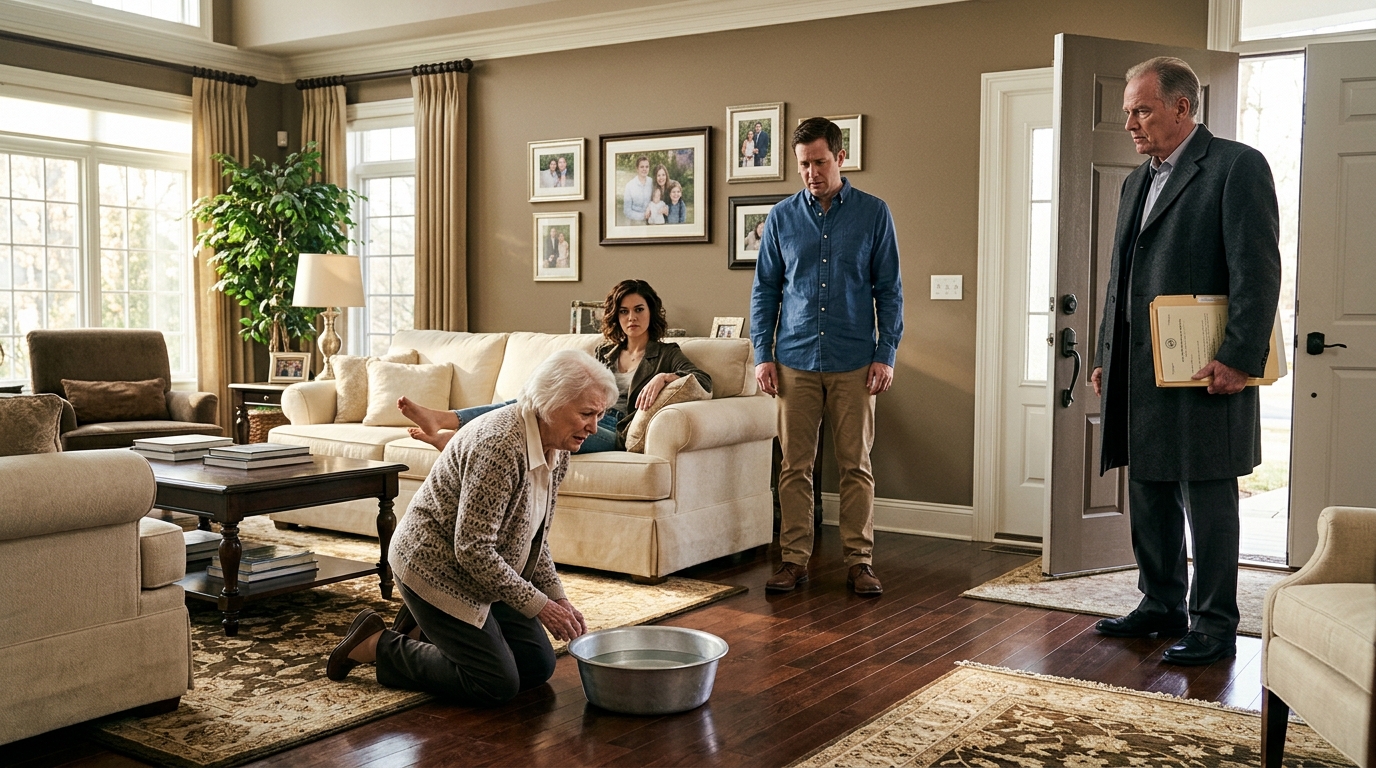
The metal basin scraped across the hardwood floor like a blade.
It hit the edge of the rug, spun once, and stopped in front of Margaret Whitmore’s knees.
The room went silent.
Not because silence belonged there.
Because everyone inside that house suddenly understood that something ugly had crossed a line.
Sunlight poured through the tall living room windows. It spilled over polished wood, cream-colored furniture, framed family portraits, and the old grandfather clock that had stood near the staircase for almost forty years.
Everything in that house looked warm.
Elegant.
Loved.
But in the center of the living room, a seventy-eight-year-old woman stood trembling in front of an icy basin while her son’s fiancée lounged on the couch like a queen waiting to be served.
“On your knees now,” Vanessa said coldly. “If you want to stay in this house, you wash my feet and beg properly.”
Margaret’s lips parted.
No words came out.
She was small now in a way she had never seemed small before. Her shoulders curved beneath a pale cardigan. Her silver hair was pinned loosely at the back of her head. Her hands, once steady enough to sew curtains, knead bread, and hold three babies through fevered nights, shook helplessly at her sides.
Behind her stood her son, Daniel.
Thirty-nine years old.
Well-dressed.
Pale.
Frozen.
“Vanessa…” he whispered.
But he did not move.
That was what broke Margaret more than the command.
Not the basin.
Not the icy water.
Not even Vanessa’s bare foot lifted toward her like an insult made physical.
It was Daniel’s silence.
Her only living son stood three feet away, horrified and ashamed, yet still unable—or unwilling—to stop the woman he planned to marry.
Vanessa turned her head toward him.
“What?” she snapped. “You said she needed to learn boundaries.”
Daniel flinched.
“I didn’t mean—”
“You didn’t mean what?” Vanessa asked. “That she lives here for free? That she still acts like this is her house? That she keeps walking around like some tragic little widow everyone has to worship?”
Margaret closed her eyes.
This was her house.
Or it had been.
Her husband, Thomas, had built it with his own hands and then rebuilt half of it after the first winter revealed every mistake he had made. They raised their children there. They celebrated birthdays in that living room. They brought home grandchildren beneath that roof. Thomas died in the upstairs bedroom with Margaret holding his hand and the rain tapping against the windows.
Every floorboard held a memory.
Every photograph on the wall had once meant family.
Now Vanessa kicked the basin closer.
“Down.”
Margaret looked at Daniel one last time.
His eyes were wet.
But his mouth stayed closed.
So she lowered herself.
Slowly.
Painfully.
Her knees touched the hardwood.
A sound moved through Daniel’s throat.
Not a word.
Not enough.
Margaret reached into the icy water.
Her fingers stiffened immediately.
Vanessa leaned back on the couch and extended one foot toward the old woman’s chest.
“Louder,” she said. “I want to hear you thank me for not throwing you out today.”
Margaret’s breath broke.
“This was my husband’s home,” she whispered.
Vanessa laughed.
A cruel, effortless sound.
“Not anymore.”
That was when the front door opened.
No knock.
No warning.
Just the click of the lock, the swing of the door, and the sudden arrival of a stern older man in a dark coat, holding a notarized folder under one arm.
Arthur Bell stepped into the living room and stopped.
He saw Margaret on her knees.
He saw the basin.
He saw Vanessa’s foot still extended toward the old woman.
He saw Daniel standing behind them, white-faced and useless.
The room froze with him.
Arthur Bell had been Thomas Whitmore’s attorney for thirty-two years.
He did not raise his voice.
He did not rush forward.
He simply stood in the doorway, looked at the scene in front of him, and said in a chillingly calm voice:
“Perfect.”
Vanessa’s smile faded.
Arthur lifted the notarized folder slightly.
“Now the woman who did this can hear the will before the police do.”
Daniel’s face went gray.
Margaret slowly lifted her tear-streaked face from the floor.
Vanessa sat up.
“What did you just say?”
Arthur stepped inside and closed the door behind him.
“Or,” he said, eyes fixed on Vanessa, “should I start with the clause written for the exact moment someone forced her to kneel in this house?”
Video: She Was Forced to Wash Her Son’s Fiancée’s Feet—Then the Lawyer Revealed the Will Had a Clause for That Exact Moment
The House Thomas Refused to Leave Unprotected
Thomas Whitmore had not trusted comfort.
That was one of the first things Arthur Bell had learned about him.
Thomas was a kind man, but he had not been naïve. He had grown up poor, built a construction business from nothing, and watched too many families destroy themselves after funerals because grief opened doors for greed.
He loved his children.
But he knew them.
His oldest daughter, Claire, had moved across the country years earlier and built a quiet life far from the family’s disputes. His younger son, Michael, died in a car accident at twenty-six. Daniel, the youngest, stayed closest to home but had always been the easiest to influence.
That had worried Thomas.
“Daniel has a good heart,” Thomas once told Arthur, sitting in the old study with a cup of black coffee. “But sometimes a good heart in a weak spine becomes somebody else’s weapon.”
Arthur remembered the sentence because it was the kind of thing Thomas said without drama.
A plain truth.
A warning.
After Margaret’s health began declining, Thomas revised the will.
Not because he distrusted Margaret.
Because he wanted her protected after he was gone.
The house was placed in a trust.
Margaret had lifetime occupancy rights.
No one could remove her.
No one could sell the home.
No one could force her into assisted living unless two independent doctors agreed she needed medical care beyond what could safely be provided at home.
Daniel could live there.
He could help manage expenses.
He could inherit part of the property later.
But only after Margaret’s death.
And only if he did not participate in coercing, humiliating, neglecting, or removing her.
Arthur had drafted the language himself.
Thomas had insisted on making it stronger.
“What if they don’t hit her?” Thomas asked.
Arthur looked up from the papers.
“What do you mean?”
“What if they make her life so miserable she leaves on her own?”
Arthur had seen that before.
Aging parents forced out not with fists, but with cold rooms, missing medication, insults, locked cabinets, threats, and family members saying, “You’re making this difficult.”
So Arthur added a clause.
It became known privately between him and Thomas as the dignity clause.
Any beneficiary who attempts to remove Margaret Whitmore from the residence by coercion, intimidation, humiliation, deprivation, forced servitude, or deliberate emotional abuse shall be deemed to have predeceased the grantor for purposes of inheritance.
Thomas read it twice.
Then said, “Add witnesses.”
Arthur did.
“Add immediate suspension of access.”
Arthur did.
“Add police referral.”
Arthur raised an eyebrow.
Thomas stared back.
Arthur added it.
Then Thomas added one more instruction.
“If someone ever makes Margaret kneel in her own home, Arthur, I want that to be the end of their claim to anything I built.”
At the time, Arthur thought the wording was emotional.
Too specific.
Almost symbolic.
Now, standing in Margaret’s living room, looking at Vanessa’s bare foot and the metal basin on the floor, he understood that Thomas had not been dramatic.
He had been accurate.
Vanessa Arrives Like a Favor
Vanessa had entered the family with perfect timing.
Six months after Thomas died, Daniel brought her to dinner.
Margaret had tried to like her.
She really had.
Vanessa was beautiful in a bright, polished way. Glossy hair. Elegant clothes. Careful laughter. She brought flowers the first time she visited and said all the right things about Thomas, though she had never met him.
“This home has so much soul,” Vanessa said, looking around the living room.
Margaret had smiled.
“It does.”
Daniel seemed lighter with her.
That mattered to Margaret.
After losing Thomas, she wanted her son to have happiness somewhere. Daniel had always been sensitive beneath his ambition. He worked in real estate but never had his father’s patience. He wanted success quickly, praise quickly, love quickly.
Vanessa gave him all three.
At first.
She admired him loudly.
Called him brilliant.
Told him he had been living under his father’s shadow too long.
Said the house needed “fresh energy.”
Said Margaret was “sweet, but emotionally dependent.”
Daniel repeated those phrases later as if he had thought of them himself.
Fresh energy.
Dependent.
Boundaries.
The first changes were small.
Vanessa rearranged the living room “just to open the space.”
Then she removed Thomas’s old chair because it made the room look “sad.”
Then she moved Margaret’s sewing basket from the sunroom to a closet.
Then the family photos were thinned.
Too many memories, Vanessa said, could trap grief.
Margaret did not fight every change.
She was tired.
That was the truth.
Grief made the house heavier. Her knees ached. Her hands stiffened. Sometimes she forgot why she walked into rooms. Daniel looked anxious whenever she objected.
So she let things go.
One chair.
One photograph.
One routine.
Then came the comments.
“Margaret, you spilled tea again.”
“Margaret, maybe you shouldn’t cook when guests are coming.”
“Margaret, Daniel and I need adult space.”
“Margaret, you don’t need to sit with us every evening.”
“Margaret, this house can’t remain a shrine forever.”
Each sentence alone sounded survivable.
Together, they became weather.
Cold weather.
Constant weather.
Margaret began eating breakfast earlier to avoid Vanessa’s sighs. She stayed in her bedroom when Daniel had friends over. She stopped inviting her bridge club because Vanessa said elderly chatter made the house feel like a waiting room.
Daniel noticed some of it.
Margaret knew he did.
But Vanessa always gave him a softer version.
“Your mother is adjusting.”
“She’s lonely, and I’m trying to help.”
“She twists things when she feels excluded.”
“Daniel, I love you, but I will not be abused by your mother’s guilt.”
And Daniel, who feared conflict more than cruelty, chose the easier interpretation.
The woman he loved was trying.
His mother was emotional.
The house was complicated.
No one was really hurting anyone.
That was how people became bystanders in their own homes.
The Day Vanessa Tried to Take the Deed
Two weeks before the basin, Vanessa invited a notary to the house.
Margaret had been in the garden clipping dead roses when Daniel came outside with a folder.
His face was tense.
“Mom, Vanessa and I think it would be smart to organize some paperwork.”
Margaret looked at the folder.
“What paperwork?”
“Just estate things.”
“Your father handled the estate.”
“I know, but some of it is outdated.”
Margaret’s hands tightened around the pruning shears.
“Arthur said everything was settled.”
Daniel shifted.
“Arthur is old-fashioned.”
The words did not sound like him.
They sounded like Vanessa.
Margaret put down the shears.
“What are you asking me to sign?”
Daniel opened the folder.
“There’s a document giving me broader authority over the house in case you become unable to manage decisions.”
Margaret stared at him.
“I am able to manage decisions.”
“I know, Mom.”
“Then why would I sign it?”
He looked toward the window.
Vanessa stood inside, watching.
Margaret followed his gaze and understood more than Daniel wanted her to.
“No,” she said.
Daniel’s face tightened.
“You didn’t even read it.”
“I said no.”
Vanessa entered the garden then, smiling.
“Margaret, please don’t make this adversarial.”
Margaret looked at her.
“It became adversarial when you brought a notary to my house without telling me.”
Vanessa’s smile vanished.
“Your house?”
Daniel whispered, “Vanessa…”
She turned on him.
“No. This is exactly the problem. She still thinks everything belongs to her.”
Margaret stood as straight as her aching knees allowed.
“Your problem is with Thomas, not me. He wrote the trust.”
Vanessa’s eyes changed.
It was the first time Margaret saw the anger beneath the polish.
“Thomas is dead.”
The garden went silent.
Daniel looked horrified.
Margaret felt something inside her go cold.
“Yes,” she said quietly. “But apparently he still knows you better than my son does.”
That was when Vanessa stopped pretending to be patient.
The notary was sent away.
The folder disappeared.
Daniel did not speak to Margaret for two days.
On the third day, Vanessa began calling Margaret “guest” in her own kitchen.
“Guests don’t criticize the menu.”
“Guests don’t rearrange furniture.”
“Guests should be grateful.”
Daniel heard it once.
Margaret saw him hear it.
He looked away.
That was the day something in her began to break.
Arthur Bell’s Suspicion
Arthur had not planned to arrive during the humiliation.
He had come because Thomas had planned better than anyone knew.
After the failed notary visit, Margaret called him.
She tried to sound calm.
She failed.
Arthur had known Margaret for decades. He knew the difference between worry and fear. Her voice carried both.
“They wanted me to sign something,” she told him.
“What exactly?”
“I don’t know. Daniel said authority over the house.”
Arthur became very still.
“Did you sign?”
“No.”
“Good.”
He asked her to send him a photo of any document she could find. She could not. Vanessa had taken the folder.
So Arthur did what attorneys do when families start circling assets.
He reviewed the trust.
Checked the property records.
Pulled recent filings.
And found something.
A preliminary transfer request had been drafted but not filed. Someone had accessed public trust information and begun preparing a petition suggesting Margaret’s cognitive decline required Daniel to assume control of residential decisions.
Attached was a physician form.
Blank.
Unsigned.
But ready.
Arthur knew then he had very little time.
He called Daniel twice.
No answer.
He called Vanessa once.
She hung up after he introduced himself.
Then he drove to the house with the notarized trust documents and a witness statement prepared.
He expected conflict.
He expected denial.
He expected perhaps a tense family meeting in the study.
He did not expect to find Margaret on her knees.
But the moment he saw her, the law became very simple.
The dignity clause had been triggered.
The Will Is Read in the Living Room
Vanessa stood up from the couch.
Her bare foot hit the floor beside the basin.
“Get out,” she said.
Arthur looked at her.
“No.”
“This is a private family matter.”
“It became a legal matter the moment you forced a protected lifetime resident to kneel and perform service under threat of eviction.”
Daniel’s voice came weakly.
“Arthur, please—”
Arthur turned to him.
“Help your mother up.”
Daniel froze.
The command seemed to strike him harder than Vanessa’s cruelty.
Arthur repeated it.
“Now.”
Daniel moved.
Finally.
He knelt beside Margaret, his hands shaking as he reached for her shoulders.
“Mom…”
She did not look at him at first.
That hurt him more than anger would have.
He helped her stand carefully. Her knees trembled. Her cardigan sleeve was wet from the basin. Her face was streaked with tears she had tried and failed to hide.
Vanessa crossed her arms.
“This is absurd. She’s being dramatic. I was teaching her respect.”
Arthur’s eyes sharpened.
“You were teaching her fear.”
Vanessa laughed.
“You don’t know anything about this family.”
Arthur lifted the folder.
“I know exactly what Thomas feared.”
The name changed the room.
Margaret closed her eyes.
Daniel lowered his head.
Vanessa scoffed.
“Oh, please. Don’t invoke the dead husband.”
Arthur opened the folder.
“I will read the relevant clause.”
Vanessa rolled her eyes.
Daniel whispered, “Vanessa, stop.”
She snapped, “No, Daniel. I am tired of being treated like an outsider in a house I’m expected to maintain.”
Margaret’s voice came softly.
“You don’t maintain this house.”
Vanessa turned.
Margaret looked at her now.
Really looked.
“You occupy it.”
For one second, Vanessa seemed ready to strike her.
Arthur saw it.
So did Daniel.
So did the phone in Arthur’s coat pocket, already recording.
Arthur began reading.
“Article Seven, Section Four: Protection of Margaret Elaine Whitmore’s lifetime occupancy and dignity.”
Vanessa’s expression shifted.
Not much.
Enough.
Arthur continued.
“No beneficiary, spouse, partner, agent, or person acting in concert with a beneficiary shall attempt to remove, coerce, intimidate, isolate, degrade, deprive, or humiliate Margaret Elaine Whitmore for the purpose of obtaining control, occupancy, title, financial advantage, or personal dominance within the residence.”
Daniel’s face crumpled.
Arthur kept reading.
“Any such act, including but not limited to threats of eviction, forced domestic service, public degradation, deliberate deprivation of comfort, or compelling Margaret Elaine Whitmore to kneel, beg, or otherwise submit as a condition of remaining in the residence, shall trigger immediate disinheritance of the participating beneficiary and suspension of residential access pending legal review.”
The room went dead silent.
Vanessa’s mouth opened.
No words came.
Arthur looked up.
“Thomas was specific.”
Margaret covered her mouth with one trembling hand.
Daniel looked as though he might collapse.
Vanessa recovered first.
“That can’t be enforceable.”
Arthur closed the folder.
“It is.”
“No court would—”
“It already has supporting affidavits, witness provisions, and emergency filing instructions. Thomas anticipated challenge.”
Vanessa pointed at Margaret.
“She manipulated him.”
Arthur’s voice lowered.
“Thomas wrote this because he knew someone might one day say exactly that.”
Daniel Finally Speaks
Daniel took one step away from Vanessa.
It was small.
But everyone saw it.
Vanessa saw it most.
“Daniel,” she said sharply.
He did not answer.
“Daniel.”
His eyes remained fixed on the basin.
The metal basin on the floor.
His mother’s wet sleeves.
His own shoes beside her knees.
The scene finally reached him fully.
Not as discomfort.
Not as something to smooth over later.
As fact.
He had watched.
He had stood in the room while the woman who raised him was forced onto the floor.
His voice shook.
“What have I done?”
Vanessa’s face hardened.
“Oh, don’t start.”
Daniel looked at her.
That was new.
Really looked.
“I let you do this.”
“You let me?” she snapped. “You begged me to help you handle her.”
“I said I didn’t know how to set boundaries.”
“And I set them.”
“You humiliated her.”
Vanessa laughed.
“She humiliates herself by clinging to a house that should be ours.”
Margaret flinched at the word ours.
Daniel heard it now.
Perhaps he had heard it before and refused to understand.
Ours.
Not family.
Not home.
Property.
Arthur watched quietly.
Sometimes legal consequences matter less than the exact second a weak man realizes weakness has made him cruel.
Daniel turned to his mother.
“Mom.”
Margaret looked at him.
The pain in her eyes almost made him look away again.
But this time, he didn’t.
“I’m sorry.”
The words were too small.
They always are.
Margaret did not forgive him.
Not then.
She only said, “You watched.”
Daniel’s face twisted.
“Yes.”
The single word held more shame than any speech could.
Vanessa grabbed her shoes from beside the couch.
“This is pathetic. Daniel, we’re leaving.”
Daniel turned.
“No.”
She froze.
“What?”
“You’re leaving.”
The room shifted.
Vanessa stared at him, stunned.
Daniel’s hands shook, but his voice became clearer.
“This is my mother’s home. My father protected it. I should have protected it. You need to leave.”
Vanessa’s face flushed.
“You spineless coward.”
Daniel flinched.
But he did not fold.
“Arthur,” he said, voice breaking, “what happens now?”
Arthur looked at Vanessa.
“I call the police.”
The Police Arrive
Vanessa tried to leave before officers arrived.
Arthur stopped her with one sentence.
“If you walk out before they take statements, I will inform them you fled after elder abuse allegations were raised.”
She called him a fossil.
He accepted the title without concern.
The police arrived within fifteen minutes.
Two officers entered the living room, and the scene told much of the story before anyone spoke.
The basin still sat on the floor.
The water still shimmered with cold.
Margaret’s sleeves were wet.
Vanessa’s bare footprints marked the hardwood near the couch.
Arthur’s recording existed.
So did the security camera Thomas had installed years ago in the front hall. It had captured the audio clearly enough.
On your knees now.
Wash my feet.
Thank me for not throwing you out.
Police took statements.
Margaret gave hers softly.
Daniel gave his with his head down.
Vanessa denied everything at first.
Then said it was a misunderstanding.
Then said Margaret had agreed.
Then said it was a private spiritual ritual.
Even one officer blinked at that.
Arthur said, “She kicked a basin at her and demanded domestic submission under threat of eviction. I recommend plain language.”
Vanessa glared at him.
The officers did not arrest her immediately in handcuffs in front of everyone, though Daniel later wished they had. Real life often moves less dramatically than justice deserves. But they escorted her from the property and opened an investigation into elder abuse, coercion, and attempted financial exploitation.
Arthur filed the emergency petition the same afternoon.
By sunset, Vanessa was barred from entering the property.
Daniel’s beneficiary status was suspended pending review due to his failure to intervene and possible participation in coercive pressure.
That part stunned him.
“I didn’t force her,” he said to Arthur.
Arthur looked at him tiredly.
“No. You only made it possible.”
Daniel had no defense.
Margaret Sleeps in Her Own Room
That night, Margaret slept in the upstairs bedroom she had shared with Thomas for fifty-one years.
For the first time in months, the house was quiet without feeling hostile.
Daniel stayed downstairs.
He did not ask to come up.
He did not ask if she forgave him.
That was wise.
Arthur arranged for a caregiver to stay overnight, not because Margaret could not function, but because no one wanted her alone after what had happened.
Claire, Margaret’s daughter, flew in the next morning.
She had not known how bad things had become.
When she saw her mother’s bruised knees and wet cardigan drying over the chair, she wept with a rage so clean and bright that Daniel could not stand in the same room.
Claire slapped him.
No one stopped her.
Margaret said only, “Claire.”
Her daughter stepped back, breathing hard.
Daniel accepted the slap.
Then Claire said something that hurt worse.
“Michael would have stopped her.”
Daniel closed his eyes.
Their dead brother’s name filled the room.
“Yes,” he whispered. “He would have.”
The following weeks were not simple.
Vanessa fought.
Of course she did.
She claimed Daniel had promised her the house.
She produced text messages where Daniel complained about his mother being stubborn.
She showed voice notes of him saying, “I can’t live like this forever.”
None of it helped him.
In fact, it hurt him.
Because the court saw what Arthur had warned: Vanessa had not acted alone in spirit, even if she had acted alone in the final humiliation.
Daniel had allowed resentment to become permission.
The judge upheld the emergency protection.
Vanessa was removed from any claim connected to the residence.
Daniel’s inheritance was placed under conditional review. He would receive nothing unless he completed counseling, made restitution for legal costs, and had no further involvement in pressuring Margaret about the house.
Margaret, however, made her own decision before the court finished deciding.
She asked Arthur to amend her personal directives.
Daniel would not manage her care.
Claire would.
The house would remain hers for life.
After her death, it would become the Thomas Whitmore House for Elder Advocacy, a small legal aid and respite center for older adults experiencing family coercion over property.
Daniel cried when Arthur told him.
Margaret did not.
She had cried enough on the floor.
The Son Who Had to Knock
Daniel moved out for six months.
Not because Margaret demanded punishment.
Because the house needed to breathe without him.
He rented a small apartment twenty minutes away and began therapy because the court required it. At first, he treated it like a task to complete.
Then one day the therapist asked him:
“When did you first learn that silence keeps you safe?”
That question undid him.
He talked about Thomas.
A good father, yes.
But strong.
Commanding.
Hard to disappoint.
He talked about being the youngest and feeling always behind Claire’s confidence and Michael’s courage.
He talked about choosing women who told him what to do because certainty felt like love when it removed responsibility.
Then he talked about the basin.
Again.
Again.
Again.
Until he could no longer hide from the truth.
He had not been trapped.
He had chosen comfort over courage until his mother paid the price.
Six months later, Daniel visited Margaret.
He knocked.
That mattered.
He stood on the porch with no key, no Vanessa, no folder, no assumptions.
Margaret opened the door herself.
She looked older.
But stronger.
“Hello, Daniel.”
“Hi, Mom.”
He held flowers.
Then seemed to realize flowers were ridiculous.
“I didn’t know what to bring.”
Margaret looked at them.
“Your father always brought flowers when he didn’t know what to say.”
Daniel’s face twisted.
“Did it work?”
“Rarely.”
He laughed once, painfully.
She let him in.
They sat in the living room.
The couch Vanessa had lounged on was gone.
Thomas’s old chair was back.
The basin had been thrown away, though Claire had wanted to keep it as evidence and possibly a weapon.
Daniel looked at the chair.
“I missed that.”
Margaret said, “So did I.”
Silence settled.
Then Daniel said, “I am not here to ask for forgiveness.”
Margaret watched him.
“I’m here to say what I should have said that day. You should never have had to look at me and wonder if your son would protect you.”
Her eyes filled, but she did not interrupt.
“I failed you before the basin,” he continued. “Not just during it. Every time I let her insult you. Every time I repeated her words. Every time I told myself you were difficult because it was easier than admitting I was afraid.”
Margaret’s hands trembled in her lap.
Daniel lowered his head.
“I don’t expect to inherit anything. I don’t deserve to. I just want to become someone who would have stood up.”
That was the first honest thing he had said in a long time.
Margaret looked toward Thomas’s chair.
Then back at her son.
“Becoming that person will take longer than saying it.”
“I know.”
“Good.”
She poured tea.
Not as forgiveness.
As a beginning.
Daniel understood the difference.
The Clause Becomes a Warning
A year later, the Thomas Whitmore House opened quietly.
No ribbon cutting with oversized scissors.
Margaret hated that sort of thing.
Instead, there was coffee, folding chairs, legal pamphlets, and a small plaque near the front door:
Dignity is not a condition of inheritance.
It is a condition of love.
Arthur Bell gave a short speech.
Claire gave a sharper one.
Margaret said only a few words.
“This house was built by my husband,” she told the small crowd. “For many years, I thought that meant walls, floors, windows, and rooms. I know now he built something else too. Protection.”
She paused.
Her hands rested on her cane.
“I hope no one who comes here ever has to kneel to prove they deserve shelter.”
No one spoke for a moment after that.
Then the applause came.
Soft.
Respectful.
Daniel stood near the back.
He had helped set up chairs that morning and left before Margaret could feel pressured to thank him. Claire noticed. She said nothing, which from Claire was almost generosity.
Vanessa never returned.
Her legal troubles followed her into other rooms. Once the Whitmore case became public, another family came forward. Then another. Vanessa had a history of attaching herself to vulnerable heirs, isolated sons, aging parents, and properties tied up in grief.
The basin had not been her first cruelty.
It had simply been the first one witnessed by the right person at the right time.
Arthur kept a copy of the dignity clause in his office.
He began recommending similar language to clients with complicated families.
“Specificity saves,” he told younger attorneys. “Do not assume decency will interpret vague wishes kindly.”
Margaret lived in the house for four more years.
She spent mornings in the sunroom with her sewing basket restored to its old place. She hosted bridge club again. She placed every family photograph back on the wall, including one of Daniel as a little boy holding a fish too small to justify his grin.
Daniel visited every Sunday.
He always knocked.
Sometimes Margaret let him cook.
Sometimes she did not.
Sometimes they spoke warmly.
Sometimes she grew quiet, remembering the floor, the basin, the silence.
Daniel learned not to rush her past it.
That became part of his repair.
Not demanding that time erase what he had not stopped.
On Margaret’s eightieth birthday, Daniel gave her a small wooden box.
Inside was a key.
Not to the house.
He did not presume that.
It was the key to Thomas’s old workshop, which Daniel had restored behind the property.
“I thought the advocacy center might use it for storage,” he said. “Or classes. Or whatever you want.”
Margaret held the key.
Then looked at him.
“Your father would like that.”
Daniel swallowed.
“I hope so.”
Margaret reached across the table and touched his hand.
It was not absolution.
But it was grace.
And grace, Daniel had learned, was not owed.
It was received carefully.
The Home That Refused to Become a Prize
After Margaret died at eighty-two, the house did not go to Daniel.
He did not contest it.
Vanessa’s attorneys sent one letter suggesting unresolved claims.
Arthur replied with three pages and a copy of the dignity clause.
They did not send a second letter.
The Thomas Whitmore House expanded.
The living room where Margaret had been forced to kneel became a consultation room. The hardwood floor was refinished, but a small square near the center remained slightly darker than the rest.
Claire wanted it replaced.
Daniel asked that it remain.
Margaret had agreed before her death.
Not as a shrine to pain.
As a reminder.
People sat in that room and told stories that sounded different but were really the same.
A daughter pressuring her father to sign over a deed.
A nephew threatening to move his aunt into a facility unless she changed her will.
A caregiver isolating an elderly widower from old friends.
A son “borrowing” money until refusal became emotional punishment.
A new spouse slowly removing photographs, routines, and dignity.
They came ashamed.
Confused.
Afraid of sounding ungrateful.
The advocates listened.
Arthur, older now and slower but still sharp, trained volunteers to ask one question early:
“Do you feel safe saying no in your own home?”
That question opened many doors.
Daniel became one of the center’s quiet donors.
No plaques.
No speeches.
No name on the wall.
He funded transportation for seniors who needed rides to legal appointments.
Claire approved of that because it was useful and not self-pitying.
On the fifth anniversary of the center’s opening, Daniel stood alone in the old living room after everyone left.
The afternoon sun crossed the hardwood.
Thomas’s chair sat near the window.
Margaret’s sewing basket rested beside it, preserved there by Claire’s insistence.
Daniel looked at the darker square on the floor.
He could still see the basin if he let himself.
His mother’s hands in the water.
Vanessa’s foot.
His own silence.
He did not look away.
That was the work.
Not drowning in guilt.
Not escaping it.
Standing where he failed and choosing, again and again, to become someone different.
Arthur found him there.
“You all right?”
Daniel gave a faint smile.
“Not exactly.”
Arthur nodded.
“That’s often the honest answer.”
Daniel looked around the room.
“He knew, didn’t he?”
“Your father?”
Daniel nodded.
Arthur stepped beside him.
“He knew people. He knew weakness. He knew love can become leverage in the wrong hands.”
Daniel’s throat tightened.
“And he knew me.”
Arthur did not soften the truth.
“Yes.”
Daniel closed his eyes.
After a moment, he said, “Thank God.”
Arthur looked at him.
Daniel opened his eyes again.
“Thank God he protected her from me too.”
The old attorney said nothing for a while.
Then he placed one hand on Daniel’s shoulder.
“That may be the first inheritance you’ve actually accepted.”
Outside, the front door opened.
An elderly woman entered with her granddaughter, both looking nervous. A volunteer greeted them gently.
The house continued its work.
The same walls.
The same sunlight.
The same floor.
But now, no one who came there had to beg for the right to remain human.
That had been Thomas’s final gift.
Not the house itself.
Not the money.
Not the legal language, though that mattered.
His final gift was the belief that dignity should be defended before it was destroyed.
Vanessa had thought the house was a prize.
Daniel had thought silence would keep peace.
Margaret had thought, for one terrible moment, that she had been abandoned in the home she helped build.
Then Arthur opened the door.
And a clause written years earlier rose like Thomas himself standing in the room, saying:
No.
Not here.
Not to her.
Not in this house.