The Cane He Shouldn’t Have Touched
The first thing people noticed about me was the cane.
That was intentional.
Old men are allowed to carry canes without explanation. People see the silver hair, the careful walk, the slow way a hand rests on polished wood, and they create the rest of the story themselves.
Weak.
Harmless.
Past tense.
I let them.
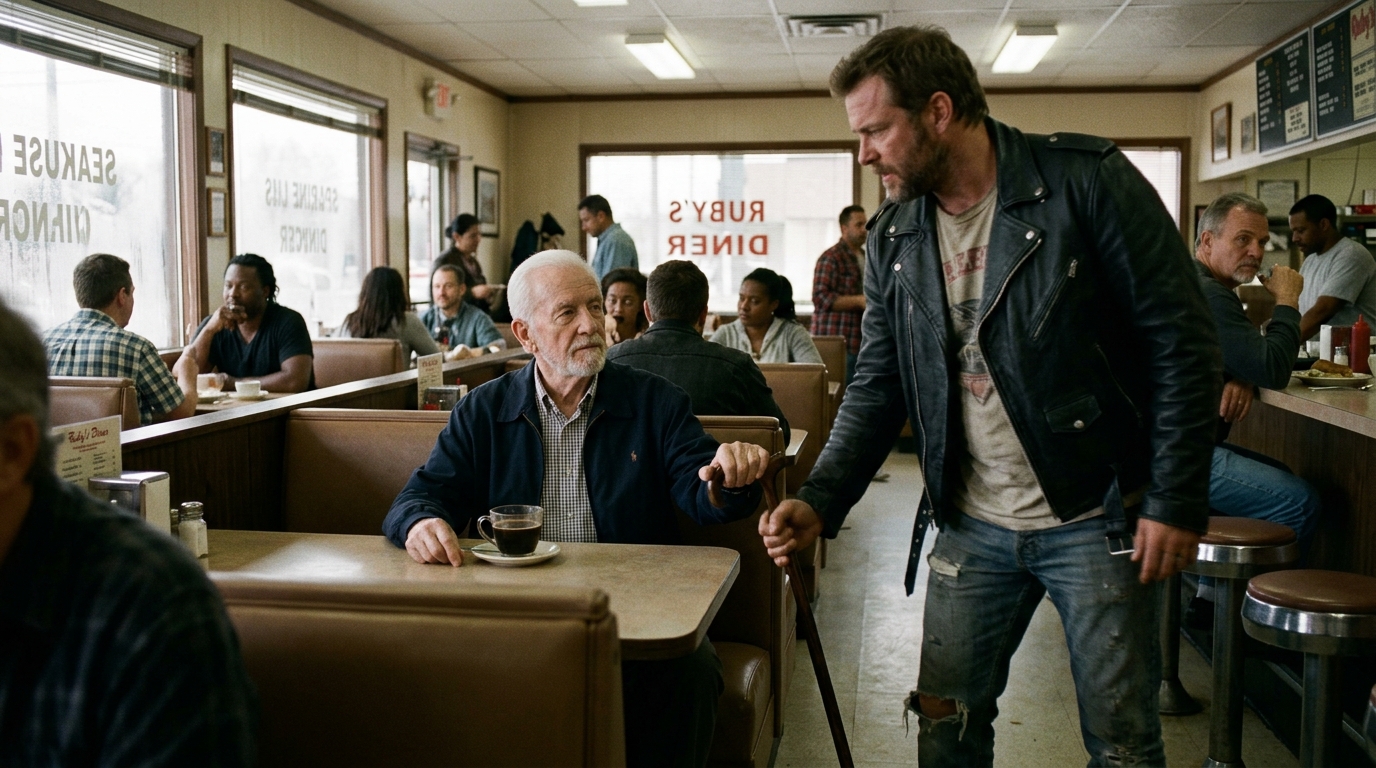
That morning, I sat alone in the corner booth of Miller’s Diner, watching steam curl from a cup of black coffee I had no intention of drinking.
The diner was warm in the way old places are warm. Grease in the walls. Sugar on the tables. Coffee burned too long in glass pots. A bell over the door that sounded tired every time someone entered.
Outside, late November rain streaked the windows.
Inside, plates clattered, waitresses moved fast, and nobody knew why I had chosen that booth.
But I knew.
From where I sat, I could see the front door, the side hallway, the register, and the long mirror behind the counter.
More importantly, the security camera above the pie case could see me.
That mattered.
At seventy-two, you learn to arrange a room before trouble arrives.
My name was Elias Mercer.
Most people in town knew me only as the old widower who lived out near Route 11. Quiet man. Bad hip. Paid cash. Tipped well. Kept to himself.
That was the version I had spent six years building.
Before that, my name meant something else.
Hawk.
Men used to say it with respect.
Some with fear.
Some with debt.
But nobody had called me that in public for a long time.
Not since my son was buried.
Not since the brotherhood I built turned its back on me.
Not since the men who called me family decided a dead boy and a silent old man were more convenient than the truth.
I looked down at the cane.
Dark hickory.
Steel cap.
Heavy handle worn smooth by my palm.
To anyone else, it was a walking stick.
To me, it was the last thing my son ever made.
Jonah carved it in my garage on a rainy Saturday when he was thirty-one and already carrying secrets too large for his chest. He told me I would need it someday.
I laughed at him.
I was still strong then.
He did not laugh back.
That should have warned me.
The bell over the diner door snapped sharply.
The room changed before anyone spoke.
Heavy boots.
Wet leather.
Loud voices pretending to be confidence.
Four bikers entered first, followed by three more. Jackets dark from rain. Beards thick. Rings on fingers. Patches on their backs that made my stomach harden even after all these years.
Iron Vultures.
The name had not always been ugly.
Once, before Roman Vale took control, we had been a club of veterans, mechanics, truckers, and men who knew how to fix engines better than they knew how to talk about pain.
We raised money after fires.
We escorted funeral processions.
We found missing teenagers before the police did.
Then money came in.
Then guns.
Then favors.
Then Roman.
And then my son died.
The largest biker scanned the diner like a man choosing what kind of performance he wanted to give. Broad shoulders. Shaved head. Red beard. A scar near his mouth.
Caleb Vale.
Roman’s youngest.
I knew him as a boy once.
He used to steal peaches from my wife’s kitchen and call me Uncle Hawk.
Now he walked like the world had failed to hit him hard enough.
His eyes landed on me.
Stayed there.
Something moved across his face.
Not recognition.
Opportunity.
Men like Caleb can smell someone they think will not fight back.
He grinned.
The waitress, Marcy, stiffened behind the counter. She knew enough about men like him to lower her eyes and keep her hands busy.
Caleb swaggered toward my booth.
The other bikers spread out behind him, hungry for entertainment.
“Well,” he said, looking down at me. “Look what we got here.”
I said nothing.
He leaned one hand on the table, close enough that I could smell rain and whiskey on his jacket.
“You lost, old timer?”
The diner quieted.
Not completely.
Enough.
Forks slowed.
Coffee cups paused.
People sensed danger and did what people usually do around danger when it has not chosen them yet.
They became furniture.
Caleb’s gaze dropped to my cane.
“Nice stick.”
His hand shot out.
Fast.
He snatched it before anyone could breathe.
The coffee cup trembled.
The water glass tipped.
Glass hit the floor and shattered.
Cold water spread across the tile, soaking the edge of my trouser leg.
Laughter erupted from the bikers behind him.
“Look at him now,” one of them shouted.
Caleb twirled the cane once, badly, mockingly, then dragged it across the floor as he walked away.
The steel tip scraped.
The sound cut through me.
Not because he had insulted me.
Because that cane still carried Jonah’s fingerprints in places no one could see.
Caleb dropped it near the center aisle.
It hit the floor with a crack that made Marcy flinch.
More laughter.
I did not stand.
I did not shout.
I looked down at the spilled water.
Then I reached inside my jacket and pulled out the small black device I had carried for six years.
Not a phone.
Not exactly.
A secure transmitter with one button.
Jonah had given it to me the week before he died.
“If it ever happens in public,” he said, “press this first. Not last.”
I had waited six years to understand what he meant.
Now I pressed it.
The device vibrated once.
A signal went out.
I held it to my ear though I did not need to.
Then I said calmly,
“It’s me. Bring them.”
The laughter continued.
But not all of it.
At the far end of the diner, one biker stopped.
A thin man with a gray braid and a faded scar across his eyebrow. He had been half laughing with the others until my voice reached him.
His mouth closed.
His eyes narrowed.
He stared at me.
Really stared.
Then his face changed.
He leaned toward the man beside him and whispered,
“No way.”
I looked at him.
And smiled for the first time.
Because someone in that room finally knew what Caleb had just touched.
The Man Who Remembered the Patch
The thin biker’s name was Reuben Shaw.
Most men called him Rue.
I remembered him at twenty-two, standing outside my garage with a busted carburetor in one hand and pride in the other, refusing charity while clearly needing it.
Jonah fixed his bike for free.
My wife fed him stew.
I gave him his first club patch.
That was before prison hardened him, before Roman used him, before loyalty became a leash around his throat.
Rue stared at me from the end of the diner like a man watching a grave open.
Caleb noticed.
“What’s wrong with you?” he barked.
Rue did not answer.
His eyes moved from my face to the cane lying on the floor.
Then to the steel cap.
Then back to me.
He had recognized it.
Good.
Jonah had carved a hawk beneath the handle. Small. Hidden. A private joke between father and son.
But Rue knew.
He had seen Jonah work on that cane in our garage.
He had sat at our table the night Jonah burned the design into the wood.
Caleb followed Rue’s stare and laughed.
“What, you scared of grandpa?”
No one answered.
The laughter weakened.
That is how fear enters a room.
Not all at once.
It starts by making jokes feel unsafe.
I reached for a napkin and slowly dried my hand.
Marcy hurried toward me with a towel, her face pale.
“Mr. Mercer, are you all right?”
“I’m fine.”
She looked at the cane.
Then at Caleb.
Then at me.
“No,” she whispered. “You’re not.”
I touched her wrist gently.
“Leave it.”
She hesitated, then backed away.
Smart woman.
Braver than most men in that diner.
Caleb picked up the cane again, annoyed now that the laughter had thinned.
“What is this thing?” he said. “Some kind of holy stick?”
Rue finally spoke.
“Put it down.”
His voice was low.
Caleb turned toward him.
“What?”
“Put. It. Down.”
The room shifted again.
A biker correcting another biker in public is not a suggestion.
It is a fracture.
Caleb’s face darkened.
“You forget who I am?”
Rue’s jaw tightened.
“No. That’s the problem.”
I watched Caleb’s fingers tighten around my cane.
He was not intelligent, but he was not completely stupid. He understood something had changed. He simply did not know which direction danger had come from.
He turned back to me.
“Who are you?”
I lifted my eyes to his.
“You don’t know?”
His expression flickered.
That irritated him.
Men like Caleb hate being the only person missing a secret.
He stepped closer.
“Maybe I should break this over my knee and find out.”
Rue moved fast.
Not at Caleb.
Toward the cane.
Two of the bikers grabbed him before he reached it.
“Don’t,” Rue said, his voice cracking now.
Caleb smiled.
There it was.
The cruelty that came from realizing someone else cared.
He held the cane out in both hands.
“Don’t what?”
Rue’s face had gone white.
“That was Jonah’s.”
The name dropped into the diner like a gunshot.
Even the kitchen sounds stopped.
Jonah Mercer.
My son.
My only child.
The official story said he died in a motorcycle crash on Blackwater Road.
Wet pavement.
High speed.
No witnesses.
No charges.
The club buried him with a patch on his chest and lies in their mouths.
Caleb stared at Rue.
Then slowly turned toward me.
This time, he looked harder.
The old face.
The snowy hair.
The beard.
The cane.
The silence.
I watched the truth arrive too late.
His mouth parted.
“No.”
I did not blink.
“Yes.”
He took half a step back.
The bikers behind him went quiet.
Not respectful.
Afraid of being wrong in public.
Rue’s voice dropped to a whisper.
“Hawk.”
Marcy covered her mouth.
An older man at the counter turned slowly on his stool.
The name moved through the diner in pieces.
Hawk.
Hawk Mercer.
I saw recognition spark in older faces.
Not all of them.
Enough.
Some remembered the charity rides.
Some remembered the funerals.
Some remembered the night Jonah died and the Iron Vultures changed their patch colors before the dirt settled on his grave.
Caleb swallowed.
Then tried to laugh.
A poor choice.
“Thought you were dead.”
“Many people found that convenient.”
His eyes sharpened.
“What do you want?”
I looked toward the window.
Outside, headlights turned into the diner lot.
Not one vehicle.
Several.
Black SUVs.
A state police cruiser.
A white van with no markings.
Caleb saw them too.
The red drained from his face.
The bell over the door rang.
A woman in a dark coat entered first.
Agent Rachel Voss.
Federal organized crime division.
Beside her came Detective Harris from county homicide, older now but still carrying the same tired eyes he had worn when he told me my son’s case was closed.
Behind them came three men I never thought I would see in one room again.
Old Vultures.
Original members.
Men who had vanished after Roman took power.
Men Jonah had trusted.
Men who had spent six years staying alive long enough to come back.
Caleb stepped away from the cane.
Too late.
Rachel Voss looked at him.
Then at me.
Then at the diner camera above the pie case.
“Did he touch it?” she asked.
I nodded.
“With both hands.”
Caleb frowned.
“What the hell is this?”
Rachel removed a pair of gloves from her pocket.
“This,” she said, looking at the cane, “is evidence in a murder investigation.”
Caleb’s mouth opened.
But before he could lie, the front door opened again.
And his father walked in.
The Father Who Sent His Son First
Roman Vale looked older than I expected.
That pleased me less than I thought it would.
I had imagined him preserved in my hatred. Tall, black-haired, smiling with that easy liar’s charm. The man who could make betrayal sound like strategy and murder sound like grief.
But time had worked on him too.
His beard was white now. His shoulders remained broad, but stiffness had entered his walk. His eyes, however, were unchanged.
Cold.
Assessing.
Always counting exits.
He entered the diner with two men behind him and stopped when he saw me sitting in the corner booth.
For one second, the years fell away.
We were young again.
Two veterans in a garage, building engines and pretending we could build better lives.
He used to call me brother.
I used to believe him.
“Hawk,” Roman said.
“Roman.”
His eyes moved to Agent Voss.
Then to Detective Harris.
Then to the cane on the floor.
The calculation in his face was almost beautiful.
He understood more in three seconds than Caleb had in ten minutes.
“What did you do?” he asked his son.
Caleb’s face flushed.
“I didn’t know.”
Roman closed his eyes briefly.
That was the first sign of love I ever saw in him.
Not remorse.
Not tenderness.
Annoyance that blood had become liability.
“You touched it,” Roman said.
Caleb looked confused.
“So?”
Roman did not answer.
Because he knew.
Jonah had been smart.
Smarter than all of them.
Smarter than me in the ways that mattered.
The cane was never just a cane.
It had a hollow steel core, sealed beneath the handle. Inside were microfilm copies of ledgers, photographs, recorded conversations, route schedules, payoffs, and the first draft of a statement Jonah planned to give federal agents before he died.
I had not known that for years.
After the funeral, the cane sat in my hallway.
I walked past it every morning.
Every night.
Cursing it sometimes because grief makes ordinary objects feel accusatory.
Then, on the fifth anniversary of Jonah’s death, I found the seam beneath the hawk carving.
Inside was everything.
Almost.
The final piece was missing.
Proof tying Roman directly to Jonah’s murder.
That proof was not in the cane.
It was on the cane.
A partial print beneath the steel cap, preserved under a layer of oil Jonah had used while sealing the hidden chamber.
Roman’s print.
Too smudged to stand alone.
Too old to reopen the case.
Unless someone from Roman’s bloodline handled the cane publicly, aggressively, while threatening me.
Unless the room had cameras.
Unless law enforcement was waiting.
Unless Roman came to retrieve his son before anyone explained what had happened.
Rachel Voss stepped toward Caleb.
“Caleb Vale, keep your hands where I can see them.”
He laughed once.
Nervous.
“You’re serious?”
No one smiled.
Behind Roman, one of his men shifted toward the exit.
An old Vulture named Mason Doyle blocked him.
Mason had lost two fingers in a factory accident and one son to Roman’s drug routes. He had not forgotten either.
Roman’s eyes never left mine.
“You always did like theater.”
“No,” I said. “Jonah did. I just learned late.”
His jaw tightened.
There.
A wound.
Small but real.
Jonah had been Roman’s favorite before he became his threat. That was the bitterest part. My son had believed Roman could still be saved. He thought if he showed him the ledger, showed him the damage, showed him the names of men overdosing in counties where our old club once delivered Christmas toys, Roman might stop.
Instead, Roman stopped him.
Rachel crouched beside the cane and opened a forensic case.
Caleb looked from her to his father.
“Dad?”
Roman did not look at him.
That hurt the boy.
Good.
Pain sometimes teaches faster than warning.
Agent Voss lifted the cane carefully.
The diner watched in total silence now.
A place built for pancakes and coffee had become a courtroom without a judge.
Rachel turned to Roman.
“Would you like to explain why your son just threatened a federal witness while handling concealed evidence linked to a reopened homicide?”
Roman smiled faintly.
“I don’t know what fantasy Elias has been feeding you.”
“Enough,” Detective Harris said.
His voice surprised me.
Not because he spoke.
Because of how tired it sounded.
Harris stepped forward, holding a yellow envelope.
“For six years, I let them close Jonah Mercer’s case as an accident. I knew it was wrong. I knew the skid marks didn’t match. I knew the bike had been tampered with. I knew the club witnesses lied.”
Roman looked at him.
“Careful, Detective.”
Harris nodded.
“I was careful. That was my mistake.”
He opened the envelope and pulled out a photograph.
Black and white.
Grainy.
A roadside camera still from the night Jonah died.
It showed Roman’s truck near Blackwater Road.
Not enough to convict him years ago.
But enough now, combined with the cane, the ledger, the resurfaced witnesses, and Caleb’s fingerprints.
Roman stared at the photo.
Then at me.
“You think this ends with me?”
I leaned back slowly.
“No.”
For the first time, his eyes flickered.
Because he heard what I had not said.
This was not the end.
This was the door.
And behind it waited every man who had paid Roman to turn a brotherhood into a machine.
Rachel’s phone buzzed.
She glanced at it.
Then looked at Roman.
“Warrants just went live.”
A murmur moved through the diner.
Roman’s face went still.
Rachel continued.
“Clubhouse. Storage units. Three auto shops. Two county offices. Judge Mallory’s lake house.”
At the judge’s name, Roman finally lost color.
Not much.
Enough.
Caleb whispered, “Dad, what did you do?”
Roman looked at his son then.
Really looked.
And said nothing.
That silence was the closest thing to a confession Caleb would ever get from him.
Then the rear kitchen door opened.
An elderly woman stepped out.
Hair pinned back.
Apron on.
Hands trembling.
Marcy’s mother, I realized.
But Roman saw her and went rigid.
I had not known she would be there.
Rachel had.
The woman looked at Roman and said,
“You told me my boy ran away.”
Roman backed up one step.
And the entire diner understood that Jonah had not been the only son buried under Roman Vale’s lies.
The Ledger Inside the Cane
Her name was Ruth Bell.
Her son, Eddie, had been nineteen when he vanished.
That was thirteen years before Jonah died.
Officially, Eddie stole club money and ran west. Roman said it with tears in his eyes at a meeting I still remembered. He put one hand on Ruth’s shoulder and promised that if Eddie ever came home, he would make sure the boy was forgiven.
Ruth believed him.
We all did.
That was Roman’s gift.
He made lies feel generous.
Now Ruth stood behind the counter at Miller’s Diner, face lined from years of waiting, holding a faded photograph of a teenage boy in a work shirt.
The room did not move.
Roman did.
He took another step toward the door.
Mason blocked him fully now.
“Stay,” Mason said.
Roman’s lip curled.
“You too?”
Mason’s voice was quiet.
“Me first.”
Rachel opened the cane’s hidden chamber with a tool no diner customer should have had to see. The handle loosened with a metallic click. Inside the hollow core was a rolled strip of sealed microfilm, a flash drive wrapped in waxed cloth, and a small folded paper.
I had seen the microfilm.
I had seen the drive.
I had never seen the folded paper.
Rachel looked at me.
“Do you know what this is?”
I shook my head.
She unfolded it carefully.
Her expression changed.
Not shock.
Recognition.
She had been expecting something.
Maybe hoping.
“What?” I asked.
She turned the page toward me.
Jonah’s handwriting.
Dad,
If you are reading this in public, then I finally got you to do one thing the hard way.
I almost laughed.
Almost.
My son had always known how to cut pain with a crooked smile.
I kept reading.
Roman didn’t start with me. He started with Eddie Bell. Then Lucas Price. Then Henry Ward. Then anyone who threatened the routes, the judges, the accounts, or the men behind them.
I thought I could bring Rue in. I thought I could make Caleb talk. I thought Roman still had enough man left in him to stop before another family lost a son.
I was wrong.
If they get me, don’t come after them alone.
Make it public.
Make it witnessed.
Make one of them touch the cane.
The final line blurred.
And Dad—
I’m sorry I made you carry the proof.
I had to sit down.
Or maybe I was already sitting.
The diner moved around me in fragments.
Rachel bagging the note.
Ruth Bell crying without sound.
Caleb staring at his father like his childhood had just been set on fire.
Roman watching me with hatred so pure it almost looked like relief.
He had known Jonah left something.
For six years, he had searched my house, my garage, my storage locker, my wife’s grave. He never took the cane because taking a dead man’s handmade gift would have raised questions.
So he left it near me.
Always near me.
Never knowing it had been accusing him from the hallway.
Detective Harris turned to Rue.
“You ready?”
Rue looked at Roman.
Fear moved through him.
Then shame.
Then something steadier.
“Yeah.”
Roman laughed.
“You think they’ll protect you?”
Rue swallowed.
“No.”
He looked at me.
“But Jonah tried.”
That was enough.
Rachel took him aside near the pie case. He gave names. Not loudly. Not dramatically. Just one after another.
Men who transported shipments through charity rides.
A mechanic who altered brake lines.
A judge who sealed toxicology reports.
A sheriff’s deputy who moved evidence.
A banker who washed club money through construction loans.
With every name, Roman seemed to shrink.
Not physically.
In the room.
The myth of him lost height.
Caleb finally spoke.
“Was Jonah right?”
Roman’s eyes snapped to him.
“Shut your mouth.”
Caleb flinched.
He was a cruel man, yes.
A bully.
A fool.
But in that moment, I saw the child who had once stolen peaches from my kitchen and grinned through juice-sticky teeth.
Roman had raised him on obedience and called it loyalty.
“Did you kill him?” Caleb asked.
The room went dead still.
Roman’s face hardened.
“He betrayed us.”
Caleb’s lips parted.
That was answer enough.
Ruth made a sound behind the counter.
A wounded, animal sound.
Roman heard it and turned toward her.
“Your boy stole from us.”
“No,” Rachel said.
She held up a page from the cane archive.
“Eddie Bell reported the first diversion account to Jonah. He didn’t steal money. He found it.”
Ruth’s knees buckled.
Marcy caught her.
I watched Roman absorb the loss of another lie.
That was the thing about men like him.
They never remember all the people they bury.
Only the ones who might still rise.
The front door opened again.
More agents entered.
This time, they moved directly toward Roman.
He looked at me once.
“You think this makes you clean, Hawk?”
The old name in his mouth made my skin crawl.
“No.”
His eyes narrowed.
“I built it with you.”
I did not deny it.
That was the hardest part.
Before Roman corrupted the club, before the routes, before the money, before the dead boys, I helped build the thing that later became his weapon.
I gave it structure.
Names.
Trust.
Men followed him because they had first followed me.
That truth had lived in my chest for six years.
It would live there longer.
“No,” I said. “This doesn’t make me clean.”
I looked at Jonah’s cane in the evidence bag.
“It just means I finally stopped protecting the dirt.”
Roman surged forward then.
Not far.
Not successfully.
Two agents slammed him against the counter before he reached me.
Coffee cups rattled.
Someone screamed.
Caleb shouted, “Dad!”
Roman twisted, face red, eyes wild.
For the first time, the mask was gone.
Not brother.
Not leader.
Not patriarch.
Just a cornered man who had mistaken fear for respect so long he no longer knew the difference.
As they cuffed him, he looked at Caleb.
And said the cruelest thing I heard all day.
“You started this.”
Caleb went still.
The blame landed exactly where Roman threw it.
I saw it hit.
I saw the boy inside the biker take one final wound from his father.
Then Rachel stepped between them.
“No,” she said. “Jonah started this. Your father just took six years to catch up.”
I closed my eyes.
For one moment, I could almost hear my son laughing.
The Son Who Planned My Return
Roman’s empire did not collapse in one day.
That would have been too merciful.
It collapsed the way rotten houses do when someone finally pulls the main beam.
First came the arrests.
Then the ledgers.
Then the accounts.
Then the missing boys.
Eddie Bell’s remains were found three weeks later in a dry ravine north of Blackwater Road. Ruth buried him under a maple tree behind her church, in a blue shirt Marcy picked out because she said Eddie had always looked good in blue.
Lucas Price was found in an unmarked county grave under a false overdose report.
Henry Ward’s mother, who had died believing her son abandoned her, never got the truth. Her surviving daughter did. Sometimes justice arrives too late to comfort the person who deserved it most.
Judge Mallory resigned before indictment.
The sheriff’s deputy took a plea.
The banker tried to flee through Dallas and discovered federal agents dislike being inconvenienced.
Caleb Vale testified.
That surprised everyone.
Including me.
He was not innocent. I will not pretend otherwise. He had hurt people. Threatened people. Laughed in rooms where silence would have been the smallest form of decency.
But he had not known everything.
And once he did, Roman’s hold on him cracked.
It did not make him good.
It made him useful.
Sometimes the law settles for useful when good is unavailable.
At Roman’s trial, the prosecutor showed the diner footage.
The laughter.
The cane snatched from my hand.
The water glass breaking.
Me pressing the black device.
Roman entering.
Rue naming him.
Ruth walking from the kitchen.
Caleb asking the question no prosecutor could have staged better.
Did you kill him?
Then Roman’s answer.
He betrayed us.
The jury watched it three times.
By the third, no one looked at Roman.
They looked at me.
I hated that.
I did not want to be the old man who survived.
I wanted to be the father whose son came home.
But courtrooms do not deal in wishes.
They deal in what can be proven.
Jonah had known that.
My son, who used to forget oil changes and leave coffee mugs in my garage, had built a case stronger than half the men paid to protect him.
He used the cane because Roman would never suspect grief.
He used me because he knew I would keep it close.
He used public humiliation because cowards behave most honestly when they think the room is on their side.
That was the part that broke me and saved me.
My son had planned for my return before I even knew I had left myself.
Roman was convicted on conspiracy, racketeering, obstruction, evidence tampering, and multiple counts tied to the deaths reopened through the cane archive. The murder charge for Jonah took longer, but it came.
When the verdict was read, I felt nothing at first.
No triumph.
No peace.
Just a strange quiet.
As though some engine that had been running inside me for six years had finally shut off.
After court, Caleb waited near the courthouse steps.
He looked smaller without the others around him.
No vest.
No swagger.
Just a man carrying the wreckage of who raised him.
“I didn’t know it was Jonah’s cane,” he said.
“I know.”
“I wouldn’t have touched it.”
I looked at him.
“That is exactly why Jonah needed someone like you to.”
He flinched.
Good.
Truth should hurt when it arrives late.
He nodded once, then walked away.
I never saw him again.
Maybe he became better.
Maybe he did not.
That was no longer mine to carry.
Months later, Miller’s Diner reopened after the trial circus moved on. The owner replaced the broken glass, fixed the front bell, and kept the same corner booth.
Marcy told me she would understand if I never came back.
I came back the next morning.
Same booth.
Black coffee.
Cane resting beside me.
People looked at it differently now.
That bothered me.
Respect can feel too close to pity when it arrives after cameras.
So I ignored it.
One rainy afternoon, Ruth Bell came in and sat across from me without asking.
She placed a photograph on the table.
Eddie at nineteen.
Jonah at thirty-one.
Both standing beside an old motorcycle in my garage, grinning like fools.
“I found it in a box,” she said.
I touched the edge of the picture.
“I remember that day.”
“Were they happy?”
The question nearly took me apart.
“Yes,” I said. “They were.”
She nodded.
Then she pushed the photograph toward me.
“Keep it. I’m tired of remembering alone.”
So we remembered together.
That became a habit.
Some mornings, old club members drifted in. Not the ones who followed Roman. The ones who left. The ones who should have spoken sooner. The ones who carried guilt like a second spine.
We did not rebuild the Iron Vultures.
Some names do not deserve resurrection.
Instead, we started a repair fund in Jonah’s name for families of missing riders, dead sons, buried reports, and cases dismissed too easily because the victims wore leather and the witnesses were afraid.
No patches.
No hierarchy.
No brotherhood speeches.
Just money, investigators, mechanics, and mothers who deserved answers.
I still carry the cane.
The original was returned after trial, sealed evidence no longer needed in court but still marked in ways I cannot erase.
The steel cap bears scratches from the diner floor.
Caleb’s hands left no visible trace.
Jonah’s carving remains beneath the handle.
A hawk.
Small.
Hidden.
Still there.
Sometimes people ask why I did not fight that day in the diner.
They want a cleaner story.
An old man rises.
A bully falls.
Everyone cheers.
But real justice rarely moves that fast.
If I had stood, they would have called it a brawl.
If I had shouted, they would have called me unstable.
If I had struck him, they would have buried the truth under my anger.
So I sat still.
I let him laugh.
I let the room reveal itself.
Then I made the call my son had planned for me years before I was brave enough to press the button.
The last time I visited Jonah’s grave, I brought the cane.
The grass was wet. The air smelled like pine and rain. I stood there longer than my hip liked and told him what happened.
Roman convicted.
Rue testified.
Ruth found Eddie.
Caleb broke.
The club gone.
The money traced.
The dead named.
The cane returned.
Then I told him the part I had avoided.
“I’m sorry I didn’t see it sooner.”
The wind moved through the cemetery trees.
No answer came.
Only the quiet.
Only the ache.
Only the strange mercy of having finally done one thing right after years of being too late.
When I turned to leave, I leaned on the cane harder than usual.
Not because I was weak.
Because it was his.
And because some burdens are not meant to be put down.
They are meant to be carried correctly.
Back at Miller’s Diner, people still talk about the day the biker stole an old man’s cane and laughed.
They remember the glass breaking.
The old man sitting still.
The call.
The agents.
The photograph of a dead son becoming evidence.
But they always get one part wrong.
They say that was the day the old man became dangerous.
They are wrong.
I was dangerous the moment I stopped wanting revenge and started wanting proof.
That is what men like Roman never understand.
Anger can be survived.
Grief can be manipulated.
But a patient man with evidence, witnesses, and nothing left to lose—
That is the man they should never provoke.