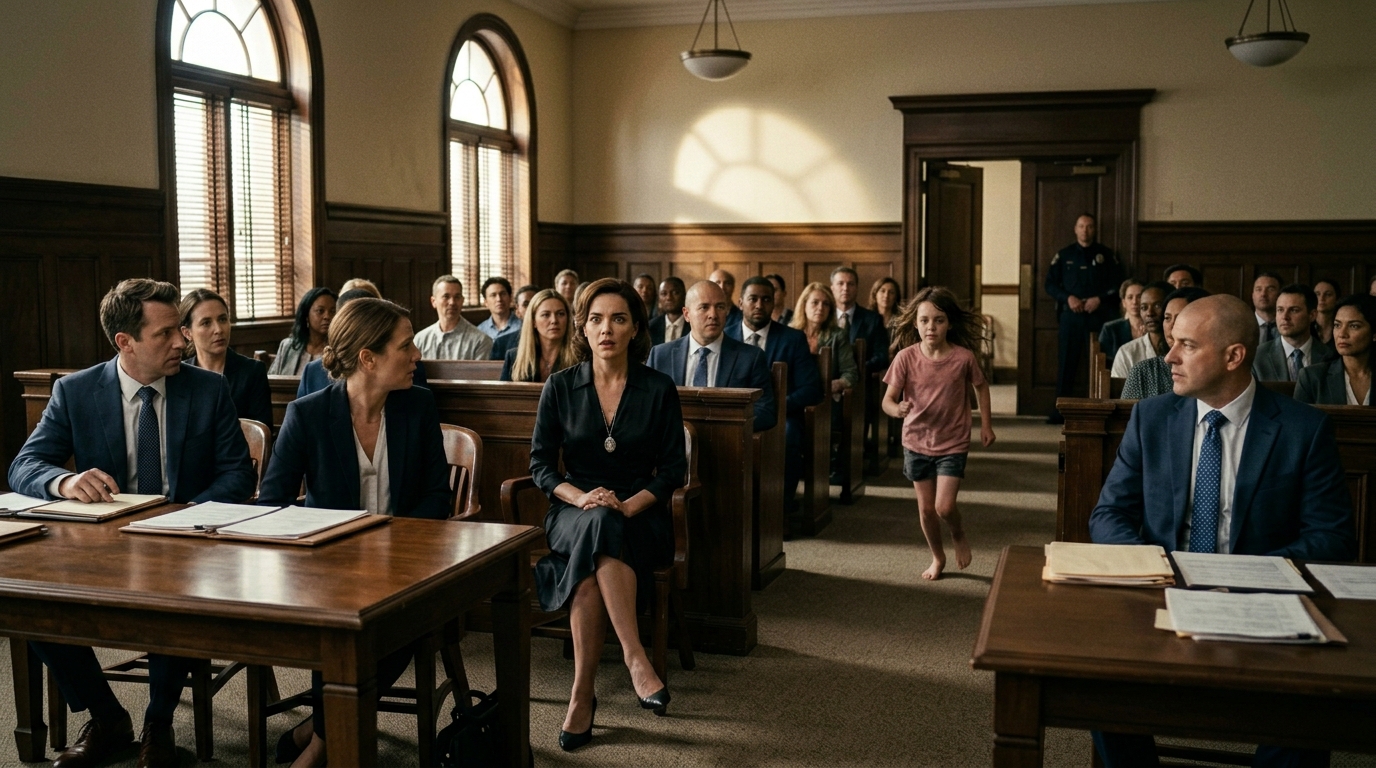
The jury had already stopped looking at me.
That was how I knew they believed her.
Not the detective.
Not the prosecutor.
Her.
Allison Harrington sat across the aisle in a black dress that probably cost more than my old car, one hand pressed to her chest, the other wrapped around a silver locket. Every tear she shed seemed perfectly timed. Every tremble in her voice landed exactly where the jury needed it to land.
I was the nanny.
She was the widow.
And in America, people believed widows before they believed women like me.
The foreman rose slowly.
My attorney closed his eyes.
The prosecutor straightened.
And just before the word guilty could leave that courtroom and destroy the rest of my life—
The back doors slammed open.
A small girl stood there barefoot.
Her pink T-shirt was wrinkled. Her hair was tangled. Her chest rose and fell like she had run through fire to get there.
Eight-year-old Lilly Harrington lifted one trembling finger.
Not at me.
At her stepmother.
“She’s not guilty,” Lilly said.
Then her voice cracked across the courtroom.
“It was her.”
The Child Who Was Supposed to Stay Silent
Nobody moved.
For one frozen second, the San Diego courtroom became less like a place of law and more like a church after someone had shouted a sin from the altar.
Allison’s face changed first.
Only for a flash.
A tiny slip.
The grieving widow vanished, and something colder looked out from behind her eyes. Not grief. Not shock.
Fear.
Then the mask came back so fast I wondered if anyone else had seen it.
“Lilly?” Allison whispered, rising from her seat with a shaking hand pressed to her mouth. “Sweetheart, what are you doing here?”
The judge struck his gavel.
“Order.”
But there was no order left.
The bailiff moved toward Lilly. Mr. Choi shot up from his chair. Detective Riley turned around so quickly his notebook slipped from his lap.
And I sat there with both hands flat on the defense table, unable to breathe.
Because Lilly was never supposed to speak.
Not because I didn’t want her to.
Because I had promised her I would not make her.
Three weeks earlier, when the police dragged me out of the Harrington mansion in handcuffs, Lilly had clung to me so tightly that one officer had to peel her fingers from my sweater.
Her lips had been against my ear.
Her voice barely there.
“Don’t tell them what I saw, Emma.”
I had whispered, “Why?”
Her little body had gone rigid.
“She said if I tell, you’ll disappear forever.”
At the time, I thought fear had made her confused. I thought Allison had threatened her in some vague, cruel way. I thought if I stayed quiet, if I took the weight, if I let the lawyers do their job, Lilly would at least remain safe inside the only home she had ever known.
I was wrong.
Allison had not wanted Lilly silent because the child was confused.
She wanted Lilly silent because the child had seen everything.
The judge leaned forward, his expression tight.
“Who brought this child into my courtroom?”
A woman appeared behind Lilly, breathless and pale.
Mrs. Alvarez.
The Harringtons’ housekeeper.
She clutched a folded sweater in one hand and looked as if she expected to be arrested for simply standing there.
“I did, Your Honor,” she said. “I’m sorry. She begged me.”
Allison’s attorney stood. “Your Honor, this is outrageous. This child has been through severe trauma. She is not listed as a witness. She has been emotionally unstable since her father’s death.”
Lilly flinched at the words.
Emotionally unstable.
That was what Allison had called her for weeks.
Sensitive.
Confused.
Overimaginative.
A poor little girl inventing monsters because she could not accept that her father was gone.
I pushed my chair back before I realized I had moved.
“Lilly,” I said softly.
She looked at me.
The moment our eyes met, her face crumpled.
Not like a child performing.
Like a child finally finding the one person who would believe her.
The prosecutor stepped forward. “Your Honor, the state objects to any spontaneous testimony from a minor without proper—”
“She saw him die,” I said.
The words slipped out before I could stop them.
The whole courtroom turned toward me.
Mr. Choi grabbed my wrist under the table.
“Emma,” he warned under his breath.
But it was too late.
The truth had already left my mouth.
And across the aisle, Allison’s fingers tightened around the silver locket until her knuckles turned white.
That was when I realized something worse than Lilly speaking.
Allison was not afraid of what Lilly had seen.
She was afraid of what Lilly had brought with her.
The Widow’s Perfect Story
Before Allison entered our lives, the Harrington house had been imperfect in a gentle way.
Too many books on the kitchen counter.
Too many crayon drawings taped crookedly to the refrigerator.
Too many half-finished coffee mugs abandoned by Mark Harrington, a man who could build a company worth hundreds of millions but could not remember where he left his glasses.
I started working for him after his first wife died.
Lilly was five then.
Small.
Watchful.
Always carrying a stuffed rabbit by one ear.
Mark hired me first as a tutor because Lilly had stopped speaking in school. Then I became the nanny. Then, slowly, something like family.
Mark was not a perfect father. He worked too much. He missed parent-teacher meetings. He forgot costume days and showed up late to ballet recitals with flowers still wrapped in grocery-store plastic.
But he loved his daughter.
That part was never fake.
Allison arrived eight months before his death.
She was beautiful in the way expensive things are beautiful.
Smooth.
Polished.
Untouchable.
At first, she treated me like furniture. Something useful that came with the house. Then she began treating me like a stain she planned to remove.
“Emma is very attached,” she told Mark once, while I stood right there pouring Lilly’s cereal.
Attached.
As if love were a disease poor women caught around rich children.
The changes were small at first.
Lilly’s art supplies disappeared because “mess stimulates anxiety.”
The telescope Mark bought her was moved to the attic because “night air isn’t good for children.”
Her old stuffed rabbit vanished from her bed because “eight is too old for babyish things.”
And then came the bruises.
Small ones.
A faint mark above her wrist.
A shadow near her elbow.
When I asked, Lilly pulled her sleeve down and whispered, “I bumped into the cabinet.”
There were no cabinets shaped like fingerprints.
I tried to tell Mark.
He looked exhausted when I did. He had one hand on his phone, the other rubbing his temple.
“Allison is strict,” he said. “But she’s trying.”
“Mark, Lilly is afraid of her.”
He looked up then.
For a moment, I saw the father underneath the businessman.
Then his phone rang.
And Allison’s voice floated from the hallway.
“Mark? The car is here.”
The moment passed.
He left.
Two nights later, he suffered the migraine that changed everything.
I went upstairs to get his heart medication from the master bathroom. Beta-blockers. A small orange bottle with a white cap. I remember noticing it was nearly full because Mark joked about forgetting doses, and I almost reminded him to set an alarm.
The next morning, the bottle was gone.
That night, Mark was dead.
The official story came quickly.
He collapsed in the living room.
He could not breathe.
By the time paramedics arrived, Allison was sobbing over him in a silk robe, screaming that I had done something.
She said Mark planned to fire me.
She said I resented her.
She said I had become obsessed with Lilly and jealous of their new family.
Detective Riley believed her because the evidence told him to.
The missing medication bottle appeared in my bedside drawer.
My fingerprints were on it because I had handled it the night before.
A search of my laptop showed articles about beta-blocker overdoses and cardiac arrest.
I had never searched those words.
But Allison had already thought of that too.
Every path led to me.
Every door closed behind me.
Every time I tried to explain, Riley looked at me as if I were another desperate guilty person inventing a villain.
Only Lilly knew the truth.
And Lilly would not speak.
Not until the morning she found what her stepmother had hidden inside the locket.
The Secret Inside the Silver Locket
The judge cleared the courtroom for ten minutes.
That was what he called it.
A recess.
But it felt like the world had been split open and everyone needed time to decide whether they had actually heard a child accuse a grieving widow of murder.
I was taken into a side room with Mr. Choi. A deputy stood outside the door. Through the frosted glass, I could see shadows moving in the hallway.
Mr. Choi gripped both sides of a chair and leaned toward me.
“What did Lilly see?”
I stared at the floor.
“Emma.”
I swallowed.
“She told me she saw Allison in the living room that night.”
His face tightened.
“You knew this?”
“She was terrified.”
“You knew there was an eyewitness, and you didn’t tell me?”
“She was eight.”
“You were facing life in prison.”
“She said Allison would make me disappear.”
Mr. Choi went quiet.
For the first time since taking my case, his exhaustion burned away and something sharper replaced it.
“You protected her.”
“I thought I was.”
He took off his glasses and rubbed his eyes.
“God help us.”
The door opened before he could say more.
Detective Riley stood there.
He looked different now.
Less certain.
Behind him was Mrs. Alvarez, still holding the folded sweater. Lilly stood beside her, one hand hidden in the fabric.
“She wants to speak to Emma,” Riley said.
Mr. Choi stood. “My client should not be questioned without—”
“She isn’t here for a question,” Riley interrupted.
His eyes moved to Lilly.
“She has something.”
Lilly stepped into the room slowly.
I wanted to run to her.
I wanted to wrap her in my arms and tell her none of this was her fault.
But I stayed seated because one wrong move in a courthouse could become another lie in someone else’s mouth.
Lilly came close enough to whisper.
“I’m sorry.”
My heart cracked.
“No, baby. No. You didn’t do anything wrong.”
Her chin trembled.
“I tried to be brave before.”
“You are brave.”
She shook her head.
“No. Daddy was.”
Then she opened her hand.
Inside her palm was the silver locket.
Allison’s locket.
The one she had clutched during every day of trial.
The one she rubbed whenever she cried.
The one the jury had probably seen as a sentimental reminder of her dead husband.
I stared at it.
“How did you get that?”
Lilly looked toward Mrs. Alvarez.
“She dropped it in the bathroom this morning,” the housekeeper said quietly. “Lilly picked it up before Mrs. Harrington noticed.”
Detective Riley stepped closer.
“Open it,” Lilly whispered.
My fingers shook as I took it.
The locket was heavier than it looked. Old-fashioned. Oval. Silver. There was a tiny hinge on one side and a nearly invisible seam down the back.
I opened the front first.
A picture of Mark smiled back.
Younger.
Alive.
Holding Lilly on his shoulders.
For a second, grief stole all the air from the room.
Then Lilly pointed.
“Not there.”
I turned it over.
There was a small compartment in the back, hidden beneath the engraving.
A message had been carved into the silver.
Forever yours, M.
Mark had given it to her.
Mark, who had loved too easily.
Trusted too quickly.
Died too soon.
Mr. Choi leaned in.
“What are we looking for?”
Lilly pressed her thumbnail under the edge.
The back popped open.
A tiny memory card fell into my palm.
Nobody spoke.
Detective Riley’s expression hardened.
“Where did that come from?”
Lilly’s voice dropped to almost nothing.
“Daddy put it there.”
The room changed.
Even the air seemed to pull back.
I looked at her.
“What do you mean?”
She twisted the hem of her shirt.
“The night before he died, Daddy came to my room. He was crying but trying not to. He said if anything happened, I should find Emma. He said Emma would know what to do.”
My vision blurred.
Mark knew.
Maybe not everything.
But enough.
Lilly continued, each word pulled from somewhere deep and painful.
“He said Allison was lying about money. He said he heard her talking to someone. He said he was going to fix it in the morning.”
A chill moved through me.
The morning never came.
Detective Riley took the memory card with gloved hands.
“We need to verify this.”
Mr. Choi pointed toward the courtroom.
“And if it contains what I think it contains, you need to stop treating my client like a murderer.”
Riley did not argue.
That frightened me more than if he had.
Because it meant he was starting to believe.
And if Mark had hidden proof before he died, then Allison had not murdered him in panic.
She had murdered him because he was about to expose her.
What Mark Recorded Before He Died
The judge allowed the memory card to be reviewed in chambers.
Allison’s attorney fought it with every expensive word he knew.
Chain of custody.
Improper disclosure.
Prejudicial impact.
Emotional manipulation by a traumatized child.
The judge listened with the patience of a man who had seen too many lawyers mistake volume for truth.
Then he looked at Lilly.
She stood beside Mrs. Alvarez with my sweater around her shoulders.
Bare feet tucked together.
Eyes down.
Small enough to be dismissed.
Brave enough to break a murder trial wide open.
The judge said, “Play it.”
The first recording was audio only.
Static.
Movement.
Then Mark’s voice.
Low.
Tired.
Angry in a way I had never heard before.
“Allison, I saw the transfer request.”
Allison’s voice answered.
Smooth.
Unbothered.
“You went through my laptop?”
“You used my daughter’s trust documents.”
“Our daughter.”
“No,” Mark snapped. “Lilly is not a business opportunity.”
A soft laugh.
Even through the speakers, it made my skin tighten.
“You really are naive.”
Someone in the room inhaled sharply.
The recording continued.
Mark accused her of opening accounts under shell companies. Allison did not deny it. She told him he had no idea how much money was wasted sitting in trusts while “useful people” had to beg for access.
Then Mark said the words that turned every face in chambers pale.
“I changed the executor this afternoon.”
Silence on the recording.
Then Allison.
“What?”
“If anything happens to me, Emma becomes Lilly’s guardian until the court reviews the estate.”
My hand flew to my mouth.
I had not known.
Nobody had told me.
Mark had made me the safeguard.
Allison’s voice lowered.
“You gave the nanny my life?”
“I gave my daughter a chance.”
The recording ended there.
For several seconds, nobody moved.
Then Detective Riley played the second file.
Video this time.
Blurry at first.
It had been captured from a small camera somewhere low, probably Mark’s phone propped against a shelf.
The living room appeared.
Dim.
Late.
Mark stood near the fireplace in pajama pants and a white T-shirt, one hand pressed to his chest. Allison stood in front of him holding a glass of water.
“You need to calm down,” she said.
“What did you give me?”
“Your medication.”
“That wasn’t my medication.”
He stumbled.
I heard Lilly gasp beside me.
Mrs. Alvarez pulled her closer, but Lilly did not look away.
On-screen, Mark reached for the edge of the table.
Allison watched him fall.
She did not scream.
She did not call 911.
She waited.
Then she knelt beside him and spoke in a voice so soft it barely reached the camera.
“You should have left the trust alone.”
My stomach turned.
Mark moved weakly.
Still alive.
Still trying.
Allison picked up a cushion from the couch.
The judge slammed his hand down before the worst of it played.
“Stop.”
The screen went black.
The silence afterward was unbearable.
Not because we did not know what happened next.
Because we did.
Lilly made a small sound.
Not a cry.
Something smaller.
Something broken.
I reached for her, and this time nobody stopped me.
She ran into my arms so hard the chair scraped backward.
“I saw,” she sobbed into my shirt. “I saw her. I was on the stairs. She looked at me after. She said if I told, you would go away too.”
I held her and looked across the room.
Through the glass panel in the chamber door, Allison stood in the hallway.
Watching.
For once, she was not crying.
Her face was still.
Empty.
Then Detective Riley stepped out.
We could not hear what he said at first.
But we saw his hand move toward his cuffs.
Allison took one step back.
Then another.
And suddenly, the widow who had performed grief for an entire courtroom understood that the performance was over.
The Nanny, the Widow, and the Girl Who Told the Truth
When we returned to the courtroom, everyone knew something had changed.
The jury felt it.
The gallery felt it.
Even Allison’s attorney looked like a man trying to hold water in his hands.
Allison was not sitting beside him anymore.
She stood near the defense aisle with two deputies on either side.
No locket.
No tears.
No trembling hand pressed to her chest.
Without the costume of grief, she looked smaller.
Not weak.
Never weak.
Just exposed.
The prosecutor requested an immediate recess to reassess charges.
Mr. Choi requested dismissal.
Detective Riley stood before the judge and said the words I had been waiting three weeks to hear.
“Your Honor, based on newly reviewed evidence, the department no longer considers Emma Miller a suspect in the murder of Mark Harrington.”
A sound moved through the courtroom.
Shock.
Whispers.
A few gasps.
I heard none of it clearly.
All I heard was Lilly breathing against my side.
All I felt was her hand holding mine.
The judge looked at me.
Then at the jury.
Then at Allison.
“This court is suspending proceedings against Ms. Miller pending formal dismissal.”
My knees almost gave out.
Mr. Choi caught my elbow.
“You’re standing,” he whispered. “Stay standing.”
So I did.
I stood while my life came back to me one piece at a time.
My name.
My future.
My ability to walk out of that courthouse without chains.
Allison turned her head slowly.
Her eyes met mine.
There was no apology there.
No remorse.
Only hatred.
As deputies guided her away, she leaned just close enough for me to hear.
“You think this makes you her mother?”
The words were meant to cut.
Once, they might have.
But Lilly stepped in front of me.
Small.
Barefoot.
Shaking.
Still brave.
“She already was,” Lilly said.
The courtroom went silent again.
Not with shock this time.
With something gentler.
Something like justice.
Allison’s face twisted.
For the first time, her control failed completely.
“You ungrateful little brat,” she hissed.
The deputies tightened their grip and pulled her back.
That was the final thing the jury saw.
Not the widow.
Not the grieving wife.
The woman underneath.
The woman Mark had tried to stop.
The woman Lilly had survived.
Two months later, the charges against me were formally dismissed.
Allison Harrington was indicted for murder, evidence tampering, fraud, and witness intimidation. Investigators found offshore transfer documents, forged estate paperwork, and a second set of messages that showed she had planned to remove me from the house long before Mark died.
She had not framed me because I was convenient.
She framed me because Mark had chosen me.
Because if I went to prison, there would be no guardian left standing between Allison and Lilly’s inheritance.
At the custody hearing, Lilly wore shoes this time.
Blue ones.
She picked them herself.
She sat beside me with her sketchbook in her lap, drawing a horse with wings while the judge reviewed Mark’s updated documents.
When he asked her where she felt safe, she did not hesitate.
“With Emma.”
No dramatic speech.
No courtroom gasp.
Just two words.
Enough to change both our lives.
The Harrington mansion was sold the following spring. I could not bear to live in a house where every hallway remembered fear. Lilly and I moved into a smaller place near the coast, with yellow curtains, too many books, and art supplies left wherever she wanted them.
The first night there, she brought me the old silver locket.
The police had returned it after removing the memory card.
“I don’t want it,” she said.
I nodded. “We can put it away.”
She shook her head.
“No. I want Daddy’s picture.”
So we opened the front.
Mark smiled up at us from the tiny frame.
Lilly touched the glass with one finger.
“He knew you’d protect me,” she whispered.
I could not answer right away.
Because the truth was, I had protected her silence.
But she had saved my life by breaking it.
Months later, when people asked about the trial, they always wanted the sensational parts.
The widow.
The murder.
The hidden recording.
The child bursting into court barefoot.
But that was never the part I remembered most.
I remembered the sound of Lilly’s voice when she finally told the truth.
Small.
Terrified.
Unbreakable.
People asked whether I hated Allison.
For a while, I thought I did.
Then one morning, I watched Lilly painting at the kitchen table, sunlight catching in her hair, her face relaxed in a way I had not seen since before Mark died.
And I realized hatred would keep Allison in the room.
So I let it go.
Not for her.
For us.
Lilly still has nightmares sometimes.
She still asks whether people can pretend to love you.
I tell her yes.
Some people can.
Then I tell her the other truth.
Some people love you quietly, imperfectly, and completely. They forget school forms. They burn pancakes. They show up late with grocery-store flowers. They hide memory cards inside lockets because they are scared and trying to be brave.
And sometimes, the person who saves you is not the one with the perfect title.
Not the wife.
Not the widow.
Not even the nanny.
Sometimes it is a barefoot little girl in a courtroom, pointing at the monster everyone else believed, finally brave enough to say:
It was her.