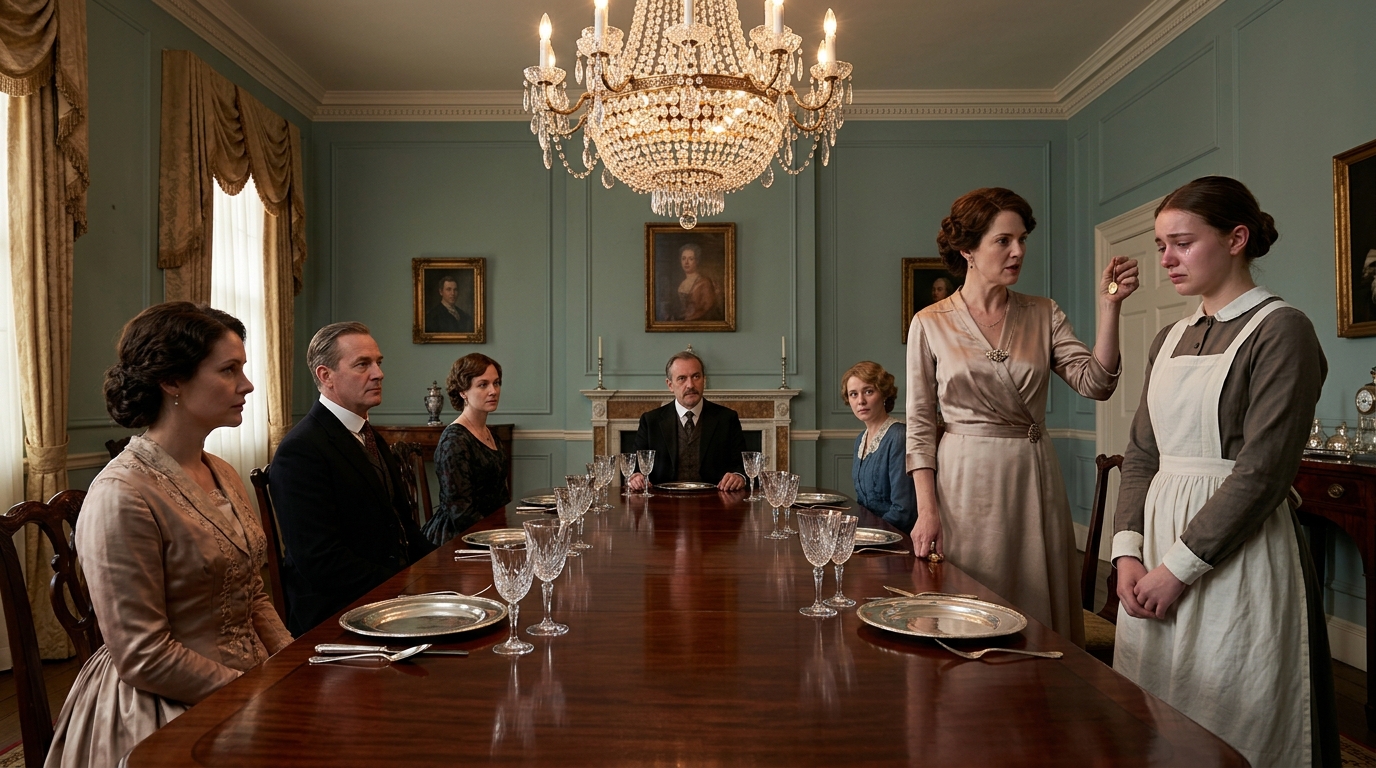
The Locket on the Dinner Table
The dinner table went quiet when the rich woman accused the maid of stealing.
Crystal glasses shimmered under the chandelier. Silver plates sat untouched. Red wine glowed darkly in tall glasses. The long dining room, usually filled with polite conversation and the soft clink of cutlery, seemed to shrink around one trembling girl in a black maid’s uniform.
At the head of the table sat Adrian Whitmore, owner of the estate, founder of Whitmore Holdings, and a man who had spent most of his life believing silence was dignity.
Beside the young maid stood his new wife, Vanessa.
She was beautiful in the way expensive rooms understood beauty. Every strand of blonde hair was pinned perfectly. Her emerald dress caught the light. Her smile was calm, almost bored, as if humiliating a servant in front of dinner guests was simply another duty of running a great house.
Between two fingers, she held a tiny gold locket.
“I found this in her apron,” Vanessa said.
The maid’s eyes filled with tears.
Her name was Clara.
She had only been working in the Whitmore house for three weeks. She was quiet. Careful. Poor enough to be judged before she spoke. Young enough that some of the guests looked at her with pity, but not enough courage to defend her.
“I didn’t steal it,” Clara whispered.
No one believed her.
Not openly.
Not cruelly.
But the room had already decided.
The locket looked old. Valuable. Personal. The kind of thing poor girls were accused of wanting before they were ever accused with proof.
Vanessa’s smile deepened.
“I warned you, Adrian,” she said softly. “We cannot keep hiring girls with no references.”
Clara flinched.
“I didn’t steal it.”
Vanessa turned the locket under the chandelier light.
“Then why was it hidden in your apron?”
Clara swallowed hard.
Her hands trembled at her sides.
Then she whispered:
“Open it.”
Vanessa’s face twitched.
Just once.
A tiny movement.
Almost nothing.
But Adrian noticed.
For the first time since the accusation began, he lifted his eyes fully from the locket to his wife’s face.
“Open it,” Clara said again.
Vanessa’s fingers tightened.
“There is no need. Theft is theft.”
Adrian extended his hand.
“Give it to me.”
Vanessa did not move immediately.
That hesitation changed the air.
One of the guests lowered his wine glass.
Adrian’s older sister, Margaret, leaned forward slightly.
Vanessa forced a laugh.
“Adrian, really. Are we going to entertain excuses from staff now?”
His voice was quiet.
“The locket.”
Slowly, Vanessa placed it in his palm.
The room watched as Adrian turned the tiny gold piece over.
It was older than he expected. Scratched along the edges. Worn smooth near the clasp. Not the kind of jewelry Vanessa usually wore. Not polished enough. Not grand enough.
His thumb found the tiny release.
Click.
The locket opened.
Inside was a faded photograph.
A much younger version of Adrian stood beneath a garden arch, smiling in a way no one at the table had seen in years.
Beside him was a woman with dark hair.
In her arms was a baby girl.
The child’s face was turned slightly toward the camera.
Near her temple was a tiny scar.
The same scar Clara had.
Adrian stopped breathing.
Vanessa stepped backward and knocked over a glass of red wine.
The wine spilled across the white tablecloth like blood.
“That picture is fake,” she said too quickly.
Clara reached into her sleeve with shaking fingers and pulled out a folded note.
On the outside was Adrian’s handwriting.
A name.
A date.
And three words that made the whole table turn cold:
Protect my daughter.
Adrian looked at Clara again.
Same eyes.
Same scar.
Same locket.
And suddenly, the maid was no longer just a maid.
Video: The Maid Was Accused of Stealing a Locket—Then the Father Saw His Own Face Inside
The Girl Everyone Had Ignored
Clara had learned early how to be invisible.
In kitchens, invisibility was survival.
You heard things people never meant to say. You saw which guests smiled at servants and which ones became cruel when no one important was watching. You learned that wealthy houses had two versions of every room: the beautiful one guests entered, and the hidden one staff moved through quietly.
Clara had entered the Whitmore estate through the service door.
Not the front.
Never the front.
She had carried linens up back staircases, polished silver in the pantry, and stood silently while Vanessa inspected her work with cold eyes.
“You missed a spot.”
“This glass is cloudy.”
“Do not stare at the family portraits.”
That last instruction had been strange.
Because Clara had stared.
Not because she was nosy.
Because the portrait above the grand staircase had made her knees go weak.
It showed Adrian Whitmore years ago, standing beside a woman Clara recognized from the locket.
Her mother.
Or the woman she had always believed was her mother.
Her name had been Elena Reed.
Elena raised Clara in small rented rooms, above laundries, behind bakeries, and once in a cold apartment where the windows rattled all winter. They never had much money, but Elena always kept three things locked inside a tin box:
The gold locket.
A folded note.
And a birth certificate with half the names scratched away.
When Clara was little, she asked about the man in the photograph.
Elena would become quiet.
“Someday,” she would say.
“Is he my father?”
Elena would touch Clara’s scar gently.
“He loved you before he knew how much danger love could bring.”
That answer made no sense to a child.
Later, it made too much.
Elena died when Clara was sixteen.
A fever.
A hospital bill they could not pay.
No dramatic goodbye. No inheritance. No family arriving in black cars.
Only the tin box and one final instruction.
“If you ever go to Whitmore House,” Elena whispered, breath thin and broken, “do not show the locket first. Watch them. Learn who lies. And if they accuse you…”
She had coughed so hard Clara had to lift her gently.
“If they accuse you, open it in front of everyone.”
Clara did not understand why her mother sounded so sure.
Now she did.
Vanessa had not accidentally found the locket.
Vanessa had been searching for it.
And she had chosen the dinner table because public shame was her favorite weapon.
The Man in the Photograph
Adrian stared at the note in Clara’s hand.
He knew that handwriting.
His handwriting.
Older.
More hurried.
But his.
His fingers tightened around the locket.
“Where did you get this?”
Clara’s lips trembled.
“My mother gave it to me.”
Vanessa cut in immediately.
“A convenient story.”
Adrian did not look at her.
“What was your mother’s name?”
Clara swallowed.
“Elena Reed.”
The name struck him so hard he nearly dropped the locket.
Margaret, his sister, gasped.
“Elena?”
The guests began whispering.
Vanessa’s voice sharpened.
“Enough. This is exactly how these girls operate. They collect details from old gossip and turn them into—”
“Stop talking,” Adrian said.
The room went silent.
Vanessa stared at him, stunned.
Adrian’s eyes stayed on Clara.
“Elena died twenty-two years ago.”
Clara shook her head slowly.
“No. She died six years ago.”
Margaret pressed one hand to her mouth.
Adrian stood from the table.
The chair scraped against the floor.
“Elena died in a fire.”
“That’s what she told me people would say.”
His face went pale.
Clara unfolded the note.
Her hands were shaking so badly Margaret stood and moved closer, as if afraid the girl might collapse.
Clara looked down and read the words written beneath Adrian’s name.
If anyone finds Elena and the child before I return, protect my daughter. Do not trust the house. Do not trust Victor. Do not trust any woman wearing my mother’s emerald ring.
Vanessa’s hand flew unconsciously to her finger.
The emerald ring glittered under the chandelier.
Adrian saw.
So did Margaret.
So did everyone.
Vanessa slowly lowered her hand.
“That means nothing,” she whispered.
Margaret’s voice was sharp now.
“That ring belonged to our mother.”
Vanessa lifted her chin.
“You gave it to me.”
“No,” Margaret said. “Adrian did. After you told him it was misplaced in storage.”
Adrian turned toward Vanessa.
His expression had changed.
The shock was still there.
But beneath it was something colder.
Recognition arriving too late.
Vanessa stepped backward again.
“Adrian, think carefully. This girl has been in the house for weeks. She could have copied your handwriting. She could have stolen old photographs. She could have—”
Clara interrupted her.
“My mother said you would call me a thief before you called me family.”
The words landed hard.
Because that was exactly what Vanessa had done.
The First Lie
Adrian had loved Elena Reed when he was young enough to believe love could win by being honest.
She was not from his world.
That was the first problem.
Elena worked at the estate as a seamstress’s assistant during the summer Adrian turned twenty-seven. She mended curtains, repaired gowns, and stitched tiny initials into napkins for dinners where no one ever learned her name.
Adrian noticed her because she refused to act impressed.
He was used to people lowering their voices around him, shaping themselves to his moods, laughing before he finished a joke.
Elena did none of that.
The first time he spilled coffee on his sleeve in the library, she handed him a cloth and said, “For a man with so much money, you are very careless with brown liquids.”
He laughed for the first time in weeks.
They became friends.
Then more.
Too quickly for the house.
Too quietly for the world outside it.
Adrian’s father disapproved.
His mother was worse.
But his brother Victor was the one who frightened Elena.
Victor had always wanted control of the estate. Adrian had inherited the majority shares, but Victor had inherited resentment. When he saw Adrian falling in love with a woman who could not be bought, he understood the threat immediately.
Elena would not flatter him.
Would not fear him properly.
Would not keep family secrets for the sake of old money.
Then Elena became pregnant.
Adrian planned to marry her.
He wrote the note the night before he left for New York to meet with attorneys and prepare legal protection for Elena and the baby.
He intended to be gone three days.
When he returned, Elena was gone.
Victor told him there had been a fire in the old guesthouse.
Elena had been trapped.
The body was too damaged.
The funeral was already arranged.
Adrian broke after that.
He left the country for months.
When he returned, Victor told him Elena had betrayed him before she died.
“She was planning to take money,” Victor said. “She was going to claim the baby was yours whether it was or not.”
Adrian struck him that day.
Then never spoke of Elena again.
Not because he believed Victor fully.
Because grief mixed with shame can become a locked room.
And Adrian had lived inside that room for twenty-two years.
Now the door had opened at his dinner table.
And a girl with Elena’s eyes stood inside it.
Vanessa’s Mistake
Vanessa had entered Adrian’s life two years earlier.
Elegant.
Sympathetic.
Patient.
She knew exactly when to speak softly and when to leave silence around him.
She said she admired his loyalty to the past.
She said she understood grief.
She said the house needed warmth again.
Margaret never trusted her.
But Adrian was tired.
Tired of eating alone at the head of a table built for family.
Tired of walking past portraits of people who had lied to him.
Tired of remembering a woman everyone insisted was dead.
Vanessa made loneliness feel less humiliating.
So he married her.
He gave her the emerald ring because she asked about it with tears in her eyes.
“It would make me feel accepted,” she said.
He had not known the ring was named in the note.
He had not known Vanessa had spent months searching the estate archives.
He had not known she had found old records of Elena Reed.
He had not known she had been waiting for Clara to make one mistake.
But Vanessa had made one first.
She opened the wrong accusation in the wrong room.
She thought class would protect her.
She thought if she accused Clara of theft before dinner guests, the room would believe her before the girl could speak.
And for a moment, it had.
That was the part Adrian would never forgive himself for.
He had looked at Clara’s uniform.
At her trembling hands.
At Vanessa’s polished certainty.
And for a moment, he had believed the easier story.
A maid stole.
A wife discovered.
A household was protected.
Then the locket opened.
And the easier story died.
The Note Beneath the Fold
Adrian took the note from Clara carefully, as if the paper itself might bruise.
There was more written inside.
His own words stared back at him from a lifetime ago.
Elena, if I do not return before morning, take the child and leave through the east road. Bell will help you. The locket contains the photograph we took before anyone could deny her. If they say I abandoned you, do not believe it. If they say you died, they are lying. If our daughter finds this one day, tell her I tried to come back.
Adrian’s hand shook.
“I never gave this to her,” he whispered.
Margaret moved beside him.
“What?”
“I wrote it,” he said, voice breaking. “But I never gave it to her. I left it in my desk before going to New York.”
Clara looked confused.
“My mother had it.”
Adrian turned slowly toward Vanessa.
No.
Not Vanessa.
This was older.
Victor.
Victor must have found the note and used it to stage Elena’s escape, then later bury the truth.
But Vanessa had found the aftermath.
And instead of bringing it to him, she had tried to destroy the girl who carried the proof.
Adrian looked at his wife.
“How long have you known?”
Vanessa’s eyes filled.
Perfect tears.
“I didn’t know anything for certain.”
Margaret’s voice cut in.
“But you knew enough to search her apron.”
Vanessa snapped, “She entered this house under false pretenses!”
Clara’s voice shook.
“I entered through the servants’ door because it was the only door open to me.”
The room went still.
Adrian closed his eyes.
That sentence would stay with him.
The only door open to his daughter had been the servants’ door.
In her father’s house.
Bell’s Confession
The old butler, Mr. Bell, had been standing near the dining room entrance the entire time.
He was eighty now, thin, silver-haired, and usually silent enough to seem part of the walls.
But when Adrian looked toward him, the old man’s face crumpled.
“You knew,” Adrian whispered.
Bell lowered his head.
“Yes, sir.”
Margaret turned sharply.
“Bell?”
The old man’s hands shook.
“I helped Miss Elena leave that night.”
Adrian stepped toward him.
“What night?”
“The night after you left for New York.”
Bell’s voice trembled with the weight of twenty-two years.
“Mr. Victor found the note. He told Miss Elena you had changed your mind. He said your family would take the child after birth and send her away. She didn’t believe him at first. Then men came to the guesthouse. There was a fire, but she was already gone.”
Adrian’s face twisted.
“Why didn’t you tell me?”
“I tried.”
Bell’s eyes filled.
“When you returned, Mr. Victor controlled the house. Your father was ill. Your mother refused to see me. I was dismissed before I could reach you. Years later, Miss Margaret brought me back, but by then…”
He looked at Clara.
“By then I thought Elena and the baby were hidden safely.”
Clara whispered, “We were never safe.”
Bell flinched as if struck.
“I am sorry.”
Clara looked away.
The apology was too late to know what to do with.
Adrian turned to Vanessa.
“And you?”
Vanessa had gone very still.
Her tears were gone.
Now she looked angry.
“I protected this house.”
“No,” Margaret said. “You protected your place in it.”
Vanessa’s voice sharpened.
“She came here with a locket and a story. You were all ready to hand her everything because she has a scar.”
Adrian looked at Clara’s temple.
The tiny scar from the photograph.
His daughter’s scar.
His daughter.
The words moved through him slowly, painfully, impossibly.
He had missed her first steps.
First words.
First birthday.
Every birthday.
He had lived in the same world as his child and never knew she was hungry in it.
Vanessa continued, desperate now.
“Think, Adrian. If this is true, if she is yours, what happens? Claims. Scandal. Inheritance disputes. Every parasite in the city will crawl toward this house.”
Adrian’s expression hardened.
“You just called my daughter a parasite.”
The room went dead silent.
Vanessa realized her mistake too late.
The Police at the Dinner Table
Margaret did what Adrian should have done sooner.
She called Detective Quinn.
No one left the dining room before police arrived.
Vanessa tried.
Twice.
The second time, Baxter, the old family dog who had been sleeping under the sideboard, rose and stood in front of the door.
That would later become a family story Clara almost smiled at.
Almost.
Detective Laura Quinn arrived within thirty minutes. She was calm, direct, and unimpressed by crystal chandeliers.
She examined the locket, the note, the photograph, Vanessa’s ring, and the old estate records Adrian ordered Bell to retrieve from the archive.
Then she asked Clara one question.
“Why tonight?”
Clara looked down at her hands.
“Because she searched my room this afternoon.”
Vanessa snapped, “Staff rooms are house property.”
Quinn looked at her.
“Do not interrupt.”
Clara continued.
“I heard her telling the housekeeper I had stolen from guests. I knew she was going to accuse me. My mother said if that happened, I should make sure the locket was opened in public.”
Quinn nodded.
“Your mother expected this?”
“She expected people like her.”
Vanessa laughed bitterly.
“You know nothing about me.”
Clara finally looked at her.
“I know you looked scared before he opened the locket.”
That was enough.
Not legally.
But humanly.
The investigation opened that night.
DNA testing followed.
Records were pulled.
Old death certificates questioned.
The guesthouse fire case reopened.
Victor Vale, Adrian’s brother, was located in Switzerland, where he had been living off family money for years.
When authorities contacted him, he claimed memory problems.
Then they found the wire transfers.
Payments made to men who worked private security the week Elena disappeared.
A closed account under Vanessa’s maiden name showed recent payments to an investigator who had traced Clara Reed months before she applied to the Whitmore estate.
Vanessa had known.
Not everything.
But enough.
Enough to know Clara might be Adrian’s daughter.
Enough to hide it.
Enough to frame her as a thief before Adrian could learn the truth.
The Daughter at the Servants’ Door
The DNA result came back three weeks later.
Clara Reed was Clara Whitmore.
Adrian’s daughter.
The report sat on the library desk between them.
Neither touched it for a long time.
Adrian had imagined many emotional reactions in those weeks.
Joy.
Shock.
Relief.
But when the truth became official, what he felt first was grief.
Heavy.
Crushing.
Unforgiving.
A daughter was not only found.
A daughter had been missed.
For twenty-two years.
Clara sat across from him in a simple gray dress Margaret had bought her after Clara refused anything expensive.
She looked small in the library, surrounded by leather-bound books, portraits, carved wood, and generations of people who would have rejected her before hearing her name.
Adrian’s voice broke.
“I don’t know how to ask forgiveness for something this large.”
Clara looked at him.
“Then don’t ask yet.”
He nodded.
It hurt.
It was fair.
She continued.
“My mother never told me to hate you.”
Adrian’s eyes filled.
“She should have.”
“No,” Clara said softly. “She said grief makes people blind if liars stand close enough.”
Adrian closed his eyes.
Elena had known him too well.
Clara looked toward the window.
“I used to imagine this house.”
“What did you imagine?”
“That the front door would open.”
Adrian could not speak.
She looked back at him.
“It didn’t.”
He swallowed.
“I will spend the rest of my life regretting that.”
Clara’s face softened slightly.
Not forgiveness.
Not yet.
But a crack in the wall.
“That sounds like a beginning.”
Vanessa’s Fall
Vanessa did not go quietly.
People like her rarely do.
She claimed she had been protecting Adrian from fraud.
She claimed Clara manipulated the household.
She claimed Margaret had always hated her and used the girl to ruin the marriage.
Then prosecutors found the investigator’s report in her private email.
Photographs of Clara leaving a boarding house.
Copies of Elena’s death certificate.
A note from Vanessa to the investigator:
If she applies under Reed, notify me before she reaches him.
That destroyed her story.
She had known Clara might be connected to Elena before Clara entered the estate.
She had hired Clara deliberately through a staff agency she controlled, hoping to watch her closely and find the locket or note before Adrian did.
But Clara had hidden them too well.
So Vanessa staged the theft.
Her downfall became a public scandal.
The wealthy wife who accused a maid of stealing.
The locket.
The secret daughter.
The old photograph.
The note in Adrian’s handwriting.
Victor was eventually extradited and charged in connection with the original disappearance, financial manipulation, and falsifying records related to Elena’s supposed death.
Vanessa was charged with fraud, obstruction, evidence suppression, and conspiracy to conceal Clara’s identity for financial gain.
At trial, Vanessa’s lawyer tried to paint Clara as ambitious.
“Isn’t it true you came to Whitmore House hoping to claim an inheritance?”
Clara sat straight.
“I came hoping to learn whether my father knew I existed.”
The courtroom went silent.
“And what did you find?”
Clara looked toward Adrian, who sat in the second row, eyes red.
“I found out everyone had lied to both of us.”
That answer traveled farther than any accusation.
Vanessa was convicted on several counts. Victor’s trial followed separately and reopened wounds Adrian had barely begun to understand.
But the law could only do so much.
It could punish lies.
It could not return childhood.
The Locket’s New Place
Months later, Adrian asked Clara to meet him in the dining room.
The same room.
The same chandelier.
The same long table.
But this time, no guests watched.
No wife smiled.
No one accused her.
Only Adrian, Margaret, Bell, and Clara stood beside the table where the locket had opened.
A small velvet stand had been placed at the center.
On it rested the gold locket.
Clara looked at it.
“What is this?”
Adrian’s voice was soft.
“This room displayed portraits of every Whitmore heir except the one who mattered most.”
Clara looked down.
“I don’t want to be displayed.”
“You won’t be.”
He gestured toward the locket.
“This is not a display of ownership. It is a correction.”
Margaret stepped forward with a small plaque.
Clara read it silently.
Clara Reed Whitmore
Daughter of Adrian Whitmore and Elena Reed
Returned by truth, not by permission.
Her eyes filled.
“My mother’s name is there.”
Adrian nodded.
“She belongs here too.”
Clara touched the locket gently.
For most of her life, it had been a secret.
Then evidence.
Then pain.
Now it felt like something else.
A witness.
Not only to what was stolen.
But to what survived.
Bell stood nearby, tears slipping down his wrinkled face.
Clara looked at him.
“I’m still angry with you.”
The old man nodded.
“You should be.”
“But you helped her leave.”
“Not enough.”
“No,” Clara said. “Not enough.”
He bowed his head.
Then she added, “But enough that I was born free.”
Bell covered his mouth.
Margaret began to cry.
Adrian looked away because his own tears were too close.
The Door Opened
Clara did not move into the estate immediately.
Adrian offered.
She refused.
Not cruelly.
Honestly.
“That house still feels like the place where I was accused.”
He accepted that.
He bought her nothing without asking.
That was harder than it sounded for a man used to solving pain with resources. He wanted to give her rooms, clothes, safety, education, everything money could provide.
But Clara had not come to him as an empty-handed girl waiting to be filled by wealth.
She came with a mother’s love.
A history.
A name.
A scar.
A locket.
And the right to choose how slowly family could begin.
So Adrian learned patience.
He visited her small apartment with groceries only after she agreed.
He asked about Elena and listened without interrupting.
He gave Clara photographs of himself from the years before grief made him cold.
She gave him stories of her mother.
Elena singing while sewing.
Elena burning soup.
Elena telling Clara never to confuse a locked door with the whole world.
Some stories made Adrian laugh.
Others made him leave the room and weep quietly in the hallway.
Clara always knew.
She never followed.
Not at first.
Then one day, she did.
She found him standing by the window, shoulders shaking.
“She loved you,” Clara said.
Adrian wiped his face.
“I failed her.”
“Yes.”
He closed his eyes.
Clara stood beside him.
“She loved you anyway.”
That was the closest thing to forgiveness either of them could hold that day.
And it was enough.
A year later, Clara walked through the front door of Whitmore House.
Not as a maid.
Not through the service entrance.
Not carrying linens.
Not lowering her eyes.
Adrian opened the door himself.
Margaret stood behind him.
Bell too.
No ceremony.
No cameras.
No grand announcement.
Just a father stepping aside so his daughter could enter the house that had once denied her.
Clara paused on the threshold.
For a second, she saw everything at once.
The dining room.
The table.
Vanessa holding up the locket.
The room deciding she was guilty.
Then the locket opening.
The photograph.
The note.
Her father’s face changing.
She took one breath.
Then walked in.
Years later, people still told the story of the maid accused of stealing at a rich man’s dinner table.
They talked about the locket.
The scar.
The photograph.
The note that said Protect my daughter.
But Clara remembered something else most clearly.
The second before Adrian opened the locket.
When no one believed her.
When the whole room had already judged her.
When she stood alone with her mother’s final instruction burning in her chest.
Open it.
And she did.
Because sometimes the truth is small enough to fit inside a locket.
But strong enough to bring a daughter home.