The Bet
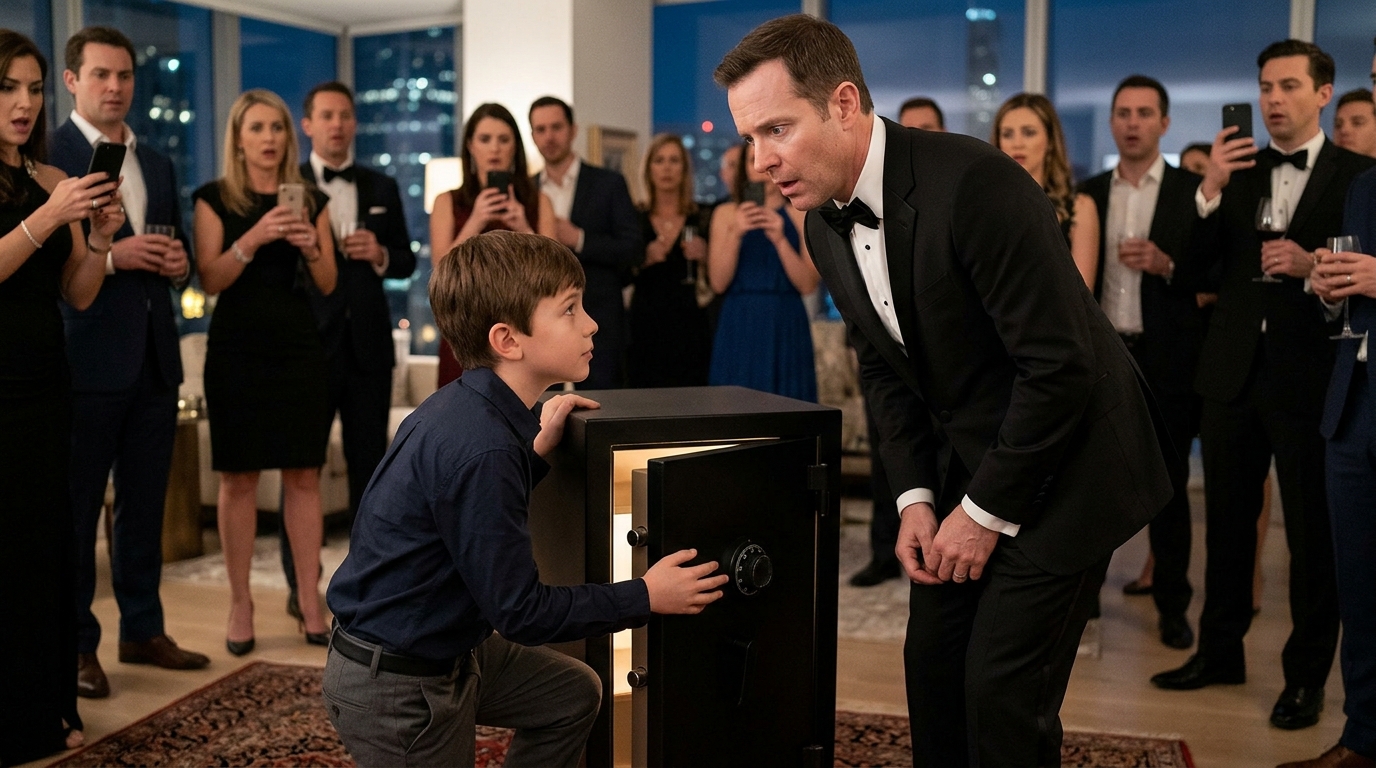
“I’LL GIVE YOU TEN THOUSAND IF YOU OPEN IT!”
The words rang through the penthouse like a champagne glass struck too hard.
For a moment, everyone turned.
The music softened beneath the sudden attention. Crystal lights shimmered above the room. The city glittered beyond the floor-to-ceiling windows, cold and distant, as if it too had paused to watch.
It was the kind of party where people laughed with their teeth showing and checked their reflections in dark glass. Men in tuxedos stood beside women in silk gowns. Watches flashed. Perfume hung in the air. Waiters moved silently between clusters of wealth, carrying silver trays nobody seemed grateful for.
At the center of it all sat the black safe.
It was massive.
Old-fashioned.
Beautiful in a strange, intimidating way.
Not the sleek digital kind mounted inside hotel closets.
This safe looked like it belonged in a bank vault from another century — thick steel door, heavy wheel handle, polished black finish, brass dial at the center.
And standing in front of it was a boy.
No older than seven.
Small.
Still.
Dressed in a faded brown tweed jacket that was too formal for a child and too worn for that room.
His shoes were clean but scuffed at the toes. His hair had been combed carefully, though one stubborn piece had fallen over his forehead.
Every phone in the penthouse turned toward him.
The adults expected embarrassment.
That was why they were recording.
The man in the tuxedo stood beside the safe with a lazy smirk.
Victor Langford.
Real estate king.
Collector.
Host of the party.
Owner of the penthouse.
A man who loved attention so much he disguised humiliation as entertainment.
He had noticed the boy standing near the safe minutes earlier, staring at it with uncomfortable focus.
Instead of asking who the child was, Victor had laughed.
“You like that safe, kid?”
The boy had nodded.
Someone chuckled.
Victor had taken another sip of champagne.
“Think you can open it?”
The boy had looked up.
Not eager.
Not frightened.
Just quiet.
“Maybe.”
That one word changed the room.
Victor’s smile widened.
Now the challenge had been shouted for everyone to hear.
Ten thousand dollars.
Open the safe.
The crowd leaned in.
A woman near the piano whispered, “This is awful.”
But she did not stop watching.
The boy looked at Victor.
“Are you sure?”
His voice was barely above a whisper.
Victor laughed.
“Am I sure?”
More laughter followed.
Victor reached into his jacket, pulled out a checkbook, and waved it in the air.
“Ten thousand dollars. Right here. Open it.”
The boy turned toward the safe.
His tiny fingers reached for the brass dial.
No fumbling.
No nervous glance.
No childish spinning.
He touched the metal gently, almost respectfully.
Then he pressed his ear against the cold steel.
The laughter faded.
The room grew quiet.
Something about the way he listened made the adults uncomfortable.
Click.
A tiny movement.
The boy turned the dial.
Slowly.
Precise.
Then again.
Then back.
Victor’s smirk faltered.
Just a fraction.
“Who taught you that?” he asked.
His voice came softer now.
The boy did not answer.
He kept listening.
The penthouse fell into complete silence.
Even the bartender stopped pouring.
Then—
A sharp metallic click echoed through the room.
The safe unlocked.
The heavy door shifted open.
Victor’s face drained of color.
The crowd did not laugh now.
No one did.
The boy stepped back, looked up at Victor, and said quietly:
“My father built this safe.”
The Safe No One Could Open
The black safe had become a legend in Victor Langford’s circle.
He loved telling the story.
He had bought it at a private auction, he said.
An antique custom build.
One of a kind.
A masterpiece of old-world craftsmanship.
Impossible to crack.
Unbreakable.
Untouched for years.
He claimed no locksmith in New York could open it without destroying it.
That was why he displayed it in the penthouse like a trophy.
Not tucked in an office.
Not hidden behind a painting.
Right there in the party room, near the marble bar and the grand piano, where guests could admire it and ask questions.
Victor always gave the same answer.
“Some things are beautiful because they refuse to surrender.”
People liked that line.
They repeated it.
They called the safe mysterious.
Powerful.
A symbol of Victor himself.
But the boy knew something no one else in the room knew.
The safe was not from an auction.
It had not been discovered in some collector’s estate.
It had been built fourteen years earlier in a small workshop in Queens by a man named Samuel Reed.
The boy’s father.
Samuel Reed was not famous.
Not in rooms like that.
He was a locksmith, metalworker, and safe designer with scarred hands, tired eyes, and a gift for hearing things others could not.
He used to say every lock had a voice.
Some clicked.
Some resisted.
Some lied.
But they all spoke if you listened properly.
His son, Eli, had grown up in the workshop.
While other children watched cartoons, Eli sat on a wooden stool beside a table full of springs, tumblers, gears, and brass keys.
Samuel never treated locks like tricks.
He treated them like promises.
“A lock is not made to keep everyone out,” he told Eli once. “It is made to decide who is allowed in.”
The black safe had been Samuel’s masterpiece.
He built it for a private client whose name he never said in front of Eli’s mother.
But Eli remembered the night it left the workshop.
He was only three then, but some memories stay not because they are clear, but because everyone around them was afraid.
A black truck came after midnight.
Two men loaded the safe carefully.
Victor Langford stood in the doorway wearing an expensive coat and a smile that did not reach his eyes.
Eli remembered his father’s hand on his shoulder.
Too tight.
He remembered Victor saying:
“You understand the agreement, Reed?”
Samuel had answered:
“I understand more than you think.”
Victor’s smile had vanished.
Three weeks later, Samuel disappeared.
The police said he left voluntarily.
Eli’s mother never believed that.
She said Samuel would never leave without his tools.
Without his wedding ring.
Without saying goodbye to his son.
But there was no body.
No proof.
No confession.
Only debt notices that appeared suddenly, legal threats they could not fight, and a workshop seized by men in suits who claimed Samuel had signed away everything.
Eli’s mother, Clara, spent years looking.
Then years surviving.
And when she became sick, she told Eli the one thing his father had told her before he vanished:
“If the black safe ever appears in public, Eli will know what to do.”
Eli had not understood.
Not then.
But two nights before the party, he saw a photo online.
Victor Langford’s penthouse.
A charity gala.
A glossy article about wealth, art, and legacy.
And behind Victor, in the corner of the room, stood the black safe.
Eli knew it instantly.
Not because it was famous.
Because his father had carved a tiny star into the lower left hinge for him.
A secret mark.
One Eli had touched with sticky toddler fingers the night before the safe disappeared.
That was why he came.
Not for ten thousand dollars.
Not to impress anyone.
He came because his father had built a door only he might open.
The Boy Who Wasn’t Invited
Eli was not on the guest list.
Of course he wasn’t.
A seven-year-old boy in a worn tweed jacket did not belong at a penthouse gala attended by billionaires, politicians, art dealers, and reporters who pretended they were not there for gossip.
He got in because of Mrs. Alvarez.
Mrs. Alvarez cleaned apartments in Victor’s building.
She had known Eli’s mother before illness took most of her strength. She was the one who brought soup when Clara could not get out of bed. She was the one who helped Eli find a jacket decent enough to wear.
“You stay by the service hallway,” she warned him. “You don’t touch anything. You don’t speak unless you must.”
“I have to see the safe.”
“I know.”
“If they catch me—”
“They will throw you out.”
Eli nodded.
He had been thrown out of nicer places than he belonged in.
Mrs. Alvarez softened.
“Your mother is sure?”
Eli looked down.
“She said Dad left something inside.”
The older woman sighed.
Then she took his face gently in her hands.
“Then you remember what she told you. No matter what they say, you are not begging.”
Eli nodded.
“You are not stealing.”
He nodded again.
“You are collecting what was hidden for you.”
That sentence helped.
Until he entered the penthouse.
Then all his courage shrank.
Everything was too bright.
Too clean.
Too expensive.
People glanced at him and looked away, assuming he was someone’s child, someone’s mistake, or someone else’s problem.
Eli slipped along the edge of the room until he saw the safe.
There it stood.
Black steel.
Brass dial.
Left hinge.
Tiny star.
His heart pounded so hard he felt sick.
He stepped closer.
That was when Victor noticed him.
And now the safe was open.
The whole room was silent.
Victor Langford was staring at him as if a ghost had taken human form.
What Was Inside
The safe door creaked wider.
The sound was deep and old.
Like something waking after years of forced sleep.
Victor moved first.
He reached toward the open safe.
Eli stepped in front of him.
The crowd gasped.
For a moment, the entire room seemed to forget Eli was a child.
Victor’s eyes flashed.
“Move.”
Eli looked up.
“No.”
Victor laughed once, but there was no confidence in it.
“You opened it. Congratulations. Now step aside.”
A man near the piano said quietly:
“Let the boy see what’s inside.”
Victor turned toward him sharply.
“This is my property.”
Eli said:
“No, it isn’t.”
The sentence caused another ripple across the room.
Phones lifted again.
Victor noticed.
That mattered.
His whole life was built on controlling what people saw.
So he forced a smile.
“Fine,” he said, spreading his hands. “Let the child satisfy his curiosity.”
But his voice had changed.
There was fear under it now.
Eli reached into the safe.
Inside was not money.
Not jewelry.
Not stacks of gold bars.
There was a leather notebook.
A metal box.
A bundle wrapped in oilcloth.
And one photograph.
Eli picked up the photograph first.
His breath caught.
It showed his father.
Samuel Reed.
Younger.
Alive.
Standing beside the completed black safe.
One hand rested proudly on its door.
Beside him stood Victor Langford.
But Victor was not smiling.
He was watching Samuel with the cold attention of a man measuring a threat.
On the back of the photograph, in Samuel’s handwriting, was a message:
For Eli, when the door finally listens.
Eli’s eyes filled with tears.
Victor lunged.
“Give me that.”
The room erupted.
A few guests shouted.
Someone stepped between them.
Eli stumbled back, clutching the photograph.
A woman in a red gown grabbed his shoulder gently and pulled him away from Victor.
“Don’t touch him,” she snapped.
Victor straightened his tuxedo.
“This has gone far enough.”
Eli ignored him.
He reached into the safe again and pulled out the metal box.
It had no lock.
Only a sliding clasp.
Inside was a small cassette recorder, an old flash drive, and a folded letter sealed in a plastic sleeve.
His father’s handwriting covered the front.
Eli.
The room was so quiet now that the opening of paper sounded loud.
Eli’s hands trembled as he unfolded the letter.
The words were written carefully, as if Samuel had known one day his son would read them under pressure.
My boy, if you are reading this, then I was right about two things. First, Victor Langford kept the safe because his ego would not let him destroy it. Second, you listened better than anyone I ever taught.
Eli swallowed hard.
A tear fell onto the paper.
I built this safe for a man who wanted more than a vault. He wanted a hiding place. When I discovered what he planned to hide, I made sure the safe would never fully belong to him.
Eli looked up.
Victor’s face had turned gray.
The letter continued:
The combination is not numbers. It is memory. Your hand. Your ear. The rhythm I taught you. If you opened it, then what is inside must leave this room. Do not trust Victor. Do not make deals. Find Mara Ellison.
At the name, someone near the back of the room stirred.
A woman in a dark suit.
She had been standing near the bar, quiet until now.
She stepped forward.
Victor saw her and went pale.
“Mara,” he said.
The woman lifted a badge.
“Detective Mara Ellison. Financial crimes division.”
The penthouse exploded with whispers.
Detective Ellison
Victor recovered faster than most people would have.
That was part of what made him dangerous.
He turned to the detective with outrage polished into authority.
“This is a private event. You have no warrant.”
Detective Ellison looked at Eli.
“No. But he had an invitation.”
Victor scoffed.
“He is not on my guest list.”
“He was invited by the man who built the safe.”
“That man is dead.”
The room froze again.
Eli looked at Victor.
Dead.
The word hit him hard even though he had lived around its shadow for years.
Detective Ellison’s eyes sharpened.
“That is interesting, Mr. Langford.”
Victor realized his mistake.
Too late.
She stepped closer.
“Because Samuel Reed was never legally declared dead. Missing, yes. Presumed, unofficially, by many people who benefited from that presumption. But not dead.”
Victor’s jaw flexed.
“I was speaking generally.”
“No,” Eli said.
Everyone looked at him.
His small voice shook, but he held the photograph against his chest.
“You said it like you knew.”
Victor stared at him with hatred now.
Not annoyance.
Not embarrassment.
Hatred.
For the first time, Eli saw the man his mother had feared.
Detective Ellison turned to the guests.
“Everyone remain where you are. Officers are on their way.”
Victor laughed sharply.
“On what grounds?”
Eli lifted the oilcloth bundle from the safe.
Mara’s face changed.
“Careful.”
He handed it to her.
She unwrapped it on the marble bar.
Inside were documents.
Old contracts.
Photographs.
Ledger pages.
Property deeds.
Bank transfer records.
And a small envelope labeled:
Langford River Project — human cost.
Mara’s expression hardened.
She glanced at Eli.
“Your father was thorough.”
Victor stepped forward.
“That material is stolen.”
Mara looked at him.
“From whom?”
He stopped.
It was the wrong answer waiting to happen.
She opened the envelope.
Inside were photographs of a row of old apartment buildings.
Then demolition permits.
Then checks.
Then insurance forms.
Then names.
Families.
Tenants.
People injured in a sudden fire that cleared the way for one of Victor’s luxury developments.
Eli did not understand every document.
But he understood enough from Mara’s face.
His father had found proof of something terrible.
Something Victor hid in the safe.
Something Samuel built a trap around.
Mara turned to Victor.
“Samuel Reed disappeared two weeks after he contacted my office.”
Victor smiled faintly.
“I have never heard that.”
“No,” Mara said. “I’m sure you haven’t.”
Then she held up the cassette recorder.
“But maybe we can ask him.”
Victor’s expression collapsed.
Samuel’s Voice
The cassette player was old, but it worked.
Mara pressed play.
At first, there was static.
Then a man’s voice filled the penthouse.
Warm.
Low.
Familiar only to Eli through home videos and dreams.
“Eli, if this tape is playing, I’m sorry I wasn’t there to teach you the rest.”
Eli made a small sound and covered his mouth.
Mrs. Alvarez, watching from the service hallway, began to cry.
Samuel’s voice continued:
“I took the job because we needed money. Your mother told me not to trust Langford. She was right. She was almost always right, though you should never tell her I admitted that.”
A few people in the room let out uneasy, emotional laughs.
Eli cried harder.
The tape crackled.
“Langford hired me to build a safe that could hide documents from investigators, partners, courts, anyone. He didn’t understand that a man who builds locks also knows when someone is hiding from justice.”
Victor stood perfectly still.
Samuel’s voice turned serious.
“I found records connecting Langford to the River Project fire. People died. Families were displaced. It was not an accident. I made copies. Some are inside this safe. Some are elsewhere.”
Mara’s eyes flicked up.
Elsewhere.
Good.
Samuel continued:
“If I vanish, Victor did not just take me. He took the truth because he feared what it would cost him.”
The tape paused.
Then Samuel’s voice softened.
“Clara, I’m sorry. I should have walked away before taking his money. I thought I could outsmart him. Maybe I did. Maybe not enough.”
Another pause.
Then:
“Eli, listen to me. A lock is not made to keep everyone out. It decides who is allowed in. If you opened this, then you were allowed. Not because you are my son, though you are. Because you listened.”
Eli bowed his head.
The final words came slowly.
“Do not be afraid of powerful men when you carry the truth. They are loud because they are hollow.”
The tape clicked off.
No one spoke.
Even the city outside seemed silent behind the glass.
Victor moved suddenly toward the safe.
Two guests shouted.
Mara stepped in front of him.
“You don’t want to do that.”
Victor’s face twisted.
“You think a recording means anything?”
Mara held his stare.
“No. I think the officers downstairs with a warrant mean something. The recording is just for your ego.”
As if summoned by her words, the penthouse elevator doors opened.
Uniformed officers stepped out.
Victor Langford looked around his own party and understood, finally, that every phone raised in the room was no longer admiring him.
They were documenting his fall.
The Father Beneath the City
Victor was arrested that night.
Not convicted.
Not yet.
Men like him did not fall in one motion.
They fought.
They hired.
They denied.
They leaked stories.
They called boys liars and missing men unstable and detectives ambitious.
But the safe changed everything.
The documents inside led to warrants.
The warrants led to storage units.
The storage units led to old payment records, sealed settlements, falsified permits, and shell companies tied to Victor’s developments.
Still, one question mattered more to Eli than all the others.
Where was his father?
Three days after the penthouse party, Mara came to the small apartment where Eli lived with his mother.
Clara sat in an armchair by the window, pale and thin from illness, a blanket over her knees.
Eli sat beside her, holding the photograph from the safe.
Mara did not soften the truth with false comfort.
“We found a location,” she said.
Clara’s hand tightened around Eli’s.
“Alive?”
Mara’s face shifted.
“We don’t know.”
The location came from a hidden note in Samuel’s ledger.
A maintenance sublevel beneath one of Victor’s unfinished towers near the river.
A tower built over the same land cleared by the fire Samuel had exposed.
The irony was not lost on anyone.
Police searched the site that afternoon.
Eli was not allowed to go.
He waited in the apartment with his mother while Mrs. Alvarez prayed in Spanish in the kitchen.
Hours passed.
Too many.
The sky outside turned from gray to orange to deep blue.
Eli sat very still.
He had spent years imagining his father walking through the door.
Sometimes healthy.
Sometimes hurt.
Sometimes angry that it had taken so long.
Sometimes unable to remember him.
But imagination is safer than waiting for real footsteps.
At 8:17 p.m., Mara called.
Clara answered on speaker.
Mara’s voice was rough.
“We found him.”
Clara closed her eyes.
Eli stopped breathing.
Mara continued:
“He’s alive.”
The phone nearly slipped from Clara’s hand.
Eli began to cry before he understood he was crying.
Samuel Reed was found in a hidden room beneath the tower, weak, bearded, injured by years of captivity and neglect, but alive.
Victor had not killed him.
Not out of mercy.
Out of usefulness.
Samuel knew where all the copies were hidden.
Victor had spent years trying to break that knowledge out of him.
He failed.
Because Samuel Reed, who built locks for a living, had become one.
The Reunion
Eli saw his father in the hospital two days later.
He had imagined running into Samuel’s arms.
Instead, he froze in the doorway.
The man in the bed looked like his father and did not.
Thinner.
Older.
Hair streaked with gray.
Face hollow.
Hands bandaged.
But his eyes—
Eli knew them.
Not from memory.
From the photograph.
From the tape.
From the part of himself that had been listening before he had words for it.
Samuel turned his head.
For a second, he looked confused.
Then he saw Eli.
His face broke.
“Eli?”
The boy took one step.
Then another.
Then ran.
Samuel tried to sit up, but he was too weak.
Eli reached him and stopped just short, afraid to hurt him.
Samuel lifted one shaking hand.
Eli grabbed it with both of his.
For a moment, neither spoke.
Then Samuel whispered:
“You opened it.”
Eli nodded, crying hard now.
“I listened.”
Samuel closed his eyes.
A tear slipped down his temple.
“My boy.”
Clara entered behind Eli.
Samuel saw her.
The room changed.
There are moments too large for language.
This was one.
Clara crossed the room slowly, one hand over her mouth.
Samuel looked at her like a man seeing daylight after years underground.
“I tried to come home,” he whispered.
Clara touched his face.
“I know.”
“I thought you’d think I left.”
“I never did.”
He broke then.
Not loudly.
Not dramatically.
The kind of crying that seems pulled from the bones.
Clara held him as carefully as if he might disappear again.
Eli climbed onto the edge of the bed, and for the first time in his life, his family existed in one place.
Not whole.
Not healed.
But together.
The Ten Thousand Dollars
The check never came.
Of course it didn’t.
Victor Langford did not pay Eli ten thousand dollars.
But the video of the bet went everywhere.
The small boy opening the safe.
Victor’s face going pale.
The sentence:
My father built this safe.
People shared it with captions about karma, justice, and rich men getting what they deserved.
Eli hated most of them.
He did not want to be a viral child.
He wanted his father to stop waking up afraid.
He wanted his mother to get stronger.
He wanted adults to stop calling him brave when all he had done was what his father told him.
Mara helped keep reporters away.
Mrs. Alvarez became terrifying with a broom whenever anyone came too close to the apartment.
Samuel recovered slowly.
Years in captivity had damaged his body.
His hands, once precise enough to hear a lock through metal, trembled often.
That hurt him.
Eli saw it.
One afternoon, months later, Samuel sat at the kitchen table trying to repair an old desk lock. His fingers slipped twice. Then again.
He cursed under his breath and pushed it away.
“I can’t do it.”
Eli climbed onto the chair beside him.
“Show me.”
Samuel looked at him.
Eli picked up the tiny tool.
Pressed his ear near the lock.
Listened.
Turned carefully.
Click.
The lock opened.
Samuel stared.
Eli looked suddenly shy.
“You taught me.”
Samuel’s eyes filled.
“No,” he said. “I started. You kept going.”
What Was Hidden
The River Project case took years.
Victor’s lawyers delayed everything.
But they could not bury the safe again.
Too many people had seen it open.
Too many copies existed.
Too many families finally had names, dates, signatures, and proof.
The fire that cleared the old apartments was officially reopened as a criminal case.
Tenants who had been dismissed as careless, poor, confused, or opportunistic were finally heard.
Compensation came.
Not enough.
Money never replaces a home.
Or a life.
But truth has its own weight.
It gave people the right to say:
We were not crazy.
We were not lying.
We were harmed.
Samuel testified.
So did Mara.
So did Eli, though only briefly and gently, with protections in place.
When asked how he opened the safe, Eli looked at the courtroom and said:
“I listened.”
The judge smiled faintly.
Victor did not.
The Safe’s New Home
After the trial, the black safe no longer belonged to Victor.
It was evidence for a long time.
Then, eventually, it was released.
Samuel did not want it.
Clara did not want it in the apartment.
Eli did.
Not in his bedroom.
Not as a trophy.
He wanted it placed somewhere people could see it and understand.
So Mara helped arrange for the safe to be displayed in a community legal center built for families displaced by corrupt development schemes.
Beside it was a plaque:
The Reed Safe
Built to hide secrets.
Opened by the builder’s son.
Used to return the truth.
Samuel cried when he saw it.
Then complained that the plaque was too dramatic.
Mara said:
“You were held captive under a skyscraper for years. You don’t get to object to drama.”
Eli laughed.
Samuel did too.
That laugh became one of Eli’s favorite sounds.
The Boy Who Asked “Are You Sure?”
People later told the story as if Eli had humiliated Victor for money.
That was not true.
The ten thousand dollars meant nothing once the safe opened.
It had never been the prize.
The prize was the photograph.
The letter.
The tape.
The proof.
His father.
When Victor shouted the challenge, he believed he was holding power.
Money against a child.
Laughter against poverty.
A room full of witnesses against one small boy in a worn jacket.
But Victor misunderstood what power was.
He thought power was owning the safe.
Samuel knew better.
Power was knowing how to open it.
Eli’s question still haunted everyone who heard it.
Are you sure?
At the time, people thought he meant the money.
The bet.
The performance.
But he meant something else.
Are you sure you want this door opened?
Are you sure you want what’s hidden to come out?
Are you sure you want the thing you stole to recognize the hand it was waiting for?
Victor had been sure.
Until the click.
Years later, Eli would sometimes visit the legal center and stand before the safe.
Children loved it.
They asked if it was magic.
Eli always shook his head.
“No. It’s listening.”
That confused them.
So he would explain the way Samuel once explained to him:
“A lock tells the truth if you are patient enough.”
Then he would touch the tiny star carved into the hinge.
The star his father made for him.
The mark that survived greed, captivity, lies, and time.
And he would remember the penthouse.
The chandeliers.
The laughter.
The man in the tuxedo.
The click.
The silence.
The moment a room full of powerful adults learned that the smallest person there had been carrying the key all along.