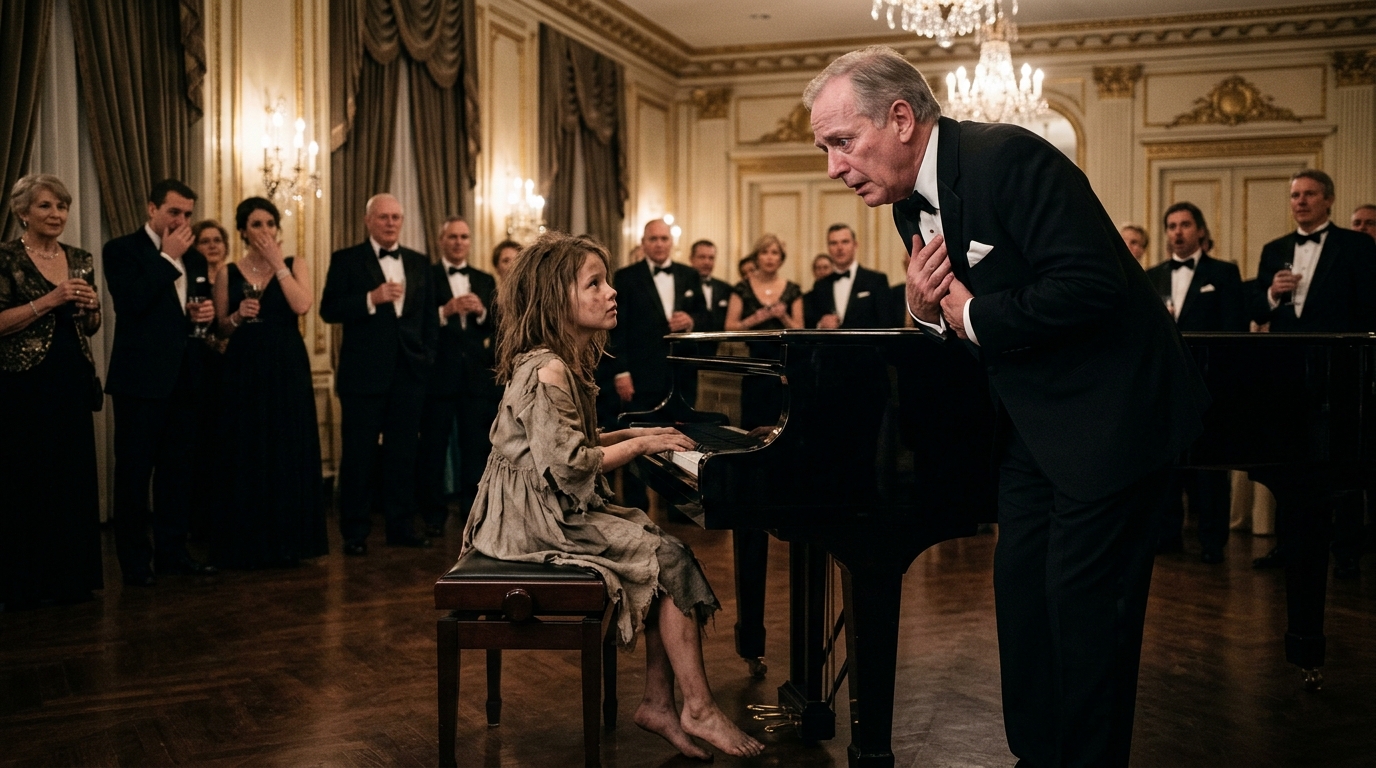
The Girl In Rags At The Piano
The mahogany doors slammed open so hard the brass handles struck the wall.
Conversation fractured mid-laugh.
Champagne stilled in crystal flutes.
A violinist near the raised platform actually flinched.
The annual Deveraux Winter Fund Gala was not the sort of event people interrupted. It was a room built for wealth and choreography: marble floors gleaming like still water, chandeliers burning warm gold above silk gowns and tuxedos, a grand piano at the center of the hall polished so dark it reflected the guests like a second world.
And into that world walked a child in rags.
She could not have been older than ten.
Barefoot.
Filthy hem dragging at her ankles.
Hair matted from rain or sweat or both.
She looked as if the city had dragged her through every cruel corner before throwing her against our doors as some kind of test.
A few guests recoiled on instinct.
A woman near the orchid arrangement lifted one jeweled hand to her throat.
Someone behind me muttered, “Good God.”
I stepped forward because the room expected me to. My name was Sebastian Deveraux. The hall belonged to my family. The gala honored the Saint Aurelia Children’s Fund, a charitable empire my mother had spent two decades turning into the kind of institution newspapers praised and governors attended.
Everything that happened inside these walls reflected on us.
And there, in the center of the room, was a starving little girl looking like she had crawled out of a storm.
She said nothing at first.
Her eyes moved over the chandeliers, the flowers, the rows of silver serving trays, the piano. Then she looked directly at me.
“Can I play,” she whispered, voice so soft I almost thought I imagined it, “for a plate of food?”
Cruel laughter rippled across the room before I could answer.
Not from everyone.
Just enough.
Enough to make the hall feel smaller.
I should tell you that I was not a cruel man by reputation. Cold, yes. Controlled, certainly. Difficult, according to every board member who had ever wanted sentiment where I preferred numbers. But cruelty had always seemed too messy for me.
That night, though, I heard my own voice sharpen into something hard and public.
“This isn’t a shelter,” I said.
More laughter.
The child lowered her gaze.
For one second, I thought she would run.
Instead, she walked straight past me.
No apology.
No begging.
No tears.
She climbed onto the piano bench with the wary, deliberate movements of someone used to expecting a blow from any adult who changed their tone too quickly. Her bare feet hung above the polished pedals. Her hands trembled as she lifted them over the keys.
A woman at table four hissed for security.
My mother, Celeste Deveraux, rose from her seat near the head table in a river of silver silk and diamonds, already shaping her outrage into something elegant enough for witnesses.
But the girl touched the piano before anyone could stop her.
The first note cut through the room like a blade drawn from velvet.
Low.
Old.
Haunting.
Not a child’s clumsy attempt.
Not random keys struck in hunger.
A melody.
Ancient-feeling, but precise.
The second phrase hit and something inside me went still.
By the third measure, the laughter had died.
By the fourth, I could no longer hear the room at all.
Because I knew that melody.
Not knew of it.
Knew it.
In my bones.
In the oldest, most private chamber of memory.
My wife used to play it in the dark.
My wife, Evelyn Hart.
The woman my family told me had stolen from us and disappeared fifteen years ago.
The woman I had buried without a body.
I stepped closer without realizing it.
The child played on, eyes fixed on the keys, the melody twisting through the lavish hall like smoke from another life. It was not just the tune itself. It was the phrasing. The hesitation before the descending run. The slight pressure on the seventh note. The same exact fragile hold Evelyn always used, as if the song hurt too much to touch directly.
I reached the edge of the piano.
My throat had gone dry.
“Wait,” I said, and my own voice sounded strange to me. Smaller. “Who taught you that song?”
The girl looked up.
“My mother,” she said softly.
The blood drained from my face.
“She said she played it here.”
A terrible silence fell over the room.
My mother’s glass slipped from her hand and shattered on the marble.
And I knew, before another word was spoken, that the dead woman I had mourned for fifteen years had not vanished by accident.
The Song I Was Never Supposed To Hear Again
My wife disappeared on a Tuesday in February.
That is the official version.
The unofficial version is uglier.
Evelyn was not born into money. She came into Deveraux Hall at nineteen through the conservatory program my father funded for gifted musicians from poor families. She arrived with one suitcase, a scholarship certificate, and hands so brilliant at the piano my father broke his own rule and invited her to perform at private family dinners.
The first time I heard her play, I forgot to be bored.
The first time I spoke to her, I forgot to be careful.
Within two years, I had married her.
My mother never forgave either of us for that.
Not openly.
Open hatred is a peasant’s weapon.
My mother preferred refined cruelty: invitations that “must have been lost,” jewels loaned to everyone but Evelyn, little comments disguised as etiquette, the endless reminding that while talent may enter a house, blood is what gives it permanence.
Evelyn survived it longer than I did.
She smiled.
She performed.
She lowered her gaze when insult was the only thing on offer.
Then she got pregnant.
That was when everything changed.
At first my mother seemed almost relieved. An heir meant legitimacy. Stability. Control. But Evelyn had been asking questions—small ones, harmless ones on the surface—about the Saint Aurelia Fund.
Why were donor records altered after signature?
Why were medicine shipments reported twice?
Why did the board treasurer visit the archive room after midnight?
I told her she was imagining patterns because she was tired.
I see now that tired men often call women irrational when the women are simply observing what the men are too complacent to notice.
Two weeks before she vanished, Evelyn played me that melody in our room after midnight.
“It’s unfinished,” she said.
I remember lying on the chaise near the fire, watching her in the half-dark.
“It sounds like it knows something terrible,” I told her.
She looked at me then with an expression I did not understand.
“Some songs do,” she said.
On the morning she disappeared, my mother told me Evelyn had emptied one of the foundation’s reserve accounts and fled before dawn with forged papers. There was a note in Evelyn’s handwriting saying she was ashamed, that she had never belonged, that the child she carried was not mine.
I believed it.
Or rather, I believed enough of it to let grief do the rest.
The police searched.
Nothing.
A body never surfaced.
A month later, my mother held a private memorial in the chapel and told me we must endure humiliation quietly if we wished to preserve what remained of the family’s dignity.
That was fifteen years ago.
And now a filthy child sat at our piano playing the one melody Evelyn had never performed in public.
The entire hall was watching me.
My mother recovered first, because of course she did.
“This is obscene,” she said sharply. “Someone remove her at once.”
The girl flinched.
I did not take my eyes off her.
“What is your mother’s name?”
She hesitated.
Then, with the sort of caution that comes only from experience, she said, “She told me not to say unless the right person asked.”
A murmur moved through the crowd.
My mother stepped forward, silver skirts whispering over marble. “Child, whatever story someone paid you to bring into this room, it ends now.”
The girl looked at her.
And something in her face changed.
Not recognition.
Fear.
Real, immediate fear.
She pressed one small hand into the pocket of her torn coat and shrank back on the bench.
That was when I noticed the scar across her wrist.
Thin.
Old.
Man-made.
Not the kind children get from rough play.
The hall suddenly felt airless.
I held up one hand toward security without looking at them. “No one touches her.”
My mother turned toward me so quickly I heard the diamonds at her throat click together.
“Sebastian.”
I ignored the warning in my name.
I kept my voice low and steady. “Tell me what your mother said.”
The girl swallowed.
“She said if they laughed,” she whispered, “I should finish the second part.”
Then she looked down and played six more notes.
Just six.
Softly.
Barely enough for the guests to register as music.
But I felt the floor vanish beneath me.
Because those six notes were not part of the melody.
They were a code.
A musical pattern Evelyn and I had once used as newlyweds to remember the safe sequence in the old green room beneath the stage, where my father kept private documents before the fund was moved to digital systems.
Only Evelyn and I knew that pattern.
Only Evelyn.
Unless—
My pulse began to hammer.
I looked at the child.
Then at my mother.
Her face had gone still in the worst possible way.
Not confused.
Not insulted.
Cornered.
And in that instant, I realized the song was not just a memory.
It was a message.
The Safe Beneath The Stage
I do not remember crossing the hall.
One moment I was beside the piano.
The next I was moving through the side corridor toward the green room staircase with the child in my wake and half the gala trailing us like witnesses following the scent of fire. Security opened the way because no one knew what else to do. My mother called after me once.
I did not stop.
The old green room sat beneath the stage behind a walnut-paneled door no longer used except by archivists and electricians. The brass plaque still read PRIVATE STORAGE, though no one had stored anything there in years. At least, that was what I had been told.
I punched the code Evelyn had just played.
The first lock clicked.
A sound went through the people gathered behind me—one of those small involuntary noises crowds make when a theory stops being speculation and becomes architecture.
I entered the second sequence.
The safe opened.
Inside were three items.
A cloth bundle.
A leather ledger.
And a sealed envelope with my name on it.
My hands shook as I took the envelope out.
Not from fear.
From recognition.
It was Evelyn’s handwriting.
No imitation this time.
No elegant forgery designed to wound.
Her real hand. I would have known the shape of those letters if I had been blind.
For Sebastian — if the song finds you before I do.
My breath caught so hard it hurt.
I broke the seal.
The letter inside was short.
“Sebastian,
If you are reading this, it means I failed to come back myself.
They found the ledgers before I could take copies. Your mother knew I had seen too much. Arthur Vane is not just treasurer. He is the pipe through which the children’s money disappears.
If I vanish, know this first: I never betrayed you. The child is yours. And the song means the archive was not emptied in time.
Do not trust the chapel records. Do not trust the doctor they send. And do not let Celeste touch our daughter if she returns hungry.
Evelyn.”
I read the last line twice.
Our daughter.
My knees weakened so suddenly I had to grip the edge of the safe.
Behind me, someone whispered, “Oh my God.”
I turned.
The little girl stood in the doorway with her hands clenched tight at her sides, eyes moving between my face and the letter like she was trying to measure whether hope was about to hurt her again.
My daughter.
The thought did not arrive gently.
It struck.
Hard.
I looked back into the safe.
The cloth bundle contained a silver locket I had given Evelyn the week we married. Inside was my photograph on one side, hers on the other. The ledger was worse. Much worse. Pages of donor funds rerouted into shell accounts. Medicine invoices duplicated and padded. Names of children’s homes listed as active years after closure. Signatures from dead board members reused.
And through it all, one name appeared over and over:
Arthur Vane.
Chief financial officer of Saint Aurelia.
My mother’s closest adviser for seventeen years.
A step sounded behind the crowd.
Then another.
Arthur himself had followed us down.
When I looked up and saw him in the doorway beside my mother, his face white and composed and already calculating, I understood that whatever happened next would not stay buried underground.
Because my mother took one glance at the open safe and said the one sentence that proved Evelyn had been telling the truth all along.
“She was supposed to burn those.”
The Woman My Mother Buried Alive
The room froze.
Arthur Vane moved first.
“Celeste,” he snapped under his breath, but too late.
Too late is a beautiful phrase when it belongs to the guilty.
Every eye in that corridor shifted to my mother.
She straightened slowly, realizing the sentence had escaped her before the mask could catch it. Then she did what powerful people do when the floor begins to open beneath them.
She tried contempt.
“You’re all behaving as if a hysterical girl and a decades-old ledger prove something.”
I looked at her.
“Hysterical?”
The word tasted poisonous.
The child took a step backward.
I knelt so our eyes met.
“What is your name?”
She hesitated again.
Then said, “Lila.”
A name Evelyn had once mentioned in passing, lying with her hand over the curve of her pregnant belly.
If it’s a girl, maybe Lila. It sounds like something that survives winter.
My vision blurred.
“How old are you, Lila?”
“Ten.”
Ten.
Which meant Evelyn had kept her alive somehow all these years.
Which meant the years between the disappearance and this moment were not empty.
They were occupied.
Filled.
Hidden.
I stood and turned back to my mother. “Where is she?”
My mother’s expression did not move.
“I have no idea what fantasy—”
Lila’s voice broke in, thin but steady.
“She’s alive.”
The corridor went silent again.
My mother’s head turned toward her so fast it looked mechanical.
Lila held her ground.
“She told me to come tonight because rich people don’t look at dirty children twice. She said if the man at the piano listened, I should tell him she’s at Saint Bartholomew House under the name Maria Vale.”
Arthur Vane swore under his breath.
And just like that, another piece fell into place.
Saint Bartholomew House.
Not a hospital.
A “rest home” on the northern edge of the city that our foundation funded quietly every year. A place for women with memory disorders, nervous collapses, and “unstable circumstances.” I had signed the budget renewals myself without ever visiting the facility.
My mother smiled then.
Actually smiled.
A terrible, tired smile.
“Well,” she said, “if she’s still breathing, I suppose they failed to keep her sedated enough.”
Lila made a small frightened sound.
The crowd behind us recoiled as if the temperature had dropped ten degrees.
I had spent years believing my mother was cold.
I had never understood that coldness was simply the polished edge of something far worse.
“You put her there,” I said.
My mother did not deny it.
“She was going to destroy everything,” she replied. “One emotional girl with a talent for performance and a stomach full of delusion. She found numbers she couldn’t interpret, panicked, and threatened a scandal that would have taken half the city’s charities down with us.”
“So you erased her?”
“I contained her,” my mother snapped. “For the institution. For the family. For you.”
That last part landed like a slap.
For you.
There it was. The oldest excuse in wealthy families and the dirtiest.
I looked at Arthur. “And you?”
His mouth tightened. “You have no idea what it takes to keep those funds alive.”
I lifted the ledger. “You stole from children.”
“We repurposed reserve channels.”
The audacity of that sentence almost made me laugh.
Behind me, one of the trustees from table seven was already on the phone. Another guest—an attorney I recognized from state procurement hearings—looked actively ill. Word was spreading upstairs by the second. The gala was over. The room above us simply had not realized it yet.
Lila tugged lightly at my sleeve.
“She said you might not believe me until you saw this.”
She reached inside her coat and pulled out a folded sheet, damp and wrinkled from being carried close to her body.
A drawing.
Crude, shaky, clearly made by an adult whose hands no longer obeyed properly.
It showed our grand piano.
The hall.
And me standing beside it.
Underneath, in trembling handwriting, Evelyn had written:
He will know me by the song. If he doesn’t, run.
That was the moment I broke.
Not loudly.
Not publicly.
But something inside me gave way forever.
Because the woman I had failed fifteen years earlier had still built her last hope around the possibility that I might listen.
The Night The Whole Hall Went Quiet
We did not go back upstairs quietly.
There are moments that return to a room like judgment.
This was one of them.
I walked back into the gala hall carrying the ledger in one hand and Evelyn’s letter in the other. Lila walked beside me, still barefoot, still filthy, still visibly terrified—but no longer invisible. Behind us came trustees, donors, two shocked board members, three security officers, and my mother with Arthur Vane close enough to smell fear coming off both of them.
The musicians had abandoned their instruments.
Guests stood in clusters, whispering in low urgent waves.
Every head turned when I crossed the threshold.
I went straight to the stage.
Took the microphone from the master of ceremonies.
And for the first time in my adult life, I spoke without calculating the social cost first.
“This gala is finished,” I said.
My voice carried farther than I expected.
“Fifteen years ago, my wife did not steal from this family. She discovered theft inside the Saint Aurelia Fund. She was removed, drugged, and hidden under another name. The child at this piano is my daughter.”
Gasps.
Actual gasps.
Arthur Vane started forward. “You cannot say that without—”
I held up the ledger.
“This contains the foundation records your office buried. The original copies were stored beneath this hall and sealed by my wife before she was taken. Several trustees here are attorneys. Several more are donors whose money was redirected through dead institutions and false medicine invoices. You may now decide whether your loyalty belongs to the truth or to the people who used starving children as camouflage.”
No one moved.
Then one trustee stepped away from my mother.
Then another.
Then a woman on the hospital board removed the Saint Aurelia brooch from her lapel and laid it on the table beside her untouched dessert plate as if it had become contaminated metal.
My mother understood before Arthur did.
The room was no longer hers.
She looked around the hall she had curated for years—the judges, the wives, the donors, the press contacts—and realized status depends on shared fiction. The second the fiction breaks, luxury becomes costume.
“You’re making a catastrophic mistake,” she said.
I almost pitied her.
Almost.
“No,” I said. “I made that mistake fifteen years ago.”
Then I looked at Roman.
“Call the police. And call Saint Bartholomew House. No warning. No transfer. No sedation order leaves that building before I arrive.”
Roman nodded once.
“At once, sir.”
Lila slipped her hand into mine.
It was small.
Cold.
Real.
I looked down at her and felt the force of lost time so violently I thought it might knock the breath out of me.
“Did she tell you I’d come?” I asked quietly.
Lila nodded.
“She said maybe not quickly,” she whispered. “But if I played it right… you’d remember.”
Remember.
Such a simple word for what it cost.
Behind us, my mother finally sat down, not gracefully, not like a woman choosing a chair, but like someone whose bones had stopped negotiating with gravity. Arthur Vane was speaking too fast into his phone now, words tumbling over each other, already ruined. Around them, the city’s elite had fallen into the kind of silence wealth cannot buy its way out of.
The same hall that had laughed at a starving child minutes earlier now stood frozen by what that child had carried in with her.
Not money.
Not jewels.
Not revenge.
Memory.
Proof.
A song.
And just before we left for Saint Bartholomew House to pull a living woman out of the grave my family had built around her, I turned back once more toward the piano.
The bench was still slightly askew from Lila’s small body climbing onto it.
The keys still gleamed under the chandeliers.
And the whole hall remained silent, as if every person in it had finally understood the same terrible thing at once:
the dirtiest child in the room had not entered begging for food.
She had come carrying the only truth rich people had failed to bury.