Chapter 1: The Man With Cement on His Hands
For twenty-five years, my stepfather worked under the sun so I could study under fluorescent lights.
He carried bricks.
Mixed cement.
Climbed scaffolding.
Came home with dust in his hair and pain hidden in his back.
And somehow, he still smiled whenever I opened a book.
My name is Sofia Alvarez.
But Alvarez was not the name I was born with.
When I was very young, my parents separated. I was too little to understand divorce, betrayal, or abandonment. All I remembered of my biological father was a blurred face, a smell of cigarettes, and a door closing one afternoon while my mother cried in the kitchen.
After that, it was just my mother, Elena, and me.
She brought me to Santiago Vale, a struggling town surrounded by rice fields, fierce winds, and houses patched together by people who had learned not to expect much from life.
We were poor.
Not the kind of poor people romanticize later.
Real poor.
Counting coins before buying rice.
Repairing sandals with wire.
Stretching soup with water.
Sleeping early during storms because candles cost money.
When I was four, my mother met Hector Alvarez.
He was not the kind of man children imagine when they think of a father.
He didn’t arrive with gifts.
He didn’t make big promises.
He didn’t speak loudly about changing our lives.
He arrived with a tired back, sun-burned skin, and hands so rough they looked like they had been carved from stone.
At first, I was afraid of him.
He left before sunrise and returned after dark, smelling of sweat, dust, and cement. His boots were always dirty. His shirts were faded. His shoulders seemed permanently bent from carrying things heavier than himself.
But he never frightened me.
That was different.
He never shouted when I spilled water.
He never mocked me when I cried.
When my bicycle chain broke, he fixed it quietly under a weak kitchen bulb.
When my sandals split open, he stitched them with thick thread and said, “They still have a few miles left.”
When I got bullied after school by children who said I had no real father, Hector rode his old bicycle through the rain to pick me up.
I still remember that ride.
I sat on the back of his bicycle, soaking wet, trying not to cry.
He didn’t ask who had hurt me.
He didn’t tell me to be strong.
He only pedaled slowly through the muddy road and said:
“I won’t force you to call me father. But I will always come when you need me.”
That was the day I first called him Dad.
Not because anyone told me to.
Because he had already become one.
Chapter 2: “Knowledge Commands Respect”
Hector was not an educated man.
He had left school when he was twelve to help feed his younger siblings. He could read simple instructions, write his name, count wages, measure wood, and calculate cement ratios faster than most men with calculators.
But books intimidated him.
He never pretended otherwise.
Whenever I brought schoolwork home, he would sit beside me anyway, elbows on the table, eyes narrowed in deep concentration.
Sometimes he understood nothing.
But he always listened.
“What is this one?” he would ask, pointing at a diagram.
“Science.”
“And this?”
“History.”
“And this?”
“English.”
He would nod seriously, as if all three were bricks and he was checking whether they were strong enough to hold a roof.
Then he would say the sentence I heard more than any other growing up:
“Knowledge commands respect. Always study well.”
In our house, education became sacred.
Not because we were rich.
Because we were not.
My mother sold vegetables in the morning and sewed clothes at night. Hector worked construction wherever he could find it — houses, roads, school walls, drainage canals, anything that paid.
During rainy seasons, work disappeared.
During dry seasons, his body disappeared into work.
He came home with cracked lips, swollen fingers, and dust lodged so deep under his nails that no amount of washing could remove it.
Yet every night, no matter how tired he was, he asked:
“How was school?”
If I said, “Fine,” he knew I was hiding something.
If I said, “Hard,” he nodded and answered:
“Good. Hard things make room for better things.”
When I won my first academic prize, he borrowed a shirt from our neighbor to attend the ceremony.
He sat in the back.
Clapped too loudly.
And when the teacher mispronounced my last name, he stood up and corrected her.
“It’s Alvarez,” he said.
Not aggressively.
Proudly.
That was the first time I realized he had given me more than food and shelter.
He had given me a name he believed I could make honorable.
Chapter 3: The Exam That Changed Everything
The year I passed the entrance exam for Metro City University, my mother cried so hard she had to sit down.
I thought Hector would shout with joy.
He didn’t.
He walked outside.
Lit a cigarette.
Then stood in the yard staring at the rice fields for a long time.
I thought maybe he was worried about money.
Of course he was.
We all were.
Metro City University was not just far away.
It was expensive in ways our family had never dared imagine.
Dorm fees.
Books.
Transport.
Uniforms.
Food.
Lab materials.
I told them I could wait.
Maybe work first.
Maybe apply again later.
Maybe choose a cheaper school.
My mother cried harder.
Hector said nothing that night.
The next morning, his old motorbike was gone.
It was the only thing he owned that had real value.
When I asked where it was, he shrugged.
“Too old. Always breaking.”
But later, I found the receipt tucked behind a jar on the shelf.
He had sold it.
He combined the money with my grandmother’s savings and my mother’s sewing income.
Then he handed me a folded cloth packet.
Inside was my first semester’s payment.
I pushed it back.
“I can’t take this.”
Hector looked offended.
“Why not?”
“You need the motorbike for work.”
“I have legs.”
“Dad—”
He raised one hand.
Not angry.
Final.
“Sofia, I have carried cement for men who build houses their children will inherit. Let me carry something for mine.”
I cried then.
He pretended not to see.
When he took me to the city, he arrived at the dorm sweating through his shirt, wearing his old cap, carrying gifts from home: rice, dried fish, peanuts, and a jar of pickled vegetables my mother insisted I would miss.
Other students arrived with suitcases, laptops, and parents in clean cars.
I arrived with my stepfather carrying a sack of rice on his shoulder.
For a moment, I felt embarrassed.
I hate admitting that.
But I did.
I saw the way people looked at him.
The dusty shoes.
The old cap.
The rough hands.
The smell of bus stations and hard labor.
Hector noticed.
Of course he did.
He always noticed more than he said.
He placed the rice near my bed, smiled gently, and said:
“Do your best, child. Study hard.”
Then he left quickly, as if making departure short would make pain smaller.
After he was gone, I opened the lunch bag my mother had packed.
Inside, beneath the food, was a folded note in Hector’s uneven handwriting:
I may not understand your studies, but I will work for them. Don’t worry.
I sat on the dorm floor and cried into my knees.
That night, I promised myself I would never again feel ashamed of the hands that built my future.
Chapter 4: The Long Road to a PhD
College was hard.
Not only academically.
Socially.
Emotionally.
Financially.
I learned quickly that poverty follows you into places where people pretend merit is all that matters.
Some students complained about cafeteria food while I calculated whether skipping dinner would help me afford a required textbook.
Some went home on weekends with laundry bags and returned with snacks.
I washed clothes by hand in the dorm bathroom.
Some called their parents to ask for extra allowance.
I avoided calling home because I knew Hector would send money he didn’t have.
But he always sent something.
A little cash hidden inside folded newspaper.
Dried fish wrapped in cloth.
Peanuts in an old jar.
A note that said: Eat properly. Thin scholars worry their parents.
Every time I tried to tell him not to work so much, he laughed.
“I’m raising a PhD.”
“I’m not even done with college yet.”
“Then I am preparing early.”
Years passed.
I finished my undergraduate degree.
Then my master’s.
Then, against every practical expectation, I entered a doctoral program.
By then, Hector’s body had begun to show the cost.
His back bent more.
His knees made sounds when he stood.
His hands shook slightly in cold weather.
His hair, once black, turned gray at the temples.
I begged him to rest.
He waved me off.
“Rest after your graduation.”
“You said that after my bachelor’s.”
“And you continued studying.”
“You said that after my master’s.”
“And you continued again.”
I laughed.
He smiled.
Then he said:
“Let me finish what I started.”
That sentence stayed with me.
Because I realized he did not see my education as mine alone.
It was his work too.
Not in the papers.
Not in the citations.
Not in the academic language.
But in the foundation.
Every page I wrote had his fingerprints beneath it.
Every conference I attended stood on his aching knees.
Every exam I passed was built from days he had spent under scaffolding, swallowing dust, so I could breathe easier.
Chapter 5: Defense Day
My doctoral defense arrived on a windy morning in May.
I had imagined the day for years.
But when it came, I was more terrified than excited.
My thesis was on rural infrastructure and social mobility — how roads, schools, and public works shaped the futures of children from poor communities.
People praised the topic as sophisticated.
But for me, it was simple.
I had grown up watching men like Hector build roads their own children could barely afford to travel.
I wanted to understand why some people carried the world and remained invisible beneath it.
Hector insisted on attending.
He borrowed a suit from a neighbor.
The sleeves were too long.
The shoulders too tight.
The shoes pinched his feet.
He bought a new hat because he said a father of a PhD should not arrive looking “too ordinary.”
When he appeared outside the auditorium, I nearly cried.
He looked uncomfortable.
Proud.
Nervous.
He held a plastic bag with food my mother had prepared, though we were standing outside a university hall full of catered refreshments.
“Dad,” I whispered, fixing his crooked tie. “You look handsome.”
He frowned.
“I look like a man pretending to be a bank manager.”
I laughed so hard my nerves broke.
My mother stood beside him, wiping her eyes already.
During the defense, Hector sat in the back row.
He did not understand most of what I said.
I knew that.
But his eyes never left me.
When I spoke about labor migration, he nodded.
When I mentioned construction workers, he sat straighter.
When I thanked my family, my voice almost failed.
“My mother, Elena, taught me endurance,” I said.
She cried openly.
“And my father, Hector Alvarez…”
I stopped.
The room blurred.
Hector looked startled, as if he had not expected to be named.
I continued:
“…taught me that dignity is not given by wealth, titles, or education. It is carried in the way a person loves without asking to be seen.”
Hector lowered his head.
His shoulders shook once.
Then he wiped his face with the back of his hand and pretended something had gotten in his eye.
After my presentation, the panel asked questions.
Hard ones.
I answered.
Not perfectly.
But honestly.
When they asked me to step outside while they deliberated, I waited in the corridor with my mother gripping my arm and Hector pacing like a man awaiting a medical diagnosis.
Finally, the door opened.
My advisor, Professor Rafael Menendez, stepped out.
He smiled.
“Congratulations, Dr. Alvarez.”
My mother screamed.
Hector froze.
I covered my mouth.
For a few seconds, I forgot every academic rule about composure and simply cried.
Then everyone moved at once.
Friends hugged me.
Faculty shook my hand.
My mother held my face and kept saying, “My daughter. My daughter.”
Hector stayed slightly behind them.
Smiling.
Quiet.
As always.
Professor Menendez approached to greet my family.
He shook my mother’s hand warmly.
Then his eyes moved to Hector.
And stopped.
The professor’s smile faded.
His face went pale.
For a moment, he looked not like a scholar, not like a respected academic, but like a man seeing someone rise from memory.
He took one step closer.
“You’re Hector Alvarez, right?”
Before Hector could respond, the professor’s voice broke.
“You saved my life.”
Chapter 6: The Man Under the Beam
The corridor went silent.
I stared at my professor.
Then at Hector.
My stepfather looked uncomfortable, almost embarrassed.
“No, sir,” he said quickly. “You must be mistaken.”
Professor Menendez shook his head.
“I am not.”
His eyes dropped to Hector’s right hand.
The crooked little finger.
The scar across his wrist.
“I never forgot that hand.”
Hector looked away.
My mother covered her mouth.
She knew something.
I turned to her.
“Mom?”
She did not speak.
Professor Menendez looked at me.
“Sofia, when I was nineteen, I worked part-time on a university construction site. My family had no money. I carried materials at night and studied during the day.”
He swallowed.
“One evening, part of the scaffolding collapsed. A steel beam came loose. I was standing directly underneath it.”
The hallway seemed to disappear.
Professor Menendez continued:
“Everyone shouted, but I froze. Your father pushed me out of the way.”
Hector lowered his eyes.
The professor’s voice trembled.
“The beam crushed his hand and injured his back. He was taken away before I even knew his name. Later, I asked about him, but the contractor said he had left.”
Hector spoke quietly.
“I did leave.”
“Why?”
Hector shrugged, still looking at the floor.
“Needed work.”
Professor Menendez stared at him.
“You were injured because of me.”
“No,” Hector said. “Because the scaffold was badly secured.”
“You saved my life.”
Hector’s face tightened.
“You were a boy.”
“So were you.”
Hector gave a small, sad smile.
“Poor boys become men early.”
No one spoke.
Professor Menendez wiped his eyes.
“I looked for you for years. I became an engineer before I became a professor because of that accident. I wanted to understand why men like you risked their bodies building institutions that rarely remembered their names.”
My chest tightened.
My thesis.
My topic.
My entire academic life suddenly stood inside a circle I had not known existed.
Professor Menendez turned to the people gathered around us.
“This man,” he said, voice growing stronger, “is one reason I am alive to teach today.”
Hector shifted awkwardly.
“Professor, please…”
But Professor Menendez did not stop.
“And today, I had the honor of approving his daughter’s PhD.”
The words broke me.
His daughter.
Not stepdaughter.
Not poor student.
His daughter.
Hector’s face crumpled.
For twenty-five years, he had worked without applause.
Without recognition.
Without expecting anyone to connect his labor to anything noble.
And now, in the corridor of the university his sacrifice had helped me enter, a professor stood before him and named what the world had refused to see.
Chapter 7: The Applause for Hector
The story spread through the room quickly.
Faculty stepped closer.
Students gathered.
My friends stood silent.
Even the administrative staff paused near the doorway.
Professor Menendez faced Hector.
“May I ask something?”
Hector looked frightened.
“What, sir?”
“Would you come inside?”
“Inside?”
“The defense room.”
Hector glanced at me.
“I don’t belong there.”
The professor’s expression changed.
Gentle.
Firm.
“Hector, men like you built that room.”
That sentence silenced everyone.
My father stared at him.
Then slowly, reluctantly, he allowed us to guide him back inside.
The committee members were still there.
So were several guests.
Professor Menendez stood at the front.
“I would like to acknowledge someone,” he said.
Hector stood near the door, hat twisting in his hands.
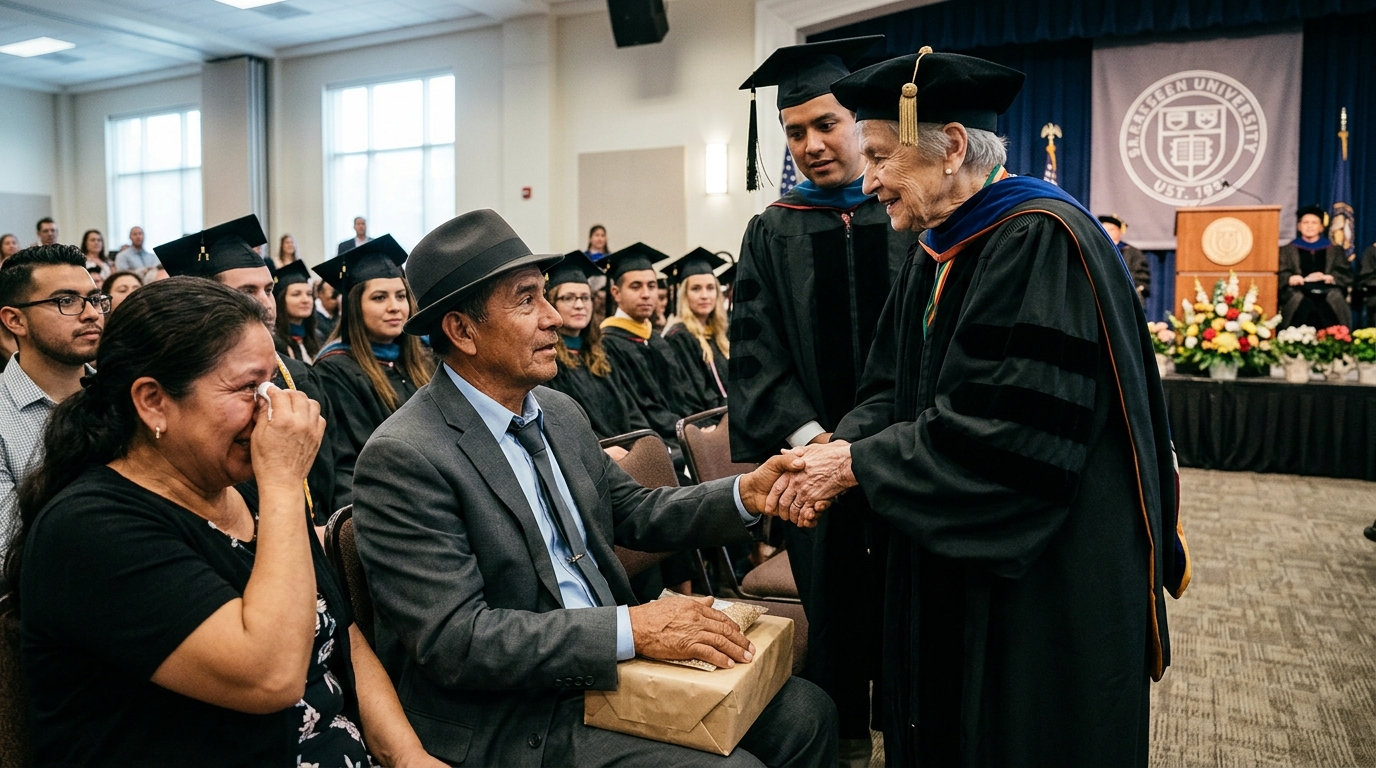
“This is Mr. Hector Alvarez. Many years ago, he saved my life on a construction site at this university. Today, his daughter successfully defended a dissertation about labor, dignity, and social mobility.”
He paused.
His voice thickened.
“I do not believe in coincidences that clean.”
A few people smiled through tears.
Professor Menendez continued:
“We often celebrate the student, the advisor, the institution. We print names on diplomas and plaques. But behind many first-generation scholars stands someone who never had the chance to enter these rooms, yet paid for them with their body.”
He turned toward Hector.
“Mr. Alvarez, this degree belongs to Dr. Sofia Alvarez. She earned it. But I hope you understand that your labor lives inside it too.”
Hector’s lips trembled.
He shook his head.
“No, sir. I only worked.”
Professor Menendez stepped closer.
“That is exactly what I mean.”
Then he began clapping.
Slowly.
Once.
Twice.
The room followed.
My mother cried.
I cried.
Hector stood there, overwhelmed, still holding his hat like he wanted to disappear into it.
But this time, he could not disappear.
The applause found him.
And for once, he had to stand in the light.
Chapter 8: The Diploma
After the ceremony, when the crowd had thinned, Hector sat alone on a bench outside the auditorium.
The borrowed shoes were off.
His socks had holes at the toes.
His hat rested beside him.
I sat down next to him.
For a while, neither of us spoke.
Then he said:
“Your professor is a good man.”
“He said you saved his life.”
Hector looked embarrassed.
“Long time ago.”
“Why didn’t you tell me?”
He shrugged.
“What would I say? That I pushed a boy and broke my hand? Life continued.”
I looked at his scarred hand.
The one that had fixed my bike.
Carried my bags.
Counted tuition money.
Held my mother’s hand through hunger and storms.
“That injury made your work harder.”
“Yes.”
“And you still kept working.”
He looked at me.
“How else would you study?”
I broke then.
All the strength I had used to survive academia, poverty, imposter syndrome, sleepless nights, and endless expectations fell apart beside him on that bench.
“I don’t know how to repay you.”
Hector frowned.
“Repay?”
“Yes.”
He looked genuinely confused.
Then almost offended.
“You think children repay parents?”
I wiped my face.
“I think I owe you everything.”
He shook his head.
“No. You owe me one thing.”
“What?”
He picked up my graduation program and tapped the printed title before my name.
Dr. Sofia Alvarez
“Do not make my sacrifices small by being ashamed of them.”
I cried harder.
He put one rough hand on my shoulder.
“You climbed higher than me. That is not debt. That is harvest.”
Chapter 9: Home
When we returned to Santiago Vale, the town received us differently.
People who once called Hector “just a laborer” now wanted to shake his hand.
Neighbors came with food.
Children stared at my graduation photos.
My mother placed my framed certificate on the wall beside an old photograph of Hector in his work clothes.
I laughed when I saw it.
“Mom, why that one?”
She smiled.
“Because that is the man who paid for the certificate.”
Hector pretended not to hear.
But I saw his eyes shine.
A week later, I visited the construction site where he was still working.
He had promised to rest after my graduation.
He lied.
I found him carrying a bucket of sand.
“Dad.”
He froze like a guilty child.
I crossed my arms.
“You said you would rest.”
He looked at the bucket.
“This is light.”
“It is sand.”
“Light sand.”
The other workers laughed.
I took the bucket from him.
He protested immediately.
“Doctor hands shouldn’t carry that.”
I looked at him.
“Construction hands raised the doctor.”
He went quiet.
Then slowly smiled.
That afternoon, I helped serve lunch to the workers.
No cameras.
No ceremony.
Just rice, fish, vegetables, sweat, laughter, and men eating under shade before returning to labor most people would never notice.
I watched Hector among them.
He looked ordinary there.
That was what struck me most.
The man who had saved a professor’s life, raised a PhD, carried a family through poverty, and sacrificed his body for my future looked ordinary to anyone who did not know how to see.
That became the next lesson of my life.
Final Chapter: His Name on the First Page
When my dissertation was later published, I added a dedication.
Not the short one I had written before.
A new one.
For Hector Alvarez, who did not read the books but built the life that allowed me to write them.
When I showed it to him, he read it slowly.
Very slowly.
His finger moved under each word.
Then he stared at the page for a long time.
“You put my name in the book?”
“Yes.”
“People will see it?”
“Yes.”
He swallowed.
“But I didn’t study.”
I smiled through tears.
“No. You taught me why study matters.”
He looked away.
His eyes were wet.
Then he said quietly:
“Your grandfather would have liked this.”
I knew he meant his own father, a man who had died without ever seeing a classroom beyond third grade.
I leaned against his shoulder.
“I think he would have liked you.”
Hector laughed softly.
“He did. He had no choice. I was his son.”
I took his rough hand in mine.
“And I’m your daughter.”
He looked at me then.
For a moment, all the years passed between us.
The bicycle ride in the rain.
The repaired sandals.
The sold motorbike.
The sacks of rice carried to my dorm.
The notes hidden in lunch bags.
The borrowed suit.
The professor’s recognition.
The applause he never asked for.
His voice was barely above a whisper.
“Yes,” he said.
“My daughter.”
And that was the title that mattered most.
Not Doctor.
Not PhD.
Not scholar.
Daughter.
Because before any university gave me a degree, a construction worker with cement on his hands gave me a future.
And for twenty-five years, he built it quietly.
One day of labor at a time.