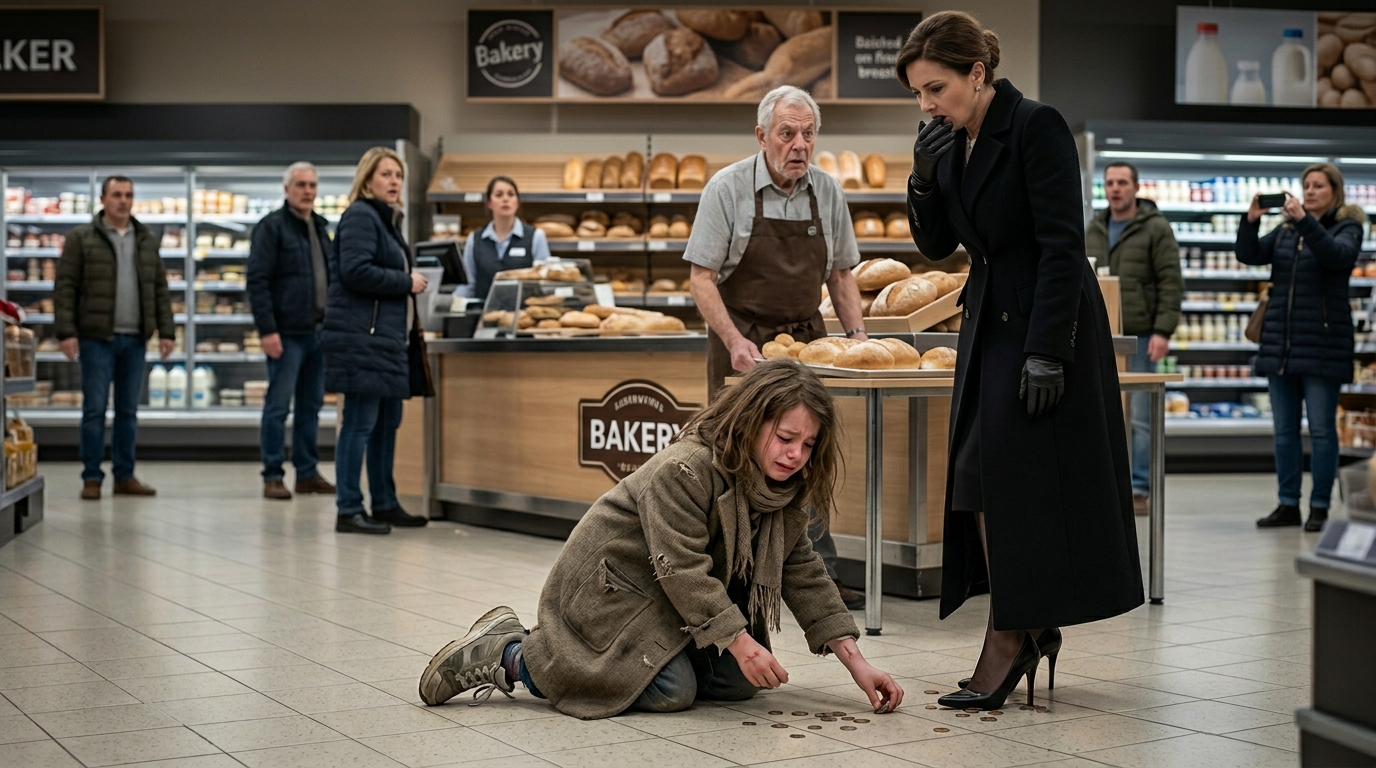
The Coins on the Floor
No one in Harbor Lane Market expected a few small coins to silence an entire aisle.
Not on a Sunday morning.
Not in a supermarket filled with warm bread, squeaking carts, tired parents, and shoppers pretending not to compare prices under fluorescent lights.
I was behind the bakery shelves when I first saw the little girl.
She stood near the fresh loaves with both hands closed around a few coins, staring at the bread as if the whole world had narrowed to that one plastic-wrapped loaf.
She could not have been more than nine.
Maybe ten.
Her coat was too thin for the cold outside. Her shoes were too large, the heels lifting each time she shifted her weight. Her hair had been brushed, but not well, and one sleeve of her sweater hung lower than the other.
She looked hungry.
But that was not what made me stop.
It was the way she waited.
Children who steal look around. Children who are lost search for adults. Children who are scared cry before anyone gives them a reason.
This girl did none of those things.
She simply stood there, holding those coins like they were sacred, watching the bread.
I was lifting a tray of rolls from the cooling rack when Vanessa Cole walked into the aisle.
Everyone in town knew Vanessa.
Not personally.
People like her made sure of that.
She was the kind of woman whose photograph appeared beside donation checks and ribbon-cutting ceremonies. Her family owned half the commercial buildings downtown, including the expensive apartments built where the old shelter used to be.
She wore a cream coat, black leather gloves, and sunglasses pushed into her hair, even though it was raining outside and the sky had been gray all morning.
She stopped when she saw the little girl blocking the bakery display.
“Excuse me,” Vanessa said.
The girl stepped aside quickly.
Too quickly.
One coin slipped from her hand and rolled across the tile.
Vanessa looked down.
Then she looked at the girl.
Her mouth curved in the kind of smile rich people use when they want cruelty to appear reasonable.
“Are you buying something?”
The girl nodded.
Her voice came out small.
“Bread.”
Vanessa’s eyes dropped to the coins.
A dime.
Three nickels.
A few pennies.
Not enough.
Not even close.
“You’re holding up the aisle for that?”
The girl’s cheeks reddened.
“I’m waiting.”
“For what?”
The girl swallowed.
“My mother said to wait here every Sunday until the man who bought two loaves saw me.”
The tray in my hands suddenly felt heavier.
The words moved through me slowly.
Not loud.
Not dramatic.
But familiar in a way that made the skin along my arms tighten.
Vanessa laughed.
Cold.
Sharp.
“That is the most ridiculous thing I’ve heard all week.”
The girl lowered her head.
“I’m not begging.”
“No,” Vanessa said, stepping closer. “You’re just standing in a store bothering real customers with your little beggar coins.”
Before anyone moved, she struck the girl’s hand.
The coins scattered.
They hit the tile with tiny, terrible sounds.
Clink.
Clink.
Clink.
Then Vanessa lifted one polished heel and stepped on them.
The aisle froze.
A cashier looked up from the front lane.
A man holding a basket of oranges stopped mid-step.
Someone near the dairy case raised a phone.
The little girl dropped to her knees.
“No,” she cried, scrambling across the floor. “Please—no, I need them.”
Vanessa looked pleased with herself.
That was what I remember most.
Not the coins.
Not the gasp from the crowd.
Her satisfaction.
The little girl reached beneath the bread shelf for a penny that had rolled near my shoes.
Her sleeve pulled back.
And I saw the scar on her wrist.
Thin. Pale. Curved like a hook.
My hands went weak.
The tray slipped from my fingers and crashed against the floor, sending rolls across the bakery aisle.
Everyone turned.
But I was no longer in Harbor Lane Market.
I was back in the parking lot twelve years earlier, rain pouring so hard the streetlights blurred, while a young mother stood outside the bakery door clutching a baby to her chest and begging me to hide her child before they found her.
The baby had that same scar.
And the mother had vanished before sunrise.
The Baby From the Parking Lot
My name is Samuel Reeves.
For thirty-eight years, I baked bread at Harbor Lane Market.
That sounds like a small life to some people.
Maybe it was.
But I knew the rhythm of the town better than most men who sat in offices above it. I knew who came in every Friday after payday, who bought discount cakes after funerals, who hid tears behind birthday balloons, who counted change in their pockets before pretending they forgot something and walking out empty-handed.
Bread tells you things about people.
Who is feeding a family.
Who is eating alone.
Who is too proud to ask for help.
That was how I met Nora Bell.
She used to come every Sunday evening, just before closing, when the markdown stickers went on the older loaves. She never bought much. One loaf. Sometimes soup. Sometimes baby formula when she could afford it.
She was young then.
Twenty-two, maybe.
Beautiful in a tired way, with dark hair always pulled into a knot and eyes that looked over her shoulder too often.
She had a baby girl wrapped against her chest.
The baby rarely cried.
That worried me.
Babies who know hunger too early learn silence before they learn words.
One Sunday, I bought two loaves at the end of my shift and left one near the back exit.
Nora found it.
She tried to pay me the next week.
I told her it had been a mistake.
She knew I was lying.
After that, it became our quiet ritual.
Every Sunday, I bought two loaves.
One for me.
One for her.
No pity spoken aloud.
No questions.
Just bread.
Then came the night she ran.
It was late November. Rain beat against the windows so hard the whole store seemed to tremble. I had stayed after closing to prep dough for the next morning when someone pounded on the back door.
I opened it and Nora nearly fell inside.
Her coat was soaked.
Her lip was bleeding.
The baby was pressed against her chest, wrapped in a blanket too thin for the weather.
“Sam,” she sobbed. “Please. Please, you have to help me.”
I remember the smell of rain and fear.
I remember the baby’s tiny wrist slipping from the blanket.
The scar was fresh then.
A thin curved mark where something sharp had cut her skin.
“What happened?” I asked.
Nora shook her head.
“No time.”
Behind her, headlights passed slowly through the alley.
A black car.
Then another.
Nora shoved a small envelope into my apron pocket.
“If anything happens to me,” she said, “one day she’ll come back for the bread.”
“What are you talking about?”
“Two loaves,” she whispered. “Every Sunday. Promise me.”
Before I could answer, voices echoed near the loading dock.
Men’s voices.
Nora turned white.
I pulled her and the baby into the dry storage room behind the flour sacks.
“Stay there,” I said.
But she grabbed my sleeve.
“If they take me, don’t believe what they say.”
Then she kissed the baby’s forehead and did something I have never forgiven myself for allowing.
She handed me the child.
Just for a moment, she said.
Just until the men left.
But the baby began to fuss.
Nora panicked.
She took her back.
Said she could calm her faster.
Said she would circle around and meet me by the dumpster.
Then she slipped out the side door into the rain.
I waited ten minutes.
Then twenty.
Then an hour.
She never came back.
By morning, the police were asking questions.
By noon, the local news reported that Nora Bell, a troubled young mother with a history of instability, had abandoned her baby near the river and disappeared.
They found a blanket in the water.
Not the baby.
Not Nora.
Just a blanket.
The town mourned for three days.
Then moved on.
I did not.
Because I had the envelope Nora left me.
Inside was a photograph of the baby, a hospital bracelet with the name Lila Bell, and one sentence written in Nora’s shaking hand.
If she ever comes back, do not let Vanessa see her first.
And now, twelve years later, Vanessa Cole was standing over that same child, smiling at the coins beneath her heel.
The Woman Who Knew Too Much
I stepped into the aisle before I knew what I was doing.
“Move your foot,” I said.
Vanessa turned slowly.
Her eyes swept over my bakery apron, my flour-dusted sleeves, the gray hair at my temples.
“Excuse me?”
“Move your foot off her coins.”
A few shoppers shifted.
The girl froze on her knees, one hand still stretched beneath the shelf.
Vanessa smiled again, but it was thinner now.
“Samuel, isn’t it?”
That chilled me.
I had worked in that store for nearly four decades.
Vanessa had never once used my name.
“I said move your foot.”
The smile vanished.
She lifted her heel.
The girl scrambled to collect the coins, her hands shaking so badly she dropped them twice.
I crouched beside her.
“What’s your name?” I asked softly.
She looked at me with wet eyes.
“Lily.”
My chest tightened.
Not Lila.
Lily.
Close enough to hide.
Close enough to remember.
“Lily what?”
She hesitated.
“Lily Ward.”
Not Bell.
Of course not.
Nora would have changed it if she had survived long enough.
Vanessa’s voice came from above us.
“How touching.”
I stood slowly.
“You know her.”
Vanessa laughed.
“I know poverty when I see it.”
The girl flinched.
I turned toward the shoppers watching us.
“Someone call the police.”
Vanessa’s face changed.
Just slightly.
But enough.
“No need for theatrics.”
“Then you won’t mind waiting.”
Her eyes locked on mine.
“Careful, Samuel.”
There it was.
Not anger.
Warning.
The same kind of warning men in black cars had carried with them that night behind the store.
Lily wiped her face with her sleeve.
“My mom said the man with two loaves would know where to look.”
Vanessa stopped breathing.
So did I.
“What did you say?” I whispered.
Lily reached into the inside pocket of her coat and pulled out a folded piece of paper. It was soft from being opened too many times.
“My mom gave me this before she went to sleep and didn’t wake up.”
The aisle seemed to tilt.
Nora was dead.
Not missing anymore.
Not running.
Dead.
Lily handed me the paper.
I unfolded it.
The handwriting was older, weaker, but I knew it immediately.
Sam, if Lily finds you, they are close. The woman who took my name is still living under hers. Look inside the flour wall. I left the truth where bread rises.
My hands began to shake.
The flour wall.
In the old bakery storage room, there was a false panel behind the industrial flour bins. Years earlier, we used it to store holiday decorations, broken scales, old employee files no one wanted to sort.
I had not opened it in a decade.
Vanessa stepped forward.
“Give me that.”
I folded the note and put it in my pocket.
“No.”
Her eyes went flat.
“You are making a terrible mistake.”
“I made that twelve years ago.”
A siren sounded faintly outside.
Someone had called.
Vanessa looked toward the front windows, then back at Lily.
For the first time, she looked afraid of the child.
Not because Lily was dangerous.
Because Lily existed.
A child everyone had been told was gone.
A child with a scar.
A child whose mother had left instructions written like a confession.
Then Lily said the words that made Vanessa’s mask crack completely.
“My mom said you were wearing her necklace the night she disappeared.”
The entire aisle went silent.
Vanessa’s hand rose instinctively to her throat.
A gold chain rested there.
I had seen it before.
Not on Vanessa.
On Nora.
The night she ran into the bakery with rain in her hair and terror in her eyes.
The Truth Behind the Flour Wall
The police arrived in pairs.
Officer Brady came first, red-faced and annoyed, as if a crying child and a wealthy woman in aisle four were equally inconvenient.
Then Detective Rachel Knox walked in behind him.
That changed everything.
Rachel had been a rookie when Nora disappeared. I remembered her standing in the parking lot that morning, looking unconvinced while older officers nodded at conclusions handed to them too neatly.
Now she was older.
Sharper.
The moment she saw Lily, her face shifted.
Not surprise.
Recognition.
“Who is this?” she asked.
Vanessa answered before anyone else could.
“A child causing a disturbance.”
Rachel ignored her.
She looked at me.
“Sam?”
I handed her the note.
She read it once.
Then again.
Her jaw tightened.
“Where is this flour wall?”
I led them to the bakery storage room.
Lily stayed close behind me. She held the bread loaf against her chest now. I had given it to her without asking for coins.
Vanessa followed too, though Rachel told her she could wait up front.
“I have every right to be present,” Vanessa said.
Rachel looked at her.
“No, Mrs. Cole. You don’t.”
The title landed strangely.
Mrs. Cole.
Nora’s last name had been Bell.
But before that, I remembered whispers.
Nora had worked in the Cole house as a live-in caregiver for Vanessa’s father-in-law, Richard Cole, founder of the supermarket chain. The official story was that Richard left Vanessa and her husband controlling interest after his health declined.
But Nora had once told me, while counting change near the bakery case, “Some families don’t inherit money. They hunt it.”
I never asked what she meant.
Cowardice often looks like politeness until it is too late.
In the storage room, I moved the flour bins away from the rear wall. My back screamed with the effort. Rachel helped. So did Officer Brady, now much less annoyed.
Behind the bins was the old plywood panel.
I found the loose nail near the bottom and pulled.
The panel opened with a dry crack.
Inside was a narrow space filled with dust, dead holiday garland, and one metal cookie tin wrapped in plastic.
Vanessa whispered, “No.”
Rachel heard it.
So did I.
I carried the tin to the prep table and opened it.
Inside were documents.
Photographs.
A small cassette tape.
A birth certificate.
And a sealed envelope addressed to Lily.
Rachel put on gloves before touching anything.
She lifted the birth certificate first.
Lila Rose Bell.
Mother: Nora Bell.
Father: Adrian Cole.
The room went completely still.
Vanessa’s husband.
The heir to the Cole fortune.
Dead eleven years now from what the papers called an accidental overdose.
Lily stared at the certificate.
“My father?”
Vanessa made a small sound, almost like a laugh.
“Absurd.”
Rachel picked up the next document.
A notarized trust amendment signed by Richard Cole six weeks before Nora disappeared.
I watched her eyes move across the page.
Then she looked at Lily.
“Richard Cole left controlling shares of Harbor Lane Markets to his first biological grandchild.”
Lily did not understand.
Vanessa did.
Her face went white.
Nora had not been running because she stole something.
She had been running because her baby had inherited everything.
Rachel lifted a photograph.
Nora stood beside Adrian Cole near the supermarket loading dock, holding baby Lila. Adrian’s arm was around her shoulders. He looked young, frightened, and happy.
On the back, Nora had written:
He promised he would tell them after Sunday.
He never got the chance.
Rachel played the cassette tape on an old recorder from the manager’s office.
At first, there was static.
Then Nora’s voice filled the bakery.
You could hear rain in the background.
You could hear a baby crying.
Then Vanessa’s voice.
Cold.
Clear.
You think a child makes you family? You were hired help. You will always be hired help.
Nora sobbed.
Adrian wanted her protected.
Vanessa laughed.
Adrian is dead because he forgot who his family was.
Nobody moved.
The tape continued.
Nora begged.
Vanessa threatened.
Then came the line that made Officer Brady reach for his radio.
Give me the baby, Nora. Give me Lila, and I might let you disappear alive.
Lily clutched my sleeve.
I looked down at her scarred wrist, at the child I should have protected twelve years ago, at the truth buried behind flour sacks while I baked bread above it every morning.
Vanessa backed toward the door.
Rachel turned.
“Vanessa Cole, don’t move.”
But Vanessa’s face had changed.
The polished charity smile was gone.
The wealthy customer outrage was gone.
All that remained was the woman from the tape.
Cornered.
Furious.
And still convinced everyone else existed to be removed.
Then she looked at Lily and said, “You should have drowned with the blanket.”
The Girl Who Bought the Bread
Vanessa tried to run.
She made it as far as the loading dock.
That was where the officers stopped her.
Not gently.
Not violently.
Just firmly, in the gray space where power finally realizes it has lost its preferred room.
By then, half the store had gathered near the bakery entrance.
Customers.
Cashiers.
Stock clerks.
The store manager, who kept whispering, “Oh my God,” as if repetition could make the morning less real.
Lily stood beside me holding the loaf of bread.
She had not cried since hearing the tape.
That worried me more than tears would have.
Children know when a room has decided their life matters. They also know when that decision has come much too late.
Rachel called child services, then a judge, then someone from the state attorney’s office. The words moved around us like weather.
Protective custody.
Emergency injunction.
Financial crimes.
Homicide review.
Fraudulent inheritance transfer.
Reopened missing person case.
Big words.
Adult words.
None of them changed the fact that Lily had come to a supermarket with coins because her mother told her bread would lead her home.
Vanessa Cole’s arrest opened a door that powerful people had nailed shut for years.
Adrian Cole had not overdosed by accident. He had tried to file paternity papers and died two days later.
Richard Cole had not willingly transferred control of the company to Vanessa. His signature had been forged after a stroke left him unable to speak.
Nora Bell had not abandoned her baby.
She had run with her.
For twelve years, she kept Lily hidden in cheap rooms, church basements, motel offices, and women’s shelters under borrowed names. She cleaned floors at night and taught Lily during the day. Every Sunday, when she could, she bought bread.
And when Nora got sick, truly sick, she gave Lily the last map she had.
A few coins.
A memory.
And the man who bought two loaves.
The trial came almost a year later.
I testified.
So did Rachel.
So did Lily, though only briefly and behind protective screens, because no child should have to stare at the woman who wished her dead.
The cassette tape did most of the speaking.
Vanessa’s lawyers tried to call it old, damaged, unreliable.
But the files in the flour wall led investigators to bank accounts, forged documents, hospital records, and payments to the men who chased Nora through the rain that night.
One of them confessed.
Not because he was sorry.
Because men like that always trade truth when prison becomes personal.
Vanessa Cole was convicted of conspiracy, fraud, kidnapping, witness intimidation, and involvement in two deaths. Nora’s body was never found, but investigators discovered enough to confirm what Lily already knew.
Her mother had died protecting her.
The supermarket changed after that.
Not the building.
Buildings rarely understand what has happened inside them.
But the people changed.
The bakery aisle became a place customers slowed down in, as if sound itself had memory. The store placed a small plaque near the bread shelves after the trial.
For Nora Bell and all mothers who ran so their children could live.
Lily came back the first Sunday after the sentencing.
She wore a warmer coat.
Shoes that fit.
Her hair was neatly braided by the foster mother who stood a few steps behind her, kind-eyed and patient.
Lily walked to the bakery counter and placed coins on the glass.
A dime.
Three nickels.
A few pennies.
The same amount she had carried that morning.
I looked at them.
Then at her.
“You know this isn’t enough,” I said gently.
She nodded.
“I know.”
“Then why bring it?”
Her chin trembled.
“Because I wanted to finish buying it.”
I had to look away for a moment.
Old men like me do not cry gracefully.
We just pretend the oven heat is bothering our eyes.
I took one loaf from the shelf.
Then another.
I placed both in a paper bag.
Lily looked confused.
“I only asked for one.”
“I always buy two,” I said.
Her eyes filled then.
Not with panic this time.
With understanding.
She reached for the bag, then stopped and looked down at her wrist.
The scar was still there.
It always would be.
A thin pale curve marking the night her life was nearly stolen before she had words for it.
But now it was not just a scar.
It was evidence.
It was memory.
It was proof that she had been here all along, even when the world called her missing, drowned, erased, impossible.
Before she left, she turned back.
“Did my mom know you’d remember?”
The question broke something in me.
I thought of Nora in the rain.
Nora at the bakery counter.
Nora whispering two loaves like a prayer.
“I think she hoped I would,” I said.
Lily nodded slowly.
Then she reached into her coat pocket and pulled out a folded paper.
“My mom wrote one more thing,” she said. “I was supposed to give it to you after I found the bread.”
My hands shook as I took it.
The note was short.
Sam, if you are reading this, then my daughter made it back. Please don’t spend the rest of your life blaming yourself for the night I ran. You gave us more time. Sometimes more time is the only miracle poor people get.
I pressed the note to my chest.
When I looked up, Lily was still there.
Waiting.
Just like her mother taught her.
I came around the counter and knelt in front of her.
“I’m sorry,” I said.
Two words.
Too small.
Too late.
But true.
Lily studied my face with those familiar eyes.
Nora’s eyes.
Adrian’s eyes.
Her own eyes.
Then she handed me one of the two loaves.
“Mom said if I found you,” she whispered, “you shouldn’t have to eat alone anymore.”
The bakery went quiet around us.
Not with shock this time.
With something softer.
Something like mercy.
I took the bread.
And for the first Sunday in twelve years, the man who bought two loaves finally understood why he had kept buying them.
He had not been waiting for forgiveness.
He had been waiting for the child to come home.