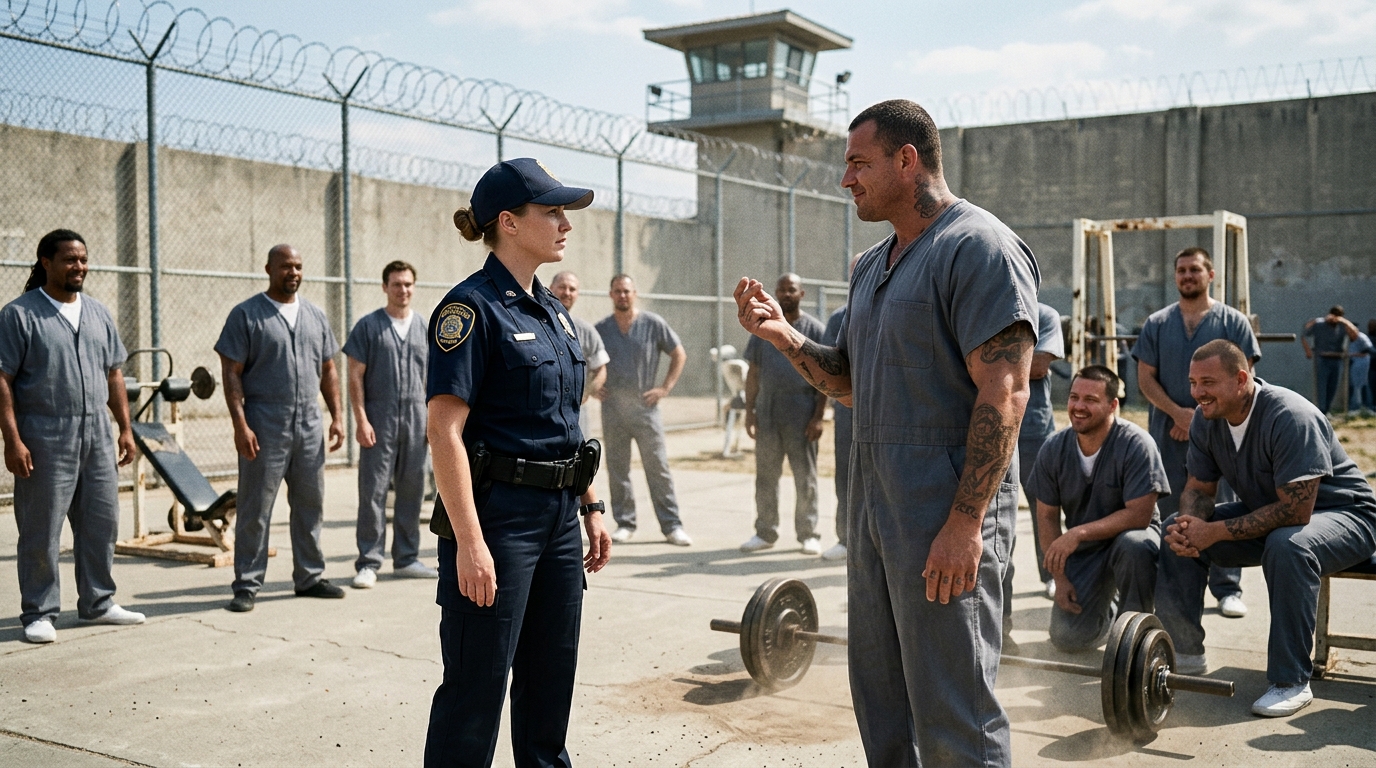
The Snap in the Yard
“PRISON IS NO PLACE FOR SOMEONE LIKE YOU!”
The words rolled across the yard like thunder.
Every inmate heard it.
Every guard did too.
Weights crashed against concrete, iron plates bouncing once before settling with a deep metallic groan. The sound cut through the dry afternoon air, loud enough to make a few men turn from the basketball court and look toward the weight pit.
I didn’t move.
That was the first rule I had learned at Blackridge Correctional.
Never give them the reaction they came for.
The man standing over the dropped weights was Darius Holt, inmate number 41782. Six foot five. Two hundred and seventy pounds. Arms thick with prison muscle. A shaved head, a scar across his jaw, and the sort of smile men use when they have already decided a room belongs to them.
He was serving life for racketeering, assault, and two murders the prosecutors could prove.
Everyone knew there were more.
The inmates called him Bishop.
Not because he was holy.
Because he moved men like pieces on a board.
I was Officer Jolene Ward, three months assigned to Yard C, the only female officer on that afternoon rotation, and the subject of every quiet bet in the cell blocks.
Too small.
Too polite.
Too soft.
Too new.
They said it when they thought I could not hear.
They were wrong.
I heard everything.
“Pick up the weights,” I said.
My voice was level.
Not loud.
Not sharp.
That was another rule.
A woman in a prison yard could not afford to sound afraid, but she could not sound eager either. Men like Holt fed on both.
He grinned wider.
A few inmates laughed near the fence.
One of them murmured, “She ain’t built for this.”
Another said, “Bishop gonna make her cry.”
I looked at Holt.
Only Holt.
“Pick them up.”
His eyes moved over me slowly, deliberately.
The uniform.
The badge.
The radio clipped to my shoulder.
The regulation belt at my waist.
Then his gaze settled on my face.
Not the way men usually looked at female guards.
This was different.
Focused.
Personal.
As if he was comparing me to a photograph.
The laughter around us faded a little.
Holt stepped closer.
My partner, Officer Renner, shifted near the gate.
I lifted two fingers slightly, telling him not yet.
Holt saw the gesture.
His grin changed.
“Look at you,” he said. “Still giving signals.”
A cold thread moved down my spine.
Still.
Not now.
Still.
I kept my face still.
“You have ten seconds to comply.”
He tilted his head.
“You don’t remember me.”
“I remember inmate records.”
That made him laugh.
Low.
Ugly.
“Records lie, Jolene.”
The name sounded wrong in his mouth.
Too familiar.
Too careful.
Then he raised his hand.
Slowly.
Not toward me.
Not like an attack.
His fingers lifted beside his face.
The yard went quiet.
Even the men who had been laughing stopped.
Holt smiled.
Then he snapped his fingers.
Once.
Twice.
Pause.
Once.
My breath locked in my chest.
The sound was small.
Almost nothing.
But the pattern tore through me like a door being kicked open inside my skull.
Once.
Twice.
Pause.
Once.
I had heard it before.
Not in this yard.
Not in this life.
I was nine years old again, hiding beneath a metal laundry cart, biting my hand to keep from screaming while boots moved across the floor and a man snapped his fingers outside the door.
Once.
Twice.
Pause.
Once.
The signal meant one thing.
Bring the girl out.
Holt’s smile widened because he saw it.
The crack.
The tiny failure in my face.
The one I had spent twenty years learning how to hide.
“Yeah,” he whispered. “There she is.”
My hand tightened near my radio.
The yard held its breath.
Every instinct told me to call backup.
Every bit of training told me to regain control.
But beneath that training, beneath Jolene Ward, beneath the badge and the uniform and the name printed on my file, another name woke up.
A name I had not spoken since I was a child.
Mara Vance.
And Darius Holt had just called her back from the dead.
The Girl From Cell Block Nine
I ordered Holt to medical lockdown for refusing a direct command.
He went quietly.
That scared me more than if he had fought.
Men like Holt did not back down unless they wanted the next move to happen somewhere else.
As two guards escorted him from the yard, he turned his head just enough for me to hear.
“Your daddy screamed louder than your mother.”
My body went cold.
Officer Renner stepped toward him.
“What did you say?”
Holt smiled at me.
I shook my head once.
No.
Not here.
Not in front of them.
Not in front of cameras.
Not in front of a hundred inmates suddenly pretending not to listen.
Holt disappeared through the steel gate, still smiling.
The yard noise returned slowly.
Weights clanged.
A basketball bounced.
Someone cursed near the phones.
Life resumed because prison always pretended nothing had happened until blood proved otherwise.
But I knew.
Something had happened.
I finished the shift on autopilot.
Count.
Gate.
Search.
Report.
Radio check.
Every action clean. Every word professional. Every breath measured.
Inside, I was nine years old again.
My real name had been Mara Vance.
My father, Daniel Vance, was a lieutenant at Greyford Juvenile Detention Center, a private facility that closed after a fire twenty years ago.
The newspapers called it an electrical tragedy.
Twelve dead.
Records destroyed.
Families compensated quietly.
My father was listed as one of the heroes who died trying to evacuate the children.
That was the story.
The truth was uglier.
My father had discovered that Greyford was not just a juvenile facility. It was a pipeline. Kids with no family, no lawyers, no one asking questions, were being transferred through fake court orders into private labor programs, illegal medical studies, and unregistered religious camps that powerful donors called rehabilitation.
My mother was the nurse who helped him copy the files.
They planned to go public.
Then the fire happened.
I survived because my mother shoved me into a laundry cart and told me not to move, no matter what I heard.
I heard everything.
Boots.
Snapping fingers.
My father screaming.
My mother begging someone not to take me.
Then the fire alarm.
Then smoke.
Then silence.
When the state investigator found me two days later hiding in a church basement three miles away, I had no voice left.
A witness protection attorney gave me a new name.
Jolene Ward.
New school.
New city.
New story.
My past became sealed under a court order so strict even I could not access parts of it.
I became a correctional officer because some wounds do not heal into peace.
They heal into purpose.
But I had never found the man who snapped his fingers.
Until now.
After shift, I went to the records room instead of going home.
The old clerk, Mrs. Devlin, looked up from her crossword.
“You look like hell.”
“Thank you.”
“That wasn’t a compliment.”
“I need Holt’s intake file.”
She glanced at the clock.
“Tomorrow.”
“Now.”
Something in my voice made her stop arguing.
She pulled the file.
Darius Holt’s prison record was thick, but clean in the way dirty men’s files often are. Lots of violence. Lots of suspected influence. No mention of Greyford. No juvenile detention connection. No listed aliases from that time.
Too clean.
I searched deeper.
Visitor logs.
Transfer notes.
Gang affiliations.
Old scars.
Then I found it.
A medical intake form from sixteen years earlier.
A tattoo documented on his left shoulder.
Black ink.
Small.
A crescent moon inside a square.
My mouth went dry.
Greyford staff wore that symbol on old internal badges.
Not public badges.
The hidden kind.
The kind my father found in a drawer beneath the warden’s desk.
My hands started shaking.
Mrs. Devlin noticed.
“Jolene?”
I closed the file.
“I’m fine.”
But I was not fine.
Because Darius Holt had not simply known my past.
He had belonged to it.
And if a man from Greyford was sitting inside Blackridge Correctional waiting for me, then my sealed file had not protected me.
It had led him to my door.
That was when Mrs. Devlin placed something on the counter.
A request slip.
“Holt filed this an hour ago,” she said. “Asked for you by name.”
I looked down.
The reason box contained only four words.
She wants the truth.
The Man Who Remembered the Fire
I met Holt in Interview Room Three the next morning.
Not alone.
I was not that reckless.
Officer Renner stood outside the door. Camera running. Recorder active. My hand close enough to the panic button beneath the table.
Holt sat shackled across from me, relaxed as if we were meeting for coffee.
“You slept bad,” he said.
I opened the folder.
“You requested this meeting.”
“I requested Mara Vance.”
My pulse kicked once.
Hard.
“My name is Officer Ward.”
He leaned back.
“That’s the name they gave you.”
“Who is they?”
Holt’s smile faded.
For the first time, he looked almost tired.
“The same people who burned Greyford and called it bad wiring.”
I studied him.
“Why say this now?”
“Because I’m dying.”
That caught me off guard.
He tapped his chest with two cuffed fingers.
“Cancer. Liver. Bones. Everywhere worth hurting.”
I did not let my face change.
Men like Holt used pity like a blade.
“Then confess to a priest.”
“I don’t owe God anything.”
“You think you owe me?”
His eyes hardened.
“No. I owe your mother.”
The room seemed to shrink.
“My mother died in the fire.”
“No,” he said. “She didn’t.”
The words hit me so hard I almost stood.
I gripped the edge of the table.
“Careful.”
He nodded slowly, as if approving of my control.
“You got her eyes. Not his. Hers.”
I stared at him.
Every lie detector in my body screamed danger.
But beneath that, something else.
Hope.
Cruel, unwanted hope.
“What do you know?”
Holt leaned forward.
“I was young at Greyford. Not staff. Not inmate. Something in between. Warden’s errand dog. I carried files. Keys. Messages. I learned when to look away.”
“The snap.”
His face changed.
Shame.
Real or performed, I couldn’t tell.
“Warden Cole used it for runners. One snap for staff. Two for transport. Once, twice, pause, once—special retrieval.”
“Children.”
He did not answer.
He didn’t need to.
I forced my voice steady.
“Did you kill my father?”
“No.”
“Did you touch my mother?”
“No.”
“Did you help them take her?”
This time, silence.
My stomach turned.
Holt looked down at his shackled hands.
“I opened the back corridor.”
I wanted to hit him.
Not in the cinematic way.
In the human way.
The ugly way.
The way grief turns the body into a weapon before the mind can stop it.
Instead, I said, “Where is she?”
“I don’t know if she’s alive now.”
“Where did they take her?”
He glanced at the camera.
Then smiled faintly.
“You still think cameras mean truth.”
I reached for the recorder and switched it off.
Bad procedure.
Maybe career-ending.
I did it anyway.
Holt’s voice dropped.
“Your father copied everything. Names. Payments. Transfer routes. Judges. Doctors. Donor families. The whole machine. He hid the master file before they killed him.”
“Where?”
“He split the location.”
“What does that mean?”
“One part with him. One with your mother. One with you.”
“I was nine.”
He nodded.
“That’s why they couldn’t finish it. You knew something without knowing you knew it.”
I sat perfectly still.
“What did I know?”
Holt lifted one cuffed hand.
He snapped once.
I flinched before I could stop myself.
He noticed, but did not smile this time.
“Not that,” he said. “The song.”
My heart stopped.
There had been a song.
My mother used to hum it when she braided my hair.
Three lines.
Soft.
Old.
Meaningless.
At least, I thought so.
Holt watched my face.
“There it is.”
“What about the song?”
“It’s a code.”
I could barely hear my own breath.
“What does it open?”
Before he could answer, the prison alarm sounded.
Not a drill.
Not a fight call.
Full lockdown.
The lights above us flashed red.
Renner’s voice shouted from the hall.
“Ward! Step away from the door!”
Holt closed his eyes.
“Too late,” he whispered.
The power cut.
The camera went dark.
And from somewhere beyond the interview room door, I heard the same snap.
Once.
Twice.
Pause.
Once.
The Door Under the Chapel
Blackridge went into chaos fast.
Prisons are built to look controlled, but control is thin. A few locked doors. A few radios. A few men believing the rules will still matter when the lights die.
The backup generators should have kicked in within eight seconds.
They did not.
Emergency lights flickered red along the corridor.
Renner slammed his shoulder against the interview room door from the outside.
“Ward! Door’s jammed!”
Holt remained seated.
Too calm.
“You planned this,” I said.
“No.”
“Then who did?”
He looked toward the dark corner of the room.
“The men who heard your file was waking up.”
Something heavy struck the hallway wall outside.
Renner cursed.
Then came a short burst of shouting.
Metal.
Boots.
Another snap.
My hand went to my belt.
Holt looked at me.
“You can sit here and follow policy, or you can leave this room alive.”
I uncuffed one of his hands from the table.
Not both.
“Try anything and I’ll break your wrist.”
He almost smiled.
“Your mother used to talk like that.”
I shoved the thought away.
The manual release beneath the table opened the inner maintenance panel. Most officers did not know it existed. I knew because I studied buildings the way other people studied faces.
We crawled through a service crawlspace behind the interview rooms, Holt moving awkwardly with one hand cuffed.
The corridor beyond was smoke-hazed from a trash fire someone had started near the laundry wing. Inmates shouted from locked tiers. Officers barked orders over failing radios.
But this was not a riot.
Not really.
Riots have noise at the center.
This had direction.
Someone had used lockdown to move through the prison toward a specific place.
Holt led me through the old chapel corridor.
Blackridge used to have a chapel before budget cuts turned it into storage. The stained-glass windows had been boarded up years ago, but colored fragments of light still slipped through cracks when the sun hit them right.
Now the hall was dark.
“Why here?” I whispered.
“Because Blackridge wasn’t built as a prison first.”
“I know. It was a state hospital.”
“Before that,” Holt said, “it was a Greyford intake site.”
I stopped.
“What?”
He turned.
“This is where they sent children before Greyford. The door is still here.”
I didn’t want to believe him.
Then I saw it.
Behind a stack of broken pews and cleaning supplies, part of the wall had a seam too straight to be natural.
A sealed door.
No handle.
Just an old brass plate covered in dust.
My throat tightened.
“What opens it?”
Holt looked at me.
“The song.”
I almost laughed.
Not because it was funny.
Because the mind rejects truth when it becomes too theatrical.
“My mother’s lullaby opens a prison door?”
“No,” he said. “The rhythm does.”
I stared at the brass plate.
Then slowly, shamefully, I hummed the tune my mother had given me before the fire.
Three soft notes.
Pause.
Two lower notes.
Pause.
Four quick notes at the end.
Holt tapped the pattern against the brass plate.
For a second, nothing happened.
Then something inside the wall clicked.
The door opened inward.
Cold air breathed out.
The smell hit me first.
Dust.
Damp concrete.
Old paper.
And something metallic beneath it all.
We stepped inside.
The room beyond was not large.
But it was full.
File cabinets.
Photographs.
Medical logs.
Transfer manifests.
Children’s intake forms.
Rows and rows of names.
Some with red stamps.
RELOCATED.
DECEASED.
ADOPTED.
UNCLAIMED.
My knees weakened.
Greyford had not burned its records.
It had moved them.
Here.
Under the prison where I had chosen to work.
On the far wall, beneath a cracked plastic sheet, hung a bulletin board covered in photographs.
One showed my father.
Lieutenant Daniel Vance.
Another showed my mother.
Nurse Rebecca Vance.
Younger than I remembered.
Alive in a way memory had softened.
Beside her photo was a note.
Asset retained after incident.
My stomach lurched.
Asset.
Not victim.
Not witness.
Asset.
Holt reached for a metal drawer marked VANCE.
I grabbed his wrist.
“I’ll do it.”
Inside were three folders.
Daniel Vance — terminated.
Mara Vance — relocated.
Rebecca Vance — transferred.
My fingers could barely open the last one.
The transfer destination had been blacked out, but beneath it, someone had pressed hard enough that the indentation remained.
I tilted the page toward the red emergency light.
Mercy Vale Psychiatric Hospital.
Closed sixteen years ago.
I looked at Holt.
He shook his head.
“She was there. I don’t know after that.”
A sound came from the chapel corridor.
Footsteps.
Slow.
Unhurried.
Then a voice I recognized from every staff meeting, every disciplinary review, every polite lie about institutional safety.
Warden Elias Creed.
“Officer Ward,” he called. “Step out of the room.”
Holt’s face went pale.
Not inmate pale.
Child pale.
“That’s his son,” he whispered.
“Whose son?”
But I already knew.
Warden Cole.
The man who snapped his fingers at Greyford.
The man who turned children into files.
His son was now running Blackridge Correctional.
And he had just found us standing inside the archive his father failed to destroy.
The Woman They Couldn’t Keep Buried
Warden Creed stepped into the hidden room with two officers behind him.
Not Renner.
Not anyone I trusted.
These were men from Internal Response. Black armor. Blank faces. Hands near weapons.
Creed looked at the open drawers, the files on the table, the photographs on the wall.
Then he sighed.
Not with panic.
With disappointment.
“Darius,” he said. “You always were sentimental.”
Holt lowered his eyes.
That told me enough.
He had feared Creed more than prison.
Creed turned to me.
“Officer Ward, you are in violation of lockdown protocol.”
I almost laughed.
The room was full of stolen children, dead parents, forged transfers, buried lives.
And he was citing protocol.
“My mother was alive after Greyford.”
His expression did not change.
“Your mother was unstable after a traumatic event.”
“Where is she?”
“She was given care.”
“Where is she?”
Creed glanced at the file in my hand.
“You do understand, don’t you? Whatever you think this is, it’s beyond your ability to repair.”
“Try me.”
For the first time, anger touched his face.
“You are alive because people chose mercy.”
“No,” I said. “I am alive because my mother hid me better than your father searched.”
Holt made a sound that might have been a laugh.
Creed looked at him.
One of the armored officers struck Holt across the face with a baton.
Hard.
Holt went down.
I moved instinctively.
The second officer raised his weapon toward me.
Then a voice came from the chapel entrance.
“Drop it.”
Officer Renner stood in the doorway, bruised, bleeding from one eyebrow, but upright. Behind him were six state investigators in tactical vests.
Detective Mara Knox stood at the front.
My former handler.
The woman who had given me the name Jolene Ward.
Her gun was raised.
Her face was grim.
“Elias Creed,” she said, “step away from Officer Ward.”
For the first time, Creed looked surprised.
Not afraid yet.
But surprised.
Knox’s eyes moved to me.
“I’m sorry,” she said.
Those two words told me she had known more than she ever told me.
And maybe she had spent twenty years trying to prove what sealed courts had buried.
Creed lifted his hands slowly.
“You have no warrant for this room.”
Knox held up a folded paper.
“Federal sealed-site warrant. Signed this morning.”
His face tightened.
“This morning?”
Knox looked at Holt.
“He sent us a letter last month.”
Holt coughed blood from the floor.
“Told you,” he rasped. “Dying makes a man tidy.”
The armored officers were disarmed.
Creed was cuffed.
But I barely saw it.
I was staring at the page in my hand.
Mercy Vale Psychiatric Hospital.
Closed sixteen years ago.
Knox stepped beside me.
“She wasn’t there when we searched it,” she said softly.
I looked at her.
“You searched it?”
“Years ago.”
“And you didn’t tell me?”
“You were seventeen.”
“I was her daughter.”
Knox flinched.
Good.
She deserved to.
“We found evidence Rebecca was transferred again,” she said. “Private care facility. Different name. No public records.”
“What name?”
Knox looked toward the open archive.
Then at the old photographs.
“Anna Mercer.”
The world went still.
Anna Mercer.
The prison librarian.
Seventy years old.
Gray hair.
Soft cardigans.
The woman who had worked in Blackridge’s library for nine years, checking out legal dictionaries and battered paperbacks to inmates who pretended not to need kindness.
The woman who always hummed while shelving books.
Three soft notes.
Pause.
Two lower notes.
Pause.
Four quick notes at the end.
My mother’s lullaby.
I ran.
Past Creed.
Past Renner.
Past Knox calling my name.
Through the chapel corridor.
Through smoke and sirens and shouted orders.
The prison was crawling with state police now, inmates locked down, officers lined against walls, the whole place exposed under emergency lights.
I reached the library out of breath.
The door was open.
A book cart lay overturned near the desk.
“Anna!”
No answer.
I moved between the shelves.
Law.
History.
Religion.
Fiction.
Then I found her near the back, sitting on the floor beside the children’s literature section, one hand pressed to her chest, a thin line of blood at her temple.
She looked up at me.
Her eyes were blue.
My eyes.
“Mara,” she whispered.
My knees hit the floor.
For a second, I was not an officer.
Not Jolene Ward.
Not the girl from the file.
Just a daughter crawling toward the mother she had mourned for twenty years.
“I didn’t know,” I said, and my voice broke into something childlike. “I didn’t know.”
Her hand lifted slowly to my face.
“They told me you died.”
I closed my eyes.
The whole prison vanished.
The alarms.
The files.
The men who built systems out of lies.
Only her hand remained.
Warm.
Real.
Alive.
Behind me, boots entered the library.
Knox.
Renner.
Medics.
My mother gripped my sleeve weakly.
“The files,” she whispered.
“We found them.”
“No.” Her eyes sharpened. “Not all.”
I leaned closer.
“What do you mean?”
She swallowed painfully.
“Greyford wasn’t the first.”
Then she gave me the name of a place I had never heard before.
And everyone in the library went silent.
The Yard After the Silence
The first indictments came within forty-eight hours.
Not because the system wanted to move quickly.
Because the archive left it no choice.
Names do that when they are written clearly enough.
Judges.
Wardens.
Private contractors.
Doctors.
Adoption brokers.
Board members.
Men who had built careers on saving troubled children while selling them into lives no one monitored.
Blackridge Correctional was taken over by the state before the week ended.
Warden Elias Creed was charged with conspiracy, obstruction, unlawful detention records, witness intimidation, and crimes connected to the Greyford cover-up.
Darius Holt testified from a hospital bed.
He did not ask for forgiveness.
That mattered to me.
Men who ask for forgiveness too quickly usually want relief more than truth.
Holt told investigators what he had done, what he had carried, whose doors he opened, whose names he remembered, and how Warden Cole trained boys like him to become useful monsters.
He died five weeks later.
I visited him once before the end.
He was thinner then, swallowed by white sheets and the smell of antiseptic.
“You came,” he said.
“I had questions.”
“Still an officer.”
“Still an inmate.”
That made him smile.
Barely.
I asked him why he snapped his fingers in the yard.
His face grew quiet.
“Because I needed to know if she was still in there.”
“Mara?”
He nodded.
“If you didn’t react, I was going to keep my mouth shut.”
“Why?”
“Because Jolene Ward couldn’t open that door.”
His breathing turned shallow.
“Mara Vance could.”
I hated him for being right.
I hated him for being part of the worst night of my life.
I hated that he had also become one of the reasons I found my mother.
People want truth to arrive clean.
It rarely does.
My mother survived.
Not easily.
Not fully.
Twenty years of sedation, false diagnoses, institutional transfers, and stolen identity do not vanish because a daughter finds you on a library floor.
Some days she knew me.
Some days she called me by my childhood nickname.
Some days she looked at my uniform and became afraid.
I stopped wearing it around her.
Eventually, I stopped wearing it altogether.
Not because I was ashamed of being an officer.
Because Blackridge had taught me that a badge is only as clean as the person willing to question who it protects.
Six months after the archive opened, I returned to Yard C.
Not as Officer Ward.
As a witness consultant for the federal inquiry.
The yard looked smaller than I remembered.
The weight pit was empty. The barbed wire glinted under pale winter sun. The concrete still held the stain where Holt’s weights had crashed that day, or maybe I imagined it.
Renner walked beside me.
He had been promoted after refusing Creed’s lockdown order and calling outside investigators.
“You okay?” he asked.
No.
But I said, “Getting there.”
He nodded.
That was enough.
Across the yard, a group of younger inmates watched us carefully. Not with the old mockery. Not with warmth either.
Just caution.
Stories travel fast in prison.
They knew about Creed.
They knew about the archive.
They knew the female guard they once called soft had helped crack open a buried system older than most of them.
At the center of the yard, I stopped.
This was where Holt had stood.
Where he dropped the weights.
Where he said prison was no place for someone like me.
At the time, I thought it was an insult.
Now I understood it had been a warning.
A test.
Maybe even a confession.
Prison was no place for someone like me because prison had already taken too much from the child I used to be.
Renner looked toward the gate.
“They’re ready for you inside.”
I nodded but did not move.
For one moment, I let the yard be quiet.
Then, from somewhere near the far fence, an inmate snapped his fingers.
Once.
A joke, maybe.
A challenge.
A foolish echo from men who did not understand what sounds can wake.
Every guard tensed.
So did I.
But this time, I did not flinch.
I turned slowly.
Looked across the yard.
The inmate lowered his hand.
No laughter followed.
No murmurs.
No shift in power.
Just silence.
I walked toward the gate.
Not because I was running from the sound.
Because it no longer owned me.
Inside the administration building, federal investigators waited with boxes of recovered files. My mother waited too, in a quiet room with tea cooling beside her and a paperback open in her lap.
When she saw me, she smiled.
Small.
Tired.
Real.
“Mara,” she said.
My name.
Not the one they gave me.
The one she had carried through fire, drugs, locked wards, and twenty years of stolen time.
I sat beside her and took her hand.
Outside, Blackridge continued making its sounds.
Keys.
Doors.
Radios.
Boots on concrete.
But beneath all of it, something had changed.
The snap had once been a command.
Then a threat.
Then a key.
Now it was only a sound.
And I was still here.