The Girl No One Noticed
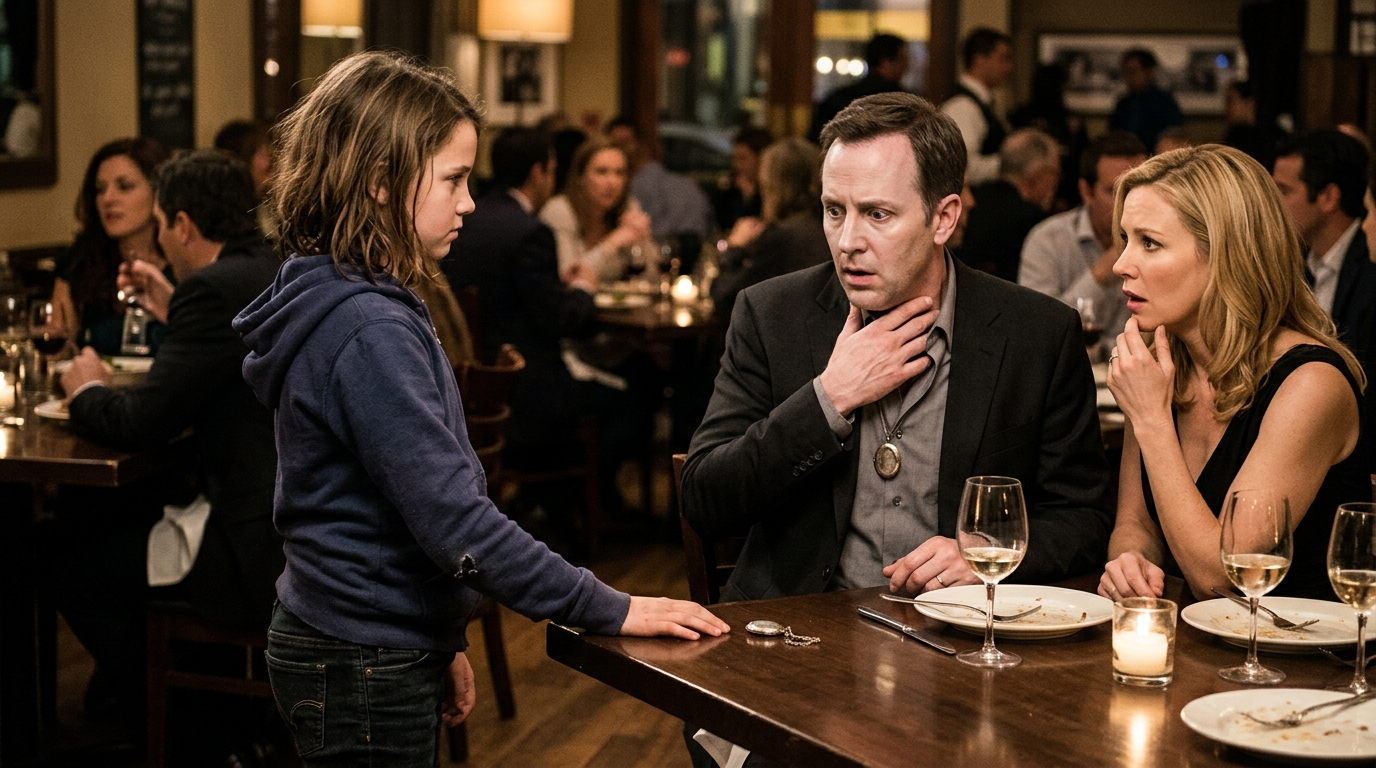
No one noticed the little girl until she stopped at his table.
Not the host.
Not the waiters.
Not the security guard near the entrance.
Not the guests in black dresses and tailored jackets who filled the private dining room with soft laughter, quiet deals, and the kind of confidence money teaches people to wear before they ever learn kindness.
She did not belong there.
That much was obvious.
She was too small.
Too quiet.
Too poorly dressed for a room where even the napkins looked expensive.
Her faded blue coat hung loose from her shoulders. Her shoes were scuffed at the toes. Her hair had been brushed, but not carefully enough to hide the fact that a child had likely done it herself.
A woman near the wine cabinet noticed her first.
“Wrong room,” she muttered.
A man at the next table chuckled.
The girl did not move.
She stood in front of the most powerful man in the room and stared at him as though she had crossed a lifetime just to reach that chair.
His name was Adrian Vale.
Hotel owner.
Real estate investor.
Widower, according to the charity brochures.
Respected father, according to the speeches.
A man whose face had appeared on magazine covers beside words like legacy, discipline, and empire.
He was seated at the head of the table with a glass of red wine in one hand and his fiancée, Marissa Clay, beside him.
Marissa wore emerald silk and diamonds bright enough to make the candles seem unnecessary. Her hand rested lightly on Adrian’s sleeve, the way a woman does when she wants the room to know she belongs beside power.
Then the girl reached into her coat pocket.
Slowly.
Carefully.
Security stepped forward.
Adrian lifted one hand.
The guard stopped.
The girl placed something on the white tablecloth.
A silver locket.
Small.
Oval.
Old.
The room seemed to lose sound.
Adrian looked at it.
His expression changed instantly.
The wine glass in his hand lowered.
Color drained from his face.
For several seconds, he did not breathe.
Then, slowly, as if his own body no longer belonged to him, Adrian’s hand rose to his neck.
He pulled a chain from beneath his shirt.
Another silver locket appeared.
Identical.
Same shape.
Same worn edge.
Same tiny scratch across the clasp.
A woman at the table gasped.
Adrian’s voice came out barely above a whisper.
“That’s not possible…”
The girl leaned closer.
“My mom said you’d react like that.”
Marissa went rigid beside him.
Her fingers tightened around her napkin.
The smile she had worn all evening disappeared so quickly it looked like someone had wiped it from her face.
Adrian did not look at her yet.
He could not.
His eyes remained locked on the child.
“What is your name?”
The girl swallowed.
“Emily.”
“Emily what?”
Her chin trembled, but she kept her gaze steady.
“Emily Hart.”
The name hit him like a blade.
Hart.
The last name of the woman he had been told died ten years ago.
The woman he had mourned.
The woman whose locket he still wore beneath every custom suit, hidden against his heart like a wound no one was allowed to see.
His voice broke.
“Who is your mother?”
Emily reached back into her coat and pulled out a folded photograph.
She placed it beside the locket.
The paper was creased, faded, and soft from being handled too often.
Adrian unfolded it with shaking hands.
In the picture stood a woman with tired eyes and a gentle smile, one arm around Emily’s shoulders.
Older.
Thinner.
Alive.
Adrian whispered her name.
“Clara.”
Marissa stood so abruptly her chair scraped against the floor.
“I think this is enough,” she said.
Everyone turned toward her.
Adrian finally looked at the woman beside him.
Her face had gone pale.
Not confused.
Not shocked.
Afraid.
Emily’s voice came softly across the table.
“My mom said if the woman in green tried to stop me…”
She looked directly at Marissa.
“…then she was the reason you never found us.”
The Locket That Was Split in Two
Adrian Vale had given Clara Hart that locket twelve years earlier.
Not one locket.
Two.
A matched pair.
He bought them from a tiny antique shop on a rainy afternoon when they had no business being happy.
Back then, Adrian was not yet the cold, polished man everyone knew. He was young, ambitious, and still foolish enough to believe love could survive a family empire built on control.
Clara was a music teacher.
Not famous.
Not wealthy.
Not interested in his name.
She lived in a small apartment above a bakery, wore cardigans with loose threads, and laughed at the way Adrian tried to act unimpressed by cheap coffee.
He loved her because she was the first person who spoke to him like he was a man, not an heir.
His family hated her immediately.
His mother called Clara unsuitable.
His business partners called her a distraction.
Marissa, who at the time was his family’s public relations director, called her dangerous.
“She makes you sentimental,” Marissa had warned him. “Sentimental men sign bad contracts.”
Adrian married Clara anyway.
Quietly.
Privately.
At a courthouse two towns away.
The lockets were his wedding gift.
Inside his, Clara placed a tiny photograph of herself laughing in the rain.
Inside hers, Adrian placed a note:
If the world separates us, this proves we were once whole.
Clara cried when she read it.
Then teased him for being dramatic.
They were happy for eleven months.
Then Clara became pregnant.
That was when happiness became evidence against them.
Adrian wanted to announce the marriage.
Clara wanted the child to have his name.
Marissa said the timing would destroy the company’s merger.
His mother said Clara was trapping him.
His lawyers said public disclosure would complicate inheritance documents.
Adrian hesitated.
Not because he didn’t love Clara.
Because he believed he could manage the truth if he waited one more week.
Then Clara disappeared.
Her apartment was empty.
Her phone disconnected.
A letter arrived three days later.
Adrian,
I can’t live in your world. I won’t let our child become another Vale possession. Don’t look for me.
Clara.
He did not believe it.
Not at first.
He searched.
He hired investigators.
He questioned everyone.
Then police found Clara’s car near a river crossing after a storm. There was blood on the steering wheel. Her coat in the passenger seat. The locket gone.
The investigators concluded she had likely run first, then died in the storm.
No body was recovered.
Adrian did not accept it.
For two years, he wore the locket openly.
For two years, he followed every rumor.
For two years, he refused to move on.
Marissa stayed beside him through all of it.
She managed the press.
Shielded him from scandal.
Comforted his mother.
Rebuilt his public image.
And slowly, she became necessary.
That was how she entered his life.
Not through love.
Through usefulness.
Ten years later, Adrian sat at a private dinner with Marissa beside him, preparing to announce their engagement publicly.
And Clara’s daughter had just placed the missing locket on his table.
The Woman in Green
Marissa recovered quickly.
Women like her often did.
Her fear vanished beneath a smooth, wounded expression.
“Adrian,” she said softly, “this is cruel. Someone is using this child.”
Emily stepped back as if the softness frightened her more than shouting.
Adrian noticed.
“Don’t talk over her.”
Marissa blinked.
“I’m trying to protect you.”
He looked at the photograph again.
Clara’s face.
Emily’s eyes.
The locket.
The room waited.
“What happened to your mother?” he asked.
Emily’s fingers curled around the edge of the table.
“She’s sick.”
Adrian’s whole body went still.
“Where is she?”
Emily looked at Marissa.
The room followed her gaze.
Marissa’s jaw tightened.
Adrian stood slowly.
“Emily. Where is Clara?”
The little girl’s eyes filled.
“She said I had to find you tonight because after tomorrow, the doctors are moving her somewhere I can’t visit.”
Marissa whispered, “Doctors?”
Emily nodded.
“The private house.”
A sound moved through the room.
Private house.
Adrian knew that phrase.
Not from Clara.
From his mother.
From old family problems.
From scandals buried beneath language like recovery, discretion, protection.
He turned to Marissa.
“What private house?”
She laughed once.
Too sharp.
“How would I know?”
Emily reached into her coat again.
This time she pulled out a small envelope.
“My mom said to give you this after the locket.”
Adrian took it.
His name was written on the front in Clara’s handwriting.
His knees nearly failed.
He opened it carefully.
Inside was a letter.
Adrian,
If Emily reaches you, then I am out of time.
I did not leave you.
I did not write the first letter.
I did not hide because I stopped loving you.
They took me the night before I was going to meet you at the old train station.
They told me you signed the papers.
They told me you chose the company.
They told me our baby would be safer if I stayed quiet.
For years, I believed you abandoned us.
Then Emily found your old interviews online and said the man in them touched his necklace whenever my name was mentioned.
I knew then.
Either you were the best liar alive, or they lied to both of us.
Ask Marissa where the first letter was written.
Ask her why she kept my locket.
Ask her why your mother’s clinic still sends invoices under my false name.
If you ever loved me, come tonight.
Clara.
The paper trembled in Adrian’s hand.
He looked at Marissa.
She did not move.
For once, she had no perfectly timed response.
“Where is she?” Adrian asked.
Marissa’s lips parted.
“Adrian—”
“Where is my wife?”
The word wife struck the room like thunder.
Marissa flinched.
Emily covered her mouth.
Adrian took one step toward Marissa.
His voice dropped.
“You knew she was alive.”
Marissa’s eyes hardened.
“Your mother knew first.”
That was not denial.
It was confession wrapped in blame.
Adrian’s face went white.
The room erupted in whispers.
Marissa looked around and realized too late that half the guests were recording.
She lowered her voice.
“She was going to ruin everything.”
Adrian stared at her.
“She was pregnant.”
“She was leverage.”
The room went silent.
Leverage.
Not woman.
Not wife.
Not child.
Leverage.
Emily’s face crumpled.
Adrian turned back to the little girl.
For the first time, he knelt.
Not as an investor.
Not as a powerful man.
As a father who had just learned he was ten years late.
“Emily,” he whispered, “are you my daughter?”
She looked at the locket around his neck.
Then at the one on the table.
“My mom said you would know before I did.”
Adrian closed his eyes.
When he opened them again, they were full of tears.
“I know.”
The Private House
Adrian did not call his driver.
He did not call his mother.
He called the federal attorney who had once warned him that private family clinics were dangerous places for women without power.
Then he called the police.
Not local.
State.
Then he called his own security team and ordered them to lock every exit.
Marissa tried to leave.
The guard at the door stopped her.
She spun toward Adrian.
“You can’t hold me here.”
“No,” he said coldly. “But I can make sure the police know you tried to run.”
She stayed.
Emily sat beside him in the car on the way to the private house.
Not close.
Not yet.
She held Clara’s locket in both hands.
Adrian wanted to ask a hundred questions.
Did Clara hate him?
Did Emily know his name growing up?
Had she ever had birthdays?
Was she afraid of him?
But the child beside him looked exhausted.
So he asked only one.
“Have you eaten today?”
Emily looked surprised.
Then shook her head.
That answer broke him in a way the letter had not.
He had spent millions funding scholarships, hospitals, and cultural foundations while his daughter went hungry somewhere under his own city’s shadow.
He handed her a wrapped sandwich from the car’s console.
She took it carefully.
“Do I have to pay you back?”
Adrian turned his face toward the window.
“No.”
“My mom says people always want something back.”
“Not this.”
Emily studied him.
Then took a small bite.
The private house stood behind a high wall at the edge of the county.
No sign.
No name.
Only a locked gate and warm lights glowing in upstairs windows.
A woman in medical scrubs answered when police knocked.
Her smile faded when she saw Adrian.
Then vanished completely when she saw Emily.
Inside, everything smelled of lavender, antiseptic, and secrets.
They found Clara in a room at the back of the second floor.
She was sitting by the window, wrapped in a gray cardigan, thinner than the photograph but alive.
Alive.
When Adrian stepped into the doorway, she turned.
For a moment, neither of them spoke.
Ten years stood between them.
Ten years of lies.
A child.
A missing life.
A stolen marriage.
Clara’s hand went to her throat, but the locket was gone because Emily had taken it to find him.
Adrian pulled his from beneath his shirt.
Clara made a sound like a sob and a laugh breaking at the same time.
“You kept it,” she whispered.
He crossed the room, then stopped before touching her.
“I looked for you.”
Her eyes filled.
“I waited.”
“I’m sorry.”
“That’s too small.”
“I know.”
Emily ran past him then.
“Mom!”
Clara opened her arms, and the little girl crashed into her.
Adrian stood there watching his wife and daughter hold each other, and the truth of his failure pressed so hard against his chest he could barely breathe.
Clara looked over Emily’s head.
“Did Marissa tell you?”
“She said my mother knew first.”
Clara closed her eyes.
“Of course she did.”
The Mother Who Built the Lie
Adrian’s mother, Evelyn Vale, was arrested three days later.
She denied everything.
Then minimized.
Then blamed Marissa.
Then claimed she had acted to protect the family from a woman trying to trap her son.
But the private house kept records.
Wealthy people often think secrecy means destruction.
It rarely does.
Secrecy usually means files.
Invoices.
False medical evaluations.
Signed transfer forms.
Forged letters.
Payments approved under family trusts.
Clara’s original letter to Adrian was found in Evelyn’s safe, unopened.
So were birthday photographs of Emily taken by private investigators.
Every year.
His mother had watched his daughter grow from a distance and still said nothing.
That nearly destroyed him.
Marissa cooperated after realizing Evelyn would sacrifice her without hesitation. She admitted the first goodbye letter had been written in her office. She admitted Clara’s locket had been taken as proof. She admitted Adrian’s investigators were redirected with false leads.
“What did you think would happen?” Adrian asked her once before the trial.
Marissa looked at him through the glass partition.
“I thought you’d grieve long enough to forget what you wanted.”
He stared at her.
“And then?”
“Then you’d want what was left.”
He left without another word.
Some people do not deserve the dignity of final speeches.
The Two Lockets
Clara did not return to Adrian’s house immediately.
She refused.
“I won’t move from one controlled room to a prettier one,” she said.
Adrian accepted that.
Not easily.
But fully.
He bought nothing without asking.
Offered nothing twice.
Visited only when Clara allowed it.
Emily watched him carefully during those first months.
She tested him in small ways.
If she said no, would he stop?
If she asked a question, would he answer?
If she cried, would he call it drama?
If she mentioned Marissa, would his face harden?
He failed sometimes.
Not badly.
But noticeably.
He spoke too quickly.
Offered solutions when she needed listening.
Tried to make up for ten years with gestures too large for a child who trusted small things more.
Clara corrected him.
Emily corrected him harder.
“You can’t buy breakfast from five places,” she told him one morning. “It’s weird.”
He looked at the table full of pastries, fruit, pancakes, and three kinds of hot chocolate.
“I panicked.”
Emily stared at him.
“About breakfast?”
“Yes.”
For the first time, she laughed.
Not politely.
Actually.
Clara heard it from the kitchen and began crying quietly where no one could see.
A year later, Adrian stood in the same private dining room where Emily had first appeared.
This time, there was no gala.
No Marissa.
No emerald silk.
No crowd waiting to laugh at a child.
Only a small gathering.
Clara.
Emily.
A few trusted friends.
And a table near the window.
Adrian placed both silver lockets in the center.
His and Clara’s.
The pair that had started everything and survived more than the people who wore them.
Emily looked at them.
“Do I get one?”
Clara smiled softly.
“These are old.”
Emily shrugged.
“So am I, kind of.”
Adrian laughed.
Then reached into his pocket.
He placed a third locket on the table.
Smaller.
Silver.
Oval.
New, but made with the same design.
Inside was a tiny photograph of all three of them.
Not perfect.
Not fully healed.
But together.
Emily picked it up slowly.
“Does this mean we’re whole now?”
Clara looked at Adrian.
Adrian looked at the lockets.
Then at his daughter.
“No,” he said gently. “It means we’re not hidden anymore.”
Emily thought about that.
Then nodded.
“I like that better.”
Years later, people still talked about the night a little girl walked into a room where no one saw her until she reached the most powerful table.
They remembered the silver locket.
The identical chain around Adrian’s neck.
The woman in green turning pale.
The photograph.
The sentence that shattered the room:
My mom said you’d react like that.
But Adrian remembered something else most clearly.
The moment Emily asked if she had to pay him back for a sandwich.
That was when he understood the cost of being late.
Not in money.
Not in reputation.
In small hungers.
Small fears.
Small questions a child should never have had to ask.
The lockets did not restore the years.
They did not erase Clara’s captivity.
They did not make Evelyn less cruel or Marissa less guilty.
But they did what Clara had hoped they would do.
They proved the truth had survived.
Two halves.
Hidden separately.
Waiting for a child brave enough to place one on the table.
And when she did, every lie in the room lost its place to sit.