The Girl in the Green Coat
“You’re freezing!”
Her tiny voice cut through the bitter night.
At first, Mason “Bear” Callahan thought the cold had finally started making him hear things.
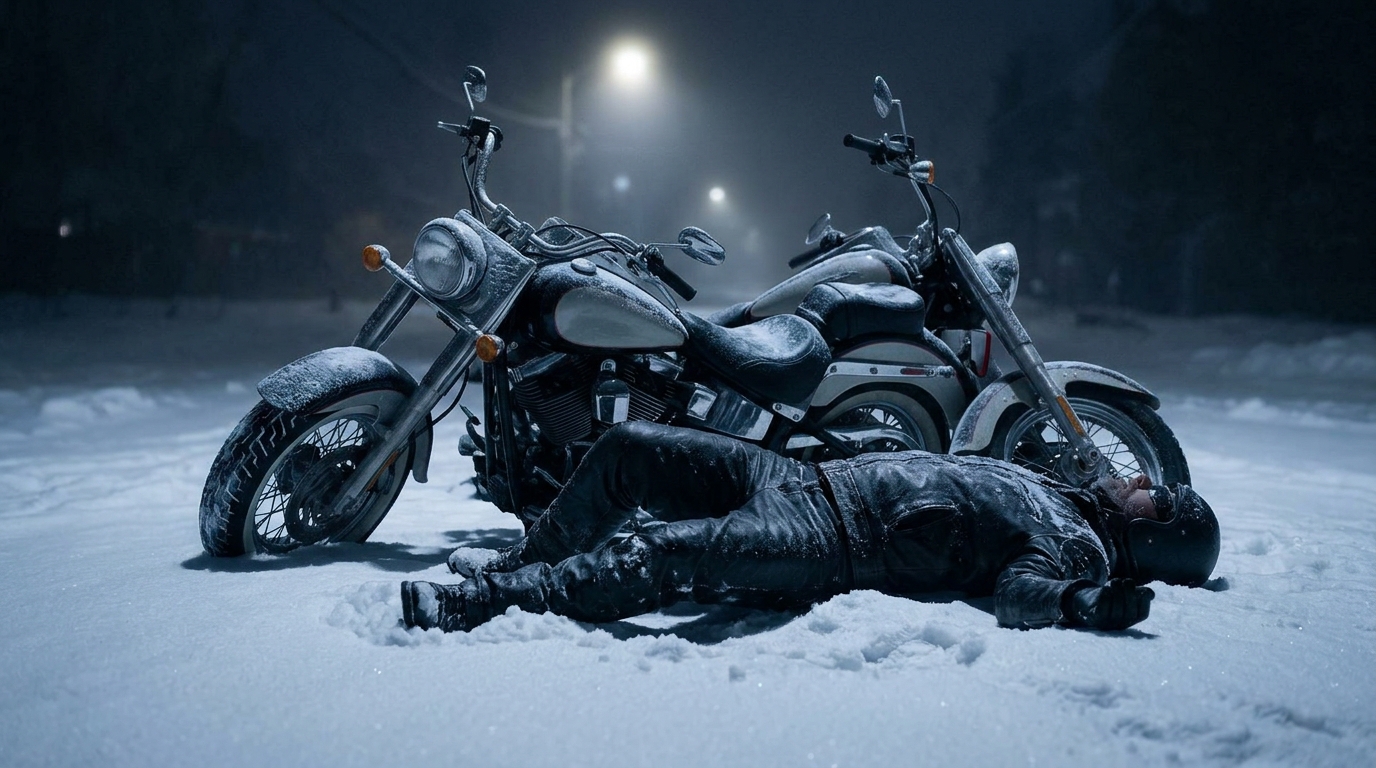
Snow fell thick over the empty roadside, swallowing the world in white. His motorcycle lay twenty feet away, half-buried in powder, its chrome dulled beneath frost and its front wheel twisted at an ugly angle.
The machine had once sounded like freedom.
Now it looked like failure.
Bear lay on his side near the shoulder, one arm pressed against his ribs, breath leaving him in sharp white bursts. His phone had shattered somewhere in the crash. His left leg throbbed. His leather jacket was torn across one sleeve. Snow had crept under his collar and into his gloves.
He had survived worse.
That was what he told himself.
But the truth was simple.
He was alone.
The road behind him stretched dark and empty except for the faint glow of holiday lights in the distance. Somewhere beyond the trees, people were probably sitting in warm kitchens, pouring coffee, wrapping gifts, arguing about harmless things.
No one saw the old biker in the snow.
No one except the little girl.
She stood a few feet away in a green coat too thin for the weather, clutching the collar with both hands. Her cheeks were red from cold. Her boots were too big. Her hair stuck out beneath a knitted hat that looked handmade and old.
She could not have been more than eight.
Maybe nine.
Bear blinked up at her.
“What are you doing out here?”
The girl ignored the question.
“You’re freezing,” she said again.
Her voice trembled, but not from fear.
From cold.
She stepped closer and began unbuttoning her green coat.
Bear tried to push himself up.
Pain shot through his side.
“No,” he groaned. “Don’t do that.”
She pulled the coat from her shoulders anyway.
Underneath, she wore a faded sweater with one sleeve stretched at the cuff.
“Put this on.”
Bear stared at her.
“You can’t stay out here without a coat.”
“You need it more.”
“No, I don’t.”
“Yes, you do.”
There was no childish uncertainty in her face.
Only stubbornness.
The kind Bear recognized instantly because he had seen it in soldiers, widows, mechanics, and bikers too proud to admit they were bleeding.
He let out a weak laugh.
“You always this bossy?”
“My mom said bossy is what people call girls when they don’t want to listen.”
Bear stopped laughing.
For one strange second, the snow seemed to quiet around them.
The little girl stepped closer and laid the green coat over his chest. It was far too small to cover him properly, but the gesture landed heavier than any blanket.
A child giving warmth to a stranger in a ditch.
A child who looked like she needed saving more than he did.
Bear reached for his own torn leather jacket and pulled it off with a grunt.
“Come here.”
She hesitated.
“I’m not supposed to go near strangers.”
“Smart rule.”
“Are you a bad stranger?”
Bear looked at his wrecked motorcycle, then back at her.
“Tonight? Mostly a stupid one.”
That almost made her smile.
He draped his leather jacket around her shoulders. It swallowed her whole, the sleeves hanging far past her hands, the back nearly touching the snow.
She looked tiny inside it.
Too tiny.
“I’ll be okay,” she whispered. “You need it more.”
Bear studied her face.
There was something wrong in the way she said that.
Not kindness.
Experience.
Children who have been protected speak differently from children who have learned to survive.
Before Bear could ask her name, headlights cut through the snow.
One pair.
Then another.
Then a long line.
The low rumble came next.
Engines.
Many of them.
Bear turned his head sharply.
A row of motorcycles rolled slowly through the storm, their headlights glowing like a procession of fireflies in the white dark.
His club.
The Iron Saints.
They had found him.
The bikes pulled over one by one. Men and women in black leather dismounted, faces grim beneath helmets and scarves.
Tank, Bear’s vice president, reached him first.
“Bear!”
“I’m alive,” Bear rasped.
Tank dropped to one knee, then froze when he saw the little girl in Bear’s jacket.
The others stopped too.
Their faces shifted.
Confusion.
Concern.
Then something like respect.
No one laughed.
No one asked why a child was standing in the snow beside their injured president wearing his jacket while Bear lay under a coat made for someone half her size.
Tank looked at her gently.
“You found him?”
She nodded.
“He was freezing.”
Bear swallowed.
“She gave me her coat.”
The riders stared at her.
Some of them had patched bullet wounds on the road.
Some had carried brothers out of wrecks.
Some had buried men under flags and engine thunder.
But none of them seemed to know what to do with a little girl in oversized leather who had given her coat to a stranger.
Tank removed his gloves and crouched to her height.
“What’s your name, sweetheart?”
The girl looked from Tank to Bear.
Then to the patch on Bear’s vest.
A silver wing stitched over a black road.
Her eyes widened.
“My daddy had that.”
The whole line of bikers went still.
Bear’s heart stumbled.
“What did you say?”
The girl pulled one sleeve of the leather jacket away from her hand and pointed at the Iron Saints patch.
“My daddy had that bird.”
Tank’s face changed.
Bear forced himself upright despite the pain.
“What was your daddy’s name?”
The girl looked directly at him.
“People called him Ghost.”
The night collapsed into silence.
Even the engines seemed to lower their voices.
Bear stared at the child as if the snow had opened beneath him.
Ghost.
No one in the Iron Saints had spoken that name in eight years.
Not without anger.
Not without shame.
Not without wondering whether they had buried the wrong truth.
The little girl’s voice trembled.
“My mom said if I ever found the man called Bear…”
She looked at him, uncertain now.
“…I had to tell him Daddy didn’t steal the money.”
The Name No One Said
No one moved.
Tank’s jaw tightened.
One of the older riders, Mercy, crossed herself under her breath.
Bear stared at the little girl in the green coat.
“What’s your name?”
“Nora.”
“Nora what?”
“Nora Reed.”
The name struck harder than the cold.
Reed had been Ghost’s real last name.
Samuel Reed.
Road name Ghost.
Once, he had been Bear’s closest brother.
Not by blood.
By miles.
By storms.
By wrecked knuckles and shared silence.
Ghost had been the quiet one in the Iron Saints. He could repair anything with an engine, calm any fight before it became blood, and make pancakes at charity breakfasts shaped like crooked stars for children who came to the clubhouse on Christmas morning.
Then everything had fallen apart.
Eight years earlier, the Iron Saints had raised money for a winter shelter for runaway kids. Forty-seven thousand dollars in donations. Cash, checks, pledges, all collected over three months.
The money vanished the same night Ghost disappeared.
So did the backup ledger.
So did one of the club’s old vans.
The evidence looked simple.
Too simple, maybe.
But anger prefers simple stories.
The club believed Ghost had stolen from them.
Bear believed it too.
Or told himself he did.
Because believing betrayal was easier than facing the possibility that someone had made a brother vanish.
Ghost’s cut was burned in the fire pit.
His name was removed from the wall.
No one rode to find him.
That was Bear’s shame.
And now Ghost’s daughter stood in the snow wearing Bear’s jacket, saying her father had not stolen anything.
Tank’s voice was rough.
“Bear, we need to get you to a hospital.”
Bear did not look away from Nora.
“Where’s your mother?”
Nora’s eyes dropped.
“She died last winter.”
The words hit the riders like another crash.
“And your father?”
Nora shook her head.
“He died before her.”
Bear closed his eyes.
The cold suddenly felt deeper than snow.
“How long have you been out here?”
Nora shrugged.
Children should not shrug at questions like that.
Mercy stepped forward, pulling off her own thick scarf and wrapping it around Nora’s neck.
“Where are you staying?”
Nora hesitated.
Bear recognized fear.
Not fear of them.
Fear of saying too much.
He softened his voice.
“Nora, nobody here is going to hurt you.”
She looked at the wrecked motorcycle.
Then at the long line of bikers.
Then at Bear.
“In the old bus station.”
Tank cursed under his breath.
Mercy’s face hardened.
“In this weather?”
Nora nodded.
“Only sometimes. There’s a vent behind the lockers. It’s warm if you sit close.”
Bear felt something in his chest twist.
He tried to stand.
Pain shot through him.
Tank caught him.
“Easy.”
Bear gritted his teeth.
“I’m fine.”
“You are absolutely not fine.”
Nora stepped closer.
“You shouldn’t move.”
Bear looked down at her.
“You sound like someone who’s had to tell adults obvious things before.”
“My mom said adults don’t listen unless you make them embarrassed.”
A few riders almost smiled.
Almost.
Bear looked at Tank.
“Call an ambulance. And call Ruth at the diner. Tell her we’re bringing a kid who needs warmth.”
Tank nodded.
“And Ghost?”
Bear looked at Nora.
The little girl was watching him like his answer mattered more than the snow, the injury, the roaring engines, or the whole night.
Bear’s voice lowered.
“We find out the truth.”
Nora reached into the pocket of the green coat she had placed over him.
“I have something.”
Bear watched as she pulled out a folded piece of oilcloth.
Inside was a small metal key, a photograph, and a worn strip of leather.
The leather had an Iron Saints patch on it.
Old.
Smoke-stained.
Cut from a vest.
Ghost’s vest.
Bear took it with shaking fingers.
On the back, written in faded marker, were four words:
Bear knows the map.
Bear looked up sharply.
Tank saw his face.
“What map?”
Bear’s throat tightened.
“The charity route.”
The night Ghost disappeared, only three people knew the full pickup route for the donations.
Bear.
Ghost.
And a man named Daryl Knox.
The club treasurer.
The same man who had accused Ghost first.
The Diner Where Truth Thawed
They took Bear to the hospital despite his protests.
Nora refused to ride in the ambulance until Mercy promised she could follow with the club.
At the emergency room, Bear was treated for bruised ribs, a sprained knee, and mild hypothermia. Nothing broken.
That seemed impossible to Nora.
“You hit the ground so hard.”
Bear gave her a tired smile.
“I’m built like bad furniture. Hard to break, ugly to look at.”
She considered that.
Then nodded seriously.
“You are kind of big.”
Tank laughed for the first time that night.
After the hospital released him, the Iron Saints brought Nora to Ruth’s Diner, the unofficial heart of the club.
Ruth opened the place after hours.
She did not ask questions at first.
She simply brought blankets, hot chocolate, grilled cheese, soup, dry socks, and the look of a woman who had already decided someone was going to answer for this child being cold.
Nora sat in the corner booth wearing Mercy’s spare sweatshirt, both hands wrapped around a mug.
Bear sat across from her with a bandage near his temple and pain in every movement.
The patch from Ghost’s vest lay between them.
Tank placed a laptop on the table.
“Daryl left the Saints four years ago,” he said. “Moved south. Runs a custom parts shop now.”
Bear stared at the screen.
Daryl Knox.
Former treasurer.
Smooth talker.
Fast smile.
The kind of man who made betrayal sound like bookkeeping.
Mercy leaned over the booth.
“Ghost never liked him.”
Bear closed his eyes.
“I know.”
“Ghost told you?”
“Once.”
“And you didn’t listen.”
Bear opened his eyes.
The words hurt because they were true.
“No. I didn’t.”
Nora looked between them.
“My dad said Bear would be angry.”
Bear swallowed.
“He was right.”
“At him?”
Bear looked at the smoke-stained patch.
“At myself.”
Nora’s hands tightened around the mug.
“My mom said Daddy tried to come back.”
The diner went silent.
“She said he came to the clubhouse one night, but someone met him before he got inside.”
Bear leaned forward.
“Who?”
Nora unfolded the photograph from the oilcloth.
It showed Ghost years ago, thinner than Bear remembered, standing outside a cheap motel with a woman holding a baby.
Nora.
On the back was handwriting.
Ghost’s.
If Bear sees this, tell him Daryl sold the route.
Money was bait. Shelter kids were the target.
Locker 12. North Terminal.
Forgive me for running with the proof instead of staying to fight.
Bear read it three times.
His hands trembled.
Tank’s face had gone pale.
Mercy whispered, “Shelter kids were the target?”
Ruth sat down hard in the next booth.
The charity money had been collected for a winter shelter.
But if Daryl had sold the route, he had not only stolen donations.
He had exposed vulnerable kids being transported that night.
Bear remembered now.
There had been confusion.
Two vans.
A canceled pickup.
A missing ledger.
Ghost shouting that something was wrong.
Daryl insisting Ghost had taken the cash.
Bear believing the louder man.
Nora looked at Bear.
“What does locker 12 mean?”
Bear’s voice was hollow.
“North Terminal. Old bus station.”
Nora blinked.
“That’s where I sleep sometimes.”
Every rider in the diner looked at her.
Nora shrank slightly.
Mercy touched her shoulder.
“Not because you did wrong, honey.”
Bear stood too quickly and winced.
Tank grabbed his arm.
“You’re not riding.”
“Then drive me.”
Mercy already had her keys out.
Ruth pointed at Bear.
“You are not taking that child into a bus station at midnight.”
Bear looked at Nora.
“She stays here. Warm. Fed. Safe.”
Nora stood immediately.
“No.”
Bear softened.
“Nora—”
“It’s my dad’s box.”
“What box?”
She looked down.
“I didn’t know how to open locker 12. I tried. The key didn’t work because I thought it was for the little lock, not the big one.”
Bear stared at the metal key on the table.
The key was not for a padlock.
It was for an old terminal storage locker.
Ghost had left proof behind.
And for years, no one had looked.
Locker 12
They found locker 12 behind a row of vending machines in the old North Terminal bus station.
The terminal had been half-closed for years. One wing still handled late-night routes, but the old storage section sat dim and nearly forgotten.
Bear entered with Tank, Mercy, and two other riders.
Nora stayed with Ruth under protest.
The key turned with a stiff scrape.
Locker 12 opened.
Inside was a waterproof duffel bag.
Bear stared at it for a long moment before touching it.
Tank said quietly, “Open it.”
Inside were ledgers.
Photographs.
USB drives.
Receipts.
A burner phone.
And a letter addressed to Bear.
His name was written in Ghost’s hand.
Bear sat on the cold tile floor of the bus station and opened it.
Brother,
If you’re reading this, then either I’m dead or I finally found enough courage to come back.
Daryl framed me.
But it’s bigger than money.
He was selling information about shelter transports to men who prey on kids with nowhere to go. The charity fund was bait. He wanted everyone looking at the missing cash while the route lists disappeared.
I took the ledger because I knew no one would believe me without proof.
Then they came for me.
I ran with Nora and Elise.
Elise was pregnant when we left. I thought I could keep them safe until I had enough evidence.
I should have trusted you.
But Daryl knew how to make a lie loud, and I was afraid your anger would hear him first.
That line broke something in Bear.
He had heard Daryl first.
He had let anger do the listening.
The letter continued.
If my daughter ever finds you, don’t make her carry my shame.
It was never hers.
And Bear…
I didn’t steal from the Saints.
I was trying to save the kids.
Ghost
Bear lowered the letter.
The old terminal blurred.
Tank sat beside him without speaking.
Mercy wiped her face.
The evidence in the duffel was more than enough to reopen old cases. Daryl’s name appeared in transactions, messages, and route exchanges. So did names of men the club had never known, men connected to transport companies, security firms, and private “placement” shelters that had long since changed names.
Ghost had not run from guilt.
He had run because he was being hunted.
And the Iron Saints had let his name burn.
Bear folded the letter carefully.
“Call the police.”
Tank nodded.
“Already did.”
Bear looked toward the lockers.
Then whispered, “I’m sorry, brother.”
For the first time in years, the name Ghost did not feel like betrayal.
It felt like a man calling from the snow, finally heard.
The Patch Returned
The investigation took months.
Daryl Knox was arrested first.
Then others.
The old charity theft was reopened. The missing funds were traced through accounts Daryl had controlled. The route lists were linked to men who had exploited vulnerable kids traveling through shelters and temporary homes.
Ghost’s name was cleared publicly.
Bear insisted on that.
Not quietly.
Not in a private club meeting.
Publicly.
At the Iron Saints clubhouse, in front of riders from three states, shelter workers, reporters, and every old member who had ever believed the lie, Bear stood beside Nora and held up Ghost’s smoke-stained patch.
His voice shook.
“Eight years ago, we called Samuel ‘Ghost’ Reed a thief.”
The crowd was silent.
“We were wrong.”
Nora stood beside Mercy, wearing a new green coat bought by Ruth, though she still kept her old one folded carefully in a box.
Bear continued.
“Ghost found proof that one of our own betrayed the charity route and put children in danger. He ran because he was trying to protect his family and the evidence. We let a liar speak louder than a brother.”
He looked down at Nora.
“That failure ends today.”
Bear turned to the wall.
The Iron Saints had a memorial board for lost riders.
Ghost’s name had once been removed from it.
Now Bear placed the patch at the center.
SAMUEL “GHOST” REED
Brother. Father. Protector.
Wronged, but not forgotten.
Nora stared at the name.
Her eyes filled.
“That’s really him?”
Bear knelt despite the pain still lingering in his knee.
“Yes.”
“Not bad?”
“No.”
Her lip trembled.
“He told Mom you’d come someday.”
Bear’s voice broke.
“I came late.”
Nora touched the patch.
“But you came.”
That was more mercy than Bear deserved.
But children sometimes offer grace before adults know how to accept it.
Nora did not become Bear’s daughter overnight.
Life was not that simple.
There were courts.
Social workers.
Paperwork.
Questions.
Trauma.
Trust built slowly.
But the Iron Saints made one thing clear from the beginning.
Nora Reed would never sleep in a bus station again.
Ruth became her temporary guardian first. Then, later, permanent guardian with Bear and the club as part of Nora’s approved support network. Mercy handled school meetings. Tank taught her how to check tire pressure. Ruth made sure she ate vegetables. Bear took her to Ghost’s grave every month until Nora began asking to go on her own terms.
The old green coat was cleaned and framed in the clubhouse, not as a sad relic, but as a reminder.
A small brass plate beneath it read:
She gave warmth before asking for any.
Every winter, the Iron Saints held the Ghost Ride.
Not a memorial for shame.
A fundraiser for children with nowhere safe to go.
They collected coats, sleeping bags, food cards, school supplies, and emergency phones. They partnered with shelters and legal advocates. They trained riders to watch bus stations, rest stops, and late-night transit points where lost kids often became invisible.
Bear led the first ride with Nora in a sidecar beside him, bundled in a thick scarf and helmet, grinning despite herself.
At the final stop, she stood on a small platform outside Ruth’s Diner and spoke into a microphone.
“I found Bear in the snow,” she said.
The crowd went quiet.
“I thought I was helping him. But my mom said sometimes when you help someone, you find the door you were looking for.”
She looked back at Bear.
He wiped his eyes and pretended snow had blown into them.
Nora smiled.
“My dad wasn’t a thief. He was brave. And I think he’d like that people know now.”
The engines roared after that.
Not wild.
Not threatening.
A rolling thunder of apology, remembrance, and promise.
Years later, people still told the story of the little girl in the green coat who found a biker freezing beside his wrecked motorcycle.
They loved the image.
The snow.
The broken bike.
The tiny coat.
The line of headlights coming through the dark.
The bikers stopping in respect.
But Bear remembered the quietest part.
Nora’s small hands unbuttoning her coat.
Her voice saying, “You need it more.”
The way she had given away warmth when she had almost none left.
That was the kind of courage men in leather talked about but did not always live.
On cold nights, Bear sometimes stood in the clubhouse and looked at the framed green coat.
Beside it hung Ghost’s restored patch.
Two pieces of cloth.
One from a child.
One from a father.
Both had carried more truth than all the angry men in the world.
And whenever a new rider joined the Iron Saints, Bear brought them to that wall.
He pointed first to Ghost’s patch.
“This reminds us not to let the loudest lie become the truth.”
Then to the green coat.
“And this reminds us that strength is not measured by what you can take.”
He would pause.
The new rider would always look at the small coat longer than expected.
Then Bear would finish.
“It’s measured by what you’re willing to give when you’re cold too.”