The Small Voice at Sunset
“Why are you selling it?”
The question was so quiet that, at first, no one understood why the laughter stopped.
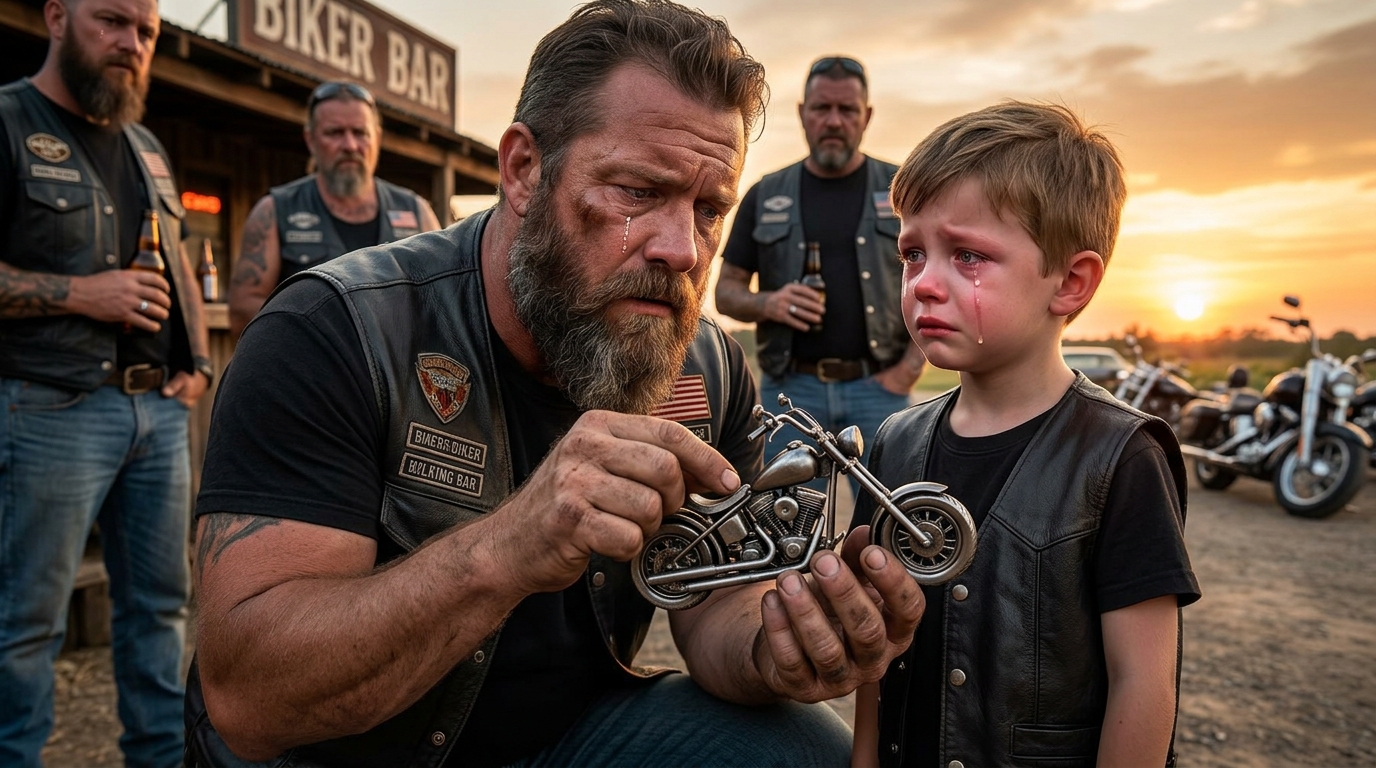
The parking lot behind Rusty Halo Bar had been alive all evening.
Engines rumbling.
Beer bottles clinking.
Boots scraping over gravel.
Men in leather vests laughing under the orange glow of sunset while a line of motorcycles gleamed beside the old fence like chrome-backed animals resting after a long ride.
At the center of the lot stood the motorcycle everyone had come to see.
A black Harley with silver flames along the tank.
Old, but beautifully kept.
Polished so clean it caught the last light of day.
A small paper tag hung from the handlebars.
AUCTION TONIGHT.
The bikers had been joking about who would bid too high, who would pretend not to cry, and who would finally get permission from his wife to bring home another bike.
Then the boy spoke.
“Why are you selling it?”
Every head turned.
He stood near the edge of the crowd, small enough that no one had noticed him walk up.
Maybe seven years old.
Maybe eight.
His cheeks were wet with tears.
His little leather vest was too big for his narrow shoulders, hanging open over a faded gray shirt. The vest was worn at the seams, but someone had stitched a tiny patch on the front.
A wing.
A wrench.
A crooked star.
In his hands, clutched so tightly his knuckles had gone pale, was a tiny metal motorcycle.
Not plastic.
Not a toy from a store.
Handmade.
A miniature bike no bigger than his forearm, built from wire, scrap metal, bottle caps, and patience.
The laughter died completely.
One of the bikers near the grill lowered his beer.
Another muttered, “Whose kid is that?”
The boy did not look at all of them.
He looked only at the black Harley.
The one with the auction tag.
“Why are you selling my dad’s bike?”
The question landed harder the second time.
A few men exchanged glances.
The leader of the group, a burly biker with a gray beard and a scar through one eyebrow, stepped forward.
His road name was Bear.
Most men called him that because he looked like one.
Broad shoulders.
Heavy boots.
Hands large enough to make a coffee mug disappear.
But when he approached the boy, he lowered himself slowly to one knee so his face was level with the child’s.
“What’s your name, little man?”
The boy sniffed.
“Noah.”
Bear’s expression changed.
Only slightly.
“Noah what?”
The boy wiped his nose with the back of his sleeve.
“Noah Kane.”
The parking lot went still.
Not quiet.
Still.
The name moved through the bikers like a chain pulled tight.
Kane.
Eli Kane.
Road name: Ghost.
The man who had vanished three years ago.
The man whose bike now stood under the auction tag.
The man half the club believed had betrayed them.
Bear stared at the child.
“Noah Kane,” he repeated softly.
The boy nodded.
“My dad can’t wake up.”
A gasp came from somewhere behind Bear.
One of the younger bikers whispered, “Jesus.”
Bear did not move.
He looked at the miniature motorcycle in Noah’s hands.
“Can I see that?”
Noah hesitated.
His fingers tightened around it.
Bear opened his palm and waited.
He did not grab.
Did not rush.
Did not smile like adults do when they think softness can cover fear.
After a moment, Noah placed the tiny bike into Bear’s hand.
It looked impossibly delicate there.
Bear turned it over carefully.
At first, he saw only the craftsmanship.
The tiny handlebars twisted from silver wire.
The bottle-cap wheels filed smooth.
The little engine carved from a piece of scrap aluminum.
Then his thumb found the mark beneath the frame.
Three small notches.
A tiny K scratched beside them.
Bear stopped breathing.
He knew that mark.
Every man in the club did.
Eli Kane used to carve three notches into anything he built.
Three rides.
Three brothers.
Three promises.
Bear’s face changed.
The toughness did not vanish.
It broke open.
His eyes filled.
A single tear slipped down into his beard.
The boy watched him, frightened now by the silence he had caused.
“My dad made it,” Noah whispered. “He said you would know.”
Bear closed his fingers gently around the miniature motorcycle.
For three years, he had believed Eli Kane rode away with club money and left his brothers to take the blame.
For three years, he had kept Eli’s bike locked in the back garage because he could not bring himself to sell it or forgive it.
Tonight’s auction had been meant to end the wound.
But the toy in his hand was not just metal.
It was a message.
And the child standing in front of him was not asking about a motorcycle.
He was asking why his father had been abandoned by the only family he thought would understand.
Bear looked at the black Harley.
Then back at Noah.
“Where is your dad?”
Noah’s lips trembled.
“In the hospital.”
The parking lot seemed to tilt.
Bear stood slowly.
“Who brought you here?”
Noah pointed toward the road.
A tired woman stood near the gate, one hand gripping a cheap purse, the other pressed against her chest as if she had used all her courage just getting the boy this far.
Bear recognized her too late.
Mara Kane.
Eli’s wife.
She looked thinner than he remembered.
Older.
Exhausted.
And terrified of the men her husband once called brothers.
The Brother They Thought Had Run
No one moved toward Mara at first.
Shame can freeze a crowd faster than fear.
Three years earlier, Eli Kane disappeared on a wet October night after a charity ride for wounded veterans.
The club had raised eighty thousand dollars.
Cash, checks, pledges, and donated equipment.
By morning, the money was gone.
So was Eli.
So was his phone.
So was his truck.
And because Eli had been the last one seen near the office safe, suspicion settled on him quickly.
Too quickly, Bear thought now.
But at the time, anger had been easier than confusion.
Eli had always been restless.
Always taking odd jobs.
Always quiet about problems at home.
Always refusing help even when his hands shook from exhaustion.
When the police found his truck abandoned two counties away with no sign of him, people began filling the silence with stories.
Maybe he ran.
Maybe he owed money.
Maybe he stole for his family.
Maybe the good brother was never good.
Bear hated those stories.
Then he began to believe them.
Not because they made sense.
Because grief needs somewhere to sit.
If Eli had been hurt, Bear had failed him.
If Eli had betrayed them, Bear could hate him instead.
So the club erased him slowly.
His photo came down from the wall.
His name stopped being said at meetings.
His bike remained locked in the back garage until the debt and bitterness attached to it became too heavy to keep.
Tonight, they planned to sell it.
Mara Kane had arrived just in time to see the auction tag hanging from her husband’s handlebars.
Noah had run forward before she could stop him.
Now Mara stood near the gate, eyes wet, face pale, waiting for judgment from men who had already judged her husband in absence.
Bear walked toward her.
The other bikers parted without a word.
“Mara,” he said.
She tightened her grip on her purse.
“Bear.”
Her voice was careful.
Exhausted.
He looked at Noah, then at her.
“You said he’s in the hospital.”
Mara nodded once.
Bear’s throat tightened.
“For how long?”
Her face twisted.
“Three years.”
The words struck the lot like a dropped wrench.
Behind Bear, someone whispered, “No.”
Mara’s eyes flashed.
“Yes.”
Bear took one step back.
His mind rejected it.
Three years.
While they cursed Eli’s name.
While they let rumors harden into truth.
While his bike sat under dust in their garage.
Eli had been alive.
Unable to wake.
“Where?” Bear asked.
“Saint Agnes Long-Term Care.”
Bear’s jaw clenched.
“That’s thirty miles from here.”
“I know.”
“Why didn’t you tell us?”
Mara laughed once.
It broke before becoming sound.
“I tried.”
The bikers went silent again.
Bear looked around slowly.
“Who did she talk to?”
No one answered.
Mara reached into her purse with shaking hands and pulled out a stack of envelopes.
Returned letters.
Unopened.
Some stamped.
Some marked undeliverable.
Some addressed to the Rusty Halo Brotherhood.
Some addressed directly to Bear.
His name.
Caleb “Bear” Maddox.
In Mara’s handwriting.
Bear stared at them.
“I never got these.”
“I figured that out.”
“Who took them?”
Mara’s gaze moved past him.
Toward the bar office.
Toward the back door where a man named Vince stood half in shadow.
Vince was the club treasurer now.
He had taken over after Eli vanished.
He was clean-shaven for a biker, with sharp eyes and a silver chain across his vest.
And suddenly, he looked very interested in leaving.
Bear turned.
“Vince.”
The man lifted his hands.
“Don’t start.”
Bear’s voice dropped.
“What did you do?”
Vince scoffed.
“Nothing. This is emotional nonsense. Her husband stole from us.”
Mara’s face hardened.
“My husband was found beaten beside Route 19 the night you told everyone he ran.”
The lot erupted.
“What?”
“Beaten?”
“Who found him?”
Mara held Noah against her side as if shielding him from the noise.
“A truck driver. He had no ID. No phone. No wallet. He was unconscious. They listed him as John Doe for six weeks.”
Bear’s knees nearly gave.
“Six weeks?”
“I was looking everywhere,” Mara said. “Police. Hospitals. Shelters. Every place I could think of. I came here twice.”
Her eyes found Bear’s.
“You were gone the first time. The second time, Vince said if I came back spreading lies, he’d make sure Noah and I lost the house.”
Every biker turned toward Vince.
Vince’s face tightened.
“You people believe this?”
Bear looked at the returned letters in his hand.
Then at the tiny motorcycle Noah had brought.
Then at Eli’s black Harley under the auction tag.
“Yes,” Bear said.
Vince laughed.
“You always were sentimental.”
Bear stepped toward him.
Vince stepped back.
That was when Noah spoke.
“My dad left something in the bike.”
Everyone froze.
Bear turned.
“What?”
Noah pointed to the miniature motorcycle in Bear’s hand.
“He said if things went bad, I should show you the small bike. Then you’d check the big one.”
Vince went pale.
And that was the moment Bear knew.
The toy was not only proof Eli had built it.
It was a key.
The Message Beneath the Tank
The black Harley was rolled into the center of the lot.
No one laughed now.
No one drank.
No one touched the auction tag until Bear tore it off himself and threw it into the gravel.
The bike looked different under the fading light.
Less like property.
More like a witness.
Noah stood beside Mara, clutching her hand.
Bear knelt near the fuel tank with the miniature motorcycle in his palm.
“Where?” he asked the boy.
Noah swallowed.
“He said the little one shows the big one.”
Bear studied the toy.
Tiny handlebars.
Little engine.
Bottle-cap wheels.
Three notches under the frame.
Then he noticed something else.
The miniature gas tank had a shallow scratch on the left side.
Not random.
An arrow.
Bear turned toward Eli’s real bike.
On the left side of the fuel tank, beneath the silver flame design, was a small irregularity in the paint.
He had seen it a hundred times.
He had assumed it was a dent.
Eli never fixed it.
Bear placed his thumb against it and pressed.
Nothing.
He pressed harder.
A hidden latch clicked.
The lot collectively inhaled.
A narrow panel beneath the tank loosened.
Bear pulled it free.
Inside was a sealed metal tube wrapped in oilcloth.
Vince turned to run.
Two bikers grabbed him before he reached the gate.
“Let go of me!” he shouted.
Bear did not look at him.
His hands shook as he opened the tube.
Inside were three things.
A small flash drive.
A folded letter.
And a club patch.
Not Eli’s regular patch.
His original one.
The one he had worn the night Bear first invited him to ride with the brotherhood.
Bear unfolded the letter.
The handwriting was Eli’s.
Rough.
Slanted.
Unmistakable.
Bear,
If you’re reading this, I either couldn’t come back or I was too late to explain.
Do not trust Vince.
The money from the veterans ride was never in the office safe when I left. Vince moved it before midnight and planned to blame me. I found the transfer records on his laptop and copied what I could.
I was going to bring it to you after checking the storage unit on Route 19. If I don’t make it, look there first.
Mara knows nothing. Keep her and Noah safe.
Tell my boy the little bike was never a toy. It was a map back to family.
Bear could not continue for a moment.
The words blurred.
He lowered the letter, breathing hard.
Mara was crying silently.
Noah looked frightened by the grown men around him who suddenly seemed less like giants and more like broken things.
Bear forced himself to read the last line.
And Bear—
If you believed I ran, I forgive you.
But don’t let them sell my bike before Noah learns to ride.
The letter shook in Bear’s hands.
A sound moved through the bikers.
Grief.
Shame.
Anger.
All at once.
Bear looked up at Vince.
The man was being held by two club members, his face pale, jaw tight.
“You let us bury him alive,” Bear said.
Vince sneered, though fear lived under it now.
“He wasn’t dead.”
“No,” Bear said. “But you made sure he was alone.”
The flash drive was taken into the office and plugged into an old laptop while everyone crowded close enough to feel each other breathing.
There were bank records.
Video files.
Transfer logs.
Emails.
A storage unit rental under Vince’s cousin’s name.
Photos of cash bags.
Messages arranging a fake theft.
And one video.
Bear clicked it.
Eli appeared on screen, sitting in what looked like a dim garage. His face was bruised. One eye was swollen. He was breathing hard, speaking quickly.
“If I don’t make it back, Vince set this up. He’s moving the money through the storage unit by Route 19. I got proof. I’m going to Bear now.”
He looked off-camera, startled by a noise.
Then back.
“Mara, if you see this, I’m sorry. Noah, buddy, remember the little bike? Three notches means three promises. Be brave. Listen to your mom. And don’t let Uncle Bear act like he’s not crying.”
The video cut off.
Bear covered his face with one hand.
A few of the bikers openly wept.
Noah whispered, “That’s Daddy.”
Mara knelt beside him.
“Yes, baby.”
Bear stepped away from the laptop and walked outside.
The sunset was gone now.
Night had settled over the lot.
For three years, he had called Eli a traitor in his heart because betrayal hurt less than failure.
Now failure stood in front of him with a child’s face.
The Hospital Room They Should Have Found
They went to Saint Agnes that night.
Not all of them.
That would have overwhelmed the hospital and frightened Noah.
Bear went.
Mara went.
Noah went.
Two trusted club members drove behind them.
Vince was handed over to police after one of the bikers called a detective who had once ridden with them in charity events. By midnight, the flash drive, the letter, and the hidden tube were logged as evidence.
But Bear barely cared about Vince by then.
His mind was at the hospital.
Saint Agnes Long-Term Care sat on a quiet hill outside the city, more faded than cruel, with warm lights in the windows and nurses who looked too tired to be surprised by broken families arriving after visiting hours.
Mara spoke to the front desk.
The nurse looked at Bear’s vest, then at Noah, then at Mara’s face.
She let them in.
Room 214.
Bear stopped outside the door.
He had faced bar fights, prison visits, funerals, highway accidents, and long nights waiting for brothers to come out of surgery.
Still, he could not make his hand reach the door handle.
Mara looked at him.
“You don’t have to.”
Bear swallowed.
“Yes, I do.”
They entered quietly.
Eli Kane lay in the bed.
Thinner.
Older.
Beard trimmed by someone else.
A scar ran along his temple.
Machines hummed softly beside him.
His eyes were closed.
His hands rested above the blanket, one curled slightly like he was still holding handlebars in a dream.
Bear gripped the doorframe.
For a moment, he saw Eli as he had been.
Laughing too loud.
Welding scraps into toys for kids at charity fairs.
Riding last in the line because he always wanted to make sure no one got left behind.
Noah ran to the bed.
“Daddy, I brought them.”
Mara covered her mouth.
Bear stepped forward slowly.
He reached the bedside and looked down at the man he had failed.
“I’m here, Ghost,” he whispered.
No response.
Bear’s face crumpled.
“I’m late.”
Mara placed one hand on Noah’s shoulder.
Noah lifted the tiny motorcycle and placed it carefully on the blanket beside Eli’s hand.
“I showed him,” Noah said. “Like you told me.”
Eli did not wake.
Of course he did not.
Stories like this would be easier if truth had the power to open eyes on command.
It did not.
But something happened.
His fingers moved.
Only slightly.
A twitch.
A small shift toward the toy.
Noah gasped.
“Dad?”
Mara froze.
Bear leaned closer.
“Eli?”
The hand moved again.
Not much.
But enough.
The nurse was called.
Then a doctor.
They explained carefully that patients in long-term unconscious states could respond to sound, touch, memory, familiar voices. It did not mean waking. Not necessarily.
Noah did not care about careful explanations.
“He heard me,” he said.
Bear nodded, crying openly now.
“Yeah, kid. He heard you.”
The next morning, the Rusty Halo Brotherhood arrived at Saint Agnes.
Not inside all at once.
They lined the parking lot.
Motorcycles parked in a long row beneath the hospital windows.
No engines revving.
No noise.
Just presence.
Mara stood at the window in Eli’s room, looking down at the men who had once believed the worst of her husband and had now come to stand guard.
Bear removed his vest.
For the first time in twenty-two years, he took off his president patch.
Mara watched.
“What are you doing?”
Bear placed the vest over the chair beside Eli’s bed.
“He was my brother when I believed him. He stayed my brother when I didn’t. I don’t deserve to wear this until I make that right.”
Mara’s eyes filled.
“You can’t undo three years.”
“No.”
“Then what are you trying to do?”
Bear looked at Noah.
The boy sat beside the bed, telling Eli about school, about the bus ride, about the toy motorcycle’s scratched wheel.
“I’m trying to make sure the next three don’t look like the last.”
The Ride That Wasn’t an Auction
Vince was arrested.
Then charged.
The evidence Eli hid in the motorcycle connected him to the stolen veterans charity money, forged transfer records, witness intimidation, and the assault that left Eli unconscious near Route 19.
The investigation widened.
Two outside accomplices were arrested.
Most of the stolen money was recovered from accounts Vince thought were hidden.
Some was gone.
The club replaced it.
Every dollar.
Bear sold his second bike.
Another man sold a boat.
Someone else emptied a savings account he had been pretending not to have.
The veterans fund received the full amount, plus interest, plus an apology signed by every member of the Rusty Halo Brotherhood.
Mara read it before they sent it.
She crossed out three lines.
Too many excuses.
Bear accepted every correction.
The black Harley was not sold.
No one spoke of selling it again.
It was cleaned, tuned, and moved to the front of the clubhouse under a new sign:
ELI “GHOST” KANE
STILL RIDING WITH US
Noah visited every Saturday.
At first, he stayed close to Mara.
Then he started helping Bear polish chrome.
Then he learned the names of tools.
Then the names of roads.
Then the difference between men who look scary and men who are safe.
Bear never rushed him.
He had already rushed judgment once.
He would not rush trust too.
Eli did not wake that month.
Or the next.
But he changed.
Small things.
Finger movements.
Eye flickers.
Breathing shifts when Noah spoke.
The doctors called it neurological response.
Noah called it listening.
Mara called it hope, but only when she thought no one heard.
One afternoon, six months after the night of the auction, Bear sat beside Eli’s hospital bed alone.
Noah was at school.
Mara had gone home to shower.
Bear held the tiny motorcycle in his hands, turning it carefully the way he had that first night.
“I hated you,” he admitted.
The machines hummed.
“I thought it was easier.”
Silence.
“I let them take your name off the wall.”
Silence.
“I’m putting it back.”
A breath.
Steady.
Mechanical.
Human.
Bear leaned forward.
“Your boy looks like you when he’s angry. It’s annoying.”
Eli’s finger twitched.
Bear froze.
“Yeah,” he whispered. “I know you heard that.”
A month later, Eli opened his eyes.
Not dramatically.
No movie music.
No sudden full recovery.
Just a slow blink while Noah was reading him a comic book.
Noah screamed so loudly a nurse dropped a clipboard.
Mara ran in.
Bear, who had been in the hallway arguing with a vending machine, nearly broke the door getting inside.
Eli’s eyes moved slowly.
Confused.
Clouded.
Alive.
His gaze found Noah first.
His lips parted.
No sound came.
Noah climbed onto the bed carefully, sobbing.
“Daddy.”
Eli’s fingers touched his son’s hair.
Then his eyes moved to Bear.
Bear stood at the foot of the bed, unable to speak.
For once.
Eli’s mouth trembled.
A rough whisper came out.
“Crying?”
Bear broke.
He laughed and sobbed at the same time.
Noah looked confused.
Mara cried harder.
Eli’s recovery took years.
Speech therapy.
Physical therapy.
Memory gaps.
Anger.
Pain.
Days when he wanted silence.
Days when Mara had to leave the room and scream into a towel because caregiving is love, but love does not make exhaustion holy.
Bear showed up anyway.
Not as hero.
As labor.
Rides to appointments.
Grocery runs.
House repairs.
School pickups.
Quiet porch sitting when Eli could not stand pity.
One year after Eli opened his eyes, the club held another sunset gathering behind Rusty Halo Bar.
This time, there was no auction tag.
No sale.
No laughter at someone else’s expense.
The black Harley stood at the center of the lot, polished under the evening light.
Eli sat beside it in a wheelchair, thinner than before, one hand resting on the handlebar.
Noah stood next to him wearing the same oversized vest, now with a new patch sewn beneath the little wing and wrench.
SON OF GHOST
Bear stood in front of the club.
He had his president patch back.
Mara had given it to him herself after Eli told her he was tired of Bear “moping like a sad refrigerator.”
Bear cleared his throat.
“We thought this bike was the end of a bad story.”
He looked at Eli.
“We were wrong.”
Eli lifted one eyebrow.
Still weak.
Still himself.
Bear continued.
“This bike carried a message when we were too angry to listen. This little metal toy carried the truth when grown men failed to carry faith.”
Noah held up the miniature motorcycle.
The bikers cheered.
Not loudly at first.
Then louder.
Eli’s eyes filled.
Bear turned to the boy.
“Noah, this belongs to you.”
Noah stared as Bear handed him the keys to the black Harley.
His eyes widened.
“I can’t ride that.”
The club laughed.
Bear smiled.
“Not yet.”
Eli whispered, “Don’t let Bear teach you first.”
Everyone laughed harder.
Bear pointed at him.
“You just woke up and you’re already disrespectful.”
Mara laughed through tears.
Noah clutched the keys.
“Can Dad teach me?”
Eli’s fingers tightened on the handlebar.
“One day,” he whispered.
And because everyone in that lot had learned something about waiting, no one corrected him.
One day was enough.
Years later, people still told the story of the boy who walked into a biker auction with a handmade toy motorcycle and stopped a whole club from selling his father’s bike.
They loved the dramatic version.
The little boy’s question.
The biker turning the toy over.
The hidden message.
The fallen brother alive in a hospital.
The corrupt treasurer exposed.
But Bear remembered the quieter part.
The moment Noah asked why.
Not angrily.
Not loudly.
Just with a child’s devastated confusion.
Why are you selling it?
That question had cut deeper than any accusation because it held the truth none of them wanted to face.
They were not just selling a motorcycle.
They were selling the last piece of faith they had in a brother who could no longer defend himself.
The toy had been metal.
But the message was mercy.
If you believed I ran, I forgive you.
Bear never fully forgave himself.
Eli told him that was boring and unproductive.
Mara told him guilt was only useful if it carried groceries.
Noah told him he was still bad at making pancakes.
Life moved forward like that.
Imperfect.
Loud.
Healing in pieces.
The black Harley eventually rode again.
Not fast.
Not far.
The first time Eli managed it, Bear rode beside him, Noah behind Mara in the support truck, both of them crying before the engine even turned over.
They rode at sunset.
Past the old bar.
Past Route 19.
Past the hospital road.
Past the storage unit where the truth had waited too long.
When they returned, Noah placed the tiny motorcycle on the clubhouse shelf beside Eli’s restored patch.
Three notches facing outward.
Three promises.
Do not abandon family.
Do not mistake silence for guilt.
Do not sell what love has not finished saving.
And every year after that, when the Rusty Halo Brotherhood held its charity ride, they ended at the hospital.
No roaring engines near the windows.
No chaos.
Just a quiet line of bikes under the evening sky, standing for people who could not yet come outside.
Because sometimes a person who cannot wake is still waiting to be found.
Sometimes a small boy knows the truth better than a room full of men.
And sometimes the smallest motorcycle in the lot carries the heaviest message home.