The restaurant felt too refined for true hunger.
Sunlight spilled through the tall windows in clean golden sheets. White tablecloths glowed beneath crystal glasses. Silverware clicked softly against porcelain. Every laugh in the room sounded measured, polished, rehearsed by people who expected comfort to last forever.
I sat at the best table with my son beside me.
Oliver was eleven years old, though pain had given him the stillness of someone much older. He sat in his custom wheelchair with both hands resting on the armrests, his legs covered by a cashmere blanket, his face trained into the patient expression adults praised because they mistook surrender for peace.
My name is Ethan Vale.
People knew me as the man who built Vale Capital from nothing. Hotels. Private hospitals. Real estate towers. Two medical research foundations. Enough money to make governments answer the phone.
But none of it had made my son walk again.
Three years earlier, a spinal infection had left Oliver paralyzed from the waist down. That was what I was told. That was what every specialist repeated. Permanent nerve damage. Catastrophic loss. Lifelong care.
My late wife, Claire, had died six months after the diagnosis.
Grief, they said.
A car accident, technically.
But everyone knew the truth.
A mother’s heart could only break so many times.
That afternoon, I had brought Oliver to La Veyra because my fiancée, Adrienne, insisted normal routines were healthy. Lunch. Sunlight. Familiar faces. The illusion that our life was still elegant.
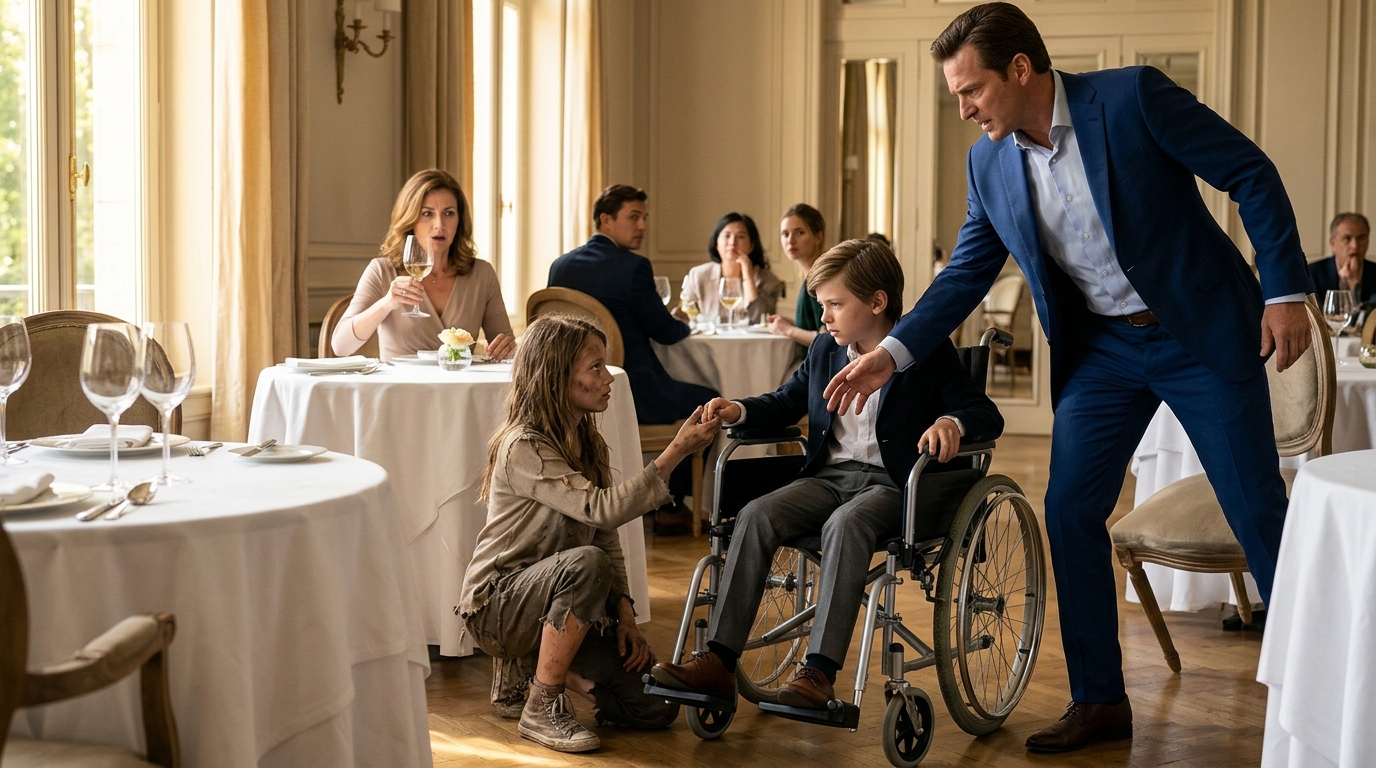
Then a grimy little hand slapped down on our table.
Plates jumped.
Wine trembled in its glass.
A few heads turned, annoyed before they were curious.
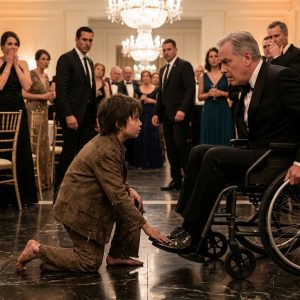
At the center of the room stood a ragged girl in torn clothes, dirt smudged across her cheeks, her dark hair tangled around a face too thin for childhood. Her ribs pressed faintly against the fabric of her shirt. One shoe was missing. The other looked stolen from someone older.
She pointed directly at Oliver.
“Feed me,” she said, “and I’ll heal him.”
For a moment, I simply stared.
Then I laughed.
Not because it was funny.
Because the insult of it was too absurd to process.
“You’ll heal my son?”
The girl did not blink.
I pushed back my chair. It scraped loudly across the marble floor.
Nearby diners turned now. A waiter froze beside a wine cart. Adrienne’s hand tightened around her water glass.
“Go away,” I said.
The girl ignored me.
That was the first thing that unsettled the room.
She moved around the table and crouched in front of Oliver, bringing her eyes level with his.
“Do you want to stand?” she asked softly.
Oliver’s face changed.
Not into confusion.
Not into fear.
Into hope.
Raw.
Dangerous.
I reached down to grab the girl by the shoulder, but stopped halfway when Oliver lifted one hand from the armrest.
A small movement.
Nothing, to anyone else.
But my son had not moved that hand without being asked in months.
The room went silent.
Adrienne whispered, “Ethan…”
I looked from Oliver’s hand to the girl.
“What did you do?”
The girl reached for him slowly.
“Nothing yet.”
The words made the silence heavier.
Because she said them like the impossible was still waiting.
Oliver’s fingers curled around hers.
His right foot slipped off the footrest.
I lunged forward.
Before I could pull them apart, the girl looked up at me and said the words that turned my polished life into ash.
“He knows me.”
The Girl Who Wasn’t Begging
I should have called security.
I almost did.
The maître d’ was already rushing toward us with the pale horror of a man watching his restaurant become a scandal. Adrienne stood so quickly her chair tilted back, one hand pressed to her necklace, her expression tight with fury disguised as concern.
“Ethan, get her away from him,” she said.
But Oliver was still holding the girl’s hand.
That stopped me.
Not because I trusted her.
Because he did.
My son had not trusted strangers since the hospital. Nurses had to announce every touch. Doctors had to explain every test. Even I sometimes saw him flinch before he remembered I was his father.
But now his fingers held onto a starving street girl like she was something familiar.
Something safe.
“What’s your name?” I asked.
The girl looked at Oliver first.
Then me.
“Mara.”
Oliver’s eyes filled instantly.
“Mara,” he whispered.
Adrienne went still.
I turned toward my son.
“You know her?”
Oliver looked frightened now.
Not of Mara.
Of remembering.
“I think so.”
Mara squeezed his hand once.
“You do.”
The restaurant had gone completely quiet. People were pretending not to watch while watching with their whole bodies. A woman at the next table lowered her wine glass and forgot to breathe.
I looked at Mara’s torn clothes. The dirt. The hunger. The way she kept her body angled toward the exits.
“You said feed you.”
She nodded.
“Then we talk.”
Adrienne snapped, “Absolutely not.”
I looked at her.
Something in my face made her stop.
We moved to a private dining room in the back.
Mara ate like someone who had learned not to trust a second chance. Bread first. Soup next. Then potatoes with both hands until she remembered the silverware and forced herself to slow down.
Oliver watched her the whole time.
Not with pity.
With pain.
“Where did I know you?” he asked.
Mara swallowed hard.
“The blue room.”
Adrienne’s face changed.
Only for a second.
But I saw it.
“What blue room?” I asked.
Mara looked at the closed door, then at the ceiling corners.
“Are there cameras?”
“This is a restaurant.”
“That doesn’t answer me.”
Her voice was too old for her face.
I stood and checked the corners. No cameras. No visible microphones. Still, Mara leaned close before speaking.
“The room at Briar Glen,” she said. “The one with the water floor and the bars. They made us walk there.”
My stomach tightened.
Briar Glen Pediatric Recovery Center.
Oliver had spent eleven months there after his diagnosis.
The best neurological rehabilitation facility in the country.
The facility Adrienne had found.
The facility my foundation had funded after Oliver became their most famous patient.
I looked at Oliver.
His face had gone pale.
“I don’t remember that.”
Mara touched the side of her own head.
“They gave us medicine when we remembered too much.”
Adrienne laughed once.
Sharp.
“There it is. This is a scam.”
Mara ignored her.
She reached into the torn lining of her jacket and pulled out a folded piece of paper wrapped in plastic.
She placed it on the table.
It was a drawing.
Two children standing beside a fountain.
One boy.
One girl.
Both holding crutches in the air like trophies.
The name written at the bottom was Oliver’s.
Not printed.
Written in his childish hand.
My son stared at it.
His lips parted.
“I drew that,” he whispered.
“No,” Adrienne said quickly. “Oliver, listen to me. You drew hundreds of things at Briar Glen. She could have stolen that from anywhere.”
Mara reached into her jacket again.
This time, she pulled out a hospital bracelet.
Faded.
Cracked.
Patient 12.
Mara Vale.
My blood went cold.
Vale.
My last name.
I looked at her sharply.
“Why does that say Vale?”
She held my gaze.
“Because that’s what they called me after your wife brought me there.”
The room seemed to narrow.
“My wife is dead.”
Mara looked at Oliver.
Then back at me.
“No,” she said. “She’s the reason I found you.”
The Medicine That Taught His Body to Lie
I did not take Mara home.
That was the first intelligent decision I made.
I took Oliver to an old apartment I still kept under a company name downtown, a place Adrienne did not know about because it belonged to a life before wealth became a performance.
Mara rode in the back seat beside him, clutching a takeout bag from the restaurant like someone might punish her for finishing it.
Adrienne called seventeen times.
I answered none of them.
At the apartment, I put Oliver on the sofa and removed the blanket from his legs.
His right foot twitched.
Once.
Then again.
I stared so hard my eyes burned.
For three years, that foot had belonged to silence.
Mara sat cross-legged on the floor.
“They told you he couldn’t feel anything?”
“Yes.”
“They lied.”
I wanted to reject it.
Instead, I heard Lila’s voice from years ago.
Claire.
My Claire.
She had said almost the same thing before she died.
They’re lying to us, Ethan.
I had thought grief had made her paranoid.
I had thought exhaustion had twisted her mind.
God help me.
I had believed everyone except my wife.
Mara pointed to the black medical bag I carried from Oliver’s wheelchair.
“Show me the night medicine.”
I opened it.
Three bottles.
Two injections.
One amber liquid prescribed for “neuromuscular stabilization.”
Mara recoiled when she saw it.
“That one.”
“What is it?”
“I don’t know the name. I know what it does.”
Oliver whispered, “It makes my legs heavy.”
I turned to him.
“You never told me that.”
His eyes filled with shame.
“Adrienne said it meant the medicine was working.”
Mara shook her head.
“It means they’re keeping the nerves quiet.”
I called Dr. Samuel Reyes.
He had been Oliver’s first neurologist before Adrienne pushed him off the case and replaced him with Briar Glen’s specialists. At the time, she said Reyes lacked access to experimental technology.
Now I wondered if his real flaw had been honesty.
Reyes answered on the fourth ring.
“Ethan?”
“I need you to test something privately.”
He arrived within an hour.
No assistant.
No white coat.
Just a medical case and a face that went grim when he saw Oliver’s medication.
“Who prescribed this?”
“Dr. Harlan Creed.”
Reyes closed his eyes.
That was not the reaction I wanted.
“What?” I asked.
He looked at Oliver.
Then at Mara.
Then back at me.
“This compound suppresses involuntary nerve activity. In certain cases, it can be medically useful for severe spasms. But if given repeatedly to a child in recovery, it could mask motor return.”
Mask.
The word landed like a verdict.
“Could it make a recovering child appear permanently paralyzed?”
Reyes did not answer fast enough.
I stood.
“Could it?”
“Yes,” he said quietly.
Oliver began to cry.
Not loudly.
Just silently, tears sliding down his face as he stared at his own legs like they had betrayed him and come back in the same breath.
I wanted to tear the apartment apart.
Instead, I knelt in front of my son.
“Look at me.”
He did.
“You did nothing wrong.”
His voice cracked.
“Did I give up?”
“No.”
I held his face gently between my hands.
“No, Oliver. Someone made you think your body was gone.”
Mara looked toward the window.
“They’ll come soon.”
“Who?”
She did not need to answer.
A black SUV had just pulled up across the street.
Then another.
My phone buzzed.
Adrienne.
This time, a message.
Bring Oliver home before you make this worse.
Dr. Reyes stepped to the window and cursed under his breath.
I looked at Mara.
“What is Briar Glen?”
She swallowed.
“A place where rich children get declared hopeless.”
Then she looked at Oliver.
“And where the ones who recover too soon disappear.”
Before I could respond, someone knocked on the apartment door.
Three slow knocks.
A pause.
Then Claire’s voice came from the other side.
“Ethan, don’t open it unless Mara is with you.”
The Wife I Buried Without Seeing
My knees almost failed.
Claire’s voice.
Not a recording.
Not memory.
Not grief playing a cruel trick.
Her voice.
Oliver stopped crying.
His whole body went still.
“Mom?”
Mara stood and walked to the door.
“She’s alone,” she said.
“How do you know?”
“Because if she wasn’t, she wouldn’t knock.”
I opened the door with the security chain still on.
Claire stood in the hallway.
Thinner.
Older.
Her hair cut short.
A scar ran from beneath her left ear to the collar of her coat.
But her eyes were the same.
The eyes I had seen in hospital rooms.
In wedding photographs.
In nightmares I told myself were only dreams.
She looked at me through the narrow gap.
“Ethan.”
I could not speak.
I unlocked the chain.
Oliver made a sound from the sofa that broke whatever remained of me.
Claire crossed the room and dropped to her knees in front of him. She reached for him, then stopped, trembling.
“Can I touch you?”
Oliver fell forward into her arms.
The sound he made was not a word.
It was three years of needing his mother and being told she was in the ground.
Claire held him like she had been surviving for this one moment.
I stood there, useless and ruined.
Mara leaned against the wall, looking away.
Dr. Reyes whispered, “My God.”
When Claire finally looked at me, there was no gentle reunion in her face.
Only urgency.
“We have minutes.”
I forced my voice to work.
“I buried you.”
“No,” she said. “You buried an empty casket.”
The room spun.
“The accident?”
“Staged.”
“By who?”
She looked toward the phone in my hand.
“Adrienne. Creed. And your board.”
My board.
Vale Capital’s private medical division had invested billions in neuro-recovery technologies. Briar Glen was our flagship facility. Oliver’s case had become proof of need. A beloved heir tragically paralyzed. A grieving father funding research. A foundation raising money around permanence.
If Oliver recovered, the story changed.
If Claire proved he could recover, the funding model collapsed.
I remembered her screaming at me in our kitchen.
They are using him.
I remembered Adrienne standing behind me that night, soft and calm, saying Claire needed help.
I remembered signing the psychiatric petition.
I remembered believing it was temporary.
“What did I do?” I whispered.
Claire’s expression softened for one second.
Then hardened again.
“You trusted people who needed you blind.”
Mara opened the takeout bag and pulled out something wrapped in napkins.
A flash drive.
“She brought this from Briar Glen,” Claire said.
Mara handed it to Dr. Reyes.
“Patient files,” she said. “Videos. Medication logs. Transfer records.”
Reyes plugged it into my laptop.
Folders appeared.
Patient 09.
Patient 12.
Patient 14.
Oliver Vale.
The videos were worse than anything I had imagined.
Oliver in the blue therapy room, standing between parallel bars while Claire cried behind the observation glass.
Oliver taking three steps.
Oliver laughing.
Oliver falling, then pushing himself back up.
Date: two years and nine months ago.
After I had been told he would never walk.
Another video.
Dr. Creed speaking to Adrienne in the corridor.
“He’s recovering too fast. If Ethan sees this, he’ll shut down the funding review.”
Adrienne’s voice was clear.
“Then Ethan doesn’t see it.”
Another file.
Claire restrained in a hospital bed.
A doctor signing involuntary commitment papers.
Adrienne standing beside her.
Then a death certificate.
Cause: traumatic injury from vehicle fire.
Witness: Adrienne Cole.
My fiancée.
Claire pointed at another folder.
“Open Mara’s.”
I did.
Patient 12.
Mara Vale.
The videos showed the ragged girl younger, frightened, holding parallel bars in the same blue room.
Then a woman entering.
Claire.
“She was there before Oliver,” Claire said. “No family. No records anyone cared about. They used her to test suppression protocols.”
Mara stared at the floor.
“When Claire found me, she started asking what happened to the children who improved.”
“And?”
Mara’s voice was flat.
“They got transferred.”
“To where?”
Before she could answer, glass shattered in the kitchen.
A canister rolled across the floor, hissing white gas.
Claire grabbed Oliver.
“Bathroom, now!”
Dr. Reyes dragged Mara behind the sofa as the front door burst open.
Men in black medical uniforms entered first.
Then Adrienne.
She wore a cream coat and pearl earrings, her expression full of disappointment.
“Ethan,” she said through the gas. “You always were sentimental.”
The First Step They Couldn’t Steal
Adrienne expected confusion.
That was her first mistake.
She expected me to freeze between the wife I had buried, the son I had failed, and the girl I had dismissed as a beggar.
But guilt, once it becomes clear, burns faster than fear.
I threw the laptop at the first man’s face.
Dr. Reyes pulled the fire alarm.
Claire slammed the bathroom door with Oliver inside and braced it with her body.
Mara moved like someone who had escaped cages before. She grabbed the fallen canister with a towel, kicked open the balcony door, and shoved it outside.
The room filled with alarms.
Water sprinklers burst overhead.
Adrienne screamed, “Get the boy!”
That sentence sealed her.
Not help him.
Not protect him.
Get him.
Federal agents entered four minutes later.
Not because I had called them.
Because Claire had.
She had been working with a medical fraud investigator for six months, waiting for enough evidence to tie Briar Glen to Vale Capital’s board. Mara had escaped the facility three days earlier with the flash drive and found Claire at a safe house.
The restaurant had not been random.
Mara had followed Adrienne there.
She had chosen a room full of witnesses.
Smart girl.
Starving girl.
Brave girl.
Adrienne tried to claim Claire was unstable.
Then investigators played the videos.
She tried to claim Mara had stolen records.
Then Dr. Reyes confirmed the medication.
She tried to claim Oliver’s recovery signs were involuntary spasms.
Then Oliver, pale and shaking from the bathroom doorway, looked directly at her and said:
“You told me not to try.”
No one spoke after that.
Briar Glen was raided that night.
Three children were found in restricted care rooms.
Two were heavily sedated.
One had been listed as transferred overseas six months earlier.
The blue therapy room was still there.
So were the medication logs.
So were the videos they thought made them look like pioneers instead of criminals.
The trial lasted nearly a year.
Adrienne’s defense was elegant, expensive, and doomed.
Dr. Creed took a plea and gave up the board members who had approved the suppression program. Their motive was not only funding. It was valuation. Permanent disability created recurring care contracts, research grants, charitable donations, and medical technology investments tied to “lifelong need.”
Recovery was bad for business.
Oliver had been the symbol.
Claire had been the obstacle.
Mara had been the discarded proof.
Adrienne received forty-five years.
Creed received thirty.
Three board members went to prison.
Vale Capital’s medical division collapsed under federal seizure.
I let it.
Then I sold what remained and built something smaller with Claire and Dr. Reyes.
A recovery trust for children whose improvement had been hidden, doubted, or priced as a threat.
Mara refused adoption papers at first.
She said papers had never protected her.
Claire told her that was exactly why these would be different.
It took nine months before Mara signed.
She did not take my last name.
Not then.
But she let Oliver call her sister.
That was enough.
Oliver’s recovery was not a miracle.
It was ugly.
Slow.
Painful.
Some days he hated his legs for returning with fire instead of strength. Some days he refused therapy. Some nights he woke screaming because he dreamed Adrienne was standing at the foot of his bed with the amber bottle.
But he tried.
Mara came to every session.
She never clapped too early.
Never said almost there.
Never told him to be grateful.
She simply stood at the end of the parallel bars and held out her hand.
“Then trust me,” she would say.
And he would.
A year after the restaurant, we returned to La Veyra.
Not for revenge.
For lunch.
The staff had changed. The maître d’ avoided my eyes. The table where Mara had slapped her hand down was still near the windows, still covered in white linen, still glowing under sunlight that made everything look cleaner than it had any right to be.
Mara wore a simple blue dress Claire had bought her.
She ate slowly now.
Not because she was not hungry.
Because she finally believed no one would take the plate away.
Oliver sat in his wheelchair beside the table.
His braces were locked beneath his trousers.
I watched him place both hands on the armrests.
Claire stopped breathing.
Mara put down her fork.
Oliver looked at her.
“Do you want to stand?” she asked, smiling faintly.
He rolled his eyes.
“You really like dramatic callbacks.”
But his voice shook.
So did mine.
He pushed himself up.
His legs trembled.
His jaw clenched.
For one terrible second, I saw pain flash across his face and nearly reached for him.
Claire touched my arm.
“Wait.”
So I did.
The hardest thing a father can do.
Wait while his child fights for something you cannot buy.
Oliver took one step.
Then another.
Then he reached Mara’s chair and grabbed the back of it, laughing through tears.
The restaurant had gone quiet again.
Just like before.
But this silence was different.
No disgust.
No spectacle.
No hunger being mistaken for disruption.
This time, everyone understood they were witnessing something sacred.
Mara stood.
Oliver held her hand.
“I told you,” she said.
He nodded, breathless.
“You said you’d heal me.”
She shook her head.
“No. I said feed me and I’ll heal him.”
He frowned.
“That’s what I said.”
“No,” Mara said softly. “The food was never for me.”
Oliver looked confused.
Then she glanced at me.
And I understood.
She had not meant bread.
Or soup.
Or the steak she devoured like survival.
She meant truth.
Feed me the chance.
Feed me the witness.
Feed me one room where someone powerful finally had to listen.
I stood slowly.
The same room that had once watched me laugh at a starving child now watched me cross the floor and kneel in front of her.
“I’m sorry,” I said.
Mara looked uncomfortable.
Children who survive cruelty often distrust apologies because adults use them too late.
Still, she did not look away.
“I know,” she said.
Not forgiveness.
Not yet.
But something.
Oliver lowered himself back into the wheelchair, exhausted and radiant.
Claire wiped her eyes.
Sunlight moved across the white tablecloths.
Silverware gleamed.
Wine glasses sparkled.
The restaurant was still refined.
Still expensive.
Still full of people who expected comfort to last forever.
But now, at our table, comfort was not the point.
Truth was.
And truth had entered that room barefoot, hungry, filthy, and brave enough to say the impossible out loud.
Feed me.
And I’ll heal him.