The restaurant shimmered as if it had been built to keep ugly things outside.
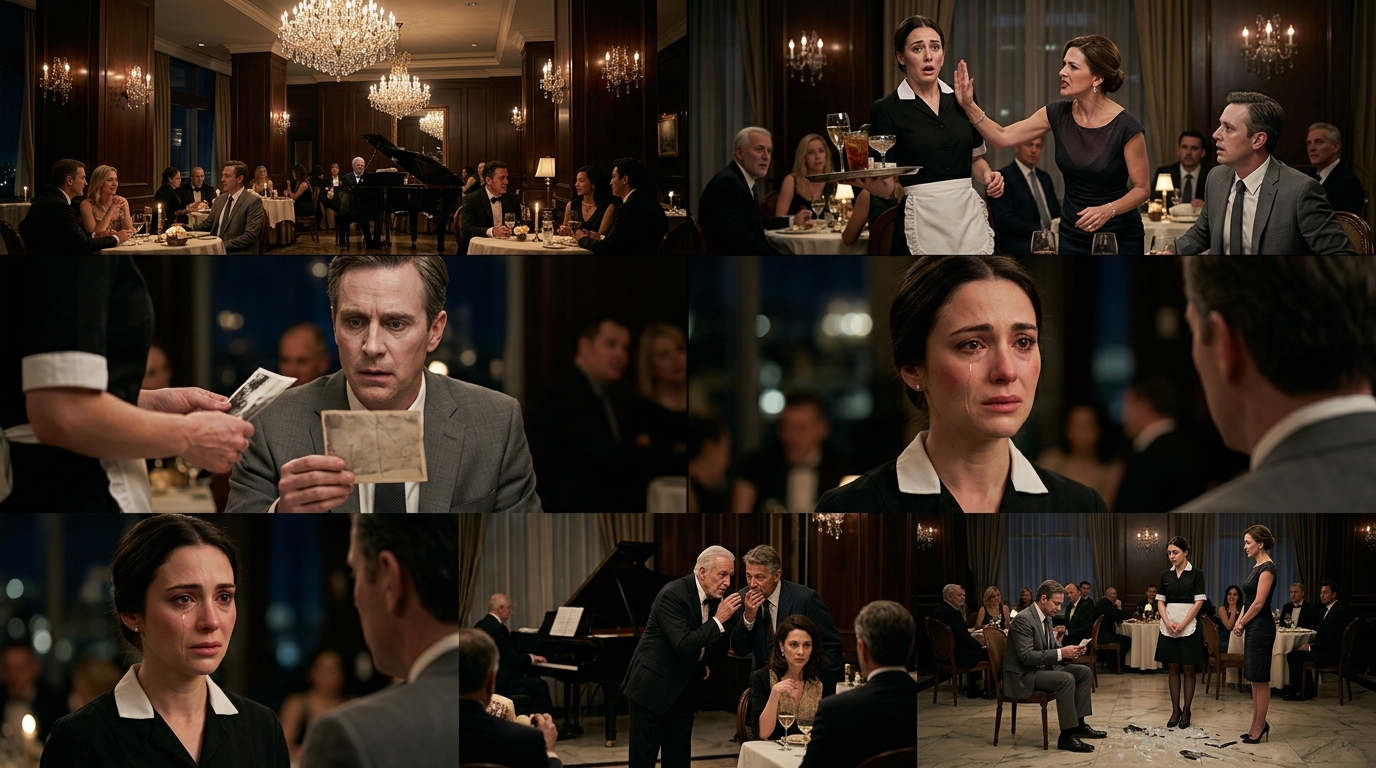
Crystal chandeliers hung over white linen tables. Soft piano music drifted across the room. Silverware clicked gently against porcelain. Waiters moved with practiced silence, appearing only when needed, disappearing before anyone could feel disturbed.
It was the kind of place where people lowered their voices not because they were polite, but because wealth had trained them to make cruelty sound elegant.
I knew that world well.
My name was Julian Ashford, and for twenty-two years, I had been one of the men everyone in that room wanted to know. Founder of Ashford Maritime. Donor to hospitals. Patron of the arts. Widower, once. Remarried, eventually. A man who had survived tragedy and rebuilt himself into something polished enough to admire from a distance.
At least, that was the story people liked.
My second wife, Claudia, sat across from me in a cream silk dress, her diamonds cold against her throat. She was beautiful in the precise, expensive way that made strangers assume she had never lost control of anything in her life.
Then she lost control in front of everyone.
A waitress brushed past our table carrying a tray of wineglasses.
Claudia stood so fast her chair nearly tipped backward.
The slap cracked across the room.
Sharp.
Freezing.
Final.
The waitress stumbled. Her tray crashed to the marble floor. Wine splashed across the white tiles like blood diluted by water.
No one moved.
Not the maître d’.
Not the pianist.
Not even me.
Claudia leaned close to the young woman, her face twisted with something far darker than jealousy.
“Stay away from my husband.”
The waitress held one trembling hand to her cheek.
She could not have been more than twenty-two.
Maybe twenty-three.
Dark hair pinned poorly at the back of her neck. Uniform slightly too large. Eyes wide with humiliation and pain.
But she did not cry immediately.
She looked at me.
Not at Claudia.
At me.
Then slowly, with shaking fingers, she reached into the pocket of her apron.
“I didn’t come for him,” she said.
Her voice broke.
“I came to give him something.”
The room seemed to stop breathing.
She pulled out a photograph.
Small.
Tattered.
Bent at the corners.
I took it before Claudia could snatch it away.
And the moment I saw what was in that picture, every sound in the restaurant vanished.
A baby.
Wrapped in a pale blue blanket.
The same blanket I had buried with my own hands.
The same blanket I had kissed before they lowered the tiny white coffin into the ground.
The blanket that should have been rotting beneath a marble angel in St. Agnes Cemetery.
My daughter’s blanket.
The pianist stood abruptly, knocking over his bench.
His face had turned gray.
“I remember that night,” he whispered.
And when the waitress looked at me again, tears finally spilling down her face, I saw what everyone else in the room saw a second later.
Her eyes.
Her mouth.
The shape of her face.
Elena’s face.
My first wife’s face.
The wife everyone told me had died after losing our child.
The waitress took one step closer.
“My mother told me,” she said, voice shaking, “if you ever tried to forget us…”
She swallowed hard.
“I had to bring you the truth.”
Claudia whispered behind me, almost too softly to hear.
“That’s impossible.”
But the waitress did not look at her.
She only looked at me.
“I didn’t come here for answers,” she said.
Her voice dropped.
“I came for what you took from us.”
The Photograph That Should Have Been Buried
I had forgotten how cold grief could make a room.
Not quiet.
Cold.
The kind of cold that moves through people before they understand why they are afraid.
The restaurant had become a theater of frozen faces. Wealthy diners sat motionless over their untouched meals. A waiter crouched near the broken glass but did not pick it up. Claudia stood beside our table with one hand pressed against her chest, as though the waitress had struck her instead.
I could not stop looking at the photograph.
The blanket had been handmade by Elena’s mother before she died. Pale blue wool. White stitched edges. A tiny silver moon embroidered in one corner.
There was no mistake.
No coincidence.
No imitation.
I had held that blanket the night my daughter was declared dead.
I had carried it to the cemetery.
I had placed it inside the coffin myself.
At least, I thought I had.
“What is your name?” I asked.
The waitress’ lips parted, but no sound came out at first.
Then she said, “Mara.”
Something inside me cracked.
Elena had wanted to name our daughter Mara.
Not after anyone. Not after tradition. She said the name sounded like the sea at night.
Claudia laughed once.
Too loudly.
“This is disgusting,” she said. “Julian, you cannot possibly be entertaining this. She is clearly trying to extort you.”
Mara flinched at the word extort.
The pianist moved then.
His name was Victor Bell. I knew him only vaguely. He had played private events for the Ashford family for years, long before Claudia entered my life. He was old now, thinner than I remembered, with silver hair and trembling hands.
He stepped away from the piano and stared at Mara as if he were seeing a ghost.
“You were at Mercy Vale,” he said.
Mara turned toward him.
The name hit me like a hand closing around my throat.
Mercy Vale Women’s Hospital.
The place where Elena gave birth.
The place where everything ended.
Victor gripped the edge of a nearby chair to steady himself.
“I played there that night,” he said. “For the Ashford donor gala. Your wife had gone into emergency labor upstairs. Everyone was whispering about it.”
My mind dragged me backward twenty-two years.
The gala.
The storm.
The rushed phone call.
Elena screaming my name as nurses pushed her down the corridor.
Then hours of white walls, sedatives, doctors with careful eyes, Claudia standing beside me as a family friend, telling me to sit, telling me to breathe, telling me Elena was unstable and needed rest.
Claudia had been there.
Of course she had been there.
She had been my late father’s legal advisor then. Brilliant. Loyal. Efficient. The woman trusted with Ashford family matters because she knew how to make problems disappear.
Mara reached into her apron again.
This time, Claudia moved.
Fast.
Her hand shot forward, but I caught her wrist before she reached the girl.
For the first time in our marriage, Claudia looked afraid of me.
Mara pulled out a folded hospital wristband.
Old plastic.
Yellowed.
Cracked with age.
Baby Girl Ashford.
My vision blurred.
I heard someone gasp.
Maybe it was me.
Mara placed the wristband on the table beside the photograph.
“My mother kept it hidden behind a loose brick in every place we lived,” she said. “She told me if anything ever happened to her, I had to find you.”
“If anything happened to her?” I repeated.
My voice sounded like it belonged to another man.
Mara looked down.
“She died three weeks ago.”
The words were quiet.
But they tore through me with more force than Claudia’s slap ever could.
Elena.
Alive all those years.
Dead three weeks.
I had spent twenty-two years mourning a woman who had been breathing somewhere without me.
“Where?” I asked.
Mara’s face tightened.
“In a motel outside Bridgeport. Under another name.”
Claudia’s wrist stiffened in my grip.
Another name.
The room tilted slightly.
Victor whispered, “No…”
I turned to him.
“What do you know?”
Victor did not answer immediately. His eyes moved from me to Claudia, then back to Mara.
“I saw Elena after they told everyone she died,” he said.
Claudia’s face went completely still.
The old pianist swallowed.
“She was alive when they took her through the service corridor.”
Before I could speak, before Mara could move, before the restaurant could absorb the horror of what he had just said, Claudia leaned toward me and whispered six words that made the entire night change shape.
“Julian, you signed the order.”
The Hospital Where Death Was Manufactured
I let go of Claudia’s wrist.
Not because I believed her.
Because suddenly I was afraid I might break it.
“What order?” I asked.
She smoothed the front of her dress as if restoring fabric could restore control.
Her voice lowered into the tone she used in board meetings, charity negotiations, and legal threats.
“You were grieving. You don’t remember everything clearly.”
Mara stared at me.
The room was watching again, but differently now. Earlier, they had watched for scandal. Now they watched for damage.
Claudia turned slightly toward the crowd.
“My husband suffered a devastating psychological collapse that night,” she said, each word carefully chosen. “His wife died after childbirth. His child died minutes later. This young woman has obviously been manipulated into exploiting that trauma.”
Mara’s face crumpled.
“She wasn’t dead.”
Claudia ignored her.
“Julian, sit down.”
I did not sit.
Victor took another step forward.
“She’s lying,” he said.
Claudia’s eyes snapped to him.
The look she gave him was not anger.
It was recognition.
And warning.
Victor’s voice shook, but he continued.
“I saw Dr. Harlan Vale sign two death certificates that night. One for the child. One for Elena. But then I saw Elena breathing. She was strapped to a gurney. There was a woman walking beside her.”
His gaze shifted to Claudia.
“You.”
A low sound moved through the restaurant.
Claudia’s mask cracked for half a second.
Then she smiled.
Poor Victor looked smaller under that smile.
“An elderly pianist with a drinking problem remembers something from twenty-two years ago,” she said. “How convenient.”
Victor flinched.
Mara stepped toward him.
“He told my mother,” she said.
Everyone looked at her.
She lifted her chin, tears still shining on her face.
“My mother said there was a man who saw them take her. A musician. She said he tried to help but they threatened him.”
Victor closed his eyes.
“I had a son,” he whispered. “Claudia knew. She said if I spoke, my son would be charged for drugs they found in his car.”
His voice broke.
“They were planted. I knew they were planted. But he was seventeen. I was scared.”
Claudia’s lips thinned.
For the first time, I saw the woman beneath my wife.
Not the hostess.
Not the philanthropist.
Not the elegant partner who stood beside me at hospital wings and museum openings.
The architect.
The one who did not create lies in panic, but in layers.
I looked at Mara.
“Do you have anything else?”
She hesitated.
Then she reached into the back of her apron and pulled out a small envelope sealed in plastic.
“My mother said not to open this unless I was standing in front of you.”
My fingers shook as I took it.
Inside was a keycard.
Old.
Mercy Vale Women’s Hospital.
Archive Access.
A number was written on the back.
B-19.
Claudia’s face changed.
Not much.
Just enough.
I knew then that the keycard was real.
I turned to the maître d’.
“Call the police.”
Claudia laughed softly.
“No police officer in this city will touch this without a warrant.”
“She’s right,” someone said.
A man rose from the back of the restaurant.
He had been sitting alone near the wine wall, unnoticed until that moment. Gray suit. Dark tie. Calm face.
He reached into his jacket and unfolded a badge.
“Federal Bureau of Investigation.”
The restaurant went silent again.
Claudia stopped smiling.
The man’s eyes settled on her.
“My name is Agent Daniel Cross. Mrs. Ashford, we’ve been waiting for someone to bring us B-19 for a long time.”
Mara covered her mouth.
Victor sank into a chair.
I stared at the badge, unable to understand how the ground beneath my life could keep opening.
Agent Cross stepped closer.
“Mr. Ashford,” he said, “your first wife was not the only woman declared dead at Mercy Vale.”
My breath caught.
Claudia took one step backward.
And for the first time since I had known her, she looked toward the exit before she looked at me.
The Basement Archive
We did not go home.
We went to Mercy Vale.
The hospital had been closed for six years, its license revoked after a malpractice scandal that, according to the newspapers, had nothing to do with my family. I had donated millions to help build its replacement wing across town. I had stood at a podium and spoken about healing, trust, and the sacred bond between medicine and community.
Now I stood outside the abandoned original building, staring at broken windows and rusted gates, understanding that I had funded the cover-up of my own life.
Agent Cross brought two other agents.
Mara came with us because she refused to leave the photograph.
Victor came because guilt had finally become heavier than fear.
Claudia came in handcuffs.
She had tried to walk out of the restaurant while everyone was distracted by Agent Cross. She made it six steps before two federal agents entered through the front doors.
She did not scream.
That frightened me more.
She simply held out her wrists and looked at me with calm contempt.
“You have no idea what you’re opening.”
The basement entrance was behind the old maternity wing.
A federal lock team cut through the chained doors. The smell that came out was dust, damp concrete, and old antiseptic.
Mara stood beside me at the top of the stairs.
Under the harsh beam of an agent’s flashlight, I could see Elena in her face more clearly than ever.
The same stubborn mouth.
The same dark lashes.
The same way she tried to look brave when her hands were shaking.
“I didn’t know,” I said.
The words were useless.
Cowardly, even.
But they were all I had.
Mara did not look at me.
“She said you would say that.”
I deserved that.
Every step down into the basement felt like a descent into a grave I had been visiting from the wrong side.
B-19 was a storage room behind two locked doors.
The keycard worked.
Even after twenty-two years.
Inside were metal shelves stacked with sealed boxes. Most had numbers instead of names. Some had dates. Some had hospital codes. A few had red stickers marked transferred.
Agent Cross moved with grim familiarity.
“We’ve suspected a private infant transfer operation for years,” he said. “We could never prove Mercy Vale was the origin point.”
“Infant transfer?” I repeated.
He looked at me.
“Stolen babies, Mr. Ashford.”
The words entered me slowly.
Like poison.
“Declared dead,” he continued. “Moved through falsified medical records. Sold into private adoption networks or used in inheritance schemes.”
Mara whispered, “Sold?”
Claudia finally spoke from behind us.
“Spare everyone the moral performance. Half those children went to better homes than the mothers could provide.”
Agent Cross turned sharply.
“That sounds like a confession.”
“It sounds like the truth,” Claudia replied.
I looked at her.
“You did this to Elena.”
She tilted her head slightly.
“Elena was inconvenient.”
A sound came from my chest.
Not a word.
Something broken.
Mara moved toward Claudia, but Victor caught her gently by the shoulder.
Agent Cross opened the box marked Ashford, Julian and Elena.
Inside was my life.
The real one.
Hospital charts.
Sedation logs.
A forged psychiatric evaluation declaring Elena a danger to herself and her newborn.
A transfer authorization bearing my signature.
Fake.
Perfect.
A death certificate for my daughter.
A death certificate for Elena.
Both signed by Dr. Harlan Vale.
Both witnessed by Claudia Mercer.
Mercer.
Claudia’s maiden name.
I picked up the transfer authorization.
My forged signature stared back at me like an accusation.
“Why?” I asked.
Claudia sighed.
“Because your father was going to leave Elena controlling interest.”
The room went still.
“What?”
She smiled faintly.
“Your father adored her. He thought she gave you a spine. Before he died, he amended the trust. If Elena gave birth to a living Ashford heir, she would control forty percent of the family voting shares until the child turned twenty-five.”
I remembered my father arguing with Claudia weeks before the birth.
I remembered Elena crying afterward.
I remembered Claudia telling me pregnancy made women emotional.
Claudia looked at Mara.
“Your existence was worth billions.”
Mara went pale.
My daughter had not been stolen because she was unwanted.
She had been stolen because she was too valuable.
Claudia continued, almost bored now.
“Elena refused to sign the postnup. She refused to surrender custody. She threatened to expose irregularities she found in the foundation accounts. So Dr. Vale helped us solve three problems at once.”
“Us?” I said.
Claudia did not answer.
Agent Cross did.
“Your father’s board.”
I turned slowly.
He held up another file.
Ashford Maritime Emergency Succession Committee.
The names blurred as I read them.
Men I had called mentors.
Godfathers.
Family friends.
Men who stood beside me at the funeral.
Men who had placed hands on my shoulder while I wept beside an empty grave.
Victor whispered a prayer.
Mara was crying silently now.
I reached the bottom of the box.
There, beneath the paperwork, was a cassette tape.
A label had been written in Elena’s handwriting.
For Julian, if our daughter finds him.
My hands nearly failed me.
Agent Cross found an old recorder in another evidence kit. It took two tries before the tape began to play.
Elena’s voice filled the basement.
Weak.
Breathless.
Alive.
“Julian, if you are hearing this, they made you believe we died.”
Mara covered her mouth.
I closed my eyes.
Elena continued.
“I tried to get back to you. Claudia told them you signed the order. She told me you chose the company over us. I don’t know if that’s true. I don’t want to believe it.”
Her voice cracked.
“Our baby is alive. Her name is Mara. I will keep her alive as long as I can. If she finds you one day, don’t waste time hating me. Don’t waste time hating yourself.”
A pause.
Then the sentence that broke whatever was left of me.
“Look for the second grave.”
The tape clicked off.
For several seconds, no one spoke.
Then Agent Cross turned toward Claudia.
“What second grave?”
Claudia stared at the floor.
And smiled.
The Second Grave
We went to St. Agnes Cemetery at dawn.
I had not visited in three years.
Not because I had stopped grieving. Because grief had become ceremonial. I sent flowers through an assistant. White roses on Elena’s birthday. Lilies on the anniversary of the baby’s death. A wreath at Christmas. Paid devotion delivered on schedule.
Now I stood before the marble angel I had once chosen while sedated by sorrow and surrounded by liars.
Beloved Wife.
Beloved Daughter.
Forever in God’s Arms.
Mara stood beside me, shivering in Victor’s borrowed coat.
Claudia stood between two agents, handcuffed, silent.
A forensic team had already sealed the area. The cemetery caretaker, pale and sweating, kept insisting he had only followed paperwork.
Everyone followed paperwork.
That was how monsters survived.
Agent Cross gave the order.
They opened the grave.
I expected the worst.
Bones.
Proof.
Some final cruelty.
But when they lifted the small coffin first, the one meant for my infant daughter, it felt too light.
A technician opened it under a white tent.
Inside was the blue blanket.
Folded perfectly.
No body.
No remains.
Just sandbags and a hospital tag.
Mara made a small sound beside me.
I reached for her hand.
She let me take it.
Then they opened Elena’s coffin.
For the first time all night, Claudia looked away.
Inside was a woman.
But not Elena.
Even after twenty-two years, even through decay and forensic caution, the truth was immediate.
The height was wrong.
The dental structure was wrong.
Agent Cross looked at Claudia.
“Who is she?”
Claudia said nothing.
Victor began shaking.
“I know her,” he whispered.
Everyone turned.
He stared into the open grave as if the dead had reached up and taken his breath.
“Her name was Celia Bell.”
Agent Cross frowned.
“Bell?”
Victor’s knees almost gave out.
“My wife.”
The cemetery went silent except for the wind moving through the trees.
Victor had told us he had been threatened through his son.
He had not told us his wife disappeared that same year.
Maybe he had not known how.
Maybe none of us ever really know the shape of the trap until we see who else was buried inside it.
Claudia finally spoke.
“She asked questions.”
Victor turned toward her slowly.
His face no longer looked old.
It looked emptied.
“You put my wife in Elena’s grave?”
Claudia’s expression did not change.
“Dr. Vale needed a body.”
Mara stepped back as if the words had physically struck her.
I thought I had reached the bottom of horror in the basement archive.
I was wrong.
There is always a lower room.
Agent Cross ordered Claudia taken away before Victor could reach her. She walked past me with the same elegance she had worn into the restaurant, but her eyes were different now.
Not defeated.
Calculating.
As she passed, she leaned close enough that only I heard her.
“You still don’t know who signed the final transfer.”
Then she was gone.
The trials took nearly two years.
Dr. Harlan Vale died before sentencing, either from a heart attack or cowardice, depending on whom you asked.
Claudia was convicted on charges that filled three pages. Kidnapping. Fraud. Conspiracy. Evidence tampering. Murder in connection with Celia Bell’s death. She received life without parole.
Six former Ashford board members went to prison.
Two died before trial.
One vanished and was later found in Portugal under a false name, because men who build cages always keep one door for themselves.
The company nearly collapsed.
I let it.
Then I rebuilt what remained under Mara’s name.
Not because money could repair anything.
Because power had been the weapon used against her before she was old enough to cry, and I wanted every surviving piece of it turned back toward the truth.
Mara did not call me Dad at first.
I did not ask her to.
She had a mother.
Elena.
A mother who had run, hidden, starved, lied when needed, begged when forced, and survived long enough to send our daughter into a restaurant with a photograph and a sentence sharp enough to cut through twenty-two years of silence.
Mara moved into the guest house first.
Then the east wing.
Then, one rainy evening, she came downstairs barefoot, wearing one of my old sweaters, and asked if I wanted tea.
That was how healing began.
Not with forgiveness.
With tea.
Victor came often. He played piano again, but only when he wanted to. Sometimes Mara sat beside him and listened. Sometimes he cried halfway through a song and apologized to no one in particular.
We buried Celia properly.
We buried the empty coffins too, in a way.
There was no ceremony for lies, but there was a day when Mara and I stood at St. Agnes and removed the old inscription.
Beloved Wife.
Beloved Daughter.
Forever in God’s Arms.
In its place, we placed two simple stones.
Elena Ashford.
Mother. Protector. Truth Keeper.
And beside it:
For the child they tried to erase, who came home carrying proof.
Mara chose that line.
On the anniversary of the night at the restaurant, she asked to go back.
The place had changed owners. The chandeliers were gone. The piano remained.
We sat at a quiet table near the back.
No Claudia.
No flashing cameras.
No crystal performance of wealth.
Just us.
Mara placed the old photograph between us.
The baby in the blue blanket.
The lie that had started everything.
“I hated you,” she said.
I nodded.
“You should have.”
She looked at me carefully.
“I don’t know what I feel now.”
“That’s alright.”
Her eyes filled, but she did not look away.
“Elena said you had kind hands.”
The words nearly undid me.
I looked down at my hands.
The hands that had held an empty coffin.
The hands that had signed business deals with monsters.
The hands that had failed to protect a wife and child because I trusted the wrong people in expensive rooms.
Mara reached across the table.
Slowly.
Not fully.
Just enough.
I met her halfway.
For a moment, neither of us spoke.
Then the pianist began to play.
Not Victor this time.
A young woman.
Soft notes moved through the restaurant, gentle and uneven, like someone learning how to make beauty without pretending pain had never existed.
Mara looked toward the sound.
Then back at me.
“She didn’t send me there for revenge,” she said quietly.
I waited.
“She sent me there so someone would finally remember us.”
Outside, rain touched the windows.
Inside, my daughter held my hand for the first time without trembling.
And I understood then that truth does not bring back the years.
It does not return the dead.
It does not make a stolen childhood whole.
But sometimes, if it is carried by the right hands, through the right door, at the exact moment a lie believes itself untouchable—
Truth can still walk into a glittering room in a waitress uniform.
Truth can stand with a burning cheek and shaking hands.
Truth can hold up an old photograph.
And truth can say:
I came for what you took from us.