The Coffee Wasn’t an Accident
The coffee cup angled deliberately.
Everyone close enough to see it knew.
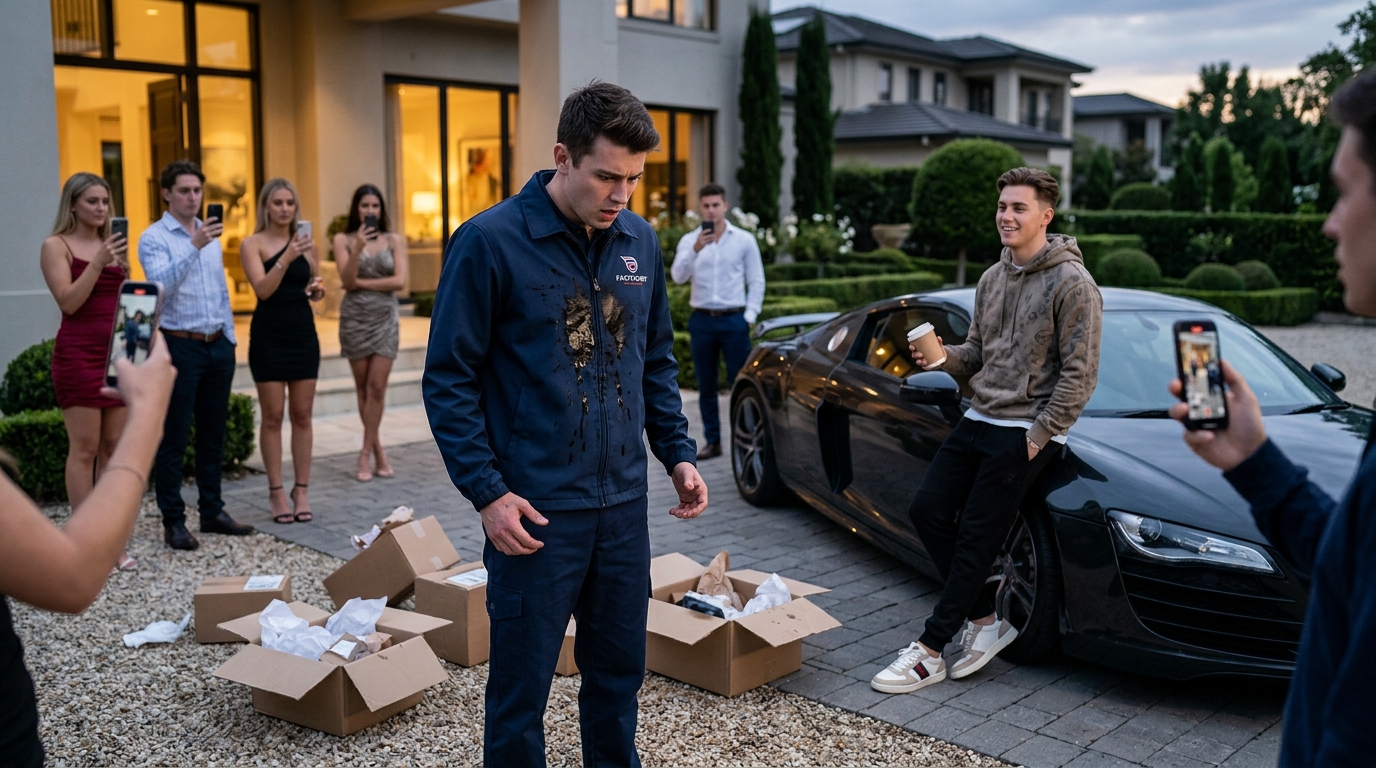
The young man in the cream designer jacket tilted his wrist just slightly as the delivery guy stepped past the fountain, and the hot coffee spilled across the courier’s chest in a brown splash that soaked straight through the cheap blue uniform.
“Watch where you’re going, idiot,” the rich kid said.
Then he laughed.
The driveway of the Whitmore estate glittered beneath strings of warm outdoor lights. Luxury cars lined the curved stone path. Waiters moved through the garden with silver trays. Women in evening gowns stood beneath white canopies, sipping champagne while men in tailored jackets discussed money loudly enough for everyone else to know they had it.
A private dinner party was underway.
The kind where every guest arrived believing the night existed for people like them.
The delivery guy stood near the entrance, frozen.
His hands trembled.
Not from the coffee.
From the eyes.
Phones came out immediately.
Someone shouted, “Bro, that’s a limited jacket! You ruined it yourself!”
Laughter scattered through the driveway.
The rich kid smiled wider.
His name was Preston Whitmore.
Twenty-three years old.
Only son of Charles Whitmore, founder of Whitmore Capital Group.
Preston was the kind of man born into rooms where every mistake was renamed youth, every cruelty called confidence, and every consequence quietly paid away before morning.
He looked at the brown stain spreading across the courier’s uniform.
“Relax,” Preston said. “You people are used to being wet.”
A few guests laughed again.
The courier looked down at his shirt.
Then at the packages stacked beside the driveway.
Six boxes.
Carefully labeled.
Fragile.
Priority.
Signature required.
Preston followed his gaze.
Something cruel moved behind his eyes.
“Oh no,” he said lazily. “My tires.”
The engine of his black sports car roared to life.
The crowd turned.
The courier’s face changed.
“Don’t.”
Preston smirked through the open window.
“Don’t what?”
The car rolled forward.
Slow.
Deliberate.
The first tire crushed the nearest box.
Cardboard split open.
The second box cracked under the weight.
Then the third.
White packing material burst across the stone driveway like snow.
Someone gasped.
Someone else laughed.
Preston drove over all six packages before stopping near the fountain.
He stepped out, lifted both hands, and called to the party:
“Relax. It’s just a courier. They’re used to it.”
The laughter came again.
But weaker this time.
Because the delivery guy did not shout.
He did not rush toward the car.
He did not plead about lost wages or damaged goods.
He simply lifted his gaze.
Very calmly, he asked:
“Are you done?”
The crowd quieted.
Preston frowned.
“What?”
The courier reached for the zipper of his stained uniform.
Slowly, he pulled it down.
Then he removed the blue jacket entirely and let it fall onto the crushed cardboard at his feet.
Beneath it was a tailored white shirt.
Not expensive in a loud way.
Expensive in the way only people who never check tags recognize.
A steel watch caught the driveway lights.
Several guests noticed at once.
Their expressions shifted.
The courier wiped coffee from his sleeve with a napkin someone had dropped earlier.
Then he looked directly at Preston.
“I just wanted to experience the ground level.”
Silence spread across the driveway.
Preston gave a sharp, uncertain laugh.
“What is that supposed to mean?”
The man’s voice stayed quiet.
“It means I wanted to see how your family treats people when nobody important is watching.”
A guest near the fountain lowered her phone.
Another whispered, “Who is he?”
The man stepped over the crushed packages and picked up one broken box.
Inside, beneath the torn cardboard, was a black hard drive case.
Undamaged.
He smiled faintly.
Then came the line that shattered the night.
“By tomorrow morning, every bank account connected to your family will be frozen.”
Someone chuckled nervously.
Preston lifted his chin.
“That’s funny. Do you even know who my father is?”
The former courier smiled for the first time.
“That’s exactly why this will be fast.”
No one laughed after that.
The Man Beneath the Uniform
His name was Adrian Cole.
Not that anyone at the party knew it yet.
To them, he had arrived as a delivery driver from a logistics company hired to bring final documents, wine shipments, and auction materials for the Whitmore Foundation’s annual donor dinner.
He looked forgettable on purpose.
Blue courier uniform.
Baseball cap.
Cheap shoes.
A clipboard.
A tired expression.
The kind of man people looked through because the room had trained them to consider service workers part of the furniture.
That was exactly why Adrian had worn it.
For six months, he had been investigating Whitmore Capital Group.
Not from outside.
From above.
Adrian was the newly appointed interim chairman of Northbridge Trust, the private holding company that owned a silent but controlling position in several Whitmore entities.
The appointment had been quiet.
No press release.
No gala introduction.
No glossy magazine profile.
The old chairman, Adrian’s grandfather, had died unexpectedly and left him not only control of Northbridge, but also a warning.
If you want to know what a family does with money, don’t attend their board meeting first. Watch how their children treat the person carrying boxes.
Adrian had thought it sounded dramatic.
Then he read the files.
Whitmore Capital had grown too fast.
Too many delayed vendor payments.
Too many shell contracts.
Too many employee pension transfers moved through “temporary liquidity structures.”
Too many charitable donations routed through companies owned by friends of Charles Whitmore.
On paper, everything looked polished.
In public, Charles Whitmore was a philanthropist.
He funded hospitals.
Sponsored youth programs.
Hosted scholarship dinners.
Spoke movingly about opportunity.
But beneath the language, money kept disappearing from people who could not fight back.
Small contractors.
Warehouse workers.
Retired employees.
Delivery firms.
Maintenance crews.
Temp staff.
People beneath the marble line.
Adrian wanted proof of culture, not just numbers.
So he created a test.
The six delivery boxes were not random.
Three contained harmless decoys.
Two contained tracking devices and hardened drives.
One contained physical copies of documents Preston’s father believed had been destroyed: internal memos, bank routing confirmations, and a letter authorizing the freezing of suspicious accounts if Whitmore executives interfered with evidence transfer.
The packages were scheduled to be delivered to the estate during the dinner because Charles Whitmore had insisted the foundation documents arrive before the donor announcements.
Adrian volunteered to deliver them himself.
His legal team hated the idea.
His security chief called it unnecessary.
His CFO called it theatrical.
Adrian called it useful.
Because if the family treated the lowest person in the driveway with respect, he would know there was at least one part of the empire not entirely rotten.
But Preston spilled coffee on him.
Then ran over the boxes.
Then laughed.
And in doing so, he did something worse than humiliate a courier.
He destroyed secured compliance materials in front of sixty witnesses and twenty recording phones.
He turned arrogance into evidence.
The Father at the Door
The front doors of the mansion opened.
Charles Whitmore stepped out.
He was tall, silver-haired, perfectly dressed, and calm in the way powerful men appear calm only when other people are afraid for them.
“Preston,” he said sharply.
His son turned.
“Dad, this guy is pretending—”
Then Charles saw Adrian’s face.
The color drained from him.
Not completely.
Men like Charles were too trained for complete collapse.
But enough.
Adrian noticed.
So did the guests.
Charles walked down the steps slowly.
“Mr. Cole,” he said.
The name moved through the driveway like a match dropped in dry grass.
“Cole?” someone whispered.
“Northbridge Cole?”
Preston’s smirk disappeared.
Adrian looked at him.
“Yes,” he said. “Now you’re catching up.”
Preston glanced between his father and the man he had soaked in coffee.
“Dad?”
Charles ignored him.
His eyes were on the crushed boxes.
“What is this?”
Adrian lifted the broken hard drive case.
“This was your last chance to cooperate quietly.”
Charles’s jaw tightened.
“You arrived dressed as a courier.”
“I arrived dressed as someone your family thought it could mistreat without consequence.”
“That is not how serious business is conducted.”
“No,” Adrian said. “Serious business usually happens in conference rooms where men like you lie better.”
A murmur moved through the crowd.
Charles stepped closer, lowering his voice.
“Careful.”
Adrian smiled faintly.
“You should have said that to your son before he drove over federally preserved documents.”
Charles froze.
Preston whispered, “Federally what?”
Adrian reached into his shirt pocket and removed his phone.
“You damaged evidence under litigation hold. You interfered with a protected compliance transfer. You did it on camera. And then you told sixty witnesses it didn’t matter because it was ‘just a courier.’”
Preston’s mouth opened.
No words came.
Charles’s eyes sharpened.
“What do you want?”
That was the first honest sentence he had spoken.
Adrian stepped closer.
“I wanted to know whether the rot reached your front door.”
He looked at Preston.
“It did.”
Then he pressed one button on his phone.
Across the driveway, three black SUVs turned on their headlights.
They had been parked in the dark beyond the gate the entire time.
Men and women in dark suits stepped out.
Not security.
Investigators.
Attorneys.
Regulatory observers.
Charles recognized one of them immediately.
Evelyn Price.
Federal financial crimes liaison.
His face changed again.
This time, the guests saw it clearly.
Fear.
The Packages Preston Crushed
The first box contained the employee pension ledger.
Printed.
Signed.
Stamped.
Physical proof that funds intended for long-term worker retirement accounts had been temporarily rerouted into Whitmore liquidity pools to cover private debt exposure.
The second contained vendor payment records.
Small companies owed for months while Whitmore executives publicly claimed all accounts were current.
One of those vendors had already filed for bankruptcy.
Another was a family-owned transport company whose owner suffered a heart attack after losing his contract.
The third box contained charitable foundation documents.
Money raised for children’s medical programs had been “reallocated” through consulting fees.
Those consulting firms belonged to friends, relatives, and political allies.
The fourth contained encrypted copies.
The fifth contained a tracking device.
The sixth contained the board authorization letter that Charles Whitmore had tried to block in court two days earlier.
Preston had crushed all six.
But the drives were protected.
And the cameras were rolling.
Evelyn Price approached the driveway, her heels clicking against stone.
She looked at the destroyed packages.
Then at Preston.
Then at Adrian’s coffee-stained shirt.
“Eventful evening?”
Adrian handed her the hard case.
“Productive.”
Charles lifted both hands slightly.
“Evelyn, surely this can be handled privately.”
She looked at him.
“That sentence has protected you for a long time, hasn’t it?”
No one spoke.
Preston tried to step back toward the mansion.
One of the investigators blocked him.
“Sir, stay where you are.”
Preston’s face flushed.
“Do you know who I am?”
Adrian looked at him.
“You asked me that already.”
Evelyn opened a folder.
“Charles Whitmore, effective immediately, emergency preservation orders are in place across all domestic accounts connected to Whitmore Capital Group, Whitmore Foundation, and related family-controlled entities pending review.”
A woman near the steps gasped.
Charles’s voice lowered.
“You cannot freeze operating accounts during an active donor event.”
Evelyn’s expression did not change.
“We can when there is probable evidence of asset flight, destruction of protected materials, and witness intimidation.”
“I did not intimidate anyone.”
Adrian looked toward the staff gathered silently near the side entrance.
A young waitress was crying.
An older driver stared at the ground.
Two catering workers stood rigid, as if waiting to be blamed for hearing too much.
Adrian turned back to Charles.
“You built a house where everyone beneath you is afraid to speak.”
Then he looked at Preston.
“And you raised a son who thought that meant they had nothing to say.”
The Driver Who Finally Spoke
The first witness was not a banker.
Not a lawyer.
Not a guest.
It was the Whitmore family driver.
His name was Luis Alvarez.
He had worked for Charles for eleven years.
Most guests knew him only as the man who opened doors, carried luggage, and waited in silence while the family finished dinners that ran three hours late.
When Evelyn asked whether anyone had seen the packages arrive intact, Luis stepped forward.
Charles turned sharply.
“Luis.”
One word.
A warning.
Luis stopped.
For a moment, the old fear returned to his face.
Then he looked at the crushed boxes.
At Adrian’s stained shirt.
At Preston, still flushed with anger.
And something in him seemed to settle.
“Yes,” Luis said. “I saw them.”
The driveway became silent.
Evelyn turned to him.
“Please continue.”
Luis swallowed.
“The courier brought them carefully. Mr. Preston spilled coffee on him first. On purpose.”
Preston snapped, “You don’t know that.”
Luis looked at him.
“I parked your car, sir. I know how you hold things when you want them to fall.”
A few guests inhaled sharply.
Luis continued.
“Then Mr. Preston got in the car and drove over the boxes. Slowly.”
Charles’s face hardened.
“Luis, remember your position.”
Luis turned to him.
“I do.”
His voice shook now.
“But tonight, maybe you should remember yours.”
That was the moment the staff changed.
One by one, people stepped forward.
A caterer said Preston had shoved a busboy into the pool last summer and paid him five hundred dollars not to complain.
A housekeeper said Charles’s office had burned documents the night after the pension inquiry began.
A former assistant, attending as a guest only because she had married a donor, said she had emails proving foundation funds were misclassified.
The room broke open.
Not loudly.
Not all at once.
But like a wall cracking under pressure it had held for years.
Charles looked at Adrian with pure hatred.
“You planned this.”
Adrian shook his head.
“No. I gave you an opportunity.”
He looked around the driveway.
“You chose the rest.”
The Morning After
By morning, the Whitmore accounts were frozen.
Not all money.
Not personal grocery money.
Not payroll needed to keep innocent workers from being hurt.
Evelyn was careful about that.
But the family’s discretionary accounts, investment vehicles, foundation transfers, and several offshore-linked structures were locked pending review.
The news broke before sunrise.
Billionaire Family Under Investigation After Evidence Destroyed at Private Dinner.
Whitmore Capital Faces Federal Review.
Courier Humiliation Video Goes Viral—Then “Delivery Man” Revealed as Holding Company Chairman.
The video spread fastest.
Preston spilling the coffee.
The laughter.
The car rolling over the boxes.
The courier removing the uniform.
By noon, millions of people had seen his face change when Adrian said:
“That’s exactly why this will be fast.”
Preston’s friends stopped answering.
The guests who laughed hired attorneys.
Charles released a statement calling the incident “an unfortunate misunderstanding involving a private security review.”
Evelyn responded with one sentence:
“The matter is not private.”
That became the headline.
Adrian did not celebrate.
That surprised some people.
They expected revenge to look satisfying.
It did not.
Not to him.
Because by the next afternoon, his office was full of real victims.
A retired warehouse supervisor whose pension payments had been delayed for six months.
A janitorial company owner who nearly lost her home because Whitmore refused to pay invoices.
A children’s clinic director who had never received the full donation promised at last year’s gala.
A delivery company manager who told Adrian that couriers were routinely insulted, delayed, underpaid, and blamed for problems caused by Whitmore staff.
Humiliation was never isolated in houses like that.
It was policy without paperwork.
Adrian sat through every meeting.
No cameras.
No press.
No speeches.
He listened.
Then he paid what could legally be paid immediately through protected restitution accounts.
The rest went through court.
Slowly.
Painfully.
Publicly.
Preston was charged separately for destruction of protected materials and intimidation-related conduct. His lawyers tried to call it youthful impulsiveness.
The judge watched the video.
Then asked, “At what age does a man in a sports car become responsible for knowing boxes are not speed bumps?”
That quote went viral too.
Charles fought harder.
He always had.
But frozen accounts make powerful men discover how many friends were only renting proximity.
The board removed him.
Whitmore Capital entered supervised restructuring.
The foundation was dissolved and rebuilt under independent control.
Luis Alvarez became one of the first employees to testify.
The young waitress who cried in the driveway later told Adrian, “I thought no one would ever believe staff over them.”
Adrian answered, “That’s why I wore the uniform.”
The Uniform in the Frame
One year later, the old Whitmore mansion hosted another dinner.
But this one was different.
No champagne tower.
No influencers.
No velvet rope at the driveway.
The estate had been sold as part of the restructuring and converted into the Whitmore Restitution Center—a place where workers, vendors, and families harmed by financial abuse could receive legal support, emergency grants, and documentation help.
Adrian did not like the name Whitmore remaining on it.
Luis convinced him otherwise.
“Let it mean something better,” he said.
So it stayed.
At the entrance, inside a glass frame, hung the stained blue courier jacket.
Coffee mark still visible.
Beneath it was a small plaque:
Respect is not owed only after power is revealed.
On opening night, Adrian stood near the same driveway where Preston had crushed the boxes.
The stone had been repaired.
The fountain cleaned.
The lights restrung.
But Adrian could still see it.
The coffee.
The laughter.
The packages bursting open.
The moment a crowd had decided a working man’s dignity was disposable.
Luis walked up beside him.
“You look like you’re back there.”
“I am, a little.”
Luis nodded.
“Good. Don’t forget it.”
“I won’t.”
A child ran past carrying a plate of cake.
A real cake this time.
Not decorative.
Not part of a donor display.
Just cake.
For people who had spent too many years being offered apologies instead of payment.
Adrian looked toward the entrance.
The former waitress was there now, greeting guests as director of community intake.
The janitorial company owner had received her overdue payments and a new contract under fair terms.
The retired warehouse supervisor’s pension was restored.
Not everything was fixed.
Some losses were too old.
Some damage too deep.
Some apologies too late.
But the lie had stopped growing.
That mattered.
Near the end of the night, a reporter asked Adrian why he had gone undercover as a courier.
He thought about giving the clean answer.
Operational review.
Ground-level audit.
Evidence transfer.
Instead, he told the truth.
“Because people who abuse power behave differently when they think power isn’t watching.”
The reporter asked, “And what did you learn?”
Adrian looked at the framed uniform.
“That power was watching the whole time. It just wasn’t listening low enough.”
Years later, people still told the story of the rich kid who ran over a delivery guy’s packages and lost his family’s fortune by morning.
They liked the reversal.
The hidden identity.
The bank freeze.
The moment arrogance turned into panic.
But Adrian remembered a different detail most clearly.
Before the coffee.
Before the tires.
Before the threat.
The delivery workers at the service gate had warned him.
“Careful with that house,” one of them said. “They don’t see us as people.”
That sentence had stayed with him.
Because it was the entire case in one line.
Financial fraud was not only numbers moved between accounts.
It was the belief beneath it.
That some people mattered less.
That their wages could wait.
That their pensions could be borrowed.
That their pain could be managed with silence.
That a courier could be soaked in coffee, mocked, and watched by a laughing crowd because no one important had been harmed.
Preston Whitmore’s mistake was not failing to recognize Adrian Cole.
His mistake was believing recognition should matter.
The man in the blue uniform deserved respect before the tailored shirt.
Before the watch.
Before the name.
Before the power.
And by the time the Whitmore family understood that, the boxes were crushed, the cameras were rolling, and every account tied to their arrogance was already on its way to being frozen.