The Bracelet in Her Pocket
The slap echoed louder than the diamonds.
For one frozen second, Maison Laurent fell completely silent.
Not the soft, respectful silence of a luxury jewelry house, where wealthy clients lowered their voices around velvet trays and flawless stones.
This was different.
This was the silence that comes after cruelty enters a beautiful room and everyone waits to see whether power will excuse it.
My cheek burned.
My shoulder hit the glass counter behind me.
A silver tray rattled.
Three diamond rings trembled under the lights.
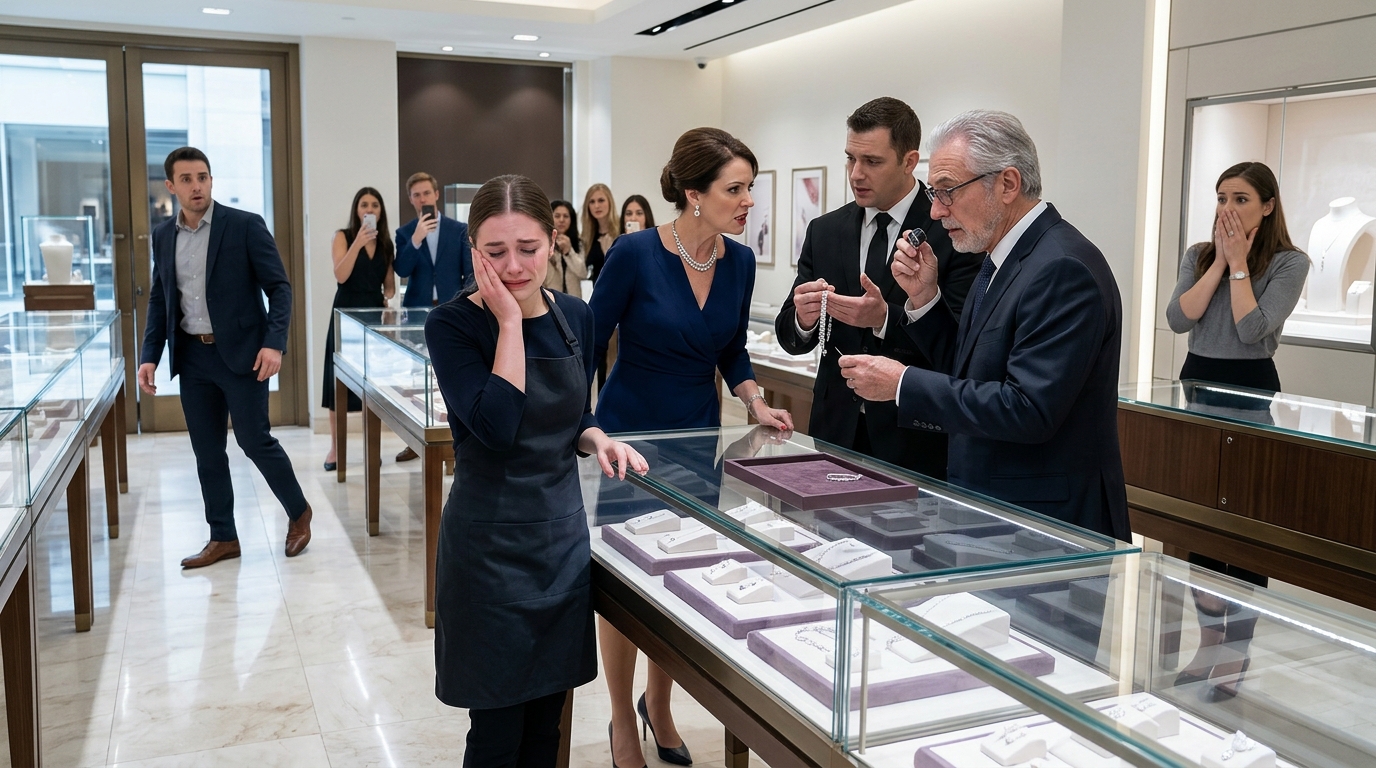
Vivienne Marchand stood in front of me, breathing hard, her emerald silk dress shimmering like something expensive and venomous. Her hand was still half-raised from striking me.
“You stole my bracelet!” she screamed.
Customers turned.
A woman near the bridal display gasped.
A man at the entrance froze with one glove still in his hand.
Phones rose.
Of course they did.
People rarely help first anymore.
They record first, then decide whether the victim deserved it.
My name was Clara Moreau, and I had been working at Maison Laurent for exactly forty-two days. I polished glass, carried trays, opened champagne for brides, and smiled through the kind of remarks wealthy women made when they thought assistants were part of the furniture.
Vivienne had arrived that morning for a private bridal consultation with Julien Laurent, her fiancé and heir to one of the oldest jewelry families in Milan.
She was beautiful in the way sharp things are beautiful.
Perfect hair.
Perfect skin.
Perfect cruelty.
The bracelet she claimed I stole was not even part of the public collection. It had appeared suddenly, brought in by Julien’s mother, Isabelle Laurent, for Vivienne’s “something old” before the wedding.
A diamond bracelet with antique links and a concealed clasp.
The moment I saw it, my body went cold.
But I said nothing.
My mother had taught me when to be silent.
And when not to be.
Vivienne grabbed my wrist.
“Open your pocket.”
“I didn’t take anything,” I whispered.
My voice shook.
I hated that.
I hated giving her the satisfaction of my fear.
She yanked my hair with her other hand and pulled me closer.
“Open it.”
Julien stood near the center display, pale and motionless.
He said her name once.
“Vivienne.”
Not enough to stop her.
Not enough to protect me.
Not enough.
A security guard rushed forward, his face stiff with panic. He did not ask me. He did not ask whether he had permission. He reached into the pocket of my black apron.
His hand came out holding the bracelet.
Gasps broke across the boutique.
Vivienne’s mouth curved into triumph.
“There,” she said. “Trash with quick fingers always thinks silk makes people blind.”
The words struck harder than the slap.
I stared at the bracelet in the guard’s hand.
I had not put it there.
I knew who had.
Across the room, Isabelle Laurent stood beside a pearl display in a pale gray suit, one hand lightly touching her throat. She looked horrified.
Too horrified.
Like a woman performing shock for witnesses.
The guard held up the bracelet.
Diamonds caught the light.
Old ones.
Hand-cut.
Soft fire instead of modern brilliance.
A piece made before jewelry became branding.
My tears spilled over, but I forced myself to speak.
“Check the clasp.”
Vivienne laughed.
“What?”
I lifted my eyes to Julien.
“Check the clasp.”
Julien’s father, Charles Laurent, stepped forward before his son could move. He was nearly seventy, tall, elegant, with silver hair and the careful posture of a man trained never to reveal too much.
He took the bracelet from the guard.
His fingers trembled slightly as he opened the concealed clasp.
Then he stopped.
Completely.
Inside the clasp, hidden beneath the hinge, was a tiny engraving.
E.L.
And beneath it, in words so small they could only be seen under the boutique light:
Do not bury what still breathes.
The old master jeweler, Signor Bellini, came rushing from the back room. He had worked for Maison Laurent since before Julien was born. He took one look at the open clasp and turned white.
“Impossible,” he whispered.
The whole boutique leaned toward him.
Vivienne’s smile faded.
Charles did not move.
The bracelet shook in his hand.
Signor Bellini’s lips parted again.
“This bracelet was sealed in the coffin of Mr. Laurent’s first wife.”
Silence crashed over the room.
Vivienne slowly turned toward Julien.
Julien’s face had gone pale.
Isabelle Laurent’s hand tightened around her pearls.
I wiped my cheek, though tears were still falling.
Then I looked at Julien and whispered the sentence my mother had made me memorize before she died.
“Then why did your mother plant it on me?”
No one moved.
Not the customers.
Not the staff.
Not the guard.
Only Signor Bellini stepped closer.
He studied my face as if time itself had folded in front of him.
Same eyes.
Same mouth.
The same slight curve of the chin he remembered from a woman whose name had been turned into a family ghost.
Then he whispered, “No… she has Elena’s face.”
The First Wife They Buried Too Quickly
My mother’s name was Elena Moreau.
Not Clara’s mother.
Not the poor seamstress from Turin.
Not the woman who avoided mirrors and hospitals and legal documents until illness forced her into all three.
Elena Moreau Laurent.
That was the name she carried for three months before the Laurent family erased it.
She told me the story in pieces.
Never all at once.
Some truths are too heavy to hand to a child whole.
When she was young, she worked as an apprentice enamel artist in a small restoration studio near Brera. Maison Laurent sent broken antique pieces there when their own artisans were too busy or too proud to repair them.
That was how she met Charles Laurent.
He came in one afternoon carrying a damaged brooch from his grandmother’s collection. He expected the master restorer. Instead, he found my mother bent over a workbench, repairing blue enamel under a magnifying glass.
She told him the brooch had been cleaned badly.
He told her no one spoke to a Laurent that directly.
She told him old jewelry deserved better than old names.
He laughed.
Then returned the next day.
And the next.
Their love began quietly, which was probably why his family did not notice until it was too late.
Charles married her in a private civil ceremony. No grand announcement. No society pages. No cathedral. Just two witnesses, one simple ring, and a promise that he would tell his family when the timing was right.
The timing was never right.
Laurent men, my mother once said, were raised to admire courage in theory and avoid it in practice.
By the time she became pregnant, Charles was under pressure to marry Isabelle Montclair, the daughter of a banking family whose money could save Laurent from a disastrous expansion.
Isabelle had grown up around the Laurents. She knew the house, the staff, the private entrances, the codes to rooms she had no right to enter.
Most importantly, she knew Charles was weak where his family was concerned.
Then came the accident.
That was the official story.
Elena Laurent died in a private clinic after complications from a fall.
There was no public funeral.
No open coffin.
No child mentioned.
Only a closed casket, a mourning husband, and a diamond bracelet supposedly placed inside as a final tribute.
That bracelet.
The one in Charles’s hand now.
The one Isabelle had planted in my apron pocket.
But my mother had not died that night.
She was drugged, moved, and told that Charles had signed away her existence in exchange for silence. She was told her marriage had been annulled. She was told if she tried to contact him, the child in her womb would be taken by the Laurents and she would be declared unstable.
She believed them.
Not because she stopped loving him.
Because fear becomes convincing when powerful people put paperwork around it.
A nurse helped her escape weeks later.
My mother spent the rest of her life hiding in plain sight. She worked in textile repair. She moved often. She never used Laurent. She never sued. She never searched loudly.
But she kept evidence.
A marriage certificate.
A clinic bracelet.
One photograph of Charles kissing her hand outside the restoration studio.
And a letter from a young jeweler named Bellini warning her not to return unless she had witnesses.
I was twenty-two when she finally told me enough to understand.
Cancer had made her thin.
Her voice came and went.
But her eyes stayed sharp.
She pressed a sealed envelope into my hands.
“If they ever humiliate you in that place,” she said, “make them open what they buried.”
I asked her what she meant.
She touched my face.
“You have mine,” she whispered. “They will see it eventually.”
After she died, I came to Milan.
Not for revenge.
Not at first.
I wanted to stand inside Maison Laurent and see if the walls remembered her.
I applied as a jewelry assistant under my mother’s maiden name.
Clara Moreau.
No one questioned it.
Names erased from family records do not alarm people who believe the erasure worked.
Only Signor Bellini stared at me too long on my first day.
He asked where I was from.
I said Turin.
He asked my mother’s name.
I said Elena.
His hands stopped moving.
Then he told me to be careful around the private collection.
I thought he meant the diamonds.
Now I knew he meant the family.
The Woman Who Planted a Ghost
Isabelle Laurent was the first to speak after Signor Bellini said my mother’s name.
“That is enough.”
Her voice cut through the boutique with the practiced authority of a woman who had ruled drawing rooms for decades.
Everyone turned to her.
She looked at me not with fear now, but with contempt.
“This girl stole a family heirloom and is now using a dead woman’s name to protect herself.”
I almost laughed.
Dead woman.
Even now.
Even with the bracelet exposed.
Even with my face making old men whisper.
She still thought naming my mother dead would keep her buried.
Charles looked at Isabelle.
His voice was quiet.
“Where did you get the bracelet?”
For the first time, something in her face flickered.
“From the vault.”
“The bracelet was in Elena’s coffin.”
“It was cataloged in the vault years ago. You know grief confused many things.”
Charles stared at her.
“No,” he said. “I watched them place it in the coffin.”
Isabelle stepped closer to him.
“You watched what you needed to watch.”
The sentence slipped out too cold.
Too sharp.
The boutique heard it.
Julien heard it.
Charles heard it most of all.
He took one step back from his wife.
“What does that mean?”
Isabelle’s face rearranged itself instantly.
Pain.
Insult.
Offense.
“Charles, do not let a servant and an old jeweler poison you against your family.”
Servant.
The word moved through me like a match touching dry paper.
Vivienne seized on it.
“Exactly. This is insane. She had the bracelet in her pocket. I was right.”
“No,” I said.
My voice sounded different now.
Still shaking.
But no longer small.
“You were useful.”
Vivienne blinked.
“What?”
I looked at Isabelle.
“She needed someone cruel enough to accuse me publicly.”
The room tightened.
Isabelle’s eyes narrowed.
I continued, “She couldn’t simply fire me. Not after Signor Bellini had seen my face. Not after I had been assigned to the bridal appointment. She needed me searched. She needed the bracelet found on me. She needed everyone to believe I was a thief before anyone wondered why I looked like Elena.”
Vivienne’s confidence wavered.
“That’s not true.”
“Then ask her why she brought a bracelet from a locked family vault to your fitting this morning.”
Julien turned to his mother.
“Isabelle?”
She lifted her chin.
“I brought you tradition.”
Signor Bellini stepped forward.
“No. You brought evidence.”
Isabelle’s eyes flashed.
“You forget yourself, old man.”
He swallowed.
Perhaps that insult would have silenced him twenty-four years earlier.
Not now.
“No,” he said. “I remembered too late. But I remember.”
He turned to Charles.
“Don Carlo told us the young wife died. Then he told us never to speak her name. But I saw Elena three weeks after the funeral.”
Charles went still.
The boutique froze with him.
“What?” he whispered.
Bellini’s hands shook.
“She came to the back entrance. She was pregnant. Sick. Terrified. She asked for you. I tried to bring her upstairs.”
His eyes moved to Isabelle.
“Madam Laurent stopped me.”
Isabelle’s face hardened.
“That woman was dangerous.”
Charles gripped the bracelet so tightly his knuckles whitened.
“Elena came here?”
Bellini nodded.
“She said men had told her you wanted her gone. She had papers with your signature.”
“I signed nothing.”
Isabelle laughed once.
Not prettily.
“Of course you didn’t. You were too broken to sign anything by then.”
Julien whispered, “Mother.”
But she kept going.
Maybe because the room had already turned.
Maybe because after decades of holding a lie, part of her wanted the ugliness out.
“You were going to destroy everything for a girl who repaired enamel in a basement,” Isabelle snapped at Charles. “Your father’s debts, the bank contracts, the Montclair investment, all of it would have collapsed because you wanted to play poor husband with a pregnant artisan.”
Charles looked as if she had struck him.
“You told me she was dead.”
“She was dead to this family.”
The words were so cruel that even Vivienne stepped back.
I felt the room tilt.
All my mother’s fear.
All her hiding.
All her years of looking over her shoulder.
Reduced by Isabelle to a family inconvenience.
The security guard at the entrance murmured into his radio.
Someone had called the police.
Good.
Isabelle noticed.
Her mask returned too late.
“This conversation is over.”
“No,” I said.
I reached into the inner lining of my uniform sleeve.
Her eyes followed the movement.
For the first time, real fear crossed her face.
I pulled out my mother’s envelope.
The paper was old.
Soft.
Sealed with thread.
“My mother said the bracelet would only open the first door.”
I looked at Charles.
“Now we open the rest.”
The Envelope Elena Left Behind
The police arrived before anyone touched the envelope.
Two officers entered through the front doors while Maison Laurent’s private security tried and failed to look useful. Behind them came a woman in a dark coat carrying a legal briefcase.
I recognized her.
Not from life.
From my mother’s papers.
Attorney Alessandra Ricci.
She had been young when she first tried to help Elena. Now she was silver-haired, severe, and clearly unsurprised to find disaster beneath diamonds.
She looked at me.
“Clara Moreau?”
I nodded.
“Your mother instructed me to come if you ever called from this address.”
My throat closed.
“I didn’t call you.”
Signor Bellini lifted his hand slightly.
“I did.”
Isabelle stared at him with pure hatred.
Alessandra looked around the boutique.
At my red cheek.
At Vivienne.
At the bracelet.
At Charles’s ruined face.
Then she said, “I see.”
She did not ask for permission before taking control of the room.
That was why my mother had trusted her.
The officers reviewed the immediate facts first.
The slap.
The accusation.
The bracelet in my pocket.
The security footage.
The cameras told the story faster than mouths could.
Isabelle had stepped close to me beside the private display ten minutes before Vivienne shouted. She had touched my sleeve as if adjusting the uniform. Her hand had dipped toward my apron pocket.
One clean movement.
Practiced.
The bracelet disappeared into my pocket.
On camera.
Vivienne’s face collapsed when she saw it.
Not because she cared about me.
Because she realized she had been turned into a weapon and filmed doing the damage.
“She told me the girl had been seen near the vault,” Vivienne said quickly. “She said staff sometimes steal before weddings. She said if I confronted her, we could catch her.”
Julien stared at his fiancée.
“And you believed that?”
Vivienne’s eyes filled.
“I was protecting our family.”
“You don’t have a family here yet.”
The sentence landed.
Hard.
Alessandra placed my mother’s envelope on the center counter.
“Before I open this, Mr. Laurent, you should understand that Elena prepared these documents in anticipation of exactly this kind of public accusation.”
Charles could barely speak.
“She’s alive?”
The question was small.
Childlike.
I felt something twist in my chest.
Not pity.
Not yet.
“Not anymore,” I said.
His face broke.
It happened all at once.
The elegant posture collapsed. The silver-haired patriarch vanished. In his place stood an old man who had just learned grief had been used to keep him obedient.
“When?” he asked.
“Eight months ago.”
He closed his eyes.
I did not comfort him.
My mother had died without his hand in hers.
He could stand with that.
Alessandra opened the envelope.
Inside were documents, photographs, a marriage certificate, medical records, and one letter.
She read the letter aloud.
Not all of it.
Enough.
Charles,
If you are reading this, then the lie has finally returned to the house that made it.
I did not leave you.
I did not steal from you.
I did not die in that clinic.
I was told you signed papers to erase me and our child. Perhaps that was true. Perhaps it was not. I stopped trying to know because my daughter needed a mother more than I needed an answer.
But if she is standing in Maison Laurent, humiliated as I once was, then I ask only this:
Look at her before you listen to anyone else.
She is not a thief.
She is what they buried.
The letter ended there.
Charles covered his mouth.
Julien turned toward me with horror dawning slowly across his face.
“Our child,” he whispered.
The boutique understood with him.
I was not just a resemblance.
Not just a poor assistant.
Not just a victim of a staged theft.
I was Charles Laurent’s daughter.
The daughter of the first wife.
The child erased so a second marriage could be brokered.
Isabelle’s voice cut in.
“You cannot prove that.”
Alessandra removed one final document.
“A DNA sample from Elena, notarized and preserved. Clara’s sample was taken legally last week before she began the final process of filing a civil claim.”
Isabelle’s face went white.
I turned to her.
“Yes,” I said. “I knew enough to begin. I came here because my mother deserved to be seen where she was erased. But I didn’t know you would plant the bracelet.”
My voice shook now.
Not from fear.
From the terrible force of being believed at last.
“You did that yourself.”
The police officer stepped toward Isabelle.
“Madam Laurent, we need you to come with us to answer questions regarding false accusation, evidence planting, and possible involvement in a historical fraud investigation.”
Isabelle looked at Charles.
For the first time, she seemed almost afraid of him.
“Charles.”
He stared at her as if seeing a stranger wearing his life.
“You buried her.”
Isabelle’s lips trembled.
“I saved you.”
“No,” he said. “You buried me too.”
The Name No Longer Hidden
The scandal did what scandals do.
It fed on beauty first.
The boutique.
The slap.
The emerald gown.
The hidden bracelet.
The coffin.
The daughter with Elena’s face.
For days, the world talked about Maison Laurent as if it were a stage play instead of the place where my mother’s life had been broken.
Videos spread.
Headlines sharpened.
Commentators turned my tears into content and Isabelle’s face into a symbol of aristocratic rot.
But beneath the spectacle, the legal work began.
The coffin was exhumed.
That detail became public despite every effort to protect it.
Inside were silk, stones, and a sealed weighted form.
No body.
No bracelet.
No Elena.
Charles attended the exhumation.
I did not.
My mother had already been buried properly beside a small church outside Turin, under the name she chose to survive with.
Elena Moreau.
I would not disturb her peace to satisfy the world’s appetite for proof.
The DNA results came back exactly as expected.
Charles Laurent was my father.
Julien was my half-brother.
Isabelle had orchestrated the disappearance with help from Charles’s late father, a corrupt clinic director, and two private security contractors, both dead by the time the case reopened. She had kept the bracelet in the family vault as insurance, a token from the lie she believed would never be questioned.
Then she used it to frame me.
Because women like Isabelle mistake old victories for permanent ones.
Vivienne disappeared from Milan society for a while. Her engagement to Julien ended quietly, though nothing about it felt quiet to her. She issued an apology through lawyers.
I did not accept it.
Not because I wanted revenge.
Because apologies written by legal teams are not offered to heal wounds. They are offered to reduce damages.
Signor Bellini retired after giving his full statement.
Before he left, he asked to see me.
We met in the empty showroom before opening.
He placed a small velvet pouch on the counter.
Inside was a ring.
Not diamond.
Not grand.
A simple gold band with tiny enamel forget-me-nots around the edge.
“Elena made this during her apprenticeship,” he said. “I kept it when she disappeared.”
I looked at him.
“You kept many things.”
His eyes filled.
“Yes.”
The word carried both confession and shame.
For a long moment, I said nothing.
Then I took the ring.
“Thank you for speaking.”
He bowed his head.
“I should have spoken sooner.”
“Yes,” I said.
He cried then.
I let him.
Forgiveness is not always the price of truth.
Sometimes truth must stand alone.
Charles tried to become my father too quickly.
That was perhaps the hardest part after the public storm.
He sent flowers.
Letters.
Offers.
He wanted to give me apartments, shares, the Laurent name, restitution, apologies wrapped in velvet boxes.
I returned most of them.
One afternoon, I agreed to meet him at the old restoration studio where he had met my mother.
It was closed now. Dust covered the windows. The sign was faded. But through the glass, I could still see workbenches inside.
“She stood there,” he said, pointing.
I did not answer.
“She told me my grandmother’s brooch had been mistreated.”
“That sounds like her.”
He smiled weakly.
Then the smile broke.
“I loved her.”
I looked at him.
“Not enough to doubt your family.”
He closed his eyes.
The sentence hit him exactly where it needed to.
“No,” he said. “Not enough then.”
We stood in silence.
Then he asked, “Is there any place for me in your life?”
I thought of my mother.
Of her years of hiding.
Of the letter that asked him to look at me before listening to anyone else.
“I don’t know,” I said.
He nodded.
“That is more than I deserve.”
It was.
But it was also true.
Months later, Maison Laurent reopened after restructuring. Julien removed Isabelle from every trust, board, and family holding. Charles transferred a significant portion of his shares into the Elena Moreau Foundation, created for women erased through family coercion, false accusations, and financial abuse.
I refused a ceremonial role.
But I accepted the foundation’s first grant in my mother’s name.
Not for me.
For the women who did not have bracelets hidden in vaults or letters waiting in envelopes.
On the first anniversary of the day Vivienne slapped me, I returned to Maison Laurent.
Not as an employee.
Not as a Laurent.
As Clara Moreau.
The boutique was quiet before opening. The counters shone. The velvet trays waited empty. In the center of the showroom stood a new display beneath soft light.
The bracelet rested there.
The concealed clasp open.
Inside, visitors could read the engraving.
Do not bury what still breathes.
Beside it was a photograph of my mother as a young woman, standing outside the restoration studio with enamel dust on her fingers and sunlight in her hair.
The plaque read:
Elena Moreau Laurent was declared dead, erased from family records, and denied her place in this house. Her daughter restored her name.
I stood before it for a long time.
I expected rage.
I expected satisfaction.
Instead, I felt my mother’s hand on my cheek in memory.
Her voice.
If they humiliate you in that place, make them open what they buried.
They had.
And what came out was not just scandal.
Not just proof.
Not just inheritance.
It was her.
Her name.
Her face.
Her story.
No longer folded into fear.
No longer hidden in the mouth of a daughter too frightened to speak.
No longer sealed inside a coffin that never held her.
People often ask what I felt when the bracelet fell from the guard’s hand into the light.
I tell them I felt afraid.
Then ashamed.
Then furious.
But when the clasp opened and the old jeweler whispered impossible, I felt something else.
A door opening.
Not for me alone.
For every version of my mother that had been locked away.
The young artist.
The secret wife.
The frightened pregnant woman.
The mother who survived.
The woman who died before hearing her name cleared.
I touched the glass lightly.
The diamonds flickered.
Beautiful things can carry ugly histories.
That does not make them worthless.
It makes the truth inside them more important.
Behind me, Charles stood near the entrance, waiting silently.
He did that now.
Waited.
Asked.
Did not assume.
I turned toward him.
“Coffee?” he asked.
I looked once more at my mother’s bracelet.
Then nodded.
“Coffee.”
It was not forgiveness.
Not yet.
Maybe not ever.
But it was a beginning.
And my mother had taught me that beginnings, like buried truths, can survive far longer than anyone expects.