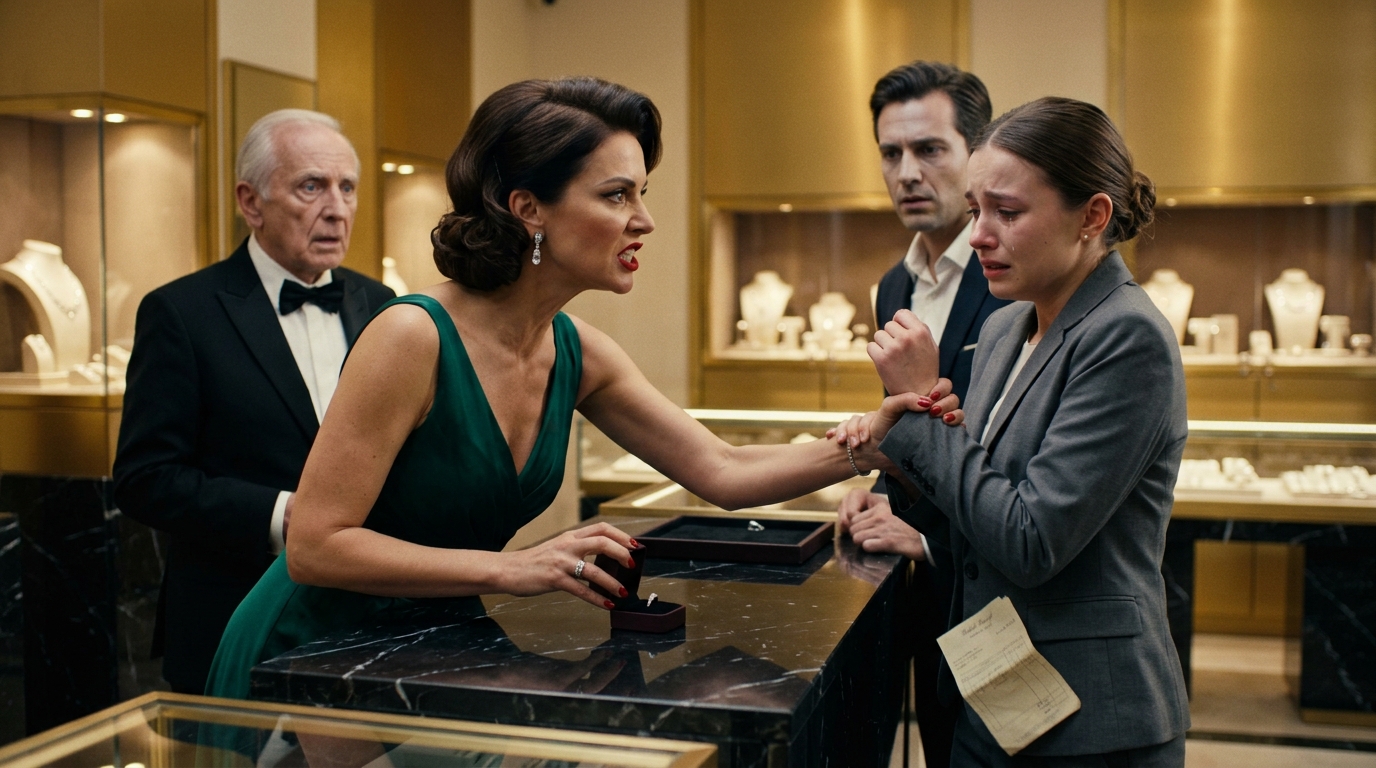
The Ring Box on the Glass Counter
The diamond ring box hit the counter so hard that everyone in the boutique turned.
The sound cracked through the soft elegance of Maison Bellandi like a gunshot wrapped in velvet.
Until that moment, the jewelry shop had been perfect.
That was the word tourists used when they stepped inside from Via Montenapoleone.
Perfect.
Soft golden lights glowed over black marble counters. Diamonds floated inside glass cases like captured stars. Sales consultants moved in hushed tones, wearing white gloves and careful smiles. Outside, Milan moved with its usual beautiful indifference, but inside Maison Bellandi, every breath seemed polished.
Then Valentina Moretti screamed.
“Open your hand right now!”
I froze behind the engagement counter.
Her fingers were already around my wrist.
Tight.
Too tight.
Her emerald designer gown shimmered beneath the lights, a deep green wave against the black marble. Her hair was pinned perfectly at the nape of her neck. Her diamond earrings trembled as she leaned toward me with fury sharp enough to make the other customers step back.
“You stole my engagement ring.”
The words struck harder than her grip.
“I didn’t,” I whispered.
But whispers do not survive well in rooms full of wealth.
Phones rose immediately.
A woman near the pearl display leaned closer.
One of the junior salesmen looked toward the back room, waiting for someone older, braver, more important to intervene.
No one did.
Valentina tightened her grip until pain shot up my arm.
“Open it.”
“I didn’t take anything,” I said again.
My voice broke.
I hated that.
I hated that she got tears from me before she got proof.
Her fiancé stood behind her, silent.
Matteo Bellandi.
Heir to the Bellandi jewelry fortune.
Elegant.
Famous.
Forty-five.
The kind of man magazines photographed beside words like legacy, tradition, and modern Italian luxury.
I had seen his face on the walls of the boutique before I ever saw him in person.
He watched me now with an expression I could not read.
Not anger.
Not exactly.
Something closer to discomfort.
But discomfort did not make him step forward.
Valentina twisted my wrist and forced my fingers open in front of everyone.
My palm was empty.
Nothing.
No diamond ring.
No hidden stone.
No stolen treasure.
For one heartbeat, the boutique held its breath.
Then something slipped from my sleeve.
A folded paper.
Old.
Soft from years of being handled.
It fluttered once in the air and landed on the glossy black floor between my shoes and Valentina’s heels.
Not jewelry.
Not money.
A receipt.
Valentina released my wrist as if it had burned her.
I stared down at the paper.
My heart stopped.
I knew that receipt.
I had carried it every day for six months, stitched into the inside lining of my uniform sleeve where no one could see it. My mother had given it to me before she died, pressed into my hand with fingers already too thin from illness.
“Never show this first,” she whispered. “Let them show who they are.”
“Who?” I had asked.
But she only closed my fingers around it.
“If a Bellandi bride ever accuses you of stealing, then let the paper speak.”
At the time, I thought grief had made her mind wander.
Now the receipt lay open on the floor of the most famous jewelry boutique in Milan.
The elderly jeweler from the back room stepped forward.
Signor Aldo.
He was seventy-eight, with silver hair, a permanent stoop, and hands that still moved with the precision of a watchmaker. He had worked for Maison Bellandi since before Matteo was born.
His eyes fell on the receipt.
Then on the handwritten surname across the top.
His face turned white.
“Impossible,” he whispered.
The entire boutique looked at him.
Valentina’s breathing quickened.
Matteo stepped closer.
“What is it?” he asked.
Signor Aldo did not look at him.
He looked at me.
At my face.
At my eyes.
Then back at the receipt.
“This was the original bride’s surname,” he said, voice trembling. “We were ordered to erase it from every record.”
The silence changed.
It became heavier.
Older.
Valentina slowly stepped back.
Matteo’s face drained of color.
I bent down, picked up the receipt with shaking hands, and held it to my chest.
Then I looked at the man who had stood silent while his bride accused me.
“My mother told me never to show this name,” I said through tears, “unless your new bride accused me first.”
Matteo stared at me.
His lips parted.
No sound came out.
Signor Aldo stepped closer, his eyes shining with disbelief.
Then he whispered one more sentence that made Matteo freeze completely.
“She has her mother’s eyes.”
The Bride Before the Bride
My mother’s name was Lucia Guerra.
For most of my life, that name meant small things.
A woman humming while kneading dough in our tiny kitchen.
A blue scarf tied around dark hair.
Red sauce simmering on Sundays.
Hands rough from sewing gowns for women who never learned her name.
She was not the kind of woman people imagined inside Maison Bellandi.
That was exactly why I applied to work there.
After she died, I found the receipt hidden in a sewing tin beneath old buttons and broken needles. It was wrapped in cream fabric and tied with black thread.
The receipt was from Maison Bellandi.
Dated twenty-four years earlier.
Two wedding bands.
One engagement ring reset.
Bride: Lucia Guerra.
Groom: Matteo Bellandi.
I read the names until they blurred.
My mother had never told me his name.
She only said my father came from a world where love was a weakness and silence was currency.
When I was a child, I asked if he was dead.
She looked out the window for a long time.
Then said, “To us, perhaps.”
I grew up believing she had loved a coward.
A rich man who chose his family over a pregnant woman with no protection.
But in the last weeks of her life, fever loosened the locks she had kept on memory.
She told me pieces.
Not enough.
Never enough.
She had been young when she met Matteo Bellandi.
He was not yet the public face of the family. He was a son trying to breathe inside a dynasty. He came to the restaurant where she worked because his driver liked the coffee. Matteo stayed because Lucia laughed at him when he mispronounced the name of a pastry.
At first, he came once a week.
Then three times.
Then every day.
He brought books. She brought him leftovers. He asked her to show him the real Milan, not the one printed in luxury magazines.
They fell in love.
Of course they did.
Stories like that always sound impossible until you remember that young people rarely ask permission before feeling.
Matteo proposed quietly, not in a ballroom, not beside photographers, but in the old courtyard behind the restaurant where laundry lines crossed above the stones.
They came to Maison Bellandi together.
Not through the main entrance.
Through the family door.
The receipt proved it.
My mother chose a simple ring. She told him she wanted something she could wear while working. He laughed and said his family would faint.
She said, “Then let them.”
Two weeks later, she disappeared from his life.
Or he disappeared from hers.
The version depended on who was lying.
My mother told me Matteo’s family accused her of stealing a Bellandi diamond. They said there was footage. Witnesses. A signed statement. They told her if she went near him again, she would be arrested and her unborn child would be taken.
Then someone came to her apartment.
A man in a black coat.
He handed her money she refused.
He slapped her when she said Matteo would never do this.
Then he placed a document on the table showing Matteo’s signature beneath a statement claiming she had manipulated him and stolen from his family.
My mother ran that night.
Not from guilt.
From power.
She survived by changing addresses, working under the table, and trusting almost no one. She raised me alone in a small town outside Parma, where nobody cared that she sometimes woke screaming or kept old receipts sewn into coat linings.
When I asked why she never confronted him, she said, “Because the truth must be opened in the room where the lie was locked.”
So after she died, I came to Milan.
I applied to Maison Bellandi under my full legal name.
Sofia Guerra.
No one noticed.
Why would they?
To the Bellandis, Guerra was a name erased from ledgers decades ago. To the staff, I was just another young assistant with careful manners, good Italian, decent English, and a willingness to work long hours for little praise.
Only Signor Aldo watched me strangely.
The first week, he asked where I was from.
“Near Parma,” I said.
“And your parents?”
“My mother is gone.”
He looked at my face for a long time.
Then said, “I am sorry.”
I thought he meant the ordinary sorry people say when death enters a conversation.
Now, standing in the boutique with my wrist burning and my mother’s receipt in my hand, I understood.
He had recognized something.
Maybe not enough to speak.
But enough to fear.
Valentina’s voice cut through the silence.
“This is absurd.”
She pointed at me, though her hand was less steady now.
“She stole my ring. Now she’s inventing some tragic story to distract everyone.”
I looked at the empty ring box on the counter.
Then at her.
“I didn’t touch your ring.”
“Liar.”
Matteo finally spoke.
“Valentina.”
One word.
Soft.
Warning.
She turned on him.
“What?”
He looked at the receipt.
Then at me.
“Let me see it.”
I almost refused.
My mother’s last proof felt too fragile for his hands.
But Signor Aldo stepped beside me.
“No,” he said.
Matteo looked stunned.
The old jeweler straightened as much as his spine allowed.
“You do not get to touch it until you hear what your father made us do.”
The Ring That Was Never Stolen
Matteo’s father arrived fifteen minutes later.
That was the thing about families like the Bellandis.
They had people everywhere.
A private security man had called him the moment Valentina screamed. Another had called him when Signor Aldo spoke the word original.
Carlo Bellandi entered through the side door in a charcoal overcoat, leaning on a silver-handled cane. He was eighty-one years old, but the room still rearranged itself around him out of habit.
Even the chandeliers seemed to dim.
He looked first at Valentina.
Then at Matteo.
Then at me.
He did not ask what happened.
He looked at the receipt in my hands and understood immediately.
His face did not go pale.
Men like Carlo Bellandi had trained their blood not to reveal fear.
Instead, his mouth hardened.
“Where did you get that?”
My voice shook.
“My mother.”
His eyes flicked over my face.
Something like recognition moved there.
Then disappeared.
“Your mother was a thief.”
Matteo flinched.
I did not.
That surprised me.
Maybe because I had spent my whole life hearing the accusation in shadows. Hearing it directly, from the man who built it, made the fear turn solid enough to fight.
“No,” I said. “She was the bride.”
Carlo laughed once.
A cold, dry sound.
“My son was briefly infatuated with a waitress. That is not the same thing.”
Signor Aldo moved forward.
“Don Carlo.”
Carlo’s gaze snapped to him.
The old jeweler stopped.
For one second, I saw the younger employee he had once been, afraid of losing his work, his pension, his place in a world controlled by another man.
Then Signor Aldo looked at me.
At my wrist, red from Valentina’s grip.
At the receipt.
At Matteo, who looked like his life was collapsing one sentence at a time.
And the old man chose, finally, to become brave too late rather than never.
“The ring was never stolen,” he said.
A sound moved through the boutique.
Valentina whispered, “What?”
Carlo’s face darkened.
“Aldo.”
“No,” Signor Aldo said. “I have carried this long enough.”
He turned toward the customers.
Toward the phones.
Toward the staff who had frozen when I needed help.
“Twenty-four years ago, Lucia Guerra came here with Matteo Bellandi. They selected wedding bands. She wore the engagement ring from the old Bellandi setting. It was entered in the private bridal ledger.”
Carlo stepped toward him.
“Stop.”
Signor Aldo did not.
“Two days later, Don Carlo ordered the ledger altered. The bride’s name was removed. The ring was reported stolen. Staff were told Lucia Guerra had taken it and vanished.”
Matteo’s voice was barely audible.
“Why didn’t you tell me?”
The old jeweler turned to him.
“Because your father said she had confessed. Because he said you knew. Because he said if any of us spoke, we would never work in jewelry again.”
Matteo looked at his father.
“I searched for her.”
Carlo’s eyes flashed.
“You were young and foolish.”
“You showed me a police report.”
“You needed to move on.”
“You showed me a letter.”
“You needed to survive.”
Matteo stepped closer.
“What did you do?”
For the first time, Carlo’s mask cracked.
Not fully.
But enough.
“I saved you.”
The words filled the room with something rotten.
I felt my mother in them.
All the nights she feared a knock at the door.
All the years she worked with bent shoulders.
All the birthdays where she looked at me with love and grief because I had my father’s smile and her ruined past.
“You didn’t save him,” I said.
Carlo looked at me as if I had forgotten my place.
“You know nothing.”
I held up the receipt.
“I know my mother died with this under her pillow.”
Matteo closed his eyes.
Valentina seized the opening.
“Enough of this.”
She grabbed the ring box and shook it toward me.
“My ring is still missing.”
A new voice answered from the entrance.
“No, signora. It is not.”
Everyone turned.
The boutique security chief stood there with a tablet. Beside him was a uniformed police officer who had arrived after one of the customers called during the screaming.
The security chief looked deeply uncomfortable.
“Camera review shows the ring was removed from the box before Signorina Guerra approached the counter.”
Valentina froze.
Matteo turned slowly toward her.
The security chief continued, “The ring appears to be in Signora Moretti’s evening clutch.”
Silence.
Then all eyes moved to the emerald clutch on the counter.
Valentina’s face drained of color.
“That is impossible.”
The police officer stepped forward.
“Please open the bag.”
She did not move.
Matteo reached for it.
She slapped his hand away.
Too late.
Everyone saw.
The officer opened the clutch.
Inside, wrapped in a white silk handkerchief, was the diamond ring.
No one breathed.
Valentina’s lips trembled.
“I was testing her,” she said quickly. “Staff steal all the time. I had a right to know who was serving me.”
The words landed like filth on clean glass.
Testing her.
That was what rich people called cruelty when they expected not to pay for it.
Matteo stared at her.
“You accused her publicly.”
Valentina’s eyes filled with tears.
“You let her touch the ring. You were looking at her strangely. I knew something was wrong.”
Carlo’s voice cut in.
“Enough. This is a private matter.”
The police officer looked at him.
“Not anymore.”
The Ledger in the Back Room
The old bridal ledger was kept in the basement.
At least, that was what Signor Aldo said.
Carlo insisted it had been destroyed.
Signor Aldo looked at him and said, “You destroyed the public copy.”
For a moment, I almost forgot to breathe.
The basement of Maison Bellandi smelled of velvet, dust, metal polish, and old secrets. The police officer came down with us. So did Matteo, Carlo, Valentina, Signor Aldo, and the security chief.
I did not want to go.
I wanted to run.
But the receipt in my hand felt warm now, as if my mother’s fingers were still folded over mine.
So I followed.
Signor Aldo opened a narrow cabinet behind a shelf of antique ring molds. Inside was a small safe.
His hands shook as he entered the combination.
Carlo watched with pure hatred.
“You kept copies.”
Signor Aldo did not look at him.
“I kept proof.”
The safe opened.
Inside were three leather-bound ledgers, a packet of photographs, and a sealed envelope yellowed with age.
Signor Aldo removed the middle ledger and placed it on the table.
He opened it carefully.
The pages were thick, cream-colored, handwritten in black ink.
Brides.
Grooms.
Stones.
Settings.
Dates.
Lives reduced to entries.
Then he stopped.
His finger rested on a line that had been crossed out so violently the paper had nearly torn.
Bride: Lucia Guerra.
Groom: Matteo Bellandi.
Engagement setting: Bellandi family diamond, oval cut, platinum.
Wedding bands: completed.
Date of collection: never collected.
Beside the entry, written later in a different hand, was one word.
Void.
Matteo touched the page like it might disappear.
His face collapsed.
“I thought she left me.”
Carlo said nothing.
Signor Aldo opened the envelope.
Inside were photographs.
My mother and Matteo standing together in the private fitting room. She was younger than I had ever known her, smiling at a ring on her hand. Matteo stood beside her, looking at her instead of the camera.
In another photo, they held the wedding bands.
In a third, my mother’s hand rested on her stomach.
Pregnant.
I had never seen that picture.
I reached for it with shaking fingers.
Matteo saw the movement and stepped back, giving me space.
For that, at least, I was grateful.
Signor Aldo’s voice broke.
“She came back once.”
Carlo closed his eyes.
Matteo looked up sharply.
“What?”
The old jeweler nodded.
“Three months after she disappeared. She came through the service door. She was thin. Frightened. Pregnant. She asked for you.”
Matteo gripped the table.
“No one told me.”
“I tried,” Aldo whispered. “Don Carlo’s men removed her before I reached the stairs. After that, I found this on the floor.”
He lifted another paper.
A note.
Folded small.
My mother’s handwriting.
I knew it instantly.
Matteo took it, hands trembling.
He read aloud.
Matteo,
They say you signed the papers. They say you called me thief. I don’t believe them, but I am tired and afraid. If you did not do this, find me. If you did, may our child never know your name.
Lucia.
Matteo sat down heavily.
As if his body had finally stopped obeying him.
Carlo spoke then.
“She would have destroyed you.”
Matteo looked at him.
“No. You destroyed us.”
“She wanted money.”
“She wanted me.”
“She wanted access to this family.”
“She was carrying my child.”
The room went still.
Everyone looked at me.
The word child moved through the basement, found my body, and settled there.
Matteo turned slowly.
His eyes met mine.
Not claiming.
Not demanding.
Just seeing.
Really seeing.
For the first time, I wondered if my mother had been wrong about one thing.
Maybe he had not abandoned us.
Maybe he had been buried too.
Carlo struck the table with his cane.
“You have no proof this girl is yours.”
The police officer looked at him.
“Sir, I recommend you stop speaking.”
But Carlo could not.
Powerful men often mistake silence for surrender, so when silence turns against them, they panic in words.
“You think a receipt and a resemblance make a family?” he snapped. “Do you have any idea how many women tried to trap my son? Lucia was beautiful, yes, but beauty does not make a woman honest.”
I stepped toward him.
My whole body shook.
But my voice was steady.
“My mother was poor,” I said. “Not dishonest.”
For the first time, Carlo had no immediate answer.
Then Matteo stood.
He removed the Bellandi signet ring from his own hand and placed it on the ledger.
The sound was soft.
Final.
“I want a DNA test,” he said.
Carlo laughed bitterly.
“And if she is yours?”
Matteo looked at me.
Then at the photograph of my mother.
“Then I will spend the rest of my life answering for what this family took from her.”
The Bride Who Lost the Room
Valentina was not arrested that day.
Not immediately.
She was escorted to a private office for questioning, furious and humiliated, insisting through tears that she had only staged the missing ring because she felt “disrespected” by the staff.
The police called it a false accusation.
The internet called it worse.
By evening, the boutique video had spread across Italy and beyond.
The glamorous bride grabbing a young assistant’s wrist.
The empty palm.
The old receipt falling.
The ring found in Valentina’s own clutch.
The jeweler whispering, “She has her mother’s eyes.”
People watched it for the drama.
They stayed for the buried scandal.
Maison Bellandi issued no statement that night.
How could it?
Its own basement had become a crime scene of memory.
Carlo Bellandi retreated behind lawyers. He denied ordering records erased. He denied threatening Lucia. He denied knowledge of forged reports or false accusations.
Then Signor Aldo gave police the safe contents.
The duplicate ledger.
The photographs.
The note.
And one more thing.
An audio cassette.
He had recorded Carlo twenty-four years earlier, not out of courage, he admitted, but self-preservation. Carlo’s voice was unmistakable.
“She will not marry my son. She will not carry a Bellandi child into this family. If she speaks, she becomes a thief. If she returns, she disappears again.”
Matteo listened to that recording in a private room with his lawyers.
I refused to sit beside him.
I sat across from him.
There is a difference.
When the recording ended, he covered his face with both hands.
“I should have known,” he said.
I had no comfort to give him.
So I gave him truth.
“Yes.”
He lowered his hands.
The word hurt him.
It needed to.
“My mother waited,” I said. “Not forever. But long enough. She thought if you loved her, you would find a crack in their story.”
“I searched.”
“With your father’s people?”
He looked down.
That was answer enough.
I thought I would hate him more in person.
I didn’t.
That was inconvenient.
Hatred is easier when the person before you is entirely guilty. Matteo was not innocent, but he was not the monster my childhood had built either.
He was weak where my mother needed him strong.
That was its own kind of sin.
The DNA results arrived two weeks later.
Probability of paternity: 99.9996%.
I read the page alone first.
Then again.
Then a third time.
There it was.
The answer to every question my mother had refused to poison my childhood with.
My father had a name.
A face.
A fortune.
A wound.
Matteo cried when he read it.
I did not.
Not then.
I was too tired.
Valentina broke the engagement herself before Matteo could publicly end it. Her family released a statement accusing Maison Bellandi of “weaponizing a misunderstanding to distract from internal legacy matters.”
No one believed it.
The emerald gown became a meme.
The phrase “testing the staff” became a public joke.
But beneath the spectacle, something deeper shifted.
Former employees came forward.
Women who remembered Carlo’s threats.
A retired driver who admitted transporting Lucia to the outskirts of Milan after being told she had stolen from the family.
A clerk who altered a police complaint.
A notary who forged a settlement acknowledgment in Lucia’s name.
The scandal grew beyond one ring.
It became a story about what powerful families do to women who enter through the wrong door.
And at the center of it was my mother.
Lucia Guerra.
The original bride.
The erased name.
The woman who had carried the truth in silence because silence was the only shield left for her child.
The Name Restored in Gold
Six months after the accusation, Maison Bellandi closed for one day.
Not for renovation.
For a ceremony.
I almost refused to attend.
Matteo asked once.
Only once.
He had learned quickly that apology becomes pressure when repeated too often.
“You don’t owe us your presence,” he said. “But her name will be restored whether you come or not.”
That was why I went.
Not for him.
For her.
The boutique looked different without customers. No soft performance. No whispered sales. No wealthy women pretending diamonds were decisions of the heart instead of status.
Only staff, journalists, lawyers, a few old employees, and Signor Aldo standing beside a glass display case.
My mother’s photograph lay inside it.
The one from the basement.
Lucia young, smiling, one hand on her stomach, a Bellandi ring on her finger.
Beside it rested the original receipt.
Cleaned.
Flattened.
Protected beneath museum glass.
Bride: Lucia Guerra.
Groom: Matteo Bellandi.
The crossed-out ledger page had been reproduced beside it with an explanation of the erasure and restoration. Matteo insisted the language remain blunt. His lawyers wanted softer words.
Historical correction.
Archival discrepancy.
Documentation irregularity.
He rejected them all.
The final plaque read:
Lucia Guerra was engaged to Matteo Bellandi in this house in 2001. Her name was wrongfully erased from our records through the actions of Carlo Bellandi and those who obeyed him. This restoration cannot repair what was taken, but it ensures the lie no longer stands in her place.
I stood in front of the plaque for a long time.
I expected to feel victory.
Instead, I felt grief.
My mother should have been there.
She should have seen her name in gold.
She should have stood before the people who called her thief and watched them lower their eyes.
But grief often arrives at the doorway of justice.
It wants to know why it came too late.
Signor Aldo approached me slowly.
His hands shook more than before.
“I am sorry,” he said.
I looked at him.
Part of me wanted to be cruel.
He had known.
Not everything, maybe.
But enough.
And silence from good people had helped dangerous people build the walls that trapped my mother.
“You should be,” I said.
His eyes filled.
“Yes.”
That was all.
No forgiveness.
No dramatic embrace.
Just truth.
Sometimes truth is the only mercy available.
Matteo stood nearby, giving me space.
He looked older than he had the day I met him. The scandal had stripped polish from him. The Bellandi board removed Carlo from all authority. Matteo retained the company only after agreeing to independent oversight, restitution funds, and full cooperation with criminal inquiries.
Carlo never apologized.
Not to me.
Not to Matteo.
Not to my mother’s memory.
At his final hearing, he called Lucia “an unfortunate influence” and me “a regrettable consequence.”
The judge did not appreciate that.
Neither did the public.
His punishment came through courts, civil claims, reputation, and isolation. Was it enough? No. Punishment rarely equals the size of what was stolen.
But his name no longer controlled the story.
That mattered.
After the ceremony, Matteo asked if we could walk.
We went outside into the late afternoon light of Milan.
For a while, neither of us spoke.
Then he said, “I don’t know how to be your father.”
I looked at him.
“I don’t know how to be your daughter.”
He nodded.
Fair.
“I would like to try,” he said.
I thought of my mother’s hands folding the receipt.
Her voice.
Let them show who they are.
Matteo had shown many things.
Weakness.
Grief.
Regret.
But maybe also a willingness to stand in the ruins without asking me to rebuild them for him.
“We can start with coffee,” I said.
His eyes shone.
“Coffee is good.”
“And you can tell me about her.”
His face changed.
Softened.
“Your mother hated bad coffee.”
I laughed before I could stop myself.
“She did.”
That was our beginning.
Not father and daughter.
Not yet.
Two people connected by a woman one had lost and the other had failed.
A month later, I left Maison Bellandi.
Matteo offered me a position anywhere in the company.
I refused.
I had not come there to inherit the room that humiliated my mother.
I came to open it.
Instead, I used part of the restitution settlement to start a foundation in Lucia’s name, providing legal support for women falsely accused by employers or powerful families. The first office was small. The sign on the door was simple.
Guerra House.
War house, some joked.
No.
My mother’s house.
Valentina tried to rebuild her reputation quietly. She married another wealthy man two years later in Lake Como. I saw the photos online by accident.
She wore white.
No emerald.
No ring from Bellandi.
I felt nothing.
That surprised me too.
The opposite of pain is not always happiness.
Sometimes it is distance.
Years later, people still recognize me from the boutique video. They ask what I felt when the receipt fell from my sleeve.
Fear, I tell them.
Then anger.
Then something stronger than both.
Inheritance.
Not money.
Not diamonds.
A receipt.
A name.
A pair of eyes an old jeweler remembered too late.
My mother left me no estate. No house. No jewelry except a thin gold chain with a broken clasp. But she left me proof. She left me patience. She left me instructions for the exact kind of cruelty she knew would reveal the truth.
The rich bride thought she was exposing a thief.
Instead, she exposed a grave with no body in it.
A marriage erased before it could begin.
A daughter hidden in plain sight.
A family legacy built, in part, on a woman’s ruined name.
On the anniversary of the restoration, I returned to the boutique before opening. Matteo met me there with two coffees. We stood in front of the display case without speaking.
My mother’s photograph glowed softly beneath the lights.
Bride: Lucia Guerra.
No longer crossed out.
No longer void.
No longer erased.
I touched the glass.
For one second, I could almost hear her voice.
Not bitter.
Not broken.
Just steady.
Let the paper speak.
It had.
And finally, everyone listened.