The Hand on Her Arm
“Ma’am, you absolutely cannot board this aircraft.”
Derek Collins said it loud enough for the entire private terminal to hear.
Not because he needed to.
Because he wanted witnesses.
His voice cut through the polished quiet of Teterboro Airport’s luxury departure lounge, bouncing off glass walls, marble floors, and the soft leather chairs where wealthy passengers waited with unread newspapers and untouched coffee.
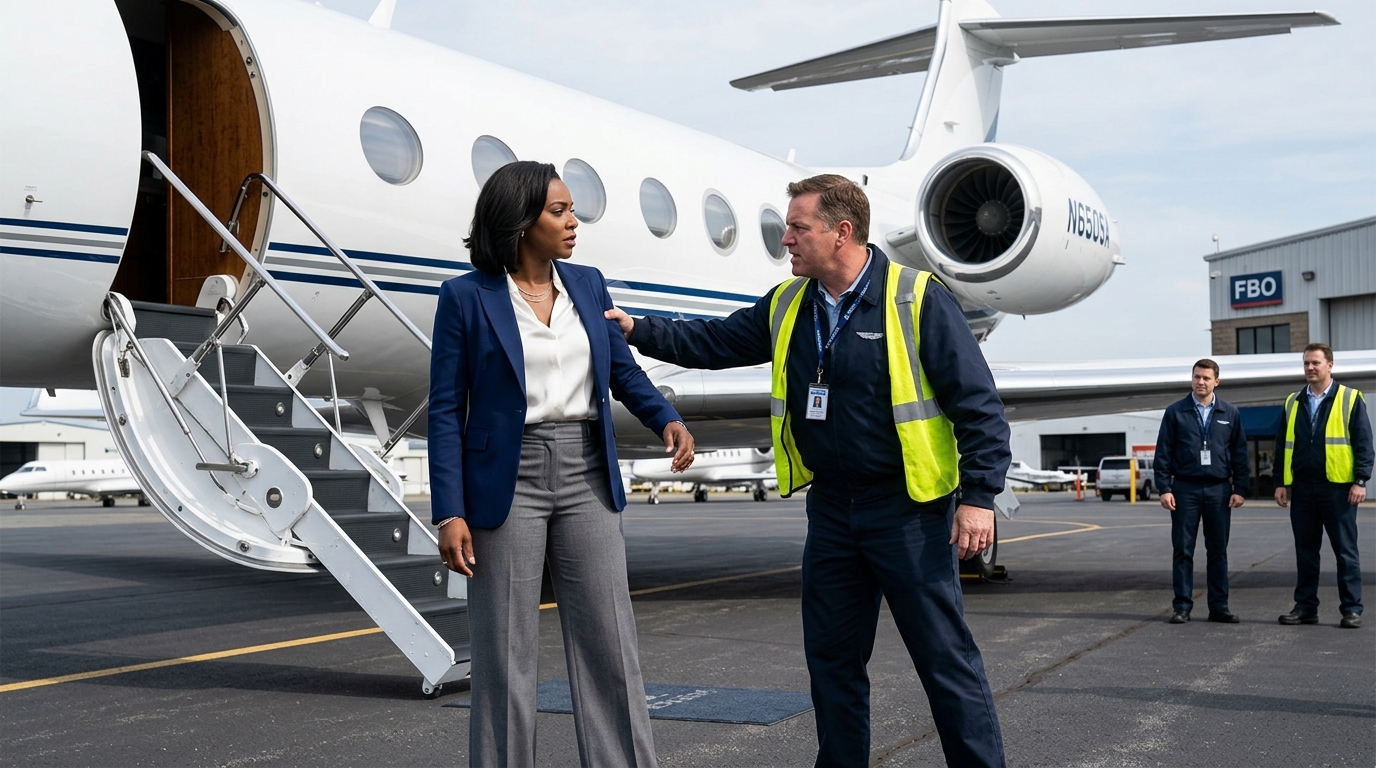
Outside, a Gulfstream G650 gleamed in the morning sun.
White body.
Silver trim.
Tail number N650SA.
Sixty million dollars of speed, privacy, and corporate power.
And Derek Collins stood at the bottom of the boarding stairs like a guard at the gates of heaven.
Blocking me from my own jet.
My name is Amara Sterling.
I was thirty-eight years old, founder and majority owner of Sterling Aerospace, a company that built propulsion systems, avionics components, and private aircraft support technology for clients who usually preferred not to be named in public.
That morning, I wore a cream coat, simple gold earrings, and flat shoes because I had a board meeting in Atlanta and a manufacturing inspection before lunch.
I was not dressed like a celebrity.
I was not surrounded by assistants.
I was not wearing a diamond watch or carrying a designer bag large enough to announce money before I did.
To Derek Collins, that was enough.
He saw a Black woman walking alone toward a private jet and decided the story before asking a single question.
“This is private property,” he said, stepping directly into my path. “Not some tour you can walk onto.”
I stopped.
The boarding stairs were ten feet behind him.
The aircraft door stood open.
The flight attendant was inside preparing the cabin. Two mechanics stood near the nose gear. A fuel truck idled in the distance.
Everyone looked.
No one moved.
I kept my voice calm.
“I’m scheduled to depart on this aircraft.”
Derek gave a short laugh.
“No, ma’am. You are not.”
He spoke the word ma’am like an insult wrapped in manners.
I reached into my coat pocket for my credentials.
He lifted his radio.
“Security, we’ve got an unauthorized person attempting to access the Sterling Aerospace aircraft.”
The name of my company sounded strange in his mouth.
Like something he respected more than the person standing in front of him.
I held out my ID.
“My name is Amara Sterling.”
He didn’t look at it.
Not even once.
Instead, he stepped closer and lowered his voice just enough to make the cruelty feel personal.
“Listen carefully. This jet belongs to one of the most powerful aerospace companies in America. You have no business being anywhere near it.”
Behind him, one of the mechanics shifted.
The younger one.
He looked uncomfortable.
But discomfort is not courage.
Derek reached out and grabbed my arm.
Hard.
His fingers dug into my sleeve, pressing through the fabric with enough force to leave a mark. It was not the grip of someone redirecting a passenger for safety.
It was the grip of a man trying to remind me who he believed had power.
He pushed me back.
Not far.
Just enough for the humiliation to be visible.
Just enough for a few people near the glass to lift their phones.
My heart began to pound.
Not from fear.
From memory.
Every boardroom where someone assumed I was an assistant.
Every investor dinner where men explained my own company to me.
Every airport lounge where staff asked whether I was “with the catering team.”
Every time I had chosen grace because anger would be used as evidence.
But this time, Derek’s hand was still on my arm.
And the jet behind him carried my initials.
N650SA.
Sterling Aerospace.
Amara Sterling.
I looked down at his hand.
Then back at his face.
“Remove your hand.”
He smiled.
“You don’t get to give orders here.”
A black SUV rolled to a stop near the hangar gate.
Then another.
Then a third.
Derek did not notice.
He was too busy performing authority for the audience he thought belonged to him.
“Escort her back inside,” he barked into the radio. “And check whether she came through the employee entrance.”
That was when my chief legal officer stepped out of the first SUV.
Then my head of flight operations.
Then two members of the board.
Derek’s radio crackled.
A voice came through, strained and urgent.
“Derek… stand down.”
His smile faltered.
“What?”
The voice repeated, sharper now.
“Stand down immediately. That’s Ms. Sterling.”
Derek’s grip loosened.
His eyes moved from my face to the jet.
Then to the tail number.
Then to the executives walking toward us.
Finally, for the first time, he looked at the ID in my hand.
The color drained from his face.
I pulled my arm free.
The entire tarmac went silent.
Then I said, quietly enough that he had to lean forward to hear it:
“You were right about one thing, Mr. Collins. This is private property.”
I looked at the jet.
Then at the staff gathered around it.
“And you no longer work on it.”
The Company That Carried Her Name
Sterling Aerospace did not begin with private jets.
It began in my father’s garage in Huntsville, Alabama.
My father, Leonard Sterling, was an aircraft mechanic with hands that always smelled faintly of oil and metal. He could diagnose engine trouble by listening from across a hangar. He used to say machines were honest if people were patient enough to hear them.
My mother was a math teacher.
She believed equations were a form of prayer because they made chaos confess its pattern.
Between the two of them, I grew up surrounded by tools, chalk dust, and the belief that nothing was too complex if you respected it enough to study it.
When I was fourteen, I built a model turbine for a science fair.
When I was nineteen, I interned at a propulsion lab where my supervisor told me I was “surprisingly technical.”
When I was twenty-seven, I founded Sterling Aerospace with two engineers, a leased workspace, and a loan I signed with hands that shook after I left the bank.
People underestimated us.
That helped.
Underestimation is information.
It tells you what others are too arrogant to protect.
By thirty-five, I had built the company into a quiet force in aerospace manufacturing. We supplied components to major aviation groups. We acquired a maintenance network. We bought our first corporate aircraft because our clients were spread across facilities too far apart for commercial routes to make sense.
The Gulfstream G650 was not a toy.
It was a tool.
A flying conference room.
A time machine.
A way to reach factory floors, accident reviews, and emergency supplier meetings before problems became disasters.
But to people like Derek Collins, aircraft like that meant one thing.
Status.
And status, in his mind, had a face.
It did not look like mine.
I had not planned to test the ground crew that morning.
At least, not originally.
But for months, complaints had been reaching my office.
Not formal reports at first.
Whispers.
Patterns.
A Black software engineer stopped twice at the private terminal despite being listed on the manifest.
A Latina executive asked if she was “the nanny” for a client family.
A Nigerian investor made to wait outside in the rain while his white assistant was waved through.
A female captain questioned repeatedly about whether she was “actually flying.”
Each incident was explained away.
Miscommunication.
Security caution.
High-profile aircraft protocols.
Difficult passenger interaction.
Those phrases are where discrimination hides when companies value reputation more than truth.
So I changed my schedule.
No entourage.
No advance greeting.
No assistant walking ahead to announce me.
I wanted to see how the system treated the owner when the owner looked, to Derek Collins, like someone who needed permission to exist near wealth.
I got my answer in less than five minutes.
He did not scan my ID.
He did not check the manifest.
He did not call dispatch.
He did not ask for confirmation.
He saw me and reached a verdict.
Then he put his hand on me.
That was why I did not raise my voice when the executives arrived.
I did not need volume.
The tarmac itself had become evidence.
My head of flight operations, Karen Liu, reached us first.
Her expression was pale with controlled fury.
“Amara,” she said, “are you injured?”
“I’ll have bruising.”
Derek’s mouth opened.
“Ms. Sterling, I had no idea—”
I turned to him.
“That is the problem.”
He swallowed.
“I was following protocol.”
“Which protocol instructs you to ignore identification, refuse to check a manifest, publicly accuse a passenger, and physically grab her?”
His eyes flicked toward the others.
No one helped him.
“I made a judgment call.”
“Yes,” I said. “You did.”
The younger mechanic lowered his head.
The flight attendant stood frozen at the aircraft door.
A security officer arrived from the terminal, then stopped as soon as he recognized the executives.
Derek tried again.
“We get people trying to take pictures of private jets all the time.”
“I wasn’t taking pictures.”
“I couldn’t know that.”
“You could have looked at my ID.”
He had no answer.
Karen stepped beside me.
“Ms. Sterling, I’ll remove him from duty pending investigation.”
“No,” I said.
Derek’s face lifted with sudden hope.
I let that hope live for one second.
Then I looked at him.
“He is terminated for cause, effective immediately. So is anyone who saw him lay hands on me and failed to intervene despite being trained to do exactly that.”
The tarmac froze.
The younger mechanic looked up in panic.
My eyes moved across the crew.
Some looked ashamed.
Some terrified.
Some angry that consequences had arrived so publicly.
Good.
I turned to Karen.
“Pull the camera footage. Pull incident logs from the last twelve months. Pull every complaint that includes the words misunderstanding, difficult, aggressive, unauthorized, or protocol.”
Karen nodded.
“Yes, ma’am.”
Derek’s voice cracked.
“You can’t fire everyone over one mistake.”
I stepped closer.
“It was not one mistake. It was a culture revealing itself.”
The Footage They Thought No One Would Watch
We moved the meeting into the private terminal conference room.
Not because Derek deserved privacy.
Because the passengers in the lounge did not need to become entertainment.
But the glass walls meant everyone still saw enough.
Derek sat at the far end of the table, arms crossed, trying to look wronged. Beside him sat the terminal manager, Paula Griggs, whose face had the tight, bloodless look of someone calculating liability faster than remorse.
Karen stood near the screen.
My legal officer, Miles Avery, opened his laptop.
I sat at the head of the table.
For the first time that morning, Derek seemed to understand that I was not a passenger demanding an apology.
I was the person deciding how deep the blade needed to go.
Paula began first.
“Ms. Sterling, on behalf of the terminal, we deeply regret any discomfort.”
“Stop.”
She blinked.
I looked at her.
“Discomfort is a delayed flight. Discomfort is weak coffee. Your employee physically blocked me from my aircraft and treated me as a trespasser after refusing to verify my identity.”
Paula swallowed.
“Yes. Of course. I only meant—”
“I know what you meant. You meant to make it smaller.”
Miles connected the laptop to the wall screen.
The tarmac footage appeared.
There I was, walking toward the aircraft.
Derek stepping into my path.
Me offering my ID.
Him refusing to look.
His hand grabbing my arm.
The push.
The people watching.
The silence in the room grew heavier with every second.
When the clip ended, Derek said, “There’s no audio.”
Miles clicked again.
A second recording began.
This one came from a ramp microphone attached to the boarding stairs.
Derek’s voice filled the room.
“This jet belongs to one of the most powerful aerospace companies in America. You have no business being anywhere near it.”
Then:
“Escort her back inside. And check whether she came through the employee entrance.”
Paula closed her eyes.
Derek looked at the table.
I asked, “How many times has this happened?”
No one answered.
So Karen did.
“Preliminary search found fourteen complaints with similar language in the last year involving Sterling Aerospace flights or partner aircraft.”
Paula’s eyes snapped open.
“Fourteen?”
Miles placed printed documents on the table.
“Fourteen that used careful wording. We believe there are more.”
I opened the first file.
A senior engineer from Atlanta.
Stopped from boarding.
Asked if he was ground maintenance.
Complaint closed as passenger attitude issue.
The second.
A supply chain consultant.
Delayed until a white colleague confirmed she was “with them.”
Complaint closed as identity confusion.
The third.
A Black female pilot.
Asked twice whether she was cabin crew despite wearing captain’s bars.
Complaint closed as uniform ambiguity.
Uniform ambiguity.
I read the phrase three times.
Then looked at Paula.
“Who wrote this?”
She did not answer.
Karen did.
“Derek did. Paula approved the closure.”
Paula’s face stiffened.
“These were operational reviews.”
“No,” I said. “These were burials.”
Derek leaned forward suddenly.
“You people are trying to ruin my career.”
The room went still.
“You people,” Miles repeated softly.
Derek realized what he had said.
Too late.
I leaned back.
There are moments when the mask falls not because someone is careless, but because they are tired of pretending.
Derek was tired.
His pride had been wounded.
His real vocabulary had slipped out.
Paula whispered, “Derek, stop talking.”
But he didn’t.
“I’ve spent twenty-two years keeping high-value aircraft secure. You have no idea how many scammers, activists, influencers, and random people try to get close to planes like that.”
I looked at him.
“And in your mind, I belonged in which category?”
He opened his mouth.
Nothing came out.
That was answer enough.
Miles turned another page.
“There is also the matter of physical contact. Staff policy prohibits touching passengers except in immediate safety emergencies.”
Paula said quickly, “That will be addressed.”
“It will,” I said. “By termination, reporting to the contractor’s licensing authority, and referral for civil action.”
Derek stood.
“This is insane.”
Security entered the conference room.
Not the same security he had called on me.
Different men.
Ours.
He looked at them, then at me.
For the first time, real fear entered his face.
“You’re making an example of me.”
“No,” I said. “You made an example of me. I am correcting the lesson.”
The Apology That Cost More Than Words
By noon, the story had already escaped the terminal.
Someone in the lounge had recorded the moment Derek grabbed my arm. The clip showed his finger pointed at the jet, my ID in my hand, and my own staff arriving seconds later.
The headline wrote itself.
Airport Staff Blocks Black Woman From Her Own Private Jet.
Social media did the rest.
People argued.
Some defended Derek.
Security is security.
How was he supposed to know?
Private jets need protection.
Others saw what I saw.
He didn’t want to know.
By the time we landed in Atlanta, Sterling Aerospace’s communications team had prepared a statement.
I refused the first draft.
It used words like incident, regrettable, and misunderstanding.
I deleted all three.
The final statement was shorter.
This morning, I was physically blocked from boarding an aircraft owned by my company after staff refused to verify my identity. This was not a misunderstanding. It was a failure of training, judgment, and basic human respect. Sterling Aerospace is conducting a full review of all contracted aviation services. Any partner who cannot treat every authorized passenger with dignity will no longer be our partner.
People called it harsh.
Good.
Harsh is sometimes what honesty sounds like when people are used to softness protecting them.
But the harder work began after the statement.
The investigation widened.
Not only Derek.
Not only Paula.
Not only Teterboro.
Our company had spent millions on private aviation services across multiple airports. We had policies, contracts, values statements, and supplier codes of conduct.
On paper, everything looked clean.
On the ground, it was not.
Employees began coming forward.
Not just Black employees.
Women.
Immigrants.
Younger engineers.
Pilots with accents.
Executives who did not dress the way private aviation staff expected powerful people to dress.
Each story carried the same wound.
They were questioned more.
Watched longer.
Doubted faster.
And when they complained, someone translated humiliation into procedure.
I spent the next week reading every account.
Some made me angry.
Some made me sick.
One made me cry.
A junior engineer named Tasha Williams wrote that after being blocked from a Sterling partner flight six months earlier, she stood in a terminal restroom and cried because the staff member kept asking who she really worked for.
She had a PhD in aerospace materials.
She had designed part of the thermal shielding system that saved one of our contracts.
And a man with a clipboard made her feel like a trespasser.
I called her personally.
She cried again.
So did I, though not until after we hung up.
A board member asked whether I was letting personal emotion influence operational decisions.
I told him yes.
Then I asked why lack of emotion had been treated as wisdom while people were being harmed in our name.
He did not raise the question again.
Within thirty days, we terminated two terminal contracts, suspended three others pending audit, and created a direct access verification system that did not depend on staff assumptions. Every authorized passenger could verify identity digitally before arriving, but staff were also trained that identity confirmation begins with procedure, not appearance.
We banned physical contact except in documented emergencies.
We required body-camera activation for disputes near aircraft.
We created an external reporting line for passengers and employees.
And we made one rule nonnegotiable:
If you feel the need to say “I didn’t know who they were” after mistreating someone, you have already confessed the deeper problem.
Derek threatened to sue.
Then footage from three prior incidents surfaced.
In one, he laughed with another employee after delaying a Black executive for twenty minutes, saying, “They always get loud when caught.”
In another, he referred to a South Asian family as “probably the catering group” while they stood beside their own charter.
In the third, he placed a hand on a female pilot’s shoulder and said, “Sweetheart, cockpit access is for crew.”
She was the captain.
Derek did not sue.
Paula resigned before her termination hearing.
The contractor issued an apology so polished it reflected nothing.
I rejected a private settlement.
Not because I wanted revenge.
Because private settlements are where patterns go to survive.
The Jet After the Silence
Six months later, I returned to Teterboro.
Not secretly.
Not with an entourage.
With Tasha Williams, Captain Priya Menon, two apprentices from our aviation scholarship program, and my mother.
My mother had never flown on the G650.
She said private jets made her nervous because “anything with cream carpet is asking for trouble.”
The terminal had changed.
New staff.
New procedures.
New cameras.
Better signage.
But buildings remember.
Or maybe people do.
As I stepped onto the tarmac, I felt again the ghost of Derek’s hand around my arm.
The shove.
The silence.
The phones.
The humiliation of being treated as an intruder beside the aircraft carrying my name.
My mother noticed.
She always noticed.
She slipped her hand into mine.
“Walk slow,” she said.
So I did.
The new ground supervisor approached.
A young man named Ellis.
He stopped at a respectful distance.
“Good morning, Ms. Sterling. Captain Menon. Dr. Williams. Mrs. Sterling. Welcome aboard.”
He verified every person the same way.
Same tone.
Same process.
Same respect.
That should not have felt revolutionary.
It did.
Tasha looked at me after Ellis walked away.
“I didn’t realize how much I was bracing for it until he didn’t do it.”
I nodded.
“That’s how you know the old way was never small.”
We boarded.
My mother paused at the stairs and looked back at the terminal.
“Is that where it happened?”
“Yes.”
She stared for a long moment.
Then shook her head.
“Your father would have wanted to have words with that man.”
I smiled faintly.
“He had plenty of people having words with him.”
“No.” She looked at me. “Your father had a special way of saying things with a wrench in his hand.”
I laughed.
For the first time, the memory loosened.
On board, I sat by the window as the jet taxied.
N650SA.
My initials on the tail.
My company’s aircraft.
But that day, I understood ownership differently.
Owning the jet had not protected me.
Owning the company had not prevented humiliation.
Power that only works after someone recognizes your title is not justice.
It is just delayed permission.
The real work was building a system where the next person did not need to be the owner to be treated correctly.
After takeoff, Tasha came forward with her laptop.
She had a design problem she wanted to discuss before the Atlanta meeting.
My mother fell asleep across the aisle.
Captain Menon’s voice came over the intercom, calm and confident.
The apprentices whispered near the back, thrilled by every detail of the aircraft.
For once, the jet felt exactly like what it was meant to be.
A tool.
Not a throne.
Not a symbol of who belonged and who didn’t.
Just a machine carrying people toward work that mattered.
Later that year, Sterling Aerospace launched a new program for first-generation aviation professionals. Not a charity slogan. A pipeline with paid training, mentorship, legal support, and guaranteed interviews with partner companies that agreed to our conduct standards.
At the opening ceremony, a young woman asked me if I had been afraid when Derek grabbed my arm.
I thought about lying.
Leaders do that too often.
Pretend fear never entered.
Pretend dignity means never shaking.
“Yes,” I said. “But I was angrier than I was afraid.”
She smiled.
I continued.
“And I had spent too many years learning that anger can be useful when you make it disciplined.”
People applauded.
I looked at the students in front of me.
Some Black.
Some brown.
Some white.
Some wearing suits.
Some wearing borrowed jackets.
All of them watching the sky like it might finally open.
I told them the truth.
“The goal is not to own the jet so no one can block you. The goal is to build a world where no one gets blocked because someone else cannot imagine them belonging.”
Years from now, people may remember the viral clip.
Derek Collins standing in front of the stairs.
My ID ignored.
His hand on my arm.
The radio call.
The moment his face changed.
They may remember that I fired him on the spot.
That part made the best headline.
But it was not the most important part.
The most important part came before the firing.
Before the executives arrived.
Before the radio crackled.
Before he realized my name was on the aircraft.
It came when I stood there, humiliated but steady, and did not accept the story he had written for me.
Unauthorized.
Unwelcome.
Out of place.
No.
I was exactly where I belonged.
He simply found out five minutes too late.