The Doorway He Wasn’t Supposed to Reach
“Captain Leo! Captain Mateo!”
The cheerful shouts rang through the sunlit playroom.
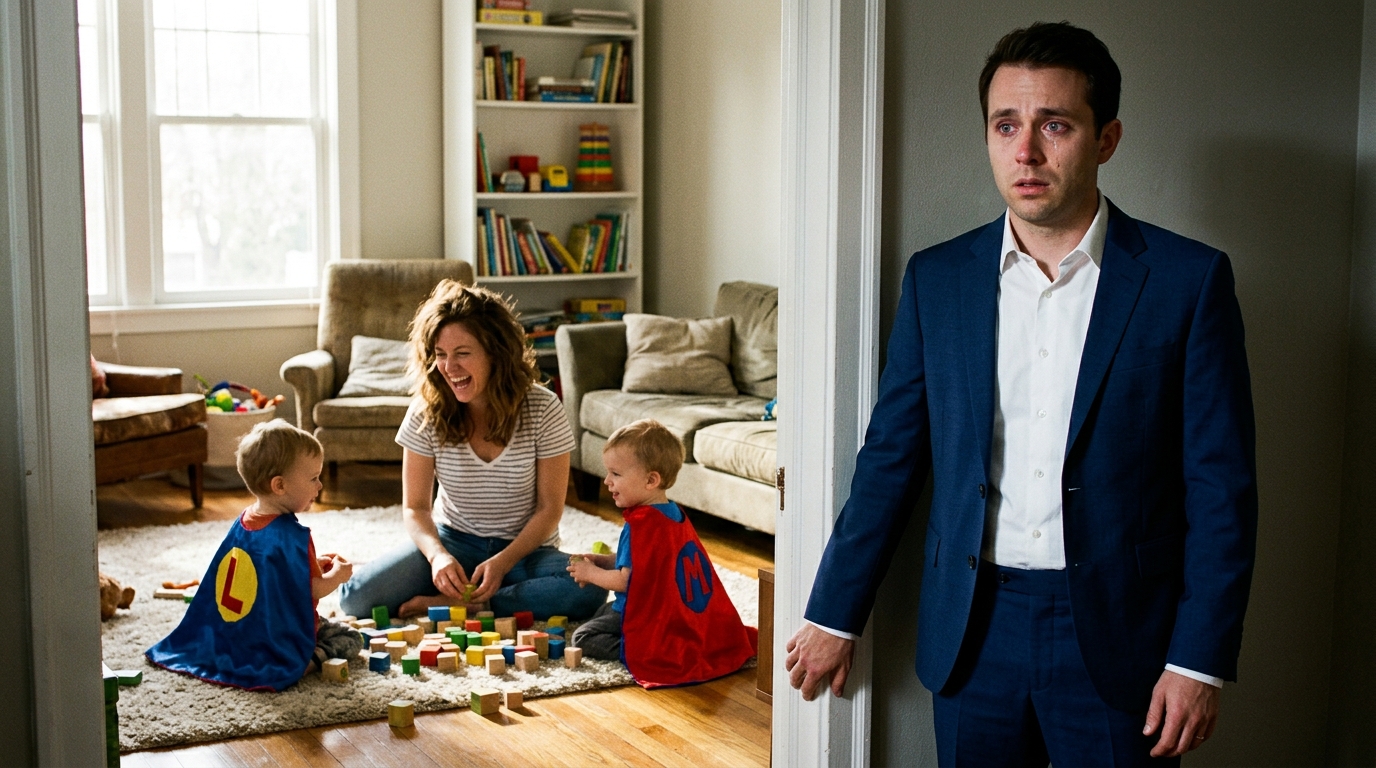
Blocks scattered across the rug like bright plastic confetti. Two little boys in matching superhero capes toddled between a cardboard rocket ship and a pile of stuffed animals, laughing so hard they could barely stand.
A woman sat on the floor with them.
Her hair was tied loosely at the back of her neck. Her sleeves were rolled up. A blue blanket lay across her lap, covered with toy soldiers, wooden trains, and tiny plastic helmets.
She smiled at them like a mother.
Not like someone pretending.
That was what broke me first.
The way she smiled.
“Captain Leo,” she said, lifting one of the boys into her arms. “Your mission is to rescue the moon bear.”
The boy squealed.
The other twin clapped both hands.
“Captain Mateo!” he shouted.
Then the toy rocket on the floor blinked red.
A cold, robotic voice filled the room.
“Mission countdown begins.”
The boys cheered.
And I stood frozen in the doorway, unable to breathe.
My name is Adrian Cole, and for eighteen months the world believed I was dead.
My wife believed it.
My children believed it, though they were too young to understand the word.
My company held a memorial.
My mother kept my photograph beside a candle.
There was a grave with my name on it.
And now, after surviving a crash, a coma, and months of recovery under a false identity in a foreign hospital, I had finally made it home.
Only to find my sons laughing with another woman.
Not with me.
Not anymore.
I gripped the doorframe, trying to steady myself.
They were so close.
Ten feet away.
Maybe less.
Leo had my eyes.
Mateo had my smile.
They were bigger than the babies I remembered. When I last held them, they were six months old, warm and small against my chest, two tiny bodies breathing in uneven rhythm while I whispered nonsense into their hair.
Now they could walk.
Talk.
Laugh.
Call themselves captains.
And when Mateo finally noticed me in the doorway, his face changed.
The joy vanished.
His mouth opened.
A sharp cry tore out of him.
Leo turned.
Saw me.
Then he cried too.
Not the soft cry of confusion.
Fear.
They scrambled backward toward the woman on the floor, tiny hands clutching her sleeves.
My heart split open.
“No,” I whispered.
One desperate word.
The woman looked up.
At first, annoyance flashed across her face, as if a staff member had interrupted a private moment.
Then she saw me clearly.
Her body went still.
The color left her cheeks.
“Adrian?”
Her voice trembled on my name.
I knew her.
Of course I knew her.
Claire Bennett.
My wife’s younger sister.
My sons’ aunt.
The woman who had stepped into my house after my supposed death to help raise the children.
The woman everyone praised for her sacrifice.
The woman sitting on the floor while my sons clung to her like she was the center of their world.
I tried to step forward.
Both boys screamed louder.
Claire pulled them close.
Not protectively.
Possessively.
That was the second thing I noticed.
Her arms tightened around them before she even thought to explain.
“Don’t come closer,” she said.
I stared at her.
“They’re my sons.”
The words sounded broken.
Small.
As if saying them could make them true again.
Claire’s eyes glistened.
“They don’t know you.”
That sentence landed harder than the crash that had nearly killed me.
I looked at the boys.
At their frightened faces.
At the toy rocket still blinking on the rug.
“Mission countdown begins,” the cold little voice repeated.
I almost laughed.
Not because anything was funny.
Because the sound was cruel.
A countdown.
Yes.
That was exactly what this felt like.
The last seconds before whatever remained of my old life finally detonated.
“Where is Elena?” I asked.
Claire looked down.
Too quickly.
My wife’s name changed the room.
Leo buried his face in Claire’s shoulder.
Mateo sobbed into her sleeve.
“Where is my wife?” I asked again.
Claire’s eyes lifted to mine.
This time there was no surprise.
No joy.
Only dread.
“Adrian,” she whispered, “Elena isn’t here.”
I took one step into the room.
The boys cried harder.
Claire flinched.
And that was when I saw it.
On the low bookshelf behind her.
A framed photograph of my sons.
Claire standing between them.
All three smiling.
Under the photograph, in bright wooden letters, someone had arranged three words.
Mommy’s Brave Captains.
Not Aunt Claire.
Not family.
Mommy.
The floor seemed to tilt beneath me.
My future had not simply moved on without me.
Someone had rewritten it.
The Death Certificate With My Name on It
I did not die in the crash.
That was the first fact no one in that house had been allowed to know.
The private jet went down over the Atlantic during a storm, three hours after leaving Lisbon. There were six people on board. Four bodies were recovered. One passenger was never found.
Me.
The reports called it a miracle at first, then a tragedy, then a closed file.
But I had been pulled from the water by a fishing vessel registered under a different flag. My passport was gone. My face was badly injured. My skull was fractured. I woke in a small coastal hospital six weeks later, unable to remember my own name.
For months, I was no one.
A man without documents.
A patient with scars.
A body that had survived but forgotten why survival mattered.
Then one morning, during physical therapy, I saw a pair of toddler shoes in the hallway.
Blue.
Tiny.
Velcro straps.
Something inside me cracked open.
Leo.
Mateo.
The memories returned in pieces after that.
My wife, Elena, standing barefoot in our kitchen, laughing because both babies had fallen asleep in the laundry basket.
My sons wearing matching striped pajamas.
The toy rocket I bought them before my trip.
My last call home.
“Daddy will be back before Captain Leo and Captain Mateo launch their next mission,” I had promised.
I was wrong.
The American consulate took weeks to confirm who I was. My face had changed. My fingerprints were damaged. Records were slow. Powerful people called the wrong offices or no offices at all.
By the time I reached New York, eighteen months had passed.
I expected grief.
I expected shock.
I expected Elena to collapse into my arms, angry and relieved and heartbroken all at once.
I expected my sons not to remember me clearly.
They had been babies.
That would hurt, but I understood.
What I did not expect was fear.
Not ordinary stranger fear.
Learned fear.
The kind children carry when adults have given them a story before they are old enough to question it.
Claire had no answer when I asked why my sons screamed at the sight of me.
She only rocked them, whispering, “It’s okay, Mommy’s here,” as if the word did not cut me open each time.
I stood in the doorway, still wearing the blue suit the consulate gave me because my own clothes had been destroyed in the crash. It fit badly. Too sharp at the shoulders. Too loose at the waist.
I must have looked like a ghost trying to dress as a man.
“Stop calling yourself that,” I said.
Claire’s face hardened.
“They call me that.”
“You taught them to.”
Her eyes flashed.
“I raised them.”
That one landed.
Because it was true.
Or partly true.
And truth, used cruelly, can wound deeper than lies.
“Where is Elena?” I asked.
Claire closed her eyes.
“She left.”
The room went silent except for the boys’ fading sobs.
“What do you mean, left?”
Claire stood slowly, holding Mateo on her hip while Leo clung to her leg.
“She couldn’t handle it after you died.”
“I didn’t die.”
“We all thought you did.”
“Where is she?”
“She signed over temporary custody and disappeared.”
“No.”
Claire’s mouth tightened.
“She abandoned them, Adrian.”
“No.”
The word came out low.
Dangerous.
Elena was many things. Impatient. Stubborn. Fiercely proud. Terrible at asking for help.
But she would not abandon her children.
Not voluntarily.
Not after everything we survived to have them.
I looked at the boys again.
Their cheeks were wet. Mateo’s little fist clutched the collar of Claire’s shirt.
“Who told them to fear me?”
Claire looked wounded.
“You walk in after eighteen months and accuse me?”
“I walked in and my sons screamed like I was a monster.”
“They don’t know you.”
“They’re afraid of me.”
“They lost their father.”
“I am their father.”
Leo peeked at me from behind her leg.
For one second, our eyes met.
Something flickered there.
Not recognition.
Curiosity.
Then Claire turned his face away.
That small movement answered a question I had not yet asked.
She was not just afraid I had come back.
She was afraid they might.
The Room Elena Left Behind
I did not stay in the playroom.
I couldn’t.
Every time I looked at the boys, their fear tore through me. Every time Claire whispered comfort into their hair, I felt the strange, humiliating truth of my absence.
I had survived.
But I had not been there.
Survival did not give me back the eighteen months they spent needing someone else.
So I stepped into the hallway.
My old house was almost unrecognizable.
The photographs of me and Elena had been removed.
The wedding portrait above the staircase was gone.
My office door was locked.
My mother’s quilt had disappeared from the reading chair.
The house smelled faintly of lavender, not Elena’s cedar candles.
Claire had not moved into our home.
She had replaced it.
I walked toward the master bedroom, but Claire followed quickly.
“Don’t go in there.”
I stopped.
“Why?”
She shifted Mateo higher on her hip.
“It’s not your room anymore.”
I turned slowly.
For a moment, neither of us spoke.
Then I reached for the door.
Claire said my name once.
A warning.
I opened it anyway.
The room was neat.
Too neat.
Bed made.
Curtains drawn.
No Elena.
No trace of her perfume.
No scarf on the chair.
No half-read book near the lamp.
No chaos of the woman I loved.
Only a room staged to prove absence.
But in the corner, beneath the window seat, I saw a small cardboard box.
My chest tightened.
Claire stepped around me.
“That’s nothing.”
I moved faster.
She reached for it, but I blocked her with my body and pulled the box into the light.
Inside were Elena’s things.
Not many.
A broken phone.
A hospital bracelet with her name on it.
A photograph of the boys as newborns.
And a folded letter.
My hands shook as I opened it.
The handwriting was Elena’s.
Messier than usual.
Written in haste.
Adrian,
If you are alive, they lied to both of us.
If you are dead, then I am writing to the only part of you that still exists in this house.
Claire says I am unstable. Your father agrees. They say the boys are safer without me until I “accept reality.” But reality is wrong. I know what I heard.
Someone called from Lisbon. A man said there was an unidentified survivor asking for “Elena” and “the captains.”
The call was cut off.
After that, your father took my phone. Claire moved into the house. They said grief was making me dangerous.
I am going to find you.
If I don’t come back, do not believe I left our sons.
I love them.
I love you.
Tell Leo and Mateo I never stopped being their mother.
The paper blurred in my hands.
Not from tears alone.
From rage.
My father.
The words hit one by one.
Your father agrees.
My father, Malcolm Cole, had controlled the family company, the family lawyers, the family narrative, and, apparently, my death.
He had never liked Elena.
She came from nothing, he said.
Too emotional.
Too independent.
Too unwilling to be shaped into the kind of wife who smiled beside corporate power and never asked what it cost.
And Claire?
Claire had always lived in Elena’s shadow.
Younger.
Softer.
Needier.
Always close enough to help, always wounded enough to be forgiven.
I looked up.
Claire stood in the doorway.
Mateo had stopped crying.
Leo stood beside her, thumb in his mouth, watching me.
“What did you do?” I whispered.
Claire’s face crumpled.
“I saved them.”
I stood.
“Where is Elena?”
“She was sick.”
“Where is she?”
“She was obsessed with finding you.”
“She was right.”
“She scared the boys.”
“They were babies.”
“She scared me.”
I stepped closer.
Claire backed away.
“You let my father take her phone.”
“She needed rest.”
“You let him declare her unstable.”
“She was unstable.”
I held up the letter.
“She was looking for me.”
Claire’s eyes filled with tears.
“You were dead.”
“No. I was inconvenient.”
That silenced her.
The boys felt the shift.
Mateo began to whimper again.
I lowered my voice.
“Claire, where is my wife?”
For a long moment, she said nothing.
Then her face changed.
Not guilt.
Not remorse.
Defeat.
“She went to Lisbon,” she whispered. “And she never came back.”
The Father Who Wanted a Cleaner Story
My father arrived that evening.
Of course Claire called him.
Men like Malcolm Cole do not enter houses in panic. They arrive as if panic belongs to other people.
He stepped out of a black car in a charcoal overcoat, silver hair combed back, expression composed. He looked older than when I last saw him, but not softer.
When he entered the foyer and saw me standing there, alive, he stopped.
Only for a second.
Then he smiled.
“My son.”
I had imagined that moment a thousand times on the flight home.
My father breaking.
My father embracing me.
My father regretting every harsh word he ever said because death had nearly won.
Instead, he opened his arms like a man greeting a business partner after an inconvenient delay.
I did not move.
His smile faded.
“You’ve been through a trauma,” he said.
I almost laughed.
“Yes.”
“We need doctors. Lawyers. Privacy.”
“There it is.”
His brow tightened.
“What?”
“Privacy. Always your favorite word when truth becomes expensive.”
Claire stood near the stairs with the twins behind her. A nanny had taken them for a while, but they had wandered back down, drawn by voices they did not understand.
My father looked past me at them.
“Boys,” he said gently.
Leo hid behind Claire.
Mateo stared at me.
My father noticed.
Something like satisfaction moved across his face.
He turned back to me.
“Reentry must be handled carefully. You have been legally declared deceased. The children have adjusted. Claire has provided stability.”
“Where is Elena?”
His expression did not change.
“She left.”
“Because you forced her out.”
“She was unwell.”
“She received a call saying I was alive.”
He paused.
Too long.
That was all the confirmation I needed.
“You knew.”
My father removed his gloves slowly.
“I knew there was an unverified report from a foreign clinic. I also knew Elena was spiraling. Chasing false hope would have destroyed the children.”
“She was right.”
“That was not clear at the time.”
“You took her phone.”
“She needed to stop receiving fraudulent calls.”
“You signed paperwork questioning her capacity.”
“She was a danger to herself.”
“And then she vanished.”
His jaw tightened.
“She chose to leave.”
I stepped closer.
“Say her name.”
He looked annoyed.
“What?”
“Say my wife’s name.”
He said nothing.
That was my father.
People became useful titles or inconvenient categories.
Wife.
Mother.
Liability.
Problem.
Never Elena.
I pulled the letter from my pocket and held it up.
“She wrote this before going to Lisbon. She said if she didn’t come back, we should not believe she abandoned the boys.”
Claire began crying quietly.
My father glanced at her.
A warning look.
She lowered her eyes.
“Adrian,” he said, “you are making emotional conclusions with incomplete information.”
“No. I’m finally making human conclusions despite the information you buried.”
The front door opened behind him.
Three people entered.
My mother.
A woman I did not know.
And a man holding a leather file.
My mother looked thinner than memory, but when she saw me, she broke completely.
She crossed the foyer and gripped my face in both hands.
“My boy,” she sobbed. “My boy.”
I closed my eyes.
For one moment, I let myself be held.
Then she pulled back and looked at my father with a hatred I had never seen in her.
“You told me not to come.”
He stiffened.
“Margaret—”
“You told me the doctors said seeing him would overwhelm him.”
I looked at her.
“What doctors?”
The woman beside my mother stepped forward.
“My name is Nora Vance. I’m a private investigator. Mrs. Cole hired me six months ago to locate Elena Cole.”
My father went still.
Claire whispered, “No.”
Nora opened the file.
“Elena traveled to Lisbon seventeen months ago. She checked into the Santa Mar hospital under her own name. She requested information about an unidentified American male patient. Twenty-four hours later, she disappeared from the hospital’s visitor registry.”
My chest tightened.
“What do you mean disappeared?”
Nora looked at my father.
“Security footage from the hospital shows her leaving with two men.”
She removed a photograph.
Grainy.
Black and white.
Elena in the hospital corridor.
One man holding her arm.
The other walking beside her.
I recognized the second man instantly.
My father’s security chief.
I looked at Malcolm Cole.
He did not deny it.
He simply closed his eyes.
As if disappointed that the photo existed.
The Truth the Children Heard
I wanted to hit him.
That is the honest truth.
For one brief, ugly second, I wanted to become the kind of son he always accused me of being.
Emotional.
Uncontrolled.
Weak.
Then Mateo made a small sound from behind Claire.
I turned.
Both boys were watching.
Their eyes were wide.
Afraid.
Not of me now.
Of the room.
Of the adults.
Of the truth rising too loudly around them.
So I did not hit my father.
I lowered my voice.
“What did you do to Elena?”
My father looked toward the children.
“This is not appropriate.”
“No,” I said. “Kidnapping my wife was not appropriate.”
Claire gasped.
My mother’s hand flew to her mouth.
Nora continued, calm but grave.
“Elena was not killed. We found records suggesting she was admitted to a private psychiatric facility outside Porto under a false referral arranged by an American legal representative.”
The word psychiatric moved through the foyer like poison.
I knew what it meant.
It meant my father had done to Elena exactly what he had always done to inconvenient truths.
He had renamed her.
Unstable.
Unfit.
Unreliable.
Then he hid her behind paperwork.
“Is she alive?” I asked.
Nora’s expression softened.
“Yes.”
The word nearly took my legs out from under me.
My mother caught my arm.
“She is alive,” Nora repeated. “But she has been difficult to access legally. I have an attorney in Portugal working with local authorities. Your return changes everything.”
Claire sank onto the stairs.
“Oh God.”
I looked at her.
“You knew.”
She shook her head.
“I didn’t know that.”
“But you knew she didn’t abandon them.”
She covered her mouth.
Tears spilled over her fingers.
“I wanted to be their mother.”
The sentence was so raw, so pathetic, so unforgivable that no one spoke.
Claire looked at the twins, then at me.
“I loved them. I did. I love them.”
“I know,” I said.
Her face lifted, hopeful for half a second.
Then I finished.
“But love without truth becomes theft.”
She crumpled.
My father stepped forward.
“Enough. This woman kept your sons alive while you were gone.”
My mother turned on him.
“And you kept their mother locked away.”
He glared at her.
“I protected this family.”
“No,” she said. “You edited it.”
That silenced him.
The investigator’s phone buzzed.
She looked down.
Then at me.
“My contact in Portugal just sent confirmation. Elena has been located and removed from the facility pending review. She is asking for two things.”
I could barely breathe.
“What?”
Nora’s eyes moved to the boys.
“Her sons.”
My voice broke.
“And?”
“You.”
For the first time since returning home, I cried openly.
Not quietly.
Not elegantly.
I stood in the foyer of my stolen life and wept.
Leo stepped away from Claire.
Only one step.
But it was toward me.
Mateo followed him.
They did not come into my arms.
Not then.
But they came close enough to look.
Leo pointed at the photograph in Nora’s file.
“Mommy?”
Claire flinched.
The word no longer belonged only to her.
I knelt slowly, careful not to frighten them.
“Yes,” I said. “That’s your mommy.”
Mateo looked confused.
He glanced at Claire.
Then back at the photo.
“Two mommies?”
How do you explain adult betrayal to a toddler?
You don’t.
You kneel on the floor and refuse to make them carry the full weight of it.
“Claire took care of you,” I said carefully. “Your mommy Elena loves you. She has been trying to come home.”
Leo looked at me for a long moment.
Then at my face.
“Daddy?”
The word was a question.
Not a reunion.
Not forgiveness.
But a beginning.
I pressed a hand to my mouth.
“Yes,” I whispered. “I’m Daddy.”
He did not hug me.
But he did not run.
That was enough for my broken heart to survive the night.
The Family Built Again From the Floor
Elena came home twelve days later.
Not to the house.
I refused to let her first return to the place where she had been erased.
We met her at a private medical center in Boston, where doctors had confirmed what Nora’s team already knew. She had been heavily medicated for months under false psychiatric claims, then kept in administrative limbo after the payments stopped and the paperwork became too tangled for anyone to resolve quickly.
When she entered the family room, she was thinner than the woman in my memory.
Her hair was shorter.
Her face older.
But her eyes—
Her eyes were Elena’s.
The boys stood beside me, each holding one of my hands.
Claire was not there.
My father was already under investigation.
My mother waited outside, giving us the moment she knew she had no right to enter first.
Elena saw Leo and Mateo.
Her face collapsed.
“My babies.”
The boys stared.
They knew her from photographs now.
From stories.
From the song she used to sing in the videos I found backed up in an old cloud account.
But knowing a mother has come home is not the same as remembering the warmth of her arms.
Elena knelt.
She did not rush toward them.
That broke me.
Even after everything, she was careful not to frighten the children who had been taught to live without her.
“Hi, my brave captains,” she whispered.
Mateo’s face changed first.
Recognition did not arrive as memory.
It arrived as sound.
The words.
The name.
The voice from infancy stored somewhere deeper than speech.
He released my hand and took two steps forward.
Then stopped.
Elena held out both hands, palms up.
Leo followed his brother.
They reached her slowly.
Then all at once.
Elena folded around them with a sound that seemed torn from her soul.
The boys began crying.
She cried harder.
I turned away for one second because the sight was too holy for my guilt to touch.
But Elena reached for me too.
“Adrian.”
I knelt beside them.
The four of us held one another on the floor of a medical center family room while doctors, lawyers, and investigators stood outside pretending not to cry.
Healing did not come quickly.
People wanted a perfect ending.
A father returned from the dead.
A mother freed.
Twin boys reunited with both parents.
A powerful villain exposed.
But families do not rebuild like headlines.
The boys had nightmares.
Sometimes they cried for Claire.
Sometimes Elena cried because they cried for Claire.
Sometimes I hated Claire.
Sometimes I remembered she had read them bedtime stories, changed diapers, kissed fevers, and also lied.
Both truths lived in the same room.
That was the hardest part.
Claire cooperated with investigators and entered a plea agreement related to custodial interference and conspiracy, though prosecutors acknowledged my father had manipulated her grief and longing. She was not allowed contact with the boys for a long time. Later, under therapeutic supervision, Elena agreed they could receive letters.
Not because Claire deserved mercy.
Because the boys deserved an honest explanation of every person who had shaped their early lives.
My father fought the charges.
Of course he did.
He called it a medical intervention.
A family protection strategy.
A necessary decision made under extraordinary circumstances.
Then Nora found the payment trails.
The facility records.
The security footage.
The forged evaluations.
The emails describing Elena as “the last obstacle to a clean guardianship transition.”
Clean.
That was my father’s language.
Clean meant silent.
Clean meant profitable.
Clean meant Elena gone, Claire installed, the children managed, and me mourned in a way that preserved the company.
He was convicted on multiple charges tied to unlawful confinement, fraud, obstruction, and conspiracy. His lawyers kept him out of prison for a while with appeals, but he never returned to the house.
My mother divorced him after forty-one years.
Quietly.
Completely.
Elena and I sold the house.
There was too much theft in the walls.
We moved to a smaller place near the coast, where the boys could run barefoot in the sand and no hallway carried the echo of someone else’s version of our lives.
The toy rocket came with us.
For months, I hated it.
That cold little voice.
Mission countdown begins.
It reminded me of the doorway.
The screaming.
The moment I realized my sons loved someone else because I had been taken from them.
Then one morning, Mateo placed it in my lap.
“Daddy,” he said. “Fix countdown?”
The batteries had died.
I stared at the toy.
Then at my son.
“Do you want me to?”
He nodded.
“Rocket needs Daddy.”
It was such a small sentence.
A child’s sentence.
But I had to leave the room before I could answer.
Later, I fixed it.
The rocket blinked red again.
The robotic voice returned.
“Mission countdown begins.”
This time, Leo climbed onto my knee.
Mateo pressed the launch button.
Elena sat across from us on the floor, smiling through tears.
The boys shouted, “Captain Daddy!”
I laughed.
Really laughed.
For the first time since coming home.
The future I thought was lost had not returned whole.
It returned scarred.
Delayed.
Changed.
But it returned.
And sometimes, that is the only miracle life allows.
Years later, the boys asked about the time I came back.
Not all at once.
Children ask truth in pieces.
“Were you sad when we cried?”
“Yes.”
“Were you mad at us?”
“Never.”
“Did Mommy look for us?”
“Every day.”
“Did Claire love us?”
Elena answered that one.
“Yes. But love must tell the truth.”
The boys accepted that better than most adults would.
On their sixth birthday, we threw them a space party in the backyard. Cardboard planets hung from the trees. Their capes were new, but they insisted on wearing the old helmets from the playroom.
Elena brought out the repaired toy rocket.
The boys pressed the button together.
“Mission countdown begins.”
They cheered.
This time, the sound did not break me.
It reminded me.
A countdown can be an ending.
But it can also be a beginning.
Ten.
The doorway.
Nine.
The screams.
Eight.
The letter.
Seven.
The photograph.
Six.
The truth.
Five.
Elena’s return.
Four.
The boys reaching for her.
Three.
A new house.
Two.
A repaired rocket.
One.
A family on the floor, laughing together.
People sometimes ask what the hardest part was.
Surviving the crash.
Coming home to children who feared me.
Learning my father had buried my wife alive in paperwork.
Watching another woman hold my sons while they called her Mommy.
The answer is simpler.
The hardest part was accepting that love does not pause when you disappear.
Children grow.
Grief changes shape.
Other hands comfort.
Other voices become familiar.
Coming back did not mean walking into the life I left.
It meant earning a place in the life that had survived without me.
So I earned it.
Breakfast by breakfast.
Story by story.
Nightmare by nightmare.
Countdown by countdown.
And every time Leo or Mateo runs into my arms now, I feel the weight of that first doorway again.
The shadow.
The crying.
The woman on the floor.
The toy voice.
Mission countdown begins.
Back then, I thought it meant my family was over.
I know better now.
It was the countdown to the truth.
And the truth, terrible as it was, brought us home.