The Girl in the Yellow Coat
The little girl did not offer me food because she was kind.
At least, not only because she was kind.
She offered it because, somewhere deep inside her small heart, she believed she had found her mother.
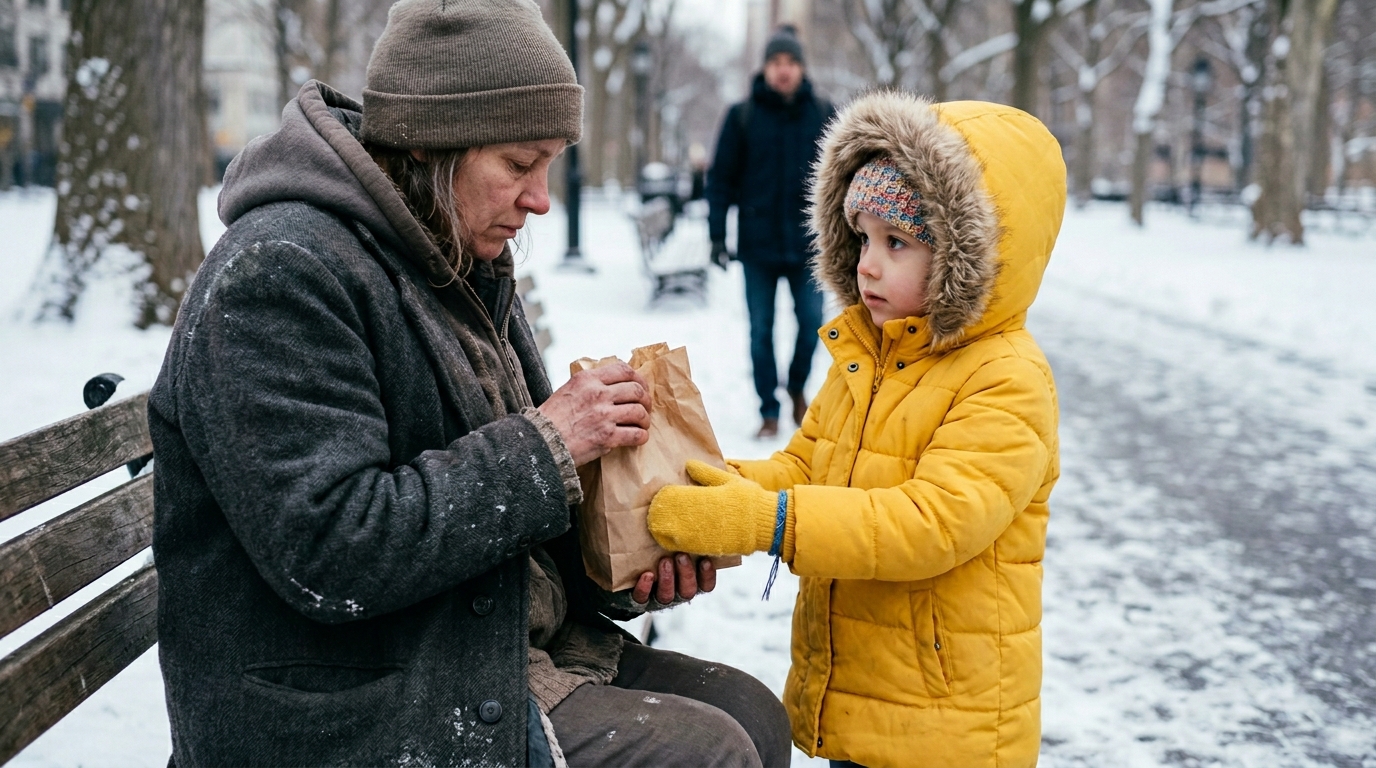
Snow fell softly over the city that afternoon, the kind of snow that looks gentle from behind warm windows but turns cruel when you have nowhere to go. It gathered on the shoulders of my gray coat, inside the torn seams of my sleeves, and around my bare ankles where my shoes had given up two days earlier.
People passed me without slowing.
That was normal.
A woman sitting on a bench in winter becomes part of the city’s background. A shape. A warning. A thing people teach their children not to stare at.
I kept my hands tucked beneath my arms, trying to hold on to whatever warmth remained in my body. Across the street, a bakery glowed gold through frosted windows. Every time the door opened, the smell of butter and cinnamon drifted into the cold.
It hurt more than hunger should.
I was thirty-one years old, though the mirror in the shelter bathroom had started telling a different story. My cheeks had hollowed. My hair had lost its shine. My eyes looked like they belonged to someone who had spent too long apologizing for being alive.
Then the little girl stopped in front of me.
She wore a bright yellow coat, red boots, and white mittens with tiny embroidered stars near the thumbs. Snowflakes clung to the curls escaping from under her knit hat.
She couldn’t have been more than six.
In both hands, she held a small brown paper bag.
“Are you cold?” she asked.
Her voice was so clear that I looked up before I could stop myself.
“A little,” I said.
That was a lie.
I was freezing.
“But I’m fine.”
Children know when adults lie badly.
She studied my face, not with fear, not with pity, but with a strange seriousness that made my breath catch.
Then she held out the bag.
“This is for you. Daddy bought them for me. But you look hungry.”
I stared at it.
Warmth bled through the paper.
My fingers trembled as I accepted it.
“Thank you.”
That could have been the whole story.
A child with a generous spirit.
A hungry woman on a snowy bench.
A small kindness that disappears into the day.
But the girl did not leave.
She stood there, looking at me as if she were trying to remember a dream.
“What’s your name?” she asked.
My throat tightened.
Names are dangerous when you have lost everything else.
“Claire,” I said.
The girl smiled.
“My name is Lily.”
The world stopped.
Not because Lily was an unusual name.
It wasn’t.
But once, years ago, in a hospital room filled with pain and white light, I had whispered that name to the baby I never got to hold.
Lily.
My daughter’s name would be Lily.
I must have made a sound, because the child stepped closer.
“Are you sad?”
I tried to smile.
“A little.”
She nodded again, as if sadness made perfect sense to her.
Then she said the sentence that stole the air from my lungs.
“You need a home, and I need a mom.”
The paper bag nearly slipped from my hands.
“What?”
Her eyes brightened, full of innocent hope.
“My daddy says moms can go away and still come back if God wants them to.”
My hands began to shake.
Not from cold now.
From something older.
Something buried.
Then I saw it.
Half hidden beneath the cuff of her mitten was a faded blue thread bracelet tied around her wrist.
My vision blurred.
It was braided in three strands.
Blue.
White.
Blue.
With one tiny silver bead in the center.
I had made that bracelet seven years earlier while sitting on the floor of our apartment, heavily pregnant, laughing as my husband tried to learn the pattern and failed.
I made only one.
For luck.
For our baby.
For Lily.
I reached toward it, then stopped myself.
“Where did you get that?” I whispered.
The girl looked down at her wrist.
“My daddy said my mommy made it before I was born.”
The snow kept falling.
The city kept moving.
But I could no longer hear it.
In the distance, a man’s voice called, “Lily?”
The girl turned.
“Daddy! I found someone!”
A man crossed the sidewalk toward us, carrying a bakery box in one hand and a child’s scarf in the other. He wore a dark wool coat, his hair dusted with snow, his expression caught somewhere between worry and apology.
Then he saw me.
He stopped.
The scarf slipped from his hand.
I looked up at him, and the paper bag fell from my fingers onto the snow.
Because I knew his face.
Older now.
Sharper with grief.
But still the face I had loved.
Ethan.
My husband.
The man who had been told I died the night our baby was born.
The Husband Who Buried an Empty Grave
For a long moment, Ethan did not move.
Neither did I.
The little girl looked between us, confused by the silence that had suddenly swallowed the street.
“Daddy?” she said.
Ethan’s lips parted.
No sound came out.
Snow gathered on his shoulders, melting into the dark wool of his coat. His eyes moved across my face with a terror so deep it looked almost like pain.
Then he whispered my name.
“Claire?”
I had imagined hearing my name in his voice a thousand times.
In shelters.
In hospital waiting rooms.
On bus benches.
In the half-sleep that comes when your body is too exhausted to dream properly.
But nothing in my imagination prepared me for the way it broke inside him.
“Ethan,” I said.
His knees almost gave out.
Lily reached for his hand.
“Daddy, do you know her?”
He did not answer.
He stepped closer, slow, as if one sudden movement might make me disappear.
“You’re dead,” he whispered.
The words hit me harder than the cold.
I shook my head.
“No.”
His eyes filled.
“They told me you died.”
“I know.”
That was all I could say.
I know.
Two small words holding seven years of stolen life.
Lily looked up at him again.
“Daddy?”
Ethan finally remembered she was there.
He knelt beside her, but his eyes never left me.
“Lily,” he said, his voice shaking, “go stand by Mrs. Patel at the bakery door for one minute, okay?”
The bakery owner, who had been watching through the window, stepped outside immediately. She knew Ethan. Everyone in that neighborhood seemed to know him.
Lily hesitated.
“But she’s cold.”
“I know,” Ethan said softly. “I’m going to help her.”
The little girl looked at me one more time before walking toward the bakery.
Not afraid.
Certain.
As if she had completed the task she came into the world to do.
Ethan sat on the bench beside me.
He did not touch me at first.
I was grateful.
I looked nothing like the woman he had lost.
The woman he married had thick dark hair, steady hands, and a laugh that filled small rooms. The woman on the bench wore donated clothes, had cracked lips, and flinched when footsteps came too close.
“Tell me,” he said.
I looked down at my hands.
“Where do I start?”
“The hospital.”
Of course.
The place where our lives split open.
I closed my eyes.
Seven years vanished.
I was back in the private maternity ward, the air sharp with antiseptic, machines beeping around me, Ethan’s hand wrapped around mine.
The labor had been difficult.
Too much bleeding.
Too many doctors entering too quickly.
I remembered Ethan being forced out for an emergency procedure. I remembered screaming for him. I remembered a nurse saying, “Stay with us, Claire.”
Then darkness.
When I woke, I was not in the same hospital.
I was in a smaller room with no windows.
My wrists were restrained.
My throat felt raw.
A woman I didn’t know told me there had been complications. She said my baby was gone. She said Ethan had signed papers. She said I had suffered a breakdown and needed treatment before I could see anyone.
I didn’t believe her.
So I fought.
That made it easier for them to call me unstable.
For weeks, maybe months, I was moved between facilities under a name that wasn’t mine. Medication blurred time. Paperwork vanished. Every time I asked for my husband, they told me he had moved on because I had become a danger to myself and others.
Eventually, I escaped.
But escape is not the same as freedom.
I had no identification.
No phone.
No money.
No proof I was alive.
When I finally reached someone who would help me search, the records said Claire Bennett had died from childbirth complications.
There was a death certificate.
A burial record.
An obituary.
A grave.
My grave.
Ethan covered his face with both hands.
A sound came from him that did not sound human.
I wanted to comfort him.
But I did not know if I still had that right.
“They told me you died,” he said again.
His voice was hoarse now.
“My mother told me. The doctor told me. The hospital administrator told me. They wouldn’t even let me see your body because they said the trauma was too severe.”
A coldness moved through me sharper than winter.
His mother.
Margaret Bennett.
She had never wanted me.
She thought I was too ordinary for her son, too poor, too unpolished, too stubborn. She smiled in public and corrected me in private. She once told Ethan that love was sweetest before it became a legal problem.
“Ethan,” I said carefully. “Who handled the arrangements?”
He looked at me.
The answer was already in his eyes.
“My mother.”
The snow seemed to stop falling.
For seven years, I had believed the nightmare was faceless. A hospital error. A criminal doctor. A system that swallowed poor women and rewrote their stories.
But now the shape of it began to appear.
Elegant.
Controlled.
Wearing pearls.
Speaking softly.
Ethan’s voice dropped.
“She told me you were gone before I got back into the room. She said she held our daughter because I was too distraught. She named her Lily because it was what you wanted.”
I looked toward the bakery window.
Lily stood inside, both hands pressed to the glass, watching us.
The bracelet glowed faintly against her sleeve.
My bracelet.
My daughter.
Our daughter.
Then Ethan said the sentence that made the past become a crime.
“My mother kept all your things.”
The Room Where My Life Was Hidden
Ethan did not take me to his house immediately.
He took me to the hospital first.
Not the old hospital.
A different one.
A safe one.
He wrapped his coat around my shoulders, called a private doctor he trusted, and stayed in the room while nurses cleaned cuts on my feet and checked the frostbite beginning in my toes.
Lily refused to leave.
She sat in the corner with Mrs. Patel, holding a cup of cocoa and staring at me like she was afraid I might vanish if she blinked too long.
I kept staring back.
Every movement hurt.
Her fingers.
Her chin.
The way she tilted her head when listening.
She was Ethan.
She was me.
She was the living proof that whatever had been stolen had not been destroyed.
When the doctor left, Ethan sat beside my bed.
“I looked for answers,” he said quietly. “For years.”
I turned toward him.
“They told you I was dead.”
“I know.” His jaw tightened. “But things never made sense.”
He told me about the night I “died.”
How Margaret controlled everything.
How she insisted he was too shattered to handle paperwork.
How she had the funeral arranged within days.
How my body was supposedly already prepared and sealed.
How she told him seeing me would ruin his last memory of me.
He had been twenty-eight, grieving, holding a newborn daughter, and surrounded by people in expensive suits who spoke in calm voices and treated his questions like symptoms.
Then, over the years, he began to notice gaps.
Hospital staff who left suddenly.
A doctor who retired early.
A nurse who refused to speak to him but cried when he mentioned my name.
He hired investigators twice.
Both times, they found nothing.
Or nothing they were allowed to show him.
“My mother said I was torturing myself,” he said. “She said Lily needed me alive, not obsessed with ghosts.”
I looked away.
Ghost.
That was what I had been made into.
Ethan’s hand trembled on the edge of the blanket.
“Claire, I buried an empty coffin.”
Neither of us spoke for a while.
There are griefs too large for language.
Then Lily slid down from her chair and walked toward me.
Ethan started to stop her, but I shook my head.
She came to the side of the bed.
“Are you my mom?”
The question was so simple.
So impossible.
Tears burned my eyes.
“I think so,” I whispered.
She frowned.
“Daddy says thinking is for math. Is your heart sure?”
A broken laugh escaped me.
Then a sob.
“Yes,” I said. “My heart is sure.”
She climbed carefully onto the edge of the bed and placed her mittened hand near mine.
Not grabbing.
Offering.
I touched her fingers.
Just that.
A mother meeting her child seven years late.
Ethan turned away, shoulders shaking.
The next morning, after I was warm, fed, and examined, Ethan drove us to his house.
Not the mansion his mother lived in.
His own home.
A brownstone with flower boxes, books in the windows, and a small wooden cross hanging near the front door. Lily ran ahead, calling for her stuffed rabbit, eager to show me proof of her life.
I stood in the entryway, unable to step farther.
The house smelled like cinnamon, laundry soap, and crayons.
Home.
The thing I had stopped letting myself imagine.
Ethan came beside me.
“You don’t have to do anything fast.”
I nodded.
Then I saw the framed photograph on the hallway table.
Ethan on a hospital chair, holding newborn Lily.
His face destroyed by grief.
Behind him stood Margaret.
Perfect hair.
Pearl earrings.
One hand resting on his shoulder like ownership.
My stomach turned.
“She has a room upstairs,” Ethan said.
“Who?”
“My mother. She stays here sometimes when she visits Lily.”
A strange stillness entered me.
“Does she have my things?”
He nodded slowly.
“Some. She said she kept them for Lily.”
“Show me.”
Ethan hesitated.
“Claire—”
“Please.”
He led me upstairs to a guest room that looked untouched. Cream curtains. White bedspread. A locked antique wardrobe in the corner.
Ethan stared at it.
“I never had the key.”
Of course not.
Margaret would never leave memory unlocked.
Ethan called a locksmith.
I stood beside the wardrobe while we waited, feeling my pulse in my throat.
When the door finally opened, the smell hit me first.
Cedar.
Dust.
Old perfume.
Inside were boxes.
My clothes.
My journals.
Letters I had written Ethan during our first year together.
Hospital discharge papers under a false name.
A folded blue blanket I had sewn while pregnant.
And beneath it, a sealed envelope addressed to Margaret Bennett.
Ethan opened it with shaking hands.
Inside was an invoice.
Not from a funeral home.
From a private medical transport company.
The date was the night Lily was born.
Patient relocation. Female. Sedated. No family contact authorized.
Ethan sat down on the floor.
I gripped the edge of the wardrobe to stay standing.
The room seemed to tilt around us.
Then Lily’s voice came from the doorway.
“Grandmother is here.”
The Woman Who Called Me Dead
Margaret Bennett entered the house wearing a camel coat, leather gloves, and the expression of a woman accustomed to rooms arranging themselves around her.
She stopped at the bottom of the staircase when she saw me.
For one second, her face emptied.
No grief.
No joy.
No shock.
Only calculation.
Then she placed a hand over her heart.
“My God,” she whispered. “Claire?”
Ethan descended the stairs slowly.
I followed, one hand on the rail.
Lily stood near the living room door, clutching her stuffed rabbit, sensing the air had changed but too young to understand why.
Margaret’s eyes moved to the child first.
Always control the child.
Then to Ethan.
“My darling,” she said. “You should have called me. This must be very confusing.”
Ethan held up the invoice.
His hand shook, but his voice did not.
“What is this?”
Margaret looked at the paper.
Then at me.
Then sighed.
Not like a woman caught.
Like a woman inconvenienced.
“Ethan, there are things you don’t understand.”
He took one step down.
“Then explain them.”
She removed her gloves slowly.
“I protected you.”
The words made something inside me go cold.
People who destroy lives often call it protection.
Ethan’s voice cracked.
“You told me my wife was dead.”
Margaret’s eyes flashed.
“She was as good as dead to you.”
The room went silent.
There it was.
Not an accident.
Not confusion.
Not grief.
A decision.
Lily began to cry quietly.
I moved toward her, but Margaret snapped, “Don’t.”
The word hit the room like a whip.
Ethan turned on her.
“Do not speak to her like that.”
Margaret looked genuinely offended.
“She is my granddaughter.”
“She is Claire’s daughter.”
Margaret’s mouth tightened.
“She was a newborn. She needed stability.”
“She needed her mother.”
“She needed a mother who would not drag her into poverty.”
The cruelty landed so cleanly I almost admired its honesty.
For years, I had wondered why.
Why me?
Why take a woman’s baby?
Why fake a death?
Now the answer stood in a camel coat beneath a family chandelier.
Class.
Control.
Inheritance.
Margaret had not seen me as a wife.
She had seen me as contamination.
Ethan stared at her as if watching his childhood burn.
“You did this because Claire wasn’t rich?”
Margaret’s eyes filled with tears then.
Real ones, maybe.
But not for me.
For herself.
“I did it because you were throwing your life away. You married a girl with nothing. No family influence. No future. I knew once the baby came, you would never leave her. So I made the choice you were too sentimental to make.”
I had imagined confronting the person responsible for seven years.
I thought I would scream.
I thought I would collapse.
Instead, I felt strangely calm.
“Where did you send me?” I asked.
Margaret looked at me with faint disgust.
“You were cared for.”
“I was drugged.”
“You were unstable after birth.”
“You made me unstable.”
Her face hardened.
“You always had a flair for drama.”
Ethan moved to the table and pressed a button on his phone.
A voice came through the speaker.
“Mr. Bennett?”
His attorney.
Ethan had already called him.
Margaret noticed.
For the first time, fear touched her expression.
“Ethan,” she said softly. “Do not do this to your mother.”
He laughed.
It was the saddest sound I had ever heard.
“You buried my wife.”
“I saved your daughter.”
“No,” he said. “Claire did that. She survived.”
A car door closed outside.
Then another.
Margaret looked toward the window.
Two police officers approached the front steps with a man in a dark suit.
Ethan’s attorney.
Lily ran to my side and wrapped her arms around my waist.
I nearly fell from the force of feeling it.
Margaret stared at us.
At her granddaughter choosing the woman she had erased.
Something bitter twisted her face.
“She doesn’t know you.”
Lily looked up.
“Yes, I do.”
Margaret froze.
Lily lifted her wrist, showing the faded blue bracelet.
“My heart knew first.”
The officers knocked.
Ethan opened the door.
And for the first time in seven years, Margaret Bennett was not the person controlling the story.
She was the person answering for it.
The First Home I Remembered
The legal battle did not end quickly.
Rich people can stretch consequences with paper.
Margaret had lawyers, influence, old hospital connections, and enough money to make simple truth walk through mud before reaching the courthouse.
But she had also kept records.
That was her arrogance.
She believed if she documented a crime in elegant enough language, it became management.
Private transfer authorizations.
Payments to a doctor who had since moved overseas.
Confidentiality agreements.
False psychiatric notes.
An empty funeral contract.
The coffin receipt.
My death certificate.
A signature from a hospital administrator who resigned three months after Lily’s birth and later admitted, under immunity, that Margaret paid him to falsify the final records.
The first time I saw my own death certificate, I could not stop shaking.
Name: Claire Bennett.
Cause: postpartum hemorrhage.
Status: deceased.
A government document had turned me into a memory while I was still breathing.
Ethan sat beside me through every deposition.
Sometimes I hated him for believing them.
Then I hated myself for hating him.
Then I remembered he had been lied to while holding a newborn and grieving a wife.
Pain is rarely clean when everyone has been wounded by the same hand.
Lily became the center of our slow repair.
She did not understand all the legal words.
Kidnapping.
Fraud.
Conspiracy.
False imprisonment.
Custodial interference.
She only knew that her mother had been lost and found.
At night, when I stayed in the guest room because I was not ready for anything more, Lily would knock softly and ask if I wanted to hear about her day.
She told me about school.
About her missing front tooth.
About the time she spilled paint on her teacher’s shoe.
About how Daddy cried on Christmas when he thought she wasn’t looking.
One evening, she brought me a box.
Inside were drawings.
Dozens of them.
A little girl.
A tall man.
And a woman with no face.
“I didn’t know what you looked like,” she said.
My throat closed.
I touched the faceless woman gently.
“May I draw one with you now?”
She nodded.
We sat on the floor with crayons.
She drew my hair too long and my eyes too big.
I drew her yellow coat.
Neither of us drew Margaret.
The trial came almost a year later.
By then, I had gained weight. My hands no longer shook constantly. My hair had been cut short and healthy. I could walk through snow without scanning every bench for a place to sleep.
But courtrooms have their own winter.
Cold wood.
Cold questions.
Cold strangers deciding how much pain can be proven.
Margaret testified that she believed I was a danger to myself and the baby. She said she acted under medical guidance. She cried when describing Ethan’s grief, as if she had not manufactured it.
Then the prosecutor played the recording Ethan’s attorney had captured in the living room.
I made the choice you were too sentimental to make.
The courtroom changed after that.
Margaret’s face did not.
She sat perfectly still.
Pearls at her throat.
Hands folded.
A mother who confused possession with love.
She was convicted on multiple charges. The sentence was long enough that Lily would be grown before Margaret had any chance of walking freely through our lives again.
Afterward, reporters shouted questions outside the courthouse.
Ethan shielded Lily with his coat.
I did not speak to the cameras.
There are stories the world wants because they are dramatic.
There are truths too sacred to feed to strangers.
That winter, one year after Lily found me on the bench, we returned to the same bakery.
Mrs. Patel cried when we entered.
She had saved the table near the window.
Lily wore the yellow coat again, though the sleeves were too short now. Around her wrist, the blue bracelet had been carefully reinforced with new thread woven around the old strands.
Ethan carried three cups of hot chocolate.
I carried the pastries.
We sat together while snow began to fall outside.
For a while, none of us spoke.
Then Lily pushed half of her cinnamon roll toward me.
“You looked hungry last time,” she said.
I smiled.
“I was.”
“Are you hungry now?”
I looked at her.
At Ethan.
At the snow beyond the glass.
At my hands, warm around the cup.
“No,” I said softly. “Not the same way.”
Ethan reached across the table.
He did not take my hand.
He placed his near mine.
An offering.
Not a claim.
We were not magically healed.
Love does not simply resume after seven stolen years. Marriage does not repair itself because truth arrives. We had grief to untangle, trust to rebuild, memories to mourn, and a daughter to love carefully through the miracle and confusion of getting her mother back.
But we were alive.
All three of us.
That was enough for the first page.
Months later, I moved into the brownstone permanently.
Not into the past.
Into something new.
Ethan and I remarried quietly in the garden behind the house, though legally we had never stopped being husband and wife. Lily stood between us holding a small bouquet of white lilies and blue ribbon.
When the pastor asked if we had rings, Lily interrupted.
“Wait.”
She untied the faded blue bracelet from her wrist.
Very carefully.
Then she wrapped it around my hand and Ethan’s together.
“It brought Mommy back,” she said. “So it should stay with both of you now.”
Nobody at the wedding made it through that dry-eyed.
Not even the pastor.
Sometimes, at night, I still wake up afraid that the house is not real.
That Lily’s room down the hall is a dream.
That Ethan’s breathing beside me is a memory my mind invented to survive the cold.
When that happens, I get up and walk to Lily’s doorway.
I watch the rise and fall of her small shoulders.
Then I touch the blue bracelet, now kept in a glass frame beside our wedding photograph.
And I remember.
A snowy street.
A warm paper bag.
A child who looked at a homeless woman and saw what the world had buried.
People say Lily found me.
That is true.
But I think some part of me found her too.
A mother can be stripped of her name, her papers, her home, even her place in the living world.
But love leaves traces.
In thread.
In memory.
In a child’s face.
In the stubborn hope that God may still return what cruelty tried to erase.
That day, my daughter did not offer me pastries because she was kind.
She offered them because her heart recognized mine before the world did.
And when her father walked through the snow and saw my face, the lie that had buried me finally opened.
Not like a grave.
Like a door.
And on the other side was the life I had been trying to come home to all along.