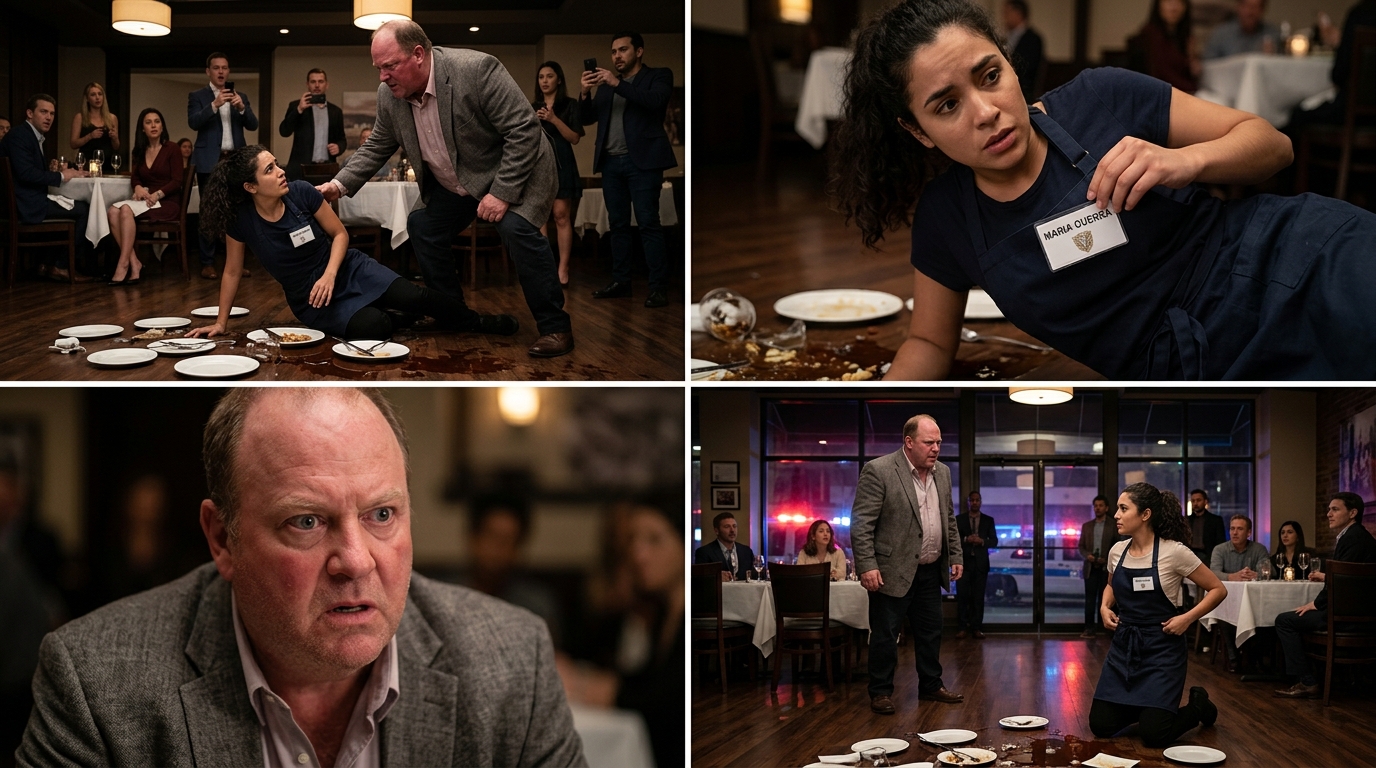
The Name Tag He Noticed Too Late
“Help! Somebody help me, please!”
The words barely left my mouth before the restaurant went silent.
Not quiet.
Silent.
The kind of silence that falls when people know something wrong has happened but are waiting to see whether someone more important will react first.
I was on the floor.
My tray lay broken beside me.
Red wine crawled across the polished tile. Sparkling water pooled beneath a chair. Shards of glass caught the soft golden light from the chandeliers above and glittered like scattered ice.
The man standing over me was breathing hard.
His face was flushed.
His hands were still half-raised from the shove.
Everyone had seen it.
Every table.
Every waiter.
Every manager.
Everyone.
And no one moved.
That was what I remembered most.
Not the pain in my hip.
Not the sting in my palm where glass had cut the skin.
Not even the humiliation of lying on the floor in my black apron while strangers lifted phones instead of hands.
It was the stillness.
The watching.
The permission that silence gives to cruelty.
The man’s name was Calvin Roarke.
He was not just a customer.
He was the kind of customer restaurants feared.
A heavy man in an expensive navy suit, with a gold watch, a loud voice, and the easy confidence of someone who believed every room should adjust itself around him. He owned buildings, sponsored charity galas, and appeared often enough in local business magazines that people called him “one of the city’s most generous developers.”
Generous men do not usually shove waitresses.
But powerful men are often described by the people too frightened to describe them honestly.
I had been serving his table for less than forty minutes.
He complained about the wine.
Then the bread.
Then the temperature of the soup.
Then the lighting.
Then my accent, though I was born twenty miles from that restaurant.
By the time he snapped his fingers in my face and told me to “move faster,” the other servers had started avoiding the section entirely.
I stayed.
Not because I wanted to.
Because I had come there to see the truth.
His table had ordered another round of drinks. I approached carefully, tray balanced on my left hand, smile fixed in the professional way women in service learn to survive.
Then he leaned back suddenly.
His elbow struck the tray.
A glass tipped.
A splash hit his sleeve.
Not much.
A few drops.
But Calvin Roarke stood as if I had thrown acid on him.
“You stupid woman!”
“I’m so sorry, sir,” I said quickly. “Let me get—”
He shoved me before I finished.
Hard.
Both hands against my shoulders.
I stumbled backward, lost my balance, and hit the floor.
The tray shattered.
Someone gasped.
Then nothing.
Phones rose.
Of course they did.
Calvin looked around, realizing he had an audience, and his face changed. Not into regret. Into performance.
“Look what she did,” he snapped. “Unstable. Incompetent. Dangerous.”
I tried to push myself up.
Pain shot through my wrist.
“Please,” I whispered. “Someone—”
The manager, Trevor Bell, stood near the bar.
He did not come to me.
He looked at Calvin.
That told me everything.
Calvin pointed at me.
“Call the police.”
Trevor nodded immediately.
“Yes, Mr. Roarke.”
I laughed once.
It came out broken.
The police.
He had shoved me to the floor, and they were calling the police on me.
Another evening.
Another public disgrace.
Another room where people waited for power to explain what their eyes had already seen.
Calvin leaned down slightly.
“You’re fired,” he said. “You incompetent—”
Then he stopped.
His eyes had dropped to my apron.
To the name tag pinned just above my heart.
MARIA GUERRA.
White letters.
Black background.
Clean.
Unbroken.
At first, he saw only the name.
Then he noticed the tiny logo beneath it.
A silver olive branch wrapped around a small letter G.
Most people would not recognize it.
Customers never did.
Even most employees did not.
But Calvin Roarke knew that emblem.
He had seen it on contracts.
On ownership deeds.
On boardroom folders.
On the private letterhead of the family trust that owned the restaurant, the building, the land under it, and half the district he had been trying to quietly acquire.
His face drained of color.
The sneer vanished.
The whole restaurant watched as his eyes fixed on that tiny mark.
His arrogance crumbled so quickly it almost looked like fear had been waiting beneath it all along.
I slowly touched the name tag with two fingers.
Not for comfort.
Not by accident.
As a reminder.
To him.
To me.
To everyone watching.
Calvin swallowed.
“Where did you get that?”
I looked up from the floor.
“My father gave it to me.”
The restaurant became even quieter.
From outside, sirens began to rise.
Calvin looked toward the entrance.
For the first time that night, he seemed to understand something.
The police he had called were coming.
But not for me.
The Waitress They Thought Was Invisible
Three weeks earlier, I had walked into Bellavita under a different kind of silence.
No cameras.
No broken glass.
No sirens.
Just the controlled hush of a luxury restaurant trying to look perfect while rotting from the inside.
Bellavita was supposed to be the crown jewel of Guerra Hospitality. My father opened the first location thirty-four years ago with twelve tables, a borrowed espresso machine, and my mother’s recipes taped to the kitchen wall.
By the time he died, the Guerra name was on restaurants in five states.
But this location was different.
This was his favorite.
The flagship.
The one built inside the old stone building he bought after people told him immigrants had no business owning property on West Mason Avenue.
He proved them wrong.
Then he left the company to me.
Not the public face of it.
Not at first.
I was Maria Guerra, chairwoman of the Guerra Family Trust and majority owner of Guerra Hospitality Group. But I had spent most of my adult life staying out of magazines, avoiding ribbon cuttings, and letting executives run the visible parts of the business.
That was my mistake.
Because distance makes rot harder to smell.
The complaints began quietly.
A hostess resigned after saying VIP guests were allowed to touch staff without consequence.
A line cook reported missing overtime pay.
A server claimed management forced employees to pay for broken glasses out of tips.
Two waitresses described Calvin Roarke by name.
One wrote only:
He comes in, he humiliates someone, and Trevor apologizes to him.
Trevor Bell was the general manager.
Polished.
Efficient.
Beloved by certain wealthy guests.
Feared by almost everyone who worked under him.
When I asked corporate for the complaint files, I received summaries that sounded too clean. Isolated incidents. Personality conflicts. Miscommunication. Difficult customer. Training opportunity.
Those phrases are often where accountability goes to die.
So I did what my father used to do when he suspected someone was lying.
I went to the floor.
Not as the owner.
As staff.
I put on the black apron.
Pinned the name tag to my chest.
And worked twelve shifts at Bellavita under the name Maria Guerra, which should have been obvious if anyone had truly cared who stood in front of them.
But people see what power teaches them to see.
To Trevor, I was a middle-aged waitress lucky to have been hired.
To wealthy guests, I was part of the furniture.
To Calvin Roarke, I was something beneath furniture.
Something movable.
Something disposable.
By the third shift, I knew the complaints had been softened beyond recognition.
The kitchen was understaffed.
The servers were terrified.
Trevor rewrote timecards.
Tips disappeared from private event gratuities.
VIP tables were allowed to abuse staff because they spent enough money to make cruelty profitable.
And Calvin Roarke was at the center of it.
He came every Thursday.
Same table.
Same bourbon.
Same expectation that the restaurant would become a stage for his temper.
Trevor always greeted him personally.
“Mr. Roarke, your table is ready.”
“Mr. Roarke, the chef prepared something special.”
“Mr. Roarke, please accept our apologies.”
Apologies for what?
For soup not hot enough.
For a waitress not smiling enough.
For a busboy walking too close.
For the existence of anyone Calvin considered lower than himself.
I watched him for three weeks.
I learned his habits.
His arrogance.
His careless little tells.
He never looked at workers’ faces unless he wanted to hurt them.
He never read name tags.
That was why I wore mine proudly.
Not because I needed him to know.
Because I needed to know whether he would see me before the name forced him to.
He didn’t.
On my tenth shift, a young waitress named Lily dropped a fork near his table. Calvin called her “useless” loudly enough for the dining room to hear. Trevor later took forty dollars from her tips to “compensate the guest experience.”
Lily cried in the alley.
She was nineteen.
It was her second job.
She asked me not to report it because she needed rent.
That night, I went home and opened the folder my investigators had built on Calvin Roarke.
The situation was worse than a rude VIP.
Calvin had been trying to buy the West Mason block for months. He already controlled two neighboring buildings through shell companies. Bellavita sat on the corner parcel he needed to complete a luxury redevelopment project.
But my father’s trust blocked any sale unless I approved.
And I had ignored every offer.
So Calvin had chosen a different route.
Pressure.
Bad inspections.
Anonymous complaints.
Online reviews from fake accounts.
Harassment of staff.
And Trevor Bell had been helping him.
Not openly.
Not cheaply.
There were payments routed through a consulting firm tied to Roarke Development.
Trevor was being paid to make Bellavita look unstable from the inside.
A failing restaurant is easier to sell.
A damaged legacy is easier to steal.
So when Calvin shoved me that night, he thought he was dealing with another powerless employee.
He had no idea he had just put his hands on the one person whose signature he needed.
The Logo Beneath My Name
The sirens grew louder.
Calvin looked toward the front windows, where red and blue light began flashing against the glass.
Trevor rushed from the bar, phone still in his hand.
“Officers are here,” he said breathlessly.
Then he saw Calvin’s face.
“What’s wrong?”
Calvin didn’t answer.
His eyes were still fixed on my name tag.
Trevor followed his gaze.
For a moment, he looked confused.
Then he saw the logo.
His entire expression collapsed.
People often think exposure happens all at once.
It doesn’t.
It moves through a guilty room in stages.
Recognition.
Denial.
Calculation.
Fear.
Trevor reached for my arm.
“Maria, let me help you up.”
I pulled away.
“Don’t touch me.”
He froze.
The restaurant heard it.
For twelve shifts, I had let him call me sweetheart, honey, Maria, and once, when he thought I was too slow, “replacement material.”
Now my voice carried differently.
Calvin heard it.
So did Trevor.
The first two officers entered through the front doors.
A third followed behind them.
Trevor immediately stepped forward.
“Thank God you’re here. We had an incident with an employee becoming aggressive toward a guest.”
The older officer looked at the broken glass.
Then at me on the floor.
Then at Calvin, who was sweating now.
“Is that right?”
Calvin forced his voice back into shape.
“Yes. She spilled drinks on me, became hysterical, and fell. I requested police assistance.”
Someone in the dining room whispered, “That’s not what happened.”
The officer turned.
A woman near table six raised her phone.
“I recorded it.”
Then another guest lifted his.
“So did I.”
A busboy stepped forward.
“I saw him shove her.”
Trevor snapped, “Miguel, go back to the kitchen.”
The officer looked at Trevor.
“Nobody goes anywhere.”
That was the first crack.
I slowly pushed myself up, wincing as pain shot through my wrist.
The female officer moved toward me.
“Ma’am, do you need medical attention?”
“Yes,” I said.
Trevor’s eyes widened.
He knew what that meant.
A formal report.
An injury.
A record outside his control.
The officer helped me into a chair.
“What’s your name?”
I looked at Calvin.
Then Trevor.
Then the dining room full of people who had raised phones before anyone raised a hand.
“Maria Guerra.”
The older officer glanced down at my name tag.
“Guerra?”
“Yes.”
Trevor interrupted quickly.
“She’s a temporary employee. New hire. We’re still verifying—”
“No,” I said.
He stopped.
I touched the tiny silver emblem beneath my name.
“I am Maria Elena Guerra, majority owner of Guerra Hospitality Group and trustee of the Guerra Family Trust.”
Nobody spoke.
Not even the people recording.
The silence this time was not shock alone.
It was shame.
Because everyone in that room was replaying how they had treated the woman on the floor before they knew she mattered.
Calvin’s mouth opened.
Closed.
Trevor whispered, “Ms. Guerra—”
I looked at him.
“Don’t.”
One word.
Small.
Enough.
The older officer straightened.
“Ms. Guerra, do you want to make a statement?”
“Yes,” I said. “I want to report an assault.”
Calvin exploded.
“This is absurd. She set this up.”
The officer turned to him.
“Sir, step back.”
“I am Calvin Roarke.”
The officer did not blink.
“Congratulations. Step back.”
A ripple moved through the room.
Not laughter.
Something better.
Reality.
Lena Ortiz, our corporate legal counsel, arrived three minutes later with two private security officers and a tablet full of evidence. She had been waiting in the office across the street, exactly as planned.
Not for me to get hurt.
Never that.
But for the moment Calvin or Trevor revealed, in public, what they had done in private.
Lena walked straight to me.
“Maria.”
“I’m okay,” I said.
“You’re bleeding.”
I looked down.
A thin line of blood ran from my palm to my wrist.
Strange.
I had not noticed until she said it.
Lena turned to the officers.
“We are prepared to provide security footage, witness contacts, employment records, and evidence related to a larger financial coercion matter involving Mr. Roarke and Mr. Bell.”
Calvin’s face changed again.
The assault scared him.
But the words larger financial coercion terrified him.
Trevor looked like he might faint.
The older officer looked from Calvin to Trevor.
“What kind of financial matter?”
Lena handed him the tablet.
“Attempted interference with trust property, commercial sabotage, bribery, wage theft concealment, and possible conspiracy to force a distressed sale.”
The restaurant went utterly still.
Calvin laughed once.
But no one joined him.
The officer read the first page.
Then looked up.
“Mr. Roarke, we need you to come with us.”
Calvin pointed at me.
“She spilled wine on my suit.”
I looked at the dark stain on his sleeve.
Then at the glass cuts on my hand.
Then at the staff members standing along the wall, watching a rich man discover the floor beneath him was not as solid as he thought.
“No,” I said quietly. “You spilled the truth on yourself.”
The Man Who Wanted the Whole Block
Calvin Roarke did not go quietly.
Men like him rarely do.
He threatened lawsuits.
He demanded supervisors.
He called the officers incompetent.
He told Lena she was making a mistake she would regret by morning.
He told me my father would be ashamed of me.
That was when I stood.
My knees trembled.
My wrist throbbed.
But I stood.
The room turned toward me.
“My father,” I said, “built this restaurant so workers could stand with dignity in a room where men like you used to make them enter through the back.”
Calvin’s jaw tightened.
“He would have thrown you out himself.”
I stepped closer.
“No. He would have opened the door for you, seated you, fed you, and expected you to behave like a human being.”
The silence that followed was deeper than applause.
Applause would have made it a performance.
This was something else.
A correction.
The officers escorted Calvin toward the entrance.
Before he reached the door, Lily, the young waitress he had humiliated days earlier, stepped forward.
Her hands were shaking.
“He made me pay for his dinner last month,” she said.
Trevor whipped around.
“Lily.”
She flinched.
Then looked at me.
I nodded once.
Not as an owner.
As a promise.
Lily continued.
“He said the service was unacceptable. Mr. Bell took it out of my tips. He said if I complained, my schedule would disappear.”
Miguel stepped out from the kitchen.
“They changed our hours too,” he said. “We worked after clock-out.”
Another server spoke.
Then another.
The room opened.
Not loudly.
Not all at once.
But the truth, once safe enough, began to breathe.
Trevor sank onto a barstool.
All the polish was gone from him now.
Without Calvin’s confidence beside him, he looked ordinary.
Small.
Lena signaled to one of our security officers, who handed her a sealed folder.
“Trevor Bell,” she said, “you are suspended immediately pending investigation. Your access to payroll, scheduling, and company systems has been revoked.”
His eyes snapped up.
“Maria, please.”
That word.
Please.
The word he never heard when employees used it.
Please don’t cut my hours.
Please don’t make me serve that table.
Please don’t take my tips.
Please believe me.
Now it belonged to him.
I felt no joy in it.
Only clarity.
“You should have said that to them,” I replied.
Trevor looked around the room.
At the staff.
At the cameras.
At the guests who had watched him choose Calvin before he chose truth.
“I was under pressure,” he said.
Miguel laughed bitterly.
“We all were.”
Lena handed the police a second tablet with bank records, internal emails, and screenshots from Trevor’s private messages with Roarke Development’s consulting arm.
Calvin had paid Trevor to document “operational decline.”
Trevor had staged staff shortages.
Allowed bad reviews to accumulate.
Ignored repairs.
Encouraged VIP misconduct.
Misreported revenue.
With enough damage, he planned to recommend that corporate sell the property to an “outside developer” before the flagship became a liability.
That developer was Calvin.
The building was not just a restaurant.
It was the last independent piece of West Mason Avenue.
If Calvin acquired it, he would control the block.
Luxury apartments.
Private club.
Boutique hotel.
No kitchen staff.
No old recipes.
No immigrant founder’s portrait by the host stand.
Just another polished place where nobody remembered what had been removed.
My father had warned me about men like Calvin.
“They never steal by grabbing first,” he once said. “They convince everyone the thing is already dying. Then they offer to bury it for a fee.”
I had thought he was being dramatic.
He was being experienced.
The police took Calvin outside.
Reporters were already gathering near the curb, drawn by the sirens and the restaurant full of people filming through the windows.
As Calvin stepped onto the sidewalk, cameras flashed.
He tried to cover his face.
Too late.
For years, he had used visibility as power.
Now visibility had turned.
Inside, the restaurant remained frozen.
Guests looked at their plates, their phones, their hands.
Some seemed ashamed.
Some simply looked disappointed that dinner had become evidence.
I turned to the staff.
“I’m sorry,” I said.
No corporate speech.
No defensive explanation.
Just that.
“I’m sorry I did not come sooner.”
Lily wiped her eyes.
Miguel looked away.
The sous-chef crossed his arms, but his face softened.
I continued.
“No one pays for broken glasses out of tips again. No one works off the clock again. No one serves a guest who abuses them again. Not in my father’s restaurant.”
A sound moved through the staff.
Not applause.
Breathing.
As if people had been holding it for years.
Then the old woman at table twelve stood.
She had watched the entire thing without filming. Her hands rested on the top of her cane.
“My husband and I came here on opening night,” she said. “Your father gave us free dessert because our anniversary was the next day.”
My throat tightened.
She looked around the dining room.
“This place was never about rich men.”
She placed cash on the table for her bill.
Then added, “Take care of it, Maria.”
I nodded.
“I will.”
And for the first time that night, I meant it not as an owner protecting property, but as a daughter answering a debt.
The Restaurant After the Sirens
The video went viral before midnight.
Of course it did.
By morning, the headline had been rewritten a dozen different ways.
Rich Developer Shoves Waitress, Learns She Owns Restaurant.
VIP Customer Calls Police, Gets Taken Away Instead.
Server’s Name Tag Exposes Plot to Steal Historic Restaurant.
People loved the twist.
They loved Calvin’s face when he saw the logo.
They loved Trevor whispering my name like a man watching his own career sink.
They loved the moment the officers told Calvin to step back.
But the part that stayed with me was not in most clips.
It happened after the police left, after the guests were refunded, after the dining room emptied, after the last camera light disappeared from the sidewalk.
The staff and I sat together at one long table.
No uniforms.
No roles.
Just people.
The kitchen made pasta because nobody had eaten.
Lily kept apologizing for crying.
Miguel kept telling her to stop apologizing.
The dishwasher, Mr. Alvarez, who had worked for my father twenty-nine years earlier, sat across from me and said nothing for almost an hour.
Then he finally spoke.
“Your father would be angry.”
I looked down.
“I know.”
“At them,” he said.
Then he pointed at me with his fork.
“And at you.”
That hurt.
Because it was true.
My father would not have cared that I was busy.
Or that executives filtered reports.
Or that I had trusted people with polished résumés.
He would have asked one question.
Did you walk the floor?
I had not.
Not enough.
So I changed that.
Within two weeks, Trevor’s wage practices were reported to the labor department. Every employee received back pay with interest. Outside investigators reviewed every complaint Calvin’s table had ever generated.
Three managers resigned.
Two were fired.
One was referred for criminal review.
Calvin Roarke’s development deal collapsed after the trust released evidence of attempted commercial sabotage. His lenders backed away first. Then his partners. Then the mayor, who suddenly remembered she had always supported small businesses.
People are brave once consequences choose a side.
Bellavita closed for ten days.
Not because it failed.
Because it needed to be cleaned in ways soap could not accomplish.
When we reopened, the first dinner service was for staff and their families only.
No VIPs.
No influencers.
No cameras.
Just long tables, loud laughter, children running between chairs, and my father’s portrait watching from the wall.
I wore the black apron again.
Not as a disguise.
As a reminder.
Lily became assistant floor lead six months later. Miguel moved into management training. Mr. Alvarez finally let us throw him the retirement dinner he had refused for years, though he still came in twice a week to “inspect the sauce” and gossip with the prep cooks.
The name tags changed too.
Every employee received a new one with their name printed large enough to read without leaning.
Beneath each name was the same small silver olive branch.
Not because everyone was an owner.
Because everyone belonged to the place.
A year after the shove, I stood near the host stand on a busy Friday night.
The restaurant was full.
Not perfect.
No restaurant ever is.
But alive.
A young server dropped a water glass near table seven. It shattered loudly.
The room turned.
The server froze.
I saw the fear in his face.
The old fear.
The inherited fear.
Before I could move, the guest at the table stood and said, “Are you okay?”
The server blinked.
Then nodded.
People helped pick up the larger pieces. A busser brought towels. Someone made a joke that was actually kind.
Nobody filmed.
Nobody laughed.
Nobody called him incompetent.
I stood there with my hand resting lightly on my own name tag.
MARIA GUERRA.
The logo beneath it caught the light.
People still ask why Calvin reacted the way he did when he saw that emblem.
They think the power was in ownership.
In legal control.
In money.
They are wrong.
The power was in recognition.
For once, a man like Calvin had to see the person he was hurting.
Not a waitress.
Not a problem.
Not a disposable body in an apron.
A name.
A history.
A daughter.
A witness.
And maybe that is the part that unsettled everyone most.
Not that I owned the restaurant.
But that I should not have needed to.
I should not have needed a family emblem under my name for the room to understand I deserved help.
No one should.
That night, Calvin Roarke called the police because he thought power worked the same way it always had.
He thought his word would outweigh my body on the floor.
He thought a broken glass was worth more than a bruised woman.
He thought the room would obey him.
For a while, it did.
That is the part I will never forget.
But then he looked down.
He saw my name.
He saw the logo.
He saw the truth he had shoved onto the floor.
And finally, the whole room saw it too.
The police came.
The cameras rolled.
The powerful man turned pale.
But justice did not begin when the sirens arrived.
It began the moment I touched my name tag and remembered who I was.