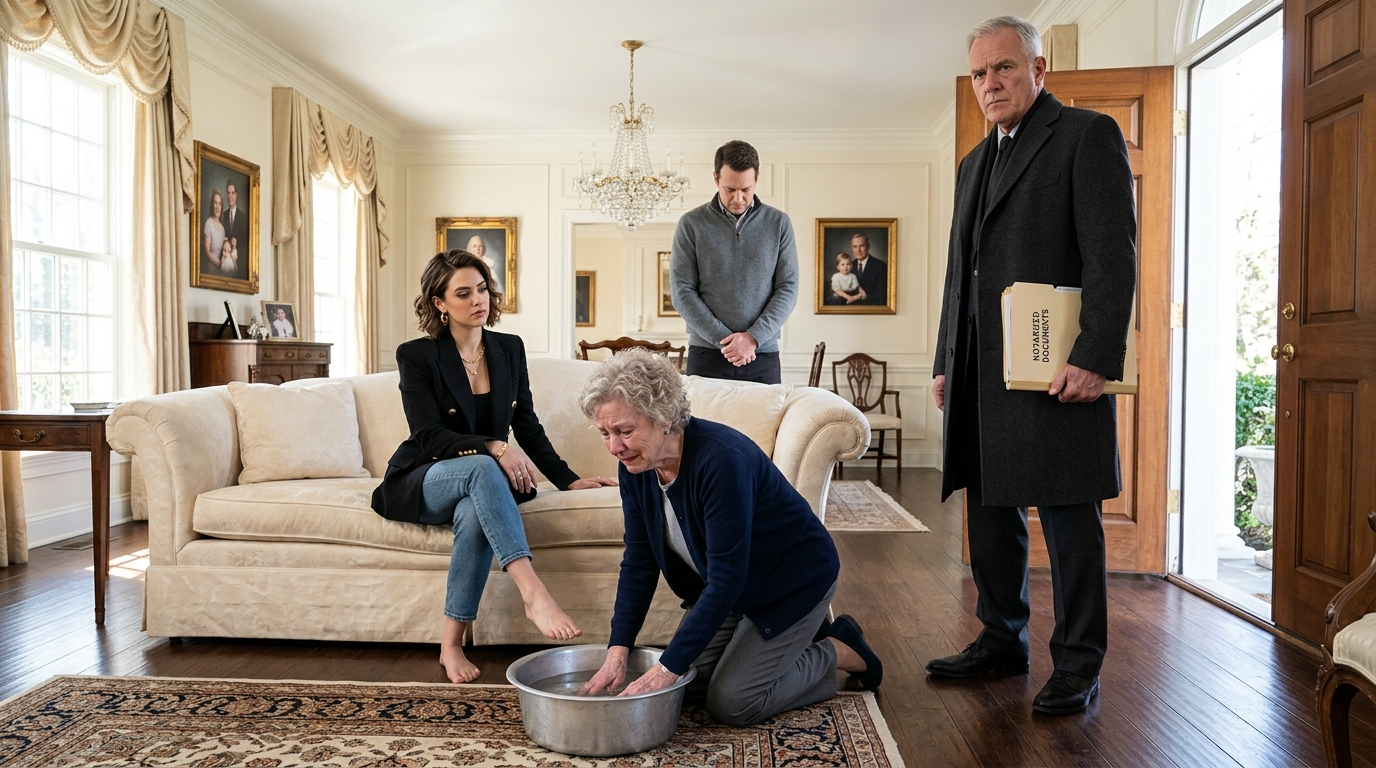
The Basin on the Marble Floor
The metal basin hit the hardwood with a scream.
It spun once.
Twice.
Then slammed into the base of the sofa, sending icy water splashing across the polished floor of the living room my husband had built with his own hands.
For a moment, I could not move.
I only stared at the water spreading toward my knees, reflecting the chandelier above me in broken, trembling pieces.
“On your knees.”
Vanessa’s voice was sharp enough to cut through bone.
She stood in front of me in cream silk pants and a gold bracelet that clicked softly every time she moved her wrist. Her hair was perfect. Her makeup was perfect. Her smile was not.
My son, Daniel, stood behind her.
Frozen.
Pale.
Silent.
That silence hurt more than her words.
I was seventy-eight years old. My knees ached on rainy mornings. My fingers shook when I tried to button my cardigan. I had lived in that house for forty-two years, buried my husband from that house, raised my only child beneath that roof, and kept every family photograph dusted because memory was the only thing grief had not taken from me.
And now, in my own living room, my son’s fiancée pointed at the floor as if I were a servant who had displeased her.
“If you want to stay in this house,” Vanessa said, “you wash my feet and beg properly.”
I looked at Daniel.
Just once.
“Danny,” I whispered.
His mouth opened.
Nothing came out.
Vanessa turned her head slowly toward him.
“Don’t,” she warned.
One word.
And my son lowered his eyes.
That was when something inside me broke.
Not loudly.
Not with rage.
Just a small, quiet collapse.
I had spent the last year pretending Daniel was overwhelmed. Pretending Vanessa was simply strong-willed. Pretending the coldness in my own home was a phase that would pass after the wedding, after the stress, after the money discussions, after whatever excuse I could invent to protect my son from the truth.
But truth does not disappear because a mother loves too hard.
It only waits.
Vanessa stepped closer.
“The floor is getting wet, Evelyn. You’re wasting time.”
My name sounded ugly in her mouth.
I sank down slowly.
Pain shot through both knees.
My hands trembled as they entered the basin. The water was so cold I gasped, but Vanessa only smiled.
“That’s better.”
She sat back on my sofa.
My sofa.
The one George bought me after his first big contract, the one we argued about because I thought it was too expensive, the one he said I deserved because I had spent twenty years sitting on secondhand furniture while he built his company.
Vanessa lifted one bare foot and pushed it toward my chest.
“Start.”
The room blurred.
I heard myself crying before I felt the tears.
Behind me, Daniel shifted.
“Vanessa,” he said weakly.
She snapped her eyes toward him.
“What?”
He swallowed.
“She’s my mother.”
Vanessa laughed.
A soft, cruel laugh.
“And that is exactly why she needs to understand boundaries before I marry you.”
Boundaries.
That was what she called humiliation.
That was what she called control.
I cupped water in my shaking hands and touched her foot because I did not know what else to do. Because I had grown tired. Because my son was watching. Because a part of me still hoped that if I obeyed, the cruelty would end quickly.
It never does.
Vanessa leaned back, satisfied.
“Louder,” she said.
I looked up.
“What?”
“I want to hear you thank me for not throwing you out today.”
Daniel flinched.
But still said nothing.
Something inside my chest twisted so sharply I could barely breathe.
“This was my husband’s home,” I whispered.
Vanessa’s smile widened.
“Not anymore.”
The front door opened before I could answer.
Cold air entered first.
Then footsteps.
Slow.
Heavy.
Certain.
A man in a dark coat stepped into the living room, carrying a notarized folder beneath one arm.
He stopped at the sight of me on my knees.
His eyes moved to the basin.
To Vanessa’s foot.
To Daniel’s silent face.
Then he became perfectly still.
I knew him immediately.
Samuel Pierce.
My husband’s oldest friend.
Our family attorney.
The man who had stood beside George’s hospital bed three years earlier while my husband signed his final documents with a hand that no longer obeyed him.
Samuel looked at Vanessa.
Then at Daniel.
Then back at me.
His voice was calm.
Too calm.
“Perfect,” he said. “Now the woman who did this can hear the will before the police do.”
Vanessa’s smile vanished.
Daniel turned the color of chalk.
I lifted my face from the floor, tears slipping down my cheeks.
Samuel raised the folder slightly.
“Or should I start with the clause written for the exact moment someone forced her to kneel in this house?”
The Clause My Husband Never Told Me About
Nobody spoke.
The house itself seemed to hold its breath.
Samuel took one step farther into the room and closed the front door behind him. He did not rush to help me up. At first, that hurt.
Then I saw why.
His eyes went to the small black camera tucked above the bookcase.
George’s old security system.
Still recording.
Samuel wanted the room exactly as he found it.
Vanessa noticed his gaze and followed it.
Her expression changed.
Not fear yet.
Calculation.
“Turn that off,” she said to Daniel.
Samuel’s voice cracked across the room.
“Touch nothing.”
Daniel froze.
Vanessa stood so fast her bracelet clattered against the glass coffee table.
“This is insane. She slipped. I was helping her.”
Samuel looked at the basin.
“At your feet?”
Vanessa’s lips tightened.
“She’s confused.”
That word.
Confused.
I had heard it often over the last few months.
When I misplaced my reading glasses.
When I forgot a grocery item.
When I asked why bank statements no longer arrived in the mail.
“She’s confused,” Vanessa would say with a gentle smile.
And Daniel would believe her because believing Vanessa was easier than admitting his mother was being cornered.
Samuel finally came to me.
He set the folder on the table, knelt carefully beside me, and offered his arm.
“Evelyn,” he said softly, “can you stand?”
I wanted to say yes.
Pride rose first.
Then pain.
“I don’t know.”
Daniel moved then.
“Mom—”
Samuel turned his head.
“Stay where you are.”
My son stopped as if struck.
I had never heard Samuel speak to him that way.
Not even when Daniel was seventeen and crashed George’s truck into the garage door.
Samuel helped me to my feet slowly. My knees trembled. I gripped his sleeve, humiliated by the way my body shook in front of the woman who had caused it.
He guided me to the armchair near the window.
George’s chair.
I had not sat in it since his death.
It felt strange beneath me.
Like being held by a ghost.
Vanessa crossed her arms.
“I want you out of this house,” she snapped at Samuel. “You have no right to come in here threatening people.”
Samuel picked up the folder.
“That is exactly what I came to discuss.”
Daniel’s voice was barely audible.
“What folder?”
Samuel looked at him then.
Not with anger.
With disappointment.
That was worse.
“Your father’s final estate documents.”
Daniel blinked.
“We already handled the estate.”
“No,” Samuel said. “You handled what your father allowed you to see.”
Vanessa’s eyes narrowed.
“What does that mean?”
Samuel opened the folder.
The sound of paper shifting filled the room.
“When George became ill, he asked me to prepare several provisions. He loved this house. More importantly, he loved the woman who made it a home.”
My throat tightened.
George.
Even now, hearing his name spoken with tenderness felt like sunlight touching a bruise.
Samuel continued, “He was concerned that after his death, Evelyn’s kindness would be mistaken for weakness.”
Daniel looked down.
Vanessa let out a laugh.
“Convenient.”
Samuel ignored her.
“He left Daniel a generous inheritance. Investments. Business shares. Liquid assets. But the house was different.”
Vanessa’s posture changed.
Just slightly.
The house.
That was what she wanted.
Everyone knew it, though Daniel pretended not to.
She had started redecorating before the engagement ring was even resized. She moved my quilts into storage. She replaced family photos with abstract art. She referred to the downstairs guest room as “the future nursery” while I was still sleeping in it during my recovery from surgery.
At first, I thought she was excited.
Then I realized she was erasing me.
Samuel read from the document.
“Evelyn Margaret Holloway retains unconditional lifetime residency of the property known as 418 Briarwood Lane.”
Vanessa’s face hardened.
“Lifetime residency doesn’t mean ownership.”
Samuel lifted his eyes.
“No. It means she cannot be removed, pressured to leave, charged rent, isolated from household access, or subjected to coercive conditions in order to remain here.”
The words settled over the room like a judge entering.
Daniel whispered, “Dad wrote that?”
Samuel turned a page.
“He wrote more.”
Vanessa took a step forward.
“I don’t know what kind of emotional performance this is, but Daniel owns this house now.”
“No,” Samuel said.
One word.
Clean.
Final.
Vanessa stopped.
Samuel continued, “The house was placed in a protective trust. Daniel was named conditional successor trustee. Conditional.”
Daniel’s face tightened.
“What condition?”
Samuel looked toward the basin.
Then at my wet hands.
Then at Vanessa’s bare feet.
“The condition that Evelyn be treated with dignity in her own home.”
The room went still again.
Samuel read slowly.
“In the event that any beneficiary, partner, spouse, fiancée, domestic companion, agent, or invited resident attempts to intimidate, evict, degrade, financially exploit, or physically humiliate my wife, Evelyn, including but not limited to forced servitude, coerced apology, confinement, denial of access, or degrading treatment within the residence, all conditional property rights granted to Daniel Holloway shall be immediately suspended pending trustee review.”
Vanessa stared at him.
Her voice came out thinner now.
“That can’t be real.”
Samuel closed the folder halfway.
“It is real.”
Daniel gripped the back of the sofa.
“Suspended?”
Samuel nodded.
“As of this moment.”
Vanessa’s eyes flashed.
“You can’t prove anything.”
Samuel looked once more at the camera above the bookcase.
Then at the water on the floor.
Then at me.
“I believe we already have.”
The Son Who Stayed Silent
Daniel sat down as if his legs had stopped working.
For the first time that afternoon, he looked like the boy I raised.
Not the polished man Vanessa had dressed in tailored suits and sharp watches.
My Danny.
The child who once cried when a bird hit our kitchen window.
The teenager who brought me gas station flowers on my birthday because he spent all his money on baseball cards.
The young man who wept at his father’s funeral and held my hand so tightly I lost feeling in two fingers.
I had not seen that version of him in a long time.
Vanessa had trained him out of softness.
Or maybe she had only found the weakness already there.
“Mom,” he whispered.
I wanted to answer.
I wanted to make it easier for him.
That is a mother’s curse.
Even when your child fails you, your first instinct is to protect him from the full weight of his failure.
But Samuel stepped between us.
“Before you speak to her,” he said, “you should understand what happens next.”
Vanessa snapped, “Nothing happens next. This is a family disagreement.”
Samuel’s eyes moved to her.
“Elder abuse is not a family disagreement.”
Her face drained.
“There was no abuse.”
“You forced a seventy-eight-year-old woman onto her knees.”
“I did not force her.”
“You told her to wash your feet or leave her own home.”
“She’s lying.”
I felt my hands curl in my lap.
I had been called confused.
Difficult.
Forgetful.
Dramatic.
But lying was different.
That word woke something in me.
I lifted my head.
“I am not lying.”
My voice was weak.
But it was mine.
Vanessa turned toward me, eyes blazing.
“Be careful, Evelyn.”
The room changed.
Even Daniel heard it.
The threat beneath the silk.
Samuel pulled out his phone.
“I’m calling the police now.”
“No,” Daniel said quickly.
Too quickly.
Everyone looked at him.
His face crumpled.
“Please. Samuel. Don’t. We can fix this.”
Something inside me went cold.
We.
He had said we.
Not she.
Not Vanessa.
We.
Samuel’s expression did not change.
“Daniel, how long has this been happening?”
My son looked at the floor.
Vanessa answered for him.
“It hasn’t.”
Samuel kept his eyes on Daniel.
“How long?”
Daniel’s hands trembled.
“I didn’t know it was this bad.”
That sentence pierced me deeper than anything Vanessa had said.
Because it contained a confession.
Not of action.
Of permission.
Samuel’s voice dropped.
“What did you know?”
Daniel rubbed his face.
“She wanted Mom to move into assisted living.”
I stared at him.
I had known Vanessa wanted me gone.
I had not known Daniel had heard it plainly enough to repeat.
“She said the stairs were dangerous,” he continued. “That Mom needed professional care. That the house was too much for her.”
Samuel asked, “And what did Evelyn say?”
Daniel swallowed.
“She said she wanted to stay.”
“And then?”
Daniel’s eyes flicked toward me.
I saw shame there.
Real shame.
But shame is not repair.
“Vanessa said if Mom loved us, she wouldn’t make our future impossible.”
Vanessa scoffed.
“That is not what I said.”
Daniel looked at her.
For the first time, truly looked.
“Yes,” he whispered. “It is.”
Her face twisted.
“You weak little boy.”
The words came out before she could stop them.
Daniel flinched.
And suddenly I understood something terrible.
I was not the only one Vanessa had been humiliating in that house.
I was simply the one she no longer bothered hiding it from.
Samuel dialed.
Vanessa lunged toward him.
Daniel grabbed her wrist.
“Don’t.”
She stared at him in disbelief.
Then she slapped him.
The sound cracked through the room.
I gasped.
Daniel released her and staggered back, one hand to his cheek.
Vanessa realized what she had done a second too late.
Samuel’s phone was already connected.
“Yes,” he said calmly. “This is Samuel Pierce, attorney for the Holloway Trust. I need officers and medical assistance at 418 Briarwood Lane. We have an elder abuse incident, physical assault, and recorded threats inside the residence.”
Vanessa backed away.
“This is ridiculous.”
But her voice shook now.
Outside, through the front windows, a car slowed.
Then another.
Neighbors.
They had heard.
Of course they had.
Vanessa had screamed loudly enough for half the street when she kicked the basin.
For months, she wanted me isolated.
Now the walls had become too thin to protect her.
Daniel sank onto the sofa.
His eyes were red.
“I’m sorry, Mom.”
I looked at him.
I wanted to forgive him immediately.
I hated that I wanted to.
But George’s chair held me steady.
“Sorry is where you start,” I said.
My voice did not tremble this time.
“It is not where you finish.”
The House That Remembered Everything
The police arrived in eleven minutes.
By then, Vanessa had changed masks three times.
First outrage.
Then tears.
Then soft fear.
When the officers entered, she stood near the fireplace with her arms wrapped around herself, looking small and wounded.
“She attacked me,” Vanessa said, pointing at me.
The younger officer looked at the basin.
Then at my wet sleeves.
Then at Daniel’s red cheek.
Then at Samuel.
Samuel handed over his card.
“Before anyone makes statements handed over his card.
“Before anyone, you should know the security system recorded the living room continuously.”
Vanessa closed her eyes.
Just once.
A tiny movement.
But I saw it.
So did Samuel.
The officers separated us.
A female paramedic checked my knees and blood pressure. She asked gently if I felt safe in the house.
I almost said yes.
Because that had always been the expected answer.
Instead, I looked at Vanessa.
Then Daniel.
Then the basin still lying on its side.
“No,” I said.
The paramedic’s eyes softened.
“Thank you for telling me.”
Such a small sentence.
It nearly undid me.
While the officers reviewed the footage, Samuel sat beside me.
He did not fill the silence.
That was one of the reasons George trusted him.
Some people talk to control a room.
Samuel listened to let the truth enter it.
From across the living room, I could hear pieces of the recording playing on the officer’s tablet.
Vanessa’s voice.
On your knees.
My crying.
Louder.
This was my husband’s home.
Not anymore.
Then the door opening.
Samuel’s voice.
Perfect.
The younger officer looked up from the tablet.
His face had changed.
Whatever Vanessa had tried to sell him had died in the recording.
He walked toward her.
“Ms. Crane, please turn around.”
She stared at him.
“What?”
“You’re being detained while we investigate.”
“This is my fiancé’s house.”
Samuel spoke before anyone else could.
“No. It is not.”
Daniel looked like he might be sick.
Vanessa turned on him.
“Say something.”
He stood slowly.
For a moment, I feared he would defend her again.
Then he looked at me.
At my wet cardigan.
At my swollen knees.
At the red mark on his own face reflected in the mirror above the mantel.
“No,” he said.
Vanessa’s expression went flat.
That frightened me more than her anger.
“You’ll regret this,” she whispered.
Daniel answered, “I already do.”
The officers led her toward the door.
She did not scream again.
She had become quiet now.
Cold.
Planning.
At the threshold, she looked back at me.
The hatred in her eyes was pure.
“You think you won,” she said.
I gripped the arms of George’s chair.
“No,” I replied softly. “I think my husband knew exactly who might come into this house after he was gone.”
For the first time, she had no response.
After she was taken away, the house felt enormous.
Water still covered part of the floor.
The basin lay dented near the sofa.
One of Vanessa’s footprints remained on the wood, pale and wet.
Daniel approached me carefully.
“Mom.”
I was suddenly very tired.
Too tired for speeches.
Too tired for anger.
Too tired to comfort the son who had failed to comfort me.
“I need you to leave tonight,” I said.
His face crumpled.
“Mom, please.”
“Samuel will arrange somewhere for you.”
“I don’t want to leave you.”
I looked at him.
“But you did.”
He flinched.
I did not take it back.
Samuel placed a hand on Daniel’s shoulder.
“Pack a bag.”
Daniel stood there for another second, perhaps waiting for the mother I used to be to rescue him from consequence.
She did not come.
He went upstairs.
I listened to his footsteps cross the ceiling.
Slow.
Heavy.
Like childhood walking away.
Samuel remained beside me.
“George hoped the clause would never be needed,” he said.
I closed my eyes.
“Did he know?”
“That Daniel might be weak?”
I opened my eyes.
Samuel’s voice softened.
“He knew grief makes people vulnerable. He knew money attracts cruelty. And he knew you would forgive too much before protecting yourself.”
A tear slipped down my cheek.
“That sounds like him.”
Samuel smiled sadly.
“He loved you very much.”
The house seemed to ache around us.
Every corner held George.
The mantel he built.
The window seat where he read the newspaper.
The crooked baseboard he promised to fix for fifteen years.
The staircase he carried Daniel down when our son broke his ankle at nine.
This was not a mansion to me.
It was a life.
And someone had tried to make me beg for permission to remain inside it.
That night, after Daniel left with one suitcase and Samuel arranged temporary security, I sat alone in George’s chair until dawn.
For the first time in months, no one told me I was confused.
No one told me I was difficult.
No one told me where I could sit, what I could eat, or whether I was allowed to remember my own life correctly.
The house was silent.
But it no longer felt hostile.
It felt like it was waiting for me to reclaim it.
The Will Read Aloud
The formal trustee review happened two weeks later in my dining room.
I insisted on that.
Not Samuel’s office.
Not a courthouse conference room.
My dining room.
The same room where Vanessa had once moved my chair away from the head of the table because she said it made more sense for Daniel to sit there now.
Samuel sat at one end with the trust documents.
Daniel sat across from me.
He looked thinner. Tired. Humbled in a way that did not yet deserve praise but perhaps deserved patience.
Vanessa was not present.
Her attorney attended by video, which suited me fine. I did not want her perfume in my house again.
Samuel read the clause formally.
Every word.
Every condition.
Every consequence.
Because George had not written it in anger.
He had written it with precision.
Daniel’s conditional rights to the residence were suspended for five years. He would retain limited financial inheritance already distributed, but all decision-making authority over the property transferred to an independent trust board. My lifetime residency was reaffirmed. A protected care fund would be established in my name, controlled by me, not Daniel, not any spouse, not any future partner.
Vanessa’s attorney objected twice.
Samuel dismantled both objections without raising his voice.
Then came the final provision.
Samuel paused before reading it.
I knew, from the way he looked at me, that this part mattered.
“In the event my wife is ever degraded in her own home by a person seeking access to this property, I direct my trustees to treat that person not as family, but as a threat to the estate, to Evelyn’s safety, and to the dignity upon which this house was built.”
Daniel covered his mouth.
His shoulders shook once.
I looked away to give him privacy he had not given me.
The marriage never happened.
Vanessa tried to sell her version of the story online.
She called me manipulative.
She called Daniel emotionally abused.
She called Samuel a greedy old lawyer.
Then the footage leaked.
Not by me.
Not by Samuel.
A neighbor’s doorbell camera had recorded enough audio through the open front windows to support the police report. A local reporter obtained the court filings after Vanessa’s attorney tried to challenge the trust clause.
The public turned quickly.
Too quickly, maybe.
People who had never met me called me sweet.
They called Vanessa evil.
They called Daniel spineless.
They called George brilliant.
Strangers love simple stories because simple stories do not ask anything of them.
The truth was harder.
Vanessa was cruel.
Daniel was weak.
George was loving but afraid.
And I had spent too long mistaking endurance for peace.
Daniel began visiting after three months.
Only with Samuel present at first.
Then alone, but never overnight.
The first time he came back, he stood in the doorway holding a bouquet of yellow roses.
“I know flowers don’t fix anything,” he said.
“No,” I replied. “They don’t.”
He nodded.
“I brought them anyway.”
That was the beginning.
Not forgiveness.
Not yet.
A beginning.
He started therapy.
He volunteered at a senior legal aid center because Samuel told him apology without education was vanity.
He learned how coercion works.
How isolation works.
How elder abuse hides behind concern.
How silence can become participation.
One afternoon, nearly a year after the basin hit the floor, Daniel came over to repair the loose handrail on the back steps.
George had been meaning to fix it before he died.
Daniel worked quietly for an hour.
When he finished, he sat on the porch beside me.
“I heard you,” he said.
I looked at him.
“That day. When you said it was Dad’s home. I heard you.”
I waited.
He swallowed.
“And I still did nothing.”
The wind moved through the maple tree George planted when Daniel was born.
“I know,” I said.
He cried then.
Not loudly.
Not for sympathy.
Just because truth had finally reached the part of him that excuses could not protect.
I placed my hand over his.
Not to erase what happened.
But because I was still his mother.
And because healing, when it comes, rarely arrives clean.
Three years later, I still live at 418 Briarwood Lane.
The sofa is different now.
The old one carried too much memory from that day, so I donated it and bought a blue one George would have hated. I can hear him complaining about it sometimes, which makes me love it more.
The metal basin is gone.
Samuel wanted it kept for evidence, but after the case closed, I asked him to dispose of it.
I did not need a monument to humiliation.
I already had something stronger.
The house.
The will.
The chair by the window.
My own voice.
On quiet mornings, I sit in George’s chair with tea and watch sunlight move across the hardwood floor. Sometimes my knees ache. Sometimes my hands shake. Sometimes I forget why I walked into a room.
But no one calls me confused as a weapon anymore.
No one tells me I should be grateful to stay.
No one makes me kneel.
People often ask what saved me that day.
They expect me to say the will.
Or Samuel.
Or the camera.
Or the police.
All of those mattered.
But they were not the first thing.
The first thing was a dead man who knew his wife better than she knew herself.
George knew I would keep forgiving.
He knew I would keep hoping Daniel would remember who he was.
He knew I would stay quiet too long because mothers are trained by love to absorb pain and call it patience.
So he wrote protection into paper keep hoping Daniel would remember who he was.
He knew I would stay quiet too long because mothers are trained by love to absorb pain and call it patience.
So he wrote protection when he could no longer stand beside me in the room.
And on the day someone tried to turn my home into a place of shame, his words walked through the door.
Not loud.
Not dramatic.
Just notarized.
Precise.
Unbreakable.
A final act of love from a husband who knew that dignity, once stolen, must be restored in full.
Sometimes I still hear Vanessa’s voice.
On your knees.
But it no longer makes me tremble.
Because another voice follows it now.
Samuel’s voice.
George’s will.
The sentence that changed everything.
The clause written for the exact moment someone forced her to kneel in this house.
And every time I remember it, I sit a little straighter in the chair my husband left me.
Because this was his home.
This is my home.
And no one will ever make me beg to belong in it again.