The Toast That Became an Execution
The first thing I remember was the laughter.
Not the slap.
Not the sting spreading across my cheek.
Not the crystal chandeliers trembling above us like frozen stars.
It was the laughter.
Five hundred and fifty people in tuxedos and silk gowns, laughing as if my humiliation had been written into the evening’s program.
I stood near the head table of the Ritz-Carlton ballroom, one hand pressed against my burning face, staring at my husband as if I had never truly seen him before.
Harrison Whitmore’s palm was still raised.
His jaw was tight.
His eyes were cold.
Behind him, his father, Winston Whitmore, wore the smallest smile.
That was how I knew.
This wasn’t an accident.
This wasn’t anger.
This was permission.
I’m Stella Whitmore, though for most of my marriage, the Whitmores treated my last name like a costume I had no right to wear. Before I married Harrison, I was Stella Mercer, daughter of a quiet man from upstate New York who wore flannel shirts, fixed old trucks, and never once corrected anyone who underestimated him.
The Whitmores loved underestimating him.
They loved underestimating me more.
To the people in that ballroom, Harrison was royalty. He was the polished vice president of Whitmore Crown Properties, one of New York’s most powerful commercial real estate firms. He had the perfect smile, the perfect watch, the perfect education, and the perfect talent for making cruelty sound like sophistication.
I was his quiet wife.
The plain one.
The lucky one.
The one who should have been grateful.
For five years, I had sat through family dinners where his sister Caroline joked that I looked like I “still clipped coupons emotionally.” I had smiled when Winston asked whether my father still “played with engines for beer money.” I had swallowed every insult because I believed silence was dignity.
Tonight was supposed to celebrate two milestones.
The thirtieth anniversary of Winston’s company.
And my fifth wedding anniversary with Harrison.
But from the moment I entered the ballroom, I understood that only one of those things mattered.
The room smelled of champagne, white roses, and money. Waiters moved silently between tables. Investors shook hands with senators. Socialites kissed cheeks while scanning for cameras. Winston had built the entire night like a coronation.
I sat beside Harrison in a black evening gown I had chosen because it was simple.
Elegant.
Quiet.
Caroline looked me up and down and smiled.
“Brave choice,” she whispered. “Very courthouse widow.”
Harrison laughed.
Not loudly.
Just enough for me to hear.
That should have been the moment I left.
Instead, I folded my napkin in my lap and stayed.
Because habit is a dangerous prison.
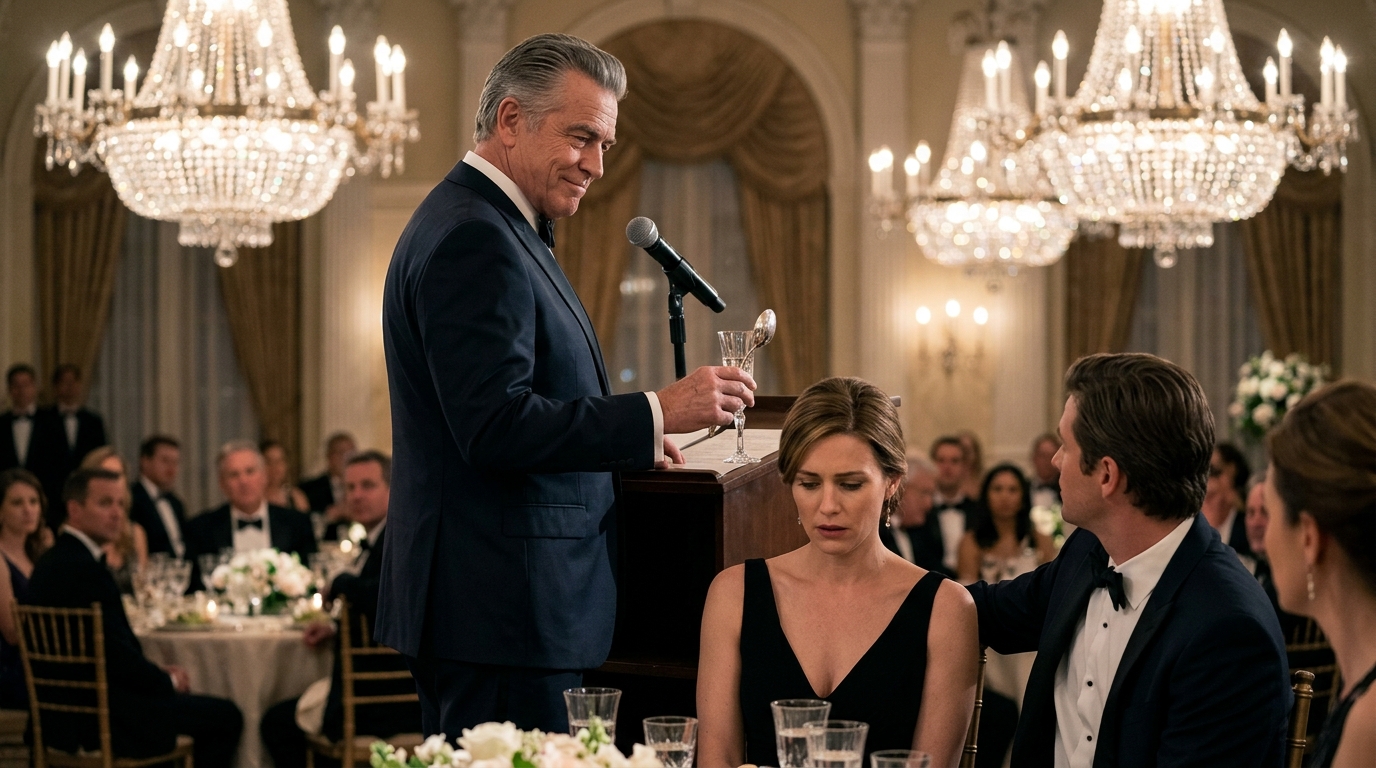
Then Winston stood.
He tapped his spoon against a crystal flute.
The room obeyed instantly.
“Ladies and gentlemen,” he began, spreading his arms like the ballroom belonged to him because, in many ways, it did. “Tonight, we celebrate thirty years of vision, discipline, and legacy.”
Applause rose.
Controlled.
Polished.
Expensive.
He spoke about acquisitions. He spoke about market dominance. He spoke about his son as if Harrison had personally lifted Manhattan from the Hudson River.
Then Winston’s gaze found me.
A faint smirk touched his mouth.
“And of course,” he said, “we also celebrate Harrison’s five years of marriage.”
The applause became softer.
Curious.
The room turned toward me.
I felt Harrison’s hand land on my knee beneath the table.
Not affection.
Warning.
Winston continued, “Marriage, like business, requires sacrifice. My son has shown extraordinary patience, commitment, and charity.”
A few people chuckled.
My stomach tightened.
“After all,” Winston said, lifting his glass, “not every man in his position would choose love over pedigree.”
The laughter came lightly at first.
Then more freely.
My face warmed.
Harrison didn’t move.
Winston looked directly at me now.
“But Harrison has always had a generous heart. He saw something in Stella that the rest of us, I confess, had difficulty identifying.”
More laughter.
This time louder.
I stared down at my plate.
The salmon sat untouched, shining under a butter sauce I suddenly couldn’t smell.
Winston raised his glass higher.
“So tonight, let us toast my son. A man who carried an ordinary woman into an extraordinary family.”
The room erupted.
Glasses lifted.
People smiled.
Harrison leaned close to my ear.
“Just take it,” he whispered. “Don’t embarrass me.”
That was the moment something inside me finally cracked.
Not loudly.
Not dramatically.
Just enough.
I stood.
The room quieted in pieces.
One table at a time.
Winston’s smile froze.
I picked up my glass.
My hand trembled, but my voice did not.
“I’d like to make a toast too.”
Harrison turned sharply.
“Stella,” he warned.
I ignored him.
I looked at Winston.
“For five years, I have listened to this family call my father small because he doesn’t wear wealth like a costume. I have listened to you call me ordinary because I never felt the need to prove otherwise.”
A murmur moved through the ballroom.
Winston’s smile vanished completely.
I continued.
“But there is a difference between quiet and weak.”
Harrison stood so fast his chair scraped against the marble floor.
“Sit down,” he said.
I looked at him.
“No.”
One word.
Small.
Final.
The room stopped breathing.
Then Harrison stepped forward.
His hand flashed.
The slap cracked across the ballroom.
My head turned with the force of it.
A gasp rose.
Then laughter.
Nervous at first.
Then cruel.
Caroline covered her mouth, pretending shock while her shoulders shook.
Winston chuckled into his glass.
Harrison leaned close enough that only I could hear him.
“You forgot who made you relevant.”
I wiped the tears from my cheek.
Slowly.
Carefully.
Then I reached into my clutch and took out my phone.
Harrison’s eyes narrowed.
“What are you doing?”
I looked at him through the blur of tears.
“Calling my father.”
And for the first time that night, Winston Whitmore stopped smiling.
The Mechanic They Mocked
My father answered on the second ring.
“Stella?”
His voice was calm.
Low.
Familiar.
For one fragile second, I was no longer standing in a ballroom full of vultures. I was twelve years old again, sitting on the hood of his old pickup while he taught me how to listen to an engine.
Not just hear it.
Listen.
“Dad,” I said.
The room was silent now.
Everyone watched me like they expected a scene.
Maybe tears.
Maybe begging.
Maybe one more performance of the grateful wife.
I gave them none of it.
My father heard something in my voice.
“What happened?”
I looked at Harrison.
Then Winston.
Then Caroline, whose diamond necklace glittered under the chandeliers like evidence waiting to be named.
“Harrison hit me.”
The silence changed.
No one laughed now.
My father did not shout.
That was how I knew he was furious.
“Are you safe?”
I looked around the room.
At the investors.
At the politicians.
At the executives who had laughed because a powerful family told them it was allowed.
“Not yet.”
A pause.
Then my father said, “Put me on speaker.”
I tapped the screen.
The ballroom listened.
“Mr. Whitmore,” my father said.
Winston straightened, more annoyed than afraid.
“Alexander,” he said with a smooth little laugh. “This is a private family matter.”
“No,” my father replied. “It became public when your son struck my daughter in front of five hundred and fifty witnesses.”
A few phones rose higher.
Harrison noticed.
His expression tightened.
Winston stepped toward me, lowering his voice.
“Stella, end the call before you create a problem you can’t manage.”
I almost smiled.
Because that was Winston’s mistake.
He still believed I was the one who couldn’t manage problems.
For five years, I had worked under a third-party consulting contract as a senior financial risk analyst. The Whitmores never knew the anonymous analyst untangling their books, restructuring their debt, and warning them about compliance exposure was the woman they mocked over Sunday dinner.
They didn’t know I had seen the internal transfers.
The shell companies.
The inflated renovation invoices.
The healthcare fund Caroline quietly used for jewelry.
The political donation routes that made even seasoned auditors nervous.
I had protected them more times than they deserved.
Not because I loved them.
Because I loved Harrison.
Or thought I did.
My father’s voice filled the ballroom.
“Winston, I warned you once not to confuse humility with helplessness.”
Winston froze.
Just a little.
But I saw it.
Recognition.
Not of the man he thought he knew.
Of a voice from another room.
Another life.
“You two know each other?” Harrison asked.
My father ignored him.
“Stella,” he said, “has he touched you before?”
Harrison’s face went pale.
“Don’t answer that,” he snapped.
That told the room everything.
I swallowed.
“Not like this.”
My father went quiet.
The kind of quiet that made powerful men check exits.
Then he said, “I’m sending counsel. And security. Do not leave with him.”
Winston laughed once.
It was ugly.
“You’re sending counsel? From what garage, Alexander?”
My father’s answer was soft.
“From Mercer Capital.”
That name landed like a dropped blade.
Not everyone reacted at first.
But the ones who understood finance did.
A man near the front table slowly lowered his champagne glass.
A woman from one of the city’s largest pension funds leaned toward her husband and whispered something urgently.
Winston’s mouth tightened.
Harrison looked confused.
Caroline stopped smiling.
Mercer Capital was not a garage.
It was one of the most private, most feared investment firms in America. It didn’t do flashy interviews. It didn’t sponsor galas. It didn’t put its name on buildings.
It owned pieces of the companies that did.
My father continued, “And Winston?”
“Yes?” Winston said, though the word barely came out.
“Tell your son to step away from my daughter.”
Harrison scoffed, but he took one step back.
Just one.
Enough.
Then the ballroom doors opened.
Not dramatically.
Not loudly.
But with the calm precision of people who had already received instructions.
Four men in dark suits entered first.
Then a woman in a navy dress carrying a leather folder.
Then another man I recognized instantly.
Elliot Granger.
My father’s chief legal officer.
He had not aged since I was sixteen. Same silver hair. Same grave eyes. Same way of walking into chaos like it was a conference room.
The crowd parted for him.
Winston stared as if a ghost had entered his party.
Elliot stopped beside me.
“Mrs. Whitmore,” he said, “are you injured?”
My throat tightened at the dignity in the question.
“No.”
“Do you wish to press charges?”
Harrison’s head snapped toward me.
“Stella, don’t be ridiculous.”
Elliot turned to him.
“Mr. Whitmore, speak to her again without permission and I will have security remove you before your board members finish filming.”
Harrison looked around.
Phones were everywhere now.
Not laughing.
Recording.
The night had shifted.
The performance had turned.
And for the first time in five years, the Whitmores were not controlling the room.
Elliot opened the folder.
“Mr. Winston Whitmore,” he said, “you should know that Mercer Capital holds significant secured interests in multiple Whitmore Crown debt instruments, including the mezzanine facility due for renewal at midnight.”
Winston’s face emptied.
Midnight.
The word struck harder than the slap.
Because I finally understood why my father had gone quiet on the phone.
He wasn’t just angry.
He was already moving.
Elliot looked at me.
“Stella, your father wants you to decide whether we proceed tonight.”
I looked at Harrison.
He had called me ordinary.
He had let them laugh.
He had raised his hand and shown me exactly what he believed I was worth.
Then I looked at Winston.
And I realized this family had not humiliated me because they thought I was weak.
They humiliated me because I had allowed them to survive my silence.
I nodded once.
“Proceed.”
Elliot closed the folder.
And Winston Whitmore whispered one word that made every head at the front table turn.
“Please.”
The Files Beneath the Empire
There are moments when power changes hands quietly.
No thunder.
No announcement.
Just one document sliding across a table.
Elliot placed the first file in front of Winston.
The old man didn’t touch it.
He only stared.
Harrison stepped closer. “Dad, what is going on?”
Winston didn’t answer.
Because he knew.
Maybe not everything.
But enough.
Mercer Capital had financed Whitmore Crown’s expansion three years earlier through layers of private debt. Winston had bragged publicly that traditional lenders begged to work with him. Privately, his company had been bleeding from failed hotel conversions, vacant luxury towers, and lawsuits buried beneath settlement agreements.
My work had kept them breathing.
My father’s money had kept them standing.
And my silence had kept them respectable.
Elliot opened the file.
“Whitmore Crown Properties is currently in breach of four covenants,” he said. “Liquidity ratio. Debt service coverage. Material litigation disclosure. And executive misrepresentation.”
A murmur spread.
Winston’s board members looked at one another.
One man at table three quietly stood and walked toward the exit, phone already pressed to his ear.
Caroline hissed, “This is insane.”
I turned to her.
“Is it?”
Her mouth shut.
I looked at the necklace resting against her collarbone.
“That’s beautiful, by the way.”
Her hand flew to it.
I continued, “Company healthcare reserve account, wire transfer marked wellness vendor, then rerouted through Bellamy Luxe Imports. Three hundred and eighty thousand dollars.”
Her face went white.
The room went still.
Harrison looked at his sister.
“Caroline?”
She shook her head. “She’s lying.”
I reached into my clutch and removed a small flash drive.
Winston’s eyes locked onto it.
For five years, I had kept copies of everything I fixed. Not to blackmail them. Not to punish them. At first, I told myself it was professional caution.
Then it became survival.
Because a woman who is constantly told she is nothing eventually starts saving proof that she is not crazy.
Elliot took the drive from my hand.
“Already mirrored,” he said quietly. “This is just symbolic.”
Winston finally spoke.
“Stella, let’s discuss this privately.”
I almost laughed.
Privately.
That had always been their favorite word.
Insult her privately.
Threaten her privately.
Apologize never.
Control the story publicly.
“No,” I said. “You made this public.”
Harrison stepped toward me again.
The security guard moved with him.
Harrison stopped.
The humiliation on his face was so raw that part of me almost felt sorry for him.
Almost.
“You planned this?” he asked.
“No,” I said. “You did.”
His brow tightened.
“You slapped me in front of your investors. Your father mocked my family in front of your lenders. Caroline wore stolen employee money around her neck in front of the people whose premiums increased last quarter.”
Caroline began crying.
Real tears this time.
Not from remorse.
From exposure.
Winston leaned heavily on the table.
“You don’t understand what you’re doing,” he said.
“I understand every number in your company better than your own CFO.”
That landed.
Hard.
Because it was true.
For years, the Whitmore executives had referred to me in emails by my consulting code.
M-17.
The analyst who saved the Riverside deal.
The analyst who found the hidden tax exposure.
The analyst who warned them against the Queens rezoning fraud.
They praised M-17 in board meetings while mocking Stella at dinner.
Elliot handed Winston the second file.
“This contains a notice of default. Mercer Capital is exercising its contractual right to appoint an interim oversight committee.”
Winston’s voice dropped.
“You can’t do that.”
Elliot didn’t blink.
“We can. You signed it.”
Harrison turned to me, panic replacing anger.
“Stella, tell them to stop.”
The sentence was so small.
So late.
I remembered the early days of our marriage. Harrison bringing me coffee in bed. Harrison kissing my hand outside a cheap diner because he said fancy restaurants made people act. Harrison telling me he loved that I didn’t need anyone’s approval.
I had married that man.
But somewhere along the way, he chose the version of himself his father respected.
And tonight, that version had slapped me.
“No,” I said.
His eyes filled with something that looked like betrayal.
That almost made me laugh too.
Betrayal.
From him.
Then the ballroom doors opened again.
This time, two uniformed police officers entered.
Not rushing.
Not confused.
Directed.
Harrison’s face changed.
“Stella,” he whispered.
I looked at Elliot.
He nodded.
“One of the guests called after witnessing the assault,” he said.
That was not entirely true.
The call had been made by my father’s security team.
But the witnesses were real.
The cameras were real.
The red mark on my face was real.
The officer approached me gently.
“Ma’am, do you want to make a statement?”
Harrison’s mother, who had not spoken all night, let out a small sob.
Winston closed his eyes.
For the first time, he looked old.
Not powerful.
Old.
I looked at Harrison.
He shook his head almost imperceptibly.
Pleading now.
After five years, he finally understood the language of mercy.
He just didn’t understand that he had taught me to stop speaking it.
“Yes,” I said.
“I do.”
The Boardroom After Midnight
By midnight, the gala had become a crime scene, a financial emergency, and the most expensive family scandal in Manhattan.
Harrison was not dragged away in handcuffs like some dramatic movie villain. Reality is often colder than that. He was escorted quietly through a side exit while cameras flashed outside the hotel.
That was worse for him.
The absence of drama gave people space to imagine it.
Winston disappeared into a private room with Elliot, three board members, and a woman from the pension fund who had once praised him as “the last gentleman developer in New York.”
Caroline sat alone at the head table, necklace removed, mascara running down her face.
I stayed in the bridal suite upstairs.
Funny.
The Ritz had upgraded it for our anniversary.
White roses.
Champagne.
Chocolate-covered strawberries arranged beside a handwritten card that read, To many more years.
I stood in front of the mirror and looked at my cheek.
The swelling had deepened.
A faint purple shadow had begun forming beneath the red.
I touched it once.
Then stopped.
Some pain should not be softened too quickly.
Elliot entered after knocking.
He looked tired.
“Your father’s jet lands in forty minutes.”
I nodded.
“How bad is it?”
“For them?”
“Yes.”
He exhaled.
“Terminal, if we choose to make it so.”
The word hung in the air.
Terminal.
Not bankrupt yet.
Not dead.
But already diagnosed.
He handed me a tablet.
On the screen were emergency board resolutions, default notices, whistleblower disclosures, and draft complaints prepared with a speed that only generational wealth can buy.
But my father had not built his firm on recklessness.
He built it on timing.
“What does Dad want?” I asked.
Elliot’s expression softened.
“He wants you safe. After that, he wants whatever you want.”
I looked back at the mirror.
For years, I thought hiding my wealth protected me. I thought it allowed love to remain pure. But secrecy had become the soil where their contempt grew.
Not because I owed them my family history.
But because I mistook endurance for virtue.
“What happens to the employees?” I asked.
Elliot’s answer came immediately.
“Protected first. Your father already authorized payroll guarantees and healthcare restoration if control transfers.”
That was my father.
The man Winston called a mechanic.
A man who knew engines because he liked fixing things with his hands.
A man who could destroy an empire and still ask whether the payroll clerk would keep her insurance.
I looked at the tablet.
“What about Harrison?”
“Assault charge is separate. Divorce counsel is ready. Prenup has a misconduct clause. Given tonight’s witnesses, his position is poor.”
Poor.
A polite word for ruined.
A knock came at the door.
Elliot opened it.
Harrison stood outside.
His bow tie was gone. His hair had fallen out of place. The polished vice president looked like a boy who had broken something expensive and only now realized it could not be replaced.
Elliot moved to block him.
“It’s okay,” I said.
Harrison stepped inside slowly.
He stared at my cheek.
For a second, shame crossed his face.
Real shame.
But shame is not the same as love.
“Stella,” he said. “I don’t know what happened to me.”
I did.
But I let him continue.
“My father was pushing me. The room was watching. You stood up and I just—”
“Hit me.”
His mouth closed.
There it was.
The thing he wanted to avoid naming.
I turned fully toward him.
“You hit me because you believed everyone in that room would agree I deserved it.”
He looked down.
That was answer enough.
“I loved you,” I said.
His eyes lifted quickly.
“Loved?”
“Yes.”
The past tense hurt him.
Good.
He took one step toward me.
Elliot’s hand moved slightly.
Harrison stopped.
“I can fix this,” Harrison said. “I’ll apologize publicly. I’ll step down for a while. We’ll go away. We’ll start over.”
I stared at him.
He still thought the problem was public relations.
Not the five years of contempt.
Not the silence when his father mocked me.
Not the way his hand moved before his conscience did.
“You don’t want forgiveness,” I said. “You want damage control.”
“That’s not fair.”
I laughed once.
Softly.
The sound surprised both of us.
“Fair?”
His face tightened.
“I made mistakes.”
“No,” I said. “A mistake is forgetting an anniversary. A mistake is saying something cruel and regretting it. You humiliated me, threatened me, hit me, then asked me to save you from the consequences.”
He swallowed.
Outside the windows, Manhattan glittered like nothing had happened.
That was the cruelest part of rich people’s disasters.
The skyline never flinches.
Harrison’s voice dropped.
“Did you ever love me, or was all of this some test?”
I stepped closer.
Not because I wanted him near.
Because I wanted him to hear every word.
“I loved you enough to hide who I was so you’d never feel bought.”
His eyes shone.
“And you hated me enough to believe I was worthless.”
He had no answer.
A message buzzed on Elliot’s phone.
He checked it.
Then looked at me.
“Your father is downstairs.”
Harrison’s face drained.
Fear.
Not of me.
Not of what he had done.
Of the mechanic he had mocked.
I walked past him toward the door.
At the threshold, he said my name one last time.
“Stella.”
I stopped.
But I did not turn around.
“There has to be something I can do.”
I looked back then.
At the man I had married.
At the stranger who wore his face.
“There is.”
Hope flickered in his eyes.
I let him have it for half a second.
Then I said, “Tell the truth.”
And left him standing in the room where our marriage finally became dead on paper.
The Morning the Whitmore Name Fell
My father was waiting in the private lobby downstairs.
Not in a suit.
That was the first thing everyone noticed.
He wore dark jeans, work boots, and a gray wool coat over a flannel shirt. His hands were clean, but there was still a faint line of oil beneath one thumbnail.
He looked exactly like the man Winston had dismissed.
And more powerful than anyone in the building.
When he saw my cheek, something in his face changed.
Not loudly.
Not theatrically.
But I saw the father beneath the titan.
He opened his arms.
I walked into them.
For the first time that night, I cried without shame.
He held me the way he had when I was a child, steady and silent. Around us, lawyers, security, executives, and hotel staff pretended not to watch.
When I pulled back, he touched my chin gently and studied the bruise.
Then he looked across the lobby.
Winston stood near the elevators.
For once, Winston did not approach like he owned the floor.
He came slowly.
Carefully.
“Alexander,” he said.
My father said nothing.
Winston swallowed.
“I owe your daughter an apology.”
“No,” my father said. “You owe her more than words.”
Winston’s mouth tightened.
“We can settle this.”
My father’s expression did not change.
“That’s the first honest thing you’ve said tonight.”
Over the next seventy-two hours, the Whitmore empire collapsed in clean, legal stages.
Mercer Capital exercised oversight rights.
The board placed Winston on emergency leave.
Harrison was suspended pending investigation.
Caroline resigned from all charitable committees after the healthcare fund misuse became public.
The CFO cooperated.
The general counsel resigned.
Three outside agencies opened inquiries.
The company did not vanish. My father refused to destroy the employees for the sins of the family that used them as furniture. Payroll continued. Healthcare accounts were restored. Projects with clean books moved forward.
But the Whitmores were removed from control.
That was the part that broke Winston.
Not the money.
Not the headlines.
Control.
On the fourth morning, I returned to the penthouse with two security guards and my divorce attorney.
Harrison was there.
Sitting alone in the living room, surrounded by skyline views he could no longer afford emotionally, even if the deed still carried his name.
He looked smaller.
Maybe he always had been.
There were papers on the table.
He had signed them.
The misconduct clause gave me more than I wanted and less than he feared. I did not need his money. I never had.
That was what made him angriest in the end.
Not losing me.
Realizing he had never owned the thing he thought gave him power.
“You could have told me,” he said quietly.
I looked at him.
“Told you what?”
“Who your father was.”
I thought about that.
Maybe once, that question would have pierced me.
Now it only sounded tired.
“You could have shown me who you were before I had to.”
He lowered his head.
I removed my wedding ring and placed it on the table.
The sound was small.
A soft click against glass.
But it felt louder than the slap.
I walked through the penthouse one last time, past the cold marble floors, the curated art, the enormous windows that had made me feel trapped above the city instead of part of it.
In the bedroom, I found the black dress from the gala hanging over a chair.
For a moment, I touched the fabric.
Then I left it there.
Some versions of yourself do not need to be carried forward.
Six months later, Winston Whitmore testified before a civil committee with no cameras allowed inside, though somehow every important detail reached the press anyway. He looked older in the photographs. Thinner. His hair less perfect.
Harrison moved to Connecticut and joined a small advisory firm that did not put his name on the door.
Caroline sold the necklace.
Not because she wanted to.
Because restitution has a way of stripping sparkle from stolen things.
And me?
I became Stella Mercer again.
Publicly this time.
I took a senior role at Mercer Capital’s ethical restructuring division, the part of the firm my father created for companies worth saving from the people ruining them.
On my first day, he left a note on my desk.
Money should bring freedom, not attention.
Underneath, he had added one more line.
But when necessary, it should also bring justice.
I framed it.
Not because it was about wealth.
Because it was about remembering.
The night of the gala did not make me powerful.
I already was.
It only taught me that quiet strength means nothing if you keep handing cruel people the microphone.
Sometimes I still hear the laughter.
Five hundred and fifty voices rising after my husband’s hand struck my face.
But I no longer hear it the same way.
Back then, it sounded like humiliation.
Now it sounds like evidence.
Every laugh.
Every glass raised.
Every person who thought silence made them safe.
They all witnessed the moment the Whitmore legacy began to fall.
And all I had to do—
was make one call.