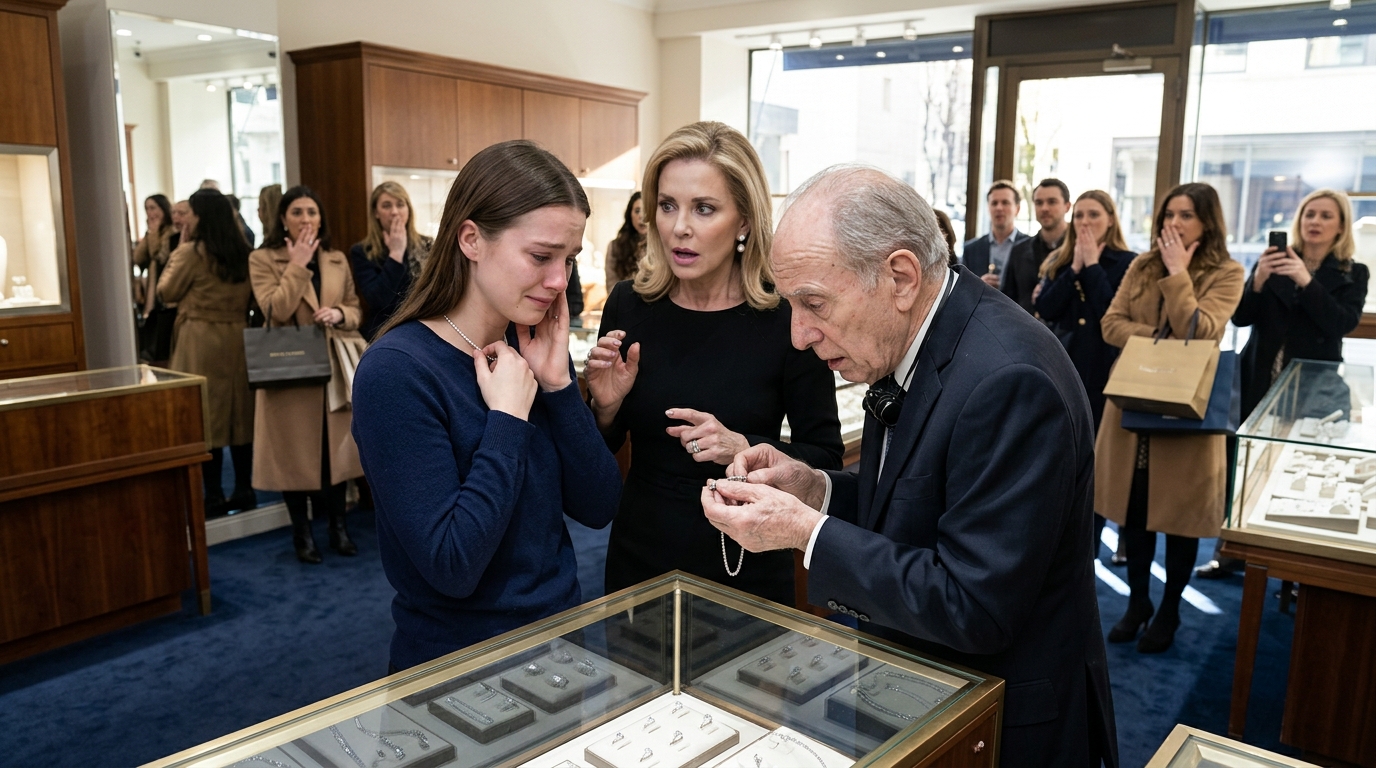
The Slap in the Diamond Room
The sound of the slap cut through the jewelry boutique like glass cracking under pressure.
For one impossible second, everything stopped.
The champagne conversations.
The soft piano music.
The polite murmurs of wealthy women comparing anniversary gifts beneath crystal lights.
Even the diamonds seemed to freeze inside their velvet trays.
I was behind the main counter when it happened, polishing a pair of antique emerald earrings for a client who had been pretending not to look at the price tag. My hand stilled over the cloth. Across the showroom, near the sapphire display, a woman in a plain beige coat staggered backward into the glass counter, one hand pressed to her cheek.
Her name, I later learned, was Clara Whitfield.
But in that moment, to everyone else in the boutique, she was simply the poor woman.
The woman who did not belong.
Her coat was worn at the cuffs. Her shoes had been repaired badly at least twice. Her handbag was old, the leather peeling near the handle. She looked like someone who had gathered every ounce of courage just to walk into a place like mine.
Standing in front of her was Vivienne Ashcroft.
Everyone in the city knew that face.
The only daughter of Theodore Ashcroft, one of the richest property developers in the state. She had been photographed at charity galas since childhood, always in silk, always smiling, always standing beside a father who looked like he owned not just buildings, but the people inside them.
Vivienne’s face was flushed with fury now.
Her diamonds trembled at her ears.
Her manicured hand was still raised slightly, as if even she had not fully realized she had struck someone in public.
“Take off the necklace you stole from my dead mother!” she screamed.
A gasp moved through the boutique.
Phones appeared instantly.
That is the world now.
Pain becomes content before anyone asks if the person on the floor is bleeding.
Clara did not scream back.
She did not defend herself.
She only covered the necklace at her throat with one shaking hand.
That was what drew my eye.
Not the slap.
Not Vivienne’s rage.
The necklace.
At first, I saw only the shape. A narrow gold chain. A pendant formed around a deep blue sapphire, framed by tiny old-cut diamonds. The style was almost extinct now, too delicate for modern tastes, too personal to be mass produced.
My heart gave one hard knock against my ribs.
No.
It could not be.
“You people even rob the dead,” Vivienne hissed, stepping closer. “Do you know who that belonged to?”
Clara’s lip trembled.
“Yes,” she whispered.
That made Vivienne angrier.
“You don’t get to say that.”
The store manager hurried forward from the consultation room, face pale, hands lifted in a useless gesture of peace.
“Miss Ashcroft, please, we can handle this privately—”
“No,” Vivienne snapped. “She walked in here wearing my mother’s necklace. My mother. That piece was buried with her twenty years ago.”
A few customers recoiled.
Someone whispered, “Buried?”
Clara closed her eyes.
Her hand tightened around the pendant.
I came around the counter slowly.
At seventy-two, I no longer moved quickly unless something was falling. But that day, I felt as if I were walking toward a ghost.
“May I see it?” I asked.
Vivienne turned on me.
“Mr. Bellamy, tell her to remove it. Now.”
I ignored her.
My eyes remained on Clara.
“Please,” I said softly. “Only the clasp.”
Clara opened her eyes. They were wet, but steady in a way that surprised me.
She did not trust me.
But she had come here for a reason.
Her fingers rose to the back of her neck. She turned slightly, lifting her hair with a trembling hand. The clasp caught the boutique light.
Small.
Oval.
Hand-filed.
Imperfect in a way only old work is allowed to be.
My work.
The room seemed to tilt beneath my feet.
I leaned closer.
There, on the inside curve of the clasp, almost worn away by time, was a hidden engraving no machine would ever have placed there.
M.A.
A small crescent.
Then three numbers.
My mouth went dry.
I had engraved that mark myself twenty years earlier.
Not for Vivienne.
Not for Theodore Ashcroft.
For Margaret Ashcroft, Vivienne’s mother, who had come into my shop one month before her death with red eyes, a sealed envelope, and a fear she tried to hide beneath pearls.
Vivienne saw my face change.
“What?” she demanded. “Say it.”
I tried to speak.
Nothing came out.
The store was silent now.
Not polite silent.
Hungry silent.
The kind of silence that knows a secret has entered the room.
I looked at the necklace again.
Then at Clara.
Then at Vivienne.
“That necklace,” I said, my voice barely above a whisper, “was buried with your mother.”
Vivienne’s fury flickered.
For the first time, doubt crossed her face.
“Then she stole it from the grave,” she said.
But she did not sound certain anymore.
Clara lowered her hand from the necklace.
Her cheek was still red from the slap.
Her voice was quiet when she spoke.
“No,” she said. “Ask your father who ordered it.”
Vivienne froze.
The words landed harder than the slap.
And standing in the center of my glittering boutique, surrounded by diamonds, mirrors, and people pretending not to record, I understood something terrible.
This was not a theft.
It was the return of something a powerful man had tried to bury twice.
The Engraving No One Was Supposed to Find
I remembered Margaret Ashcroft as she had been before the newspapers turned her into a portrait.
The city remembered her as elegant.
Generous.
Tragic.
I remembered her as frightened.
She came into my shop on a rainy Thursday evening, three weeks before the car accident that supposedly killed her. I was fifty-two then, still vain enough to think I could read people well, still foolish enough to believe rich families were only dramatic from a distance.
Margaret arrived without an appointment.
No driver.
No assistant.
No husband.
She wore a gray coat and a silk scarf pulled high around her throat. Rain dotted her hair. Her hands were bare, no wedding ring visible, which I noticed immediately because jewelers notice what people remove before they notice what people wear.
She placed the sapphire necklace on my counter.
It was already beautiful, already old. It had belonged to her grandmother, she told me. But she wanted the clasp altered.
“Altered how?” I asked.
She looked toward the door.
Then toward the windows.
Then she removed a folded paper from her handbag.
“I need a chamber inside it,” she said.
I thought I had misheard.
“A chamber?”
“Small enough for a key. Or a message.”
I should have refused.
Any respectable jeweler would have.
But Margaret’s face had the bruised exhaustion of someone who had run out of respectable options.
“Mrs. Ashcroft,” I said carefully, “is there something you need help with?”
Her smile was heartbreaking because it tried so hard to be normal.
“Not unless you can make a dead woman speak.”
I remembered those words too often after she died.
At the time, I thought she meant it poetically.
Grief before grief.
Fear speaking in riddles.
I built the chamber. It took me two nights. I reinforced the clasp, engraved the private mark inside, and returned the necklace to her in a velvet box.
She held it like it was not jewelry at all.
Like it was evidence.
“If something happens to me,” she said, “and this necklace ever comes back to you, do not give it to Theodore.”
That sentence haunted me for twenty years.
Because something did happen.
Margaret Ashcroft died twelve days later.
A car lost control on a coastal road at night. Her driver survived with a concussion. Margaret did not. Theodore gave a statement with tears in his eyes. Vivienne, only sixteen at the time, stood beside him in black, pale and broken.
The funeral was private, but Theodore asked me to attend.
He said Margaret had loved my work.
He said she would have wanted the necklace on her.
So I stood at the edge of that marble family crypt and watched as the sapphire rested at Margaret’s throat before the casket was sealed.
I remember the cold of the chapel.
The white roses.
The way Theodore kept one hand on Vivienne’s shoulder.
The way his eyes never turned red from crying.
And now, twenty years later, that same necklace was around Clara Whitfield’s neck.
Vivienne’s voice pulled me back into the present.
“You’re lying,” she said.
She was looking at Clara, but the words were for all of us.
Clara shook her head.
“I wish I were.”
“Who are you?”
The question came out sharp.
But beneath it was fear.
Clara swallowed.
“My name is Clara Whitfield.”
“That means nothing to me.”
“It meant something to your mother.”
Vivienne’s face hardened again.
“Don’t you dare talk about my mother.”
Clara reached into her handbag.
Vivienne flinched backward as if expecting a weapon.
But Clara only removed an old envelope.
The paper was yellowed at the edges, soft from being folded and unfolded too many times. Across the front, written in a careful hand I recognized with a jolt, were four words.
For Mr. Bellamy only.
My fingers went numb.
Clara held it out to me.
“My father told me to bring this here before he died.”
“Your father?” I asked.
“Henry Whitfield,” she said.
The name struck another buried memory.
Henry Whitfield.
Groundskeeper at Saint Bartholomew Cemetery.
Quiet man.
Bent shoulders.
Always smelled faintly of cut grass and tobacco.
He had been there the day Margaret was buried.
Vivienne looked from Clara to me.
“What is going on?”
I opened the envelope.
Inside was a letter.
Short.
Written in Henry Whitfield’s uneven script.
Mr. Bellamy,
If you are reading this, then the girl has finally found the courage to do what I was too afraid to do.
I was paid to open Margaret Ashcroft’s grave three months after the funeral.
The order came from Theodore Ashcroft.
He wanted the necklace.
He said it was a family matter.
But when I removed it, I found the clasp had been altered. I knew enough to know it mattered. I did not give it to him. I gave him a copy.
God forgive me for what I did.
God forgive me for waiting so long.
The real necklace belongs to the truth.
The letter ended there.
The room had gone dead quiet.
I looked up.
Vivienne had turned white.
Clara was crying silently.
And at that exact moment, the boutique doors opened.
A tall man in a charcoal overcoat stepped inside with two private security guards behind him.
Theodore Ashcroft had arrived.
He looked at the phones.
At the crowd.
At Clara.
At the necklace.
Then he smiled the coldest smile I had ever seen.
“Arthur,” he said calmly, “I think it’s time we handled this like adults.”
And that was when I realized Theodore had not come to deny the grave was opened.
He had come to take back what Henry Whitfield had stolen from him.
The Father Who Ordered the Grave Opened
Power has a sound.
It is not always loud.
Sometimes it is the soft closing of a boutique door as two security guards position themselves in front of it.
Sometimes it is a billionaire saying your first name like he already owns your answer.
Theodore Ashcroft did not look like a man caught in a scandal.
He looked irritated.
As if the truth were an employee who had arrived late.
“Vivienne,” he said, turning to his daughter. “Come here.”
She did not move.
For the first time since the slap, she looked younger than her diamonds.
“Dad,” she whispered. “Is it true?”
Theodore’s expression softened.
Only slightly.
Only for her.
“This woman is a con artist,” he said. “And Arthur is old enough to be confused by a convincing story.”
I should have been offended.
Instead, I watched his eyes.
They never left the necklace for long.
Clara stepped back instinctively.
One of the security guards shifted with her.
I moved in front of her before I thought better of it.
Theodore noticed.
His smile thinned.
“Careful, Arthur.”
“There are customers here,” I said. “Cameras too.”
“That is unfortunate for everyone involved.”
Vivienne’s voice broke.
“You opened Mother’s grave?”
Theodore sighed, as if explaining a tedious business expense.
“Your mother was buried with several pieces of family jewelry. After the funeral, I realized one item should have remained in the estate. That is all.”
“That is all?” Clara repeated.
Her voice was still soft, but something in it had changed.
The shame from the slap was gone.
What remained was anger held under pressure.
“My father lost his job because he refused to give you the real necklace,” she said. “He drank himself sick from fear. He checked the windows every night for twenty years. That is not all.”
Theodore looked at her fully for the first time.
“And what did your father tell you that necklace was worth?”
“Nothing,” Clara said. “He told me it was dangerous.”
A murmur moved through the boutique.
Theodore heard it.
His eyes sharpened.
“Ladies and gentlemen,” he announced, turning slightly to the crowd, “I apologize for this embarrassing interruption. My family has been targeted before. Wealth attracts unstable people. Please allow my security team to clear the room so this can be handled legally.”
No one moved.
Phones stayed up.
That was the first time I saw Theodore’s confidence crack.
Not because people believed Clara.
Because people were watching him without permission.
Vivienne stared at her father.
“What is inside the clasp?”
Theodore went still.
Only for a breath.
But I saw it.
So did Clara.
“So you know,” Clara whispered.
Vivienne turned toward her.
“Know what?”
Clara touched the necklace.
“My father tried to open it before he died. He couldn’t. He said the man who made it would know how.”
Theodore took one step forward.
“That necklace belongs to the Ashcroft estate.”
“No,” I said.
Everyone looked at me.
My voice was steadier than I felt.
“Not until we know what Margaret placed inside it.”
Theodore’s face darkened.
“You have no authority.”
“This is my shop,” I said. “And that is my work.”
He glanced at the security guards.
One of them moved toward me.
Vivienne suddenly stepped between us.
“Don’t,” she said.
The guard hesitated.
Theodore’s eyes narrowed at his daughter.
“Vivienne.”
“No,” she said, though her voice shook. “I want to know.”
The silence that followed was colder than any shouting.
I took the necklace from Clara with her permission. Her fingers released it slowly, reluctantly, as though she feared it might vanish the moment it left her skin.
I carried it to my work counter.
The entire store seemed to lean forward.
The clasp was old, but well preserved. Henry had been right. It could not be opened by force without destroying what was hidden inside.
But I remembered the trick.
Margaret had wanted something simple enough for her to open with shaking hands.
A pressure point beneath the crescent.
A quarter turn.
Then a pull.
My thumbnail found the groove.
Theodore’s voice cut through the room.
“Arthur, I am warning you.”
I pressed.
The clasp clicked.
A woman near the pearl display gasped.
From inside the tiny chamber slid a flat brass key, darkened with age, wrapped in a strip of paper so thin it had nearly become part of the metal.
I unfolded it carefully.
There were three lines in Margaret’s handwriting.
Vault 19.
First Federal Trust.
For my daughter.
Vivienne inhaled sharply.
Theodore’s face changed completely.
Gone was the polished grief.
Gone was the public calm.
What remained was naked fear.
Then Clara whispered the sentence that made Vivienne turn toward her with tears already forming.
“She didn’t mean only you.”
The Vault Margaret Left Behind
First Federal Trust was four blocks from my boutique.
Theodore tried to stop us before we reached the sidewalk.
He threatened lawsuits.
Then defamation.
Then criminal charges.
When none of that worked, he changed tactics and became tender.
That was worse.
He turned to Vivienne, lowering his voice as if the rest of us had disappeared.
“Sweetheart, grief makes people vulnerable. Your mother was unwell before she died. She wrote strange things. She imagined betrayals. I protected you from that because you were a child.”
Vivienne stood on the pavement, shaking.
For twenty years, she had lived inside the story he gave her.
Her mother died tragically.
Her father carried the family forward.
The world was cruel, but the Ashcrofts survived because they protected one another.
Now the story had a crack in it.
And through that crack, something ugly was breathing.
“Then come with us,” she said.
Theodore looked at her.
“What?”
“If it’s nothing, come with us.”
He smiled faintly.
“Banks do not open private vaults because a stranger brings a stolen key.”
“I’m not a stranger,” Clara said.
Theodore turned toward her with a hatred so quick and sharp I almost missed it.
Almost.
Vivienne saw it.
That look did more damage than any document could have.
First Federal Trust still had marble floors and brass lamps, the kind of old wealth design meant to make people whisper. I had done repairs for several of their executives over the years. When the manager saw Theodore, he came forward smiling.
The smile faded when Vivienne placed the brass key on the counter.
“Vault nineteen,” she said.
The manager looked at Theodore.
Theodore did not speak.
That silence was answer enough.
It took nearly an hour.
Lawyers were called.
Police arrived quietly, then not so quietly when Clara showed them Henry Whitfield’s letter and several customers from the boutique sent video clips of Theodore attempting to seize the necklace.
The bank eventually opened the private viewing room.
Not for me.
Not for Clara.
For Vivienne.
Because the vault was registered under Margaret Ashcroft’s maiden name, with one authorized heir listed in the event of death.
Vivienne Ashcroft.
She asked Clara to come in with her.
Theodore objected.
The police told him to sit down.
I waited outside the viewing room with my hands folded over my cane, feeling every year of my age. Through the frosted glass, I saw shadows move.
Then I heard Vivienne cry out.
Not a scream.
Something worse.
A sound from the center of a person breaking.
The door opened ten minutes later.
Vivienne stepped out holding a stack of papers in one hand and a photograph in the other.
Clara followed behind her, face drained of color.
The photograph was old.
It showed Margaret much younger, sitting in a hospital bed, holding a newborn wrapped in a pink blanket.
On the back, in Margaret’s handwriting, were two names.
Clara Rose.
My first light.
Vivienne looked at Theodore.
“You told me she died.”
The room froze.
Theodore did not answer.
Vivienne took one step toward him.
“You told Mother her baby died.”
Clara covered her mouth with both hands.
I understood then.
Not all of it.
But enough.
Before Vivienne, before the grand Ashcroft life became public property, Margaret had given birth to another daughter. Clara. A child Theodore had erased before marrying into Margaret’s family fortune. He had convinced Margaret the baby died from complications, then sent the child into a private adoption arranged through lawyers who knew how to make records disappear.
But Margaret found out.
Years later.
Too late to raise the child.
Not too late to leave proof.
The vault held everything.
The original birth certificate.
The sealed adoption file.
Letters from Margaret to Clara that had never been mailed.
A revised will naming both daughters as heirs.
And a recorded statement from Margaret, transcribed and notarized, saying she feared Theodore would kill her before she could expose what he had done.
Vivienne looked at her father as if seeing him for the first time.
“You killed her,” she whispered.
Theodore stood slowly.
His lawyer gripped his arm.
“Do not answer that.”
But Theodore was no longer looking at the lawyer.
He was looking at Clara.
The poor woman.
The woman his daughter had slapped.
The woman he had erased before she had a name.
“You should have stayed buried,” he said.
The police officer beside him immediately reached for his cuffs.
And just like that, the great Theodore Ashcroft finally said the quiet part out loud.
The Sister Behind the Secret
The trial lasted nine weeks.
By then, the slap had been viewed millions of times.
People argued online about Vivienne first. They called her cruel, spoiled, vicious. They froze her worst moment and made it her whole life.
She did not defend herself.
Not once.
When reporters shouted questions outside the courthouse, she walked past them without makeup, without diamonds, without the hard polished beauty she had worn like armor.
Clara walked beside her.
That surprised people more than anything.
They wanted enemies.
The rich daughter and the poor daughter.
The legitimate heir and the erased child.
The slapper and the victim.
But grief does not always follow the script strangers write for it.
Vivienne had slapped Clara because Theodore had trained her to protect a lie.
Clara had every right to hate her for it.
Maybe part of her did.
But the first time Vivienne saw Margaret’s letters, she sat on the floor of the bank viewing room and sobbed until Clara knelt beside her.
Neither of them knew how to be sisters.
But both of them knew what it meant to be robbed by the same man.
Theodore’s empire did not fall all at once.
Men like him build walls around their crimes.
Lawyers.
Shell companies.
Loyal employees.
Paid silence.
But Margaret had been smarter than he thought. Henry Whitfield’s letter opened one door. The vault opened another. Bank records led to the cemetery payment. Cemetery records led to the funeral director. The funeral director, dying and terrified, finally admitted Theodore had ordered Margaret’s grave opened three months after burial.
Not for sentimental reasons.
Not for estate reasons.
Because he had discovered she hid something in the necklace.
He thought Henry had given him the real one.
Henry had given him a copy.
That one small act of cowardly courage kept Margaret’s truth alive for twenty years.
The car accident was harder to prove.
At first.
Then prosecutors found the driver.
He had been living under another name in Arizona, paid through one of Theodore’s development companies. He admitted the crash was staged to frighten Margaret into silence, not to kill her. But Theodore had ordered the route. Theodore had chosen the road. Theodore had sent the driver out in the rain.
Margaret died because a powerful man believed consequences were for other people.
The verdict came on a gray morning.
Guilty of conspiracy.
Guilty of fraud.
Guilty of evidence tampering.
Guilty of unlawful disposal and disturbance of human remains.
Guilty of manslaughter.
Theodore did not look at Clara when the judge sentenced him.
He looked at Vivienne.
That was his final cruelty.
As if she were the one who had betrayed him.
Vivienne did not lower her eyes.
Clara reached for her hand.
And this time, Vivienne took it.
After the sentencing, the sisters returned to my boutique.
I had closed early for them.
No customers.
No phones.
No mirrors catching anyone’s shame.
Just the three of us and the necklace resting on black velvet beneath the warm counter light.
Clara touched the sapphire first.
“I used to think it felt heavy because it was expensive,” she said.
Vivienne gave a sad smile.
“It was heavy because everyone lied about it.”
I repaired the clasp one final time.
Not to hide anything.
To preserve what had survived.
Inside the chamber, we placed a new slip of paper. Vivienne wrote one line. Clara wrote the next.
Margaret Ashcroft had two daughters.
Both found the truth.
They asked me to engrave two initials beside Margaret’s old mark.
V.A.
C.W.
I did it slowly.
Carefully.
My hands are not as steady as they once were, but some work deserves patience.
When I finished, Clara lifted the necklace.
For a moment, I thought she would put it back on.
Instead, she turned to Vivienne.
“You should keep it.”
Vivienne shook her head.
“No. She left it so you could be found.”
Clara’s eyes filled.
“She left it so both of us could be free.”
In the end, they donated most of Theodore’s seized estate to a foundation for illegally adopted and displaced children. Vivienne sold the Ashcroft mansion. Clara kept Margaret’s letters. The sisters met every Sunday for coffee in a small place where no one cared about last names.
As for the necklace, it did not return to a grave.
It did not return to a vault.
It stayed in my boutique, in a small private case near the back, not for sale.
A sapphire.
A hidden clasp.
A scar in gold.
Sometimes customers ask about it.
I tell them it belonged to a woman who knew the truth might take years to rise, so she gave it something stronger than memory to hold onto.
Metal.
Stone.
A daughter’s name.
Two daughters’ names.
And every so often, Clara and Vivienne come in together.
They stand before the necklace without speaking.
One born into wealth.
One raised outside it.
Both marked by the same dead woman’s love.
The slap that started it all remains online forever. Cruelty often does.
But that is not the part I remember most.
I remember what happened after.
The whisper.
The key.
The vault.
The moment Vivienne looked at the woman she had humiliated and realized she had not been looking at a thief.
She had been looking at her sister.
And the necklace she thought had been stolen from the dead—
Had really been sent back by the dead to expose the living.