The Girl Who Rolled Into the Thunder
The gas station should have gone quiet before the motorcycles arrived.
Places like that always did.
People heard engines before they saw leather. They smelled exhaust before they recognized faces. Parents tightened their hands around children’s shoulders. Cashiers glanced toward the windows. Men who had been talking too loudly suddenly found something interesting on the floor.
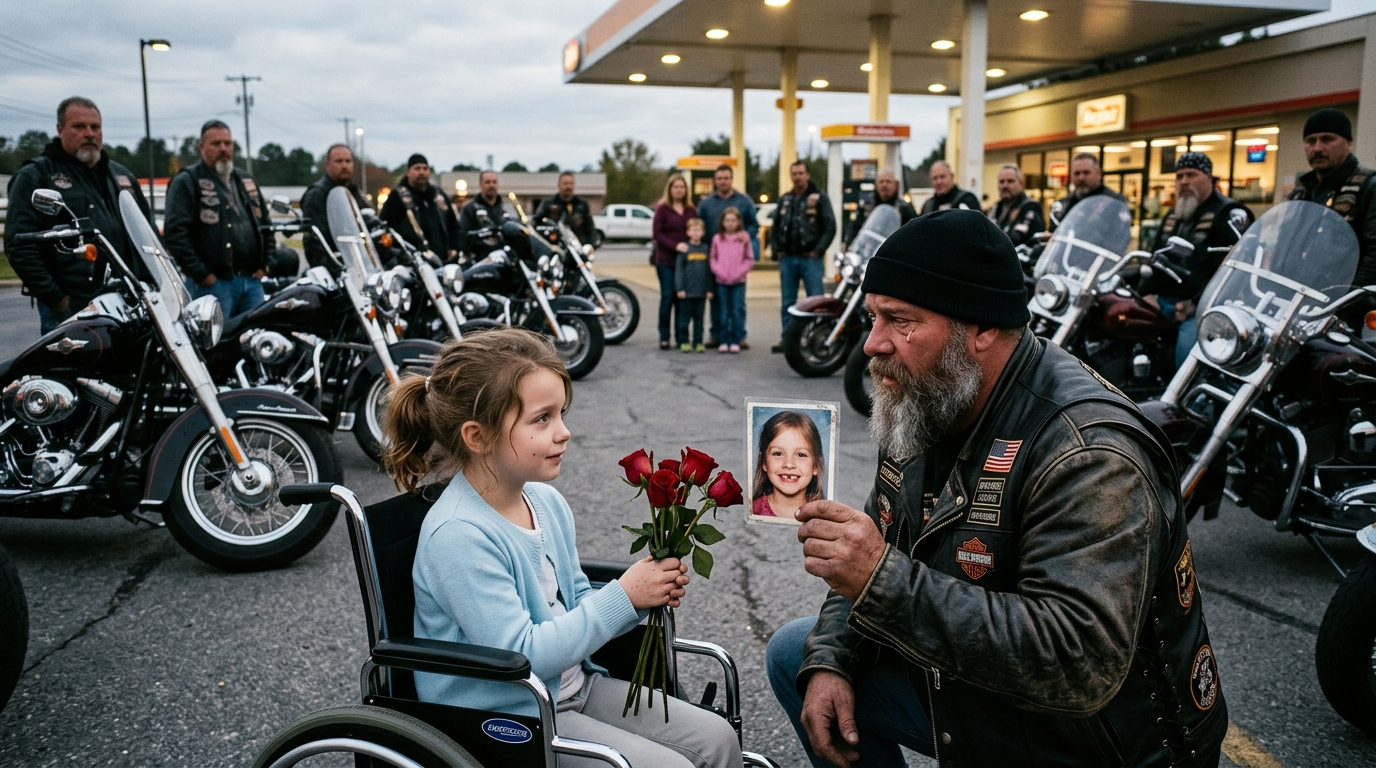
Twenty Harley engines rolled into the lot just before sunset.
Chrome flashed beneath the orange sky. Black leather cuts shifted as the riders parked in a long, slow line beside the pumps. The low rumble of engines drowned out the evening crickets, swallowed the soft hiss of traffic, and turned the gas station into something that felt less like a place to buy coffee and more like the edge of a storm.
The Iron Wolves had that effect.
Most people judged them before a word was spoken.
That was safer, maybe.
The man at the front of the line was the one everyone noticed first.
Jonah Mercer.
Most called him Bear.
At fifty-four, he looked like a man carved out of old road and bad weather. His beard had gone gray at the edges. His arms were thick. His leather vest was worn smooth in places from years of rain, sun, and grief. His eyes were the kind people looked away from quickly.
Not because they were cruel.
Because they looked like they remembered too much.
Bear stepped off his bike and removed his gloves.
Around him, his men laughed, stretched, fueled their motorcycles, and shook stiffness out of their shoulders. They had just finished a charity ride for a children’s hospital two counties over. Outsiders saw intimidation. They did not see the teddy bears strapped to the back of one bike, the donation receipts folded in Bear’s pocket, or the quiet way Duke wiped his eyes after meeting a boy waiting for a transplant.
Kindness looked strange in leather.
That did not make it less real.
Near the store entrance, a woman pulled her son closer when the riders walked past.
Bear noticed.
He always noticed.
He said nothing.
Then someone shouted.
“Hey, careful, sweetie!”
The voice came from near the air pump.
Bear turned.
A little girl in a wheelchair was rolling straight toward the bikes.
She was small, maybe seven or eight, wrapped in a pale yellow sweater too thin for the evening chill. A pink blanket lay across her lap. Her dark hair was tied back with a ribbon that had come loose on one side. Her hands were thin but determined on the wheels.
A woman near the gas station door reached after her, but the girl did not stop.
Not for the shouting.
Not for the engines.
Not for the men in leather who suddenly looked uncertain in the face of something too fragile to understand danger properly.
She rolled straight into the middle of them.
Straight toward Bear.
The yard noise fell apart.
Duke stopped laughing.
Miller lowered the gas nozzle.
Rafe froze with one boot on the curb.
The girl stopped in front of Bear’s bike and looked up at him.
In one trembling hand, she held a small bundle of wilted roses.
The flowers were tired. Petals bruised. Stems uneven, like they had been picked from the side of a fence or rescued from someone else’s trash.
She held them out.
“These are for you,” she whispered.
Bear did not move.
The girl swallowed.
“You look sad. My daddy says sad people need flowers first.”
The silence that followed became so heavy even the gas pump clicking off sounded too loud.
Bear looked down at the roses.
Then at the girl.
He had not smiled in years. Not properly. His men joked that his face had forgotten the shape. But this was not the kind of moment a man smiled through.
Slowly, Bear lowered himself to one knee on the oil-stained pavement.
His leather vest creaked.
The little girl held the flowers out farther.
He still did not take them.
Instead, his hand moved toward the inside pocket of his vest.
Duke straightened.
“Bear?”
Bear pulled out a small laminated photograph.
Old.
Creased at the edges.
Protected from rain by cheap plastic.
His hand began to tremble before anyone saw the picture.
He looked at the girl in the wheelchair.
Then at the girl in the photograph.
Same wide brown eyes.
Same small chin.
Same missing front tooth.
Same smile, though the girl in front of him was not smiling now.
Bear’s throat tightened so hard he could barely breathe.
He was not staring at a stranger.
He was looking at the child from the night he had spent seven years trying to bury.
The girl tilted her head.
“My daddy said you’d have my picture.”
Bear’s voice came out broken.
“What’s your name?”
She held the wilted roses against her chest.
“Annie.”
Duke took one step back.
Miller whispered, “No.”
Bear stared at the photograph again.
Because the name written on the back, in a hand he knew better than his own, was:
Annie Vale. Age 7. If you find her, tell Bear I kept my promise.
Bear looked up slowly.
“Who is your father?”
The girl’s answer was soft.
But every Iron Wolf heard it.
“Elias Vale.”
A gas pump clicked.
A woman gasped.
And Bear felt the past split open beneath him.
Because Elias Vale had been his brother in everything but blood.
And Elias Vale had been buried six years ago.
The Photo Bear Carried
Bear stood too fast.
The girl flinched.
He saw it and hated himself for it.
So he lowered his hands. Open. Empty.
“Easy,” he said, though he was not sure whether he meant it for her or himself. “I’m not going to hurt you.”
Annie studied him with the careful eyes of a child who had been promised safety by too many adults who failed to deliver it.
“My daddy said you were scary,” she said.
Duke coughed once.
Miller looked away.
Bear swallowed.
“He said that?”
Annie nodded.
“But good scary.”
That almost broke him.
Because Elias had said the same thing once.
Years ago, outside a county courthouse, after Bear stood between him and three men who had come to collect a debt Elias did not owe.
Scary is only bad if it points the wrong way, brother.
Bear looked down at the photo again.
He had carried it for six years.
Not because he understood it.
Because it was the last thing Elias had left behind.
The photo had been found inside Elias’s saddlebag after the wreck. A little girl smiling at the camera, front tooth missing, hands covered in mud as if she had been planting something. On the back was that message.
Annie Vale. Age 7. If you find her, tell Bear I kept my promise.
No one knew who Annie was.
Elias had no child, as far as the club knew.
No wife.
No family.
At least, that was the story.
Then Elias died.
A truck hit his bike on Ridge Road at 2:13 in the morning. The police called it a hit-and-run. The club called it murder. But there had been no proof, only grief.
Bear had arrived first at the scene.
He still remembered the rain.
The smell of burned rubber.
Elias’s bike twisted in the ditch.
The saddlebag torn open.
The photograph lying in the mud.
And Elias, bleeding, clutching Bear’s vest with one hand while trying to speak through broken breath.
Find her.
That was all Bear heard.
Then Elias was gone.
Or so he had believed.
Now a girl in a wheelchair was holding wilted roses in front of him and saying the dead man was her father.
Bear crouched again.
“Annie, where is Elias?”
She looked toward the road.
Not far.
Her face tightened.
“He’s in the blue house.”
“What blue house?”
“The one with boards on the windows.”
Duke stepped closer, voice low.
“Bear.”
Bear lifted one hand.
Not now.
He looked at Annie’s wheelchair.
It was old. The left wheel wobbled slightly. One footrest was tied on with cord. Her shoes were too small, and the pink blanket across her lap was damp at the edge from pavement spray.
“How did you get here?”
“I rolled.”
“From the blue house?”
She nodded.
Every man around them went still.
The closest boarded house was at least two miles down the service road.
A little girl had pushed herself two miles in a broken wheelchair to reach a gas station full of bikers.
Bear’s jaw tightened.
“Why?”
Annie held out the roses again.
“Daddy said you wouldn’t listen if I came crying.”
Bear closed his eyes.
That was Elias too.
Always knew where to stick the knife.
Annie continued.
“He said bring flowers first. So you’d remember you’re not angry before you’re sad.”
Duke swore under his breath.
Bear finally took the roses.
They were cold and wet in his hand.
“Is your daddy awake?”
Annie shook her head.
Her lips trembled.
“He was. Then the bad sleep came again.”
“The bad sleep?”
She nodded.
“The medicine sleep. The one they give him when he talks too much.”
Bear felt the world narrow.
Medicine sleep.
Not injury.
Not illness.
Someone had been drugging Elias.
“Who gives it to him?”
Annie looked toward the gas station entrance.
Fear passed across her face so fast Bear almost missed it.
Almost.
He turned.
A black sedan had pulled into the lot.
Then another.
Engines off.
Windows dark.
Annie’s hand shot out and grabbed Bear’s vest.
“They found me.”
Bear looked at Duke.
Duke was already moving.
Miller passed a quiet signal down the line.
The Iron Wolves changed without sound.
Shoulders squared.
Positions shifted.
Men who had looked like rough travelers a moment ago became a wall.
The driver’s door of the first sedan opened.
A man stepped out wearing a gray coat and polished shoes.
No badge.
No uniform.
No panic.
Just a calm face and cold eyes.
He smiled when he saw Annie.
“There you are, sweetheart.”
Annie’s fingers dug into Bear’s leather.
“That’s not my uncle,” she whispered.
Bear did not look away from the man.
“Funny,” he said. “I was just about to ask.”
The Blue House With Boards on the Windows
The man in the gray coat introduced himself as Martin Hale.
Family services consultant.
That was how he said it.
Consultant.
As if the word could make him harmless.
He claimed Annie was under protective care. Claimed she had behavioral issues. Claimed she invented stories about her father because of “trauma confusion.” He held out a folder with papers that looked official from a distance and thinner the closer Duke got to them.
Duke had once worked in county records before life took him sideways.
He took one look and laughed.
“This is a petition draft.”
Martin’s smile tightened.
“It authorizes temporary retrieval.”
“No judge signature.”
“It’s in process.”
Bear looked at Annie.
She was shaking now, but she stayed beside him.
“Did this man take you?”
Martin sighed.
“Mr. Mercer, I understand this looks dramatic, but the child is medically fragile and easily influenced.”
Annie whispered, “He told them my legs don’t work because I’m bad.”
Bear’s hand tightened around the wilted roses.
Martin heard her.
His eyes hardened.
“Annie.”
One word.
A warning.
The gas station clerk had frozen behind the glass.
Parents were pulling children into cars.
The evening had gone unnaturally quiet.
Bear spoke slowly.
“Get back in your car.”
Martin’s smile vanished.
“I don’t think you understand the legal situation.”
“I don’t care about the legal situation you printed in your car.”
Duke grinned faintly.
Miller moved Annie’s wheelchair behind Bear’s bike.
Martin glanced toward the second sedan.
Two men got out.
Larger.
Quiet.
Hands low.
Bear had seen hired force before. These men wore it like a coat.
One of them said, “We can do this easy.”
Bear looked at him.
“No,” he said. “You can’t.”
It almost turned ugly there.
Almost.
But then a siren sounded in the distance.
Not close enough to matter, but enough.
Martin’s face shifted.
He had not expected police.
The gas station clerk had called.
Good man.
Martin stepped back.
“This isn’t over.”
Bear looked down at Annie.
“No,” he said. “It isn’t.”
The sedans left.
Not fast.
Not panicked.
That worried Bear.
Men who retreated calmly were either harmless or prepared.
Martin Hale was not harmless.
Bear turned to the Iron Wolves.
“Blue house.”
No one asked if he was sure.
Duke lifted Annie gently from the wheelchair and set her in the passenger seat of his truck. She clutched the roses Bear had given back to her because she said Daddy would want proof he took them.
The bikes followed the truck down the service road.
Engines low.
No showing off.
No noise for the sake of noise.
Just a slow procession toward a place none of them wanted to exist.
Annie pointed after two miles.
“There.”
The blue house sat behind a chain-link fence, paint peeling, porch sagging, every window boarded from inside. Weeds grew waist-high around the front steps. A child’s sock lay in the mud near the gate.
Bear saw it and felt sick.
Duke parked first.
Miller cut the lock.
Inside, the house smelled of damp wood, canned soup, dust, and medicine.
A mattress lay in the living room.
A child’s blanket.
A stack of plastic cups.
A crate of old medical supplies.
And in the back room, on a cot beneath a cracked window, lay Elias Vale.
Alive.
Barely.
Bear stopped in the doorway.
For six years, he had carried guilt like a stone behind his ribs.
Now the stone had a face.
Elias was thinner than memory allowed. His beard had grown wild. One side of his face carried a scar from temple to jaw. His left hand was cuffed loosely to the cot rail with a medical restraint.
Duke muttered, “God help us.”
Annie slipped past Bear and climbed onto the cot.
“Daddy.”
Elias did not wake.
Bear crossed the room slowly.
His knees felt unsteady.
He touched Elias’s shoulder.
“Saint.”
Nothing.
“Elias.”
His eyelids fluttered.
For one impossible second, the dead man looked up.
His eyes found Bear.
Recognition came slowly.
Then pain.
Then something that almost became a smile.
“Took you long enough,” Elias rasped.
Bear’s breath broke.
And then Elias’s eyes rolled back.
The File Hidden in the Wheelchair
The ambulance took Elias under police escort.
That was Bear’s condition.
Police escort.
No private transport.
No “consultants.”
No men named Martin Hale.
Annie refused to leave her father until Bear promised she could ride in the ambulance. The paramedic tried to object. Duke simply looked at him until the objection quietly died.
At the hospital, doctors confirmed what Annie had called the bad sleep.
Sedatives.
Repeated dosing.
Controlled enough to keep Elias weak and disoriented, not enough to kill him.
His body told the story the paperwork had tried to hide.
Old injuries.
New bruises.
Signs of long-term restraint.
Bear stood in the waiting room with the wilted roses in one hand and Elias’s photo in the other.
He felt rage.
But beneath it was something worse.
Shame.
Because Elias had told him to find her.
And Bear had not.
He had looked for three months after the crash. Asked around. Called in favors. Scared men who deserved it and some who didn’t. But when no one found Annie, the club accepted the idea that the photo was old, maybe a child from a case Elias had stumbled across, maybe a stranger.
Then Rex had said, “Brother, sometimes the dead leave nonsense behind because dying ain’t tidy.”
Rex.
Bear’s former vice president.
The man who had handled Elias’s funeral.
The man who identified the body.
The man who died two years later.
Or so they thought.
Bear looked toward Annie’s wheelchair in the corner of the hospital room.
Something about it bothered him.
The way Martin Hale had looked at it.
Not at Annie.
At the chair.
“Duke.”
Duke turned.
Bear pointed.
“Check the wheelchair.”
Miller got there first.
He turned it over gently, careful not to damage anything. The underside was dirty, rusted, patched with tape and wire. One metal panel beneath the seat looked newer than the rest.
Miller removed two screws with a pocket tool.
Inside was a flat plastic pouch.
Annie watched from the bed beside her father.
Her eyes widened.
“Daddy said the chair remembers.”
Bear took the pouch.
Inside were documents.
A flash drive.
A small silver key.
And a letter addressed to him.
Bear,
If Annie reached you, I’m either dead or close enough that it doesn’t matter.
I tried to keep her hidden. I failed.
Martin Hale is not family services. He runs transfers for Northstar Recovery. They take children from mothers labeled unstable, fathers labeled criminal, families too poor to fight, and move them through private guardianship orders.
I found the ledger six years ago.
That’s why they hit my bike.
They needed me dead enough for you to stop looking, alive enough to sign what they needed when they found out I had copied the records.
Bear had to stop reading.
His vision blurred.
Duke finished the next line aloud.
“Rex helped them.”
The room went cold.
Rex.
Again.
The letter continued.
Rex identified another body as mine. He arranged the closed casket. He told you Annie was impossible. Don’t trust his grave.
Miller swore softly.
Not trust his grave.
The flash drive held the rest.
Videos.
Ledger pages.
Names.
Transfers.
Payments.
Northstar Recovery.
Martin Hale.
Judge Willis.
Private foster brokers.
And buried in the files was the truth of Elias’s “death.”
The body in the coffin had not been Elias.
It belonged to an unidentified man found after a warehouse fire.
Rex signed the identification.
The club buried a stranger.
Then burned Elias’s cut.
Then stopped saying his name.
Annie reached for Bear’s hand.
He looked down.
She was staring at the letter.
“Daddy said you would be mad.”
Bear swallowed.
“Yes.”
“At him?”
“No.”
“At me?”
The question hit harder than anything else that night.
Bear crouched beside her.
“No, sweetheart. Never at you.”
She looked toward Elias, asleep beneath hospital blankets.
“Then at who?”
Bear looked at the flash drive.
At the records.
At the name Rex Maddox, still signing documents two years after his supposed death.
“At the men who made us stop looking.”
The Grave That Lied
Rex Maddox’s grave was opened at dawn.
There were police there.
A county investigator.
Two federal agents.
And twelve Iron Wolves standing beyond the cemetery rope in a silent line.
The coffin came out of the ground under a sky the color of steel.
Bear knew before they lifted the lid.
Maybe every man there did.
The coffin was too light.
Inside were bricks.
A leather glove.
And a sealed envelope.
Bear did not touch it until the investigator photographed everything and handed it over.
On the front, in Rex’s handwriting:
For Bear, when the child finally teaches him to dig.
Duke made a low sound in his throat.
Bear opened it.
The letter inside was short.
You always were sentimental. That made you useful.
Elias should have died on Ridge Road. He didn’t. I corrected the story. Northstar paid well. The club survived because I made hard choices you were too soft to make.
If Annie found you, bring the files to the old train depot. Come alone, unless you want the girl to lose what’s left of her father.
Bear folded the letter carefully.
Miller looked at him.
“You’re not going alone.”
“No.”
Duke nodded.
“Good.”
“I’m bringing everybody.”
The old train depot sat abandoned near the river, a place where weeds grew through cracked platforms and pigeons nested in the rafters. Rex had chosen it because it had exits, shadows, and history. He had forgotten the Iron Wolves knew old places better than men in suits.
They did not go in blind.
Miller sent the files to the federal agents.
Duke arranged the perimeter with riders who knew how to disappear behind freight cars.
Bear walked onto the platform with Elias’s old photo in his pocket and Annie’s wilted roses tucked inside his vest.
Rex emerged from the station office.
Alive.
Older.
Heavier.
Still wearing the same crooked smile Bear had once trusted with his life.
“Brother,” Rex said.
Bear stared at him.
“No.”
Rex chuckled.
“That easy?”
“You lost that word.”
Rex shrugged.
“You always did get dramatic about loyalty.”
Behind him stood Martin Hale.
Two hired men.
One black medical van.
Bear’s eyes moved to the van.
Rex noticed.
“Elias is a signature, nothing more. His usefulness is almost done.”
Bear’s hands curled.
“Why Annie?”
“Leverage,” Martin said simply.
Bear looked at him.
A child.
A wheelchair.
A handful of wilted roses.
Leverage.
That was what men like Martin called anything human they wanted to use.
Rex held out one hand.
“The files.”
Bear shook his head.
“No.”
Martin smiled.
“You think law enforcement is cleaner than us?”
“No,” Bear said. “I think they’re louder when they arrive with cameras.”
Rex’s smile faltered.
From the far end of the depot came the sound of tires.
Then doors.
Then voices.
Federal agents moved in from both sides.
The hired men reached for weapons and found Iron Wolves already behind them.
Duke took one down with a tackle that shook dust from the rafters.
Miller disarmed the other with a wrench because Miller believed in using tools properly.
Rex tried to run.
Bear caught him at the platform edge.
For one second, they stood face to face.
All the years between them.
All the rides.
All the lies.
All the names burned because one man decided survival mattered more than truth.
Rex smiled weakly.
“You won’t kill me.”
Bear looked at the agents closing in.
“No,” he said. “That would make this too quick.”
Rex’s face changed.
Good.
Bear let the agents take him.
The Flowers He Finally Took
Elias woke fully three days later.
The first thing he asked for was Annie.
The second was Bear.
Annie climbed onto the hospital bed and tucked herself against his side. Elias held her with one arm and looked over her head at Bear.
For a long moment, neither man spoke.
Six years stood in the room with them.
The fake funeral.
The burned cut.
The photograph in the mud.
The search that stopped.
The daughter who rolled two miles in a broken wheelchair because grown men had failed her father.
Bear removed his vest.
Not the club cut.
The personal vest beneath it.
He folded it once and placed it on the chair.
“I believed them,” he said.
Elias’s voice was rough.
“I know.”
“I stopped looking.”
“I know.”
“I burned your name.”
Elias closed his eyes.
That one hurt.
When he opened them again, his gaze was tired but clear.
“Then put it back.”
So Bear did.
Not that day.
Not in the hospital.
But two weeks later, when Elias could sit upright and Annie insisted he wear socks because “hospital floors are sneaky cold,” the Iron Wolves gathered at the clubhouse.
They placed Elias Mercer’s name back on the wall.
Not as a dead brother.
Not as a traitor.
As a man wronged by lies and returned by his daughter.
Below his name, Bear added one line:
Found because Annie carried the flowers.
The club changed after that.
It had to.
Some men left when the investigation spread.
Some were told to.
Two went to prison.
One took a plea and named judges, transport companies, and private clinics tied to Northstar Recovery.
The Iron Wolves had to face the ugliest truth of all.
They had not all been guilty.
But they had been useful.
They had accepted sealed jobs.
Trusted Rex’s explanations.
Let loyalty become a blindfold.
That ended.
No more private transports.
No more sealed cargo.
No more charity rides without paperwork read twice by men who knew what evil looked like when it came dressed as help.
Annie’s legs did not magically heal.
This was not that kind of story.
Her wheelchair had not come from one injury but from years of neglect, wrong treatment, and fear disguised as care. Some days she could stand with braces. Some days she could not. Physical therapy became part of her life, but not the definition of it.
The chair changed too.
Miller repaired it first.
Then replaced it.
Then built a ramp at the clubhouse because Annie said she was tired of being carried like luggage.
Elias laughed for the first time when she said that.
Bear cried later where no one could see.
Except Duke saw.
Duke always saw too much.
One year after the gas station, the Iron Wolves returned from another hospital charity ride.
Same county road.
Same sunset.
Same gas station.
But this time, when they pulled in, Annie was waiting near the air pump in a new wheelchair with red spokes and a bell she rang whenever Duke annoyed her.
She held flowers again.
Fresh ones this time.
Roses from the clubhouse garden.
The garden had been her idea.
“Sad people need flowers first,” she had told them.
So the Iron Wolves planted flowers.
Badly.
Crooked rows.
Too much water.
Not enough sunlight.
But they grew anyway.
Annie rolled up to Bear and held out the roses.
“These are for you.”
This time, Bear took them immediately.
No hesitation.
No fear.
He knelt on the pavement in front of her.
“Thank you, sweetheart.”
She studied him.
“You still look sad.”
Bear looked toward Elias, who was leaning against his bike with a cane in one hand and a smile that had come back slowly, piece by piece.
“Sometimes,” Bear said.
Annie nodded like that made sense.
“Daddy says sad is okay if it doesn’t make you stop.”
Bear looked at the flowers.
Then at the girl who had crossed two miles of road to drag the truth back into their lives.
“Your daddy is a smart man.”
Annie grinned.
Her missing front tooth had grown in by then.
Bear almost missed the old smile.
Almost.
People later asked what happened the evening a little girl in a wheelchair rolled into a gas station full of bikers and handed flowers to the scariest man there.
They wanted the dramatic parts.
The sedans.
The blue house.
The hidden files.
The empty grave.
The train depot.
Rex in handcuffs.
The dead man waking in a hospital bed.
But Bear always remembered the first moment.
A child offering wilted roses with shaking hands.
A photograph trembling in his own.
The impossible truth of a face he had failed to find.
And a sentence so simple it broke through six years of anger.
You look sad. My daddy says sad people need flowers first.
She had been right.
Before justice.
Before rage.
Before engines and guns and graves and records.
There had to be flowers.
Because the truth did not come back roaring.
It rolled in quietly.
Small.
Brave.
Holding roses.