The Rhythm No One Was Supposed to Know
The sound crashed onto the table like a challenge.
Loud.
Piercing.
Enough to hush the crowd.
“Play something — or get out!”
Laughter erupted through the marble lobby.
Easy.
Cruel.
The kind of laughter that comes from people who have never been told no by hunger, cold, or locked doors.
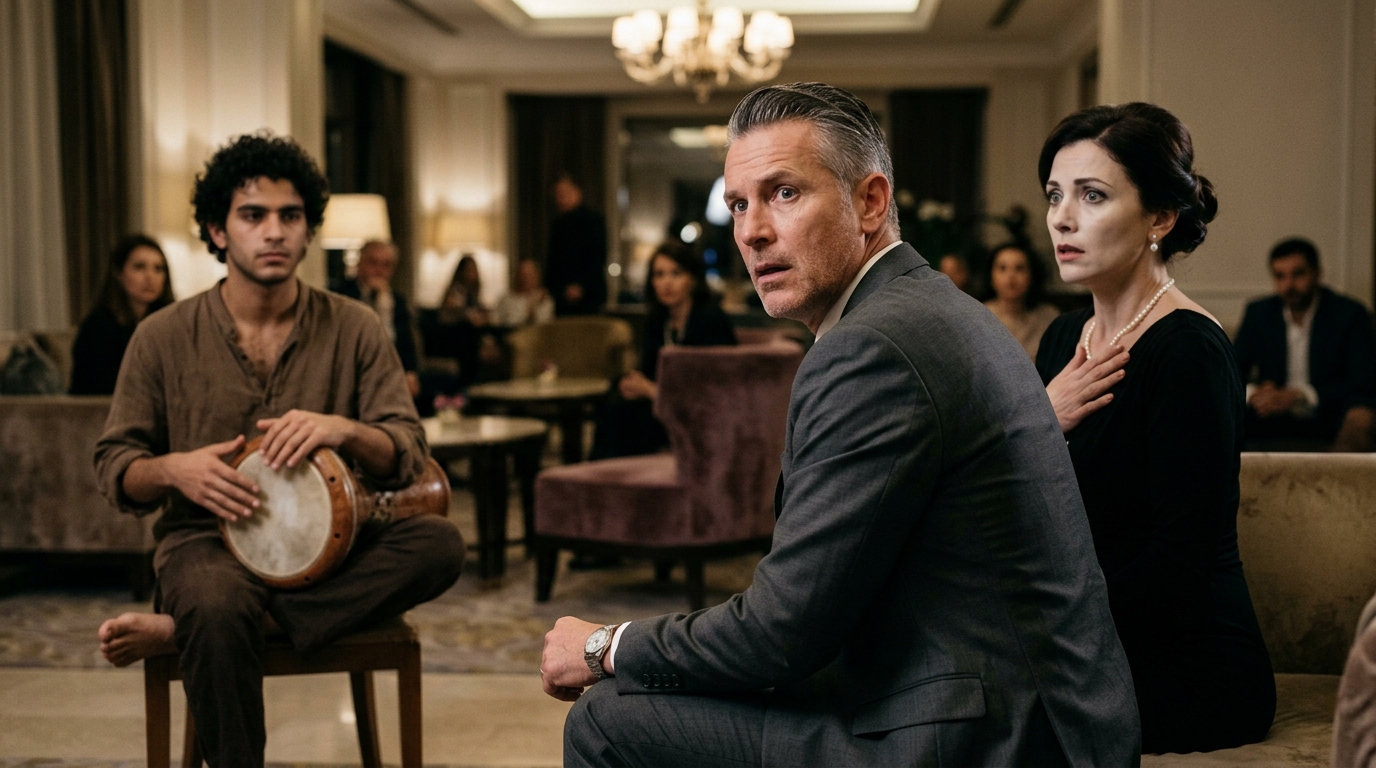
The Grand Meridian Hotel glittered around them like a palace pretending it had no memory. Gold light spilled from chandeliers. Champagne flutes shimmered in manicured hands. Women in silk gowns turned their heads slowly, curious but not concerned. Men in dark suits smiled as though the humiliation of a barefoot child was simply an unexpected addition to the evening’s entertainment.
At the center of it all stood the boy.
Barefoot.
Motionless.
No older than twelve.
His shirt was clean but faded. His trousers were too short at the ankles. His hair was dark, damp from the rain outside, and curled against his forehead. He carried nothing but a small cloth bundle and a stillness that made him seem older than everyone laughing at him.
The man who had spoken was Darius Vale.
Owner of the Grand Meridian.
Billionaire hotelier.
Collector of rare art, expensive watches, and public admiration.
He sat at the main table beneath the lobby’s central chandelier, one hand resting on a crystal glass, the other folded near his wife’s hand.
His wife, Celeste, wore emerald satin and diamonds at her throat.
She had smiled first when the boy entered.
Not kindly.
Like someone recognizing danger before everyone else and choosing mockery as a shield.
The boy had walked through the lobby during the annual Meridian Foundation gala, past security, past waiters, past guests who assumed someone else would remove him. He had not begged. He had not wandered. He had crossed the marble floor directly toward Darius’s table.
That was what made people uncomfortable.
Poor children were supposed to hover at edges.
Not approach power.
Darius had been irritated before the boy even spoke.
“Sir,” the boy said quietly.
Celeste leaned toward her husband.
“Security should be embarrassed.”
Darius lifted his hand before the boy could continue.
“You want money?”
The boy shook his head.
“I came to play something.”
More laughter.
A woman near the fountain covered her mouth.
A young man lifted his phone.
Someone whispered, “This is going online.”
Darius looked toward the grand piano near the far wall.
“You play?”
The boy said nothing.
Darius reached into his jacket, pulled out a folded bill, and slapped it onto the table.
The sound cracked through the lobby.
“Play something — or get out.”
The laughter rose again.
But the boy did not move toward the piano.
He did not argue.
Did not flinch.
Did not look at the money.
Instead, he turned slowly toward a small darbuka resting beside a chair near the musicians’ stand. The drum had been part of the evening’s decorative “world music” display, placed there after the hired ensemble finished their set.
No one expected the child to touch it.
He did.
He bent down, lifted the darbuka carefully, and sat on a low stool in the middle of the lobby.
The laughter thinned.
The boy rested the drum against his knee.
Then he waited.
One second.
Two.
Darius smirked.
Celeste’s fingers tightened around her champagne glass.
Then came the first strike.
Deep.
Resonant.
It rolled through the entire lobby, rebounding off marble and glass like something ancient waking beneath the floor.
The room froze.
Another beat followed.
Then another.
Faster.
Layered.
Precise.
Alive.
The rhythm rose in the air, slipping under conversations, breaking through thought, demanding attention whether anyone wanted to give it or not.
Phones lowered.
Smiles vanished.
This was not entertainment.
It was memory.
Darius’s face changed first.
Only slightly at first.
A narrowing of the eyes.
A sudden stillness in his shoulders.
Then fear crept into the space where arrogance had been.
“No,” he whispered.
The boy kept playing.
The rhythm shifted.
Darker now.
More deliberate.
Not a song.
A message.
Darius stood slowly.
His chair scraped against the floor.
“That rhythm…”
Celeste’s face had gone pale.
Darius’s voice trembled.
“That pattern… no one knows that.”
The boy did not stop.
If anything, his hands moved faster.
Stronger.
The final strike hit hard.
It echoed like a door slamming shut.
Silence fell.
Heavy.
Absolute.
The boy slowly raised his gaze and locked eyes with Darius.
“Then ask your wife,” he said.
A pause.
Brief.
Deadly.
“Why my mother died with your ring.”
The air shattered.
Darius turned.
Slowly.
Too slowly.
Toward Celeste.
Her expression had already changed.
Color drained from her face.
Her eyes widened.
No denial.
Only fear.
Real fear.
Somewhere in the lobby, the darbuka gave one faint echo, like a heartbeat refusing to fade.
And for the first time in twenty years, Darius Vale looked at his wife as if she had become a stranger wearing a familiar face.
The Woman Behind the Rhythm
The boy’s name was Sami.
Sami Nassar.
His mother had been Layla Nassar, though most people who knew music in old New York remembered her by another name.
Layla of the Seven Beats.
She had played the darbuka like it was a second language.
Not loudly for attention.
Not fast merely to impress.
She played with the kind of precision that made people feel as if she were opening doors inside them they had forgotten were locked.
Twenty years earlier, before Darius Vale became a billionaire whose name appeared on hotels across three continents, he was the restless heir to a failing family property.
The Grand Meridian had been old then.
Beautiful, yes.
But fading.
Its carpets worn.
Its lobby half-empty.
Its owners drowning in debt behind polished smiles.
Darius was young, ambitious, and desperate to prove he could restore the hotel before investors stripped it apart.
He hired musicians for a private investor night, hoping to make the old lobby feel alive again.
That was when he heard Layla.
She was not the main performer.
She was supposed to play in the background near the fountain while guests arrived.
But the moment her hands touched the darbuka, the room changed.
Darius forgot the investors.
Forgot the speeches.
Forgot the carefully rehearsed charm he used on men with money.
He stood near the staircase and listened.
After the event, he found her packing her drum into a worn case.
“What was that rhythm?” he asked.
She smiled.
“Which one?”
“The one near the end. Seven strikes, then the turn.”
Her smile faded slightly.
“You noticed?”
“I couldn’t ignore it.”
She studied him for a moment.
“My grandmother called it the door rhythm.”
“Why?”
“Because if someone knows it, they know where to find you.”
That should have sounded like poetry.
Instead, Darius heard a promise.
Over the next year, Layla became the secret life Darius did not tell his family about.
She played late-night sets in the old lobby after events ended. He sat in the back with loosened tie and tired eyes, listening as if every rhythm removed one layer of the man he was expected to become.
She taught him the seven-beat pattern.
He taught her how to read hotel ledgers.
She laughed at his seriousness.
He loved her before he admitted it.
Then Celeste arrived.
Celeste Hart was the daughter of one of the investors who held the Grand Meridian’s debt. She was polished, brilliant, and raised to understand that marriage could be a merger if dressed properly.
Darius’s family wanted him to marry Celeste.
Celeste wanted the hotel.
Layla wanted none of that world.
And Darius, weak in the way young men can be when standing between love and ambition, tried to believe he could keep both.
He could not.
When Layla became pregnant, everything changed.
Darius gave her his father’s ring.
A gold signet ring engraved with the Vale crest.
Not publicly.
Not legally.
But with trembling hands in a small apartment above a bakery, he slipped it into her palm and said, “Until I can do this properly.”
Layla looked at the ring.
Then at him.
“Properly means in daylight.”
“I know.”
“Not after business meetings. Not after your family sleeps. Not when your future wife is across town planning your life.”
“She is not my future wife.”
Layla’s eyes softened with sadness.
“Then tell her.”
Darius promised he would.
He did not.
Two weeks later, Layla vanished.
Her apartment was cleared.
Her drum was gone.
Her phone disconnected.
Darius received one letter.
It said she had left because she wanted money, not him. It said the child was not his. It said she had taken the ring as payment for what she called “a convenient mistake.”
Darius did not believe it at first.
Then Celeste showed him a bank transfer.
A statement.
A witness.
A photograph of Layla leaving the city with a man he did not know.
Darius broke.
Or perhaps he chose the version of breaking that required the least courage.
He married Celeste eight months later.
The Grand Meridian survived.
Then thrived.
Then became an empire.
But every year, on the anniversary of the night Layla disappeared, Darius heard the seven-beat rhythm in his sleep.
He never told Celeste.
He did not need to.
She knew.
Now, two decades later, a barefoot boy had played that rhythm in the lobby.
The exact pattern.
The door rhythm.
And claimed his mother died with Darius’s ring.
The Ring Celeste Said Was Stolen
Darius’s voice was barely audible.
“What does he mean?”
Celeste did not answer.
The guests sat frozen around them, no longer entertained. The phones that had risen to record humiliation now recorded something far more dangerous.
Darius turned back to Sami.
“Who was your mother?”
The boy’s expression did not change.
“Layla Nassar.”
A sound moved through the room.
Not loud.
But sharp.
Some of the older guests knew the name.
The elderly violinist near the piano lowered his bow with shaking fingers.
Darius gripped the edge of the table.
“That is impossible.”
Sami reached into the cloth bundle beside his feet.
Celeste suddenly stood.
“Security.”
Her voice cracked.
That crack doomed her.
No one moved.
Darius lifted one hand.
“Stay where you are.”
The security guards stopped.
Sami unfolded the cloth bundle.
Inside was a small wooden box, worn smooth at the corners. He opened it and removed three things.
A photograph.
A folded letter.
And a gold ring.
The ring caught the chandelier light.
Darius staggered back.
It was his father’s ring.
The Vale crest.
The same scratch near the edge from the night he dropped it on Layla’s kitchen floor.
The same ring Celeste told him Layla had stolen.
Sami placed it on the table.
“My mother said you gave it to her.”
Darius stared.
“She kept it?”
“She died holding it.”
Celeste whispered, “This is a trick.”
Sami turned toward her.
“My mother said you would say that.”
Celeste’s face hardened.
The boy placed the photograph beside the ring.
It showed Layla years after Darius last saw her.
Older.
Thinner.
Tired.
But alive.
She stood in front of a small clinic, one arm around a little boy of about five. On her finger was the Vale ring.
Darius reached for the photo.
His fingers trembled.
“She was alive.”
Sami nodded.
“Until last winter.”
Darius closed his eyes.
Twenty years collapsed inside him.
Every night he had wondered.
Every time he told himself she chose to leave.
Every time he let anger protect him from grief.
Every time Celeste said, “Some women know how to use men like you.”
The lie had not died.
It had aged.
Sami unfolded the letter.
“My mother wrote this before she died.”
He held it out to Darius.
Celeste moved suddenly.
“Don’t read that.”
Darius looked at her.
Her hand froze midair.
The room saw it.
Darius took the letter.
Layla’s handwriting was different from the one in the old goodbye note.
He knew that immediately.
The letter Celeste had shown him years ago had been sharp, slanted, cold.
This letter curved gently.
Like the notes Layla once left in the margins of hotel ledgers.
Darius,
If this reaches you, then Sami found courage I never found in life.
I did not leave because I wanted to.
I left because Celeste came to my apartment with two men and a document she said would destroy you, me, and the child if I refused.
She knew I was pregnant.
She knew the ring was yours.
She told me your family would bury me in court, call me a thief, and take the baby the moment he was born.
I ran because I believed fear before I believed love.
For that, I am sorry.
I tried to come back once.
Darius stopped.
His breath caught.
He forced himself to continue.
I came to the Grand Meridian when Sami was four. I waited in the lobby during the winter gala. I saw you with Celeste.
I was leaving when she found me.
That night, I lost the last chance to speak to you.
She took the only copy of Sami’s birth certificate and told me if I ever returned, he would disappear into a system where neither of us could find him.
I kept the ring because it was the only proof that there had once been truth between us.
If Sami stands before you now, do not let Celeste touch him.
And if he plays the seven-beat door, remember this:
I never stopped listening.
Layla
Darius lowered the letter.
The marble lobby seemed to tilt beneath him.
Sami watched him without tears.
Children who have cried too much sometimes become careful about when they spend the rest.
Darius turned toward Celeste.
“Tell me it is not true.”
Celeste’s lips parted.
No sound.
“Tell me,” he said again.
Her eyes moved to the ring.
Then to the phones.
Then to the guests.
Then back to him.
“Darius,” she whispered, “you don’t understand what she would have done to you.”
The answer was not a confession in words.
It was worse.
It was a confession in purpose.
The Night Layla Returned
The elderly violinist stepped forward before Darius could speak again.
His name was Roman Bell.
He had played at the Grand Meridian since before Darius inherited it. In his youth, Roman had performed with Layla in smoky rooms where music mattered more than money.
His face was pale now.
“I saw her.”
Darius turned.
Roman swallowed.
“The winter gala. Sixteen years ago. I saw Layla in the lobby.”
Darius stared at him.
“You never told me.”
Roman looked down.
“I tried.”
Celeste’s face sharpened.
Roman continued.
“Mrs. Vale told me I was mistaken. She said grief makes old musicians see ghosts. Then my contract was canceled for two years.”
Darius’s voice shook.
“And you stayed silent?”
Roman’s eyes filled.
“I was poor. Afraid. Ashamed.”
Sami looked at him.
“Did she have a child with her?”
Roman nodded slowly.
“A little boy. Curly hair. Red scarf.”
Sami touched his throat as if remembering something from another life.
“My mother kept that scarf.”
Celeste’s mask cracked.
“This is absurd,” she said. “You are letting a street child and a bitter old violinist rewrite history in front of strangers.”
Darius looked at his wife.
“No. I am letting them speak after you spent twenty years making sure they couldn’t.”
The words struck her.
She straightened.
“Everything you have exists because of me.”
There it was.
The sentence beneath all the silk.
Darius stared at her.
“The hotel?”
“The empire,” she snapped. “The investors. The expansion. The family name. Do you think Layla Nassar could have stood beside you in boardrooms? Do you think that child would have made your life easier?”
Sami’s face hardened.
Darius stepped toward him instinctively.
Celeste saw it.
A bitter laugh escaped her.
“You hear a drumbeat and suddenly you are a father?”
The lobby went silent.
Darius turned slowly.
“Am I?”
Celeste said nothing.
Sami reached into the wooden box one last time and removed a folded medical document.
“My birth certificate copy. My mother hid it behind the drum skin.”
Darius took it.
Father: Darius Vale.
The room blurred.
He pressed one hand to the table.
Celeste whispered, “Anyone can forge paper.”
Darius looked at her.
“Then we test it.”
Her eyes flickered.
There.
Fear again.
Darius saw it now with the clarity of a man who had spent too many years explaining away the obvious.
“You knew,” he said.
Celeste’s voice lowered.
“I knew enough.”
“Enough?”
“Enough to know she would ruin you.”
“My son was born.”
“Our life was built.”
“On what?”
She stepped closer, furious now.
“On choices you were too weak to make. You wanted the hotel, the family name, the money, and the girl with the drum in the bakery apartment. I chose for you.”
Darius flinched.
Because part of that accusation held truth.
Not justice.
But truth.
He had been weak.
He had delayed.
He had hidden Layla in shadows until Celeste weaponized the darkness.
That guilt was his.
But Celeste’s cruelty was hers.
Darius looked toward the hotel manager.
“Lock down the security office. Preserve all archived footage and records from the winter gala sixteen years ago.”
Celeste laughed.
“Sixteen years? You think footage still exists?”
Roman spoke.
“The Grand Meridian archived gala footage for promotional use. Always did.”
Darius stared at Celeste.
She went white.
The manager left immediately.
Celeste grabbed her purse.
Darius said, “No.”
She froze.
“You will not leave.”
Her eyes flashed.
“You cannot detain me.”
“No,” Darius said. “But the police can question you.”
At the word police, Sami finally looked like a child.
Not afraid exactly.
Exhausted.
The kind of exhausted that comes when truth takes more strength than lying ever did.
Darius lowered himself to one knee before him.
The entire lobby watched.
“I am sorry,” he said.
Sami stared.
Darius’s voice broke.
“I don’t know how much I could have stopped if I had been braver then. But I know I should have looked harder. I should have known the letter was not hers. I should have found you.”
Sami’s mouth trembled once.
Only once.
“My mother said you might say sorry.”
Darius nodded.
“What did she say I should do next?”
Sami looked at Celeste.
“She said truth first.”
The Door the Drum Opened
The DNA test confirmed what the rhythm already knew.
Sami Nassar was Darius Vale’s son.
The investigation that followed exposed more than even Layla’s letter had revealed.
Celeste had not acted alone.
Her father’s investment firm had pressured Layla into leaving. Legal threats had been drafted but never filed. A forged letter had been created to make Darius believe Layla abandoned him. Payments had been made to a private security company the night Layla returned to the Grand Meridian with four-year-old Sami.
Archived footage showed Celeste speaking to Layla near the side lobby.
It showed two men escorting Layla and the child out through the service entrance.
It showed Roman Bell watching from the musicians’ corridor.
It did not show what happened after.
But records did.
Layla moved three times in six months.
Each move followed a threatening message.
Each message traced back to a company tied to Celeste’s family office.
Celeste was arrested first for fraud, coercion, and conspiracy related to falsified documents and intimidation. More charges followed. Her family fought quietly, then loudly, then less loudly once investigators found old communications they had believed deleted.
Darius did not hide from his part.
That surprised people most.
He issued no polished statement blaming “outside forces.”
He stood in the Grand Meridian lobby, in the same place where Sami had played the darbuka, and spoke plainly.
“Twenty years ago, I failed the woman I loved by allowing ambition, fear, and family pressure to keep her in the shadows. Others committed crimes. Those crimes will be pursued. But my cowardice created the darkness where those crimes became possible.”
Reporters went silent.
Then he said Layla’s name.
Fully.
Clearly.
Layla Nassar.
Not former performer.
Not alleged mistress.
Not scandal.
Layla Nassar, musician, mother, and the woman whose rhythm returned the truth to this hotel.
Sami watched from a private room upstairs with Roman beside him.
He did not want cameras.
Darius respected that.
At first, Sami refused to move into the Vale residence.
“I had a mother,” he said.
Darius nodded.
“Yes.”
“I’m not replacing her with your house.”
“No.”
“I don’t want your wife’s room.”
“She is gone.”
“I still don’t want it.”
“Then you won’t have it.”
Trust began there.
Not with money.
With not forcing.
Sami chose to stay with Mara Nassar, Layla’s older cousin, who had taken him in after Layla died. Darius arranged support through lawyers, but Sami made the decisions where possible.
School.
Home.
Music.
Visits.
Name.
He kept Nassar.
Darius did not ask him to change it.
The darbuka returned to the Grand Meridian once, six months later, during a memorial concert for Layla.
No champagne gala.
No forced smiles.
No investor table.
Just musicians, old friends, hotel staff, and people who had come because her story had moved them.
Roman played violin.
Then Sami sat at the center of the lobby with his mother’s darbuka.
Darius stood in the back.
He did not sit at the main table.
There was no main table.
Sami played the seven-beat door.
This time, the rhythm did not accuse.
It mourned.
It remembered.
It opened.
Darius cried without hiding it.
Years later, people still told the story of the barefoot boy who entered the Grand Meridian and played a drumbeat that made a billionaire turn pale.
They loved the dramatic version.
The cruel command.
The lobby going silent.
The glowing chandeliers.
The wife’s face draining of color.
The line that shattered the room:
Ask your wife why my mother died with your ring.
But Sami remembered other things.
The weight of the darbuka against his knee.
The way his hands almost shook before the first strike.
The old violinist whispering, “I saw her.”
Darius kneeling.
Celeste finally looking afraid.
And the faint echo after the final beat, as if his mother’s hands had answered from somewhere beyond the room.
When Sami was older, he asked Darius a question neither of them had been ready for before.
“Did you love her enough?”
Darius did not answer quickly.
That mattered.
“No,” he said finally. “Not then. I loved her, but not bravely enough.”
Sami looked down at the ring, now kept in a glass case beside Layla’s drum.
“My mother said love without courage becomes another kind of lie.”
Darius closed his eyes.
“She was right.”
Sami nodded.
Then he picked up the darbuka and tapped the seven-beat pattern softly.
Not as accusation.
Not as forgiveness.
As memory.
Darius listened.
Because he had learned, too late but not never, that some rhythms are not meant to entertain a room.
Some are meant to call the lost home.
Some are meant to wake the guilty.
Some are meant to tell the truth when every document has been forged, every witness frightened, every door locked, and every powerful person convinced the past has finally gone quiet.
But the past had not gone quiet.
It had learned the drum.
And when Sami Nassar struck the final beat in that marble lobby, the sound did not fade.
It stayed in the walls.
In the glass.
In the name of Layla Nassar, restored above the music hall Darius built in her honor.
And in the life of a boy who entered barefoot while strangers laughed, sat down with a drum, and opened a door no one rich enough to hide the truth had managed to keep closed.