The Rice Bag in the Rain
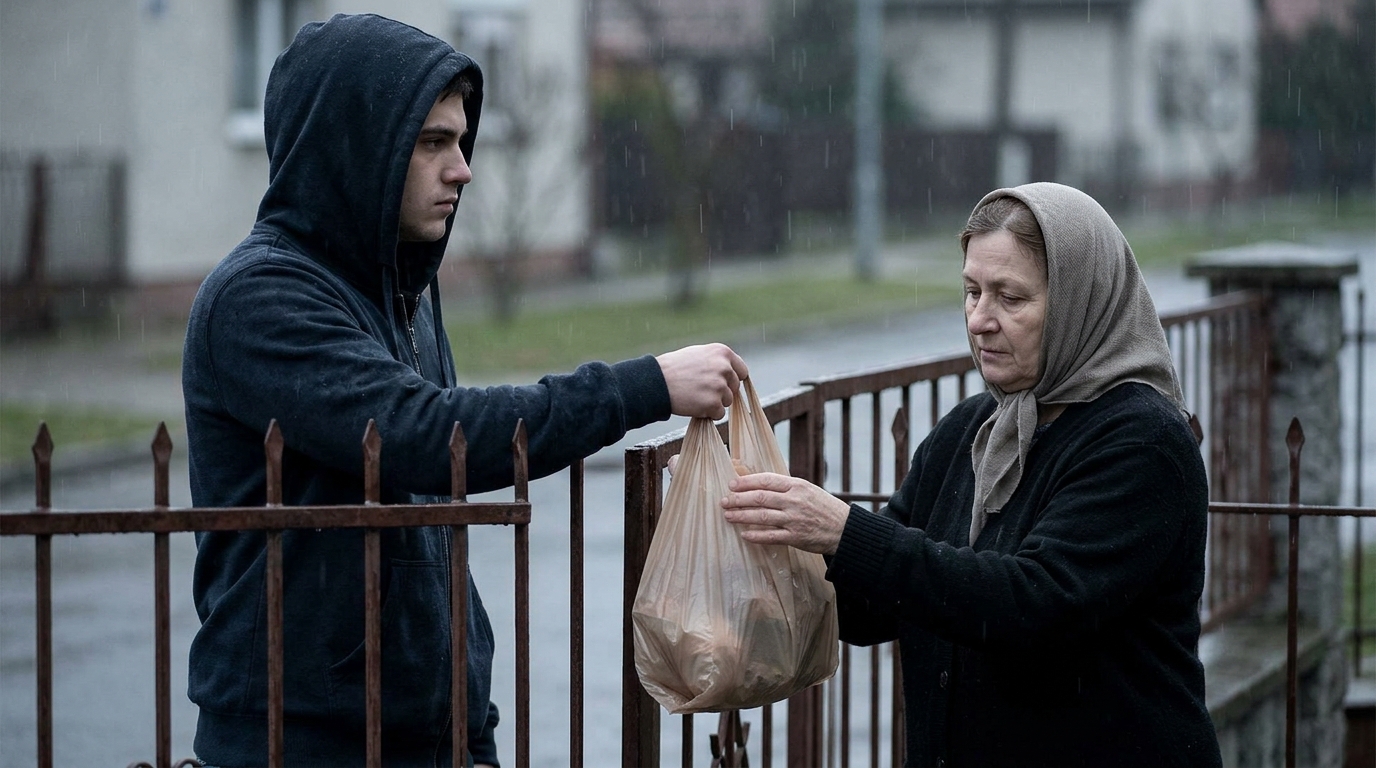
“Take the rice and go, Mom.”
His voice was flat.
Distant.
Almost empty.
As if the woman standing outside his gate was not the person who had carried him on her back through flooded roads when he was a child.
As if she had not gone hungry so he could eat.
As if she had not sold her wedding bangles to pay his exam fees.
The burlap bag landed in her hands.
Not gently.
Not harshly.
Just without feeling.
That was what hurt most.
Mrs. Lien Tran stood outside the iron gate with rain sliding down her gray hair and soaking the shoulders of her thin brown sweater. The bag of rice was heavy in her arms, but the heaviness in her chest was worse.
Her son, Minh, did not look at her for long.
He was dressed in a clean white shirt and dark trousers, the kind of clothes she had once dreamed he would wear someday when he no longer had to bend his back in the fields like she did.
Behind him, through the half-open door, a woman’s voice rang out.
“Minh, are you done yet? Don’t stand there all night.”
His wife.
Clara.
Lien lowered her eyes.
Minh’s jaw tightened, but only for a second.
Then his face went blank again.
“Yes,” he called back.
He turned to his mother.
“Go home before the rain gets worse.”
Lien tried to smile.
It trembled before it could become real.
“I just wanted to see if you were eating well.”
“I’m fine.”
“And the children?”
“They’re fine.”
“Your back? Last month you said—”
“Mom.”
One word.
Sharp.
Final.
Lien stopped speaking.
The rain fell harder between them.
Minh looked away.
“Take it and go.”
Then he stepped back.
The gate shut.
Not slammed.
That might have been easier.
It closed with a soft metal click.
The kind of sound that tells a person they have not merely been sent away.
They have been placed outside.
Lien stood there for several seconds, holding the rice bag against her chest while rainwater ran down her face. She did not know whether she was crying yet. The rain was kind enough to hide the answer.
“He’s just struggling,” she whispered.
No one heard her.
She said it anyway.
Because mothers defend their children even when their children are not there to deserve it.
“He has a family now. He has pressure. He didn’t mean it.”
The street was empty.
The houses along the lane glowed warmly behind glass windows and locked gates. Somewhere inside one of them, people were eating dinner. Someone laughed. Someone turned on a television. Someone called a child to wash their hands.
Lien adjusted the rice bag in her arms and began the long walk home.
Her tiny house sat at the edge of the old market road, where the pavement cracked and rainwater gathered in shallow brown pools. By the time she reached it, her sandals were muddy, her sweater clung to her thin frame, and the rice bag felt heavier than it should have.
She pushed open the wooden door.
The house groaned in the wind.
Inside, there was silence.
Only the rain tapping against the window.
Only the drip from the corner of the ceiling into the metal basin she kept beneath it.
Only the small table where she ate alone.
Lien set the rice bag down carefully.
She should have felt grateful.
Rice was rice.
Food was food.
A mother should not complain when a son gives her anything, she told herself.
But her hands shook as she touched the zipper tied across the top of the bag.
Not from the cold.
From something deeper.
She opened it slowly.
Quietly.
The sound of the zipper seemed too loud in the little room.
At first, she saw only rice.
White grains packed tightly inside the plastic liner.
Then her fingers brushed against something that did not belong.
Hard.
Flat.
Wrapped in cloth.
Lien froze.
Her breath caught.
She pushed aside the top layer of rice and pulled out a thick brown envelope sealed with tape.
Her name was written across it.
MOM.
Not Mother.
Not Mrs. Tran.
Mom.
The letters were careful.
Uneven in one place, as if the hand that wrote them had paused too long.
Lien’s fingers trembled.
She opened the envelope.
Inside was cash.
Stacks of it.
More money than she had ever held at one time.
Her knees weakened.
She gripped the table to steady herself.
The first tears came then, but still she did not sob.
Not yet.
Because something else slipped from the envelope and fell onto the table.
A small folded note.
Lien picked it up.
The paper was damp at one corner from the rain, but the writing inside was clear.
I’m sorry, Mom.
The words broke her.
She sank slowly into the chair.
Her hand covered her mouth.
For a moment, she could not read further.
Then, through the blur of tears, she forced herself to continue.
I couldn’t say it in front of her.
The room seemed to tilt around her.
The rain grew louder.
And suddenly the cold voice at the gate did not sound cold anymore.
It sounded trapped.
The Words He Couldn’t Say
Lien read the note three times before she could believe it.
Mom,
I know how I sounded tonight.
I know you must have felt hurt.
Please forgive me.
I couldn’t say anything kind in front of Clara. She checks everything. She counts what I spend. She asks why I give you anything. If she knew I was sending this money, she would take it before it reached you.
The rice is only an excuse.
Please hide the envelope carefully.
Use it for medicine first. Then fix the roof. Then buy yourself warm clothes. Do not save it all for me. I know you. Don’t do that.
I have been trying to visit you, but every time I mention it, she starts a fight. She says my mother is not my responsibility anymore.
That sentence cut through Lien harder than the rain had.
Not my responsibility anymore.
She pressed the note to her chest.
Minh had written more.
You are my mother.
Before I had a wife, before I had a house, before I had children, before I became anything, I was your son.
I have not forgotten.
Lien bent over the table and wept.
Not quietly now.
Not politely.
She cried with the whole weight of a woman who had spent years pretending she did not need much.
A woman who had walked away from her son’s gate telling herself he was only tired.
A woman who had believed, for one terrible hour, that the boy she raised had learned to be ashamed of her.
The money lay on the table.
But it was not about the money.
Not really.
It was about the sentence he could not say aloud.
I have not forgotten.
Lien wiped her face with the end of her sleeve and continued reading.
There is something else.
If anything happens to me, take this note to Uncle Bao. He knows where the rest of the documents are.
Lien stopped.
The room became still.
Something else?
Documents?
Her heart began to beat faster.
She turned the page.
I’m not just hiding money from Clara.
I’m trying to protect the house.
My father’s land.
Your land.
She wants me to transfer everything into her name. She says it’s for the children. But I saw the messages on her phone. She and her brother have been planning to sell the old land near the canal after I sign.
Lien stared at the paper.
The old land.
The small strip of soil her husband had left before he died.
Worth little when she was young.
Worth far more now that the new road was being built nearby.
Minh’s note continued.
I was foolish. I signed some papers already because I trusted her. Uncle Bao warned me something was wrong. I didn’t listen.
Now I’m trying to undo it.
I acted cold tonight because Clara was standing behind the curtain watching us. If I had spoken gently, she would have known.
Mom, please forgive me.
I am trying to fix what I should have protected sooner.
Lien’s hands shook so badly the paper rustled.
She looked at the rice bag.
Then the envelope.
Then the rain outside her window.
For years, she had thought Clara merely disliked her.
She had not imagined this.
Clara had always smiled when others were watching.
A thin smile.
A controlled smile.
The kind of smile that never reached the eyes.
At family gatherings, Clara served tea in beautiful cups and called Lien “Mother” in a voice sweet enough to fool strangers. But when Minh left the room, the sweetness vanished.
“You shouldn’t come too often,” Clara once said while stacking plates. “Minh works hard. He needs peace.”
Lien had nodded.
Peace.
She wanted her son to have peace.
Another time, Lien brought vegetables from her garden. Clara accepted them at the door, then Lien later saw the bag sitting untouched near the trash.
“They had dirt on them,” Clara said.
Lien apologized.
She apologized often.
For visiting.
For calling.
For bringing food.
For being old.
Now she understood.
Clara had not simply disliked her.
Clara had been removing her.
Piece by piece.
Visit by visit.
Call by call.
Until Minh had to hide love inside a rice bag like contraband.
Lien looked back at the note.
The last line was shorter.
I will come when I can.
Don’t open the gate for anyone Clara sends.
Your son,
Minh
Lien sat alone at the wooden table until the candle burned low.
The money remained before her.
The note in her hand.
The rice bag open beside her like an ordinary thing that had carried an extraordinary truth.
Outside, rain kept falling.
But the house no longer felt empty.
It felt watched over by words her son had been forced to bury and brave enough to send anyway.
The Woman Behind the Curtain
Minh did not sleep that night.
After closing the gate, he stood in the narrow hallway for several seconds, his hand still resting on the latch.
He had heard the rain.
He had heard his mother’s slow steps leaving.
Every instinct in him screamed to open the gate, run after her, wrap his arms around her thin shoulders, and say everything.
I’m sorry.
I love you.
Don’t believe my voice.
But Clara’s reflection watched him from the glass cabinet near the door.
She was standing in the living room entrance with one arm crossed over her chest, the other hand holding her phone.
“You gave her the rice?” she asked.
Minh turned.
“Yes.”
“Nothing else?”
“No.”
Her eyes narrowed.
“That bag looked heavy.”
“It was rice.”
“How much?”
“Enough.”
“Enough for what?”
He forced himself not to react.
“For my mother to eat.”
Clara’s mouth tightened.
“You’re very generous with people who never helped us build this house.”
Minh looked at her.
“My mother raised me.”
“And now you have a wife and children.”
“I know.”
“Do you?”
The argument wanted to begin.
Minh could feel it moving toward him like a storm he had walked through too many times.
He stepped past her.
“I’m tired.”
Clara followed.
“You always get tired when I talk about your mother.”
He did not answer.
That was safer.
It had taken Minh too long to understand the shape of his own home.
At first, Clara’s control had looked like care.
She organized bills.
Managed savings.
Reminded him not to lend money to relatives.
Told him he was too soft.
Too easily used.
Too attached to old obligations.
When his business began growing, she became more involved. She said she wanted to protect what they built together. He believed her.
Then she began checking his phone.
Calling it transparency.
She tracked his bank withdrawals.
Calling it budgeting.
She complained when he visited Lien.
Calling it boundaries.
When their first child was born, Clara told him his mother’s house was too dirty for a baby.
When their second child came, she said old people carry old sickness.
When Minh objected, she cried.
When he insisted, she went silent for days.
It was easier to give in.
That was the trap.
Control rarely begins with chains.
It begins with exhaustion.
Then came the land.
The old strip near the canal.
His father had left it to Lien, and Lien had later transferred part of it to Minh because she said a son should have something to stand on. Minh never planned to sell it. It was not just land. It was memory. His father’s sweat. His mother’s years. His childhood running barefoot between rows of vegetables.
Clara saw something else.
Opportunity.
A new road project.
Developers.
Money.
She said selling it would secure the children’s future.
Minh hesitated.
Then her brother, Dennis, appeared with documents.
“Just preliminary authorization,” he said.
Minh signed one paper.
Then another.
He did not realize until Uncle Bao visited unexpectedly and demanded to see the copies.
Uncle Bao was Lien’s younger brother, retired from the district office, with sharp eyes and a sharper tongue.
“You fool,” Bao said after reading the documents. “This is not authorization. This gives them control to negotiate sale terms.”
Minh felt the floor disappear.
He confronted Clara that night.
She denied everything.
Then cried.
Then accused him of trusting outsiders over his wife.
Then threatened to take the children to her mother’s house.
The next day, Minh found messages on her tablet.
Dennis: Once he signs the final transfer, old woman can’t interfere.
Clara: He’ll sign. He’s weak when I talk about the kids.
Dennis: What about his mother?
Clara: I’m handling her.
That was when Minh began hiding money.
Not from responsibility.
From theft.
He opened a separate account through Uncle Bao.
He copied documents.
He spoke to a lawyer.
And when he wanted to send his mother enough money to repair her roof and survive whatever came next, he knew Clara would notice any transfer.
So he bought rice.
One bag.
Then hid the envelope inside.
He practiced the words all afternoon.
Take the rice and go, Mom.
He hated himself for each syllable.
But Clara had insisted on watching from behind the curtain.
And Minh needed her to believe the cruelty.
He lay awake that night beside his sleeping wife, staring at the ceiling.
In the next room, his children slept safely.
For their sake, he had endured too much.
For their sake, he had mistaken silence for peace.
But now his mother was in danger.
His father’s land was in danger.
And his children were being raised in a house where love had to be hidden inside rice.
That could not continue.
The Uncle Who Kept the Copies
Lien went to Uncle Bao the next morning.
She carried the note wrapped in plastic beneath her blouse and the envelope hidden under old vegetables in a basket.
The rain had stopped, but the road was still muddy.
Bao lived behind the temple in a narrow house filled with government forms, old calendars, and the smell of strong tea.
When he opened the door and saw his sister’s face, his expression changed.
“What happened?”
Lien tried to answer.
Instead, she cried.
Bao guided her inside without another question.
He read Minh’s note twice.
By the second reading, his face had hardened into something Lien had not seen since their youth — the look he wore when someone in the village cheated a widow or bullied a child.
“I told that boy not to sign anything without me,” Bao muttered.
“He trusted his wife.”
“Trust does not mean giving someone a knife and closing your eyes.”
“Bao.”
“I know, I know. He is your son. I will insult him later.”
Despite everything, Lien almost laughed.
Bao opened a metal cabinet and removed a folder.
Inside were copies of the land documents, bank statements, screenshots of messages Minh had sent him, and a handwritten timeline.
Lien stared.
“You knew this much?”
“Minh came to me three weeks ago.”
“He didn’t tell me.”
“He was ashamed.”
Lien lowered her eyes.
Bao softened.
“He didn’t want you to know how trapped he felt.”
“A son should not be afraid to tell his mother he is suffering.”
“No,” Bao said. “But many are.”
He poured her tea.
Then he explained what Clara and Dennis had nearly done.
The final transfer needed one more signature from Minh and one notarized acknowledgment related to Lien’s retained rights. Without it, they could not fully sell the land.
“They need you out of the way emotionally,” Bao said. “If Minh cuts you off, they can pressure him to sign. If you believe he no longer cares, you may not challenge anything.”
Lien held the tea but did not drink.
“So last night…”
“He was performing for her.”
Lien closed her eyes.
Her son’s voice returned.
Take the rice and go.
Flat.
Distant.
Painful.
Now she heard the words beneath it.
Please understand.
Please leave before she looks closer.
Please forgive me.
Bao reached across the table and tapped the note.
“He sent you proof. That means he is ready.”
“Ready for what?”
Bao’s eyes sharpened.
“To stop being afraid of his own house.”
That evening, Minh arrived at Bao’s house after dark.
He came through the back alley, wearing a cap low over his face. When Lien saw him, she stood so quickly her chair scraped the floor.
For one second, mother and son only stared at each other.
Then Minh fell to his knees.
“Mom.”
Lien crossed the room and held his face in both hands.
“Get up.”
“I’m sorry.”
“Get up first.”
He shook his head, tears already falling.
“I hurt you.”
“You warned me.”
“I spoke like a stranger.”
“You wrote like my son.”
That broke him.
He folded forward, pressing his forehead against her hands the way he had as a child when fever made him weak.
Lien bent over him, crying into his hair.
Bao stood near the doorway, pretending to look outside.
After a while, he cleared his throat.
“Enough tears. We have work.”
Minh wiped his face and stood.
Bao spread the documents across the table.
The plan was simple.
Not easy.
Simple.
Minh would refuse the final transfer.
Lien would file a notice protecting her retained rights.
Bao’s lawyer friend would submit a complaint regarding coercive property manipulation.
Minh would move copies of business funds into a protected account until the marital finances could be reviewed legally.
And most difficult of all, Minh would confront Clara in the presence of witnesses.
His mother.
Uncle Bao.
A lawyer.
And a recorder.
Minh’s hands shook when Bao said it.
Lien saw.
“You are afraid of her.”
Minh looked ashamed.
“I am afraid of what she will do with the children.”
Bao’s voice softened.
“Then do this correctly. Not angrily. Not secretly. Correctly.”
Lien reached for Minh’s hand.
“Your children should not grow up thinking love means fear.”
He looked at her.
That sentence settled deeper than all the legal advice.
The House That Heard the Truth
Clara did not expect Lien to return.
That was clear from her face when the gate opened two days later.
She stood in the doorway wearing a silk robe, phone in hand, expression already sharpened for insult.
Then she saw Bao.
Then the lawyer.
Then Minh standing behind them with a face pale but resolved.
Her eyes narrowed.
“What is this?”
Minh stepped forward.
“We need to talk.”
Clara laughed.
“With an audience?”
“With witnesses.”
Her smile vanished.
“Minh.”
For years, that tone had worked.
A warning.
A command.
A hook.
This time, he did not lower his eyes.
Lien stood quietly beside Bao.
She had dressed in her cleanest blouse, hair combed neatly back, the rice money untouched except for one small amount used to buy medicine. She looked poor. She looked old. She looked tired.
But she did not look ashamed.
Clara noticed.
“What did you tell them?” Clara snapped at Minh.
“The truth.”
“The truth is that your family is trying to interfere in our marriage.”
Bao snorted.
“The truth is that you and your brother tried to steal land from my sister.”
Clara’s face flushed.
“How dare you?”
The lawyer opened his folder.
“Mrs. Tran, this meeting is being documented. I advise everyone to speak carefully.”
Clara turned to Minh.
“You’re letting them threaten me in my own home?”
Minh’s voice shook, but held.
“This home was built partly from money my mother gave us.”
Clara’s eyes flashed.
“And there it is. She wants repayment.”
Lien finally spoke.
“No.”
Everyone turned.
Her voice was soft, but steady.
“I wanted my son to be happy here.”
For one moment, Clara seemed almost uncertain.
Then she hardened.
“If you cared about his happiness, you would stop clinging to him.”
Lien’s eyes filled.
But she did not look away.
“I did let him go. You are the one who would not let him love anyone else.”
The room went silent.
Minh looked at his mother.
Clara laughed, but it sounded forced.
“Very poetic. Did Bao teach you that?”
Minh removed his phone and placed it on the table.
Then he played the message.
Clara’s voice filled the room from the recording he had made the night before.
Once your mother signs, we can sell before she changes her mind. Stop feeling guilty. Old people always act helpless when money is involved.
Then Dennis’s voice from a speaker call.
If Minh hesitates, tell him the kids need private school. He’ll fold.
Clara’s face went white.
Minh stopped the recording.
No one spoke.
Then Clara said, “You recorded me?”
Minh looked at her.
“Yes.”
“You betrayed me.”
He swallowed.
“No. I finally believed you.”
That sentence hit harder than anger.
Clara looked from face to face, searching for someone to manipulate.
Bao was stone.
The lawyer was calm.
Lien was crying silently but standing firm.
Minh was shaking, but he did not step back.
For the first time, Clara had no room to perform innocence.
Her voice dropped.
“You think you can take the children from me?”
Minh closed his eyes briefly.
When he opened them, he looked broken but clear.
“No. I think we need legal boundaries before we teach them this is normal.”
Clara stared at him.
Then at Lien.
“You did this.”
Lien shook her head.
“No. A rice bag did.”
Bao nearly smiled.
The confrontation did not end with shouting.
That surprised Lien.
She had expected fury, smashed plates, threats.
Instead, Clara called her brother.
Then her own lawyer.
Then locked herself in the bedroom.
But the spell had broken.
Not completely.
Spells built over years do not vanish in one afternoon.
Still, Minh had spoken.
In front of witnesses.
Without asking permission to love his mother.
That mattered.
The Rice He Brought Openly
The legal process took months.
Clara and Dennis fought hard.
People like them rarely release control politely.
They claimed misunderstanding.
They claimed family pressure.
They claimed Minh was unstable, manipulated by his mother, confused by old obligations.
But documents have a way of staying calm when people lie loudly.
The messages existed.
The recordings existed.
The improper land papers existed.
Bao’s copies existed.
Lien’s retained rights were upheld.
The land near the canal was protected from sale.
Minh separated his finances and filed for legal mediation. The marriage did not end immediately, but it changed. Clara could no longer control every visit, every account, every conversation. Whether love remained between them, Lien did not know.
That was not hers to decide.
Her concern was simpler.
Her son had found his voice again.
The first time Minh came to her house openly, he arrived on a Sunday morning carrying a small bag of rice.
Lien opened the door and stared at it.
He looked embarrassed.
“I thought we could cook lunch.”
She looked behind him.
No Clara.
No hidden watcher.
No rushed expression.
Just Minh standing at her door with rice in one hand and his youngest daughter holding the other.
“Grandma?” the little girl whispered.
Lien dropped to her knees.
The child ran into her arms.
Minh turned away, wiping his eyes.
That day, they cooked together.
Rice.
Fish.
Soup with mustard greens.
Nothing special.
Everything special.
Minh repaired the leaking roof before leaving. His daughter drew flowers on scrap paper at the table. Lien packed leftovers for them despite Minh protesting, because mothers do not stop packing food simply because sons grow tall.
Before he left, Minh stood at the gate.
This time, open.
No iron bars between them.
“Mom,” he said.
Lien looked up.
“Yes?”
“I should have been braver sooner.”
She touched his cheek.
“You became brave when you were ready.”
“I hurt you.”
“Yes.”
He flinched.
She continued.
“But you came back with the truth.”
His eyes filled.
“Is that enough?”
Lien smiled sadly.
“Not for everything. But for today, yes.”
He nodded.
That was honest.
Healing needed honesty more than drama.
Years passed.
The story of the rice bag became family history, though not a funny one at first.
Only later, when wounds had softened, would Lien tease him.
“If you bring rice, I check for envelopes first.”
Minh would groan.
“Mom.”
His children would ask, “What envelopes?”
Lien would smile.
“Ask your father when you are older.”
Clara eventually left.
Not suddenly.
Not peacefully.
But legally.
The children stayed connected to both parents under court arrangements, though Minh fought hard to make sure they saw their grandmother without interference.
Dennis tried once more to approach Lien about the land.
Bao chased him from the yard with a broom.
That became a funnier family story.
The old house was repaired.
Not lavishly.
Just enough.
A new roof.
A stronger door.
A proper stove.
A shelf where Lien kept the original note in a small wooden box.
Sometimes, on rainy nights, she opened it.
I couldn’t say it in front of her.
I have not forgotten.
The paper had yellowed with time.
The fold lines grew soft.
But the words remained.
Years later, when Minh’s oldest son was preparing to leave for university, he came to Lien with worry on his face.
“Grandma,” he asked, “how do you know if you’re becoming a good man?”
Lien looked at him for a long moment.
Then she said, “When you stop hiding kindness from the people who taught it to you.”
He did not fully understand.
Not then.
But Minh, standing near the doorway, did.
His eyes met his mother’s.
No shame now.
Only memory.
On Lien’s seventieth birthday, the family gathered in her little repaired house.
Children ran through the rooms.
Bao complained that the soup lacked pepper.
Minh brought a large sack of rice as a joke, though he had tied a red ribbon around it.
Lien laughed when she saw it.
“Should I open this in private?”
Everyone laughed too, though only the adults understood why Minh’s eyes were wet.
After dinner, he stood and cleared his throat.
“I want to say something.”
The room quieted.
Minh looked at his mother.
“Years ago, I gave my mother rice at the gate and spoke to her like she was a stranger. I thought I was protecting her by being cold. But no mother should have to search through a bag of rice to find proof that her son still loves her.”
Lien’s eyes filled.
Minh continued.
“I am sorry, Mom. Not just for that night. For every day I let someone make me ashamed of loving you openly.”
He walked to her and knelt.
Not in guilt this time.
In honor.
“You gave me everything before I knew what anything cost.”
Lien placed both hands on his head.
The room blurred through tears.
“You are my son,” she whispered. “That was always enough.”
People remember dramatic revelations.
The envelope.
The money.
The note.
The secret inside the rice.
But Lien remembered the first Sunday he came back openly.
The small bag of rice.
The child running into her arms.
The gate left wide open.
That was when the wound truly began to heal.
Not when she found the money.
Not when Clara was exposed.
Not when the land was saved.
But when her son no longer had to disguise love as indifference.
The rain returned that night after the birthday dinner.
Soft at first.
Then louder.
Lien stood by the window, watching it silver the lane outside her house.
Minh came to stand beside her.
For a while, neither spoke.
Then he said, “I still hate remembering that night.”
She looked at him.
“I don’t.”
He turned, surprised.
“How can you not?”
Lien smiled gently.
“Because that was the night I learned your heart was still inside the house, even when your voice was locked outside.”
Minh bowed his head.
She took his hand.
His hands were older now.
Rougher.
Not unlike hers.
The rain tapped against the window.
The house was quiet.
But no longer empty.
And in the wooden box on the shelf, the note remained — not as proof of pain, but proof that even love forced into hiding can still find a way home.
Sometimes inside a letter.
Sometimes inside a bag of rice.
Sometimes inside the words a son finally becomes brave enough to say aloud.