The Woman Who Did Not Belong
No one at the charity gala understood why the older woman was there.
That was the first thing they noticed.
Not her face.
Not her trembling hands.
Not the way she kept one palm pressed against her chest as if her heart might break loose and fall onto the marble floor.
They noticed that she did not belong.
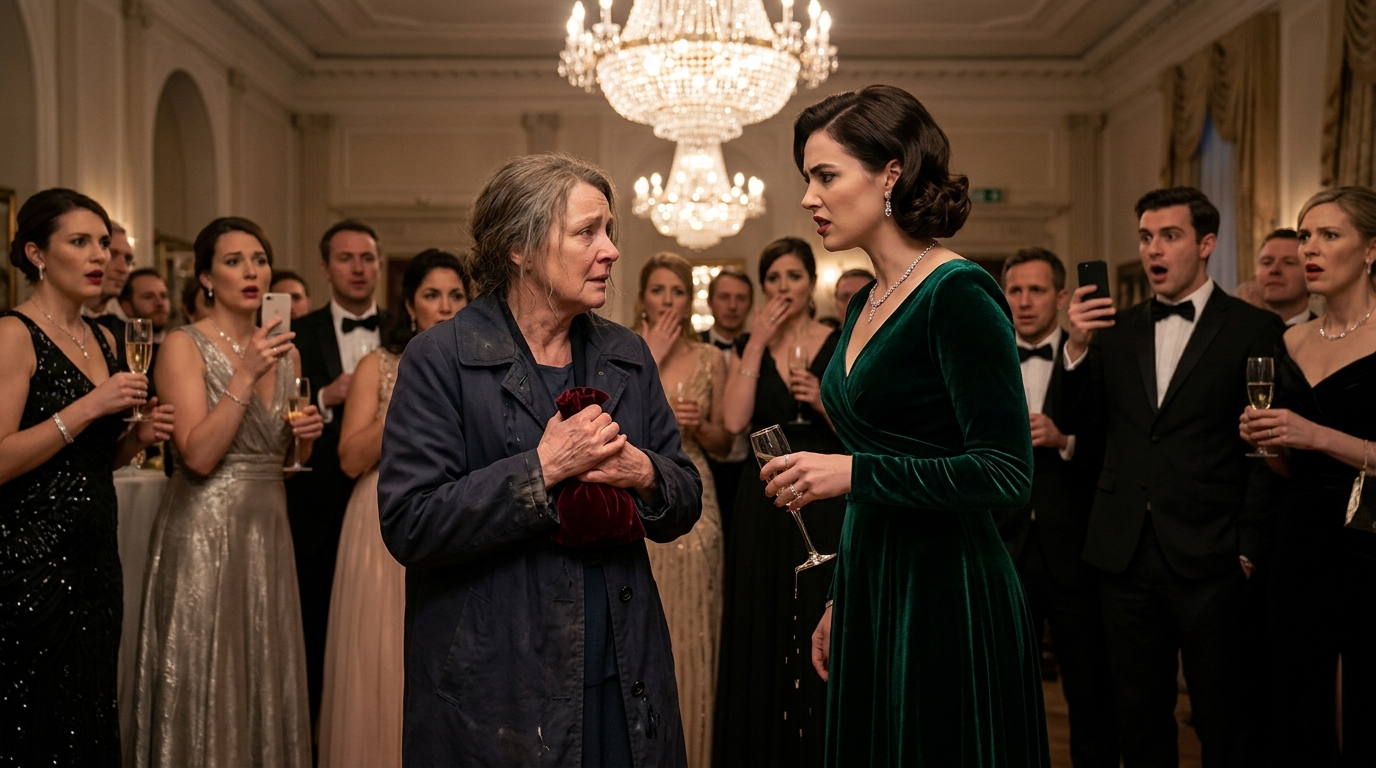
The ballroom glittered with diamonds, champagne flutes, polished shoes, and gowns that whispered against the floor like money had learned to move softly. Chandeliers hung above the room in great circles of light. A string quartet played near the white roses. Waiters carried trays of tiny food no one could name but everyone accepted with practiced smiles.
At the center of it all stood Vivienne St. Clair.
Radiant.
Elegant.
Untouchable.
She was twenty-four years old and already the face of half the city’s charity world. Magazines called her “the golden daughter of modern philanthropy.” Television hosts praised her grace. Donors adored her. Board members treated her like proof that wealth could be beautiful if photographed correctly.
That night, she wore a silver gown that caught the chandelier light with every turn. Her dark hair fell in soft waves over one shoulder. A diamond necklace rested at her throat. Cameras flashed each time she smiled.
Behind her, a banner stretched across the stage:
THE ST. CLAIR CHILDREN’S HOPE FOUNDATION
ANNUAL GALA FOR MOTHERS AND CHILDREN IN CRISIS
Vivienne had just finished speaking about compassion.
About the sacred bond between mothers and children.
About the importance of protecting vulnerable families before they were torn apart.
The room gave her a standing ovation.
Then the older woman entered.
She came through the side doors near the service corridor, not the grand entrance. Her dress was plain and dark. Her coat was too thin for the cold. Her shoes were worn at the sides. Her gray-streaked hair had been pinned carefully, though one side had already loosened. In both hands, she clutched a small velvet pouch.
She looked like someone who had almost turned back many times before finding the courage to keep walking.
Several guests noticed her.
A woman in emerald earrings frowned.
A man near the bar whispered, “Is she staff?”
A security guard straightened.
The older woman did not look at any of them.
She looked only at Vivienne.
For twenty-four years, Elena Marquez had carried one wound that never healed.
A hospital room.
A baby’s cry.
A nurse who would not meet her eyes.
And a sentence that had ended her life without killing her.
Your daughter is gone.
For twenty-four years, she had believed her baby girl died before she could even bring her home.
Then, three weeks ago, a letter arrived with no return address.
One photograph.
One gala invitation.
And four words written across the back:
She is still alive.
So Elena came.
Not because she expected kindness.
Not because she expected to be believed.
Because a mother who has spent twenty-four years grieving a child will walk through any room, no matter how bright, if there is even a chance that child is standing inside it.
Vivienne saw her.
The smile faded.
Not slowly.
Not politely.
It disappeared as if someone had cut a thread.
“What is she doing here?” Vivienne snapped.
The music softened, then stumbled into silence.
Elena stopped a few feet from the stage.
The room turned toward her.
She swallowed, gripping the velvet pouch so tightly her knuckles whitened.
“I came for my daughter.”
The words moved through the ballroom with terrible simplicity.
A few guests gasped.
Others smiled awkwardly, assuming this was some confused woman, some unstable intruder, some sad mistake security would soon correct.
Vivienne’s face hardened.
“Excuse me?”
Elena stepped closer.
“My daughter,” she said again. “They told me she died. But I was given this invitation. I was told she would be here.”
Vivienne’s jaw tightened.
“Security.”
The guard moved forward.
Elena raised the pouch.
“Please,” she whispered. “Just look at this.”
Vivienne’s expression twisted.
Perhaps it was fear.
Perhaps anger.
Perhaps a lifetime of being taught that desperate women were threats if they came too close to polished rooms.
Before anyone could stop her, Vivienne snatched a champagne flute from a passing waiter and threw it directly into Elena’s face.
The golden liquid splashed across the older woman’s cheeks, hair, and coat.
The room froze.
The glass slipped from Vivienne’s fingers and shattered against the marble.
Phones rose instantly.
Elena stood still, drenched in champagne and public disgrace.
Her lips trembled.
Her eyes filled.
But she did not run.
She only tightened her grip on the pouch.
Vivienne stepped down from the stage, furious now in the way only people accustomed to being protected can be furious.
“Enough of this.”
She grabbed the pouch from Elena’s hands.
The older woman reached for it.
“No, please—”
Vivienne yanked it open.
Inside was a diamond bracelet.
Not grand enough to impress that ballroom.
Not by their standards.
It was delicate. Old. A little scratched along the clasp. The stones were small, but real. The kind of bracelet a poor mother might have kept wrapped in cloth for decades, not because it was expensive, but because it had once touched someone she loved.
Vivienne’s anger faltered.
The bracelet looked familiar.
Not visually.
Deeper than that.
A memory without a picture.
She turned it over.
There was an engraving inside the band.
Tiny.
Worn.
But clear enough.
Mila Rose.
May 14.
Vivienne stopped breathing.
The ballroom blurred.
Mila Rose.
Not Vivienne St. Clair.
Not the name on magazine covers.
Not the name printed on foundation brochures.
Mila.
The name that had appeared in dreams she never told anyone about.
The name an old woman sometimes whispered in a nightmare from somewhere beyond memory.
The name her adoptive mother, Beatrice St. Clair, had once forbidden a nanny from singing when Vivienne was four.
Vivienne’s hand began to shake.
Elena stared at her, already crumbling.
“They told me,” she whispered, “she was dead.”
The bracelet slipped from Vivienne’s hand and struck the marble floor with a soft, bright sound.
No one moved.
Because if the poor woman was telling the truth, then the elegant life standing beneath the chandeliers had not begun with adoption, charity, and family legacy.
It had begun with a stolen child.
The Bracelet From the Hospital Crib
Vivienne did not remember being a baby.
No one does.
But she remembered flashes that had never fit inside the life she was given.
A lullaby in Spanish.
A woman’s hands, rough and warm, touching her hair.
A room that smelled of soap and rain.
The word Mila, spoken so softly it felt more like breath than language.
Whenever Vivienne asked about it as a child, Beatrice St. Clair would smile and say, “Dreams are strange, darling. Don’t make stories from shadows.”
Beatrice was excellent at smiling.
She had been excellent at everything society rewarded.
Perfect hostess.
Perfect donor.
Perfect mother in photographs.
She and her husband, Conrad St. Clair, adopted Vivienne as an infant and presented her to the world as a miracle after years of failed pregnancies. The story was clean and tragic enough to satisfy curiosity: a young mother had surrendered her baby legally, wanting her to have a better life. The records were sealed to protect everyone involved.
Vivienne had grown up inside that story.
Private schools.
Piano lessons.
Summer houses.
Foundation events.
Christmas cards with matching velvet dresses.
Her parents told her she was chosen.
Special.
Rescued.
They told her love was not blood.
That part was true.
But truth can be used to cover a theft.
Vivienne bent slowly and picked up the bracelet from the marble floor.
Her fingers closed around it.
The room remained silent.
Elena stood before her, champagne dripping from her chin, looking less like an intruder now and more like someone who had walked through fire and found only another flame waiting.
Vivienne’s voice was barely audible.
“Where did you get this?”
Elena pressed both hands together, as if praying.
“I bought it before she was born.”
“Before who was born?”
“My daughter.”
Vivienne stared at the engraving.
Mila Rose.
May 14.
Her own birthday was May 17.
At least, that was what every official document said.
A soft murmur moved through the room.
Vivienne’s foundation director, Julian Cross, hurried toward her from the donor tables. He was a polished man in his fifties, silver-haired, sharp-eyed, and always close enough to protect the St. Clair name before anyone had to ask.
“Vivienne,” he said quietly, “do not engage.”
She did not look at him.
Elena did.
And fear crossed her face.
Julian saw it.
So did Vivienne.
“Do you know him?” Vivienne asked.
Elena’s lips parted.
Julian stepped between them.
“This woman is clearly unstable. We should take this somewhere private.”
“No,” Elena said.
The word came out small, but firm.
Julian turned toward her.
“Elena, this is not the place.”
Vivienne looked at him sharply.
“Elena?”
The room shifted.
He had used her name.
Not “ma’am.”
Not “this woman.”
Elena.
Julian’s expression flickered.
Only once.
Enough.
Vivienne stepped away from him.
“How do you know her name?”
Julian lowered his voice.
“Vivienne, please.”
“How?”
He did not answer.
Elena looked at Vivienne with tears in her eyes.
“I was twenty years old,” she said. “I gave birth at St. Bartholomew’s Hospital. My daughter was alive. I heard her cry. They placed her on my chest. I named her Mila Rose.”
Vivienne closed her eyes.
The ballroom disappeared.
For one terrible second, she heard it.
Mila.
A whisper.
A heartbeat.
A sound from somewhere before memory.
Elena continued, voice shaking.
“I put this bracelet on her wrist. My mother had saved for months to buy it. She said every girl should enter the world wearing something chosen with love.”
Vivienne looked down at the bracelet.
Her skin seemed to remember what her mind could not.
“Then what happened?” she asked.
Elena swallowed.
“They said I was bleeding. They took me away. When I woke, they told me my baby had died. They said there was no body to see. Infection risk. Hospital protocol. I begged. I screamed. They sedated me.”
Julian’s face had gone pale.
The cameras were still recording.
Vivienne heard them now.
The soft clicks.
The whispers.
The phones capturing the collapse of a story that had funded entire wings of hospitals.
Elena reached into her coat pocket with trembling fingers.
Security moved.
Vivienne snapped, “Stop.”
Everyone stopped.
Elena pulled out a folded paper sealed in plastic.
A birth certificate.
Old.
Creased.
Marked with a hospital stamp.
Child: Mila Rose Marquez.
Mother: Elena Marquez.
Date: May 14.
Vivienne stared.
Her own legal birth certificate, the one in the family archives, said:
Vivienne Claire St. Clair.
Date: May 17.
Mother: Beatrice St. Clair.
Father: Conrad St. Clair.
Adoption filed: private, sealed.
Julian spoke again, too quickly.
“Documents can be forged.”
Elena turned toward him.
“You know that better than anyone.”
The words landed hard.
Vivienne looked at Julian.
“What does that mean?”
Elena lifted her chin.
“He was there.”
Julian’s mouth tightened.
Vivienne’s voice sharpened.
“Where?”
Elena pointed at him with a shaking hand.
“At the hospital. He was the young lawyer who told me poor girls like me should be grateful my baby did not have to suffer.”
The ballroom erupted.
Guests began whispering.
A donor stood.
A reporter near the back pushed forward.
Julian stepped close to Vivienne.
“Do not listen to this.”
Vivienne looked at him.
For the first time in her life, the people around her were no longer shaping the room for her protection.
They were shaping it for theirs.
She held up the bracelet.
“Then explain this.”
Julian’s eyes went cold.
Before he could answer, a voice came from the staircase above the ballroom.
“I can.”
Everyone turned.
Beatrice St. Clair stood at the top of the marble stairs.
White gown.
Pearls.
Silver hair swept back.
The woman Vivienne had called mother all her life.
She looked at the bracelet in Vivienne’s hand.
Then at Elena’s wet, trembling face.
And she whispered, “I told them to destroy that.”
The Mother Who Raised Her and the Mother Who Lost Her
Vivienne felt the words before she understood them.
I told them to destroy that.
Not I have never seen it.
Not this woman is lying.
Not what is happening?
Destroy that.
The room went quiet in a way that was almost sacred.
Beatrice descended the stairs slowly, one hand gliding along the railing. She looked every inch the St. Clair matriarch, even now. Calm. Controlled. Beautifully lit beneath the chandeliers.
But her eyes were not calm.
They were afraid.
Vivienne stared at her.
“What did you just say?”
Beatrice stopped several feet away.
Julian looked as though he wanted to physically place himself between them, but the cameras made every movement dangerous.
“Vivienne,” Beatrice said softly, “you are upset.”
“Answer me.”
“I can explain.”
The phrase was so small.
So ordinary.
So useless.
Elena made a broken sound.
Beatrice’s eyes moved to her.
For a moment, something like shame crossed her face.
Then it vanished behind habit.
“Elena,” she said.
The older woman flinched hearing her name from that mouth.
Vivienne stepped back.
“You know her too.”
Beatrice did not answer.
Vivienne turned the bracelet over in her palm.
“Mila Rose,” she whispered. “Was that my name?”
Beatrice closed her eyes.
Only for a second.
“Yes.”
The word struck Vivienne in the chest.
The ballroom tilted.
Elena covered her mouth with both hands and began sobbing.
Not loudly.
Not dramatically.
Like someone whose body had been holding a scream for twenty-four years and had finally run out of strength.
Vivienne looked at her.
Then at Beatrice.
“You told me my birth mother gave me up.”
“She did not have the means to raise you.”
“That is not what I asked.”
Beatrice’s face tightened.
“She was a child herself.”
“I was her child.”
The sentence silenced even the whispering guests.
Beatrice’s expression cracked, not with guilt exactly, but with the terrible strain of a woman whose justifications had once sounded noble in private and now looked monstrous under public light.
“Your father and I were desperate,” she said. “We had lost three pregnancies. The agency said—”
Elena’s voice cut through her.
“There was no agency.”
Beatrice looked at her.
Elena stepped forward.
Her wet shoes squeaked against the marble.
“You came to the maternity ward with him.” She pointed at Julian. “You stood behind the glass. I remember your pearls. I remember thinking rich women must never cry because your face was so still.”
Beatrice’s jaw trembled.
Elena continued.
“My baby was alive. She was on my chest. She had this bracelet on her wrist. Then a nurse said the doctor needed me. When I woke up, she was gone.”
Vivienne pressed the bracelet to her chest.
Beatrice whispered, “We loved you.”
Vivienne turned sharply.
“Do not use love before truth.”
That sentence landed like a slap.
Beatrice recoiled.
Julian stepped in.
“This discussion is reckless. Legal matters from decades ago cannot be resolved in a ballroom.”
Vivienne looked at him.
“You helped take me.”
His mouth opened.
No sound came.
“You helped forge my birth certificate.”
“Your adoption was arranged through proper—”
“Stop.”
He stopped.
Perhaps because of her tone.
Perhaps because every phone in the room had moved closer.
Beatrice reached toward Vivienne.
“Darling, please. Whatever happened, I raised you. I held you when you were sick. I taught you to read. I sat through every recital. I was your mother.”
Elena sobbed harder.
Vivienne shut her eyes.
Because that was the cruelty of it.
Beatrice was not a stranger.
Beatrice had kissed scraped knees.
Beatrice had stayed awake during fevers.
Beatrice had brushed Vivienne’s hair before school photos.
Beatrice had also built motherhood on another woman’s grave.
A grave that had never held a body.
Vivienne opened her eyes.
“And she mourned me.”
Beatrice’s lips trembled.
Vivienne turned toward Elena.
The older woman looked terrified now. Not of Beatrice. Not of Julian. Of hope.
Hope was the most dangerous thing in that room.
Vivienne took one step toward her.
Elena did not move.
“I don’t know what to call you,” Vivienne said.
Elena’s face crumpled.
“That’s all right.”
“I don’t remember you.”
“I know.”
“I’m angry.”
“You should be.”
Vivienne looked down at the bracelet.
“Did you really put this on me?”
Elena nodded.
“With both hands. You were so tiny. You kept curling your fingers around my thumb. I told you your name. I said, ‘Mila Rose, you are mine, and I am yours.’”
Vivienne’s breath broke.
Behind her, Beatrice began crying.
But for the first time in Vivienne’s life, Beatrice’s tears did not decide the room.
Vivienne held the bracelet out to Elena.
The older woman shook her head immediately.
“No. It is yours.”
Vivienne’s hand trembled.
“It was always yours to give me.”
Elena touched the bracelet with one finger.
Not taking it.
Only touching.
That was when the ballroom doors opened again.
Two men in dark suits entered with a woman in a navy coat between them.
The woman carried a leather briefcase and a federal badge clipped to her belt.
Julian turned pale.
Beatrice whispered, “No.”
The woman looked directly at Vivienne.
“Ms. St. Clair, my name is Agent Dana Mercer. Elena Marquez contacted our office three days ago. We advised her to attend tonight only because we believed the people who took her child would reveal themselves in public.”
Vivienne looked at Beatrice.
Then Julian.
Then the banner behind the stage.
Children’s Hope.
Mothers in crisis.
A foundation built on the wound of a mother whose child had been stolen.
Agent Mercer opened her briefcase.
“And Ms. St. Clair,” she said, “you were not the only baby.”
The Foundation Built on Missing Children
The gala ended without dessert.
By midnight, the ballroom had become a crime scene.
Guests were escorted out through side exits. Reporters gathered behind police lines outside the hotel. Staff whispered in corners. The broken champagne glass remained near the stage longer than it should have, glittering on the marble beneath the lights.
Elena sat in a quiet side room wrapped in a wool blanket someone finally had the decency to bring her.
Vivienne sat across from her.
Not beside Beatrice.
Not beside Julian.
Across from Elena.
The space between them was only a few feet.
It felt like twenty-four years.
Agent Dana Mercer laid documents on the table.
One by one.
Hospital records.
Adoption filings.
Charity contracts.
Payments from St. Clair family accounts to a private maternity home called Haven House.
Vivienne recognized the name.
Of course she did.
The St. Clair Children’s Hope Foundation still funded Haven House programs. She had visited one the previous year, smiling for cameras beside pregnant teenagers and promising them support, dignity, and choice.
Agent Mercer watched her face carefully.
“Haven House operated legally in some areas and illegally in others,” she said. “For decades, it targeted young mothers in crisis. Some were pressured into adoption. Some signed documents they did not understand. Some, like Ms. Marquez, were told their babies died.”
Elena looked down at her hands.
Vivienne felt sick.
“How many?” she asked.
Agent Mercer did not soften the answer.
“We are still counting.”
Beatrice sat at the far end of the room with her attorney now, no longer speaking freely. Julian had been removed for questioning after attempting to leave through the service elevator. Conrad St. Clair, Vivienne’s adoptive father, had died five years earlier, escaping the humiliation of answering for what he had purchased.
But the dead leave records.
They always do if someone knows where to look.
Agent Mercer removed a photograph from the file.
A much younger Beatrice standing outside St. Bartholomew’s Hospital.
Beside her, Julian Cross, twenty-something and smiling.
Behind them, a nurse carried a bundle wrapped in a white blanket.
Vivienne stared.
“Is that me?”
Elena leaned forward.
Her whole body shook.
“Yes.”
One word.
Enough to make the room blur.
Vivienne pushed the photo back.
Not because she didn’t want it.
Because she wanted it too much.
“What happens now?”
Agent Mercer looked at her.
“To the case?”
“To her.” Vivienne looked at Elena. “To me. To the women. To the foundation.”
“That depends partly on you.”
“My cooperation?”
“Yes.”
Vivienne almost laughed.
The word cooperation sounded absurd in a life that had been decided for her before she could hold up her own head.
Agent Mercer continued.
“The foundation archives may contain records we have never been able to access. Donor ledgers. Private placement files. Sealed adoption references. Correspondence with hospitals.”
Vivienne turned toward Beatrice.
Her adoptive mother looked smaller now.
Not less guilty.
Only older.
“Did you know about the others?” Vivienne asked.
Beatrice’s attorney touched her arm.
Beatrice ignored him.
“At first, no.”
The answer was poison.
Vivienne’s voice dropped.
“At first?”
Beatrice looked at the floor.
“Later, I suspected Haven House was not always honest.”
Elena made a sound of disbelief.
Beatrice continued, voice breaking.
“But by then, you were ours. If we exposed them, we could lose you.”
Elena stood so suddenly the chair scraped backward.
“You had already taken her from me!”
Beatrice flinched.
“I know.”
“No,” Elena said, shaking. “You do not know. You watched her grow up. You heard her first words. You held her when she cried. I had a bracelet and an empty crib.”
The room fell silent.
Vivienne could not look away from Elena.
An empty crib.
That phrase entered her and stayed.
Beatrice began to cry again.
This time, Vivienne felt nothing.
Not cruelty.
Not satisfaction.
Nothing.
The body has limits. Sometimes betrayal fills every available space and leaves no room even for pity.
Agent Mercer placed a final document on the table.
It was a death certificate.
Mila Rose Marquez.
Date of death: May 15.
Cause: neonatal complications.
Vivienne stared at her own death certificate.
A legal ghost.
Signed.
Stamped.
Filed.
The signature at the bottom belonged to a doctor long dead.
The witness line belonged to Julian Cross.
Elena reached toward the document, then stopped.
“I asked for her body,” she whispered. “They said no.”
Vivienne closed her eyes.
Twenty-four years of birthday cakes.
Private schools.
Magazine covers.
Foundation speeches.
All while a document somewhere declared Mila Rose dead.
When she opened her eyes, she knew what she had to do.
Not because it would heal anything.
Because not doing it would continue the crime.
She stood.
Her legs felt unsteady, but her voice did not.
“I want the foundation servers preserved. Tonight. No internal review. No private legal filtering. Agent Mercer gets full access.”
Beatrice’s attorney stood.
“Vivienne, you cannot unilaterally—”
“I am chair of the foundation board.”
“Only acting chair.”
Vivienne looked at him.
“Then watch me act.”
Agent Mercer nodded once.
The attorney sat down.
Vivienne turned to Elena.
“I can’t give you back what they stole.”
Elena’s face softened with grief so deep it looked almost gentle.
“No.”
“I can’t become Mila tonight.”
“I know.”
“I don’t know who I am right now.”
Elena’s eyes filled again.
“You are alive.”
The sentence broke something in Vivienne.
Not loudly.
Not dramatically.
Just enough that she had to grip the back of the chair.
Alive.
Not chosen.
Not rescued.
Not polished.
Alive.
A woman with two names.
One life built by lies.
One mother who raised her.
One mother who lost her.
And somewhere in the foundation archives, other mothers still waiting for proof that their grief had been manufactured.
Vivienne picked up the bracelet and fastened it around her own wrist.
It fit tightly.
As if it had been waiting for a smaller arm.
As if time itself was reminding her that the first girl who wore it had been stolen before she could grow.
Then she looked at Agent Mercer.
“Open everything.”
The Names in the Locked Room
The foundation archives were stored beneath St. Clair House in a locked climate-controlled room Beatrice had always called “the museum.”
As a child, Vivienne hated that room.
Not because she had been told to fear it.
Because the adults did.
Whenever she wandered near the basement corridor, someone redirected her. A nanny. A housekeeper. Julian. Once, Beatrice herself, smiling too brightly as she placed both hands on Vivienne’s shoulders and said, “Nothing down there but old paper and dust.”
Old paper and dust filled three walls.
So did names.
Agent Mercer’s team entered the archive before dawn.
Vivienne went with them.
Elena came too, despite the hour, despite exhaustion, despite the champagne still faintly sour in her hair. She had washed her face in the hotel bathroom, but her eyes remained red.
Beatrice did not come.
She was advised not to.
Or perhaps she simply could not bear to watch the room open.
The archive door required two keys and a biometric scan.
Vivienne had never used either.
Julian had controlled access for years.
That alone now seemed absurd.
The agents forced the override.
Inside, the air was cold and dry.
Rows of cabinets.
Digitized storage drives.
Boxes labeled by year.
Haven House.
St. Bartholomew’s.
Private placements.
Maternal support grants.
Confidential adoptions.
Agent Mercer’s face hardened as she scanned the labels.
“This is bigger than we thought.”
Vivienne felt the bracelet around her wrist like a pulse.
Elena stood near the doorway, one hand over her mouth.
“What are these?”
Agent Mercer answered carefully.
“Lives.”
They began with the year Vivienne was born.
There was a file for Elena Marquez.
Age twenty.
Occupation: seamstress.
Family support: minimal.
Child: female.
Status: deceased.
Placement: completed.
Vivienne read that line three times.
Placement completed.
Not death.
Placement.
Completed.
Behind the paperwork was a Polaroid.
Elena in a hospital bed.
Young.
Exhausted.
Smiling down at a newborn wearing the diamond bracelet.
Vivienne pressed one hand to the cabinet.
Elena reached for the photo with shaking fingers.
“That was the only time I held you,” she whispered.
Vivienne could not speak.
Agent Mercer copied the file immediately.
Then came more.
A boy in 1998.
Twin girls in 2003.
A baby taken from a mother recovering from surgery in 2005.
A child listed as stillborn in 2007, then placed with a donor family in Connecticut.
Some mothers had signed under pressure.
Some had not signed at all.
Some had been told their babies died.
Some babies had been renamed within days.
Beside many files were donor numbers.
Payment records.
Foundation contributions.
Hospital renovation pledges.
Scholarship grants.
Charity had been used as a language for purchase.
Vivienne moved through the archive with a growing horror so large it became almost calm.
This was not one family’s sin.
It was an industry of grief.
Elena stopped in front of a cabinet marked UNSUCCESSFUL CONTACTS.
“What does that mean?”
Agent Mercer opened it.
Inside were letters.
Hundreds.
Returned.
Unanswered.
Filed away.
Letters from mothers who had changed their minds.
Letters from women asking where their babies were buried.
Letters from grandparents.
Sisters.
Fathers.
One letter had been opened and marked in red:
Marquez continues inquiry. Discourage.
Elena took it.
Her own handwriting filled the page.
Dear St. Bartholomew’s,
I am asking one last time for the location of my daughter’s grave. I do not want money. I do not want trouble. I just want to bring flowers.
Elena sank into a chair.
A sound came from her that Vivienne never forgot.
Not a sob.
Not a scream.
A mother realizing her grief had been read, stamped, and stored instead of answered.
Vivienne knelt beside her.
Elena did not reach for her.
Not yet.
But she did not move away.
Agent Mercer’s team worked through sunrise.
By 8:00 a.m., warrants expanded.
By 10:00, Haven House offices were raided.
By noon, news networks had the story.
Not the whole story.
That would take years.
But enough.
Charity Heiress May Be Stolen Baby.
Foundation Archive Reveals Decades of Illegal Adoptions.
Mothers Told Children Died.
The city convulsed.
Donors denied knowledge.
Board members resigned.
Hospitals issued statements full of sorrow and no admissions.
Beatrice St. Clair entered a private medical facility, citing exhaustion. Vivienne did not visit her that week.
She stayed in the archive.
Reading names.
Because if she stopped, she feared she would become only the headline.
The stolen heiress.
The charity princess.
The woman with two mothers.
But the files would not let her be the center.
That became their mercy.
There were too many.
Too many women like Elena.
Too many children like Mila.
Too many lives renamed to protect people who thought money could turn longing into paperwork.
Three days after the gala, Vivienne held a press conference.
Not at St. Clair House.
Not in the ballroom.
Outside St. Bartholomew’s Hospital, where Elena had lost her.
Elena stood beside her, not touching her, but close enough that cameras could not crop her out.
Vivienne wore no diamonds except the bracelet.
Her voice was steady when she spoke.
“My name is Vivienne St. Clair,” she said. “My first name was Mila Rose Marquez. I was taken from my mother, Elena Marquez, twenty-four years ago. She was told I died. She did not abandon me.”
The cameras flashed.
Vivienne continued.
“The foundation that made me its face helped preserve the system that stole me. Effective immediately, all foundation operations are suspended pending federal investigation. All archives will be opened to authorities and to affected families through a court-supervised process.”
A reporter shouted, “Do you blame your adoptive mother?”
Vivienne looked at Elena.
Then back at the cameras.
“I blame everyone who decided a mother’s poverty made her child available.”
The clip traveled everywhere.
People called it brave.
Vivienne hated that.
Bravery had been Elena walking into the gala in worn shoes.
Bravery had been carrying a bracelet for twenty-four years.
Vivienne had simply stopped lying once the lie could no longer hold her.
The Name She Could Finally Hear
The investigation lasted years.
The first arrests came quickly.
Julian Cross was charged with conspiracy, document fraud, obstruction, and facilitating illegal adoption placements. Former Haven House administrators followed. Two retired hospital officials were brought out of comfortable houses and into courtrooms they had avoided for decades. Several cases were too old for the punishment families deserved, but civil actions reopened paths criminal law could not.
Beatrice St. Clair was indicted eight months after the gala.
That nearly destroyed Vivienne a second time.
People expected her to choose a simple position.
Victim or daughter.
Condemnation or loyalty.
But love and harm do not arrange themselves neatly for public consumption.
Beatrice had raised her.
Beatrice had lied.
Beatrice had held her during fevers.
Beatrice had allowed Elena to mourn a living child.
All of it was true.
Vivienne testified.
She did not look at Beatrice when shown the false birth certificate.
She did look at her when asked whether Beatrice had been a loving mother.
“Yes,” Vivienne said.
The courtroom stirred.
Then she added, “And love did not make the lie less violent.”
Beatrice cried silently.
Elena sat behind Vivienne that day.
Not close.
Not far.
Present.
That was what they had learned to be for each other first.
Present.
Not mother and daughter in the way Elena had dreamed.
Not strangers either.
Something wounded, awkward, and slowly breathing.
Their first private meeting after the gala happened in a small kitchen in Elena’s apartment.
Not St. Clair House.
Not a restaurant.
Not a place with chandeliers.
Elena made tea she was too nervous to drink. Vivienne sat at the table wearing jeans, a sweater, and the bracelet. Without stylists, diamonds, and gala lighting, she looked younger. More uncertain. Less like a woman the world had taught to stand under cameras.
Elena placed a plate of cookies between them.
“I don’t know what you like,” she said.
Vivienne touched the rim of the teacup.
“I don’t know either right now.”
That made Elena laugh.
A small, broken laugh.
Then both of them cried.
They did not hug that day.
They talked.
Badly at first.
Too carefully.
Elena told her about the day she was born. How she cried immediately. How she had a tiny crease between her eyebrows like she was already suspicious of the world. How Elena’s mother had kissed the bracelet before placing it on her wrist.
Vivienne told Elena about childhood. Piano lessons. A blue bedroom. Fear of thunderstorms. Her first speech at age sixteen. How Beatrice used to sing when Vivienne had nightmares, but never in Spanish.
Elena listened to everything.
Even the parts that hurt.
Especially those.
At the end of the visit, Vivienne stood by the door, unsure how to leave.
Elena looked at her.
“May I say it once?”
Vivienne knew what she meant.
Her throat tightened.
She nodded.
Elena took a breath.
“Mila.”
The name entered the room softly.
Not as a demand.
Not as a correction.
As a door opened for a child who had been carried out through another one.
Vivienne closed her eyes.
She did not feel whole.
She did not feel healed.
But somewhere inside her, something turned toward the sound.
Years passed.
The St. Clair Children’s Hope Foundation was dissolved and rebuilt under a new court-supervised trust controlled by survivors, adoptees, and birth families. Its first project was not a gala.
It was a records center.
Plain walls.
Long tables.
Counselors on site.
Legal aid in the next room.
Coffee always available.
Tissues everywhere.
Families came with trembling hands and old questions.
Some found answers.
Some found only fragments.
Some found siblings.
Some found graves.
Some learned their children were alive.
Some learned they were too late.
Elena volunteered there twice a week.
Vivienne did too, though she no longer used St. Clair in that building.
On her badge, she printed:
Vivienne Marquez-St. Clair
The first time Elena saw it, she touched the hyphen with one finger and smiled through tears.
Beatrice died before the final civil settlement was approved.
Vivienne visited her once near the end.
Their conversation remained private.
When reporters later asked whether she forgave her, Vivienne said, “That question is too small for what happened.”
It was.
On the tenth anniversary of the gala, the hotel ballroom reopened after renovations. The chandeliers remained. The marble remained. But the foundation banner was gone.
In its place, for one night only, hung a wall of names.
Mothers.
Children.
Those found.
Those still searching.
At the center was a glass case holding the diamond bracelet.
Not as jewelry.
As evidence.
As witness.
As the thing one poor woman held onto when everyone told her there was nothing left to hold.
Elena stood beside Vivienne in front of it.
She was older now. Softer in some ways. Still strong in the way grief makes some people strong without asking permission.
Vivienne looked at the bracelet.
“I hated you for a moment that night,” she said quietly.
Elena nodded.
“I know.”
“I thought you came to ruin me.”
“No,” Elena said. “I came because I was already ruined.”
Vivienne turned to her.
“And now?”
Elena looked at the wall of names.
“Now I am not alone in it.”
That was not happiness.
But it was truth.
And sometimes truth is the first mercy after a lifetime of being denied even that.
Later, when the room had emptied, Elena and Vivienne remained beneath the chandeliers.
The same room.
The same lights.
A different silence.
Vivienne removed the bracelet from the case with permission from the archivist. She held it carefully, then turned to Elena.
“Will you put it on me?”
Elena’s hands trembled.
“They’re not as steady as they were.”
“That’s all right.”
Elena fastened the bracelet around Vivienne’s wrist.
It still fit tightly.
It always would.
A bracelet made for an infant could never fully belong to the grown woman, not physically.
But that was not the point.
The bracelet belonged to the moment before the theft.
The moment when Elena held her baby and named her.
The moment before paperwork, money, fear, and power tried to rewrite blood and memory.
Vivienne touched the engraving.
Mila Rose.
“I don’t know if I’ll ever feel like that name is fully mine,” she said.
Elena smiled sadly.
“You don’t have to choose only one.”
Vivienne looked at her.
Elena continued, “They stole your beginning. They don’t get to steal the rest by making you fight your own names.”
Vivienne swallowed.
Then, very softly, she said it.
“Mila.”
This time, the name did not feel like a ghost.
It felt like a child somewhere inside her lifting her head.
Elena reached for her hand.
Vivienne let her.
No cameras captured it.
No donors applauded.
No music swelled.
The real ending was quieter than the scandal.
A mother and daughter standing together in a ballroom where one had been humiliated and the other had been exposed, holding between them a bracelet that had survived twenty-four years of lies.
The world would remember the champagne.
The gasp.
The diamond bracelet falling open.
The heiress learning she had been stolen.
But Elena remembered the weight of a newborn on her chest.
Vivienne remembered the first time she heard her lost name spoken with love instead of secrecy.
And both of them understood that the bracelet had never been proof of wealth.
It was proof that before anyone renamed her, claimed her, photographed her, or lied about her death—
Mila Rose had belonged to someone who loved her enough to keep searching after everyone else said there was no one left to find.