The Boy Who Walked Straight to His Table
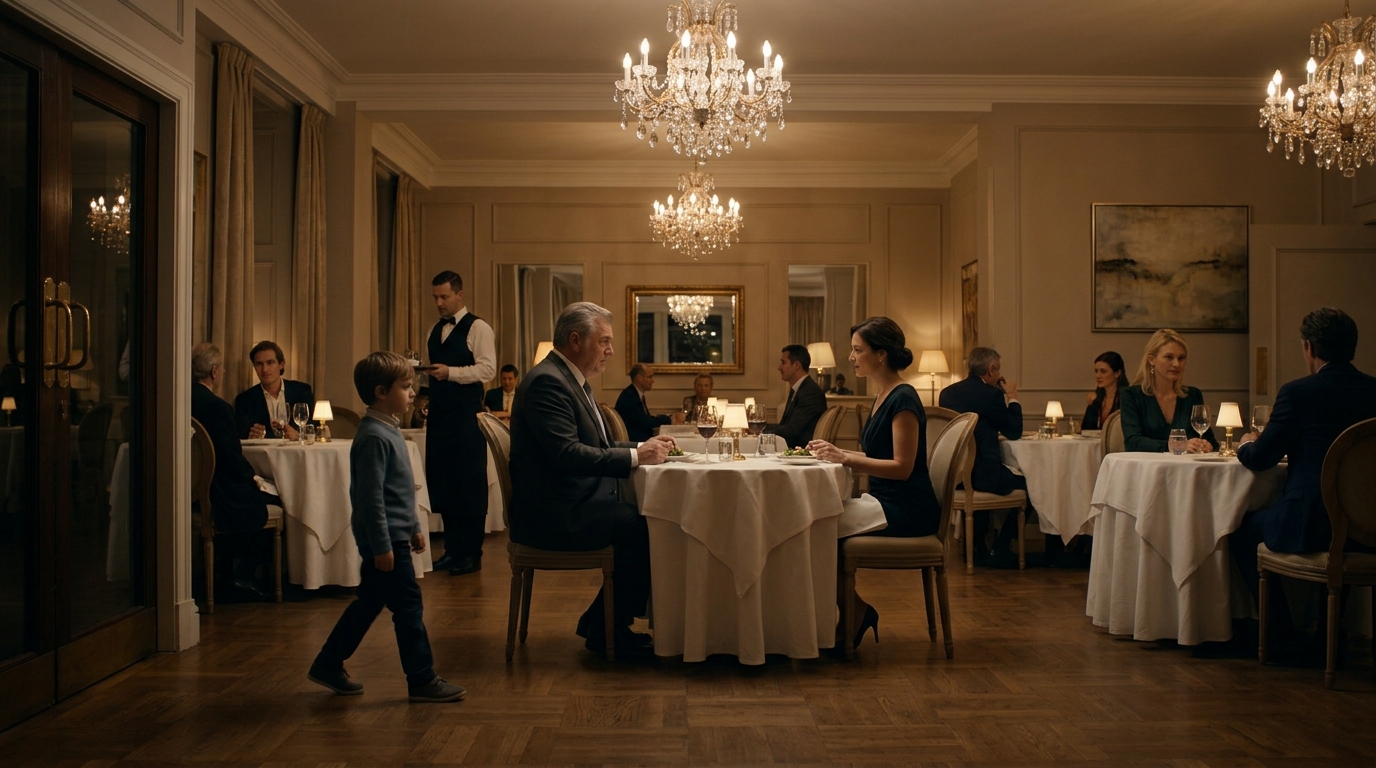
The restaurant was serene in the way only expensive places can be.
Not quiet exactly.
Controlled.
Forks touched porcelain with soft, careful sounds. Champagne rose in crystal glasses. Conversations moved beneath the glow of chandeliers, low and polished, as if every word had been trained not to disturb the money in the room.
The Aurelia Room sat on the top floor of the Meridian Hotel, overlooking the city through walls of glass. Below, traffic moved like red and white threads. Inside, everything was velvet chairs, white tablecloths, fresh orchids, and waiters who seemed to glide instead of walk.
Then the boy entered.
No one stopped him.
No one noticed at first.
That was the strange part.
He was small, maybe eleven, wearing a dark hoodie too thin for the weather and sneakers with one frayed lace dragging along the floor. His hair was damp from rain. His face was pale, but not frightened. Not exactly.
He looked like a child who had already been afraid for so long that fear had become ordinary.
He did not look around in wonder.
He did not stare at the chandeliers.
He did not pause at the host stand.
He walked straight through the restaurant as if he had counted the tables before arriving.
A waiter turned too late.
“Hey—”
The boy slipped past him.
A woman near the bar frowned.
A man in a navy suit whispered, “Whose kid is that?”
The boy did not answer anyone.
He kept walking.
Straight toward the most powerful man in the room.
Victor Halden sat at the center table by the glass.
Everyone knew him.
Even people who pretended not to.
Real estate titan. Hospital donor. Foundation chairman. Billionaire. Survivor of the Harbor Bridge accident. The man whose photograph had appeared in newspapers for seven years beside headlines about resilience, leadership, and the tragedy that took his ability to walk.
His wheelchair was custom-built, black and chrome, positioned at the head of the table like a throne.
Beside him sat his fiancée, Celeste Ward, elegant in emerald silk, one hand resting lightly on his shoulder. Around them were donors, board members, city officials, and men who laughed before Victor finished jokes because influence had its own gravity.
Victor had not stood in public since the accident.
Not once.
That was part of his legend.
The boy stopped at his table.
The conversations died one by one.
Victor barely glanced down.
“You?”
His voice carried mild annoyance, the tone of a man who expected interruptions to apologize before explaining themselves.
The boy stood very still.
“Sir.”
A security guard began moving from the entrance.
Victor lifted one hand lazily, stopping him.
The gesture said he was amused.
For now.
The boy looked at Victor’s legs.
Then back at his face.
“I can fix your leg.”
A pause.
Then laughter.
Soft at first.
Polite.
Disbelieving.
Someone at the table covered a smile with a napkin. A woman near the window whispered, “Poor thing.” Celeste’s mouth tightened, not with pity, but with irritation.
Victor leaned back in his wheelchair.
“My leg?”
“Both,” the boy said.
More laughter.
Victor studied him with a strange expression now. Less amused. More curious.
“How long?”
The boy did not blink.
“A few seconds.”
That did it.
The table erupted.
Victor smiled for the first time, wide enough for the whole restaurant to see.
“If you can fix my legs in a few seconds,” he said, voice rich with mockery, “I’ll give you a million dollars.”
The boy nodded once.
“I don’t want your money.”
The laughter thinned.
Victor’s smile changed.
“What do you want?”
The boy stepped closer.
Celeste’s fingers tightened on Victor’s shoulder.
“Don’t let him touch you,” she said.
But Victor raised a hand again.
He was enjoying the performance.
Or pretending to.
“Go on, then,” he said. “Perform your miracle.”
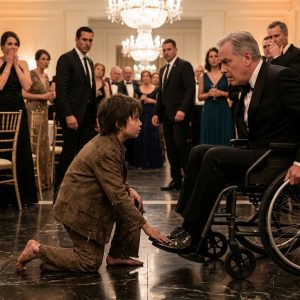
The boy knelt.
A waiter whispered, “Security should stop this.”
No one moved.
Phones appeared now, rising from laps and tabletops.
The boy reached toward Victor’s right foot.
Victor’s expression flickered.
Only for a moment.
The boy saw it.
So did Celeste.
He placed two fingers lightly against the outside of Victor’s ankle, just below the bone.
“Count,” the boy said.
Victor chuckled.
“This is ridiculous.”
“One.”
The boy pressed.
Victor’s face tightened.
Not from pain.
From recognition.
“Two,” the boy said. “Stand up.”
The room held its breath.
Victor’s hands gripped the arms of his wheelchair.
For one long second, nothing happened.
Then his right foot shifted.
A woman gasped.
His left knee bent.
Celeste’s hand flew from his shoulder.
Victor pushed himself forward.
Slowly.
Unnaturally.
Then, in front of the entire Aurelia Room, Victor Halden stood.
No assistance.
No stumble.
No cry of pain.
Just stood.
The restaurant froze.
Every face changed.
The cameras trembled.
A fork clattered against a plate somewhere near the back.
But the real shock was not that Victor was standing.
It was his expression.
He was not looking at his legs.
He was looking at the boy.
And he did not look amazed.
He looked terrified.
“That’s impossible,” Victor whispered.
The boy rose to his feet.
Rainwater dripped from his sleeve onto the polished floor.
“You’ve seen me before.”
Victor’s mouth opened.
No sound came out.
The boy stepped closer.
“Not like this,” he said. “But you saw me.”
Celeste had gone white.
Because she understood before anyone else did.
The boy was not there to heal Victor Halden.
He was there to make him forget he was pretending.
The Accident That Built a Saint
Seven years earlier, the Harbor Bridge accident turned Victor Halden into a hero.
That was the story the city was told.
A storm.
A runaway utility truck.
A chain collision.
A family van crushed near the south exit.
Victor Halden, already wealthy but not yet beloved, supposedly pulled two victims from the wreckage before falling from the bridge barrier and suffering catastrophic spinal trauma.
By morning, every news station carried his photograph.
Victor in a hospital bed.
Victor holding a nurse’s hand.
Victor promising to build a trauma center.
Victor weeping as he spoke about the people who had not survived.
The city needed a hero that week.
He gave them one.
Within months, the Halden Foundation launched the Harbor Mercy Initiative. Millions poured in. The trauma center broke ground. Politicians stood beside Victor’s wheelchair and praised his courage. Celeste Ward, then a crisis communications consultant, became his closest adviser and later his fiancée.
The accident had taken his legs, the media said.
But it had given him a mission.
That was the public version.
The boy’s name was Elias Rowan.
Eli, to the woman who raised him.
His mother, Mara Rowan, had been in the crushed van that night. She survived long enough to give three statements.
The first disappeared.
The second was labeled inconsistent.
The third was never filed.
By the time she died six months later, the official report had settled firmly into the version Victor preferred.
Runaway truck.
Poor visibility.
Heroic rescue.
Unavoidable tragedy.
Eli had been four when the accident happened.
Too young, everyone said, to remember.
But memory does not always arrive as clear pictures.
Sometimes it arrives as sound.
A tire screaming.
Rain on glass.
His mother’s voice saying, “Don’t look.”
A man shouting, “Move the boy.”
A red emergency light flashing across a face leaning into the van.
Victor’s face.
Older now.
Publicly noble.
Privately unrecognizable unless fear opened the old door.
Mara had not died believing Victor was a hero.
She died trying to prove he caused the crash.
According to the papers hidden beneath her mattress, Victor Halden’s private SUV had forced the Rowan family van toward the bridge barrier while chasing a courier carrying documents tied to illegal property seizures. The utility truck swerved to avoid them. The pileup followed.
Victor had not pulled Mara from the wreckage.
A paramedic had.
Victor had fallen later, after slipping on the rain-slick pavement while trying to retrieve a briefcase from the wrecked vehicle.
His injuries were real at first.
His paralysis was not permanent.
The secret was buried inside medical files, settlement agreements, nondisclosure payments, and one private physical therapist who vanished from the city after refusing to falsify a recovery report.
Eli found the truth in pieces.
A box under the bed.
His mother’s letters.
A photograph of Victor standing in a private rehabilitation clinic two years after the accident.
A name written again and again in Mara’s handwriting.
Dr. Simon Vale.
Find him.
So Eli did.
Or rather, he found what remained.
Dr. Vale lived above a shuttered pharmacy on the east side, half-blind, disgraced, and still frightened of the Halden name. At first, he refused to speak to the boy.
Then Eli showed him the photograph.
Victor standing.
One hand against a therapy bar.
Right ankle turned slightly outward.
Dr. Vale began crying before he said a word.
“He recovered,” the old doctor whispered. “Not fully at first. But enough. Enough to walk. Enough to stand. Enough to stop lying.”
“Why didn’t he?” Eli asked.
Dr. Vale looked at him with exhausted shame.
“Because the chair made him untouchable.”
The wheelchair had become Victor’s shield.
His sainthood.
His immunity.
No one wanted to accuse a man who had supposedly sacrificed his body for strangers. No prosecutor wanted to challenge the beloved survivor who funded hospitals. No journalist wanted to ask why the hero’s medical records were sealed. No judge wanted to appear cruel.
Victor learned that pity could be stronger than power.
And Celeste learned how to sell it.
Dr. Vale told Eli one more thing.
Victor’s injury had left nerve sensitivity near the outside of his ankle. A trained pressure point there could trigger an involuntary motor response if he was already bracing his legs. It would not heal a paralyzed man.
It would expose a man pretending to be one.
“You cannot do this alone,” Dr. Vale warned.
Eli looked at his mother’s photograph.
“I have been alone since I was four.”
For months, he watched Victor.
Charity dinners.
Foundation events.
Ribbon cuttings.
A pattern emerged.
Victor never stood in public.
But in private, when he believed no one was close, his legs shifted. He braced subtly while moving between chair and car. His driver positioned the vehicle too perfectly. His custom wheelchair was built less for medical need and more for theater.
Still, suspicion was not enough.
Eli needed witnesses.
He needed cameras.
He needed Victor to betray his own body in a room that could not be silenced.
So he waited until the annual Harbor Mercy Gala at the Aurelia Room.
A restaurant full of donors.
Press outside.
Phones everywhere.
Celeste beside him.
The whole lie sitting under chandeliers.
Then Eli walked in.
Small.
Silent.
Out of place.
And asked to fix what Victor had never truly lost.
The Room Realizes What It Saw
For several seconds after Victor stood, no one moved.
The restaurant seemed trapped between miracle and crime.
A few people began clapping.
Confused claps.
Nervous.
The kind people offer when they think they have witnessed something miraculous but cannot understand why no one looks happy.
Then Celeste snapped, “Sit down.”
Her voice cracked across the room.
Victor flinched.
That broke the spell.
Everyone saw it.
Not a medical crisis.
Not a man overwhelmed by healing.
A man obeying someone who knew the performance rules.
Victor lowered himself back into the chair too quickly.
Too smoothly.
Too practiced.
The clapping stopped.
Eli turned toward the nearest phone camera.
“Did you get it?”
The young woman holding the phone nodded, eyes wide.
Celeste stood.
“Security.”
Two guards moved forward.
Eli did not run.
He reached into his hoodie and pulled out a folded packet.
“Before they take me,” he said loudly, “ask him why my mother’s statement disappeared.”
Victor’s face changed.
The name had not been spoken yet.
But he knew.
Eli opened the packet and held up a photograph.
Mara Rowan in a hospital bed.
Bruised.
Bandaged.
Alive.
Holding a handwritten statement.
“My mother said Victor Halden caused the Harbor Bridge crash,” Eli said. “She said he wasn’t rescuing us. He was chasing the documents in our van.”
A wave of murmurs spread through the restaurant.
Celeste’s expression hardened.
“That child is disturbed.”
Eli looked at her.
“My mother said you’d say that.”
Celeste froze.
He pulled out another page.
A copy of an email.
From Celeste Ward to a private investigator.
Subject: Rowan boy.
Instruction: Monitor foster placement. Prevent media contact.
The room erupted.
Reporters were not inside the gala, but donors were. Board members. Lawyers. City officials. People who understood documents before they understood morality.
Victor found his voice.
“This is absurd. I was paralyzed in that accident.”
Eli looked at him.
“You just stood.”
“I was startled.”
“You stood because you forgot to act hurt.”
Victor’s face reddened.
Celeste stepped between them.
“He is a child exploiting trauma for attention. This event is over.”
“No,” a voice said from the back.
Everyone turned.
An old man stood near the service doors, leaning on a cane.
Dr. Simon Vale.
He had not wanted to come.
Eli had begged him.
Now he walked forward slowly, each step costing him more than age alone.
Victor stared at him.
This time, real terror entered his face.
“Simon,” he whispered.
Dr. Vale stopped beside Eli.
“I treated Mr. Halden for eighteen months after the accident,” he said. “His spinal trauma was serious. His recovery was real. His public paralysis was not.”
Celeste’s mouth tightened.
“You signed confidentiality agreements.”
“I did,” Dr. Vale said. “And I signed false discharge summaries because I was afraid. That is why I brought the originals.”
He raised a folder.
Victor gripped the arms of his wheelchair.
“You bitter old fool.”
Dr. Vale looked at him sadly.
“Yes. I have been a fool for seven years. But tonight I am simply late.”
The restaurant changed again.
That sentence did something no accusation had.
It gave the room permission to believe what it had seen.
A city councilman pushed his chair back.
A foundation trustee whispered into his phone.
One of Victor’s board members stood and walked away from the table as if distance might save him.
Eli looked at Victor.
“You saw me in the van.”
Victor said nothing.
“You leaned in,” Eli continued. “My mom told you I was alive. You said, ‘Move the boy.’”
Victor’s face had gone gray.
Eli’s voice broke for the first time.
“You didn’t ask my name.”
No one in the room breathed.
Then Mrs. Gold, the oldest donor at the table, turned slowly toward Victor.
“Is this true?”
Victor looked at her.
Then at the cameras.
Then at Celeste.
Celeste’s eyes were warning him.
Stay silent.
Stay controlled.
Stay inside the lie.
But Victor was standing at the edge of seven years of performance, and the boy had struck the one place the chair could not protect.
His pride.
“I built the trauma center,” Victor snapped.
The words came out too loud.
Too fast.
Celeste closed her eyes.
Victor continued, voice rising.
“I saved more lives with that center than anyone in that van could have imagined. One accident, one tragic night, and you people want to tear down everything good I created?”
Eli stared at him.
“So it is true.”
Victor’s mouth closed.
Too late.
The phones had caught every word.
The Documents in the Van
The police arrived before dessert could be cleared.
Not because Victor called them.
Because half the restaurant did.
By then, the video had already begun spreading.
The boy touching Victor’s foot.
Victor standing.
Celeste ordering him to sit.
The old doctor naming the lie.
Victor saying, “One accident.”
The city watched its saint fracture in real time.
But the scandal did not stop at the wheelchair.
It never had.
The wheelchair was only the statue built over the buried thing.
The documents in the Rowan family van were the real reason Mara died afraid.
Mara Rowan had worked as a records clerk for the Halden Redevelopment Authority, a public-private partnership that bought distressed properties near the waterfront. She discovered that Victor’s company had been forcing elderly homeowners and immigrant families into fraudulent defaults, then acquiring their land through shell entities before city rezoning announcements made the properties worth ten times more.
She copied files.
She tried to deliver them to a reporter.
Victor’s people found out.
On the night of the Harbor Bridge crash, Mara, her husband, and Eli were driving those documents across town.
Victor’s SUV followed.
Then the rain came.
Then the bridge.
Then the crash.
Mara’s husband died on impact.
Mara survived long enough to name Victor.
Eli survived because a paramedic ignored a suited man shouting about clearing the scene and pulled the child out first.
Dr. Vale had records proving Victor’s recovery.
But Mara had left something better.
Not with police.
Not with lawyers.
With Eli.
He did not know it until two months before the gala, when he found the lining of his old stuffed dinosaur had been sewn shut.
Inside was a flash drive wrapped in plastic.
His mother’s final insurance.
Property transfers.
Emails.
Bribe ledgers.
Photographs.
The original reporter contact.
And a short video.
Mara sitting in a hospital bed, voice weak, face bruised, speaking directly into the camera.
“My name is Mara Rowan. If my son is watching this someday, it means the people who promised to help us did not.”
The video played on every news station the next morning.
Not in full.
No one needed all of it to understand.
Mara named Victor Halden.
She named the officers who pressured her to change her statement.
She named the attorney who offered money while her husband’s body was still in the morgue.
She named Celeste Ward as the woman who came to her room and said, “Think carefully before you make your son an orphan twice.”
That sentence ended Celeste’s public life before charges even began.
Eli watched the first broadcast from Detective Alvarez’s office with a blanket around his shoulders and Dr. Vale seated beside him.
Detective Alvarez had reopened the Harbor Bridge file three hours after the gala.
By sunrise, warrants were prepared.
By noon, Halden Foundation offices were searched.
By evening, city officials began resigning with statements full of “shock” and “deep concern,” which usually meant lawyers had advised them not to use the word guilt.
Victor was arrested two days later.
He did not arrive in a wheelchair.
That was not the police department’s choice.
It was his.
For seven years, the chair had made people lower their voices around him.
Now every camera wanted to see whether he would use it.
He walked into the courthouse with a cane.
The city understood.
The trial took sixteen months.
Victor’s defense argued that his medical condition was complex, that recovery did not equal fraud, that charity work had been weaponized against him, that a grieving child had been manipulated by bitter adults.
Then prosecutors played the restaurant video.
After that, they played Mara Rowan’s hospital recording.
The courtroom went silent.
No lawyer could soften her voice.
No foundation plaque could compete with a dying mother telling her son where she hid the truth.
Dr. Vale testified.
So did the paramedic from the bridge.
So did three families who had lost homes through Halden shell companies.
So did Eli, briefly, carefully, with a child advocate beside him.
The prosecutor asked him what he remembered.
Eli looked at Victor.
“He looked at me like I was in the way.”
Victor did not meet his eyes.
The Boy Who Didn’t Want the Million
Victor Halden was convicted on fraud, obstruction, witness intimidation, evidence suppression, and conspiracy charges tied to the redevelopment scheme and the cover-up after the Harbor Bridge crash. Additional civil judgments followed. The trauma center kept operating, but the Halden name was removed from the building before sentencing.
Celeste took a plea.
People argued about that.
Some wanted her punished more severely.
Some said she had been trapped in Victor’s machine.
Eli did not care what they called her.
At her hearing, she turned toward him and said, “I’m sorry.”
He looked at the floor.
Not forgiving.
Not accepting.
Just tired.
Later, Dr. Vale asked if he was all right.
Eli shrugged.
“She said it like she wanted it to do something.”
That was the wisdom grief had forced into him too early.
Apologies do not always do something.
Sometimes they only show up after truth has done the work.
The city tried to turn Eli into a symbol.
The miracle boy.
The child who made a paralyzed millionaire stand.
The son who exposed a fraud.
Reporters wanted interviews. Podcasts wanted his story. Donors wanted to meet him. Strangers sent gifts, money, letters, offers, prayers.
Eli wanted none of it.
He wanted his mother back.
Since that was impossible, he asked for two things.
A quiet school.
And to keep Dr. Vale’s old dog, Baxter, who had followed him around the doctor’s apartment during the months they planned the gala confrontation.
Both were arranged.
The million dollars Victor had mockingly promised at the restaurant became a public obsession for a few weeks.
Would Eli sue for it?
Could the verbal promise count?
Should he get it?
When asked, Eli said, “I told him I didn’t want his money.”
And that was that.
But the court did create a restitution fund from seized Halden assets.
Not for Eli alone.
For the families harmed by the redevelopment scheme.
For medical debts from the Harbor Bridge crash.
For children who lost parents, homes, or records because Victor Halden learned how to turn tragedy into branding.
Eli insisted his mother’s name be on it.
The Rowan Justice Fund opened one year after the gala.
The ceremony was held not at the Aurelia Room, but near the Harbor Bridge, where a small memorial had been built.
No chandeliers.
No champagne.
Just folding chairs, winter wind, and families standing where the city had once accepted the wrong story.
Eli did not speak.
Dr. Vale did.
He stood with both hands on his cane and looked at the crowd.
“I spent seven years afraid of a powerful man’s lie,” he said. “A child spent seven years living inside the consequences of it. Do not confuse my confession with courage. Courage walked into a restaurant wearing wet sneakers.”
Eli looked embarrassed.
Baxter leaned against his leg.
After the ceremony, Detective Alvarez gave Eli something sealed in a plastic evidence sleeve.
The stuffed dinosaur.
The one that had held Mara’s flash drive.
It had been repaired.
Badly.
A line of new stitching ran along its belly.
Eli hugged it to his chest without caring who saw.
That was the photograph that eventually mattered most to the city.
Not Victor standing.
Not Celeste crying.
Not the wheelchair empty beside a courtroom bench.
A boy holding the toy his mother had turned into a vault.
Years later, people still repeated the restaurant story.
They told it in exaggerated ways.
The boy healed him with one touch.
The millionaire stood by magic.
The whole room gasped.
Eli hated that version.
“There was no magic,” he would say.
And he was right.
There was only a body that betrayed a lie.
A doctor who finally spoke.
A mother who hid proof where love would find it.
A child who understood that powerful men could survive accusations but not always humiliation in front of the right witnesses.
When Eli was fifteen, he returned once to the Aurelia Room.
It had changed owners by then. The table by the glass was gone. The restaurant no longer hosted foundation galas. The new manager recognized him but pretended not to, which Eli appreciated.
He sat near the window with Dr. Vale, who was older now, weaker, but still alive.
Baxter slept under the table.
Eli looked across the room.
“This place feels smaller.”
Dr. Vale smiled.
“Most monsters do after you survive them.”
Eli looked at the spot where Victor’s wheelchair had been.
“I thought I’d feel better here.”
“Do you?”
“No.”
“That’s all right.”
Eli touched the old stuffed dinosaur beside him.
“I keep thinking about what he said. That he built the trauma center. That he saved people.”
“He may have.”
“Does that matter?”
Dr. Vale took a long breath.
“Yes.”
Eli looked at him sharply.
The old doctor continued.
“But it does not purchase the right to destroy others. Good done with stolen truth still owes a debt.”
Eli sat with that.
Outside, traffic moved below the glass.
The city kept going.
It always had.
That was both the comfort and the insult.
After dinner, Eli walked past the entrance where he had once slipped in unnoticed.
This time, the host held the door for him.
“Have a good evening,” the man said.
Eli nodded.
On the sidewalk, rain had begun to fall lightly.
He looked up at it and thought of the bridge.
Not as clearly anymore.
The memories had softened at the edges.
But his mother’s voice remained.
If my son is watching this someday…
He was.
Still.
Always.
Not because he wanted to live in the past.
Because the past had almost been rewritten by men with money, chairs, foundations, and perfectly worded lies.
Eli walked beside Dr. Vale into the rain.
He had not healed Victor Halden.
He had not performed a miracle.
He had done something far more difficult.
He had made a room full of people look at a powerful man and see not the legend he sold them, but the lie he needed to keep sitting in.
And once they saw it, Victor could never sit above the truth again.