The Man in the Old Pickup
The old pickup coughed twice before it stopped in front of Agro Max Equipment.
It was the kind of truck people noticed only long enough to judge.
Faded red paint.
Rust along the wheel wells.
One headlight clouded yellow with age.
The tailgate held on with more determination than metal.
Inside, James Whitaker sat behind the wheel for a moment, one calloused hand resting on the cracked steering wheel, his eyes fixed through the wide glass front of the dealership.
Agro Max was built to impress men with money.
Steel beams.
Tall windows.
Polished concrete floors.
Flags hanging from the ceiling.
Rows of massive new tractors gleaming under showroom lights like machines from another planet.
James looked at them quietly.
Then he looked down at his own hands.
Rough.
Brown from sun.
Nails lined with dirt no amount of scrubbing ever fully removed.
Fifty-eight years of weather had written themselves across his knuckles.
He took a slow breath.
Then he opened the truck door.
His boots touched the pavement with a tired heaviness. He wore worn jeans, a faded work shirt, and a straw hat that had seen too many summers. The kind of man most people in places like Agro Max believed they understood before he ever opened his mouth.
He walked to the glass door and pushed it open.
Cold air-conditioning hit him immediately.
So did the smell.
Fresh rubber.
Diesel.
Polished metal.
New equipment.
Expensive promises.
James paused just inside the entrance, as if stepping into a church where he wasn’t sure he was welcome. His eyes moved across the tractors slowly—red, green, blue, each one towering beneath the lights, each one carrying a price tag that could make a banker sweat.
Near the counter, three salesmen stood laughing over coffee.
One of them noticed him first.
Michael Reynolds.
Twenty-nine years old.
Slicked-back hair.
Fitted dress shirt.
Shoes too clean for the business he claimed to understand.
He looked James up and down, then sighed.
The other two salesmen followed his gaze.
One smirked.
The other whispered something into his coffee cup.
They laughed.
James heard it.
He only removed his straw hat and held it against his chest.
Michael walked toward him slowly, eyes still on his phone.
“Can I help you?”
James smiled politely.
“Good morning, sir. I was hoping to look at some tractors, if I could.”
Michael finally looked up.
Not fully.
Just enough.
“You know where you are, right?”
James blinked.
“Yes, sir.”
“This is new equipment. High-end machinery.”
“I know. It’s new tractors I’m interested in.”
Michael tucked his phone away and crossed his arms.
A performance was beginning.
He knew it.
His coworkers knew it.
James knew it too.
“Okay,” Michael said, drawing the word out. “Just so you understand, each tractor here costs more than a house.”
James scratched the side of his head.
“Is that right?”
“That red one over there is two hundred seventy thousand. The green one is three hundred forty.”
James let his eyes widen.
“Good Lord. Two hundred seventy thousand?”
Michael smiled.
“Yeah. That’s why I said it. This isn’t really backyard equipment.”
“I understand.”
“These are for serious operators. Big farms. Companies. People with financing already lined up.”
James nodded as if the explanation were very complicated.
“I see. I see.”
He walked closer to the nearest tractor and ran one hand along the tire, admiring the size of it. The machine was spotless. His fingers left a faint streak of dust on the black rubber.
Michael noticed.
His smile tightened.
James looked up at the cab.
“Beautiful machine.”
“They are.”
“Never seen one this close.”
Michael glanced back at his colleagues.
They were watching now, amused.
James continued, “My land’s been having trouble with old machines. Thought maybe it was time.”
Michael leaned against the counter.
“How many acres you got?”
James hesitated.
“Oh, a few pieces here and there.”
“A few pieces?”
“Yes, sir.”
Michael laughed softly.
“Look, Mr…?”
“Whitaker. James Whitaker.”
“Mr. Whitaker, these tractors aren’t really for a few small pieces. Maybe you’d want to check a used equipment lot. We sometimes get trade-ins, but even those may be a stretch.”
James nodded slowly.
“I appreciate that. But it’s not just me.”
“No?”
“I work with some friends. We pool our land sometimes. Small farmers’ association. Something like that.”
The salesmen near the counter chuckled.
“Something like that,” one repeated under his breath.
Michael smiled wider.
“Well, even if you’re pooling land, you’re still talking about serious money. Financing. Credit checks. Insurance. Service contracts. Delivery fees. It’s not like buying a lawn mower.”
James looked embarrassed.
“That complicated?”
“Yes.”
“I thought it was just buying.”
Michael laughed now.
Not kindly.
“No, sir. This is serious business.”
James looked down at his hat.
“Could the manager maybe explain it better? I don’t understand much about these things.”
Michael’s smile faded into irritation.
“The manager is busy.”
“I understand.”
“And he’s going to tell you the same thing.”
“Probably.”
Michael looked at his coworkers again, then rolled his eyes.
“I’ll see if he has a minute. No promises.”
He walked toward the back office.
James stayed near the tractor, still touching the tire, still looking like a man overwhelmed by machinery too expensive for his world.
But his eyes were not overwhelmed.
They were measuring.
The showroom.
The employees.
The smiles.
The tone.
How quickly respect disappeared when people saw worn boots instead of a tailored suit.
A glass office door opened at the back.
Robert Williams stepped out.
Thirty-six.
Manager.
Immaculate suit.
Expensive watch.
A man who had learned the language of authority before learning the meaning of service.
He approached James with a practiced smile that never reached his eyes.
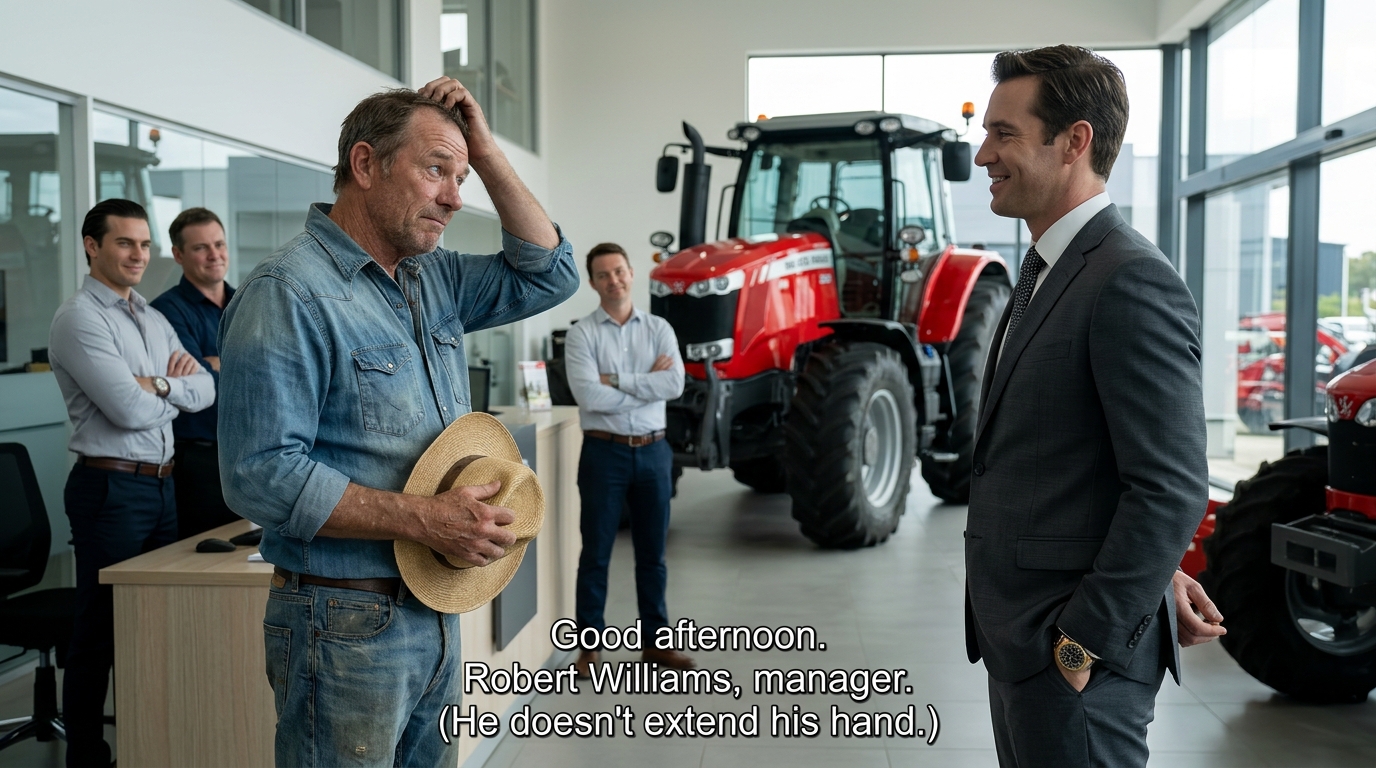
“Good afternoon,” he said. “Robert Williams, general manager.”
He did not extend his hand.
James noticed.
So did Michael.
So did the two salesmen at the counter.
Robert looked James up and down.
Then he glanced toward the old pickup outside.
His smile sharpened.
“So. Michael tells me you’re interested in new tractors.”
James held his hat with both hands.
“Yes, sir. If it’s not too much trouble.”
Robert looked around the showroom as if trouble had already arrived in muddy boots.
“Well,” he said, “let’s find out whether we’re talking dreams or business.”
The Price of Being Looked Down On
Robert led James toward a small desk near the back of the showroom.
Not the private consultation office.
Not the client lounge with leather chairs and coffee machines.
A side desk.
The one used for quick questions and walk-ins who were not expected to matter.
James sat.
Robert remained standing.
That was deliberate.
Michael lingered nearby, pretending to check inventory on a tablet.
The other two salesmen drifted closer.
No one wanted to miss the entertainment.
Robert folded his arms.
“What exactly are you looking for?”
James looked toward the tractors.
“Well, something strong. Reliable. Good for heavy work.”
“That describes all of them.”
“Yes, sir.”
“What’s your budget?”
James rubbed his thumb along the edge of his straw hat.
“I’m not sure yet.”
Robert smiled.
“You’re not sure.”
“No, sir.”
“That’s not usually how people buy equipment.”
“I suppose not.”
Robert leaned slightly closer.
“Mr. Whitaker, I’ll be direct with you. New equipment requires financial readiness. These are not machines people buy because they like the paint.”
James nodded.
“Of course.”
“Do you have financing approval?”
“No.”
“Business credit?”
James hesitated.
“I don’t think so.”
“Tax documents?”
“Not with me.”
“Proof of land ownership?”
James looked down.
“No.”
Michael made a small sound behind him.
Almost a laugh.
Robert ignored it.
“Then what exactly did you expect to happen today?”
James lifted his eyes.
“I thought I could ask some questions. Maybe see what would work.”
Robert sighed.
A long, theatrical sigh.
“Mr. Whitaker, my sales team handles serious buyers. We can’t spend all afternoon walking someone through machines they can’t qualify for.”
The words landed cleanly.
James stayed quiet.
Robert continued.
“There’s no shame in starting smaller. Used equipment. Older models. Auctions. Maybe rent something for a season.”
Michael added, “Or there’s a place down county road 9 that sells old implements. Might be more your speed.”
The other salesmen laughed.
James looked at them.
Then back at Robert.
“I see.”
Robert must have mistaken his silence for embarrassment.
Because he pressed harder.
“You farmers come in sometimes because you see commercials and think there’s some special program. But this isn’t a charity office.”
James’s fingers tightened slightly around the hat.
Only slightly.
Michael noticed, and his grin widened.
Robert did too.
“Look,” the manager said, lowering his voice in a way that was meant to sound generous. “I don’t want you wasting your day. You probably drove a long way in that truck.”
James nodded.
“About ninety minutes.”
“There you go. I’d hate for you to leave disappointed.”
A woman near the service desk looked over.
She had been listening.
Her name tag read Hannah.
She looked uncomfortable but said nothing.
James turned toward her briefly.
She lowered her eyes.
Robert followed his gaze.
“Hannah, can you bring Mr. Whitaker a brochure for the used equipment partners?”
Her face flushed.
“Yes, sir.”
James looked back at Robert.
“I asked about new tractors.”
“And I answered,” Robert said.
The smile was gone now.
“New tractors require new-tractor money.”
The showroom went silent enough for the sentence to hang.
James sat very still.
Then he nodded once.
“I understand.”
Robert looked satisfied.
Michael looked delighted.
Hannah returned with a brochure she clearly hated handing over.
James took it gently.
“Thank you, ma’am.”
Her eyes lifted for half a second.
There was apology in them.
Again, without action.
James folded the brochure once and set it on the desk.
“Could I ask one more thing?”
Robert checked his watch.
“One.”
“If a person wanted more than one tractor, how would that work?”
Michael laughed outright.
Robert’s mouth twitched.
“More than one?”
“Yes, sir.”
“How many are we pretending?”
The word pretending slid across the desk like a slap.
James looked at him.
For the first time, something in the old farmer’s expression changed.
Not anger.
Not yet.
Stillness.
Robert missed it.
Michael did not.
He shifted slightly, but the joke had already grown too large for him to stop.
James answered calmly.
“Thirty.”
The showroom froze for half a breath.
Then the salesmen burst out laughing.
Michael leaned against the counter.
“Thirty tractors?”
James nodded.
“Yes, sir.”
Robert laughed too, though more quietly.
“Mr. Whitaker, thirty tractors would be an order worth somewhere between eight and ten million dollars depending on configuration.”
James looked impressed.
“That much?”
“At least.”
“Goodness.”
Michael wiped at the corner of his eye.
“Maybe start with thirty toy tractors.”
One of the other salesmen slapped the counter.
Even Robert smiled now.
Hannah did not.
She looked at James differently.
As if she had finally noticed the thing the others had not.
His calm.
Too calm.
His patience.
Too exact.
James stood slowly.
The laughter faded a little.
Robert straightened.
“Leaving?”
“In a moment.”
James reached into the inside pocket of his worn work shirt.
Michael smirked.
“What, you got coupons?”
James pulled out a folded envelope.
Plain.
Thick.
Cream-colored.
He placed it on the desk.
The room went quiet.
Robert looked at it.
Then at James.
“What is that?”
James did not answer immediately.
He turned toward the tractors again.
“I’ve farmed this county for thirty-eight years,” he said. “My father farmed it before me. His father before him. I’ve bought seed on credit, fixed engines with wire, skipped meals during drought years, and watched neighbors lose land because banks understood paperwork better than weather.”
No one laughed now.
James looked back at Robert.
“Last year, thirty-two small farms formed a cooperative. We pooled land, equipment, storage, contracts, and risk. Then a company came through wanting our grain corridor. Offered to buy us out.”
Robert’s face shifted.
Something like recognition entered it.
James continued.
“We didn’t sell the land. We leased access. Long-term. Paid up front.”
Michael’s smirk had vanished.
James tapped the envelope.
“So when I asked about thirty tractors, Mr. Williams, I wasn’t pretending.”
He opened the envelope.
Inside were bank letters, purchase authorization documents, and certified funds verification from First State Agricultural Bank.
Robert’s face drained of color.
James removed the top page and placed it on the desk.
Approved purchasing authority:
$11,800,000.
Buyer:
Whitaker Regional Farm Cooperative.
Authorized representative:
James Whitaker.
The showroom became so quiet the air-conditioning sounded loud.
James looked at Michael.
“Do you still think I should try the toy aisle?”
The Envelope No One Wanted to Touch
No one moved toward the papers.
That was the strangest part.
For nearly an hour, they had treated James like someone who might dirty the showroom by touching too much. Now that millions of dollars lay on the desk, nobody wanted to touch the proof.
Robert recovered first.
Managers like him are trained to smell money faster than shame.
His expression shifted.
The smirk disappeared.
A professional smile took its place.
“Mr. Whitaker,” he said warmly, “clearly there has been a misunderstanding.”
James looked at him.
“No. I understood you just fine.”
Robert’s smile twitched.
Michael stared at the bank letter, face pale.
Hannah stood near the service desk, one hand pressed lightly against her throat.
Robert reached for the papers.
James placed one calloused hand over them.
“Not yet.”
Robert froze.
“I only want to review—”
“You had your chance to review me.”
That landed hard.
One of the salesmen looked down.
The other stepped backward, suddenly fascinated by the floor.
Robert lowered his voice.
“Mr. Whitaker, I apologize if anything came across—”
“It came across clear.”
“Then allow me to make it right.”
James picked up the used equipment brochure and held it between two fingers.
“Is this what making it right looks like?”
Robert swallowed.
“Sir, I can assure you—”
“Don’t call me sir now because the number got bigger.”
Robert’s face reddened.
Michael finally spoke.
“Mr. Whitaker, I’m sorry. I was joking.”
James turned to him.
“That’s the problem with jokes, son. They tell people what you think when you believe it won’t cost you.”
Michael’s mouth closed.
The front door opened behind them.
An older man entered with a leather briefcase.
He wore a navy suit, but his boots were dusty. His hair was gray. His face was familiar to everyone who worked at Agro Max.
Charles Benton.
Regional director.
The man whose photograph hung in the hallway beside framed award plaques.
Robert’s eyes widened.
“Mr. Benton.”
Charles did not answer him.
He looked at James first.
Then at the papers on the desk.
Then at the used equipment brochure in James’s hand.
His face darkened.
“Oh no,” Charles said quietly.
James gave him a small nod.
“Charlie.”
The showroom froze a second time.
Charlie.
Not Mr. Benton.
Not sir.
Charlie.
Robert looked from one man to the other.
“You know each other?”
Charles walked toward James and extended his hand immediately.
James took it.
The handshake was firm.
Old.
Equal.
Charles looked embarrassed before he even spoke.
“James, I was supposed to be here before you arrived.”
“I know.”
“My meeting ran long.”
“I figured.”
Charles looked around the showroom.
Then back at James.
“Did they know who you were?”
James slipped the bank letter back into the envelope.
“They knew enough.”
Charles’s jaw tightened.
He turned to Robert.
“What happened?”
Robert began quickly.
“Mr. Benton, there was confusion regarding qualification—”
James interrupted calmly.
“No confusion. I came in asking about tractors. Michael explained these machines cost more than a house. Robert explained this wasn’t a charity office. Then they gave me a brochure for used equipment and laughed when I asked about thirty units.”
Charles’s face went red.
Robert’s mouth opened.
Closed.
Michael looked like he wanted to disappear behind the counter.
Charles turned to Hannah.
“Is that accurate?”
The showroom tightened.
Hannah looked at Robert.
Robert’s eyes warned her.
James saw that too.
Charles did as well.
“Hannah,” Charles said, “you can answer without fear.”
She swallowed.
“Yes, sir. That’s accurate.”
Robert said sharply, “Hannah—”
Charles turned on him.
“Not another word.”
The sentence cracked through the showroom.
James watched silently.
Charles took a slow breath, then faced him again.
“James, on behalf of Agro Max, I apologize.”
James nodded.
“I accept your apology personally.”
Charles’s shoulders loosened slightly.
Then James added, “But the cooperative won’t be buying here.”
Charles closed his eyes.
The words hit the room like a dropped engine block.
Robert stepped forward.
“Mr. Whitaker, please. Let’s not make a business decision emotionally.”
James looked at him.
“I didn’t.”
Robert blinked.
“I made it before I came in.”
The room went still.
James continued.
“Our cooperative visited five dealerships this month. Same clothes. Same truck. Same questions. We wanted to know who saw farmers and who saw wallets.”
Charles lowered his gaze.
James looked around the showroom.
“At Martin County Equipment, the salesman pulled out a chair before asking my budget. At Riverline Tractor, the owner walked me through service plans for two hours after I told him I wasn’t ready to buy. At Green Hollow, a young woman named Denise explained financing like I deserved to understand it.”
His eyes returned to Robert.
“Here, I got laughed at.”
Michael whispered, “We didn’t know.”
James turned toward him.
“You weren’t supposed to know. That was the test.”
Robert tried again, desperation slipping into his voice.
“We can offer discounts. Priority delivery. Extended service contracts. Whatever Riverline offered, we can beat it.”
James shook his head.
“You still think this is about price.”
Charles looked at the tractors.
At his manager.
At the salesmen.
At Hannah, who stood with tears in her eyes because perhaps she had known for a long time what kind of place she worked in and hated that truth quietly.
James picked up his hat.
“My people don’t need the cheapest machines. We need partners who won’t treat a farmer like a fool until a bank proves otherwise.”
He placed the used equipment brochure back on the desk.
Then he turned to leave.
At the door, he paused.
“Charlie.”
Charles looked up.
“You’ve got fine tractors.”
Charles nodded once.
James looked toward Robert and Michael.
“Bad soil.”
The Contract That Left the Building
James walked out of the dealership with the same slow steps he had used walking in.
No dramatic exit.
No speech for the cameras.
No slammed door.
Just an old farmer in worn boots crossing polished concrete while every person in the building finally understood what had just left with him.
Eleven point eight million dollars.
Thirty tractors.
Service plans.
Maintenance contracts.
Parts accounts.
Delivery fees.
Future upgrades.
A relationship that could have fed the dealership for a decade.
Gone.
Through the glass, they watched James climb into his old pickup.
The engine coughed once.
Then started.
Michael stood near the counter, white-faced.
Robert stared at the envelope James had taken back as if he could still somehow negotiate with the empty air.
Charles Benton did not move until the truck pulled out of the lot.
Then he turned.
“My office. Now.”
Robert straightened.
“Mr. Benton, I can explain.”
“No. You can answer.”
The three salesmen followed him into the manager’s office.
Hannah remained outside.
For twenty minutes, the office blinds stayed open.
That was unusual.
Everyone in the showroom could see Charles standing while Robert sat.
They could see Michael talking too fast.
They could see one salesman with his head lowered.
They could see Charles place both hands on the desk and lean forward, saying something that made Robert go completely still.
Then the blinds closed.
That was when Hannah finally sat down.
She exhaled like she had been holding her breath for years.
The next morning, James drove to Riverline Tractor Company.
Same old pickup.
Same straw hat.
Same work shirt.
But this time, when he stepped through the door, the owner himself came out from behind the counter.
“Mr. Whitaker,” Denise said, smiling from the sales desk. “Coffee?”
James smiled.
“Yes, ma’am. Thank you.”
By noon, the papers were signed.
Thirty tractors.
Twenty-four heavy-duty units.
Six smaller utility models.
A service fleet agreement.
Training sessions for cooperative members.
Parts discounts.
Emergency repair priority during harvest.
The contract was not perfect because no contract ever is, but it was fair.
More importantly, it was respectful.
Riverline did not get the order because they knew James was rich.
They got it because they treated him like his questions mattered when they thought he might not buy anything at all.
The story broke three days later.
Not from James.
From Agro Max.
Someone posted security footage from the showroom.
Probably one of the salesmen trying to make James look foolish before realizing how the story ended.
The video showed the old pickup.
James walking in with his hat in his hands.
Michael smirking.
Robert refusing to shake his hand.
The used equipment brochure.
The laughter.
Then Charles Benton arriving.
Then the bank letter.
The internet did what it does.
It chose a sentence and turned it into a hammer.
Bad soil.
Within twenty-four hours, local farmers were sharing the clip everywhere.
Some added their own stories.
They ignored me until I said I owned 600 acres.
They asked my wife if she needed her husband before discussing financing.
They quoted one price to my white neighbor and another to me.
They laughed at my boots too.
By the end of the week, Agro Max was drowning in reviews, calls, cancellations, and angry suppliers who wanted to know why their premium brand was being represented by men who mocked farmers for looking like farmers.
Charles called James five times.
James answered the sixth.
“I’m not calling to win back the sale,” Charles said.
“Good.”
“I’m calling because you were right.”
James said nothing.
Charles continued.
“I built regional sales on relationships. Somewhere along the line, this location started selling status instead of equipment.”
“That happens when people forget who uses the machines.”
“Yes.”
Another silence.
Then Charles said, “Robert is gone.”
James closed his eyes.
He was not happy.
People expected him to enjoy that part.
He didn’t.
A man losing a job is not a harvest.
Sometimes it is necessary.
That does not make it sweet.
“Michael?”
“Suspended pending review.”
“And Hannah?”
Charles’s voice softened.
“Promoted to interim showroom lead.”
James smiled then.
A little.
“She knew what was wrong.”
“She did.”
“But she was quiet.”
“She was.”
James looked out over his land through the kitchen window.
Corn stubble.
Fence posts.
A low gray sky.
“She’ll have to learn that knowing ain’t enough.”
Charles said, “I think she has.”
The call ended.
Outside, James’s grandson was trying to fix an old gate latch with a wrench too big for his hand. James watched him struggle for a moment, then headed out to help.
That was where his heart was.
Not in revenge.
Not in viral clips.
In teaching the next generation how things hold together.
The Farmers Who Arrived Together
Two months later, the first Riverline tractor rolled onto Whitaker land.
It arrived just after sunrise.
The machine was red, enormous, and bright enough to make every child in the cooperative stare like it had landed from space.
James stood with his hands in his pockets as the delivery truck lowered it onto the gravel.
Around him stood men and women from thirty-two farms.
Old farmers.
Young farmers.
Widows who had inherited land and learned quickly how many men confused grief with weakness.
Brothers who had nearly lost everything during the drought.
A retired teacher who owned forty acres and ran goats because she said goats had more sense than school boards.
And children.
Always children.
Because farmers bring children to important days whether the children understand them or not.
Denise from Riverline climbed down from the transport truck with a clipboard.
She handed James the keys.
“First one,” she said.
He looked at the tractor.
Then at the key.
Then at the people behind him.
“No,” he said.
Denise looked confused.
James turned and held the key out to Mrs. Alvarez.
She was seventy-three, five feet tall, and had kept her orchard alive through three bad seasons by selling pies at church and refusing to sell land to developers.
She stared at the key.
“James.”
“You lost the most equipment last year.”
“I can’t drive that monster.”
“You can learn.”
The cooperative laughed softly.
Mrs. Alvarez took the key like it was made of glass.
Her grandson climbed onto the tractor with her, grinning wide enough to split his face.
The engine roared to life.
People cheered.
James stood back.
That was what Agro Max had failed to understand.
The thirty tractors were never about him.
They were about survival becoming collective.
For decades, each small farm had fought alone. One broken machine could ruin a season. One bad loan could swallow a field. One medical bill could put a family in front of a banker who had never planted anything but signatures.
The cooperative changed that.
Shared machinery.
Shared storage.
Shared bargaining power.
Shared risk.
Not charity.
Not pretending.
Business.
The kind Michael Reynolds claimed to understand while laughing at the man who brought it through the door.
By spring, the tractors were working across county lines.
Riverline’s service trucks became familiar sights on gravel roads. Denise visited farms herself, taking notes, asking what worked and what didn’t. She learned names. Children. Soil types. Which gates stuck. Which dogs bit. Which farmers needed explanations twice but would remember forever once they understood.
Agro Max changed too.
Slowly.
Painfully.
Charles Benton brought in new leadership. He made every sales employee spend two weeks visiting working farms before returning to the showroom. Not for photo opportunities. For labor. Fence repair. Equipment cleaning. Parts hauling. Listening.
Michael Reynolds returned after six months.
Not as a salesman.
As a trainee in the parts department.
James saw him once at a county equipment fair.
Michael approached with his hat in his hands.
He looked thinner.
Less shiny.
“Mr. Whitaker,” he said.
James waited.
“I owe you an apology.”
“You gave me one already.”
“No,” Michael said. “I gave you one when I thought apologizing might save the sale.”
James said nothing.
Michael swallowed.
“This one’s because I was wrong.”
James studied him.
“You working parts now?”
“Yes, sir.”
“Learning anything?”
Michael looked toward the equipment displays.
“More than I learned selling.”
“That’s good.”
“I didn’t understand farmers.”
James almost smiled.
“No. You understood stereotypes.”
Michael accepted that.
“Yes, sir.”
James looked at him for a long moment.
Then said, “Learn the difference between worn out and worthless. You’ll do better.”
Michael nodded.
James walked away.
That was all.
No forgiveness ceremony.
No handshake under golden light.
Just a sentence that might grow into a better man if Michael had the sense to water it.
A year after the Agro Max incident, the cooperative held its first harvest festival.
Not because farmers had suddenly become sentimental.
Because they had survived.
That year, yields were up.
Repair costs were down.
Loan rates improved because the cooperative negotiated as a bloc.
Three families avoided foreclosure.
Two young farmers returned home after leaving for city jobs.
Mrs. Alvarez expanded her orchard.
James’s grandson learned to drive the smallest utility tractor and hit only one fence post, which everyone agreed was respectable for a beginner.
At dusk, James stood near the old red pickup.
It still ran.
Barely.
Someone had offered him a new truck after the tractor deal closed.
He refused.
Not because he enjoyed discomfort.
Because the truck still had work left in it.
Denise walked up beside him with two paper cups of lemonade.
“Quite a year,” she said.
James took one.
“Yes, ma’am.”
“You ever regret walking into Agro Max first?”
James looked across the field.
Children chased one another between hay bales. Farmers talked near folding tables loaded with food. One of the new tractors sat parked near the barn, dusty now, no longer showroom-perfect.
Finally useful.
“No,” James said.
Denise looked surprised.
“No?”
“If I hadn’t walked in there, I might’ve thought respect was something you ask for after the money shows.”
He sipped his lemonade.
“Turns out it’s something people either give before they know, or they don’t really have it.”
Denise nodded slowly.
Across the field, Mrs. Alvarez was teaching two teenagers how to check hydraulic lines. She was scolding them loudly. They were listening.
James smiled.
People later kept telling the story as if the best part was the silence in the showroom.
The moment the bank letter came out.
The faces of the men who had laughed.
The big reveal.
James never thought so.
To him, the best part came months later.
Mud on the tires.
Engines working before dawn.
Farmers who used to compete now sharing fuel costs and repair schedules.
A little boy climbing into a tractor cab beside his grandmother.
A young saleswoman named Denise remembering every farmer’s name.
A former arrogant salesman learning parts from the bottom shelf up.
The tractors mattered.
Of course they did.
But the real purchase was not thirty machines.
It was dignity.
It was proof that small farms were not small people.
It was a reminder that the hands that look dirtiest in a showroom are often the same hands that keep a country fed.
And sometimes, when a man walks in wearing old boots and holding his hat like he’s unsure he belongs, the smartest thing you can do is offer him a chair.
Because he may not be there to buy one tractor.
He may be there to decide whether your soil is worth planting anything in at all.