The Bag That Burst on the Asphalt
The parking lot was too bright for something that cruel.
That was what I remember first.
Not the shouting.
Not the clatter of the shopping carts.
Not even the oranges rolling across the wet asphalt like small pieces of sunlight trying to escape.
It was the brightness.
The afternoon sun beat down on the grocery store lot, bouncing off windshields and puddles left by the morning rain. Families moved slowly between rows of cars. An employee in a yellow vest gathered carts near the entrance. Somewhere, a child cried because his mother wouldn’t buy him candy.
Ordinary sounds.
Ordinary errands.
Ordinary life.
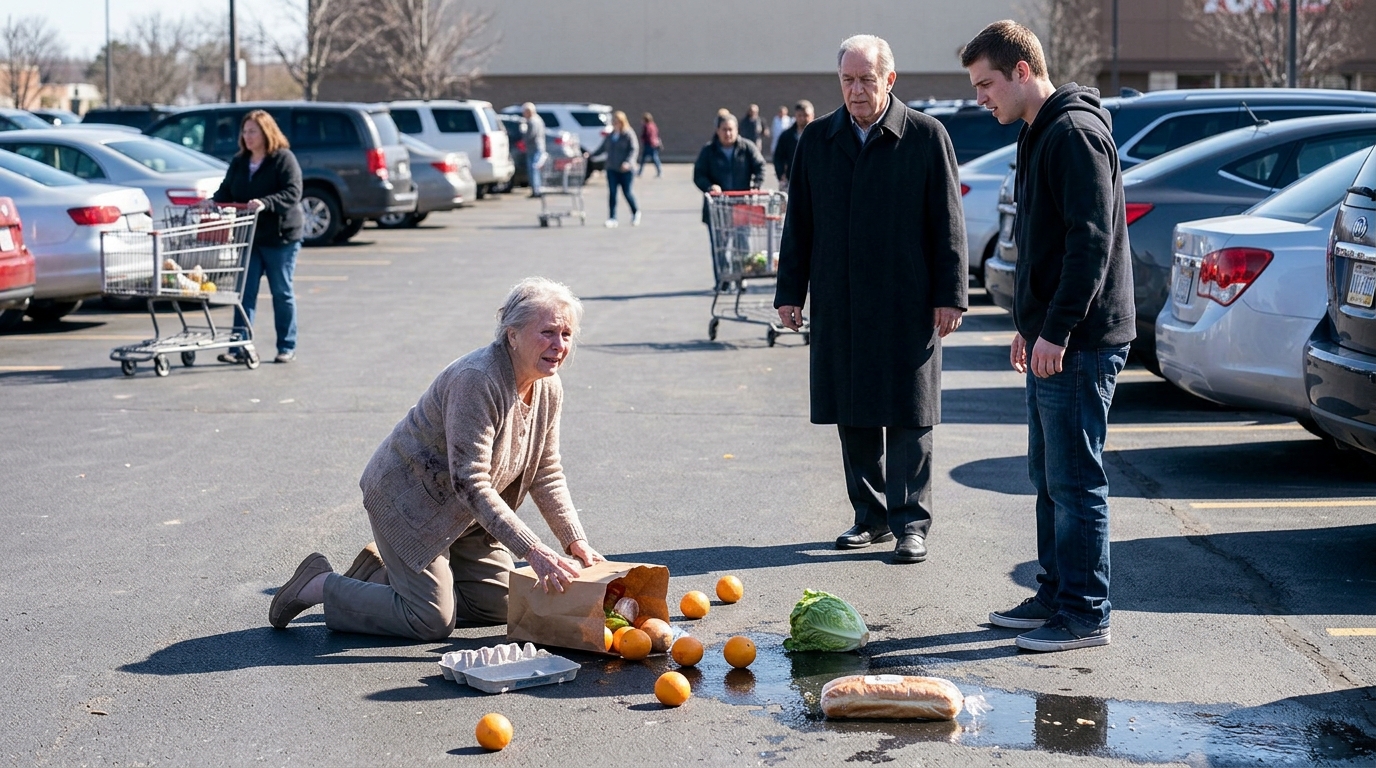
Then the paper grocery bag hit the ground.
Hard.
It burst open on impact.
Oranges scattered under a parked SUV. Lettuce slid across the wet pavement. A carton split along one side, spilling eggs into a shallow puddle. Bread landed near the curb, soaking through before anyone could reach it.
The elderly woman stood beside the mess as if something inside her had broken before the bag did.
Her hands hovered uselessly in the air.
Her mouth trembled.
“That was my last money.”
Her voice was so small I barely heard it over the idling cars.
Then she sank to her knees.
Not slowly.
Not dramatically.
Quickly, frantically, with the panic of someone who knows there is no second chance.
She began gathering the ruined groceries with shaking hands, trying to save what could not be saved. She picked up wet bread. Cradled cracked eggs. Wiped mud from an orange with the sleeve of her old cardigan.
“My God,” she whispered. “That was my last money.”
The young man who had thrown the bag stood over her.
He was maybe twenty-five. Tall, clean-shaven, expensive watch, expensive shoes, the kind of haircut that suggested someone else had always paid to keep him presentable. His black sports car sat behind him at an angle, taking up two spaces.
He was breathing hard.
Not from effort.
From outrage.
As if the elderly woman’s groceries had personally offended him.
“You scratched my car,” he snapped.
The woman looked up, confused through her tears.
“I didn’t mean to. The cart slipped.”
“You people never mean to.”
That phrase made several people look over.
But no one stepped in.
That was how it begins.
Not with cruelty.
With silence making room for it.
The young man pointed at the bumper of his car, where a faint gray mark barely showed against the black paint.
“Do you know what this costs?”
The woman tried to stand, failed, and went back to collecting the groceries.
“I’m sorry. I can give you my number. I can pay a little each month.”
He laughed.
A short, ugly sound.
“With what? Coupons?”
A teenage boy near the cart return lifted his phone.
A woman in yoga clothes stopped halfway to her SUV, holding her keys tightly.
A man in a business suit looked over, decided it was not his problem, and kept walking.
I stepped out from between two parked cars.
My name is Arthur Bell.
I was seventy-one years old that spring, old enough for people to underestimate my body and young enough to remember every sin I had failed to stop. I wore a dark overcoat despite the mild weather because old habits cling to old men. For thirty-eight years, I had been an attorney for wealthy families who liked their secrets organized before they were buried.
The Whitmores had been one of those families.
That was why I recognized the young man before he recognized me.
Not his face at first.
The gesture.
The way he had snatched the grocery bag from the woman’s arms.
The way he had thrown it downward, not outward, forcing her to kneel among the damage.
The way he stood over her afterward, waiting for shame to do the rest.
I had seen that exact motion once before.
Twenty-four years earlier.
In a marble kitchen.
With a different bag of food.
And a woman crying over baby formula spilled across the floor.
I walked toward him.
“That’s enough.”
The young man turned, annoyed.
Then uncertain.
Because I wasn’t glaring.
I was studying him.
His jaw.
His eyes.
The arrogance trained into his posture.
The past had a terrible sense of humor.
He looked so much like his father that for a moment I felt twenty-four years collapse into one afternoon.
“Mind your business, old man,” he said.
I looked down at the ruined groceries.
At the elderly woman kneeling on the asphalt.
At the young man whose expensive shoes were inches from a puddle full of broken eggs.
Then I said very quietly, “You throw food exactly like your father did.”
The young man went still.
Only for a second.
But enough.
The woman looked up at me through tears.
She did not know me.
Not at first.
Then her eyes narrowed.
Recognition came slowly, then painfully.
“Mr. Bell?”
The young man’s head snapped toward her.
“You know him?”
I did not answer.
I crouched beside the woman and picked up an orange from the puddle.
“Mrs. Avery,” I said softly. “I’m sorry I’m late.”
Her face crumpled.
“You came.”
“Yes.”
The young man looked from me to her.
His irritation began to bend into suspicion.
“Late for what?”
Mrs. Avery clutched the torn grocery bag against her chest as if it could still hold something.
I stood slowly.
“For the truth your father paid me not to tell.”
The Woman His Family Called a Thief
The young man’s name was Nolan Whitmore.
He knew me by reputation, though not well enough to be afraid yet.
His father, Victor Whitmore, had made sure of that. Men like Victor did not introduce their children to the people who cleaned up after them. They kept lawyers, drivers, private investigators, and quiet witnesses in the background where guilt could remain expensive but invisible.
Nolan stared at me.
“My father doesn’t know you.”
I almost smiled.
That was exactly the sort of lie a son believes because he needs it.
“Your father knows me well enough,” I said.
Mrs. Avery tried again to stand.
I helped her up.
She weighed almost nothing.
Up close, she looked older than I expected. Not just in years, but in wear. Her coat was carefully mended at the elbows. Her shoes had been polished though the soles were thin. Her hands trembled from cold, hunger, or shock. Maybe all three.
A store employee hurried over with a plastic bag.
“I can help clean this up,” he said.
Nolan snapped, “Don’t touch anything. She damaged my car.”
The employee froze.
I turned to him.
“Bring her another bag of groceries. The same items. Add milk, eggs, bread, fresh fruit, and whatever else she asks for. Put it on my account.”
Nolan scoffed.
“What account? This is a grocery store.”
I looked at him.
“Then I’ll pay like ordinary people do.”
Something flickered across his face.
He did not like being made small in front of witnesses.
That, too, came from his father.
Mrs. Avery whispered, “I can’t let you.”
“You can,” I said. “And you will.”
Nolan pointed toward the grocery store entrance.
“Are we done with this performance?”
“No,” I said.
I reached into my coat and pulled out a sealed envelope.
Mrs. Avery saw it and covered her mouth.
The envelope had her name written across the front.
Miriam Avery.
Her fingers shook as she took it.
“What is that?” Nolan demanded.
“The reason I came to find her.”
Mrs. Avery looked at the seal.
“I thought you changed your mind.”
“I almost did.”
That was the truth.
Cowardice does not retire just because a man gets old.
For twenty-four years, I told myself that keeping silent had protected someone. A child. A mother. A family from scandal. I told myself there were documents I never saw, threats I could not prove, choices forced by powerful men.
But most lies become easier to carry when they benefit the person carrying them.
Mine had paid for a lake house.
A second car.
My daughter’s law school.
And every time I drove past Whitmore Tower, I remembered a young woman in a kitchen holding baby formula against her chest while Victor Whitmore laughed.
Mrs. Avery tried to open the envelope, but her fingers could not manage the flap.
“Not here,” I said.
Nolan stepped closer.
“What does this have to do with me?”
Mrs. Avery looked at him then.
Really looked.
Her face shifted in a way that made him uncomfortable.
Grief.
Recognition.
Love that had never been allowed a place to land.
“You have her eyes,” she whispered.
Nolan’s jaw tightened.
“Whose?”
Before she could answer, a black Range Rover turned into the parking lot too fast.
It pulled up beside Nolan’s sports car.
The driver stepped out first.
Then Victor Whitmore.
Even at sixty, Victor moved like money had promised never to let him fall. Silver hair. Navy coat. Gold watch. Calm mouth. He looked at the groceries on the ground, then at me, then at Mrs. Avery.
For the first time in two decades, I saw fear cross his face.
Not much.
Enough.
“Arthur,” he said.
Nolan turned sharply.
“You do know him.”
Victor ignored him.
His eyes stayed on the envelope in Mrs. Avery’s hands.
“I wondered when guilt would finally make you stupid.”
Mrs. Avery stepped back.
Victor looked at her with mild disgust.
“Miriam. Still collecting pity in public.”
Her face went white.
Nolan stared.
“Miriam?”
Victor’s voice softened falsely.
“Son, this woman is not stable. She has harassed our family for years.”
Mrs. Avery clutched the envelope.
“I only wanted to see my grandson.”
The parking lot went silent.
Nolan’s face drained of color.
Victor closed his eyes briefly.
And that was when everyone understood.
The groceries were no longer the story.
The ruined bread, the broken eggs, the last money—those were only the door.
The room behind it had been locked for twenty-four years.
And Nolan Whitmore had just heard the key turn.
The Baby Taken From the Kitchen
Nolan laughed once.
It came out wrong.
“My grandmother is dead.”
Mrs. Avery flinched.
Victor stepped toward his son.
“Yes. She is. This woman is confused.”
“No,” I said.
Victor’s eyes cut to me.
“Careful.”
The old warning.
The one that had worked when I was forty-seven and had too much mortgage, too much ambition, and not enough courage.
Now I was seventy-one.
A man loses many things with age, but he can lose fear too, if shame finally weighs more.
“Your mother is dead,” I told Nolan. “But not the woman he means.”
Nolan looked at me.
His face had hardened, but his eyes were uncertain now.
Good.
Truth needs an opening.
“Your father told you your mother was Elise Whitmore,” I said. “His wife. The woman in the portraits. The woman buried at Saint Mark’s.”
“She was my mother.”
“She raised you,” I said. “For a while.”
Victor’s voice dropped.
“Arthur, stop.”
I did not.
“Your birth mother was Clara Avery. Miriam’s daughter.”
Nolan stared at me as if the words had no language inside him.
Mrs. Avery began to cry silently.
Victor’s face twisted.
“That girl was a housekeeper.”
“That girl was twenty-two,” I said. “And your son loved her until she became inconvenient.”
Nolan turned to his father.
“Is this true?”
Victor’s answer came too quickly.
“No.”
Mrs. Avery opened the envelope with sudden force, tearing the flap.
Inside were copies.
A birth record.
A photograph.
A signed hospital intake form.
And a letter written in Clara Avery’s hand.
Miriam pulled out the photograph first.
Her fingers trembled as she handed it to Nolan.
He did not take it.
So I did.
The picture showed a young woman sitting on the back steps of the Whitmore estate kitchen. She had dark hair, tired eyes, and a smile that looked like it had survived against its own better judgment. In her arms was a newborn wrapped in a pale blue blanket.
On the back, written in blue ink, were four words.
Nolan, three days old.
Nolan stared at the photograph.
His mouth parted.
The baby had a small crescent-shaped birthmark near his left collarbone.
Nolan’s hand moved unconsciously to the base of his neck.
Victor saw it.
So did I.
So did Mrs. Avery.
Nolan stepped back.
“No.”
I knew that word.
People say no to truth before they understand they are not refusing it.
They are mourning what it takes.
Mrs. Avery pulled out the letter.
“I never wanted to hurt you,” she said to Nolan. “I only wanted you to know she existed.”
Victor snatched for the letter.
I caught his wrist.
The old man in me surprised both of us.
His eyes widened.
Then narrowed.
“You really want to do this in a grocery store parking lot?”
I looked around.
At the teenage boy filming.
At the yoga woman holding her keys.
At the store employee with replacement groceries halfway gathered in a cart.
At the puddle full of broken eggs.
“Yes,” I said. “I think public places suit your family best.”
Nolan took the letter from Mrs. Avery.
His hands shook as he unfolded it.
Clara’s handwriting was delicate, slanted, rushed.
My sweet boy,
If you are reading this, then your grandmother found you, or someone finally grew brave enough to tell the truth.
I did not leave you.
I did not sell you.
I did not sign anything freely.
Your father said his family would destroy me if I tried to keep you. He said no court would believe a housekeeper over a Whitmore. He said your life would be better if I disappeared.
I was young enough to believe power meant permanence.
I was wrong.
Power only lasts until someone keeps proof.
Your grandmother has proof.
Arthur Bell knows where the rest is.
Do not hate the woman who raised you. Hate the lie that made all of us live like thieves around your name.
I loved you before they taught you who to be.
Mom
Nolan lowered the page.
The parking lot had gone completely quiet.
Even Victor said nothing.
Because there are lies money can fight.
And there are sentences a dead woman writes that go straight past money and into blood.
Nolan looked at me.
“What happened to her?”
Mrs. Avery made a sound like she had been waiting twenty-four years to be asked and dreading it at the same time.
Victor spoke first.
“She was troubled. She ran away.”
“No,” I said.
Victor’s face hardened.
I looked at Nolan.
“Your mother tried to come back when you were two months old. Your father had her arrested outside the estate for trespassing and attempted theft. I prepared the injunction.”
Mrs. Avery began sobbing openly now.
Nolan looked sick.
“I signed papers I should have burned,” I continued. “Your father claimed Clara had tried to extort him. He claimed she was unstable. He claimed Mrs. Avery here was encouraging harassment.”
Victor smiled faintly.
“That was all legally handled.”
“Legally,” I said, “is not the same as clean.”
The teenage boy filming whispered, “Oh my God.”
Victor looked toward him.
The boy lowered the phone, frightened.
Nolan saw that too.
For the first time, he seemed to see the shape of the thing he had inherited.
Not wealth.
Not cars.
Not a name.
A way of making people afraid.
Mrs. Avery reached into her coat pocket and pulled out one more object.
A tiny silver baby spoon.
The handle was bent.
Initials were engraved along the side.
N.W.
“I brought this to the estate when you turned one,” she whispered. “Your father threw the food I’d bought onto the kitchen floor and told me if I came back, he would make sure Clara disappeared for good.”
Nolan looked at the ruined groceries on the asphalt.
Then at his father.
“You did this before.”
Victor’s expression went cold.
“I protected you from trash.”
The word landed.
Mrs. Avery recoiled as if struck.
Nolan looked down at the wet bread near his shoe.
His face changed.
Not redemption.
Not yet.
Recognition.
He had just seen himself from the outside.
And it horrified him.
Then Victor’s phone rang.
He looked at the screen and stiffened.
I knew before he answered.
The video had already reached someone he couldn’t threaten in a parking lot.
The Proof in the Safety Deposit Box
Victor walked away to take the call.
That was his second mistake.
His first had been thinking cruelty still belonged to private rooms.
The world had changed.
Cameras lived in pockets now.
And shame could travel faster than lawyers.
Nolan stood motionless beside the ruined groceries, still holding his mother’s letter. He looked younger suddenly. Not innocent. But stripped. Like the expensive clothes had become a costume he no longer knew how to wear.
Mrs. Avery bent to pick up the soaked bread again.
He stopped her.
Not roughly.
Gently.
“Don’t,” he said.
She froze.
He crouched and began gathering the ruined food himself.
The people watching seemed unsure what to do with that.
So was I.
He picked up the oranges first.
Then the lettuce.
Then the broken egg carton.
When he reached the bread, he held it in both hands for a moment and looked like he might be sick.
“I’m sorry,” he said.
Mrs. Avery did not answer.
Good.
Some apologies deserve to stand alone before anyone is asked to carry them.
Victor returned, face tight.
“We’re leaving,” he told Nolan.
Nolan stood.
“No.”
It was a small word.
It shook Victor more than shouting would have.
“Nolan.”
“I said no.”
Victor’s eyes flicked toward me.
“What did you give him?”
“Less than I should have.”
Victor stepped closer to his son.
“Everything you have came from me.”
Nolan looked at him.
“That’s what I’m starting to worry about.”
Victor’s face darkened.
I stepped between them before the moment could turn violent.
“The rest of the proof is in a safety deposit box,” I said.
Victor went still.
Nolan turned to me.
“What proof?”
I reached into my coat and removed a brass key on a faded red tag.
For twenty-four years, I had kept it in a locked drawer beneath old tax papers and the kind of guilt that waits for an heir.
“Clara gave me this before she disappeared,” I said. “I told myself I would use it if anything happened to her.”
Mrs. Avery whispered, “You had it?”
“Yes.”
Her face twisted.
Pain.
Anger.
Betrayal.
All deserved.
“Why didn’t you help us?”
There it was.
The question I had rehearsed answers to for decades.
None of them survived her voice.
“Because I was weak,” I said.
The parking lot did not forgive me.
Neither did she.
But she nodded once, not with acceptance, only with understanding that the truth had finally stopped hiding.
Victor laughed.
“You think a twenty-four-year-old box scares me?”
“No,” I said. “I think what’s inside it does.”
His jaw tightened.
Because he remembered now.
The night Clara came to my office with a bruise along her cheekbone, a baby blanket in her arms, and a folder she said could destroy Victor if someone honest opened it.
I had not been honest then.
But I had not destroyed it either.
Cowards sometimes preserve evidence because preserving feels less dangerous than using.
An hour later, we were at First Commonwealth Bank.
Nolan drove Mrs. Avery.
I rode with them.
Victor followed in the Range Rover with two attorneys already on speakerphone.
By then, the parking lot video had crossed fifty thousand views. The phrase “You throw food exactly like your father did” was spreading faster than any of us could process.
At the bank, the manager tried to delay us until Victor’s lawyers arrived.
Then Nolan placed his driver’s license on the counter and said, “My name is Nolan Whitmore. If that box contains records about my birth, I want it opened now.”
The manager looked at Victor.
That was a mistake.
Nolan saw it.
“My father isn’t the customer,” he said. “Mr. Bell is.”
The box was small.
Smaller than I remembered.
Metal.
Dull gray.
The kind of container that looks too ordinary for the damage it holds.
When the manager placed it on the table in the private viewing room, no one moved.
Mrs. Avery sat with both hands folded in her lap.
Nolan stood behind her.
Victor stood near the door, flanked by attorneys who had arrived breathless and angry.
I inserted the key.
It turned.
Inside were documents wrapped in a blue baby blanket.
Nolan reached for the blanket first.
The crescent moon pattern had faded, but it was still there.
The same blanket from the photograph.
Mrs. Avery covered her mouth.
Beneath it were hospital records, photographs, letters, a notarized statement from Clara, and a cassette tape.
The bank manager found an old player in a storage closet because banks, like old men, keep things they do not know they will need.
The tape hissed when it began.
Then Clara’s voice filled the room.
Young.
Tired.
Terrified.
“My name is Clara Avery. My son’s name is Nolan. If this recording is being played, it means Victor Whitmore has taken him from me or made it impossible for me to speak safely.”
Nolan’s face crumpled.
Victor said, “Turn that off.”
No one did.
Clara’s voice continued.
“Victor said he would claim I was unstable. He said he would say I stole from the house. He said Mr. Bell would prepare the papers because Mr. Bell knows how rich men keep clean hands.”
I closed my eyes.
There was my name.
At last.
“He also said the Avery land would belong to him either way. But my mother never sold it. The deed he has is false. The signature is not hers.”
Victor’s attorneys looked at him.
For the first time, they looked afraid of their client.
Clara’s voice broke.
“If my son ever hears this, I need him to know one thing. I did not leave because I didn’t love him. I left because I was told the people I loved would be safer if I vanished.”
A pause.
Then softer.
“Nolan, if you hear me, I hope you became kind before you became powerful.”
The tape clicked.
Silence filled the bank room.
Nolan sat down slowly beside Mrs. Avery.
Victor’s face had lost all color.
I lifted the deed records from the box.
The Avery land.
Forty acres outside town that had become, over twenty-four years, the foundation of a Whitmore development corridor worth millions.
Victor had not only taken the child.
He had taken the family’s land.
And the woman kneeling in a grocery store parking lot had been made poor by the man whose son had just thrown away her last food.
The Son Who Had to Choose
The legal storm began before sunset.
That is the phrase newspapers used later.
Storm.
As if storms come from nowhere.
This one had been forming for twenty-four years.
The grocery store video went national because people understood the image before they knew the history: an old woman on her knees, ruined food around her, a rich young man towering above her, and an older man saying the sentence that cracked the family open.
You throw food exactly like your father did.
By morning, Victor Whitmore’s company announced an internal review.
By noon, three former employees contacted reporters.
By evening, county prosecutors requested the documents from the safety deposit box.
Within two weeks, the Avery land transfer was frozen.
Within two months, Victor was under investigation for fraud, coercion, falsified property records, and obstruction connected to Clara Avery’s disappearance.
Disappearance.
That word became another battlefield.
Victor insisted Clara had left town voluntarily.
Mrs. Avery insisted her daughter had tried to come home.
I testified that I had prepared legal documents based on statements I knew were incomplete and possibly false.
That confession cost me my license.
It should have.
People called me brave afterward.
They were wrong.
Delayed honesty is not bravery.
It is debt collection.
Nolan vanished from public view for a while.
The sports car disappeared first. Then the social media accounts. Then the glossy photographs of him at charity events beside his father. For months, the town only saw him in glimpses—leaving the courthouse, entering his grandmother’s small house, carrying repair supplies up her broken porch steps.
Mrs. Avery did not welcome him easily.
She had loved an idea of him for twenty-four years.
The real man had thrown her groceries into a puddle.
Love does not erase that.
But one afternoon, I saw them together outside her house.
Nolan was painting the porch railing.
Badly.
Mrs. Avery sat in a lawn chair giving instructions with the severity of a woman who had survived too much to tolerate sloppy brushwork.
He listened.
That, too, was a beginning.
Victor’s trial lasted six weeks.
The courtroom was full every day.
Clara’s tape played on the second day, and no one moved while her voice traveled through the speakers. Nolan sat beside Mrs. Avery, his hands clasped so tightly his knuckles whitened.
Victor never looked at him.
Not once.
Men like Victor do not forgive their children for becoming witnesses.
The jury convicted him on the financial charges they could prove. The investigation into Clara’s disappearance remained open. That part hurt Mrs. Avery most. She wanted a grave, a confession, a final answer. The law gave her prison time for stolen land before it gave her truth about a stolen daughter.
Still, something changed.
The Avery deed was restored.
The development contracts collapsed.
A compensation fund was created from seized Whitmore assets.
Mrs. Avery received more money than she would ever spend, but the first thing she bought was not a car, not a new house, not jewelry.
She bought groceries.
For the food pantry.
Every Friday.
Nolan went with her.
The first time he carried the bags, someone filmed them.
He hated that.
Mrs. Avery hated it more.
“Put your phone down,” she snapped at the person recording. “He’s not a performance. He’s carrying bread.”
The video did not go viral.
I was glad.
Not every act of repair should become public property.
A year after the parking lot incident, the grocery store installed a small bench near the entrance. Mrs. Avery paid for half of it. Nolan paid for the other half.
The plaque read:
For anyone whose last money deserves dignity.
No names.
She insisted on that.
I visited the bench on a cold afternoon in March.
Mrs. Avery was there with two bags of groceries beside her. Nolan stood near the cart return, helping an elderly man load water bottles into a trunk.
He saw me and walked over.
He looked different.
Not fixed.
People are not furniture.
But different.
Quieter.
Less polished.
More awake.
“Mr. Bell,” he said.
“Nolan.”
We stood in awkward silence.
Then he looked toward the spot where the groceries had fallen a year earlier.
“I still see it,” he said.
“You should.”
He nodded.
“I know.”
Mrs. Avery watched us from the bench.
She did not smile, but she did not look away either.
Nolan reached into his coat pocket and pulled out something wrapped in cloth.
A small silver baby spoon.
The one Mrs. Avery had carried that day.
He held it carefully.
“I had it repaired,” he said. “The handle was bent.”
I looked at the engraved initials.
N.W.
“Does she know?”
“She said it looked better bent.”
That sounded like Miriam.
Nolan gave a faint smile.
“She said some things shouldn’t look untouched after what happened to them.”
He wrapped the spoon again.
Then he looked at me.
“Do you think she would have hated me?”
I did not need to ask who he meant.
Clara.
His mother.
The woman whose voice still lived on a cassette tape.
“I think she would have hated what you did,” I said.
He absorbed that.
Then I added, “And I think she would have been relieved you were ashamed of it.”
His eyes filled, but he did not let the tears fall.
Good.
Shame is not useful when it asks to be comforted too quickly.
Across the lot, a paper grocery bag tore in a woman’s hands. Apples rolled near the curb. Nolan turned immediately and went to help.
He did not hurry dramatically.
He did not make a speech.
He simply knelt, picked up the apples, and placed them carefully into a new bag.
Mrs. Avery watched him.
This time, she did smile.
Only a little.
But enough.
I stood beside the bench and felt the strange cruelty of time. Twenty-four years earlier, I had watched food hit the floor and said nothing. A young mother vanished. A grandmother was kept from her grandson. A boy grew into the shape of the man who raised him.
Then one bag burst in a grocery store parking lot, and the past finally found a voice.
That is the thing about family secrets.
They do not stay buried because they are strong.
They stay buried because witnesses decide the cost of speaking is too high.
I know that better than anyone.
But I also know this.
Sometimes truth does not arrive in a courtroom or a confession.
Sometimes it comes rolling across wet asphalt in the form of oranges, broken eggs, soaked bread, and an old woman whispering that it was her last money.
And sometimes the man who finally speaks is not brave.
Only late.
But late, if it opens the grave of a lie, is still better than never.