The Woman on the Frozen Bench
“Emily?”
The suitcase hit the gravel before John realized he had let go.
It landed hard, one wheel cracking against a stone, the sound disappearing beneath the dull wind that moved through Hawthorne Park. The winter afternoon had turned the sky the color of old metal. Bare trees clawed at the air. The fountain in the center of the park had been drained weeks ago, leaving only a dark basin filled with leaves and dirty ice.
John had come there to leave.
Not dramatically.
Not bravely.
Just finally.
One suitcase.
One train ticket.
One last walk through the city he had spent thirty-eight years trying to belong to.
He had no interest in what was inside the suitcase anymore. Clothes, papers, a watch his father gave him before becoming the kind of man John no longer wanted to remember. None of it mattered. He was walking away from the Whitmore name, from the family firm, from the townhouse that felt more like a museum than a home.
Then he saw her.
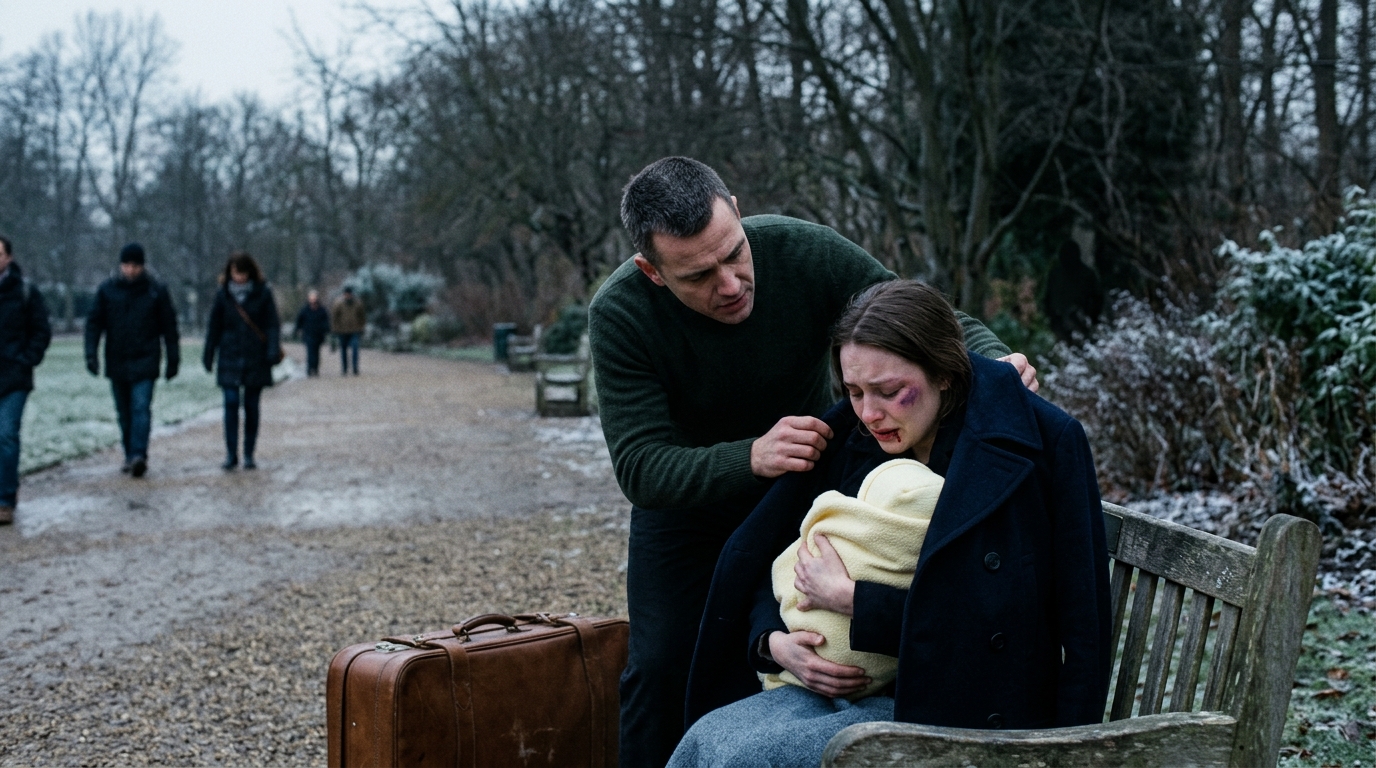
Curled on a bench beneath the dead branches of an elm tree.
Emily.
At first, his mind refused the shape of her.
Too thin.
Too pale.
Too still.
Then she lifted her face.
And the world stopped.
A bruise bloomed across her cheek, dark at the center, yellowing at the edges. Her lower lip was split, the blood still fresh, bright red against skin made colorless by cold. Her hair hung loose around her face, damp from mist and sweat. One hand clutched a baby against her chest beneath a thin blanket.
Not a bundle.
Not a stranger’s child.
A baby.
John’s breath left him.
For two years, he had believed Emily was gone.
Not dead.
Worse.
Gone by choice.
She had vanished six weeks before their wedding, leaving behind a note in her handwriting that said she couldn’t marry into the Whitmore family, couldn’t live under his father’s shadow, couldn’t love a man too weak to protect her from the life he came from.
He had read that note until the paper softened at the folds.
He had hated her.
Missed her.
Defended her.
Cursed her.
Then buried the part of himself that still waited for her to come back.
Now she sat on a park bench, bleeding, holding a baby like the world had been trying to take it from her.
Passersby moved around the scene with the practiced blindness of the city.
One woman glanced, slowed, then looked away.
A man with earbuds stepped off the path to avoid them.
A cyclist passed close enough to splash dirty water near Emily’s shoes and never turned around.
John felt rage rise in him, cold and clean.
He crossed the path quickly.
Emily saw movement and flinched before she recognized him.
That flinch almost broke him.
Not because she feared him.
Because her body had learned fear before her mind had time to choose.
He stopped several feet away and lowered his voice.
“Emily.”
Her eyes focused.
For one impossible second, something like relief passed through them.
Then terror crushed it.
“No,” she whispered. “You can’t be here.”
John removed his coat slowly.
“I’m not leaving you like this.”
She shook her head, her grip tightening around the baby.
“You have to go.”
He placed the coat over her shoulders.
She flinched again.
Small.
Automatic.
He saw the bruise.
The blood.
The trembling.
The way she kept her body curved around the child even while shaking from cold.
“What happened?”
Emily closed her eyes.
The baby stirred, making a tiny sound beneath the blanket.
John looked down.
A little girl.
Maybe three months old.
Pink cheeks.
Dark lashes.
A small crescent birthmark near her left ear.
The same birthmark John had beneath his collarbone.
His throat tightened.
Emily saw him see it.
Her face crumpled.
“John…”
He couldn’t speak.
The baby opened her eyes.
Gray-blue.
His mother’s eyes.
His eyes.
John took one step back as if the truth had physically struck him.
“Is she mine?”
Emily’s silence answered first.
Then she whispered, “Her name is Grace.”
Grace.
The name Emily had once chosen on a rainy Sunday morning when they were still happy enough to make dangerous plans.
If we ever have a girl, she had said, I want to name her Grace. Not because life is easy. Because sometimes it gives you something you don’t deserve and asks you to become worthy of it.
John’s hands shook.
“You had my child and never told me?”
Pain flashed across Emily’s face.
“I tried.”
Before he could ask what that meant, her eyes shifted over his shoulder.
Everything in her changed.
The color drained from her face.
John turned.
Near the treeline, half-hidden behind the bare branches, stood a man in a dark coat.
He was not walking.
Not passing through.
Watching.
When John turned fully, the man stepped back into shadow.
Emily’s voice broke.
“He found me.”
And in that moment, John understood the nightmare was not over.
It had followed her into the park.
The Man in the Trees
John moved instinctively.
He stepped between Emily and the treeline, one hand already reaching for the phone in his pocket.
Emily grabbed his wrist.
“No police.”
Her fingers were cold.
Desperate.
“Emily, he hurt you.”
“No police,” she repeated. “Not local. Not anyone your father can reach.”
The words cut through him.
Your father.
Not the man.
Not whoever did this.
Your father.
John looked back at the trees.
The man was gone.
Only wet leaves moved under the wind.
But the feeling remained.
A shape in the air.
A warning.
John turned back to Emily.
“What does my father have to do with this?”
She looked at the baby.
Grace had fallen asleep again, tiny mouth parted, one fist resting against Emily’s collar.
Emily’s face softened for half a second.
Then fear returned.
“Everything.”
John wanted to demand answers.
Two years of them.
Why did you leave?
Who wrote the note?
Why was my daughter born in hiding?
Why are you bleeding on a bench while my family still raises glasses at charity dinners?
But Emily swayed.
Her lips went gray.
The questions died.
He caught her before she fell.
The nearest safe place was not his house.
Not a hospital.
Not the police station.
It was a bookstore three blocks away owned by Mrs. Alvarez, a woman who had known John since he was a boy and had once told his father to get out of her shop because money was not manners.
John carried Grace while Emily leaned against him, each step costing her something. His suitcase stayed behind on the gravel.
He did not look back at it.
Mrs. Alvarez locked the bookstore door the moment she saw Emily.
No questions.
No panic.
Just action.
She pulled down the blinds, turned the sign to closed, and led them into the back room that smelled of old paper, tea, and dust.
Emily sat on the worn sofa.
John placed Grace gently in her arms.
Mrs. Alvarez brought warm water, towels, and a first aid kit.
When she touched Emily’s cheek, the older woman’s mouth tightened.
“Who did this?”
Emily looked at John.
“His name is Nathan Cole.”
John went still.
He knew that name.
Nathan Cole had worked for Whitmore Strategic Holdings for fifteen years. Officially, he was director of risk management. Unofficially, he fixed problems before they reached courtrooms.
John had seen him only a handful of times.
Always at the edge of rooms.
Always silent.
Always close to John’s father.
“He works for my father,” John said.
Emily nodded.
“He works for your brother too.”
“Andrew?”
Her eyes lowered.
That was another answer.
Andrew Whitmore, John’s older brother, had always been the family’s natural heir. Polished, ruthless, charming in the way knives could shine under warm light. Their father loved Andrew because Andrew never questioned the price of winning.
John had questioned everything.
That was why he had finally packed the suitcase.
Emily opened the baby blanket and pulled something from beneath Grace’s back.
A folded envelope.
Wrinkled.
Damp.
Sealed with tape.
“I was supposed to give you this if he found us.”
John took it carefully.
His name was written across the front.
Not in Emily’s handwriting.
His mother’s.
The room tilted.
His mother, Margaret Whitmore, had died seven years earlier. Cancer, officially. Silence, more honestly. She had spent the last decade of her life locked inside a marriage that looked perfect in photographs and hollow in private.
John opened the envelope.
Inside was a letter and a flash drive.
The letter began with one sentence.
John, if Emily has this child, your father will try to erase them both.
He stopped breathing.
Emily watched him read.
“My mother knew?”
“She found me before she died,” Emily whispered. “She knew what your father was planning.”
John read on.
Your father changed the Whitmore Trust after Andrew’s first scandal. If Andrew inherits alone, the board can challenge control. If you have a lawful child, your line becomes the controlling branch. He will not allow that child to exist outside his control.
John’s grip tightened on the page.
His father had never cared about grandchildren.
He cared about leverage.
The letter continued.
If Emily disappears, do not believe she left willingly. If a note appears, assume it was written under threat. If the baby survives, protect her from Andrew first.
John looked up.
“Andrew knew?”
Emily’s eyes filled.
“He was the one who came to my apartment the night before our wedding.”
The back room went silent.
Emily continued, voice trembling.
“He said if I married you, your father would destroy my mother’s medical coverage, frame my brother for theft, and make sure I never saw you again. Then Nathan Cole put a paper in front of me and told me to copy the note.”
John felt something break open inside him.
The note.
The years.
The hatred he had used to survive her absence.
All of it built from fear someone else had placed in her hand.
“I looked for you,” he whispered.
“I know.”
“How?”
“I watched from across the street once,” she said. “At your mother’s funeral anniversary. Cole was there too. Watching you. Watching me.”
John closed his eyes.
Mrs. Alvarez inserted the flash drive into an old laptop on her desk.
Files appeared.
Trust documents.
Medical records.
Emails.
Photographs.
Then one video.
John clicked it.
His mother appeared on screen, thinner than he remembered, sitting in the garden behind the family house.
Her voice was weak but clear.
“If Grace is alive, then John still has a chance to save what I could not.”
Emily covered her mouth.
John leaned closer to the screen.
His mother looked directly into the camera.
“Your father did not kill me, John. But he let me die slowly by making sure every doctor, every nurse, every visitor reported to him first. Do not let him do the same to your daughter.”
The laptop screen suddenly went black.
The lights in the bookstore flickered once.
Then twice.
Outside, tires rolled to a stop at the curb.
Mrs. Alvarez looked through the blind and whispered, “Three cars.”
Emily clutched Grace.
John stood.
The nightmare had not followed them.
It had surrounded them.
The Baby They Wanted on Paper
Nathan Cole entered the bookstore as if he had a key.
He did.
That was the first terrible thing.
Mrs. Alvarez had owned the shop for thirty years, and still, Cole opened the front door calmly, pocketed the key, and stepped inside with two men behind him.
John met him between the shelves.
“You’re trespassing.”
Cole looked at him with flat eyes.
“Mr. Whitmore, your father wants this handled quietly.”
“Tell my father to go to hell.”
Cole’s mouth barely moved.
“Those were almost your mother’s last words too.”
John lunged.
One of Cole’s men stepped forward, but John hit him first. Not cleanly. Not like a fighter. Like a man who had just heard his mother’s death used as a polite threat.
Books crashed from a shelf.
Mrs. Alvarez shouted.
Grace began crying in the back room.
Emily screamed John’s name.
Cole did not flinch.
He simply raised one hand.
The second man pulled a gun.
Everything stopped.
The baby’s crying filled the bookstore.
Cole looked past John toward the back room.
“We do not need Emily,” he said. “We need the child.”
John’s blood turned cold.
“Why?”
Cole sighed, as if explaining business to an employee who should already understand.
“The trust hearing is tomorrow. Your father is ill. Andrew’s position is unstable. The existence of John Whitmore’s biological daughter secures the family line, but only if custody is properly assigned.”
“Assigned?”
“To a suitable guardian.”
“My father.”
Cole smiled faintly.
“Temporarily.”
John understood then.
Grace was not a child to them.
She was a document.
A signature.
A key to voting control.
Emily had been beaten because she ran.
Grace was being hunted because she existed.
From the back room, Emily spoke.
Her voice was shaking, but loud enough.
“John.”
Cole turned.
Emily stood in the doorway with Grace against her chest and a kitchen knife in her free hand. Blood still marked her lip. John’s coat hung over her shoulders. She looked terrified.
But she also looked finished running.
Cole tilted his head.
“Emily. You have made this very difficult.”
“You said if I left, you’d let my brother live.”
John turned sharply.
Emily’s face crumpled.
Cole looked almost bored.
“Your brother made his own choices.”
“What did you do?” John asked.
Cole ignored him.
Emily’s hand tightened on the knife.
“He’s dead, isn’t he?”
Cole said nothing.
That was enough.
Emily made a sound so small it hurt more than screaming.
John saw her knees weaken.
He stepped toward her.
Cole lifted the gun again.
“No closer.”
Then Mrs. Alvarez moved.
Old, small, underestimated Mrs. Alvarez.
She threw a pot of boiling tea into the gunman’s face.
The room exploded.
The gun went off.
A shelf splintered above John’s shoulder.
Emily dropped behind the doorframe with Grace.
John drove his elbow into Cole’s throat and slammed him into the display table. The second man crashed into Mrs. Alvarez’s front counter as she hit him with a brass bookend hard enough to make even John wince.
Outside, sirens screamed.
Not local police.
Federal.
Three black vehicles boxed in Cole’s cars at the curb.
Agents poured through the doorway with weapons drawn.
“Hands!”
Cole froze beneath John’s grip.
For the first time, his expression changed.
Not fear.
Calculation.
A woman in a navy coat entered behind the agents.
John recognized her from business news.
Special Investigator Mara Voss.
Federal financial crimes.
She looked at Emily.
Then at Grace.
Then at Cole.
“Mr. Cole,” she said, “thank you for confirming the attempted child seizure on record.”
John stared at her.
“What?”
Mrs. Alvarez coughed from behind the counter.
“I called my nephew while you were busy reading,” she said. “He works for people your father can’t buy.”
Mara Voss lifted a tiny recorder from her coat pocket.
“We heard enough.”
Cole’s jaw tightened.
“You have no idea how high this goes.”
Voss stepped closer.
“Then start talking low and work your way up.”
Cole looked at John.
Then smiled through blood.
“You think this ends with me?”
John said nothing.
Cole’s eyes shifted to Emily.
“Andrew already has the original custody order.”
Emily went pale.
Voss snapped her head toward him.
“What custody order?”
Cole smiled wider.
“The one signed this morning.”
And suddenly John understood why the hearing was tomorrow.
They had not come to take Grace illegally.
They had come to enforce a lie that had already been filed.
The Order Signed Before the Truth
The custody order had been signed by Judge Harold Renner at 8:12 that morning.
Emergency guardianship.
Infant minor: Grace Whitmore.
Mother: Emily Hart, deemed unstable.
Father: John Whitmore, location unknown and presumed unwilling to assume custody.
Temporary guardian: Andrew Whitmore.
John read the document inside the federal field office while Emily slept in a chair beside Grace, one hand still resting on the baby’s blanket.
Location unknown.
He had been walking through a public park with a train ticket in his pocket.
Unwilling.
He had not even known his daughter existed.
The document was not sloppy.
That was what made it terrifying.
It had signatures.
Stamps.
Medical evaluations.
Witness statements.
A forged report claiming Emily had been seen endangering the child.
A statement from Andrew saying John had “repeatedly expressed disinterest in fatherhood and family obligations.”
John wanted to laugh.
Or break something.
Maybe both.
Investigator Voss sat across from him.
“Your brother filed this through a private family court channel connected to the Whitmore Trust.”
“He can do that?”
“He did.”
“And you can stop it?”
She hesitated.
That hesitation told him too much.
“We can challenge it. But if Andrew already has a certified order, any local officer could technically remove the child pending review.”
Emily woke at those words.
“No.”
John stood.
“No one is taking her.”
Voss looked at him.
“Then we need the original evidence tying Andrew to coercion, falsification, and intent to traffic custody for financial control.”
John turned toward Emily.
“My mother’s drive.”
Voss shook her head.
“It helps. But your mother’s files prove motive. We need Andrew’s direct instruction.”
Emily looked down at Grace.
Then whispered, “I know where it is.”
Every eye turned to her.
She reached into the lining of John’s coat, the one he had placed over her in the park. Her fingers found a small tear near the inside seam.
From it, she pulled a thin memory card.
John stared.
“You hid it in my coat?”
“No,” she said softly. “Your mother did.”
His throat tightened.
Emily continued, “She gave me the coat the day she found out I was pregnant. She said if I ever got close enough to you again, I should return what belonged to you.”
John looked at the coat.
His mother’s final gift.
Warmth.
Evidence.
A way back.
Voss inserted the card into a secure laptop.
One file loaded.
A video.
Andrew Whitmore stood in his father’s study, speaking to Nathan Cole.
His voice was clear.
“The girl doesn’t matter. Emily doesn’t matter. The baby is the asset. Once custody transfers, John can scream all he wants. He signed away voting rights when he left the firm.”
Cole asked, “And if Emily runs?”
Andrew smiled.
“Break her enough that no court believes her.”
Emily covered her mouth.
John could not move.
The room went silent.
Then the video continued.
John’s father appeared in the frame, seated near the fireplace, thinner than John remembered, wrapped in a blanket.
“Enough,” the old man said.
Andrew turned.
“Dad—”
“I said enough.”
John leaned toward the screen.
His father looked ill.
Not powerful.
Not in control.
Afraid.
“I built this family badly,” his father said. “But I will not let you steal a child.”
Andrew stepped toward him.
“You don’t decide anymore.”
His father lifted something from his lap.
A document.
“I changed the trust.”
Andrew’s face changed.
The video cut off as Cole moved toward the camera.
Voss immediately replayed the last seconds.
John stared at his father.
At the man he had spent his life trying to escape.
At the man who had controlled, judged, manipulated, and wounded.
At the man who, somehow, had tried to stop Andrew before the end.
“When was this recorded?” John asked.
Voss checked the metadata.
“Four days ago.”
John’s blood turned cold.
“My father has been in hospice for two weeks. Nobody has been allowed to see him except Andrew.”
Emily whispered, “John…”
He already knew.
His father might not be dead.
But he was imprisoned behind medical doors his own son controlled.
Voss stood.
“Where is he?”
John looked at the city lights through the window.
“The Whitmore estate.”
At that exact moment, an alert appeared on Voss’s phone.
She read it.
Her face hardened.
“What?”
She turned the screen toward him.
Breaking news.
Whitmore patriarch dies peacefully at family estate.
Andrew Whitmore assumes emergency control ahead of trust hearing.
John felt the room drop away beneath him.
His father had tried to protect Grace.
And Andrew had just made sure he would never testify.
The Daughter Who Changed the Will
They reached the Whitmore estate before dawn.
Federal agents took the front gate.
Investigator Voss took the side entrance.
John went through the garden door because he still remembered the code from childhood, and because some houses never imagine the child they broke might return through the back.
The estate was quiet in that unnatural way rich houses become quiet when servants have been dismissed and secrets are being moved.
In his father’s room, the bed was empty.
The machines were gone.
The sheets already changed.
Too fast.
Too clean.
Andrew stood in the study wearing a black suit and no grief.
He looked up when John entered.
For half a second, surprise crossed his face.
Then amusement.
“John,” he said. “I thought you were leaving town.”
John stepped inside.
“I changed my mind.”
Andrew’s eyes moved past him to the agents entering the hall.
His face hardened.
“You have no right to be here.”
Voss appeared behind John.
“Federal warrant says otherwise.”
Andrew laughed.
“You people have no idea what you’re interfering with.”
John almost smiled.
Everyone in his family said that when cornered.
Voss placed the tablet on the desk and played the video.
Andrew watched himself call Grace an asset.
Watched himself order Emily broken.
Watched his father say he had changed the trust.
He did not deny it.
That was the most chilling part.
He only looked at John and said, “You were never going to use the power properly.”
John stared at him.
“She’s a baby.”
“She is control. She is succession. She is the difference between keeping everything intact and watching committees tear apart what generations built.”
“You mean what you wanted.”
Andrew’s face twisted.
“What I earned.”
There it was.
Not love.
Not family.
Entitlement polished into rage.
Voss signaled to an agent.
“Andrew Whitmore, you are under arrest for conspiracy, coercion, fraud, obstruction, and attempted unlawful custody transfer.”
Andrew stepped back.
Then his gaze shifted toward the fireplace.
John saw it.
A folder.
Half-burned.
He moved before Andrew did.
The two brothers collided near the hearth.
Andrew swung first.
John hit the edge of the desk.
Pain flashed through his ribs.
Andrew grabbed the folder and shoved it toward the flames.
John caught his wrist.
For years, he had let Andrew be stronger.
Louder.
More certain.
Not now.
They struggled beside the fire until Voss and another agent pulled Andrew back and forced him to the floor.
John snatched the folder from the hearth.
The edges smoked.
The first page was charred.
The signature remained.
Final Amendment to the Whitmore Family Trust.
Signed by Charles Whitmore.
Witnessed by Margaret Whitmore, pre-recorded affidavit attached.
John turned the page with shaking hands.
If any child of John Whitmore is born living, all controlling voting rights transfer into protective trust under John Whitmore until the child reaches twenty-five. Andrew Whitmore is permanently excluded from guardianship, management, and inheritance authority.
John’s knees nearly gave.
His father had done it.
Too late for many things.
But not for Grace.
Voss took the document carefully.
“We need to secure this.”
John looked toward the bedroom.
“Where is my father?”
Andrew, face pressed against the carpet, laughed.
It was a low, broken sound.
“You think he was saving you? He was saving his name.”
John knelt beside him.
“No,” he said. “He was saving my daughter.”
Andrew’s smile vanished.
At the hospital morgue, they confirmed Charles Whitmore had died of a morphine overdose inconsistent with hospice protocol.
Andrew was charged with murder within forty-eight hours.
The trust hearing became a criminal proceeding.
Emily testified behind protective glass at first, then eventually without it.
Her voice shook when she described being forced to copy the goodbye note.
It steadied when she described running with Grace.
It did not break when Andrew’s attorney suggested she had invented the abuse to gain access to Whitmore money.
She looked at the jury and said, “If I wanted money, I would have stayed with the people who had it. I ran because my daughter was worth more than all of them.”
That sentence followed the trial for weeks.
Nathan Cole cooperated after the murder charge attached itself to Andrew. Men like Cole serve power until prison teaches them arithmetic.
Andrew was convicted on all major counts.
John did not attend the sentencing.
He had already seen enough of his brother behind tables, behind lawyers, behind family names.
Instead, he went back to Hawthorne Park with Emily and Grace.
Spring had come by then.
The bench was dry.
The trees had leaves.
The fountain was running again.
Emily stood beside him, one hand on the stroller handle, the other tucked into his.
She was still healing.
So was he.
Not in the clean way people imagine.
Healing was messy.
Some nights Emily woke shaking.
Some mornings John looked at Grace and felt grief for every day he had missed before joy could catch up.
Some truths came too late to fix what they revealed.
But not too late to build something after.
Grace slept in the stroller, her tiny fist curled around the edge of the blanket.
John looked at the spot where he had dropped the suitcase.
Someone had probably thrown it away.
Good.
That life had been full of things he no longer needed.
Emily followed his gaze.
“You were really leaving?”
“Yes.”
“Where?”
He smiled faintly.
“I don’t remember.”
She leaned against him.
For a while, neither spoke.
Then Emily whispered, “I thought no one would stand with me.”
John looked at Grace.
Then at Emily.
Then at the park where the nightmare had finally turned toward daylight.
“I should have found you sooner.”
Emily closed her eyes.
“You found us when it mattered.”
He did not forgive himself that easily.
Maybe he never would.
But Grace stirred then, opening her eyes, looking up at him with that same impossible birthmark near her ear.
John bent down and touched her tiny hand.
She wrapped her fingers around his thumb.
A grip too small to hold anything.
Strong enough to keep him there.
The man who hurt Emily had believed she was alone.
Andrew had believed Grace was paper.
Their father had believed legacy could be repaired at the edge of death.
But in the end, the truth had begun with one broken woman on a frozen bench, one baby in her arms, and one man who finally stopped walking away.
John had come to the park to leave his life behind.
Instead, he found the only life worth staying for.