The Woman on the Wrong Yacht
The champagne flowed like the night had already forgiven everyone.
Music pulsed beneath the open sky. Crystal flutes caught the harbor lights. Women in silk dresses laughed near the rail while men in linen jackets discussed acquisitions, valuations, and all the ways rich people make theft sound like strategy.
The yacht was called The Aurelia.
It gleamed white and gold beneath the moon, docked at the center of the marina like a floating palace. Cameras moved through the crowd. Influencers posed near the staircase. Sponsors smiled beneath banners printed with the name that used to belong to my father.
Bennett Marine.
At least, it had once belonged to him.
Now it belonged to Julian Cross.
Or so everyone on that deck believed.
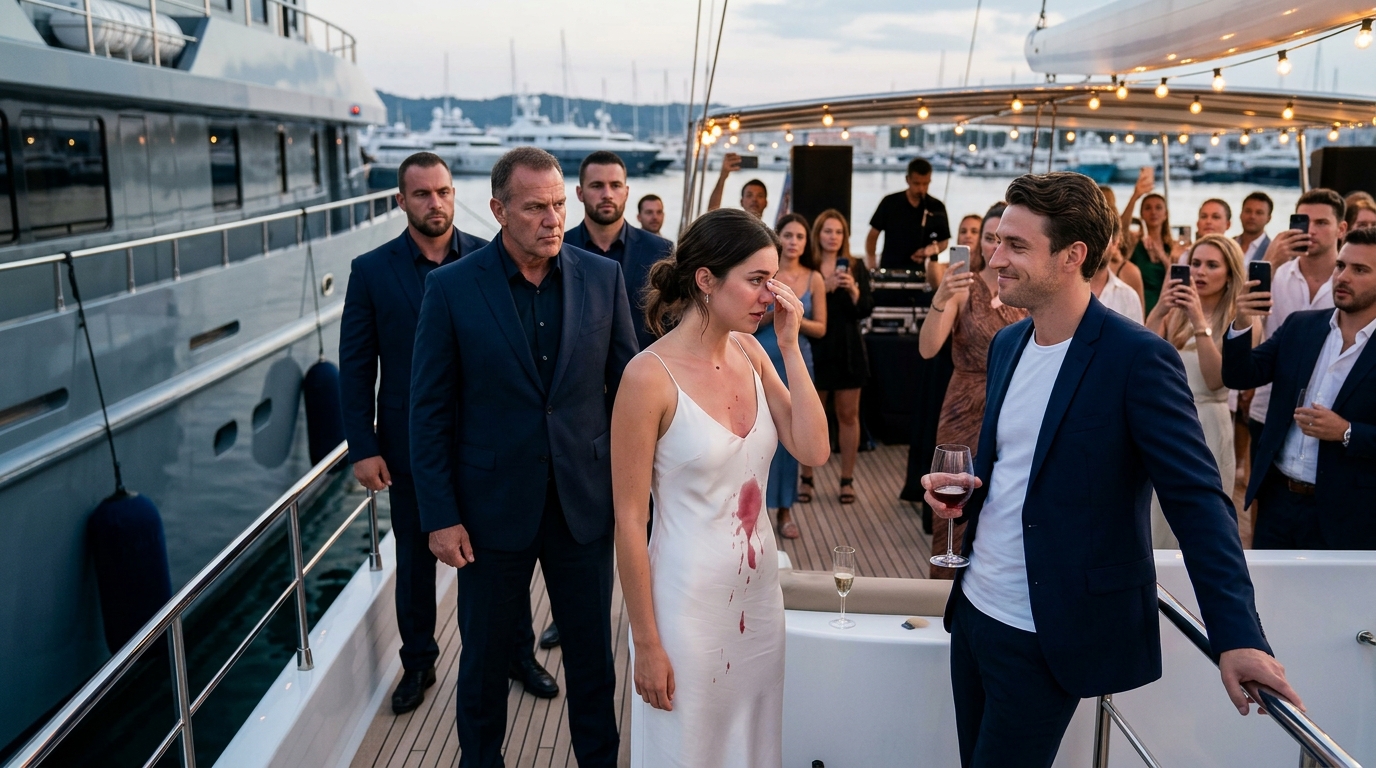
I stood near the bar in a simple navy dress, damp hair tucked behind one ear, trying to look invisible in a place designed to punish anyone who didn’t sparkle.
I had not come for revenge.
Not at first.
I had come to say goodbye.
To the company my father built with his hands.
To the yacht he designed before cancer hollowed him out.
To the last piece of a life Julian had convinced the world I had abandoned.
Then Julian saw me.
He stood at the center of the deck surrounded by investors, sponsors, and cameras. His smile was bright. Expensive. Practiced. He wore a white dinner jacket and a watch that cost more than the apartment I had been living in for the past year.
For one second, his face went still.
Not surprised.
Annoyed.
Like a stain had appeared on something he owned.
Then he lifted a glass of red wine from a passing tray and walked toward me.
Every step made the conversation around us thin out.
“Elena,” he said, loud enough for nearby phones to turn. “I didn’t realize the guest list included ghosts.”
I held my ground.
“I just came to say goodbye.”
He smiled.
That smile had fooled me once.
It had fooled my father too.
“Goodbye?” he repeated. “That’s dramatic, even for you.”
A few people laughed.
Not because it was funny.
Because Julian had trained rooms to follow him.
I looked past him at the yacht’s upper deck, where Bennett Marine’s logo glowed in blue light. My father had drawn the first version of that compass symbol on a napkin when I was nine years old. He told me companies needed more than names. They needed direction.
Julian had kept the logo.
He had simply erased the daughter.
“I won’t stay,” I said.
“No,” he replied softly. “You won’t.”
Then his expression shifted.
The warmth vanished.
He tilted the wineglass.
And splashed red wine across my face.
Gasps broke across the deck.
The wine hit cold first, then sticky. It ran down my cheek, into my eye, over the front of my dress. For one stunned heartbeat, I heard only the soft patter of droplets hitting the teak floor.
Then the phones came up.
Of course they did.
Julian chuckled.
“Relax,” he said, turning to the crowd. “This party isn’t for people like you.”
My throat tightened.
I wiped my eyes with the back of my hand.
Somewhere near the bar, a woman whispered, “Isn’t that his ex?”
Another voice said, “I heard she signed everything over.”
Julian leaned closer.
“You left with nothing,” he said. “Don’t forget that.”
The sentence landed exactly where he intended.
Because for months, I had repeated those words to myself.
I left with nothing.
No company.
No home.
No husband.
No proof.
No father to defend me.
Only a sealed envelope I had been too afraid to open and three brothers I had refused to call because I could not bear for them to see how far I had fallen.
Then a low rumble cut through the music.
At first, people thought it was thunder.
But the sky was clear.
The sound deepened.
Engines.
One yacht glided toward us from the dark water.
Then another.
Then a third.
Steel-gray.
Clean lines.
No party lights.
No music.
They came in with military precision, forming a quiet wall around The Aurelia.
The DJ lowered the music.
Then stopped completely.
Guests turned toward the rail.
A uniformed officer stepped onto the boarding platform.
“Ma’am?” he called.
I swallowed.
“Yes?”
Behind him, three men boarded.
The first wore a dark suit beneath a navy overcoat, his hair silver at the temples, his posture calm in the way only dangerous men can afford.
The second scanned the deck like he was counting exits, threats, and cowards.
The third did not look at the crowd at all.
He looked only at me.
At the wine on my face.
At my shaking hands.
At Julian standing too close.
The first man spoke gently.
“Little sister. You okay?”
The deck went silent.
Julian’s smile vanished.
The second man looked around the crowd.
“Who spilled wine on her?”
No one answered.
The third man turned to the captain.
“Shut it down.”
Julian stepped back.
“Wait. Who are you?”
My voice came out barely above a whisper.
“My brothers.”
Someone dropped a glass.
The sound cracked across the deck.
Julian glanced at the rail, then at the men, then at the cameras that were still recording everything.
“This is a joke,” he said. “Security—”
“No,” said my oldest brother, Adrian. “This is accountability.”
And for the first time since the night he stole my life, Julian Cross looked afraid.
The Brothers I Didn’t Call
Adrian Bennett did not raise his voice.
He had never needed to.
He was the oldest of us, the one who learned responsibility before he learned how to be young. Former Navy intelligence. Now a federal maritime investigator whose name made certain men suddenly remember they had other appointments.
Beside him stood Luca, our second brother, built like a wall and twice as difficult to move. He ran private security for people who needed discretion more than comfort.
The third was Noah, the youngest son and the best liar among us, which was why he had become an attorney.
Not the kind who polished corruption.
The kind who opened it.
They stood on Julian’s yacht as if they had walked into a room they already owned.
Julian tried to recover quickly.
Men like him always do.
He laughed, but it came out wrong.
“Elena, this is embarrassing,” he said. “You brought family drama to a sponsor event?”
Noah looked at him.
“You humiliated our sister in front of guests, and you’re concerned about drama?”
Julian’s jaw tightened.
“Your sister signed her shares away legally.”
I flinched.
There it was.
The blade he always carried.
The signature.
The document.
The night my father died.
Julian turned to the crowd, performing again.
“This is an unfortunate situation. Elena has been under emotional distress for some time. After her father’s death, she made certain choices she regrets.”
Adrian’s eyes moved to me.
Not asking if it was true.
Asking how much it still hurt.
I looked away.
Because Julian had chosen the right wound.
My father died in a hospital room overlooking the harbor. By then, Bennett Marine was already in trouble. Investors were circling. Julian, my husband then, promised he could save it.
He said I was too emotional to negotiate.
He said my father’s creditors would destroy us if I didn’t trust him.
He said the documents were temporary.
Protective.
Routine.
I signed because my father was dying and Julian held my hand while I did it.
The next morning, my shares were gone.
My board seat was gone.
My access was gone.
And Julian told everyone I had chosen to walk away.
Noah stepped forward.
“Those documents are under review.”
Julian scoffed.
“By whom?”
The uniformed officer behind Adrian answered.
“Federal Maritime Financial Crimes Division.”
The color shifted in Julian’s face.
Just slightly.
Enough.
Luca looked at the red wine dripping from my sleeve.
“Did he touch you?”
I shook my head.
“No.”
Julian smiled with relief.
Then I added, “Not tonight.”
The deck went very still.
Julian’s smile died again.
Adrian’s expression did not change, but something behind his eyes went cold.
“Explain,” he said.
I could not.
Not there.
Not in front of investors and cameras and women who had laughed while wine ran down my face.
So Noah did it for me.
He pulled a tablet from his coat and tapped the screen.
On the yacht’s central display, the sponsor slideshow cut out.
A document appeared.
Bennett Marine Emergency Transfer Agreement.
My signature sat at the bottom.
Then another version appeared beside it.
Same document.
Same date.
But the metadata was different.
Noah’s voice carried over the silent deck.
“The document Julian Cross submitted to the board was generated at 11:42 p.m. The version Elena signed was generated at 9:18 p.m. Two pages were replaced after execution.”
Murmurs spread through the crowd.
Julian lunged toward the tablet.
Luca stepped in front of him.
“No.”
The word was quiet.
Final.
Noah tapped again.
A security image appeared.
Julian in my father’s hospital room after I had fallen asleep in the chair beside the bed.
A nurse beside him.
A notary.
My father unconscious.
Julian placing documents into a folder.
I covered my mouth.
I had never seen that footage.
Julian looked toward the cameras, suddenly aware that every phone on the deck had become a witness.
“This is fabricated.”
Adrian spoke for the first time in several minutes.
“We found it in the offshore insurance archive connected to The Aurelia’s ownership transfer.”
Julian froze.
There.
That was the thing.
The yacht.
Not the company.
Not the shares.
The yacht was the mistake.
My father had registered The Aurelia under a shell company before his death, not to hide money, but to protect the final prototype of the navigation system he had spent ten years building.
Julian thought it was a luxury asset.
He had sold sponsorship packages around it.
He had thrown a party on evidence.
Noah looked at me.
“You said you came to say goodbye.”
I nodded.
“To Dad’s last boat.”
Noah’s expression softened.
Then he tapped the screen one last time.
A folder appeared.
AUDIO RECOVERED FROM AURELIA PROTOTYPE CORE.
My breath stopped.
Julian went pale.
“What is that?” I whispered.
Adrian looked at me.
“Dad left you something.”
And before Julian could move, my father’s voice filled the yacht.
“Elena, if you’re hearing this, then Julian has already done what I was afraid he would do.”
The Voice Beneath the Deck
The deck transformed.
A party became a courtroom.
Champagne glasses lowered.
Sponsors stopped smiling.
Guests who had lifted phones for humiliation were now recording evidence.
My father’s voice came through the yacht speakers thin but clear, roughened by illness and pain.
“Elena, sweetheart, I am sorry. I should have told you sooner. I trusted Julian because I wanted to believe you wouldn’t be alone when I was gone.”
I pressed both hands to my mouth.
For months, I had dreamed of hearing my father’s voice again.
Not like this.
Never like this.
The audio crackled.
“I discovered altered invoices tied to Cross Capital two weeks ago. Julian has been moving Bennett Marine intellectual property through shell companies. If I confront him directly, he will hide the trail. So I buried the core logs inside The Aurelia’s navigation prototype.”
Julian shouted, “Turn that off!”
No one moved.
Adrian looked at him.
“Make me.”
The recording continued.
“I know he has isolated you. I know he makes you think your grief is weakness. It isn’t. It is proof you still love people more than power.”
I closed my eyes.
Tears mixed with wine on my face.
“He will try to make you sign. He will tell you the company needs saving. He will tell you your brothers are too far away, too military, too angry, too proud to understand. He is lying. Call them.”
I broke then.
Not loudly.
Just enough for my knees to weaken.
Luca caught my elbow.
Julian looked around the deck, cornered now by the one person he could not charm.
A dead man.
My father’s voice hardened.
“Adrian, Luca, Noah. If Elena hears this before you do, forgive her for not calling. Pride runs in this family like bad weather.”
A broken laugh escaped Noah.
Even Adrian looked down.
The recording continued.
“The prototype contains the original ownership chain, altered board files, and shipment logs. If Julian launches The Aurelia publicly, he exposes himself. Let him. Men like him cannot resist applause.”
The crowd stared at Julian.
He stood beneath his own banner, surrounded by sponsors who had paid to be near his success and were now calculating distance.
My father’s final words came softer.
“Elena, this company was never the legacy. You were. Don’t let anyone convince you that leaving with nothing means you are nothing.”
The audio ended.
No one spoke.
The harbor wind moved over the deck.
I looked at Julian.
All the humiliation he had fed me for months rose between us.
You’re unstable.
You’re grieving.
You signed it.
You left with nothing.
But standing there with my brothers behind me and my father’s truth beneath my feet, I realized how small he really was.
Not harmless.
Never harmless.
But small.
A man who needed stolen rooms to feel tall.
Julian backed toward the rail.
“This is inadmissible,” he said.
Noah almost smiled.
“That’s cute.”
The uniformed officer stepped forward.
“Julian Cross, this vessel is being detained pending investigation into maritime fraud, financial crimes, intellectual property theft, and evidence tampering.”
Julian looked at the sponsors.
“Someone call my attorney.”
One of them stepped back.
Another lowered her glass.
A third deleted something on his phone.
That was when Julian understood the first rule of expensive loyalty.
It rents.
It does not stay.
He turned toward me.
“Elena,” he said, voice softening. “You know I was trying to save what your father built.”
I stared at him.
He had used that tone in the hospital.
At the funeral.
At our kitchen table when I asked why my keycard no longer worked.
I had once mistaken it for love.
Now I heard only strategy.
“You splashed wine in my face,” I said.
His mouth tightened.
“That was unfortunate.”
“No,” I said. “That was you.”
Luca moved toward him.
Julian stepped back too quickly.
His heel hit a coil of rope near the rail.
He slipped.
His arms windmilled once.
Then he went over.
The splash echoed across the harbor.
For one frozen second, nobody moved.
Then Adrian sighed.
“Get him out.”
Two officers hauled Julian from the water less than a minute later, soaked, sputtering, and furious beneath the cameras he had invited.
By morning, his sponsors were gone.
By noon, the board had suspended him.
By nightfall, Cross Capital’s accounts were frozen.
But the worst thing for Julian had not happened yet.
Because The Aurelia had not only recorded my father.
It had recorded the night Julian decided he should die sooner.
The Night My Father Stopped Breathing
The hospital footage came from The Aurelia’s prototype logs indirectly.
That was what took time to understand.
My father had built maritime systems designed to collect encrypted environmental and operational data even under hostile conditions. Redundant audio. Passive transfer records. Backup timestamps. Metadata trails hidden beneath ordinary diagnostics.
He believed machines should remember what powerful people tried to erase.
Julian did not know that.
He thought stealing the yacht was symbolic.
It was evidence.
After the party, federal agents moved through The Aurelia for fourteen hours. They removed servers, prototype drives, encrypted modules, and one old leather satchel hidden behind an access panel in the captain’s cabin.
Inside the satchel was my father’s notebook.
Not polished.
Not legal.
Human.
His handwriting began neat, then worsened as cancer advanced.
At the front were engineering sketches.
At the back were names.
Payments.
Dates.
Threats.
Julian.
My father had written his name twenty-seven times.
The final page had only one sentence.
If he pushes the morphine, it won’t look like murder.
I read that line in a federal interview room with my brothers beside me.
Noah cursed under his breath.
Luca stood and walked to the window.
Adrian said nothing.
He did not have to.
The investigator, Agent Marlowe, slid another file across the table.
“We need to ask you about the night your father died.”
I knew that question had been coming.
Still, it hollowed me.
The night my father died had always been covered in fog.
Machines beeping.
Rain on the hospital glass.
Julian beside me, telling me to rest.
A nurse bringing tea.
My hand on my father’s wrist.
Then waking in the chair at 3:14 a.m. to Julian shaking my shoulder and saying, “He’s gone.”
I had blamed myself for sleeping.
For months, I believed I had missed my father’s final breath because grief had exhausted me.
Agent Marlowe opened a laptop.
“We recovered internal hospital access logs from your father’s private care wing. Someone used Julian Cross’s visitor credentials to enter the medication cabinet at 2:48 a.m.”
My hands went cold.
“No.”
Noah reached for me under the table.
I did not take his hand.
Not because I didn’t need it.
Because if I did, I would fall apart.
Marlowe continued.
“The morphine pump was manually adjusted at 2:51. The nurse assigned to your father’s room had been sent to another floor by a false emergency page.”
Julian.
The room blurred.
“Was he in pain?” I whispered.
The agent’s face softened.
“Your father was unconscious by then.”
That was not comfort.
But it was something.
Marlowe hesitated.
“There’s more.”
She played the hospital hallway footage.
No sound.
Gray-green night vision.
Julian entering my father’s room.
Julian leaving nine minutes later.
Julian pausing in the hall.
Looking directly into the camera.
Smiling.
I stood so fast the chair hit the wall behind me.
Luca caught my shoulders.
“Elena.”
“He smiled.”
My voice did not sound like mine.
Adrian shut the laptop.
His hands were steady, but his face had changed.
For all his discipline, for all his training, he was still the son of the man on that hospital bed.
And Julian had stood over our father’s last breath like a thief checking a lock.
The arrest came that evening.
Not for fraud.
For murder.
Julian was taken from a private legal office where he had been preparing a statement blaming me, grief, and “family instability” for the yacht incident.
Cameras caught him in handcuffs.
Soaked hair replaced by perfect styling again.
Face pale.
Eyes wild.
He shouted my name as agents pushed him into the car.
Not an apology.
Never that.
“Elena! Tell them this is a mistake!”
I watched from across the street with Adrian beside me.
For a moment, the old training returned.
Comfort him.
Explain.
Absorb his fear.
Make the room easier for everyone else.
Then my brother took my hand.
“You don’t owe him softness.”
The words entered me slowly.
Like medicine.
So I watched Julian disappear behind the car door.
And I did not move.
The trial began seven months later.
The prosecutors called it financial murder.
Not passion.
Not rage.
Profit.
Julian had killed my father because Bennett Marine’s revised trust documents would have removed him from all operational access after my father’s death. He needed the old structure preserved. He needed me isolated. He needed my signature before the updated filings surfaced.
My father had known.
He just died before he could stop it.
The jury heard the audio from The Aurelia.
They saw the altered documents.
They saw the hospital footage.
They watched the party video too.
The wine.
The laughter.
The exact moment Julian showed the world who he was before the law ever had to prove it.
When I testified, Julian stared at me the entire time.
I did not look away.
His attorney tried to make me sound bitter.
Unstable.
Humiliated.
“Mrs. Cross,” he asked, “isn’t it true that your anger toward my client intensified after the yacht incident?”
I looked at the jury.
“No,” I said. “The yacht incident did not create my anger. It ended my fear.”
That line followed me out of the courtroom.
By evening, it was everywhere.
By morning, his sponsors were not just gone.
They were denying they had ever truly known him.
The Woman Who Didn’t Look Back
Julian was convicted on all major counts.
Fraud.
Evidence tampering.
Coercion.
Financial abuse.
And second-degree murder in my father’s death.
When the verdict was read, he did not cry.
Men like Julian cry only when tears might buy them something.
He looked at me instead.
As if the conviction were something I had done to him.
As if consequences were betrayal.
I felt nothing at first.
That frightened me.
Then Noah leaned close and whispered, “Breathe.”
So I did.
In.
Out.
Alive.
My father was still dead.
The company was still wounded.
The years Julian stole were still gone.
But for the first time in nearly a year, I was no longer standing inside his version of the story.
Bennett Marine did not recover quickly.
People think justice fixes what fraud breaks.
It doesn’t.
Justice opens the door.
Then you have to walk through the wreckage and decide what is still worth rebuilding.
The board offered me my seat back.
I declined at first.
Not because I didn’t want it.
Because I was afraid I only wanted revenge.
Adrian told me that was a good reason to wait, not a good reason to vanish.
Luca moved into my guest room for two weeks without asking and replaced every lock in the house.
Noah sued half the people Julian had bribed and enjoyed himself so much that I worried about him.
As for me, I went to the shipyard.
Every morning.
At first, the workers avoided looking at me.
I understood.
They had watched me disappear from the company newsletter, the board meetings, the annual holiday card. They had heard rumors that I had walked away with money, that I had broken down, that I had betrayed my father’s legacy.
Then I showed up in jeans and tied-back hair and asked the foreman where to start.
He handed me a clipboard.
Not gently.
Not symbolically.
Practically.
“Inventory,” he said.
So I started there.
I counted parts.
Reviewed damage.
Read old design notes.
Listened more than I spoke.
And slowly, Bennett Marine began to remember me.
Not as the woman in the wine-stained dress.
Not as Julian Cross’s ex-wife.
As Elena Bennett.
Daughter of Thomas Bennett.
Sister of three impossible men.
Engineer by training.
Owner by right.
The Aurelia never became a luxury yacht.
I refused to let it.
We stripped the party fixtures.
Removed Julian’s gold accents.
Restored the prototype systems.
Then relaunched it one year later as a research and rescue vessel under my father’s original compass logo.
No champagne towers.
No influencers.
No sponsor wall.
Just workers, families, my brothers, and a small brass plaque near the helm.
THOMAS BENNETT.
HE BUILT THINGS THAT REMEMBERED THE TRUTH.
After the ceremony, I stood alone on the deck where Julian had splashed wine in my face.
The harbor was quiet.
Sunset turned the water copper.
For a moment, I could still hear the party.
The laughter.
The glass dropping.
The splash.
Then Adrian came to stand beside me.
“You okay?”
I smiled faintly.
“Do you ever get tired of asking me that?”
“No.”
Luca joined us with two paper cups of coffee.
Noah followed, already complaining that the coffee tasted like engine cleaner.
We stood there shoulder to shoulder, just as they had stood behind me that night.
The three men I had not called because shame convinced me I had to survive alone.
The three men who came anyway.
Noah looked over the rail.
“You know, legally speaking, Julian falling into the harbor was still the funniest part.”
Luca snorted.
Adrian sighed.
I laughed.
Really laughed.
The sound surprised me.
It surprised them too.
Grief had made our family quiet for so long that laughter felt almost disrespectful.
But then I thought of my father.
Of his message.
Of his bad weather line.
Pride runs in this family like bad weather.
Maybe laughter did too.
Months later, I visited Julian once in prison.
Not because he asked.
He had asked many times.
I went because I needed to know whether seeing him would still turn me into the woman on that deck, wiping wine from her eyes while strangers recorded her humiliation.
It didn’t.
He looked smaller behind glass.
Still handsome.
Still polished.
Still waiting for someone to mistake his self-pity for remorse.
“Elena,” he said, picking up the phone. “You came.”
I sat down.
“I did.”
He smiled sadly.
“I knew you still cared.”
“No,” I said. “I came to say goodbye.”
His smile faded.
He understood the words this time.
Maybe he remembered the yacht.
Maybe he remembered the woman he mocked for saying them.
Maybe he finally realized that goodbye, from the right person, is not weakness.
It is a locked door.
I hung up before he could speak again.
Then I walked out.
I did not look back.
That evening, I returned to The Aurelia.
The crew was preparing for a coastal rescue systems test. Workers moved across the deck with purpose. No one wore tuxedos. No cameras hunted for scandal. No music drowned out truth.
Just wind.
Water.
Work.
I stood at the rail as the harbor lights came on.
My brothers waited near the helm.
Behind us, my father’s compass glowed softly on the mast.
For almost a year, Julian had convinced me I left with nothing.
But he had been wrong.
I had left with memory.
With blood.
With the truth hidden beneath stolen wood and polished lies.
And when I finally returned, I did not come back alone.
The night he splashed wine in my face, he thought the crowd was watching my humiliation.
He didn’t understand.
They were witnessing the first crack in his empire.
And all it took to finish him was the one thing he never believed I still had.
A family willing to cross the water for me.