The Boy Who Came in the Rain
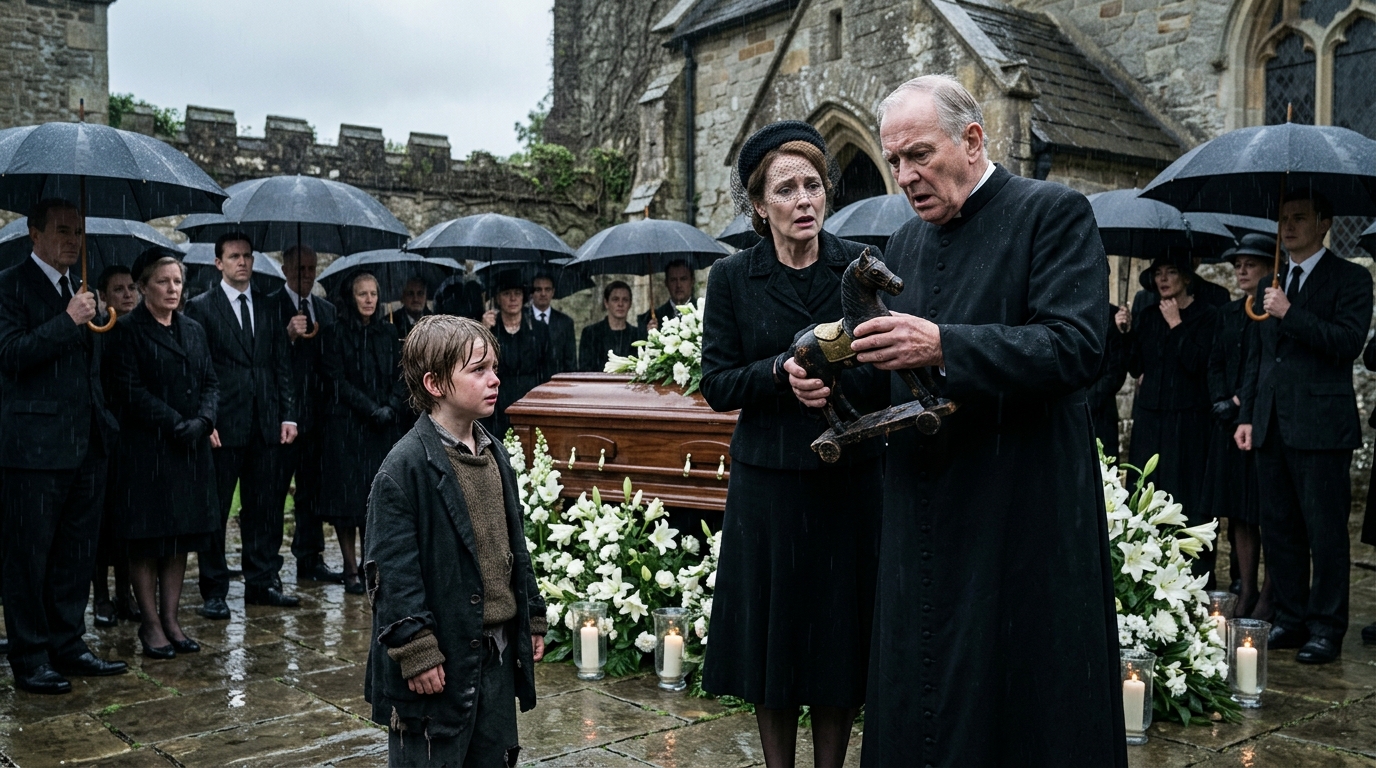
Rain fell softly over St. Clement’s courtyard, the kind of cold, patient rain that made every black umbrella shine like polished stone.
The funeral looked exactly the way wealthy funerals are designed to look.
White lilies arranged in perfect arches.
Candles flickering beside the coffin.
Men in dark wool coats standing with their hands folded.
Women whispering through veils.
A choir humming low from the church steps, their voices trembling beneath the gray sky.
At the center of it all lay Edmund Ashford.
Philanthropist.
Real estate heir.
Hospital donor.
A man whose name was carved into buildings across the city.
His coffin gleamed beneath the rain, covered in white flowers and guarded by silence.
I stood beside it in my priestly collar, Bible in hand, trying not to think of the last time I had seen Edmund alive.
Three nights before his death, he came to my office after midnight.
No driver.
No assistant.
No polished smile.
Just an old man soaked from rain, clutching a muddy envelope and whispering, “Father Gabriel, I think I buried the wrong child.”
Before I could ask what he meant, his phone rang.
He looked at the screen and went pale.
Then he left.
The next morning, he was dead.
Heart failure, the papers said.
Peaceful, the family said.
Expected, the doctors said.
But Edmund had not looked like a man expecting death.
He had looked like a man being hunted by a truth he had hidden too long.
Now his widow stood in the front row.
Evelyn Ashford.
Immaculate in black.
Pearls at her throat.
A veil over her face.
She looked like grief had been tailored for her.
Not one wrinkle out of place.
Not one tear misplaced.
Beside her stood her nephew, Malcolm Vale, the man everyone knew would inherit operational control of the Ashford Trust once probate cleared. He held Evelyn’s elbow like a loyal son, though there was something watchful in his eyes.
I began the prayer.
Then a gasp broke through the courtyard.
Not loud.
But sharp enough to cut the service in half.
Heads turned.
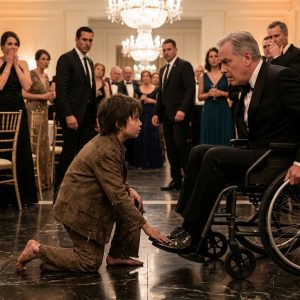
At the back of the gathering stood a small boy.
He was soaked through.
No umbrella.
No coat thick enough for the weather.
His hair clung to his forehead. Mud streaked his knees. His lips were blue from cold.
In his arms, he held a wooden toy horse.
Charred black along one side.
Burned almost beyond recognition.
But he held it against his chest like it was the last warm thing in the world.
Evelyn saw him first.
Her face changed so quickly that I almost missed it.
Not sadness.
Not confusion.
Horror.
“Who let him in?” she snapped.
The boy flinched.
But he did not run.
That was what made the courtyard go still.
A child that frightened should have turned and fled.
Instead, he stepped forward.
One step.
Then another.
The mourners parted without realizing they were doing it. Phones came out slowly, discreetly at first, then openly. Rain ticked against screens and umbrellas as the boy walked toward Edmund Ashford’s coffin.
Evelyn’s fingers tightened around Malcolm’s arm.
“Remove him,” she said.
But the boy raised his voice before security could move.
“He told my mother to keep this safe.”
A murmur passed through the crowd.
I stepped down from beside the coffin.
“Who did, son?”
The boy swallowed hard.
“Mr. Ashford.”
Evelyn’s breath caught.
I heard it.
So did Malcolm.
So did the old groundskeeper standing near the church gate.
The boy held out the toy horse.
His hands shook so badly that the horse nearly slipped.
I took it gently.
The burned wood was cold.
Too familiar.
My stomach tightened before my mind understood why.
I had held this toy once before.
Eighteen years ago.
During another funeral.
A smaller coffin.
A closed coffin.
A mother screaming so hard the church windows seemed to tremble.
The funeral of Evelyn Ashford’s five-year-old son, Julian.
Everyone said the boy had died in the nursery fire at the Ashford estate.
There had been no body for the public to see.
Only a sealed coffin.
And this wooden horse, placed inside at Evelyn’s request.
My fingers turned the toy over.
The bottom was blackened but intact.
Then I saw it.
A thin seam beneath the horse’s belly.
A concealed latch.
My heart stopped.
Evelyn saw it too.
All color drained from her face.
Her lips parted.
The polished widow vanished for half a second, and beneath her stood a terrified woman staring at something that should have been buried forever.
I looked up at her.
“This was hidden in your son’s coffin,” I said.
The entire courtyard went silent.
The boy stood in the rain, tears shining on his lashes, watching all of us as if he had walked into a room full of adults and realized none of them were safe.
Then the latch clicked open in my hand.
And inside the toy horse was a key wrapped in Edmund Ashford’s funeral card.
The Key Beneath the Burned Wood
Nobody moved.
Rain dripped from the edge of my umbrella onto the stone path.
The key lay in my palm, small and brass, darkened with age. Around it was a narrow strip of paper folded so tightly it looked almost like thread.
I recognized Edmund’s handwriting before I unfolded it.
Father Gabriel, if this comes back to St. Clement’s, do not trust Evelyn. The boy is blood. Open the Briar Chapel vault before probate.
The boy is blood.
I read the sentence twice.
Then a third time.
Evelyn stepped forward.
“That belongs to my family,” she said.
Her voice shook.
Only slightly.
But enough.
I folded the paper closed.
“No,” I said. “I believe it was given to the child.”
Her eyes sharpened.
“You have no legal right to interfere in private family matters.”
A child had arrived at her husband’s funeral drenched, hungry, and holding an object from her dead son’s coffin.
And Evelyn Ashford was worried about legal rights.
That told me everything and nothing at once.
I turned to the boy.
“What’s your name?”
He looked at Evelyn before answering.
“Noah.”
“Noah what?”
His lips trembled.
“Noah Miller.”
The name struck Malcolm first.
I saw his expression shift.
Recognition.
Then calculation.
Evelyn noticed too.
Her hand moved toward him, warning or command, I couldn’t tell.
I crouched slightly so Noah did not have to look up so far.
“Where is your mother, Noah?”
He hugged himself, suddenly smaller than before.
“She died.”
The courtyard softened for half a second.
Even people who had been recording lowered their phones.
“When?”
“Last week.”
His voice was barely audible.
“She was sick. But she said I couldn’t go to the hospital because they would find me.”
“Who would?”
Noah looked at Evelyn.
The answer sat there between us.
A black car pulled up beyond the church gate.
Not a hearse.
Not a mourner’s car.
A private security vehicle.
Malcolm glanced toward it, then leaned close to Evelyn.
“We should move inside,” he murmured.
“No,” Evelyn said.
Too fast.
Too sharp.
Her composure was slipping.
“Noah,” I said gently, “how did your mother get this toy?”
“Mr. Ashford came to our apartment,” he whispered. “He was crying. I’d never seen an old man cry before. He gave Mom the horse and said if anything happened to him, I had to bring it here.”
“And did he say why?”
Noah nodded.
“He said the dead boy wasn’t dead.”
A sound rippled through the mourners.
Not a gasp.
Something lower.
Fear beginning to understand itself.
Evelyn’s face twisted.
“That is enough,” she said. “This child has clearly been coached.”
I looked at her.
“By whom?”
She didn’t answer.
That was when the black car doors opened.
Two men stepped out in dark coats.
Not police.
Not family.
Men who moved with the confidence of being paid too much to ask questions.
Noah stepped behind me.
A boy who had never met me chose my shadow over Evelyn Ashford’s protection.
That, too, told me everything.
I tucked the key and note into my Bible.
“Everyone inside,” I said.
Evelyn laughed once.
A brittle sound.
“You cannot take over my husband’s funeral.”
“No,” I said. “But I can keep a child out of the rain.”
For a moment, it looked like she might slap me in front of half the city’s elite.
Instead, she turned toward Malcolm.
“Call Judge Renner.”
The name chilled me.
Judge Thomas Renner handled probate for the Ashford Trust.
He was also the man who signed the sealed burial order for Julian Ashford eighteen years earlier.
I remembered because I had thought it strange at the time.
A child’s coffin sealed before the priest arrived.
A grieving mother refusing a final blessing.
A father so sedated he could barely stand.
And a toy horse placed in the coffin by Evelyn herself while nobody was allowed close enough to see inside.
I looked down at the burned horse again.
The latch had been hidden carefully.
Not by a child.
By someone expecting the toy to survive fire.
Or expecting the grave to be opened one day.
Inside the church, I led Noah to the sacristy and gave him a blanket. The poor boy’s fingers were stiff with cold. A nun brought him tea and bread, which he tried not to eat too quickly.
I asked where he had slept the night before.
He said, “Under the bridge by the train tracks.”
I asked where his mother was buried.
He said, “She isn’t.”
The answer struck the room quiet.
Before I could ask what that meant, the church doors slammed open.
Malcolm entered with two security men behind him.
His funeral grief was gone.
In its place was something far more honest.
Panic.
“Father,” he said, “hand over the boy.”
Noah dropped the bread.
I stood between them.
Malcolm’s voice lowered.
“You don’t understand what that child is carrying.”
I looked at the Bible in my hand.
Then at the brass key hidden inside it.
“No,” I said. “But I’m beginning to understand what your family buried.”
The Coffin That Had Been Opened
The Briar Chapel vault sat beneath the oldest part of St. Clement’s property.
Most families buried their dead in the public cemetery behind the church. The Ashfords did not. They built private rooms beneath stone and stained glass, each generation sealed behind iron gates and Latin inscriptions.
I had entered the vault only twice.
Once for Julian.
Once for Edmund’s father.
Both times, Evelyn had been present.
Both times, she had watched every movement with the focus of someone counting secrets.
The brass key from the toy horse opened the lower gate.
It should not have.
The lock had been changed after Julian’s burial. Evelyn claimed vandals had tried to break in. She hired private contractors, replaced the gate, and insisted only the Ashford family attorney retain keys.
Yet Edmund’s key slid in smoothly.
Turned.
Clicked.
Noah stood beside me with both hands tucked inside the sleeves of his borrowed coat.
He should not have been there.
I knew that.
But he refused to stay upstairs, and after what he had already survived, I could not bring myself to make another adult decision over his fear.
With us came Detective Mara Ellis, a woman from the city’s cold case unit whom I trusted because she had never once enjoyed rich people’s explanations. I had called her from the sacristy while Malcolm was still threatening legal action.
She arrived in twenty minutes.
With a warrant in forty.
Some prayers are answered by stubborn women with badges.
The vault smelled of stone, dust, and old flowers.
Edmund’s family name was carved everywhere.
ASHFORD.
Over doors.
Across plaques.
Beneath statues.
A name repeated so many times it felt less like heritage and more like a warning.
Julian Ashford’s chamber was the smallest.
A child’s alcove.
White marble.
A bronze angel.
A plaque with dates that had always troubled me.
JULIAN MICHAEL ASHFORD.
BELOVED SON.
FOREVER FIVE.
Detective Ellis held her flashlight on the coffin seal.
The wax was broken.
Not recently.
Not eighteen years old either.
“Someone opened it,” she said.
My throat tightened.
I looked at Noah.
His face had gone pale.
“Mr. Ashford,” he whispered.
Maybe.
Maybe Edmund had come down here after discovering the truth.
Maybe he had opened his son’s coffin and found the toy horse.
Maybe he had placed the key inside it after realizing his own house was no longer safe.
Detective Ellis photographed the seal before opening the coffin.
I stepped back.
Noah did not.
The lid rose with a low groan that seemed too loud beneath the chapel floor.
Inside lay a child-sized coffin lining.
Old satin.
Collapsed flowers.
A small indentation where the toy horse had once rested.
And bones.
Not many.
Not enough.
Detective Ellis leaned closer.
Her expression changed.
“What is it?” I asked.
She pointed to the wrist.
“This child had an orthopedic pin.”
My pulse slowed.
Julian Ashford had never had a broken wrist.
But I knew a child who had.
Eighteen years ago, a poor boy from the east side named Caleb Miller died in a tenement fire three days before Julian’s funeral. I remembered his mother coming to St. Clement’s asking for burial help. She had nothing. No money. No husband. No family plot.
Then, suddenly, she stopped coming.
The city record later stated Caleb Miller had been cremated by the county.
But here, in Julian Ashford’s coffin, lay a child with a surgical pin in his left wrist.
Detective Ellis looked at me.
“Father?”
My voice felt far away.
“This isn’t Julian.”
Noah made a sound behind me.
I turned.
He had pulled something from beneath the loose lining of the coffin.
A sealed envelope.
The paper was yellowed, but the ink remained clear.
EDMUND.
DO NOT LET EVELYN FIND THIS.
Inside was a hospital discharge bracelet.
A birth record.
And a photograph.
A little boy, five years old, lying in a hospital bed with burns on his hands but very much alive.
Beside him stood a young woman in a nurse’s uniform.
The name on her badge read:
SARAH MILLER.
Noah stared at the photograph.
“That’s my grandma,” he whispered.
Detective Ellis took the birth record from my hand.
Her eyes moved across the page.
Then stopped.
“Father,” she said quietly, “you need to see the name.”
I looked down.
Patient Name: Julian Michael Ashford.
Transferred under emergency protective identity: Jonah Caleb Miller.
Mother of record: Sarah Miller.
My knees nearly gave way.
Evelyn had not buried her son.
She had erased him.
And Noah Miller, the homeless boy shivering in the vault, was standing over the coffin of the child whose name his family had been forced to carry.
The Widow’s First Lie
We found the rest in Edmund’s study.
Not the public study in the Ashford mansion, where portraits and leather books performed sophistication for visitors.
The real study.
A narrow room behind the wine cellar, hidden by a mechanical shelf that Edmund had installed after his first stroke and apparently told no one about except the priest he almost confessed to.
The key to that room had been taped beneath the hospital photograph in Julian’s coffin.
Detective Ellis entered first.
Then me.
Then Noah.
The room smelled of paper, cigar smoke, and fear.
Files covered the desk.
Ashford Trust documents.
Private investigator reports.
DNA results.
Old hospital records.
Photographs of Noah and his mother taken from across streets, subway platforms, shelter lines.
Edmund had been watching them.
Not as a predator.
As a man trying to gather enough courage to walk across the street.
On the wall was a timeline.
The fire at Ashford House.
The disappearance of Julian.
The false burial.
Sarah Miller’s sudden relocation.
Her son Jonah Miller’s sealed juvenile file.
Jonah’s marriage.
Noah’s birth.
Jonah’s death in a warehouse accident.
Noah’s mother, Lena, petitioning the trust office and being dismissed as mentally unstable.
The day Edmund finally realized that Jonah Miller was Julian Ashford.
The day he learned Noah was his grandson.
The day Lena died.
I stopped at that entry.
Lena Miller.
Noah’s mother.
Found dead under the East Rail Bridge.
Reported overdose.
Noah stood very still.
“She wasn’t sick?” he asked.
Detective Ellis said nothing.
That was the kindest answer she had.
I opened the top folder on Edmund’s desk.
Inside was a letter written in his hand.
Father Gabriel,
I was told my son died in the nursery fire. I was told grief had damaged my mind when I questioned the sealed coffin. Evelyn handled everything. The doctors. The burial. The insurance. The trust.
I believed her because I needed someone to tell me what to survive.
Years later, a woman named Lena Miller came to the house claiming her husband Jonah had been born Julian Ashford. I had her removed. God forgive me, I had her removed.
She came again with the boy. Noah. My grandson.
I refused to see them.
Then she sent me the hospital bracelet.
The letter blurred.
I kept reading.
The truth is worse than death. Evelyn arranged the fire to force my father’s trust into her control. Julian survived. To avoid scandal, she paid Dr. Renner and Sarah Miller to hide him under a false identity. Sarah believed she was saving him from Evelyn. She raised him as her nephew, then son. When she tried to confess, she vanished.
My son lived poor while I mourned him in marble.
My grandson slept hungry while his inheritance fed banquets.
I looked at Noah.
He stared at the floor, breathing through his mouth, trying not to cry in front of adults who kept proving monsters could wear pearls.
Detective Ellis opened another folder.
Her face hardened.
“What?”
She turned the page toward me.
Bank transfers.
Evelyn Ashford to Dr. Thomas Renner.
Evelyn Ashford to private security firms.
Evelyn Ashford to Malcolm Vale.
The last transfer was dated three days before Edmund died.
Memo line: Final containment.
Noah saw the date.
“My mom died that night,” he whispered.
The room went colder than the vault.
Detective Ellis’ phone buzzed.
She answered, listened, and looked at me.
“Evelyn just filed an emergency petition claiming Noah is a mentally unstable runaway who assaulted her husband’s funeral and stole family property.”
Of course she had.
People like Evelyn do not wait for truth to arrive.
They send paperwork to meet it at the door.
Before Ellis could say more, shouting erupted upstairs.
A crash.
Then Malcolm’s voice.
“Find the boy!”
Noah looked at me.
His eyes were huge.
He had brought the toy horse to a funeral seeking the truth.
Now the family he belonged to had come to bury him with it.
The Child Who Inherited the Name
The Ashford mansion did not fall quietly.
Houses like that never do.
They collapse first through whispers, then court filings, then cameras at the gate.
Detective Ellis got Noah out through the old coal tunnel while Malcolm’s men searched the wine cellar. I followed with Edmund’s files tucked under my coat and the charred toy horse pressed against my chest.
By dawn, three news outlets had the documents.
By noon, Judge Renner’s signature was tied to the forged transfer records.
By evening, Evelyn Ashford was standing on the front steps of the mansion beneath a black umbrella, telling reporters that grief had made her late husband vulnerable to extortion.
She looked perfect.
That was what frightened people most.
Not that she lied.
That she looked so peaceful doing it.
Then the hospital photograph of Julian alive appeared on every screen in the city.
Then the DNA test.
Then the bank transfers.
Then the audio recording Edmund had made two days before his death.
Evelyn knew. Malcolm knew. If I am found dead, protect Noah before they turn him into another Miller grave.
The city that had spent decades admiring the Ashfords began learning what marble had hidden.
Sarah Miller’s disappearance was reopened.
Lena Miller’s death was reclassified.
Edmund’s body was tested for toxins after Detective Ellis noticed inconsistencies in his medication log.
Heart failure became homicide investigation.
The funeral never resumed.
The coffin remained at St. Clement’s for four days under police guard, a strange and solemn thing. Mourners came anyway. Not the powerful ones. They vanished first.
The people who came were nurses.
Shelter workers.
Old tenants from Ashford buildings.
A mechanic who said Jonah Miller once fixed his car for free.
A woman who brought a photograph of Noah’s mother smiling outside a laundromat.
Noah stood through all of it in borrowed clothes, holding the toy horse.
When Evelyn was arrested, she said nothing.
Malcolm cried.
That surprised no one.
Men like Malcolm are loyal until handcuffs make honesty cheaper.
He confessed first to the cover-up, then to helping Evelyn locate Lena after she tried to contact Edmund. He claimed he did not know Lena would die.
Detective Ellis did not believe him.
Neither did I.
The trials lasted more than a year.
Evelyn’s attorneys argued that everyone else had acted around her.
Doctors.
Lawyers.
Security men.
Judges.
Even Edmund.
She was only a grieving widow, they said.
A mother who had lost her child once and then lost her husband to delusion.
Then Noah took the stand.
He looked very small in the witness chair.
Twelve years old.
Hair neatly combed.
Hands folded around the charred horse.
The prosecutor asked him why he had gone to the funeral.
Noah looked toward the jury.
“Because my mom said rich people can hide behind doors,” he said. “But funerals make them stand outside.”
Nobody moved.
The prosecutor asked what his mother had told him before she died.
Noah swallowed.
“She said Mr. Ashford was my grandfather. She said he did bad by us, but he was trying to fix it. She said if I gave the horse to the priest, the dead boy would get his name back.”
The dead boy.
Julian.
Jonah.
Father.
Son.
All the names that power had broken apart.
Evelyn was convicted of conspiracy, fraud, obstruction, and accessory to murder in Lena’s death. New charges followed when Edmund’s toxicology report came back.
Judge Renner died before trial, which felt less like mercy than escape.
Malcolm received twenty-two years.
The Ashford Trust was frozen, audited, and restructured under court supervision. After months of legal battle, the court recognized Jonah Caleb Miller as Julian Michael Ashford and Noah Miller as his lawful heir.
The newspapers called Noah “the boy who inherited a dynasty.”
They loved that phrase.
I hated it.
Noah did not inherit a dynasty.
He inherited a graveyard.
A name that had been used to erase his family.
A house where his father should have grown up.
Money that had arrived too late to feed his mother.
The first thing he asked for was not a mansion.
Not a car.
Not anything the reporters expected.
He asked where Lena was buried.
She had been placed in a county grave under the wrong spelling of her name.
Noah stood there with the charred toy horse in his arms while the headstone was corrected.
LENA MILLER.
BELOVED MOTHER.
BRAVE UNTIL THE END.
Then he asked for one more change.
Beside her name, beneath the dates, the stonecutter added four words:
SHE BROUGHT HIM HOME.
Years later, St. Clement’s keeps the wooden horse in a glass case near the side chapel.
Not as a relic.
As a warning.
Visitors often ask why such a burned, broken thing sits beneath a candle.
I tell them it belonged to a child who was buried under the wrong name, carried by a mother who refused to let truth die, and returned by a boy brave enough to walk into a funeral where nobody wanted him.
Noah still visits sometimes.
He is taller now.
Quieter.
Still careful in rooms full of polished people.
But he smiles more than he used to.
On the anniversary of Lena’s burial, he comes to the church, lights two candles, and places his hand on the glass above the toy horse.
One candle for the mother who raised him.
One for the father who lived and died under a stolen name.
And sometimes, when the rain taps softly against the stained glass, I remember the day he first appeared at the edge of the courtyard.
Drenched.
Shivering.
Unwelcome.
Holding the one thing Evelyn Ashford feared more than any court, any priest, or any police officer.
Proof.
Because the truth does not always arrive clean.
Sometimes it comes burned.
Broken.
Clutched in the hands of a homeless child.
And by the time the powerful recognize it, the latch has already opened.