The Boy Outside the Glass Doors
“This is your fault!”
The scream hit me before the water did.
I had just stepped out of the black sedan when the bucket flew.
Filthy water exploded across the entrance of Le Marceau, streaking down the polished glass doors in brown sheets. Mud splashed over the brass handles, the marble step, and the white flowers my staff replaced every morning because wealthy people trusted places that never looked touched by weather.
The crowd froze.
A valet stood with one hand still raised toward my car door. A woman in silver heels gasped as dirty water spotted the hem of her dress. A man near the entrance cursed and lifted his phone at the same time.
That was the modern instinct.
Outrage first.
Recording second.
Compassion somewhere too far behind to matter.
I stepped onto the curb in a cream coat, diamond earrings, and a temper I had spent forty-six years learning to hide behind elegance.
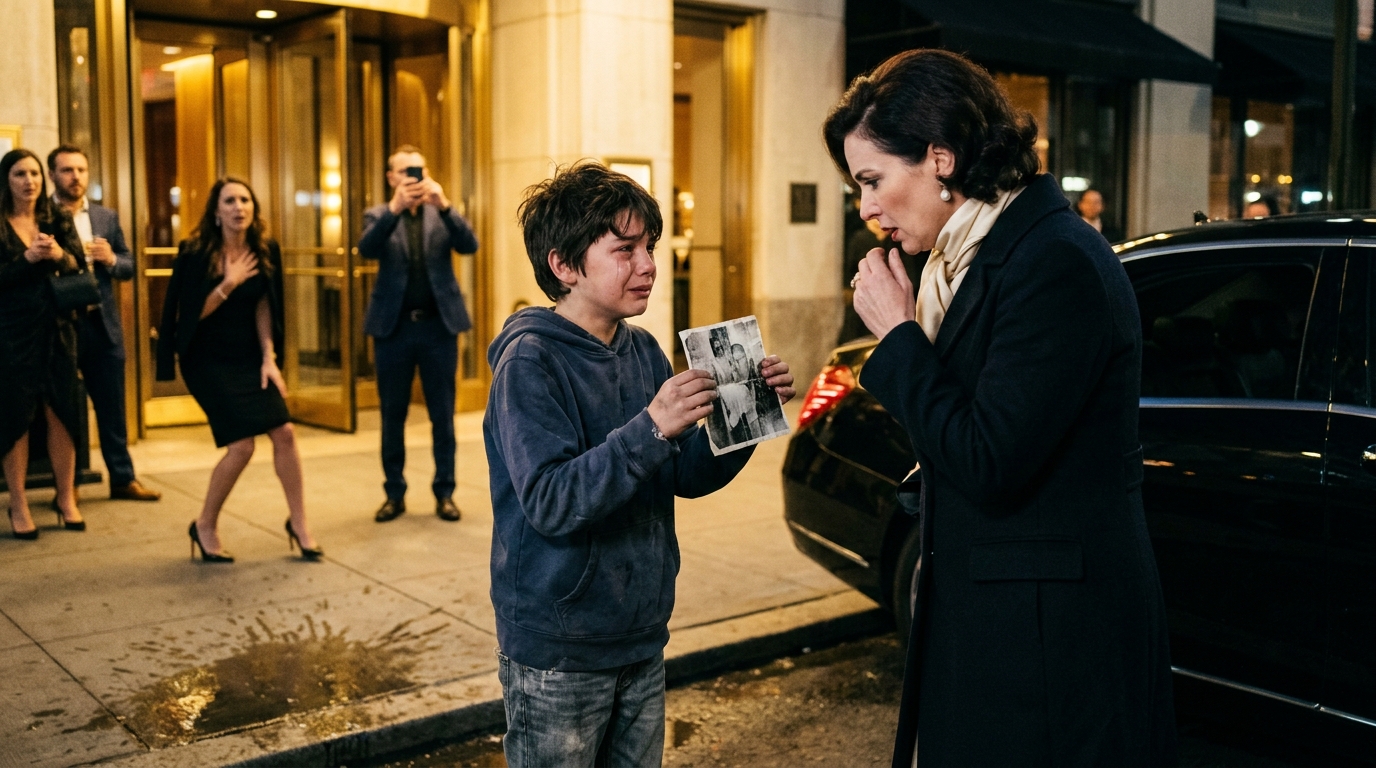
The boy stood in front of the restaurant holding the empty bucket.
He couldn’t have been more than twelve.
Thin.
Soaked.
Shaking.
His hair stuck to his forehead. His sneakers were split at the soles. His hands were red from cold. He looked like a child who had walked through half the city carrying grief heavier than the bucket.
Security moved immediately.
I lifted one hand.
They stopped.
Not because I was kind.
Because I wanted to know why this child had chosen me.
“Have you lost your mind?” I snapped.
My voice rang across the sidewalk.
The boy did not flinch.
That unsettled me.
Most adults flinched when I used that voice. Employees did. Lawyers did. Men who thought they were powerful did. It had taken me years to build a tone that could quiet a room before I ever raised it.
But this boy simply stared at me with eyes too old for his face.
“You left my mother begging in the rain,” he said.
The sidewalk fell silent.
A few people lowered their phones slightly.
Only slightly.
I felt the first crack of recognition, but I pushed it away.
Women came to me all the time.
With letters.
With accusations.
With stories.
When your family name was engraved on hospital wings, scholarship funds, and courthouse plaques, strangers learned to believe your guilt might be worth money.
“I don’t know your mother,” I said.
His face twisted.
Not with anger.
With disbelief.
Like I had said something obscene.
“She came here,” he said. “Three nights ago. She waited by that door until her shoes filled with water.”
My jaw tightened.
Three nights ago.
The charity dinner.
The storm.
The woman outside.
A memory flashed through me.
A figure near the entrance, wrapped in a wet brown coat, clutching an envelope to her chest while my assistant whispered, “Mrs. Vale, she’s been asking for you for nearly an hour.”
I had glanced at her through the glass.
Only glanced.
Then I told security to handle it.
Because inside, the mayor was waiting.
Because the donors were watching.
Because my restaurant was not a shelter.
Because I had become very good at choosing comfort over interruption.
The boy reached into his jacket.
Security stepped forward again.
I raised my hand again, slower this time.
The boy pulled out an old photograph.
Creased.
Soft at the folds.
Protected in a clear plastic sleeve that had turned cloudy from age.
He opened it with trembling hands and held it up.
The crowd leaned in.
Phones rose higher.
I looked down.
And the world stopped.
The photograph showed a hospital bench.
A young woman sat there wearing a pale blue gown, her hair loose around her shoulders, her face exhausted but glowing with a kind of fragile joy.
She was holding a baby.
A newborn wrapped in a striped blanket.
Her hand rested against the child’s cheek as if she was afraid someone might take him.
The young woman was me.
Twenty-six years ago.
Before the pearls.
Before the restaurants.
Before the Vale Foundation.
Before I learned how to make grief look like grace.
My breath left my body.
The boy’s voice dropped.
“She said you were my real mother.”
Every sound around us vanished.
No traffic.
No gasps.
No rainwater dripping from the glass.
Just that sentence.
You were my real mother.
The photo shook in his hands.
“And before she died…”
He swallowed hard.
His eyes locked onto mine.
“My mother told me why you gave me away.”
My knees nearly failed.
Because there was only one problem with what he had just said.
I had never given my son away.
I had been told he was dead.
The Woman I Refused to See
I took the boy inside because leaving him on the sidewalk would have looked cruel.
That was the reason I gave myself.
The real reason was terror.
My manager rushed toward us, pale and whispering about press, guests, damage, and whether I wanted police called. I told him to clear the private dining room in the back. Then I told security that if anyone touched the boy, they would never work in this city again.
The boy followed me without trust.
Not behind me.
Beside me.
Like he refused to be led.
His name was Jacob.
Jacob Morales.
His mother’s name was Elena Morales.
Not his real mother, he said.
His mother.
He made the distinction with a child’s fierce loyalty and a wounded man’s precision.
Inside the private dining room, the noise of the restaurant dimmed behind thick doors. Crystal chandeliers glowed over a table set for twelve. White roses sat in the center, perfect and useless.
Jacob stood dripping on the antique rug.
I wanted to tell him to sit.
I wanted to ask if he was hungry.
I wanted to demand the photograph and run from it at the same time.
Instead, I said, “Where is Elena now?”
His face hardened.
“Dead.”
The word was flat.
Dry.
All the tears had already been spent somewhere else.
I gripped the back of a chair.
“I’m sorry.”
“No, you’re not.”
The words hit clean.
I deserved them.
“When did she die?”
“Yesterday morning.”
My chest tightened.
The woman in the rain.
Three nights ago, Elena Morales had come to my restaurant and asked to see me. My assistant, Frances, said she had no appointment. Elena refused to leave. Security escorted her to the sidewalk.
I remembered watching from the upper balcony.
Only for a second.
Long enough to see her look up at the windows.
Long enough for her eyes to find mine.
I had turned away.
Jacob reached into his jacket again and pulled out a folded envelope.
The paper was warped from rain.
“She said to give you this if you finally looked at me.”
The sentence almost broke me.
If you finally looked at me.
I took the envelope.
My name was written across the front.
CLAIRE VALE.
Not Mrs. Vale.
Not Madam.
Claire.
A name few people used anymore.
Inside was a letter.
The handwriting was uneven, as if written by someone in pain.
Claire,
I came to you because I am dying and because your son deserves the truth before I leave him alone in the world. I know what they told you. I know because I was there the night they took him.
I stopped reading.
My hands went cold.
The private dining room seemed to tilt.
Jacob watched me.
Waiting.
Judging.
Hoping.
I forced myself to continue.
I was a nurse at St. Aurelia’s Hospital. I was twenty-four, broke, and afraid of losing my job. Your father said the child would be placed safely. He said you had agreed. He said the baby was an embarrassment your family could not survive.
I never believed him fully. But I signed what he put in front of me.
Then I held that baby once.
Just once.
And I could not hand him to the people waiting in the back hall.
So I ran.
My breath became shallow.
St. Aurelia’s.
The hospital my father funded.
The hospital where I had given birth in secret at nineteen.
The hospital where they told me my baby boy had lived for less than six minutes.
The hospital whose records burned in a convenient electrical fire two years later.
The letter continued.
I raised him as my own. I named him Jacob because it means one who follows, and I prayed one day he would follow the truth back to you. I tried to tell you before, but your father’s people found us every time. Last week, I learned the Vale Trust will transfer control to your nephew unless a direct male heir is proven alive before the annual filing.
That is why they are looking for him again.
That is why I came.
That is why, if I am dead, you must run before you ask questions.
The room went silent around me.
Not quiet.
Silent.
The kind silence gets when it is waiting for a bullet.
I looked up at Jacob.
He was staring at the floor, jaw clenched so hard I could see the muscle jump in his cheek.
“How did she die?” I asked.
His answer came without emotion.
“Hit-and-run.”
My stomach turned.
“Where?”
“Outside a shelter on Ninth.”
“Was anyone arrested?”
He laughed once.
A child’s laugh should never sound like that.
“No.”
I folded the letter carefully.
The door opened.
Frances, my assistant, stepped in with a forced calm expression.
“Claire,” she said, “your father is on the phone.”
I looked at her.
“He says it’s urgent.”
Jacob took one step backward.
His fear told me everything.
I had not called my father.
I had not told anyone what Jacob carried.
But somehow, Arthur Vale already knew the boy had found me.
The Baby Declared Dead
My father was not a man people ignored.
Arthur Vale had built hospitals, bought politicians, buried scandals, and donated enough money to have his name spoken softly in rooms where other men’s names were shouted.
He was eighty-one now, but age had only refined his cruelty.
It made him slower.
Not weaker.
I took the call in the hallway outside the private room while Jacob stayed inside with two guards I trusted as much as I trusted anyone, which meant not fully.
My father did not greet me.
“Send the boy away.”
His voice entered my ear like a door locking.
I closed my eyes.
“You know him.”
A pause.
Small.
Deadly.
“I know what he is.”
I pressed one hand against the wall.
“What is he?”
“A mistake that survived.”
The sentence stole what little air I had left.
For twenty-six years, I had carried one grief like a stone inside my chest. I had never spoken of it publicly. My husband knew pieces. My closest friends knew nothing. My father had told me silence was dignity.
He had said, “The child is gone, Claire. Don’t let a tragedy become a stain.”
I had believed him because I was nineteen, bleeding, sedated, and broken.
Now the stain had a name.
Jacob.
“You told me he died.”
“He did, legally.”
I felt something inside me go very still.
“You forged his death certificate.”
“I protected you.”
“You stole my child.”
My father sighed.
Not with remorse.
With irritation.
“You were a pregnant teenager with no husband, no judgment, and a family name that would have been dragged through every gutter in Boston. I made the necessary decisions.”
“Necessary for whom?”
“For all of us.”
“No,” I whispered. “For you.”
He did not deny it.
That hurt more than shouting would have.
“The boy is dangerous,” he said. “Not because he matters, but because others will use him. The trust clause is clear. A living biological son changes succession.”
There it was.
The truth beneath the grave.
Not shame.
Not morality.
Money.
The Vale Trust controlled hospitals, real estate, charities, private equity, and enough political influence to make prosecutors cautious. My father had spent two decades preparing my sister’s son, Malcolm, to inherit voting control.
But if Jacob was alive—
My son stood ahead of him.
My father had not buried a scandal.
He had buried an heir.
“What did you do to Elena?” I asked.
Another pause.
This one longer.
“Do not become sentimental over a thief.”
“She raised the child you stole from me.”
“She stole Vale property.”
My vision went red.
Not metaphorically.
Actually.
The hallway lights blurred.
The carpet moved beneath my shoes.
“His name is Jacob.”
“He has no name that matters unless I allow it.”
That was when I understood my father completely.
Maybe for the first time.
I had spent my life calling him controlling, cold, impossible, severe. Those words were too soft. They gave him the dignity of personality.
Arthur Vale did not love power.
He believed power was truth.
Everything else was paperwork to be adjusted.
I hung up.
For several seconds, I stood in the hallway with the phone still pressed to my ear, listening to nothing.
Then Frances approached.
Her face was pale.
“Claire?”
“How did he know?”
She looked away.
My heart sank.
“Frances.”
Her eyes filled instantly.
“I’m sorry.”
The apology came too quickly.
Too practiced.
Too guilty.
“He called before the boy came inside,” she whispered. “He said if a child showed up with a photograph, I was to stall you and call security.”
The hallway narrowed.
“How long have you known?”
“I didn’t know what it meant.”
“How long?”
She swallowed.
“Since the woman came in the rain.”
The room behind me disappeared.
“Elena.”
Frances nodded, crying now.
“She had documents. She said Mr. Vale would kill her if you didn’t listen. I thought she was unstable. Your father said she had been harassing the family for years.”
“And I turned away.”
Frances said nothing.
She didn’t need to.
I opened the private dining room door.
Jacob stood by the window.
He had heard enough to know he was not safe.
Maybe he had always known.
“We need to leave,” I said.
He looked at me with suspicion sharp enough to cut.
“Why?”
“Because my father knows you’re here.”
His face emptied.
Then he whispered, “Mom said if Arthur knew, I had one hour.”
I stepped toward him.
“One hour before what?”
Before he could answer, the restaurant lights went out.
The Trust Written in Blood
Emergency lighting washed the private dining room in red.
Guests screamed beyond the doors. Glass shattered somewhere in the main hall. Security radios crackled all at once.
Jacob moved fast.
Too fast for a child who had not practiced running.
He ducked under the table and pulled me down with him just as something struck the window.
Not a bullet.
A small black device.
It hissed once.
Smoke filled the room.
My guards shouted.
The door burst open.
Men in dark clothes came through without speaking.
Professionals.
Not thieves.
Not kidnappers looking for ransom.
Men sent to remove evidence.
Jacob crawled beneath the table toward the service door, pulling me by the sleeve.
“This way,” he whispered.
I followed.
Not because I was brave.
Because he was.
We slipped into the kitchen, where cooks and servers were coughing through smoke and panic. Jacob knew exactly where to go. Through dry storage. Past the wine room. Down the narrow staff stairs to the alley.
“How do you know this building?” I gasped.
“Mom made me memorize exits everywhere.”
Of course she had.
Elena had raised a child hunted by wealth.
The alley was slick with rain and kitchen grease. My heels nearly went out from under me. Jacob grabbed my hand and kept moving.
A black SUV waited at the far end.
He froze.
I pulled him the other way.
A familiar voice shouted behind us.
“Claire!”
Malcolm.
My nephew.
Thirty-two years old.
Perfect hair.
Perfect schools.
Perfect smile.
The son my father wished he’d had.
He stood under the alley light in a long dark coat, rain beading on his shoulders.
“Don’t make this worse,” he called.
That sentence.
Always that sentence.
As if the wound were not the crime, only the refusal to bleed quietly.
Jacob’s hand tightened in mine.
Malcolm saw it.
His mouth hardened.
“He’s not your son,” he said. “He’s leverage.”
I stepped in front of Jacob.
“He’s a child.”
“He’s a lawsuit. A trust disruption. A walking scandal created by a dying nurse who wanted revenge.”
I looked at him.
“You knew too.”
His silence answered.
“How long?”
He smiled sadly.
That was worse than cruelty.
“Long enough to understand what Grandfather sacrificed.”
I almost laughed.
Sacrificed.
Men like Malcolm loved that word when the blood belonged to someone else.
“You mean what he stole.”
“He protected the family.”
“No,” I said. “He protected your inheritance.”
Malcolm’s mask slipped.
There he was.
Not the polished heir.
The frightened boy under the expensive coat, terrified that a starving child might outrank him by blood.
“You have no idea what happens if this becomes public,” he said.
“Then explain it to me.”
“The board panics. The trust freezes. Hospitals lose funding. Thousands of employees suffer because one woman couldn’t accept a private arrangement.”
“Private arrangement?” Jacob shouted.
His voice cracked through the rain.
“My mom died in the street!”
For one second, Malcolm looked at him.
Really looked.
And even he flinched.
Then the SUV doors opened.
Two men stepped out.
Malcolm looked relieved.
That relief told me he was not in control.
He was only another servant of my father’s fear.
The men advanced.
Jacob backed into me.
My mind raced.
No guards.
No phone signal.
No weapon.
Then a delivery truck turned into the alley.
Its headlights flooded everything white.
The driver slammed the brakes, horn blaring.
I didn’t think.
I ran toward it, dragging Jacob with me.
The driver’s window rolled down.
An older woman leaned out.
“Get in!”
I didn’t know her.
Jacob did.
“Aunt Rosa!”
We climbed into the cab.
Rosa hit the gas before the door fully closed.
The truck clipped a trash bin, bounced over the curb, and shot into traffic as the SUV roared behind us.
“Who are you?” I demanded.
Rosa glanced at me.
“Elena’s sister.”
Jacob was sobbing now for the first time, hard and silent, folded into the corner of the seat.
Rosa reached across and touched his knee.
“She made it to you,” she said softly.
I looked at her.
“What do you mean?”
Rosa pulled a flash drive from her coat pocket and dropped it into my lap.
“She knew she wouldn’t survive long enough to hand this over. So she sent the boy with the photograph and gave me the rest.”
“The rest of what?”
Rosa’s eyes met mine in the mirror.
“Proof your father murdered three people to keep that trust clean.”
The truck sped through the rain toward an address Elena had written on the back of a grocery receipt.
Not a police station.
Not a lawyer.
A church basement in South Boston where a retired judge named Miriam Lasker had been waiting for Elena for two days.
The basement smelled of coffee, old wood, and wet coats.
Judge Lasker plugged in the flash drive without wasting a word.
Files appeared.
Hospital records.
Bank transfers.
Security footage.
Audio recordings.
A forged death certificate bearing my father’s private seal.
And the hit-and-run video.
Elena crossing the street in the rain.
A gray town car speeding up.
Not swerving.
Speeding up.
Jacob turned away before impact.
I did not.
I watched because I owed Elena that much.
Then the judge opened the final file.
A video of Elena, weak and pale, speaking directly into the camera.
“Claire,” she said, “they told Jacob you gave him away because I needed him to hate you enough to find you. I’m sorry. I knew if he came gently, your father would make him disappear before you listened.”
I covered my mouth.
“I was there when you woke up,” Elena continued. “You asked for your baby. You begged. Arthur told the doctor to increase the sedative. You never signed anything. You never gave him away.”
Jacob stared at the screen.
His entire life rearranging in the glow of a basement computer.
Elena’s voice broke.
“I told him the wrong story because anger moves faster than hope. But the truth is this: you were robbed too.”
The video ended.
No one spoke.
Then Jacob turned to me.
His face was wet.
Not just from rain now.
“You didn’t give me away?”
I knelt in front of him.
The answer should have healed something.
Instead, it exposed how deep the wound was.
“No,” I whispered. “I didn’t know you were alive.”
His chin trembled.
For one brief, impossible second, he looked like the baby in the photograph.
Then Judge Lasker’s phone rang.
She answered.
Listened.
Her face changed.
She looked at me.
“Your father just filed an emergency custody claim over Jacob.”
My blood went cold.
The judge continued, “He’s claiming you’re mentally unstable and the boy is an extortion attempt.”
Outside the church basement, tires screeched against wet pavement.
Arthur Vale had not just buried my son once.
He had come to do it again.
The Son Who Would Not Disappear
My father underestimated one thing.
Not me.
He had measured me accurately for years.
He knew my weaknesses.
My vanity.
My trained obedience.
My habit of mistaking silence for dignity.
He underestimated Elena.
A woman he had dismissed as a poor nurse, a thief, a disposable problem.
Elena had spent twelve years building a map out of fear.
She had sent copies to Judge Lasker.
To Rosa.
To a journalist at the Globe.
To the state attorney general.
To three former hospital employees whose careers Arthur ruined after they asked the wrong questions.
By the time my father’s lawyers arrived at the church basement with emergency paperwork, the story was already moving through the world.
Vale Patriarch Accused of Falsifying Infant Death to Control $80 Million Trust.
Hidden Heir Surfaces After Mother Killed in Hit-and-Run.
Former Nurse’s Files Expose Decades of Hospital Cover-Ups.
The men at the church doors did not find a frightened woman and a boy they could erase.
They found cameras.
Reporters.
A retired judge.
Two state investigators.
And me.
For the first time in my life, I stood in public against my father without lowering my voice.
I held Jacob’s hand on the church steps while rain fell over us both.
The same rain Elena had stood in outside my restaurant.
The same rain I had chosen not to step into.
A reporter shouted, “Mrs. Vale, is this boy your son?”
I looked down at Jacob.
He looked terrified.
But he did not let go.
“Yes,” I said.
The word traveled through microphones, camera lenses, live feeds, and every locked room my father had ever controlled.
Yes.
It was the simplest truth.
And somehow, the most dangerous.
Arthur Vale was arrested two days later.
Not at home.
Not in a hospital boardroom.
At the private airport, where his jet was fueled for Geneva.
Malcolm turned state witness within a week.
Cowardice sometimes resembles cooperation when prison is close enough.
The trial lasted eleven months.
I learned things no daughter should learn about her father.
I learned that Arthur had paid Dr. Samuel Creighton to sign the death certificate before my son was removed from the ward.
I learned that the hospital fire two years later had destroyed original records scheduled for audit.
I learned that Elena had tried to contact me five separate times.
Each time, Frances or another assistant intercepted her.
Each time, my father’s people moved her farther from my life.
Until she came to the restaurant in the rain.
Until I looked at her and chose not to see.
That guilt did not vanish when I learned the full truth.
It changed shape.
Before, it was a blade.
After, it became a debt.
Jacob testified once.
Only once.
The prosecutor asked him what Elena had told him before she died.
He held Rosa’s hand on one side and mine on the other.
Then he said, “She told me rich people can change papers, but they can’t change who carried you when you were cold.”
The courtroom went completely silent.
Arthur did not look at him.
Not once.
Men like my father cannot bear to look at what they failed to erase.
He was sentenced to life in prison for conspiracy, fraud, obstruction, and murder connected to Elena’s death and two earlier witnesses.
The Vale Trust was frozen, audited, and restructured under court supervision. Hospitals lost his name. The foundation removed his portrait. Plaques came down quietly at night, as if even the buildings were ashamed.
Jacob did not move into my house immediately.
He moved in with Rosa first.
That was right.
Love is not ownership.
Blood is not a key that opens every locked door.
I visited.
Awkwardly at first.
I brought groceries he pretended not to care about. I attended school meetings. I learned that he hated peas, loved drawing city buses, and slept with the photograph under his pillow even after Rosa framed a copy.
The original stayed with him.
Always.
For months, he called me Mrs. Vale.
Then Claire.
Then nothing for a while.
One evening, nearly a year after the restaurant, he came with me to Le Marceau.
Not through the front entrance.
He wasn’t ready.
We went in through the kitchen, where my staff had been told the full story and still cried whenever they saw him.
The glass doors had been replaced.
The flowers were different.
The marble step no longer showed any stain from the dirty water.
But I saw it anyway.
I would always see it.
Jacob stood beside me on the sidewalk after dinner, staring at the entrance.
“I ruined it,” he said.
“What?”
“The restaurant.”
I looked at the glowing doors.
At the guests laughing inside.
At the valets moving around clean cars under soft golden light.
“No,” I said. “You told it the truth.”
He considered that.
Then he reached into his jacket and pulled out the old photograph.
The hospital bench.
The young woman.
The baby.
Me.
Him.
“I used to hate you when I looked at this,” he said.
The honesty hurt.
But it was a gift.
“And now?”
He shrugged.
“I don’t know yet.”
I nodded.
“That’s fair.”
He looked up at me.
“Did you want me?”
The question was so quiet that the city nearly swallowed it.
I crouched in front of him, right there on the sidewalk where he had once thrown a bucket of filthy water at my perfect life.
“I wanted you before I knew your name,” I said. “And when they told me you were gone, something in me went with you.”
His eyes filled.
He looked away fast, angry at the tears.
Elena had raised him proud.
I loved her for that.
I would spend the rest of my life loving her for that.
Finally, Jacob leaned forward.
Not all the way.
Not into my arms.
Just enough for his forehead to touch my shoulder.
It lasted three seconds.
Maybe four.
Then he stepped back and wiped his face with his sleeve.
But those three seconds gave me more mercy than I deserved.
Years later, people would remember the scandal by its headlines.
The hidden heir.
The murdered nurse.
The billionaire patriarch.
The trust.
The trial.
But I would remember it differently.
I would remember a boy in the rain, holding a bucket, brave enough to make a room full of powerful people uncomfortable.
I would remember the woman I failed to help, who still found a way to save my son.
I would remember the photograph that turned accusation into truth.
And I would remember the moment Jacob asked if I had wanted him.
Because that was the question beneath every document, every lie, every grave my father dug on paper.
Not who owned the money.
Not who controlled the name.
Not who inherited the empire.
Just one child asking if he had ever been loved.
And finally, after twelve stolen years, I could give him the only answer that mattered.
“Yes,” I whispered as he stood beside me under the restaurant lights. “Always.”