The Boy Who Walked Into the Light
The restaurant was the kind of place where people lowered their voices because money had already done the shouting.
Crystal glasses chimed under amber chandeliers. Silverware moved softly over white linen. A jazz trio played near the terrace doors, slow and polished, as if even the music had been trained not to disturb the rich.
I sat at the center table, exactly where I always sat.
Not because I needed attention.
Because people expected me there.
Preston Vale. Founder of Vale Biotech. Billionaire before forty. Paralyzed from the waist down after a private highway accident that had nearly killed me three years earlier.
At least, that was the story everyone knew.
My wheelchair was custom-built, black carbon fiber with polished chrome accents. My suit was midnight blue, tailored so perfectly it made the chair look like part of the design. My smile was controlled. My posture was perfect. My life, from the outside, still looked expensive enough to be envied.
Only my legs betrayed me.
They rested still beneath the table, dressed in shoes I no longer felt, attached to a body I had learned to manage like a broken machine.
Across from me, my wife, Camille, laughed softly at something one of the donors said. Her hand rested on my shoulder with practiced tenderness.
The photographers loved that.
The devoted wife.
The brilliant husband.
The tragedy turned into elegance.
We were hosting a private fundraising dinner for the Preston Vale NeuroRecovery Foundation, a nonprofit Camille had founded after my accident. It raised millions every year for spinal cord research. Celebrities came. Senators came. Doctors came. Cameras came.
And through it all, Camille stood beside me like an angel in silk.
Then the boy walked in.
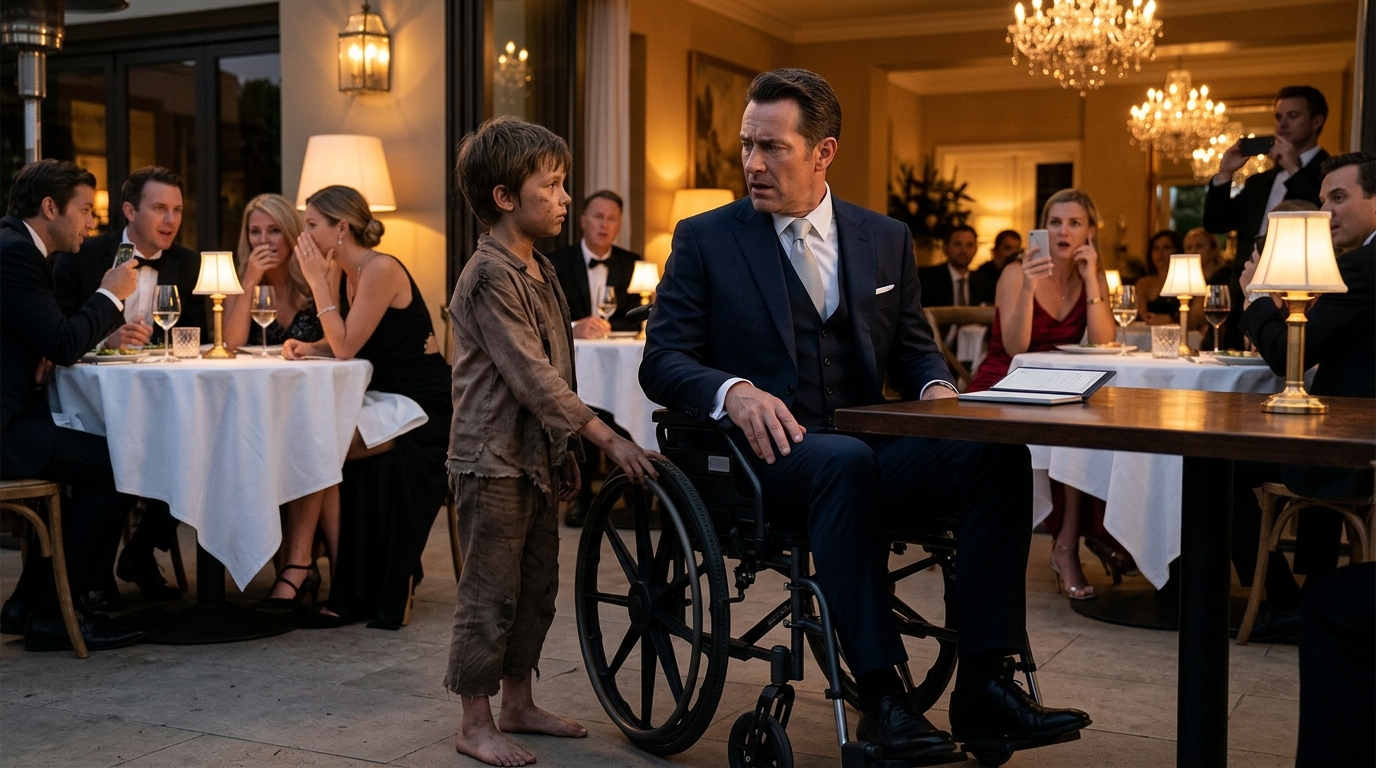
No one noticed him at first. He slipped through the terrace entrance, small enough to pass between waiters, quiet enough to be mistaken for someone’s child until the dirt gave him away.
He was barefoot.
His clothes hung loose from his thin shoulders. His brown hair was tangled and damp at the ends. His face was pale, streaked with dust, and his eyes were fixed on one person.
Me.
A waiter reached for him, but the boy moved around him.
The table went quiet.
Camille’s hand tightened on my shoulder.
The boy stopped beside my wheelchair, breathing hard, as if he had run for miles to reach me.
Then he said, “Sir… I can fix your leg.”
For one impossible second, nobody reacted.
Then the table erupted.
A man beside me choked on his wine. Someone laughed too loudly. A woman in pearls covered her mouth, not to hide shock, but amusement.
“Is this a joke?” someone whispered.
“Who let him in?” another voice muttered.
Phones lifted almost instantly.
That was the modern reflex.
Not help.
Not concern.
Record.
The boy didn’t look at them. His eyes stayed on mine.
I should have been angry.
Instead, I smiled.
It was the kind of smile I had used in boardrooms when men underestimated me. Calm. Polite. Dangerous.
“You?” I asked, leaning back in my chair. “You can fix my leg?”
The boy nodded.
“How long will that take?”
He swallowed once.
“Just a few seconds.”
The laughter came harder this time.
Even Camille smiled, though hers was thin and bloodless.
I reached into my jacket pocket, pulled out my checkbook, and placed it on the table.
It landed with a soft slap against the linen.
“Fix it,” I said quietly, “and I’ll give you a million dollars.”
The laughter died in pieces.
Not because anyone believed him.
Because suddenly, the joke had a price.
The boy stepped closer.
Camille’s fingers dug into my shoulder.
“Preston,” she murmured. “Don’t encourage this.”
But something had already shifted inside me.
Maybe it was the boy’s eyes.
Maybe it was the way he wasn’t asking for money.
Maybe it was the fact that, when Camille touched me, he looked at her hand with hatred.
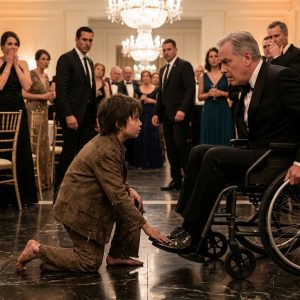
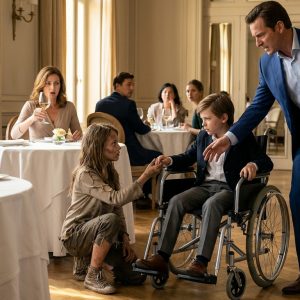
He knelt beside my wheelchair.
The entire restaurant watched.
Phones hovered.
Waiters froze in place.
The jazz music kept playing for three more notes before the pianist stopped.
The boy placed one small hand on my right leg.
His palm was cold through the fabric of my trousers.
“Count with me,” he whispered.
I almost laughed.
“This is ridiculous.”
But I didn’t finish the sentence.
Because something moved.
Not my body.
Not my chair.
My leg.
A flicker.
So faint I thought my mind had invented it.
My breath stopped.
The boy whispered, “One.”
Another twitch.
This time stronger.
My hand slammed against the table so hard a wineglass tipped over, spreading red across the cloth like blood.
The guests went silent.
I stared down at my leg.
For three years, I had stared at those legs as if they belonged to a dead man.
And now—
They had moved.
“Two,” the boy said.
My calf tightened.
A muscle I hadn’t felt in years pulled beneath my skin.
Pain shot upward, thin and electric, but alive.
Alive.
A sound tore from my throat before I could stop it.
Camille stepped back.
The boy looked up at me.
For the first time, he smiled.
But it wasn’t innocent.
It was knowing.
“Three.”
My foot jerked forward.
The restaurant exploded.
People screamed. Someone dropped a plate. Chairs scraped violently against marble. Phones shook in trembling hands as the impossible became content in real time.
I tried to push myself upright.
My arms locked.
The chair creaked.
My body shook with terror and hope.
“What did you do?” I gasped.
The boy leaned closer.
His lips barely moved.
But the words slid into my ear like a blade.
“Your spine was never broken.”
Everything around me vanished.
The lights.
The guests.
The cameras.
Even Camille.
I stared at the boy, unable to breathe, because he had just spoken the one fear I had buried so deep I had almost forgotten it had ever existed.
Then he whispered one name.
And the whole world went cold.
The Name My Wife Didn’t Want Spoken
“Dr. Elias Voss.”
The boy said it softly.
But Camille heard it.
I knew she heard it because the color drained from her face so quickly that, for a moment, she looked less like my wife and more like a portrait of one.
She moved fast.
Too fast.
“Security,” she snapped.
Her voice cracked on the final syllable.
Not much.
But enough.
Two men in black suits came from the entrance. The boy turned to run, but I grabbed his wrist before he could move.
I hadn’t meant to.
I didn’t know I still had that kind of speed in me.
His bones felt tiny beneath my hand.
“What do you know about Voss?” I demanded.
The boy looked at Camille first.
Then back at me.
“He killed my mother,” he said.
The security guards reached us.
Camille’s expression had reset by then. The soft concern returned. The public mask was back in place.
“This child is unstable,” she said smoothly. “He needs help. Please take him outside.”
The boy fought as they pulled him away.
Not wildly.
Desperately.
Like he knew this was his only chance.
“Check the implant!” he shouted. “Check the implant behind your spine!”
My stomach turned.
The word hit something old.
Something hidden.
Implant.
After the accident, Dr. Voss had performed three emergency surgeries on me. He was considered a pioneer in experimental nerve-interface technology. Camille had found him. Camille had insisted on him. Camille had signed every urgent consent form while I drifted in and out of anesthesia.
I remembered waking up in white rooms.
Camille crying.
Voss standing at the foot of my bed with calm, elegant hands.
“I’m sorry, Mr. Vale,” he had said. “The damage is irreversible.”
For three years, I believed him.
The boy twisted in the guard’s grip and looked at me one final time.
“Ask why your recovery foundation pays him every month!”
Then they dragged him through the terrace doors.
The restaurant remained frozen.
Everyone had seen my leg move.
Everyone had heard enough to know something was wrong, but not enough to understand what.
Camille bent beside me, her perfume surrounding me like a beautiful cage.
“Preston,” she whispered. “Look at me.”
I did.
Her eyes were wet.
Perfectly wet.
“We need to leave,” she said. “Now. Before this becomes a circus.”
But it already had.
A senator was whispering into his phone. A donor’s wife was crying. A young influencer near the bar was still recording, her mouth open in shock.
I looked down at my leg.
Still again.
Dead again.
But not the same.
Nothing would ever be the same.
Camille placed both hands on my face.
“Preston, listen to me. That boy could have hurt you. He may have triggered a spasm. That’s all this was.”
“A spasm?” I said.
My voice sounded far away.
“Yes.”
“He knew Voss.”
She hesitated.
Only for a breath.
But I had built an empire by noticing hesitation.
“Voss is famous,” she replied. “Anyone could know his name.”
“And the implant?”
Her expression softened in that careful way I had once mistaken for love.
“You had several procedures. You were dying. You don’t remember everything.”
That was true.
And that was the problem.
I didn’t remember everything.
Camille guided the conversation around me like a surgeon cutting away dangerous tissue. She apologized to the guests. She blamed trauma. She mentioned neurological spasms and stress response and unauthorized intrusions.
People nodded because rich people love explanations that preserve the room.
Within ten minutes, I was in the back of our car.
Camille sat beside me, one hand wrapped around mine.
Her grip was steady.
Mine was not.
Outside, camera flashes burst against the tinted windows.
“You scared me tonight,” she said.
I looked at her.
“Did I?”
A small wound appeared in her expression.
“Don’t do that.”
“Do what?”
“Turn on me because some street child performed a trick.”
There it was.
The old power.
Not anger.
Disappointment.
Camille had always known how to make me feel cruel for questioning her.
I turned toward the window.
The city passed in gold and black streaks.
My right leg burned faintly.
Not pain exactly.
Memory.
When we reached the house, Camille insisted I take my night medication early. She said my nervous system had been overstimulated. She said I needed rest before the press twisted everything.
The pills sat in her palm.
Two white.
One blue.
One small yellow capsule.
I had swallowed them every night for three years.
Muscle relaxants.
Anti-inflammatory support.
Nerve pain stabilizers.
That was what Voss called them.
I stared at the pills.
Then I looked at Camille.
“Not tonight.”
Her hand closed.
“What?”
“I don’t want them.”
The room changed.
It was subtle, but it happened.
The warmth left her eyes.
“Preston,” she said gently, “you know what happens when you skip doses.”
“No,” I said. “I know what you told me happens.”
For a moment, neither of us spoke.
Then she smiled.
A sad smile.
A patient smile.
A smile meant for a difficult child.
“You’re exhausted.”
“Maybe.”
“You’re not thinking clearly.”
“Maybe not.”
I wheeled myself toward the elevator.
Her voice followed me.
“Preston.”
I stopped.
“Take the medication.”
It was not a request.
Not anymore.
I turned back.
Camille stood in the center of the marble foyer, still wearing her diamond earrings from dinner, still beautiful, still calm.
But her hand was clenched around the pills so tightly her knuckles had gone white.
And that was when I understood something that terrified me more than the boy’s whisper.
My wife wasn’t afraid that I had been humiliated.
She was afraid that I might wake up.
The File Hidden Behind the Foundation
I waited until Camille thought I was asleep.
Then I moved.
Slowly.
Carefully.
The mansion was too quiet at night. Every sound felt guilty. The faint hum of climate control. The soft click of the elevator door. The small mechanical whisper of my wheelchair over polished floors.
My office sat at the far end of the second floor, behind a wall of glass overlooking the city. Before the accident, it had been my war room. Afterward, Camille had softened it. Removed the darker furniture. Added plants. Framed family photos. Made it less mine.
I locked the door behind me.
My hands trembled as I opened my private server.
Vale Biotech had security layers most governments would envy. Camille had access to our public holdings, foundation accounts, medical documents, household systems.
But not my old corporate archives.
Not the emergency mirror drives I had built back when I trusted machines more than people.
I searched one name.
Elias Voss.
Thousands of results appeared.
Research grants.
Press releases.
Foundation payments.
Consulting invoices.
Clinical trial documents.
At first, it all looked legitimate.
Too legitimate.
Then I filtered by recurring private transfers.
One file appeared under an old subsidiary Camille had told me was inactive.
VNR Rehabilitation Logistics.
I opened it.
My throat tightened.
Every month, for thirty-six months, the foundation had wired $480,000 to VNR. The stated purpose was “neuro-muscular maintenance protocol.” The approving officer was Camille Vale.
The receiving consultant was Dr. Elias Voss.
Thirty-six months.
The exact length of my paralysis.
I kept digging.
The deeper I went, the colder I became.
There were encrypted attachments tied to my patient ID. Surgical summaries. Medication schedules. Neuromodulation reports.
Then I found the file name that made my pulse hammer.
PV Mobility Suppression Compliance.
I opened it.
The password prompt appeared.
I tried my birthdate.
Denied.
Camille’s birthdate.
Denied.
Our wedding anniversary.
Denied.
Then I remembered what the boy had said.
He killed my mother.
I searched news archives for Elias Voss and death.
Most results were academic.
Awards.
Conferences.
A malpractice suit dismissed five years earlier.
Then I found a local article buried in an archived newspaper.
Nurse Dies in Suspicious House Fire After Filing Complaint Against Prominent Surgeon.
Her name was Mara Bell.
She had worked as a surgical assistant under Dr. Voss at St. Orlan Medical Center. She had accused him of performing unauthorized implants on unconscious trauma patients. The complaint disappeared after her death. The hospital settled quietly. Her surviving son was listed as Caleb Bell, age nine.
Caleb.
The barefoot boy.
My hands hovered over the keyboard.
I returned to the password field.
MaraBell.
Denied.
CalebBell.
Denied.
Then I tried the name of the hospital.
StOrlan.
Denied.
My frustration turned sharp. I slammed my fist against the desk, and the impact sent a spasm down my right thigh.
I froze.
There it was again.
A flicker.
Not much.
But real.
I rolled back from the desk and looked at my legs like they were strangers returning from war.
My phone buzzed.
Unknown number.
I almost didn’t answer.
Then a text appeared.
Stop taking the yellow pill.
My blood went cold.
A second message followed.
The implant is real. She controls it through the chair.
I looked down at the wheelchair beneath me.
For three years, Camille had insisted on this model. She said it was safer. Smarter. Better for my posture. The chair connected to an app for diagnostics, pressure management, nerve monitoring.
I had never questioned it.
Why would I?
It had been presented as care.
A third message appeared.
Go to the old pool room. Your house cameras have blind spots. Hers don’t.
I stared at the screen.
Then typed back.
Caleb?
No answer.
I moved toward the door.
Halfway there, my office lights flickered.
My computer screen went black.
Then the house intercom clicked on.
Camille’s voice filled the room.
Soft.
Tired.
Devastatingly calm.
“Preston,” she said. “Come downstairs.”
I didn’t move.
The lock on my office door beeped.
Once.
Twice.
Then opened from the outside.
Camille stood there in a silk robe, holding my medication tray.
Behind her were two men I had never seen before.
Not security.
Not staff.
Doctors.
One carried a black medical bag.
The other held a syringe.
Camille looked at my open laptop.
Then at me.
The sadness on her face was gone.
“So,” she said quietly. “The boy found you after all.”
The Procedure I Never Consented To
For three years, I had imagined what betrayal might look like.
A secret lover.
A stolen fortune.
A signature forged on documents.
I had never imagined it would wear my wife’s face and hold a syringe beside my wheelchair.
“Camille,” I said carefully. “Tell them to leave.”
She stepped into the office.
The doctors followed.
“Not until you calm down.”
“I am calm.”
“No,” she said. “You are paranoid, noncompliant, and medically unstable after a public neurological episode.”
The words were too polished.
Prepared.
That frightened me more than shouting would have.
“You planned this.”
Her expression hardened.
“You forced this.”
One doctor moved behind me. I reached for the wheel, but my chair did not respond.
The control screen flashed red.
Remote lock engaged.
My stomach dropped.
The chair.
She controlled the chair.
Of course she did.
I tried to push myself up with my arms, but the second doctor caught my shoulder. The syringe glinted under the office lights.
“Don’t,” I warned.
But my voice had lost its power.
A man who cannot stand learns quickly how much authority depends on height.
Camille crouched in front of me.
For the first time in years, she looked directly into me without pretending.
“You had everything,” she whispered. “You had the company, the money, the name, the world worshiping your recovery story before you even recovered.”
“My recovery story?”
Her laugh was small.
Cruel.
“You really don’t understand, do you?”
The doctor pressed the needle toward my arm.
Then the window behind my desk shattered.
Glass exploded inward.
The doctors ducked.
Camille screamed.
A small object bounced across the floor, hissing smoke.
Not smoke.
Powder.
The room filled with a harsh chemical cloud that burned my eyes and throat. The doctor with the syringe stumbled backward, coughing. Camille fell against the wall, one hand over her mouth.
Through the broken window came a figure in black.
Small.
Fast.
Caleb.
He had climbed from the balcony ledge outside my office, twelve stories above the rear garden.
Insane.
Impossible.
But he was there.
He grabbed the syringe from the floor and slammed it into the doctor’s thigh.
The man collapsed in seconds.
“Unlock the chair!” Caleb shouted.
“I can’t!”
“The side panel!”
I tore at the carbon fiber casing near my right wheel. My fingers found a recessed latch. It popped open, revealing wiring, a hidden receiver, and a small blinking module I had never seen before.
Caleb ripped it free.
The chair jolted.
My controls came back.
“Move!” he shouted.
The second doctor lunged at him, but Caleb ducked beneath his arm and drove a letter opener into the man’s hand. The doctor howled.
Camille was already crawling toward the door.
Not running.
Crawling.
Trying to reach the hall panel.
Trying to lock us in.
I drove the wheelchair forward and slammed it into her path.
She looked up at me with pure hatred.
“You ungrateful bastard.”
The words stunned me.
Not because they were cruel.
Because they were honest.
“What did you do to me?” I asked.
Caleb grabbed my laptop from the desk.
“No time,” he said.
But I couldn’t look away from Camille.
“What did you do?”
Her eyes flicked to Caleb.
Then back to me.
And she smiled.
“You were going to leave me.”
My breath stopped.
“What?”
“Before the accident,” she said. “You were going to divorce me. Don’t pretend you forgot.”
Images flashed through me.
A fight.
Rain.
My hand on a car door.
Camille crying in the driveway.
Me saying, “I can’t do this anymore.”
Then headlights.
Metal.
Pain.
Darkness.
“You caused the crash,” I whispered.
“No,” she said. “The crash was luck.”
I felt sick.
“The surgery was opportunity.”
Caleb’s face turned pale with rage.
“My mother found out,” he said.
Camille glanced at him as if he were an insect.
“Your mother was careless.”
He stepped toward her.
I caught his arm.
Not to protect Camille.
To protect him from becoming something she made.
Camille’s smile widened.
“Voss didn’t sever your nerves,” she said. “He installed a gate. A beautiful little device near the lumbar roots. It interrupts motor signals when active. Keeps everything quiet. Keeps you dependent.”
“The yellow pill,” I said.
“Prevents inflammation around the implant,” she replied. “Also helps with compliance.”
Compliance.
That word nearly broke something inside me.
Three years of dead legs.
Three years of pity.
Three years of Camille bathing me, dressing me, smiling for cameras, collecting donations in my name.
And all of it had been engineered.
“Why?” I asked.
Her eyes sharpened.
“Because tragedy made you more valuable.”
Silence swallowed the room.
She continued, almost tenderly.
“Before the accident, you were a brilliant man with a failing marriage and a company under investigation. Afterward, you became a symbol. Donations tripled. Vale stock recovered. The foundation gave us access to experimental grants, federal programs, private investors.”
“Us?” I said.
“Voss. Me. The board members smart enough to understand what suffering is worth.”
Caleb opened the laptop and turned the screen toward me.
He had bypassed the password.
The file was open.
PV Mobility Suppression Compliance.
Video logs.
Surgical notes.
Medication schedules.
Payment chains.
Names.
So many names.
Then I saw the final folder.
Public Re-Emergence Protocol.
My pulse slowed.
“What is that?”
Camille’s expression changed.
For the first time, real fear moved through her.
Caleb clicked it.
A video loaded.
It showed Camille and Dr. Voss seated in a conference room.
Voss spoke first.
“Phase Four begins at the gala. Subject will demonstrate involuntary movement under controlled conditions, suggesting a breakthrough response.”
Camille nodded.
“Then we announce the trial?”
“Within forty-eight hours,” Voss replied. “Vale walks again within six months. The market response will be historic.”
My mouth went dry.
They had planned tonight.
Not Caleb.
Them.
The twitch at dinner had not been a miracle.
It had been a scheduled preview.
A staged neurological event to launch their new treatment platform.
Camille stared at me.
“You were supposed to become hope,” she whispered.
I looked at my legs.
Then at her.
“No,” I said. “I was supposed to become proof.”
And before she could answer, sirens began screaming through the gates below.
The Man Who Finally Stood
Caleb had called the police before entering the house.
Not local patrol.
Federal investigators.
His mother’s old complaint had not disappeared completely. It had sat dormant in a sealed medical fraud archive until Caleb, barely seventeen and living out of shelters, learned how to chase ghosts through court records, hospital databases, and foundation filings.
He had tracked Voss first.
Then Camille.
Then me.
The barefoot boy who had walked into the restaurant had not come to heal me.
He had come to expose them.
The federal raid lasted six hours.
Camille did not cry when they handcuffed her.
She did not beg.
She watched me with the calm fury of a person who still believed the world owed her an explanation.
Dr. Voss was arrested at a private clinic before dawn. Three board members were taken from their homes. Two foundation attorneys tried to flee the country and failed.
By sunrise, every major news channel in America was running the same headline.
Billionaire’s Paralysis Allegedly Engineered in Medical Fraud Scheme.
But headlines are clean things.
They don’t show what comes after.
They don’t show the first morning you wake up and realize the person who fed you pills was poisoning your future.
They don’t show the shame of needing help from nurses who now look at you with pity for an entirely different reason.
They don’t show the rage.
Or the grief.
Or the unbearable question that comes when your body begins to return.
Who would I have been if they had not stolen three years from me?
The implant was removed two weeks later.
The surgery took nine hours.
When I woke, Caleb was sitting in the corner of my hospital room, wearing shoes for the first time since I had met him. Someone from federal victim services had bought them for him.
They were too clean.
He looked uncomfortable in them.
“You stayed,” I said.
He shrugged.
“My mother didn’t get to finish it.”
“No,” I said. “But you did.”
His jaw tightened.
“Not yet.”
He was right.
Camille’s trial lasted seven months.
The prosecution called it one of the most sophisticated medical exploitation conspiracies in modern corporate history. Voss had used experimental implants to suppress mobility in four patients over six years. Camille had turned my paralysis into a financial engine. The foundation had been less charity than theater.
Mara Bell’s complaint became central evidence.
So did the files Caleb had stolen.
So did the dinner footage, captured by a hundred phones, showing my leg moving when the world was still supposed to believe it never could.
Camille testified once.
She wore white.
Of course she did.
When asked why she had done it, she spoke for nearly twelve minutes about pressure, legacy, research, public good, and how history always demanded sacrifice.
Then the prosecutor asked one simple question.
“Did Preston Vale consent to being sacrificed?”
Camille did not answer.
That silence convicted her more deeply than any confession could have.
She was sentenced to forty-eight years in federal prison.
Voss received life.
The foundation was dissolved, then rebuilt under court supervision into a victim recovery trust named after Mara Bell.
Caleb refused money at first.
Then I told him it wasn’t charity.
It was evidence finally becoming justice.
My own recovery was slower than the headlines wanted.
People love miracle stories because they end quickly.
Real healing does not.
The first time I stood, it was not dramatic.
There were no cameras.
No donors.
No chandeliers.
Just a rehabilitation room at 6:40 in the morning, smelling of disinfectant and rubber mats, with two physical therapists beside me and Caleb leaning against the wall pretending not to care.
My hands gripped the parallel bars.
My legs shook violently.
Pain tore through muscles that had been silent too long.
For one terrifying second, I thought I would fall.
Then my right foot held.
Then my left.
I stood.
Not well.
Not beautifully.
But honestly.
Caleb looked away first.
I saw him wipe his face with his sleeve.
I took one step that day.
Only one.
But it was mine.
Months later, I returned to the restaurant.
Not for dinner.
Not for revenge.
For memory.
The table had been replaced. The terrace doors were polished. The jazz trio was different. Life had swallowed the scene whole, as it always does.
I walked in with a cane.
Caleb walked beside me.
He was taller now, cleaner, still too serious for his age.
The manager nearly cried when he saw me. People stared, but nobody laughed.
Not this time.
We sat at the same table.
For a while, neither of us spoke.
Then Caleb looked toward the terrace entrance, the same place he had come through barefoot and desperate months earlier.
“You really would’ve given me the million?” he asked.
I smiled.
“No.”
He looked at me.
I reached into my jacket and placed an envelope on the table.
Inside was a trust document in his name.
Not one million.
More.
Enough for school.
Enough for a home.
Enough to stop surviving and begin choosing.
Caleb stared at it for a long time.
Then he said, “My mother would’ve liked you.”
I looked down at my right hand resting on the cane.
Then at my legs beneath the table.
Scarred.
Weak.
Alive.
“No,” I said softly. “She would’ve liked you.”
Outside, evening light spilled across the terrace, warm and gold, almost like the night this all began.
Only now, I understood something I hadn’t then.
The boy had not fixed my leg in a few seconds.
He had broken the lie.
And sometimes, that is the first movement that matters.