The Challenge Beside the White Piano
“If you can play, I’ll adopt you.”
The words floated through the ballroom like a cruel little joke dressed in silk.
A few guests laughed at first.
Not loudly.
Not enough to seem heartless.
Just enough to show they understood the game.
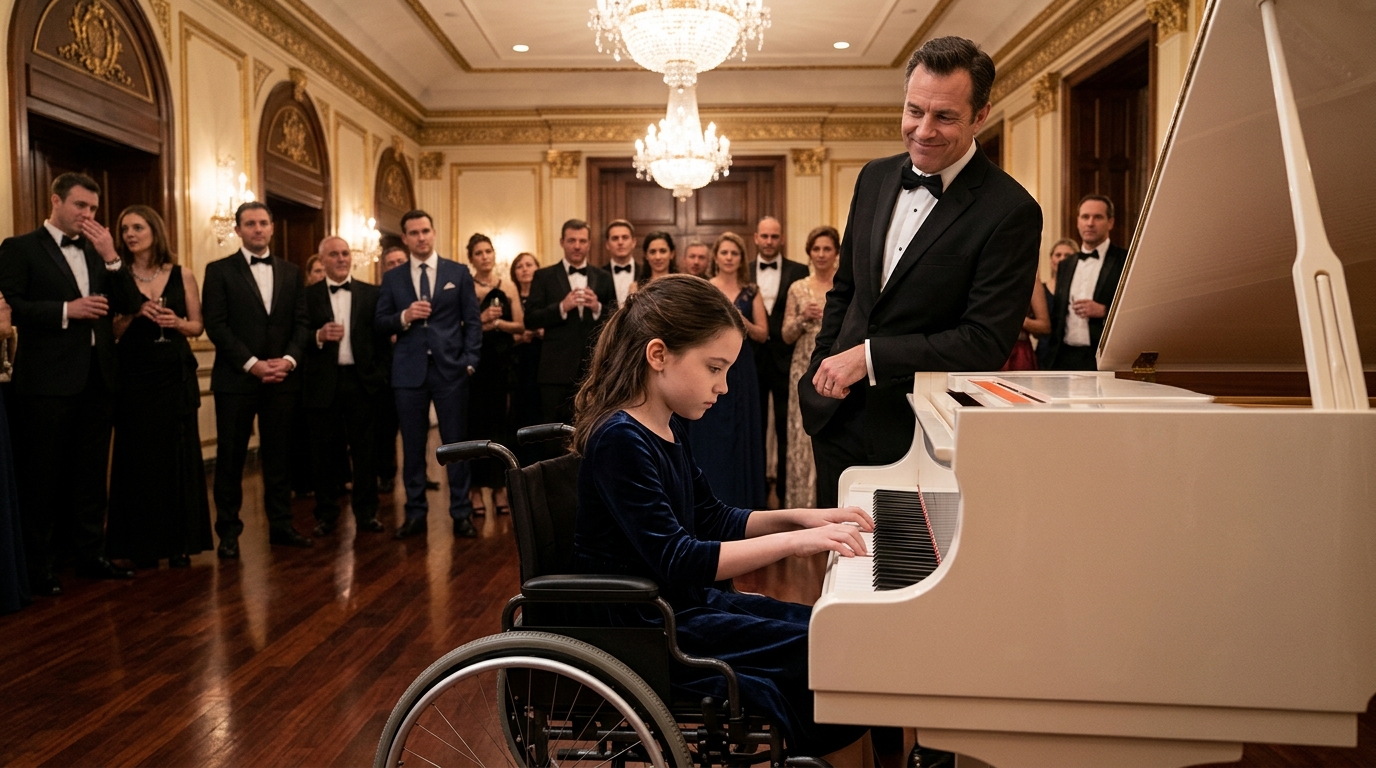
The Winter Hearts Charity Ball had been arranged to look compassionate. Crystal chandeliers hung above a polished marble floor. White roses climbed the columns. Waiters drifted between tables with silver trays and champagne flutes. At the far end of the ballroom, beneath a soft spotlight, stood a pristine white piano.
It was not there for decoration.
At least, that was what the invitation had claimed.
The evening was meant to raise money for the Bellamy Children’s Home, a struggling orphanage outside the city. Wealthy donors had gathered to bid on paintings, jewelry, private dinners, and performances by gifted children who needed sponsors.
But everyone understood the unspoken truth.
Some guests came to help.
Most came to be seen helping.
And then there was Adrian Blackwood.
He stood beside the white piano in a black tuxedo, a glass of champagne in one hand, a smile on his face that always looked slightly rehearsed. He was wealthy enough to make others careful around him. Hotels, music halls, property, investments, old family money turned into modern influence.
He had not planned to attend until the organizers placed the piano onstage.
That piano had once belonged to him.
Or, more accurately, to a woman he had spent ten years trying not to remember.
Now a young girl in a wheelchair sat a few feet away from it.
She looked small beneath the chandeliers.
Her dress was pale blue, clean but plain, clearly borrowed for the event. Her dark hair was tied back with a ribbon that had already started to loosen. Her hands rested in her lap, fingers thin and tense. Her wheelchair was old, the left wheel squeaking whenever she moved.
Her name was Lily Hart.
Ten years old.
Quiet.
Careful.
Used to being stared at.
She had been brought to the gala with six other children from Bellamy House. Some sang. One recited a poem. Two boys performed a violin duet badly enough that the room applauded harder out of pity.
Lily had not been scheduled to perform.
She had simply stared at the piano too long.
Adrian noticed.
He always noticed when someone looked at a piano as if it were a door.
“Do you play?” he asked.
The girl did not answer immediately.
Her caretaker, Mrs. Bellamy, hurried forward.
“She knows a few notes, Mr. Blackwood. Nothing prepared. We didn’t mean to—”
Adrian lifted one hand.
The room quieted.
He looked down at Lily with that wide, charming smile.
“If you can play,” he said, “I’ll adopt you.”
The silence afterward was sharp.
Mrs. Bellamy’s face went pale.
The guests looked at each other, unsure whether to laugh, applaud, or pretend the sentence had been kind.
Lily looked up.
“Adopt me?”
Adrian’s smile widened.
“Why not? A dramatic evening deserves a dramatic promise.”
A woman in diamonds chuckled behind her fan.
Someone near the champagne table whispered, “He’s impossible.”
Another said, “Imagine if she actually plays.”
Lily’s hands tightened in her lap.
She knew what people expected.
They expected her to blush.
To refuse.
To cry.
To make the room feel charitable again.
But Lily did not look at the guests.
She looked at the piano.
The white piano.
Her mother’s stories had always mentioned a white piano.
Not often.
Only on nights when fever made memories loose, or when rain hit the windows and her mother forgot to be careful.
There was a white piano once, her mother would whisper.
And a man who played like he was trying to apologize before he even knew what he had done.
Lily turned her wheelchair toward the stage.
The left wheel squeaked.
A few guests shifted uncomfortably.
Adrian’s smile faltered.
“You don’t have to,” he said, though everyone heard the amusement still hidden in his voice.
Lily did not answer.
She reached the piano bench but could not transfer by herself. For one terrible moment, the room watched her struggle.
No one moved.
Then a young waiter stepped forward and quietly adjusted the bench away from the keys so she could sit close enough from her chair. Lily nodded once in thanks.
Adrian watched, suddenly less entertained.
Lily placed her hands over the keys.
Her fingers hovered there.
Fragile.
Resolute.
A breath.
Then the first notes rose.
Soft.
Eerie.
Familiar.
Adrian’s smile disappeared.
His glass lowered slowly.
The melody moved through the ballroom like cold wind under a closed door. It was simple at first, almost like a lullaby. Then it shifted into something older, sadder, a progression no child should have known unless someone had placed it carefully into her hands.
Adrian’s face changed.
Confusion.
Then recognition.
Then dread.
He stepped closer.
“Who taught you that?”
His voice was barely above a whisper.
Lily kept playing.
Her gaze lifted to meet his.
“My mother.”
The notes climbed.
Then softened.
“She said you would know me when you heard it.”
Adrian’s complexion turned ashen.
The room, moments ago amused by the challenge, fell into silence so complete that the piano seemed to be playing inside every person there.
Adrian looked at the girl.
Truly looked.
At her eyes.
At the small scar near her eyebrow.
At the shape of her mouth when she tried not to tremble.
And suddenly, the ballroom was gone.
He was ten years younger, standing in a music room during a storm, listening to a woman named Elise play that same melody on the same white piano.
The woman he had loved.
The woman he was told had left him.
The woman who, according to everyone around him, had disappeared with another man before he could give her his name.
Lily played the final phrase.
Not perfectly.
But exactly.
The secret ending Elise had written and never published.
Adrian staggered back.
“What was your mother’s name?”
Lily’s fingers rested on the keys.
“Elise Hart.”
The champagne glass slipped from Adrian’s hand.
It shattered on the marble floor.
The Melody Elise Never Wrote Down
No one moved.
Adrian barely heard the gasps around him.
Elise Hart.
The name had lived in him for a decade like a locked room.
He had met her before the hotels, before the magazine covers, before the name Blackwood became polished enough to hide the cracks beneath it. She was a pianist then, not famous, but gifted in a way that made rooms lean toward her. She played in small theaters, church halls, school auditoriums, and once, at a charity rehearsal in Adrian’s family home.
That was where the white piano stood.
It had belonged to Adrian’s mother, a woman who had loved music more than money and died before she could teach him how to survive his family. After her death, the piano sat untouched in the east music room.
Until Elise.
She had been hired to perform at one of his father’s events.
During rehearsal, Adrian found her alone at the piano, playing something that was not on the program.
“What is that?” he asked.
She stopped at once.
“Nothing.”
“It didn’t sound like nothing.”
“It isn’t finished.”
“Then finish it.”
She looked at him over her shoulder.
“You always talk like people are waiting for you to approve the world?”
He smiled.
“Usually they are.”
She turned back to the piano.
“Then you need better people around you.”
That was the beginning.
For eight months, they met in secret.
Not because Adrian was ashamed of her.
At least, that was what he told himself.
In truth, he was afraid.
His father, Malcolm Blackwood, saw marriage as a business arrangement. Love was something servants had, singers performed, and poor people used to justify bad decisions. Adrian was expected to marry someone with land, shares, and a family name that could survive scandal.
Elise had no name that mattered to Malcolm.
She had talent.
That was worse.
Talent gave her dignity he could not buy.
When Elise became pregnant, Adrian was terrified.
Then happy.
Then terrified again.
Elise saw all of it.
“You can be afraid,” she told him. “But you cannot be absent.”
He promised he would speak to his father.
He promised he would protect her.
He promised he would return the next morning with a plan.
He returned to an empty apartment.
Elise was gone.
Her clothes were gone. Her sheet music was gone. The little plant by the window had been left behind, dead from lack of water. On the table was a letter in Elise’s handwriting.
Adrian,
I cannot raise a child in a house where love needs permission. Do not follow me.
Elise
Adrian did follow.
For weeks.
Then months.
His father produced evidence.
A train ticket.
Bank withdrawals.
A witness who saw Elise board a coach with a man from her old theater company.
A second letter, colder than the first.
She doesn’t want you, Malcolm said. Do not turn rejection into romance.
Adrian hardened after that.
Not all at once.
Grief does not always break people loudly.
Sometimes it makes them elegant.
He became richer. Sharper. Less trusting. He bought theaters and shut down the ones that failed him. He donated to children’s homes every Christmas but never stayed long enough to learn the children’s names.
He kept the white piano in storage.
Then, when the charity ball asked for a centerpiece, his assistant suggested donating it for the evening.
He agreed because he thought he was finally beyond memory.
Then Lily Hart played the melody Elise had never written down.
Now the girl sat before him, small and pale under the chandelier light, and the past had hands.
Adrian stepped closer.
“Where is Elise?”
Lily looked down.
The answer came before she spoke.
He saw it in the way her shoulders folded inward.
“She died last winter.”
The words did not sound dramatic.
That made them worse.
Adrian lowered himself onto the piano bench as if his body had forgotten how to stand.
Lily watched him carefully.
“She was sick for a long time,” she said. “She told me not to find you until she was gone.”
Adrian’s throat tightened.
“Why?”
Lily’s eyes flicked toward the crowd.
Toward the wealthy guests.
Toward the people who had laughed when Adrian made his cruel promise.
“She said rich men can mistake guilt for love.”
The sentence struck the room silent.
Adrian closed his eyes.
Elise.
Even dying, she had known where to aim.
Mrs. Bellamy stepped forward, nervous and protective.
“Lily, dear, maybe we should—”
“No,” Adrian said.
His voice was rough.
He opened his eyes and looked at Lily again.
“How old are you?”
“Ten.”
His breath stopped.
Ten.
The age fit.
Too perfectly.
He looked at her wheelchair.
“What happened?”
Lily’s fingers tightened on the edge of the piano.
“My legs were hurt when I was little.”
“How?”
She did not answer.
Instead, she reached into the small pocket of her blue dress and pulled out a folded envelope.
“My mother said if you asked that,” she whispered, “I should give you this.”
Adrian took it with shaking hands.
The paper inside was thin and worn.
The first line nearly destroyed him.
Adrian, if you are reading this, then our daughter played the song, and you finally listened.
The Letter From the Woman He Lost
The ballroom remained silent while Adrian read.
No one dared laugh now.
Elise’s handwriting filled the page, smaller than he remembered, weaker near the bottom.
Adrian,
I left because your father came before you did.
He knew about the baby. He knew about us. He came with lawyers, money, and threats dressed as concern.
He told me you had chosen your family.
I did not believe him.
Then he showed me a letter in your hand.
I know now it may have been forced, forged, or stolen, but I was young and frightened and carrying a child I already loved more than pride.
He said if I stayed, the baby would be taken.
He said no court would trust a poor pianist over the Blackwood name.
He said if I loved her, I would disappear before she was born.
So I ran.
Adrian’s vision blurred.
His father had been dead for three years, but suddenly the old man felt alive in every locked door, every polished lie, every silence Adrian had mistaken for dignity.
He forced himself to continue.
I named her Lily because your mother once said lilies bloom even in rooms that have forgotten the sun.
She is yours.
She has your stubbornness, my temper, and a frightening ear for melody.
When she was four, someone found us.
I do not know if your father sent them or if old money simply leaves long shadows, but men came to the boarding house asking questions. We ran again. There was an accident on the bridge. Lily survived. Her spine was injured.
I spent years blaming myself.
Do not make that mistake about her. Pity will wound her faster than truth.
If you want to know her, begin with truth.
Not money.
Not adoption papers.
Not grand gestures in rooms full of people.
Truth.
Tell her why you stopped looking.
If the answer shames you, say it anyway.
Adrian stopped reading.
His hands shook so badly the paper rattled.
Lily watched him without blinking.
He looked up.
The entire ballroom was waiting.
The man who had tossed a cruel challenge into the air now held the answer to it in his trembling hands.
Lily spoke first.
“Why did you stop looking?”
The question was small.
But it filled the ballroom more completely than the music had.
Adrian looked at her.
He could have blamed his father.
He could have blamed forged letters.
He could have blamed wealth, manipulation, youth, grief.
All of that would have been partly true.
But Elise’s letter had asked for truth, not explanation.
So he gave the ugliest part.
“Because believing she left hurt less than fighting my family and learning I might have failed her.”
Lily’s face changed.
Not forgiveness.
Not yet.
But something shifted.
“You were scared?”
“Yes.”
“You were rich.”
“Yes.”
“That didn’t help?”
Adrian looked around the ballroom.
At chandeliers.
At champagne.
At the white piano.
At the people who had watched him mock a child and called it charm.
“No,” he said. “It may have made me worse.”
Lily looked down at her hands.
“My mother said that might happen.”
Adrian almost smiled through tears.
“Your mother was usually right.”
“She said you rush the sad part when you play.”
A broken laugh escaped him.
He covered his face with one hand.
For the first time in years, Adrian Blackwood cried in public.
Not elegantly.
Not handsomely.
He cried like a man whose past had finally found him and refused to let him polish it.
The Man Who Made a Promise Too Quickly
The gala could not continue after that.
Not in the same way.
People began moving quietly, whispering with the discomfort of those who had arrived expecting charity and found witness.
Mrs. Bellamy took Lily’s wheelchair handles, but Lily stopped her with one raised hand.
“I want to finish the letter,” she said.
Adrian looked at the paper.
There was more.
He read silently first.
Then aloud, because the room had heard enough cruelty and deserved to hear Elise’s truth too.
If Adrian Blackwood offers you the world, Lily, ask first whether he knows how to sit beside you when there is no audience.
If he offers to adopt you because he feels guilty, say no.
If he offers to know you slowly, you may consider it.
Do not let anyone turn you into a charity story.
You are not a wound to be displayed.
You are my song.
And maybe his, if he learns to listen.
The last line was almost unreadable.
Play the ending only if you forgive me for keeping you from him.
Lily’s mouth trembled.
“I don’t forgive her for everything,” she whispered.
Adrian folded the letter carefully.
“You don’t have to.”
Her eyes snapped to him, surprised.
He continued.
“She loved you. She protected you. She also made choices that hurt you. All of those can be true.”
Lily stared.
Then looked away quickly, as if the words had touched something too fragile.
Adrian turned toward the gala organizer.
“End the auction.”
The woman blinked.
“Mr. Blackwood?”
“End it.”
A donor near the front protested softly, “But the fundraiser—”
Adrian stood.
“The fundraiser will be covered.”
The room reacted.
He looked toward Mrs. Bellamy.
“How much does Bellamy House need to remain open for five years?”
Mrs. Bellamy stammered.
“I couldn’t possibly—”
“Give my office the number.”
Lily’s face tightened.
Adrian saw it immediately.
Elise’s warning returned.
Not money.
Not grand gestures in rooms full of people.
Truth.
He turned back to Lily.
“That is not for you to owe me.”
She said nothing.
“It is not payment.”
Still nothing.
He lowered his voice.
“It is something I should have done before tonight for children I kept pretending to help.”
Lily looked at him.
“You were pretending?”
Adrian glanced around the ballroom.
“Yes.”
The answer made several guests uncomfortable.
Good.
Adrian walked to the microphone near the piano.
The room held its breath again.
He did not perform grief.
He had performed enough in his life.
“I made a cruel promise tonight,” he said. “I told a child I would adopt her if she could play, as though family were a prize, and as though talent were proof of worth.”
His voice shook.
“I said it because I thought I was being charming. I was being arrogant. And I am sorry.”
Lily watched him carefully.
Adrian continued.
“This event was meant to help children, but I treated one as entertainment. I suspect I am not the only person in this room who has confused generosity with power.”
The silence sharpened.
He looked back at Lily.
“Lily Hart owes this room nothing. Not music. Not forgiveness. Not a story we can tell at dinner to feel better about ourselves.”
He stepped away from the microphone.
Then, without asking for applause, he returned to the piano.
The guests did not clap.
For once, they seemed to understand that applause would be too easy.
The Hidden Room in Blackwood House
Lily did not go home with Adrian that night.
He asked if he could speak with her again.
She asked if Mrs. Bellamy could stay in the room.
He said yes.
That was the first small test.
The next morning, Adrian visited Bellamy House.
No cameras.
No assistant carrying flowers.
No dramatic car procession.
Just him, a black coat, and a box of documents Elise had mentioned in the letter.
Lily met him in the library, sitting near the window with a blanket over her knees.
“You came,” she said.
“I said I would.”
“People say things.”
“I know.”
Mrs. Bellamy sat nearby, knitting with the intensity of a woman prepared to stab a millionaire with a needle if necessary.
Adrian placed the box on the table.
“These were in my father’s archive.”
Lily did not touch it.
“What is it?”
“Letters. Records. Reports. I found them last night.”
The truth had worsened after the gala.
Adrian returned to Blackwood House and ordered the locked west archive opened. His father’s old secretary, now retired and frightened, admitted there had been a private file under Elise’s name.
Inside were reports from investigators hired to track Elise after she ran.
His father had known where she was for at least two years.
He had received photos.
One of Elise holding baby Lily outside a small market.
One of Lily at age three sitting beside a street musician.
One of the boarding house where they lived before the accident.
Adrian’s father had hidden all of it.
And Adrian had never looked in the place where his family kept secrets because some part of him was afraid secrets might be there.
Lily stared at the photographs.
Her fingers hovered over the one of her mother holding her.
“I don’t remember this.”
“You were a baby.”
“She looks happy.”
“She does.”
Lily looked at him.
“Were you happy?”
Adrian thought about his life after Elise disappeared.
The money.
The parties.
The business deals.
The women he never let close.
The applause.
“No.”
She absorbed that.
Then said, “My mother laughed when she played. Even when she was sick.”
Adrian smiled faintly.
“She did that before too.”
For the first time, they shared a memory of Elise that did not hurt exactly the same way.
That became the beginning.
Not adoption.
Not reunion.
Beginning.
Adrian visited once a week.
Then twice.
Lily set rules.
No gifts unless she asked.
No interviews.
No calling her “my daughter” in public yet.
No touching her wheelchair without permission.
No speaking badly about Elise.
No pretending everything was fine.
Adrian wrote the rules down.
Lily watched him.
“You’re really writing them?”
“Yes.”
“Why?”
“Because you said them.”
She looked away.
That mattered.
Weeks passed.
He learned things.
Lily liked orange marmalade but hated orange juice.
She read mystery novels too advanced for her age.
She named her wheelchair Georgina when it squeaked.
She hated being called brave by strangers.
She loved music but refused to play when anyone begged.
She missed her mother most in the morning.
He told her things too.
About his mother and the white piano.
About how Elise corrected his timing.
About how he once tried to cook for Elise and burned soup so badly she said the pot needed a funeral.
Lily laughed at that.
A small laugh.
A real one.
Adrian treasured it and tried not to look too hungry for more.
The Adoption Papers
Three months after the gala, Lily asked the question.
Not Adrian.
Lily.
They were sitting in the Bellamy House music room, which Adrian had paid to repair anonymously until Lily found out and scolded him for being “sneaky with walls.”
“Did you mean it?” she asked.
He looked up from the piano bench.
“Mean what?”
“When you said you’d adopt me.”
His hands went still.
“No.”
Lily’s face closed.
He quickly added, “I mean, not the way I said it.”
She watched him.
“I said it as a performance. That was wrong.”
“Oh.”
“If you are asking whether I want to be responsible for you, know you, care for you, protect you, and become family if you choose that slowly, then yes.”
Lily looked down.
“That was a lot longer than adopt.”
“It needed to be.”
She traced a finger along the edge of the music book.
“My mother said family is not the person who takes you. It’s the person who stays after learning you’re not easy.”
Adrian nodded.
“She was right.”
“I’m not easy.”
“I don’t need easy.”
She looked at him sharply.
He held her gaze.
“I need honest.”
Lily swallowed.
“Would I have to leave Bellamy House right away?”
“No.”
“Would Mrs. Bellamy still see me?”
“Whenever you want.”
“Would I have to call you Dad?”
His throat tightened.
“No.”
“Would you be sad if I didn’t?”
“Yes.”
Her face changed.
He continued.
“But that would be mine to carry, not yours to fix.”
Lily looked at him for a long time.
Then nodded once.
“Okay.”
“Okay?”
“You can ask the lawyer.”
Adrian’s eyes filled.
He looked away quickly, but Lily saw.
“Are you crying?”
“No.”
“You’re lying.”
“Yes.”
She almost smiled.
The adoption process was not simple.
It should not have been.
There were interviews, evaluations, legal reviews, medical plans, guardianship assessments, and careful consideration of whether Adrian’s guilt was moving faster than Lily’s trust.
Lily’s advocate asked difficult questions.
Adrian answered them.
Some badly at first.
Then better.
When asked why he wanted to adopt Lily, he almost said, Because she is my daughter.
Instead, he stopped.
Then said, “Because she deserves a home where her mother’s memory is honored, her needs are understood, her choices are respected, and my failures are not hidden from her.”
The advocate wrote that down.
Lily later asked what he said.
He told her exactly.
She approved.
Mostly.
“You used too many commas,” she said.
The DNA test came back confirming what the melody had already told them.
Adrian Blackwood was Lily’s biological father.
The legal adoption became a recognition as much as a beginning.
On the day the papers were signed, Lily wore the same blue dress from the gala because she said it deserved a better memory.
Adrian wore a plain gray suit.
Mrs. Bellamy cried.
The young waiter from the gala, whose name was Thomas, attended too because Lily insisted he was “the first person who moved the bench.”
After the judge signed, Adrian looked at Lily.
“Would you like to come home?”
She thought about it.
Then said, “For dinner.”
Adrian smiled.
“That’s a start.”
The White Piano Comes Home
Blackwood House changed before Lily moved in fully.
Not all at once.
Old houses resist healing.
Adrian opened the west wing, removed his father’s portrait from the main stairwell, and turned the locked archive into a music room with windows that opened.
Lily’s room was on the ground floor because she said elevators in old houses sounded “judgmental.”
Adrian installed ramps without asking reporters to photograph them.
He learned to ask before helping.
Sometimes he forgot.
Lily corrected him.
He thanked her.
The white piano was placed in the new music room.
Not as a relic.
As an instrument.
The first night Lily stayed over, she wheeled herself to it after dinner.
Adrian stood in the doorway.
She looked back.
“You can come in.”
He entered.
She touched the keys.
“Did she play here?”
“In the old music room,” Adrian said. “But this piano, yes.”
Lily began the melody.
The same one from the gala.
Adrian stood still.
When she reached the turn, she stopped.
“You play the opening,” she said.
He shook his head.
“I don’t think I can.”
“You said you wanted honest.”
“That is honest.”
She considered him.
Then patted the bench.
“Sit.”
He sat.
His hands hovered above the keys.
For the first time in ten years, Adrian played the first phrase Elise had written with him.
His fingers were stiff.
The timing uneven.
The sadness rushed.
Lily sighed.
“You do rush the sad part.”
He laughed.
Then cried.
Then played again.
This time slower.
Lily joined on the answer.
The melody moved through the room.
Not as a ghost now.
As inheritance.
Something painful.
Something alive.
Something neither of them owned alone.
Months became years.
Lily grew.
Her wheelchair changed. Her doctors changed. Her music deepened. She learned to compose pieces that made Adrian feel as if Elise were standing behind him saying, “Don’t flatter her. She knows she’s good.”
Adrian made mistakes.
Many.
He overprotected.
He underexplained.
He tried to solve grief with plans.
He once bought Lily an entire set of custom instruments because she mentioned liking the sound of a cello.
She stared at the delivery and said, “This is what Mom meant by rich men mistaking guilt for love.”
He returned all but one.
The cello stayed because Lily admitted she liked it.
Adrian learned.
Slowly.
Lily learned too.
That trust could grow without betraying the mother who raised her.
That loving Adrian did not mean forgiving every absence.
That family could begin late and still become real.
On the anniversary of the gala, they returned to the ballroom.
Not for another charity spectacle.
For a concert.
Bellamy House children performed, but only those who wanted to. No child’s story was auctioned. No donor was allowed onstage to praise themselves. The event raised enough money to fund the home for years, but the focus was music.
Lily performed last.
She wheeled herself to the white piano, now temporarily returned to the ballroom.
The chandeliers shone above her.
The room was full again.
But different.
At least to her.
She adjusted her sleeves, looked toward Adrian in the front row, then toward Mrs. Bellamy beside him.
“You may recognize the first piece,” she told the audience.
A few people smiled gently.
“This is not the song I played last year.”
Adrian looked surprised.
Lily continued.
“That song belonged to my mother. This one is mine.”
Then she played.
The melody began with Elise’s first three notes.
Then changed.
It moved brighter, then darker, then somewhere neither Adrian nor Elise had gone. It held grief without kneeling to it. It carried anger without becoming cruel. It ended not with resolution, but with a question left open enough to breathe.
When the final note faded, the room did not erupt immediately.
It listened to the silence after her.
Then applause rose.
Lily looked uncomfortable.
Then pleased.
Adrian stood, tears in his eyes, but he did not rush the stage.
He had learned.
She would come to him if she wanted.
She did.
After the concert, Lily found him near the white piano.
“Well?” she asked.
He smiled.
“You didn’t rush the sad part.”
She nodded solemnly.
“Someone had to learn.”
He laughed.
Then she reached for his hand.
Not because cameras were there.
Not because the room needed a perfect ending.
Because she chose to.
Years later, people still told the story of the millionaire who told a girl in a wheelchair, “If you can play, I’ll adopt you.”
They loved the shock of it.
The challenge.
The white piano.
The melody.
The glass shattering.
The lost daughter revealed.
But Lily never liked that version.
It made it sound as if her worth began when she played well enough to be wanted.
That was not the truth.
The truth was that she had always been worth staying for.
Before the piano.
Before the ballroom.
Before Adrian knew her name.
Before any audience listened.
Her mother had known.
And eventually, Adrian learned.
So when people asked Lily what happened that night, she would say:
“I played a song my mother gave me. My father finally heard it.”
Then, if they asked whether he adopted her because she could play, Lily would smile slightly and answer,
“No. He adopted me after he learned to listen.”