The Axe at the Funeral Home
“Stop!” the maid shouted, her voice cracking. “She’s not dead!”
No one listened at first.
Why would they?
All eyes were fixed on the pristine white coffin in the center of the funeral home, surrounded by lilies, white roses, polished candles, and the kind of expensive silence people mistake for dignity.
Vivian Vale lay inside.
Beloved wife.
Patron of children’s hospitals.
Chairwoman of the Vale Foundation.
A woman whose name had appeared on libraries, orphanages, scholarships, and hospital wings.
Dead, according to the doctor.
Dead, according to the certificate.
Dead, according to the priest standing near the coffin with a black prayer book pressed against his chest.
Beside the coffin stood her husband, Edgar Vale.
Seventy-one years old, dressed in black, rigid with grief. He looked like a man trying to hold himself upright by sheer discipline. His face was pale, his jaw locked, one gloved hand resting on the edge of the coffin as if touching the polished wood was the closest he could come to holding his wife again.
Then Rosa ran in.
She was the funeral home’s cleaning woman, still wearing her vivid orange uniform, hair half-loose from its bun, breath coming in short bursts.
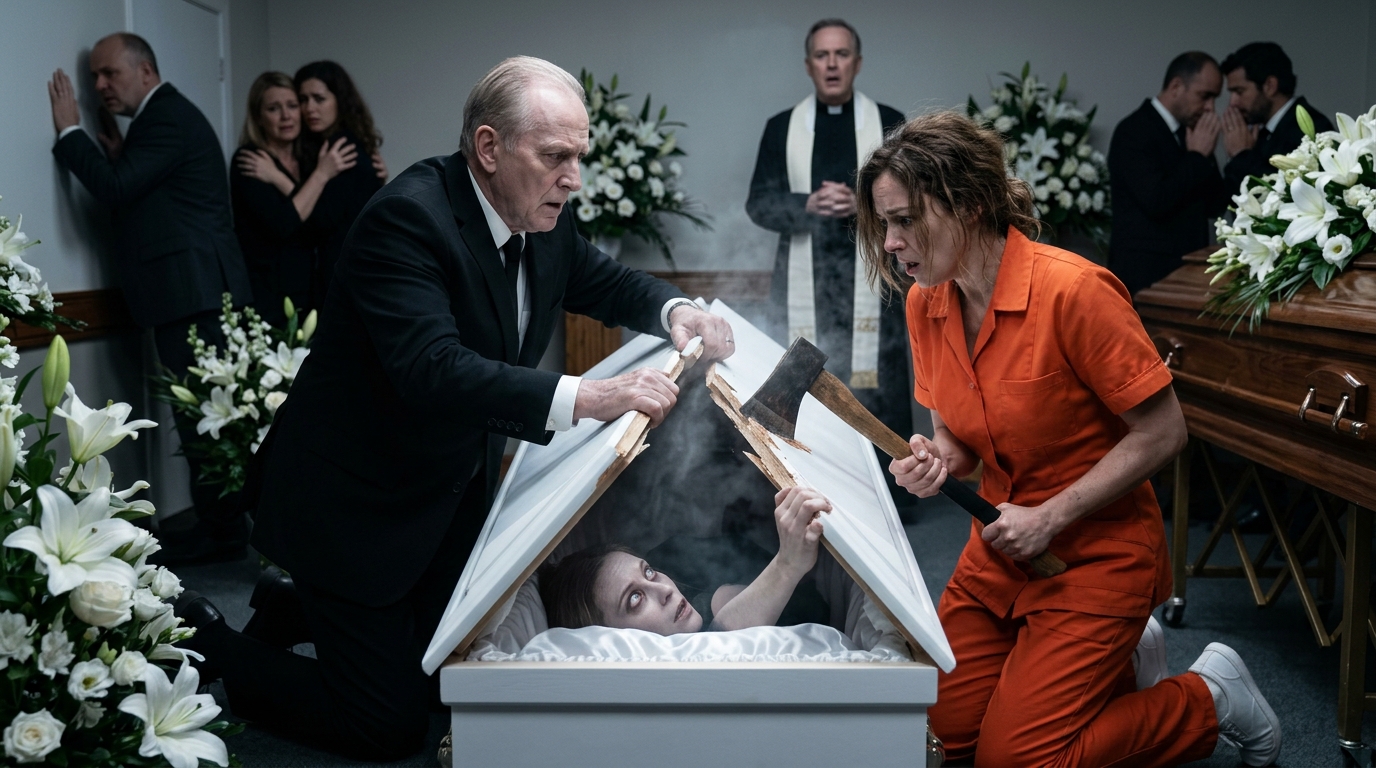
In her hands was an axe.
The room froze.
Someone gasped.
The priest turned sharply.
“Rosa,” he said, “put that down.”
But she was already moving.
“No,” she cried. “I heard her!”
Before anyone could stop her, Rosa raised the axe.
CRACK.
The blade split the coffin lid.
Women screamed. A man stumbled backward into a row of chairs. Phones dropped. Flowers shook from their stands.
The axe lodged deep into the white wood.
Rosa yanked it free with both hands, nearly falling from the effort.
Edgar rushed toward her.
“Have you lost your mind?!”
His voice cracked with something beyond anger.
Rosa turned to him, ashen-faced, eyes wild but certain.
“I heard her.”
A ripple of murmurs swept through the room.
“That’s impossible,” Edgar said.
Rosa shook her head so violently her hair came undone.
“I was changing the flowers in the hallway. I heard scratching.”
The priest, Father Malcolm, stepped forward.
“This is grief speaking through fear. Everyone, please remain calm.”
But Rosa was not looking at him.
She was looking at the coffin.
Her hands trembled around the axe handle.
“Then I heard breathing.”
The room went colder.
Edgar stared at the jagged crack in the coffin lid. His wife had been declared dead that morning. He had kissed her forehead himself. It had been cold. Too cold. Still, he had trusted the doctor. Trusted the priest. Trusted the arrangements made around him while grief stole the strength from his legs.
Rosa dropped to her knees beside the coffin.
“She’s breathing,” she whispered.
The words changed every face in the room.
Edgar knelt slowly, as if approaching his own execution.
He placed one hand over the split wood.
For one second, nothing happened.
Then—
THUMP.
A heavy strike from inside the coffin.
Not settling wood.
Not imagination.
A desperate blow.
One woman screamed and collapsed into her husband’s arms.
Edgar’s face drained completely.
Another thump came.
Harder.
The broken lid jolted upward.
Rosa clutched Edgar’s sleeve.
“Open it!”
Edgar gripped the fractured wood with both hands and pulled.
Splinters tore loose. The lid cracked wider. Two men rushed forward to help. Someone shouted for an ambulance. Someone else began praying.
A cold gust of trapped air escaped from inside.
Then Vivian Vale’s eyes flew open.
For one impossible second, nobody moved.
She was pale.
Her lips were dry.
Her chest rose in shallow, painful pulls.
But she was alive.
Edgar reached for her.
“Vivian!”
Before he could touch her face, she grabbed his wrist with surprising strength.
Her eyes were not on him.
They were fixed past his shoulder.
At Father Malcolm.
Vivian’s voice came out raw, broken, barely human.
“Don’t trust him.”
The Priest Who Prayed Too Quickly
Father Malcolm did not move.
That was the first thing Edgar noticed.
Everyone else reacted.
Rosa sobbed.
The mourners gasped.
The funeral director shouted for the staff to open the side doors.
A young man called emergency services with shaking hands.
But Father Malcolm stood perfectly still.
His fingers tightened around the prayer book.
His face did not show horror.
It showed calculation.
Then, as if remembering the room was watching, he stepped forward.
“Vivian,” he said softly, “you are confused.”
Vivian’s hand tightened around Edgar’s wrist.
“No.”
The word was weak.
But clear.
Father Malcolm turned to the others.
“She needs medical attention, not panic. Everyone step back.”
He reached toward her.
Vivian recoiled so violently she almost struck her head against the coffin lining.
Edgar moved between them.
“Don’t touch her.”
The priest’s expression flickered.
“Edgar, she has just suffered a traumatic medical episode. She may not understand what she is saying.”
“She understands enough to fear you.”
A silence fell.
The priest’s eyes narrowed for half a second.
Then he softened his face again.
That was what Father Malcolm did best.
Softness.
For twenty years, he had been the Vale family’s spiritual advisor. He baptized children in the hospital wing Vivian funded. He sat with dying donors. He blessed buildings before ribbon cuttings. He spoke at charity dinners with a voice that could make wealthy people feel holy for writing checks.
After Vivian fell ill, he became constant.
He visited the estate almost daily.
He prayed beside her bed.
He advised Edgar to rest.
He handled calls when Edgar was too exhausted.
He spoke gently to doctors.
He arranged the funeral before Edgar could bear to think about it.
Too quickly, Edgar realized now.
Everything had moved too quickly.
Vivian had collapsed the night before. By morning, Dr. Harlan Voss declared her dead. Father Malcolm advised a closed, immediate service, saying Vivian had once spoken about “returning to God without spectacle.”
Edgar had been too shattered to question him.
Now Vivian was gasping inside a coffin.
Rosa had split it open with an axe.
And the priest was telling everyone she was confused.
The paramedics arrived within minutes.
They lifted Vivian out carefully, wrapped her in heated blankets, and placed oxygen over her face. Edgar stayed beside her, gripping her hand.
As they wheeled her toward the ambulance, Father Malcolm followed.
“I will ride with her,” he said.
Vivian tore the oxygen mask from her face.
“No!”
The sound was ragged, but everyone heard it.
The paramedic stopped.
Edgar turned toward the priest.
“You heard her.”
Father Malcolm’s smile thinned.
“Edgar, this is not wise.”
“No,” Edgar said. “What wasn’t wise was burying my wife before she finished dying.”
The priest’s face hardened.
Only for a breath.
But Rosa saw it.
So did Edgar.
As the ambulance doors closed, Vivian dragged Edgar closer and whispered something into his ear.
“Blue chapel… under Mary.”
Then she lost consciousness.
Edgar froze.
The blue chapel.
It was the small private chapel inside the Vale estate, built by Vivian’s grandfather. Beneath the statue of the Virgin Mary was an old candle drawer nobody used anymore.
Edgar looked toward Father Malcolm.
The priest had heard enough to go pale.
That was when Edgar knew Vivian’s warning was not fever.
It was evidence.
The Drawer Beneath Mary
Vivian was rushed to the hospital under police supervision.
This time, Edgar demanded every test.
Every scan.
Every toxicology panel.
No private physician.
No family priest.
No soft explanations.
Rosa insisted on going with him to the estate.
“I heard her once,” she said. “I won’t stop listening now.”
Edgar did not argue.
By then, the video of the coffin had already started spreading.
The maid with the axe.
The white coffin split open.
The dead wife breathing.
The warning about the priest.
Reporters gathered outside the funeral home before Vivian reached the emergency room.
But Edgar did not care about headlines.
He cared about the blue chapel.
He and Rosa entered the Vale estate through the side door, avoiding the crowd near the front gate. The house felt wrong. Too quiet. Too polished. Too prepared for Vivian never to return.
In the chapel, candles still burned.
Father Malcolm had been there that morning before the funeral.
Rosa crossed herself and stood by the door.
Edgar went straight to the statue of Mary.
The drawer beneath it stuck at first.
Then opened with a dry wooden scrape.
Inside was a velvet pouch.
And a folded letter in Vivian’s handwriting.
Edgar’s hands trembled as he opened it.
Edgar,
If I am alive when you find this, do not let Father Malcolm near me. If I am dead, do not let him bury the evidence with me.
Edgar gripped the edge of the altar.
Rosa covered her mouth.
The letter continued.
I have been drugged slowly. Not enough to kill me at once. Enough to make me weak. Enough to make me appear confused. Enough, perhaps, to make me appear dead if they misjudge the dose.
Edgar’s vision blurred.
He forced himself to read.
Malcolm is not acting alone. Dr. Voss has altered my medication records. The foundation accounts have been drained through Saint Ormond Outreach, the charity Malcolm controls. I found the transfers two weeks ago. When I confronted him, he smiled and told me some truths should be confessed only to God.
Rosa whispered, “Saint Ormond…”
Edgar looked at her.
“You know it?”
“My cousin’s son was in one of their homes,” she said quietly. “They closed it overnight. Children moved. No records.”
Edgar returned to the letter.
The proof is in the pouch. If I disappear, open it publicly. Malcolm survives because people trust his collar more than their own eyes. Make them see.
Inside the velvet pouch was a small flash drive, a key, and a silver rosary.
The rosary was Vivian’s.
Edgar recognized it instantly.
But one bead near the cross was slightly larger than the rest.
Rosa turned it gently.
The bead opened.
Inside was a tiny memory card.
Edgar stared at it.
Vivian had known.
She had known the house was watched.
She had known papers could be stolen.
So she hid the truth in prayer itself.
A sound came from the hallway.
A floorboard creaked.
Rosa turned first.
Father Malcolm stood in the chapel doorway.
His black coat was damp from the rain. His expression was calm now.
Too calm.
“Edgar,” he said, “you should have stayed at the hospital.”
Edgar closed his hand around the rosary.
“And you should have stayed at the funeral.”
Father Malcolm glanced at the open drawer.
Then at the pouch.
His face lost all softness.
“You do not understand what she found.”
Rosa stepped back.
Edgar stood in front of her.
“What did you do to my wife?”
The priest’s voice dropped.
“What was necessary.”
The Charity Built on Silence
Father Malcolm did not attack them.
He did not need to.
Men like him rarely used their own hands first.
He simply stepped aside.
Two men entered behind him.
Not church staff.
Security.
Private.
The kind Edgar had seen at foundation galas, standing near VIP doors with earpieces and blank faces.
One reached for Edgar.
Rosa moved first.
She grabbed the brass candle stand from beside the altar and swung it with both hands.
The first man stumbled back, blood on his lip.
Edgar shoved the second into the pews.
Father Malcolm shouted, “Stop!”
But Rosa was already running.
She grabbed Edgar’s sleeve and pulled him through the side sacristy door, out into the rain behind the chapel.
They escaped through the garden path, past the old fountain, into the garage, and into Edgar’s car.
Only when the gates closed behind them did Rosa speak.
“He was going to take it.”
Edgar looked at the rosary in his hand.
“Yes.”
“Then we don’t go to your lawyer.”
Edgar glanced at her.
Rosa’s face was pale but fierce.
“Rich men’s lawyers talk to priests. Priests talk to doctors. Doctors talk to police. She said make them see.”
Edgar understood.
The hospital had a press entrance.
So did the world.
He called Margaret Bell, a retired judge and Vivian’s oldest friend. She had no patience for priests, politicians, or polite lies. She arrived at the hospital twenty minutes later with two independent attorneys, a state investigator, and a journalist she trusted enough to hate.
In Vivian’s hospital room, Edgar played the first file from the memory card.
The video showed Vivian seated at her study desk, thinner than usual, but sharp-eyed.
“If you are watching this,” she said, “then Father Malcolm has convinced someone that I am either dead, confused, or unwell.”
Her voice was steady.
“I am none of those things.”
The room went silent.
Vivian explained everything.
Saint Ormond Outreach had been created to support vulnerable children and elderly women through church-linked shelters. The Vale Foundation had funded it for fifteen years.
But the money had not gone where it should.
Millions had moved through shell programs. Properties purchased for shelters were transferred to private holding companies. Children listed as “relocated” had vanished into records sealed by religious exemptions and private care contracts.
Vivian discovered the fraud when a former nun sent her a ledger.
The nun died in a hit-and-run three days later.
Dr. Voss began adjusting Vivian’s medication the following week.
Father Malcolm increased his visits.
Edgar was gently encouraged to rest.
Vivian was gently encouraged to stop asking questions.
Then came the final file.
Audio.
Father Malcolm’s voice filled the hospital room.
“You should have let the foundation remain beautiful, Vivian.”
Vivian’s voice answered.
“Beautiful?”
“Yes. People need symbols. They do not need accounting.”
“You stole from children.”
“I preserved influence.”
“You buried records.”
“I protected the Church.”
“You’re not the Church, Malcolm.”
A pause.
Then the priest’s voice became cold.
“No. But I know how to make people kneel.”
Rosa crossed herself again.
The state investigator stood.
“I need that drive.”
Edgar placed the rosary in his hand.
“And I need guards outside my wife’s door.”
The Woman Who Woke Up Twice
Vivian woke properly the next morning.
Not in a coffin.
Not in darkness.
In a hospital room full of light.
Edgar sat beside her bed, one hand wrapped around hers.
Rosa slept in a chair near the door, still wearing the orange uniform from the funeral home, the axe now replaced by a paper cup of bad coffee.
Vivian turned her head slowly.
“Did I die?”
Edgar’s eyes filled.
“No.”
She closed her eyes.
“Close enough.”
He leaned over her hand.
“I’m sorry.”
Vivian looked at him.
“For what?”
“For believing them.”
Her face softened.
“You were grieving before I was gone. That is how they did it.”
The door opened.
Margaret Bell entered with the state investigator.
Vivian smiled weakly.
“Margaret.”
The retired judge came to her bedside.
“You always did know how to ruin a funeral.”
Vivian laughed once.
It became a cough.
Then a wince.
Then Edgar calling for the nurse.
But she was alive.
And now she could speak.
The toxicology report confirmed what Vivian suspected.
A compound had been administered over time, interacting with her heart medication to create weakness, disorientation, and eventually a state resembling death under careless examination.
Dr. Voss had signed the death certificate within fourteen minutes of arriving.
Fourteen minutes.
No independent confirmation.
No hospital transfer.
No autopsy.
Father Malcolm had arranged immediate funeral preparation through a director tied to Saint Ormond donors.
They had not expected Rosa.
That was the miracle.
Not Vivian waking.
Not the coffin cracking.
Rosa.
A cleaning woman changing hallway flowers, hearing the faint scrape of fingernails against wood, and believing what powerful men needed everyone to dismiss.
The investigation moved quickly after the video became public.
Father Malcolm tried to claim Vivian had suffered paranoid delusions.
Then the audio files spread.
Dr. Voss tried to leave the country.
He was arrested at a private airport.
Two Saint Ormond accountants turned over records within forty-eight hours.
Three former staff members came forward.
Then seven.
Then nineteen.
The missing children’s files were reopened.
Some were found.
Some were not.
That was the part Vivian never recovered from fully.
The living could be protected.
The lost had to be named.
Father Malcolm was arrested outside the cathedral after delivering a sermon about persecution.
The cameras caught everything.
He did not resist.
He only looked directly into the lens and said, “They have chosen scandal over faith.”
Vivian, watching from her hospital bed, whispered:
“No. We chose children over silence.”
The Maid Who Heard the Truth
The trial lasted sixteen months.
It became impossible to separate one crime from another.
Financial fraud.
Medical abuse.
Attempted murder.
False death certification.
Obstruction.
Charity theft.
Unlawful confinement.
Records destruction.
Father Malcolm’s defense rested on reputation.
He had prayed with families.
Built shelters.
Sat beside the dying.
Blessed children.
Counseled widows.
Comforted Edgar.
Then prosecutors played the coffin video.
Not the viral version.
The full one.
Rosa screaming.
The axe falling.
The mourners recoiling.
The thump from inside.
Vivian’s eyes opening.
And the whisper:
“Don’t trust him.”
After that, no reputation sounded holy.
Rosa testified on the fourth day.
She wore a navy dress borrowed from her sister and kept twisting her hands in her lap.
The defense attorney tried to make her look unstable.
“You attacked a coffin with an axe in a room full of grieving people.”
Rosa lifted her chin.
“Yes.”
“You could have traumatized everyone present.”
“She was breathing.”
“You had no medical training.”
“She was breathing.”
“You could have been wrong.”
Rosa’s eyes filled, but her voice held.
“Then I would have apologized to the dead. But I was not going to apologize to the living for letting her suffocate.”
The courtroom went silent.
Vivian cried openly.
Edgar did too.
Father Malcolm did not look at Rosa once.
That said enough.
In the end, he was convicted.
So was Dr. Voss.
So were the men who moved the money, altered the records, sealed the files, and made cruelty look like charity.
But the sentence that mattered most to Rosa came outside the courthouse.
Vivian was waiting for her.
Still thin.
Still walking with a cane.
Alive.
She took Rosa’s hands.
“You saved my life.”
Rosa shook her head.
“I almost didn’t.”
“But you did.”
“I was scared.”
Vivian smiled.
“So was I.”
Rosa looked down.
“They told me I had no right to touch the coffin.”
Vivian squeezed her hands.
“You had every right to hear me.”
The Coffin Behind Glass
The white coffin was not buried.
Vivian refused.
“Enough things have been buried,” she said.
Instead, after the trial, the shattered coffin lid was preserved behind glass in the lobby of the newly rebuilt Vale Center for Missing and Exploited Children.
Not as a spectacle.
As a warning.
The crack from Rosa’s axe ran straight down the middle.
Beside it was a small plaque:
When power says silence, listen harder.
Rosa hated the attention at first.
People called her brave.
Hero.
Miracle maid.
She disliked all of it.
“I was cleaning flowers,” she said whenever reporters asked.
Vivian corrected her every time.
“You were listening.”
The Vale Foundation changed completely.
Edgar stepped down.
Vivian returned as chairwoman only long enough to restructure it, remove every person tied to Saint Ormond, open the archives, and create a permanent investigative fund for children hidden behind religious, medical, or private-care records.
Then she named Rosa director of community witness outreach.
Rosa laughed when she first heard the title.
“I clean floors.”
Vivian said, “Then you know what people drop and pretend not to see.”
That ended the argument.
Years later, people still told the story of the maid who split open a coffin.
Some versions made it sound like horror.
Some made it sound like a miracle.
Some exaggerated the axe, the scream, the priest, the dead woman’s eyes opening in the shadows.
But Rosa told it differently.
She always began with the sound.
Not the axe.
Not the scream.
The scratching.
“That was the important part,” she would say. “The sound no one wanted to believe.”
Vivian lived nine more years.
Not quietly.
Never quietly again.
On the first anniversary of the funeral, she returned to the same funeral home.
Not for death.
For a ceremony.
The room had been changed. The lilies were gone. The coffin was gone. The walls were brighter now, the windows open.
Vivian stood where her coffin had once been and looked at Edgar.
“Did you really kneel beside it?”
He smiled sadly.
“I did.”
“And Rosa really hit it with an axe?”
Rosa, standing nearby, crossed her arms.
“Twice.”
Vivian laughed.
The sound filled the room gently.
Not like a woman untouched by fear.
Like a woman who had gone into darkness and come back with no patience for silence.
Edgar took her hand.
“I heard the thump,” he said.
Vivian looked at him.
“I was trying to reach you.”
“You did.”
She turned toward Rosa.
“No,” she said softly. “I reached her first.”
Rosa blinked quickly.
Then looked away.
Outside, sunlight spilled across the steps of the funeral home.
Inside, the place that had nearly sealed a living woman inside polished wood now held a gathering of survivors, investigators, families, and children whose names had been restored because one woman with a mop bucket heard what everyone else missed.
Vivian touched the scar on her wrist from the coffin splinters.
Then she looked toward the door.
“Open the windows,” she said.
Rosa smiled.
“All of them?”
Vivian nodded.
“All of them.”
And for the first time in that room, the air moved freely.